Grade 7 vs Grade 12 titanium: start with the process conditions.
Palladium-alloyed titanium and Ti-Ni-Mo titanium solve different parts of a materials problem. A useful comparison combines corrosion evidence, mechanical design, fabrication and complete supply cost.
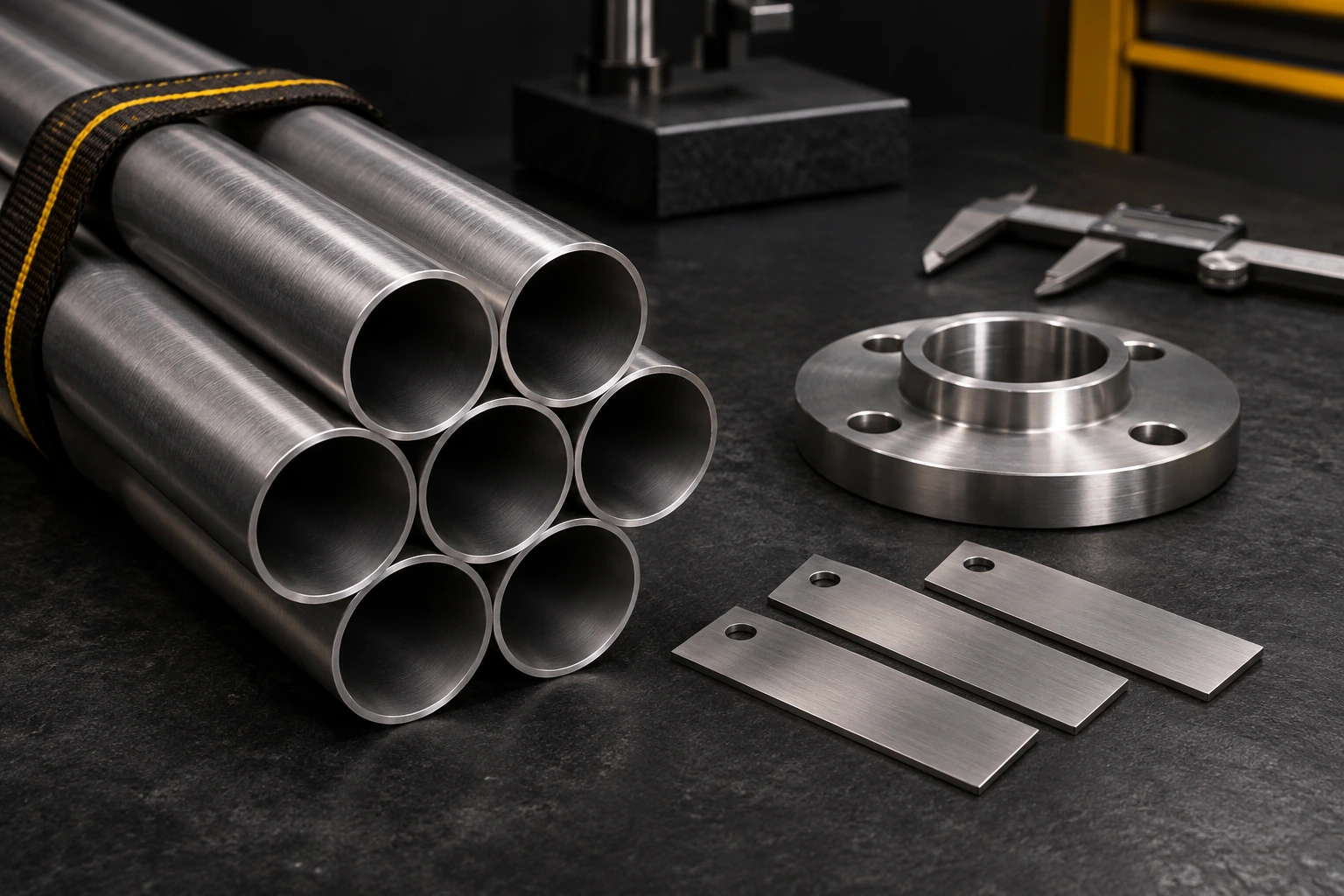
AI illustration. Appearance and labels do not verify material compliance.
Quick answer
Grade 7 is palladium-alloyed titanium; Grade 12 is a titanium alloy with nickel and molybdenum additions. Both may be considered when unalloyed titanium needs further review, but neither is a universal replacement for the other. Grade 12 can offer a higher strength level, while corrosion selection depends on the complete environment. Compare chemistry, temperature, crevices, upset conditions, product standard and required evidence before deciding by price.
01 / Alloy and service
Corrosion resistance is not a single ranking.
A grade 7 vs grade 12 titanium enquiry often starts after a buyer sees a price difference or encounters a service condition that raises concern about Grade 2. The useful next step is to define the environment and design constraints. The names of two corrosion-resistant alloys are not enough to decide which one belongs in a heat exchanger, vessel, fitting or pump component.
Grade 7 uses a palladium addition. Grade 12 is commonly described as Ti-0.8Ni-0.3Mo. TIMET’s Grade 12 reference discusses improvements over unalloyed titanium in certain environments and a higher strength level than Grade 2 or Grade 7. Its corrosion comparisons also show why the actual medium and test condition must accompany any material ranking. [1][2]
Buying question
Grade 7 route
Grade 12 route
Alloy distinction
Palladium-alloyed titanium
Nickel-molybdenum titanium alloy
Reason to evaluate
Corrosion performance in the defined service
Corrosion and strength balance in the defined service
Mechanical design
Use product- and temperature-specific requirements
Do not turn higher strength into an unapproved wall reduction
Corrosion evidence
Match medium, concentration, temperature and geometry
Match the same conditions; do not generalize from a different test
Fabrication
Verify forming, joining and surface requirements
Verify the actual route and final-condition requirements
Cost
Quote exact form, size, quantity and qualification scope
Compare the same accepted deliverable
Substitution
Engineering and corrosion review required
Engineering and corrosion review required
General corrosion and crevice behavior are different questions
A low general-corrosion rate from an open coupon does not establish performance in a gasketed joint, deposit-covered region or stagnant crevice. Identify where the component can retain liquid, concentrate species or create a local environment different from the bulk process. A simple chemical name on an RFQ can hide these controlling details.
For a candidate Grade 7 supply route, describe the operating conditions and the geometry that motivated the choice. If Grade 12 is proposed as an alternative, ask for a comparison against that same envelope. A favorable result in a different solution is not a substitute for relevant evidence.
A stronger alloy does not automatically solve corrosion
Strength and corrosion performance should be reviewed separately and then combined in the design. Higher strength may support a different section when the governing design basis permits it. It does not establish a lower corrosion rate or remove the need for local-corrosion, hydrogen-related or fabrication considerations in the actual service.
If the process conditions are not yet stable, identify the uncertainty rather than selecting a grade from the most favorable assumed case. A material choice based only on normal operation may be undermined by cleaning, startup or a short upset that creates a more demanding environment.
Define the process stream in a form a corrosion specialist can review
A medium name and a maximum temperature are usually an incomplete description of service. State the composition range, the units used for concentration, relevant impurities, operating and cleaning conditions, and whether the fluid is well mixed at the component. Distinguish measured values from design assumptions. A percentage without a stated basis can be ambiguous, and a normal bulk concentration may not describe a local concentration at an evaporation, mixing or stagnant location.
Describe the operating cycle as well as the steady condition. Identify startup, shutdown, draining, cleaning and any period when deposits or retained liquid remain against the surface. State which conditions occur routinely and which are credible excursions that the design must consider. The technical reviewer can then decide which conditions require specific evidence rather than inferring them from the phrase “chemical service.”
Service information
Why the distinction matters
Composition and concentration basis
Different descriptions may refer to different actual mixtures
Temperature range and duration
A short excursion and continuous exposure are different cases
Flow, stagnation and deposits
Local conditions may differ from the bulk process stream
Joints, gaskets and crevices
The component includes locations not represented by an open flat surface
Cleaning and contamination
Maintenance chemicals and carryover may create another exposure case
If the process owner cannot provide a complete envelope, mark the missing items and avoid presenting the material choice as settled. TiHubs can coordinate supplier clarification around a defined enquiry, but an incomplete process description should remain an open technical question. This is especially important when a quotation proposes Grade 12 solely as a lower-cost replacement for a Grade 7 requirement.
02 / Operating envelope
Build a service envelope that can be reviewed.
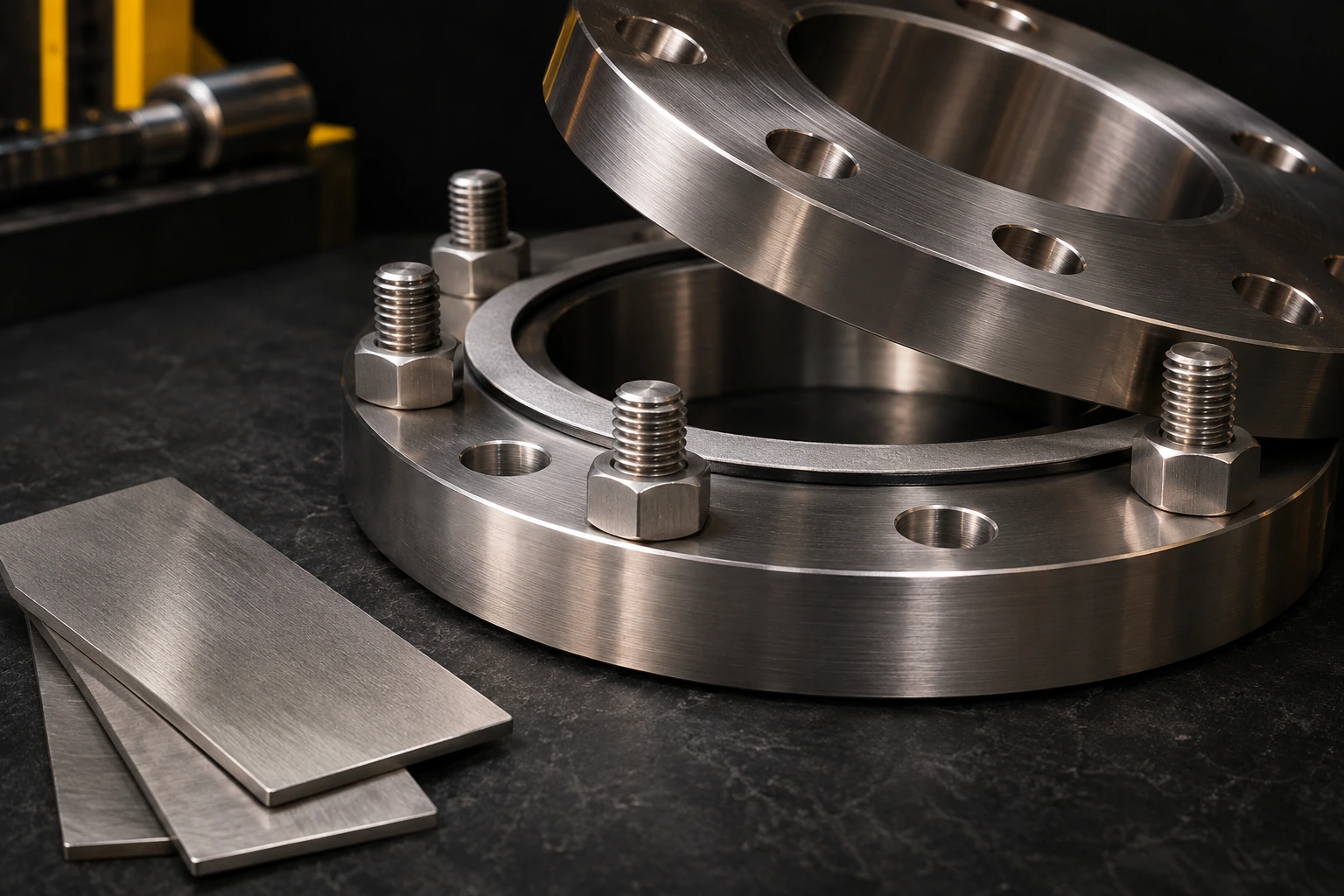
Material selection / 01Identify the crevice geometry.
Open-coupon data may not represent a gasketed joint. AI illustration; not a production or inspection record.
Document normal, transient and cleaning conditions
Service information
What to provide
Why it matters
Fluid chemistry
All significant species and concentration ranges
A trade name or pH alone may omit controlling chemistry
Temperature
Normal, maximum, minimum and upset duration
Corrosion and mechanical requirements can change with exposure
Aeration and redox context
Known oxygen or oxidizing/reducing conditions
Bulk labels may not describe the local environment
Flow and solids
Velocity context, stagnation, deposits and solids
Local conditions and damage mechanisms may differ
Crevices
Gaskets, threads, supports, deposits and dead legs
Open-surface data may not represent these regions
Cleaning
Chemicals, concentration, temperature and frequency
Maintenance can create the controlling exposure
Contacts
Other metals, coatings and electrical connections
Assembly interactions require review
Design basis
Pressure, temperature, code and intended life
Material selection must fit the complete equipment design
Do not omit trace contaminants merely because their concentration is small. Provide available process analyses and uncertainty ranges to the corrosion specialist. If the supplier requests more information, it should explain which decision the missing value affects. This makes the review more productive than asking for a generic declaration that the material is “acid resistant.”
Use a relevant comparison test when the evidence is insufficient
Where published data and service history do not adequately represent the application, the technical owner may need a defined corrosion test program. Specify the medium, temperature, duration, aeration, surface condition, crevice arrangement where relevant, specimen identity and evaluation method. A laboratory should help design a test that answers the actual uncertainty.
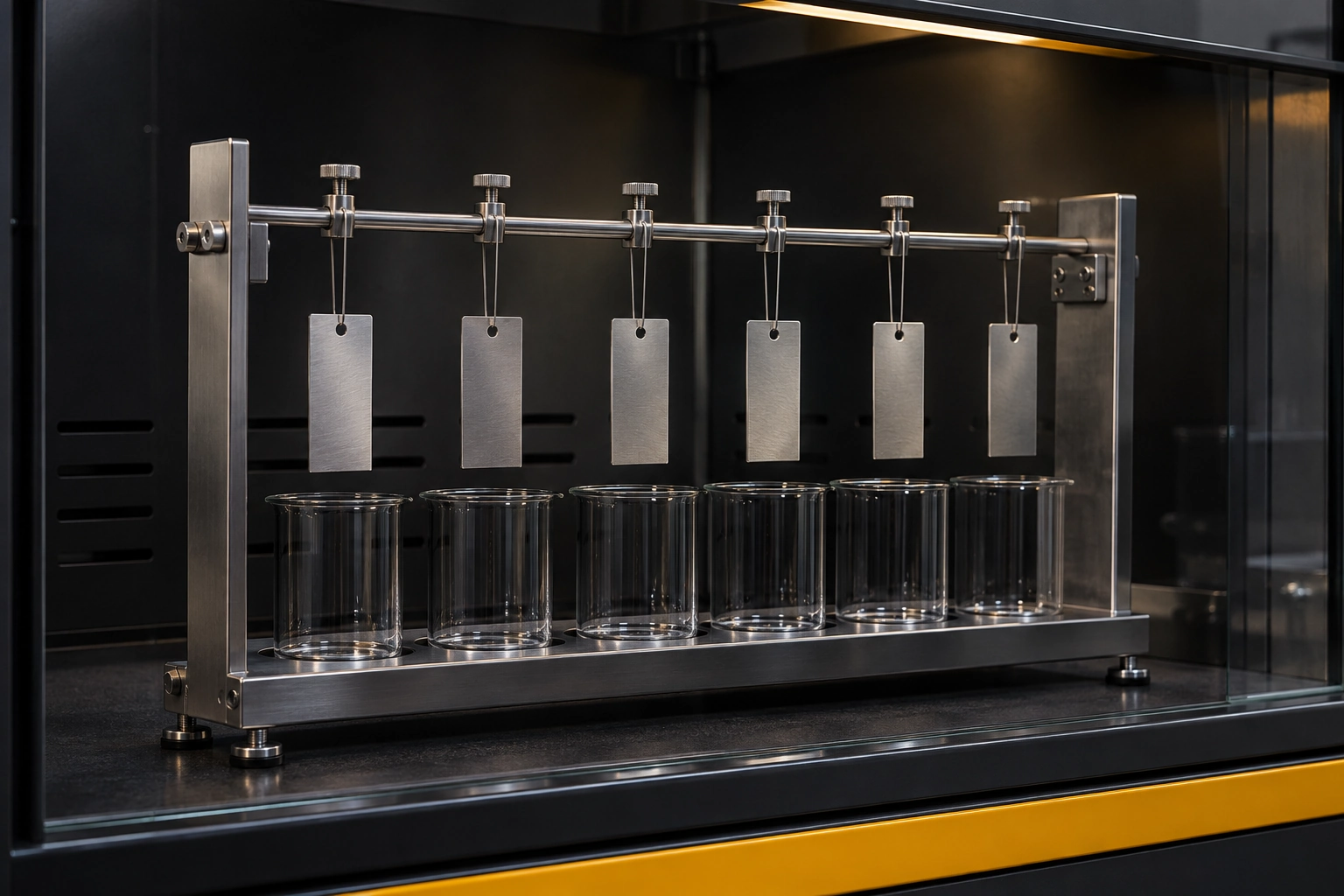
Material selection / 02Define the test before interpreting the result.
Medium, temperature, specimen and evaluation scope matter. AI illustration; not a production or inspection record.
Record the limitations of the test. An accelerated exposure is not automatically a direct service-life prediction. A laboratory coupon may not reproduce welds, residual stress, deposits or the equipment’s local geometry. The result should support a documented materials decision within its scope rather than produce an unsupported number of guaranteed years.
Include welds and surface condition in the review
A material decision must survive fabrication. Identify welds, bends, machined surfaces and any thermal or chemical processing that can affect the final state. Agree the appropriate welding procedure, cleanliness and inspection requirements for the actual product. A parent-material datasheet does not certify the finished assembly.
For components where finish and cleaning affect the supply scope, the titanium surface-finish guide helps distinguish appearance, roughness and cleanliness requirements. State the functional requirement instead of requesting a polished finish as a general symbol of quality.
Keep the pressure-design question with the design owner
The relevant code, material listing, product specification, temperature-dependent allowable data and joint factors must be checked for the actual equipment. A historical manufacturer statement about code use is not approval for every current design. Procurement should request the approved material and dimensional requirements once that review is complete.
If a thinner Grade 12 section is proposed for cost or weight reasons, it is a design change. Check the full pressure and mechanical basis, minimum wall after fabrication, corrosion allowance where applicable, supports and inspection access. Do not reduce thickness by taking a simple ratio of room-temperature yield strengths.
Make a comparison test representative of the question being asked
Where available data does not address the actual service, ask the responsible corrosion specialist to define a relevant evaluation. A useful test plan states the objective, material condition, specimen or component features, exposure conditions, evaluation method and acceptance criteria. The supplier should know whether the question concerns general surface behavior, a crevice detail, a welded region or another defined feature.
Include the surface and joining condition that the evaluation is intended to represent. A smooth laboratory coupon may be informative while failing to represent a production joint, a gasketed interface or a deposit-retaining geometry. Conversely, a deliberately severe test condition should be identified as such rather than reported as a direct prediction of normal service life. Keep the interpretation connected to the purpose and limits of the test.
Agree how specimens will be identified and assessed. Photographs, dimensional records and laboratory observations may all support the evaluation, but the approved method determines what is required. Record deviations from the planned exposure and retain the original observations. If the test reveals a local problem, avoid reducing the result to a single overall average that hides the feature responsible for the concern.
The final technical review should state what the evidence supports and what remains uncertain. A favorable comparison under one defined exposure is not blanket approval for every concentration, temperature or cleaning chemistry. If the operating envelope later changes, revisit the basis of selection. This preserves the value of the test while preventing a limited result from becoming an unsupported universal claim about Grade 7 or Grade 12.
ASTM G31 is a useful reference for factors affecting laboratory immersion tests and for recording the conditions behind a result. Its scope does not cover the specific evaluation of localized attack, environmentally assisted cracking or flow effects. A crevice or other localized-service question therefore needs an evaluation selected for that question; naming G31 alone does not close it. [4]
03 / Evidence and total cost
Compare qualified supply routes and lifecycle assumptions.
Illustrative case: a lower-cost substitute for a gasketed component
A buyer specifies Grade 7 for a component exposed to a defined chemical process. A supplier offers Grade 12 at a lower price and cites a general corrosion table. The reviewer needs to know whether that table represents the actual chemistry, temperature and gasket crevice. If not, the lower price does not yet describe a technically acceptable alternative.
Request a separate alternative proposal with the relevant evidence, limitations and required validation. Keep the original Grade 7 quote as the compliant baseline. The corrosion and design owners can decide whether the alternative is acceptable, needs further testing or should be rejected before purchasing time is spent negotiating it.
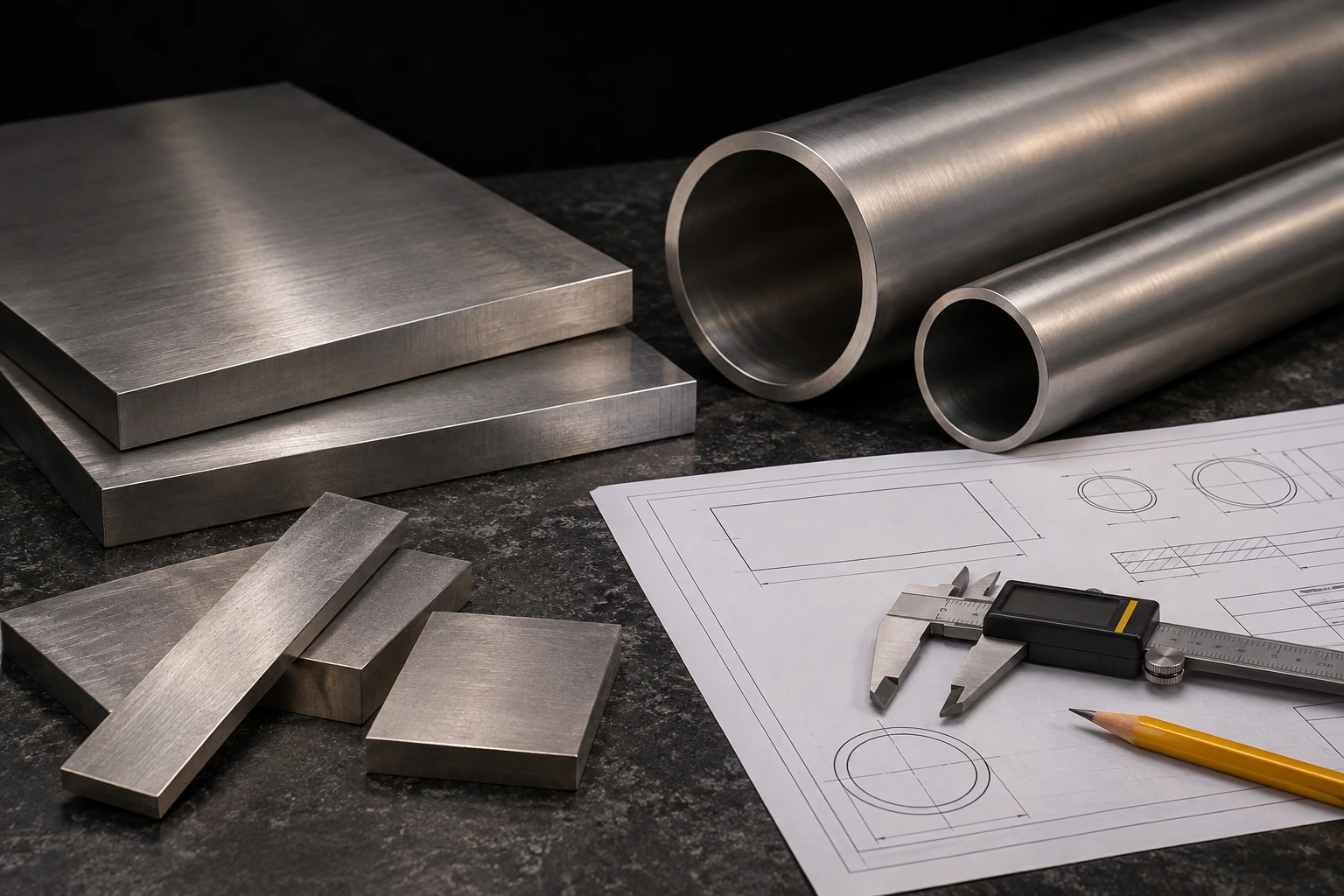
Material selection / 03Carry the approved grade through delivery.
Chemistry, product identity and inspection evidence must agree. AI illustration; not a production or inspection record.
Ask for chemistry evidence appropriate to the grade
The certificate should identify the full designation and required chemistry, including the intentional alloying elements. Confirm that the analytical method and report support the applicable limits. A generic titanium identification result does not establish the complete Grade 7 or Grade 12 chemistry. Link the results to the actual heat and delivered product.
Also review mechanical properties, condition, dimensions and required examinations. The mill certificate checklist provides a structured way to connect these records. When a processor issues a final report, preserve the link to the original material evidence rather than replacing it with an untraceable summary.
A lifecycle comparison needs stated assumptions
Compare material, fabrication, testing, installation, maintenance, replacement and downtime using the same service scenario. State which costs are known quotations and which are estimates. If service life is uncertain, show more than one scenario instead of presenting a precise payback date. A higher initial material cost can only be justified through the requirements and evidence relevant to the application.
Price differences also depend on stock form, alloying inputs, batch size, usable dimensions and certification. There is no universal Grade 7 premium or Grade 12 saving that applies to every order. Compare identical delivered scopes and ask how price or lead time changes if additional testing or a custom production run is needed.
Complete the technical decision before shipment
Freeze the service envelope and original design requirement.
Identify each proposed grade, product standard, condition and geometry.
Review relevant corrosion and mechanical evidence, including its limitations.
Define any trial or qualification and obtain the required approval.
Carry the approved requirement into the purchase order and inspection plan.
Reconcile the delivered material, tests, labels and document package.
If the starting question is whether unalloyed titanium needs upgrading at all, the Grade 2 versus Grade 7 application guide helps frame that earlier decision. For Grade 7 versus Grade 12, retain the same discipline: identify the operating problem first, then compare the evidence and complete cost.
Compare quotations after closing the material-selection question
Once the technically acceptable route or routes are defined, compare the complete commercial scope. Request product form, dimensions, condition, manufacturing route, quantity basis, inspection, records and delivery terms. If one route requires a special production campaign while another uses available stock, identify that distinction explicitly. It affects the offer, but it does not establish that the stocked material is a suitable substitute.
For a palladium-bearing grade, do not use a fixed article-level premium as a purchasing rule. Ask for a dated quotation for the actual product and required evidence. The commercial difference between grades can change with alloying inputs, available stock, usable yield, processing and order quantity. A percentage taken from an old quotation may be irrelevant to a different size or delivery scope.
Then separate purchase cost from the service-cost assumptions used by the equipment owner. Include inspection access, planned maintenance, replacement work and downtime only where there is a defensible basis for the estimate. A supplier can quote material and contracted operations; it should not casually guarantee a service life from a brief description of the process. Record any stated performance commitment precisely and distinguish it from general reference information.
Before release, reconcile the final order with the approved material decision. Check that a revised quotation has not changed the grade, condition, product standard or test scope while retaining the original price heading. Keep the approval record with the drawing and enquiry so that repeat orders follow the same technical basis. The quotation comparison checklist is useful at this stage because it separates material, documentation and delivery assumptions that can otherwise disappear inside a single price per kilogram.
04 / Build your RFQ
Turn the comparison into a clear enquiry.
Provide a service envelope rather than a single fluid name. Include normal and upset chemistry, temperatures, cleaning and crevice details, together with the approved product standard and any alternatives permitted for review.
Information to include
Complete fluid chemistry, concentration ranges and contaminants
Normal/upset temperatures, exposure duration and aeration context
Flow, deposits, crevices, cleaning and dissimilar-metal contacts
Product form, dimensions, pressure/design basis and drawing revision
Grade, condition, corrosion evidence and qualification requirements
Chemistry, inspection, traceability, quantity, destination and schedule
Build your RFQ checklist
Choose the product and add the information you have. Copy the resulting brief or send your requirements to TiHubs. Submitting an enquiry does not place an order.
05 / FAQs
Questions buyers ask
What is the main difference between Grade 7 and Grade 12?
Grade 7 is palladium-alloyed titanium; Grade 12 uses nickel and molybdenum additions. Their corrosion and mechanical performance must be compared for the actual product and service.
Is Grade 12 always cheaper than Grade 7?
No fixed ranking applies to every order. Stock, dimensions, quantity, processing and certification scope can change the complete price.
Can Grade 12 replace Grade 7?
Only after the required corrosion and design review. Compare the complete service envelope and acceptance requirements, then obtain written approval.
Is pH enough to select the grade?
No. Species, concentrations, temperature, aeration, contaminants, cleaning and local geometry can all matter.
Does a corrosion coupon predict equipment life?
Only within a justified interpretation of its test scope. It may not reproduce all operating, fabrication and local-geometry conditions.
Can higher Grade 12 strength justify a thinner wall?
Only through the applicable design review, including final wall, joints, temperature-dependent requirements and the full equipment load case.
06 / Key takeaways
Keep the purchase requirements connected.
Compare the same complete operating envelope.
Separate general corrosion, crevice behavior and mechanical design.
Include cleaning, transients and fabrication.
Require relevant evidence for an alternative grade.
Use stated assumptions in any lifecycle cost model.
Technical references
Sources and data scope
References reviewed November 9, 2026. Manufacturer data explains material behavior; it does not certify an offered heat or establish design allowables. Use the controlled product specification, required edition and approved engineering requirements for acceptance.
TiHubs coordinates titanium materials and custom supply from Baoji, China. Our founder’s 20 years in titanium inform a specification-led sourcing approach: clarify the product, manufacturing and acceptance requirements before quotation. Learn about our sourcing role.
Contents
TiHubs
Talk to TiHubs
Ask about titanium materials, grades or custom parts.
Enter your email to start chatting.
We use your email to respond to your enquiry. Your conversation is stored on this website.
Our team is away right now. Leave your enquiry and we will follow up by email.