Baoji High-tech Zone, ChinaTitanium sourcing · One contact


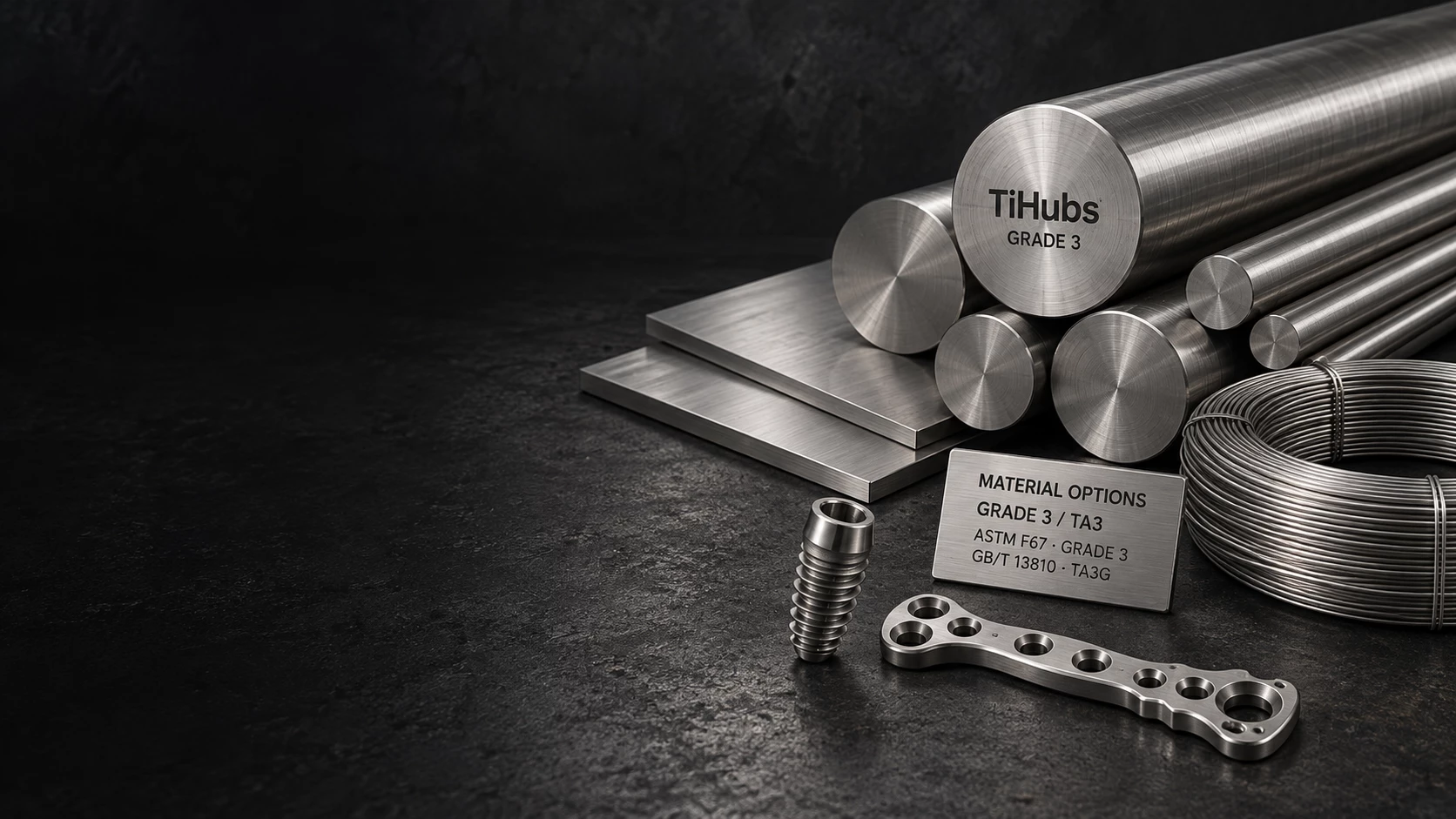
Grade 3 · Gr3 · UNS R50550 · Medical TA3G
Grade 3 / TA3G titanium.For medical machining.
Commercially pure titanium for dental and selected orthopedic component requirements. Source bar, sheet, plate and wire with a defined medical standard, material condition and traceability package. Industrial TA3 and seamless tube requirements are also reviewed here.
Start with a specification, drawing or application. We’ll help identify the details still needed.
Material review. Supply coordination.
One contact in Baoji, China.
Grade 3 / Gr3UNS R50550 · Medical TA3G · Industrial TA3
ASTM · ISO · GB/TDefine the product, revision and acceptance requirements
One contact20 years of founder experience · 100+ Baoji factories
01 / Product forms
Find your
Grade 3 / TA3G product.
Select a starting form. We review dimensions, condition, inspection and delivery before confirming a suitable supply route.
01 / 06
Grade 3 / Gr3 · TA3G · UNS R50550
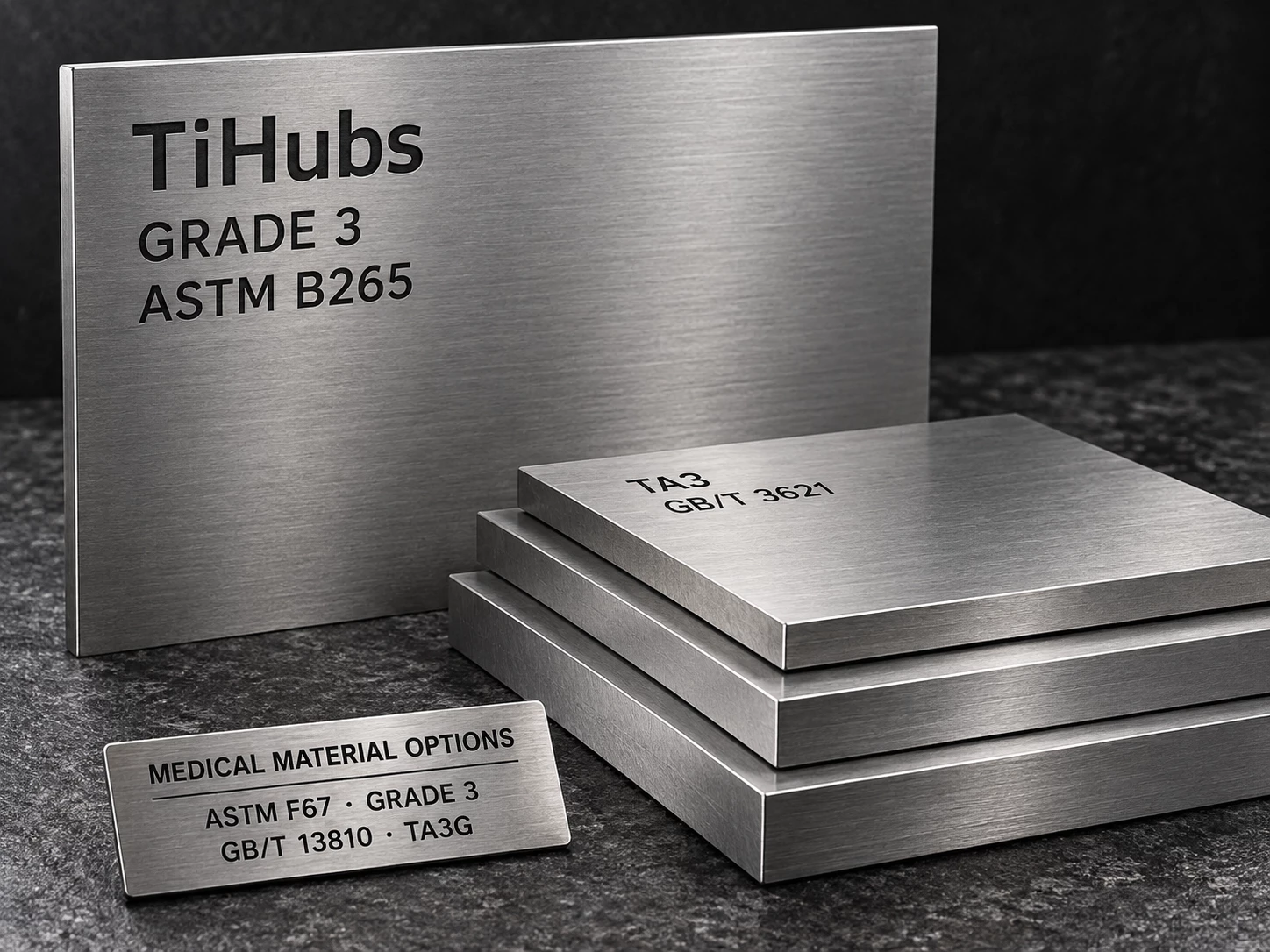
Grade 3 / TA3G titanium sheet & plate
For drawing-based medical parts and formed or machined blanks. Identify the medical material route at enquiry stage; an industrial TA3 plate description alone does not establish implant-material conformity.
- Specification
- ASTM F67 Grade 3, the specified ISO 5832-2 requirements, or GB/T 13810 TA3G. Industrial alternatives: ASTM B265 Grade 3 or GB/T 3621 TA3.
- Dimensions
- Thickness × width × length; thickness tolerance, flatness, usable area, rolling direction and cut-edge allowance.
- Condition
- Specify delivery condition, surface finish and subsequent forming or heat treatment. Confirm machining allowance and removal of any unacceptable surface layer.
- Acceptance
- Heat/lot identity, chemistry, form-specific mechanical tests, microstructure and dimensional or surface checks required by the selected standard and order.
02 / 06
Grade 3 / Gr3 · TA3G · UNS R50550
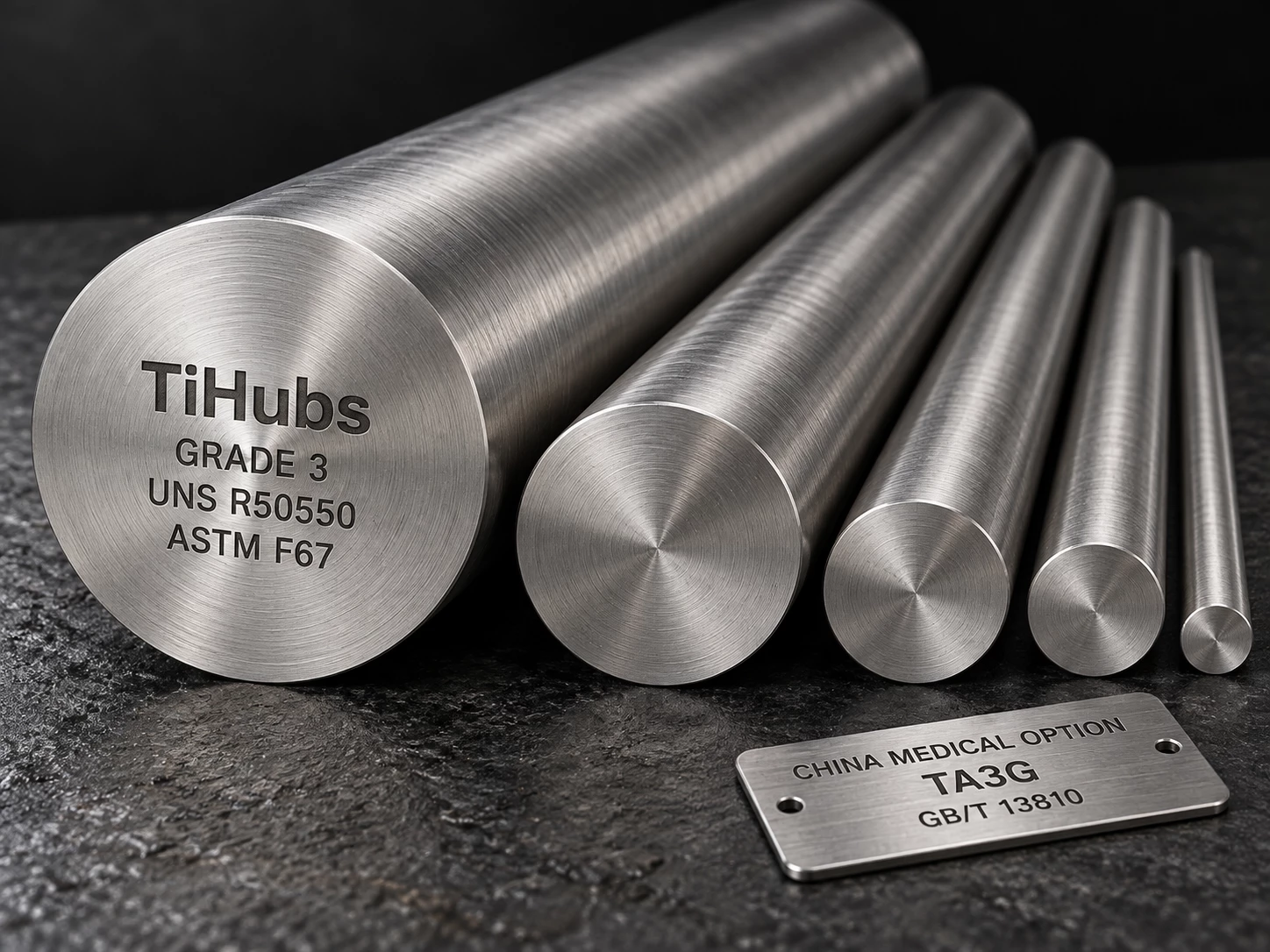
Grade 3 / TA3G titanium bar & rod
A starting form for precision turning of dental implant components and selected orthopedic parts. Send the finished drawing as well as the starting-bar dimensions so material and machining requirements can be reviewed together.
- Specification
- ASTM F67 Grade 3 / UNS R50550 or GB/T 13810 TA3G; add ISO 5832-2 when required. ASTM B348 Grade 3 and GB/T 2965 TA3 are industrial routes.
- Dimensions
- Diameter, diameter tolerance, roundness, straightness and usable length; include bar-feeder requirements and cut-piece quantities.
- Condition
- Annealed or another explicitly agreed condition; peeled, ground or turned surface as specified. Avoid changing condition without design approval.
- Acceptance
- Material certificate matched to heat/lot, mechanical and microstructural requirements, surface acceptance and any agreed ultrasonic inspection.
03 / 06
Grade 3 / Gr3 · Industrial TA3 · UNS R50550
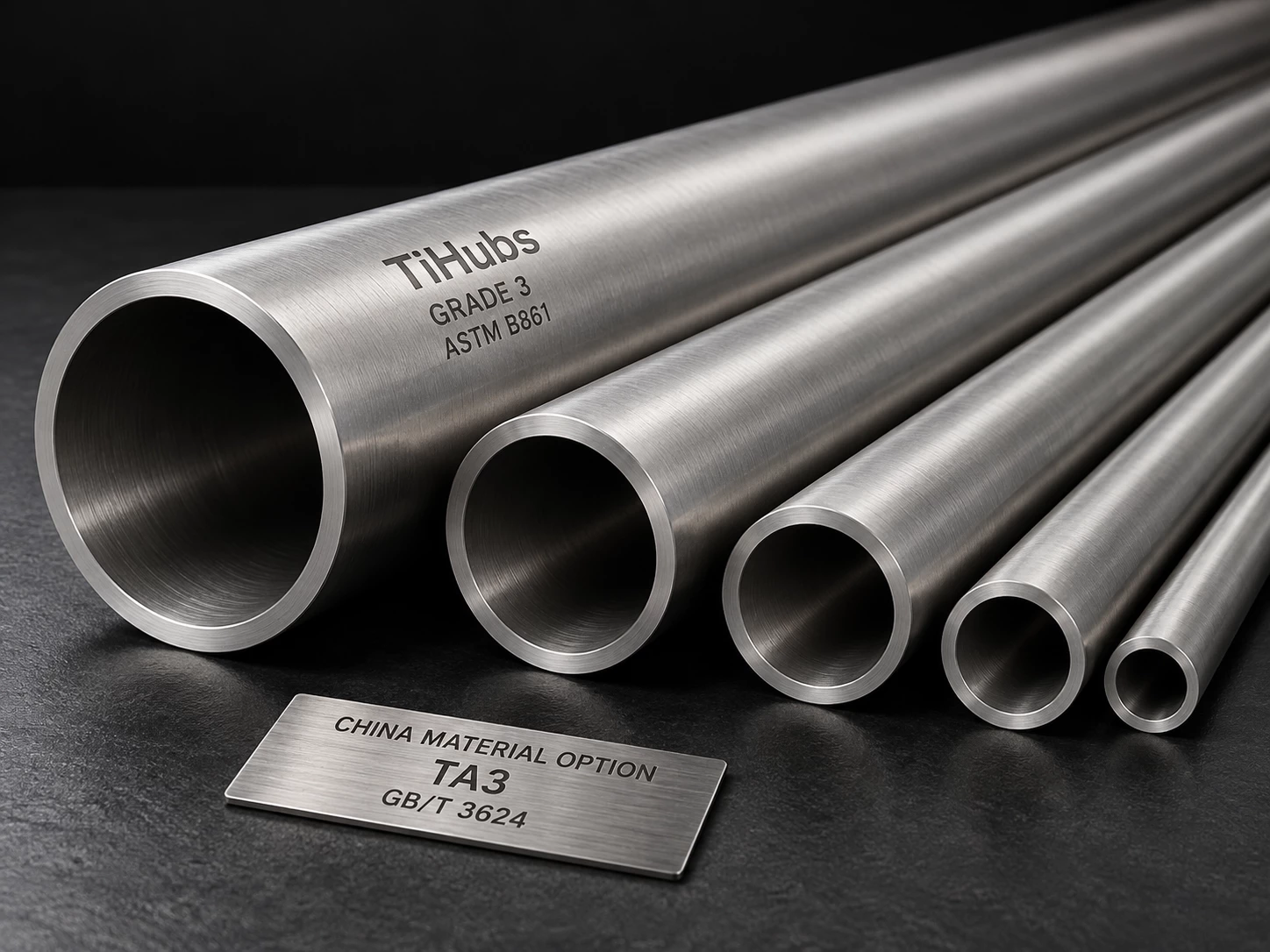
Grade 3 / TA3 titanium seamless tube
For defined tube, pipe and heat-transfer requirements. Medical tubing requires a separate specification review; do not order an implant component simply as industrial Grade 3 tube.
- Specification
- ASTM B338 for condenser/heat-exchanger tube or ASTM B861 for seamless pipe, as applicable. Chinese industrial routes include GB/T 3624 and GB/T 3625 with the grade and scope confirmed.
- Dimensions
- Outside diameter × wall thickness × length; minimum or nominal wall basis, ovality, straightness, bore and end requirements.
- Condition
- Manufacturing route, delivery condition, surface and end preparation. For a medical drawing, agree how tubing is covered and tested before quotation.
- Acceptance
- Heat/lot traceability, dimensions and agreed NDT, leak or pressure tests. ASTM F67 allows other forms including tubing by purchaser/supplier agreement; GB/T 13810-2017 covers plate, bar and wire.
04 / 06
Grade 3 / Gr3 · TA3G · UNS R50550
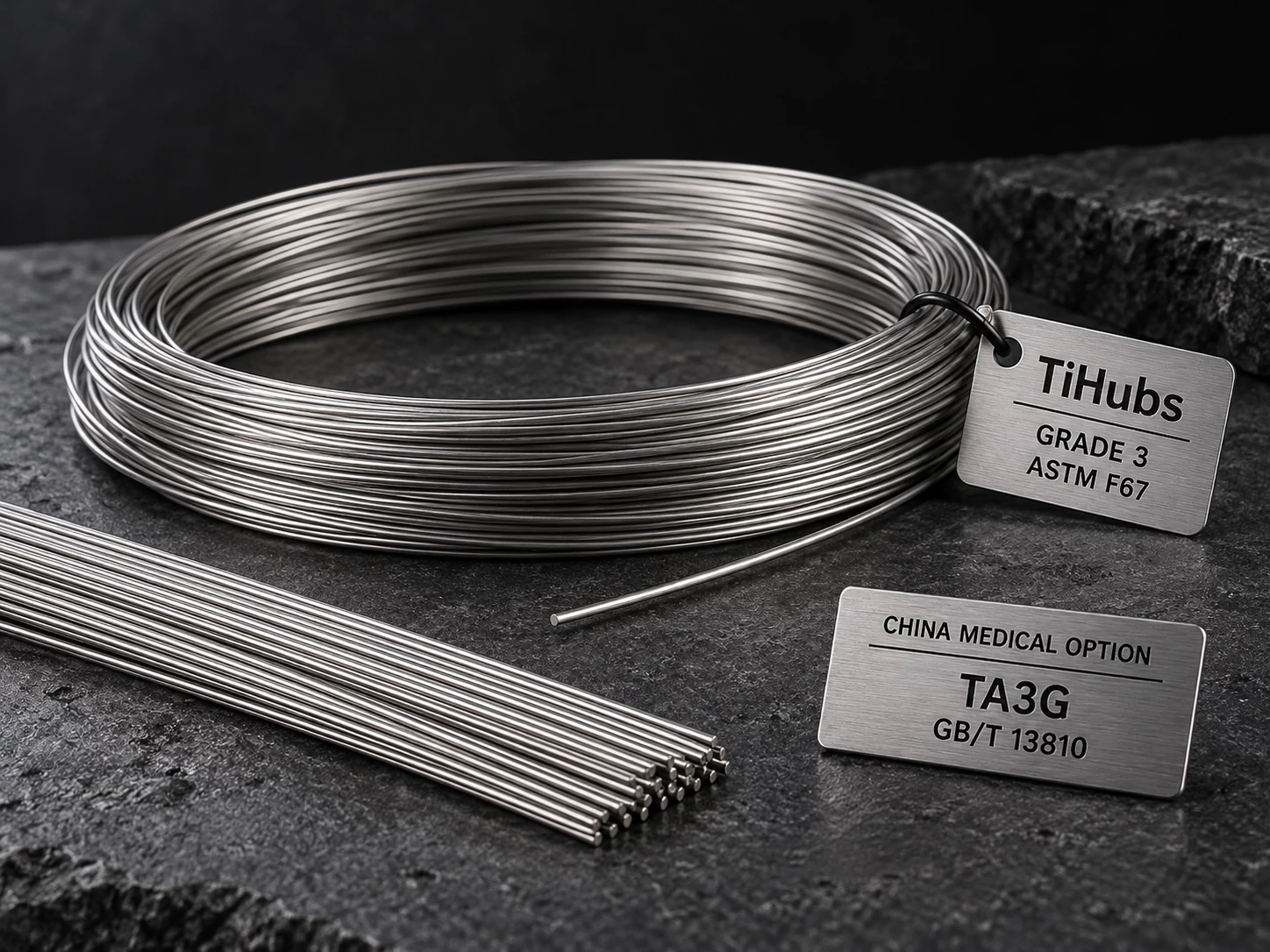
Grade 3 / TA3G titanium wire
For drawing-defined medical wire components or industrial forming requirements. Diameter and condition affect testing and forming behaviour, so specify the intended manufacturing process.
- Specification
- ASTM F67 Grade 3 or GB/T 13810 TA3G for the specified medical route. ASTM B863 Grade 3 or GB/T 3623 TA3 for industrial wire.
- Dimensions
- Diameter and tolerance, coil or straight lengths, coil dimensions, straightness and required quantity.
- Condition
- Delivery condition, surface finish and forming requirements; confirm any cold-worked property requirements explicitly.
- Acceptance
- Diameter-specific mechanical requirements, surface condition, traceability and required records. Bar test values must not be applied to every wire diameter.

05 / 06
Grade 3 / Gr3 · TA3G · UNS R50550
Titanium for dental implant machining
Discuss Grade 3 / TA3G bar or machining blanks when the approved dental design specifies commercially pure titanium. This illustration shows a manufacturing application, not a certified finished device.
- Specification
- State ASTM F67 Grade 3, ISO 5832-2 requirements or GB/T 13810 TA3G exactly as required by the device material specification.
- Dimensions
- Starting stock, drawing revision, thread and interface tolerances, concentricity, burr limits and machining allowances.
- Condition
- Material condition and surface at supply; define which later cleaning, surface treatment and validation steps belong to the device manufacturer.
- Acceptance
- Material identity through cutting and machining, inspection of critical interfaces, sample approval and change-control requirements.

06 / 06
Grade 3 / Gr3 · TA3G · UNS R50550
Titanium for orthopedic component machining
For selected fixation and other orthopedic component designs specifying Grade 3 / TA3G. Material choice must follow the approved design, load case and manufacturing process; it is not interchangeable with every titanium implant alloy.
- Specification
- Use the specified medical material standard and revision. Grade 3 commercially pure titanium is distinct from Grade 23 Ti-6Al-4V ELI.
- Dimensions
- Part and blank drawings, material direction where relevant, hole/thread geometry, thickness and critical surface requirements.
- Condition
- Agree annealed or other required condition, blank preparation and any subsequent forming or thermal processing.
- Acceptance
- Heat/lot and piece identification, material records, drawing inspection, first-article scope and documented approval of changes.
Images illustrate material forms and dental/orthopedic machining applications. Markings show specification options; they do not establish stock, dual conformity or approval of a finished medical device.
Bring the specification, drawing or manufacturing requirement.
We help define the material, supply scope and acceptance records before quotation.
01 / Custom requirement
A medical material specification
Send the grade, standard revision, product form and any purchaser-specific requirements. We review the supply route and records together.
02 / Custom requirement
A component drawing
Send the drawing revision, starting-stock preference and critical interfaces. Define whether you need raw material, blanks or machining coordination.
03 / Custom requirement
An industrial TA3 requirement
Send the product standard, dimensions, service and inspection scope. We keep the industrial quotation aligned with your intended use.
02 / Material identity
What is Grade 3 / TA3G titanium?
Grade 3 titanium, also written Gr3 or Gr. 3, is commercially pure titanium identified as UNS R50550. ASTM F67 includes Grade 3 for surgical-implant manufacturing materials. TA3G is the Chinese medical designation in GB/T 13810-2017; TA3 is the related industrial designation.
This page brings the medical and industrial purchasing routes together. Matching a grade family does not establish identical acceptance requirements: specify the product standard, revision, condition and required test records. Grade 3 is unalloyed titanium, not Ti-6Al-4V.
450MPa
Minimum tensile strength
ASTM F67-13(2017) Grade 3 annealed-bar reference
380MPa
Minimum 0.2% yield strength
ASTM F67-13(2017) Grade 3 annealed-bar reference
18%
Minimum elongation
ASTM F67-13(2017) Grade 3 annealed-bar reference
| Material / condition | Reference | Purchasing implication |
|---|---|---|
| ASTM F67 Grade 3 annealed bar | 450 MPa tensile · 380 MPa yield · 18% elongation | Table 3 reference; apply its dimensions, sampling, gauge length and test provisions. These are not finished-device design allowables. |
| GB/T 13810-2017 TA3G annealed bar | 500 MPa tensile · 380 MPa yield · 18% elongation | The Chinese medical bar requirement differs in minimum tensile strength. Verify the applicable size range and all other requirements. |
| Sheet, plate and wire | Use the relevant product and size requirements | Do not transfer a bar property table to all flat products or wire diameters. |
| Material condition | As specified in the order | Annealed and cold-worked conditions must not be treated as the same material-property basis. |
| Industrial TA3 | Specify the applicable GB/T product route | An industrial certificate alone does not demonstrate TA3G medical conformity. |
Sources: supplied ASTM F67-13(2017), Table 3, and GB/T 13810-2017 bar requirements. The complete specifications and agreed order govern acceptance.
| Element | Symbol | ASTM F67 Grade 3 heat-analysis limit, wt % |
|---|---|---|
| Oxygen | O | ≤0.35 |
| Iron | Fe | ≤0.30 |
| Nitrogen | N | ≤0.05 |
| Carbon | C | ≤0.08 |
| Hydrogen | H | ≤0.015 |
| Titanium | Ti | Balance |
Source: ASTM F67-13(2017), Table 1. The billet hydrogen maximum is 0.010 wt %. Product-analysis tolerances are separate from heat-analysis limits. For TA3G or an ISO order, apply the complete requirements of the stated standard and revision; this table is not a declaration of dual conformity.
| Comparison | What changes | What to specify |
|---|---|---|
| Grade 3 / Gr3 and TA3G | Related medical commercially pure titanium routes, with potentially different product requirements. The annealed-bar tensile comparison above is one example. | Standard and revision, product form, condition, all acceptance limits and required records. |
| Medical TA3G and industrial TA3 | GB/T 13810-2017 uses TA3G for the medical route; TA3 appears in industrial material specifications. | Intended medical or industrial use and the governing product specification. |
| Grade 3 and Grade 2 / Grade 4 | Different specified chemistry and strength/ductility requirements within commercially pure titanium. | Design-approved grade, condition, forming/machining needs and mechanical test basis. |
| Grade 3 and Grade 23 | Grade 3 is commercially pure titanium; Grade 23 is Ti-6Al-4V ELI alloy. | Device-approved material; do not substitute on a general medical-use description. |
| Material compliance and device acceptance | Raw-material tests do not establish completed-device safety, fatigue performance, biological evaluation or regulatory authorization. | Material supply scope, component inspection and the device manufacturer’s validation requirements. |
Related grade pages: Grade 2 / TA2 ↗. Send the approved material specification if you need a comparison before quotation.
03 / Medical applications & other requirements
Grade 3 / TA3G.
Start with the medical design.
Dental and selected orthopedic manufacturing are the focus of this page. Define the approved material and component requirements first; then review the supply forms, manufacturing steps and records needed for your purchase.
Application review / 01
Bar stock for dental implant components
Grade 3 / TA3G can be specified as commercially pure titanium feedstock for dental implant components. The device drawing and approved material specification govern the selection.
Products to discuss
Round bar and cut blanks for turning; custom machining discussion against a controlled drawing.
What we need to review
Material standard and revision, bar geometry, thread/interface tolerances, traceability, surface and sample-approval requirements.
Application review / 02
Material for selected orthopedic designs
Selected orthopedic fixation and other component designs may use Grade 3 commercially pure titanium. The load case and finished-device requirements determine whether it is the appropriate grade.
Products to discuss
Bar, sheet/plate or defined blanks according to the component geometry.
What we need to review
Drawing revision, material condition, forming and machining sequence, critical features and required material/inspection records.
Application review / 03
Sheet and plate for drawing-defined medical parts
A flat-product order needs its own mechanical, surface and dimensional basis. It should not inherit every value quoted for annealed bar.
Products to discuss
Sheet, plate, cut pieces and blanks under the selected medical material route.
What we need to review
Thickness tolerance, rolling direction, blank layout, bending requirements, surface condition and form-specific tests.
Application review / 04
Wire for specified medical component production
Medical wire requirements vary with diameter, delivery condition and downstream forming. Define these before applying a material-property target.
Products to discuss
Coiled or straight wire to a medical material specification within its applicable scope.
What we need to review
Diameter, condition, surface, coil/straight-length format, test basis, lot identity and forming requirements.
Application review / 05
Samples for your supplier evaluation
Samples can support the buyer’s machining trials and material or supplier qualification process. The sample plan should represent the material and condition intended for production.
Products to discuss
Representative bar, plate or wire samples and drawing-defined trial blanks.
What we need to review
Sample quantity, test plan, documentation, acceptance criteria, production comparability and approval milestones.
Application review / 06
Grade 3 / TA3 heat-exchanger tubing
For an industrial design specifying Grade 3 or TA3, define the tube standard, fluid duty and joining method. Medical grade language is not a substitute for the heat-exchanger tube specification.
Products to discuss
Seamless tube with agreed end, surface and inspection requirements.
What we need to review
Fluid composition and temperature, OD/wall/length, tube-sheet connection, NDT and leak or pressure-test scope.
Application review / 07
TA3 material for industrial machining
TA3 is also used as an industrial commercially pure titanium designation. The required product standard, mechanical condition and service determine the purchase specification.
Products to discuss
Bar and plate for drawing-based industrial parts and blanks.
What we need to review
Product standard, dimensions, condition, surface, critical tolerances and inspection. Avoid treating industrial records as medical qualification.
Application review / 08
One enquiry for several material forms
A medical or industrial project can require several titanium forms. Consolidate the schedule while retaining the correct standard and acceptance requirements for each item.
Products to discuss
Sheet/plate, bar, wire and separately specified tube requirements.
What we need to review
Line-item grades and standards, quantities, document matching, packaging, identification and coordinated dispatch.
Medical material references: Daido Grade 3 medical material ↗ · ISO 5832-2:2018 scope ↗. The purchasing examples below illustrate how to define an order; they are not claims of TiHubs clinical results or finished-device approval.
Medical application / Dental
Define the bar before the implant component is machined.
For a dental manufacturer, a useful quotation connects the medical material specification to the actual turning process. A grade name alone does not establish the bar geometry, material condition or evidence needed for production release.
Start with the approved material
Identify Grade 3 / UNS R50550 or TA3G, standard revision and any additional limits. If more than one standard is requested, assess every requirement before promising dual conformity.
Connect stock to the drawing
Specify usable bar length, diameter tolerance and straightness for the machine setup. Review threads, interfaces, concentricity, machining allowance and surface requirements against the drawing revision.
Keep identity through the process
Agree how heat/lot identification follows cut blanks and machined lots. Define material certificates, sample inspection, packaging and responsibility for subsequent cleaning and surface treatment.
Example enquiry: dental implant machining material
Please quote annealed titanium bar to ASTM F67-13(2017), Grade 3, UNS R50550, for dental implant component machining. Bar diameter, tolerance, length, quantity and drawing revision are attached. Please identify the included material tests, traceability records and sample lead time.
For a Chinese medical route, specify TA3G to GB/T 13810-2017 and the relevant product requirements. TiHubs reviews material and machining coordination; finished-device validation and market authorization are separate responsibilities.
Medical application / Orthopedics
Match the material to the component design and load case.
Grade 3 / TA3G may be selected for orthopedic parts where the design specifies commercially pure titanium. Procurement should preserve that design decision through material supply, blank preparation, machining and inspection.
Confirm what is being supplied
Distinguish raw bar or plate, cut blanks and drawing-based machined parts. State the dimensions and condition at each handover; do not assume a material standard includes completed-part acceptance.
Review manufacturing effects
Identify forming, machining, heat treatment and surface processing after material delivery. Agree where critical dimensions and material properties are verified, including first-article requirements.
Define acceptance evidence
Link material records to the supplied lot and dimensional results to the drawing revision. Agree critical inspection points and how nonconformities or proposed changes will be submitted for review.
Example enquiry: orthopedic component blanks
Please review Grade 3 / TA3G blanks for the attached orthopedic component drawing. Confirm the applicable medical standard, required condition, machining allowance, quantity and document package. Identify any technical points requiring approval before quotation.
Grade 3 is not Ti-6Al-4V ELI. Strength, fatigue performance and finished-device suitability cannot be inferred from a generic titanium description or this application illustration.
Medical purchasing / Documentation
Make the material handover reviewable.
The purchasing team needs records that identify the material actually supplied. Agree the required documents and control points early so the quotation covers the intended review process.
Material and test records
Define grade, standard revision, condition, heat/lot number and the chemical, mechanical and microstructural results required by the applicable specification.
Inspection and change control
Define dimensional/surface checks, sample approvals and additional testing. Material substitution, condition changes and departures from approved requirements need written agreement.
Packaging and identification
Agree labels, piece or bundle identity, protection of critical surfaces and packing-list references. Define cleanliness and packaging requirements explicitly; raw material is not supplied as a sterile implant by implication.
What to include in a medical material RFQ
Product form; Grade 3 / Gr3 or TA3G; standard and revision; dimensions and tolerances; condition and surface; quantity and destination; intended manufacturing process; required tests, documents and supplier-qualification requirements.
You can start with the information you have. We identify missing details and discuss a suitable supply proposal before preparing the quotation.
04 / Standards & documentation
Match the standard
to the product.
Medical Grade 3 / TA3G and industrial Grade 3 / TA3 routes are shown separately. Select the standard for the intended use and product form, then agree the edition and acceptance evidence before quotation.
| Product form | ASTM / ISO route | Chinese standard route | Clarify before quotation |
|---|---|---|---|
| Medical material · Grade 3 / TA3G | ASTM / ISOASTM F67-13(2017) View PDF ↗ISO 5832-2:2018 View PDF ↗ | China · GB/TGB/T 13810-2017 View PDF ↗ | Medical standard and revision, form, condition, chemistry, mechanical/microstructural requirements and records. Review additional purchaser requirements. |
| Industrial identity · TA3 | ASTM / ISOGrade 3 / Gr3 · UNS R50550
Apply the chemistry required by the selected product standard. |
China · GB/TGB/T 3620.1-2016 View PDF ↗ | Industrial TA3 is not a stand-alone medical material specification. Use with the applicable product standard. |
| Industrial sheet & plate | ASTM / ISOASTM B265-08 View PDF ↗ | China · GB/TGB/T 3621-2022 View PDF ↗ | Thickness, usable size, condition, flatness, surface, rolling direction and tests. |
| Industrial bar & rod | ASTM / ISOASTM B348-08a View PDF ↗ | China · GB/TGB/T 2965-2023 View PDF ↗ | Diameter/section, straightness, length, condition, surface and inspection. |
| Industrial seamless pipe / tube | ASTM / ISOASTM B861-10 View PDF ↗ | China · GB/TGB/T 3624-2023 View PDF ↗ | Pipe versus tube, dimensional system, wall basis, manufacturing route and inspection. |
| Heat-exchanger / condenser tubes | ASTM / ISOASTM B338-08b View PDF ↗ | China · GB/TGB/T 3625-2007 View PDF ↗ | OD, wall, length, joint requirements, NDT and leak/pressure-test scope. |
| Industrial wire | ASTM / ISOASTM B863-19 View PDF ↗ | China · GB/TGB/T 3623-2022 View PDF ↗ | Diameter, tolerance, condition, surface, coil/straight format and size-specific tests. |
Use the revision required by your order. PDF labels retain the supplied editions. ISO 5832-2:2018 has been replaced by ISO 5832-2:2025; the available download here remains the 2018 file. Medical material conformity and finished-device acceptance are separate requirements.
Medical scope references: ASTM F67-13(2017) ↗ · ISO 5832-2:2018 edition status ↗. For TA3G, use the supplied GB/T 13810-2017 product requirements. ASTM F67 permits other forms including tubing by agreement; GB/T 13810-2017 covers plate, bar and wire.
05 / Order coordination
Know the scope
before ordering.
Our founder’s 20 years in titanium inform the questions we ask before quotation and the supply options we review with you.
A quotation you can evaluate
Agree the grade, standard edition, dimensions, tolerance, condition and quantity before comparing prices.
- Identify whether inspection, samples and tooling are included.
- Confirm packaging, transport and delivery terms.
- Record items that still need technical confirmation.
Acceptance agreed before supply
Agree the medical or industrial material standard, revision, product form and condition before supply. For medical materials, identify chemistry, mechanical and microstructural requirements, heat/lot traceability, surface criteria and required material records.
Define additional dimensional inspection, sample approval and any independent inspection by scope, timing, acceptance criteria and cost.
Delivery with clear milestones
Review the proposed lead time, approvals, production sequence and dispatch requirements. For several product forms, coordinate document and packing readiness together.
Material substitutions and technical changes require written approval. A schedule deviation should identify the impact, decisions needed and next steps.
One contact when an issue arises
Contact TiHubs with the order reference, affected items and supporting photos or inspection records.
We record the issue, review it against the agreed requirements and coordinate the next steps with the relevant manufacturing parties.
01 / Material identity
Material records
Grade, standard revision, condition and test results linked to the supplied heat or lot; include required medical material records.
02 / Agreed acceptance
Inspection records
Dimensional, surface and agreed test records matched to the material or controlled component drawing.
03 / Ready for dispatch
Dispatch records
Item and lot identification, packing-list references, agreed surface protection and shipment documents.
06 / Questions before sourcing
Before you specify
Grade 3 / TA3G.
A clear material designation is the beginning. Product form, specification revision, material condition and acceptance complete the requirement.
A useful first enquiry
- Product and specificationGrade 3 / Gr3 or TA3G for the medical route; specify TA3 for an industrial requirement.
- Order and deliveryQuantity, destination and any required delivery date.
- Acceptance requirementsMedical material specification, drawing revision, tests, traceability, documents and packaging requirements.
Not every detail is finalized? Send the information you have. We can help identify the questions to resolve before quotation.
What happens next: requirement review, technical clarification, then a supply proposal and quotation.
What are Grade 3, Gr3, TA3G and TA3?
Grade 3, also written Gr3 or Gr. 3, is commercially pure titanium identified as UNS R50550. TA3G is the Chinese medical designation in GB/T 13810-2017; TA3 is an industrial designation in the related commercially pure titanium family. They are presented on one page for procurement comparison, but the name alone does not establish identical requirements or dual conformity.
Is Grade 3 titanium suitable for medical applications?
Grade 3 is included in ASTM F67 for unalloyed titanium used to manufacture surgical implants. It can be considered for dental and selected orthopedic components when specified by the approved device design. Material conformity does not establish finished-device performance, biological evaluation, sterilization or regulatory authorization.
Can industrial TA3 be supplied as medical TA3G?
Not on an industrial grade certificate alone. A TA3G order must meet the specified GB/T 13810 product requirements and any additional purchaser requirements, with corresponding records. For example, the supplied standard gives TA3G annealed bar a minimum tensile strength of 500 MPa, whereas the supplied ASTM F67 Grade 3 annealed-bar reference is 450 MPa. Substitution needs technical review and written agreement.
Which standard should I specify for a dental or orthopedic order?
Use the standard and revision required by the device material specification: for example ASTM F67 Grade 3, ISO 5832-2 or GB/T 13810 TA3G. Include the product form, condition, dimensions, testing and records. The linked ISO PDF is the supplied 2018 edition, which has been replaced by the 2025 edition; state the revision required by your order.
How does Grade 3 compare with Grade 2, Grade 4 and Grade 23?
Grades 2, 3 and 4 are commercially pure titanium grades with different specified chemistry and strength/ductility requirements. Grade 23 is Ti-6Al-4V ELI, a titanium alloy. Compare the applicable material standard, condition, geometry and device design requirements rather than substituting by a general medical-use label.
Can you supply medical tubing or welding wire under these standards?
Medical tubing needs an agreed product and inspection basis. ASTM F67-13(2017) permits other forms, including tubing, by purchaser/supplier agreement; GB/T 13810-2017 covers plate, bar and wire. Industrial tube standards do not automatically establish medical conformity. Similarly, material wire is not automatically a classified welding filler.
Can you coordinate drawings, samples and inspection records?
Send the drawing revision, material specification, critical features and required records. We can review raw material, blanks and machining coordination, and discuss samples or independent inspection. The scope, acceptance criteria, timing and cost are agreed for the order; application images are illustrative.
What are the minimum order quantity and lead time?
They depend on product form, dimensions, condition, quantity, manufacturing route and inspection requirements. Send your material schedule, destination and target date. We review feasibility and confirm the quotation basis and proposed milestones rather than applying one quantity or lead time to every product.
What should I send for a quotation, and who handles an order issue?
Start with a specification, drawing or application, plus quantity and destination if known. TiHubs helps clarify the missing requirements and remains the technical and commercial contact. If an issue arises, we record it, compare it with the agreed requirements and coordinate the next steps with the relevant manufacturing parties.
07 / Your next step
Start with the
requirement you have.
Send the product details, drawing or operating conditions you already know. We will identify missing information and discuss a suitable supply route before quotation.
- Requirement review
- Technical clarification
- Supply proposal and quotation
Combine several items in one enquiry.
Send the medical material specification or component drawing, product form, dimensions, condition and quantity. For an industrial TA3 order, identify the intended use and product standard.
Share delivery and acceptance priorities.
Include the required tests and material records, traceability and packaging requirements, destination and target date. We can start with the information already available and clarify the rest.
Baoji, China · info@tihubs.com
Start your Grade 3 / TA3G enquiry
Tell us what you need. Details can be clarified after your first enquiry.