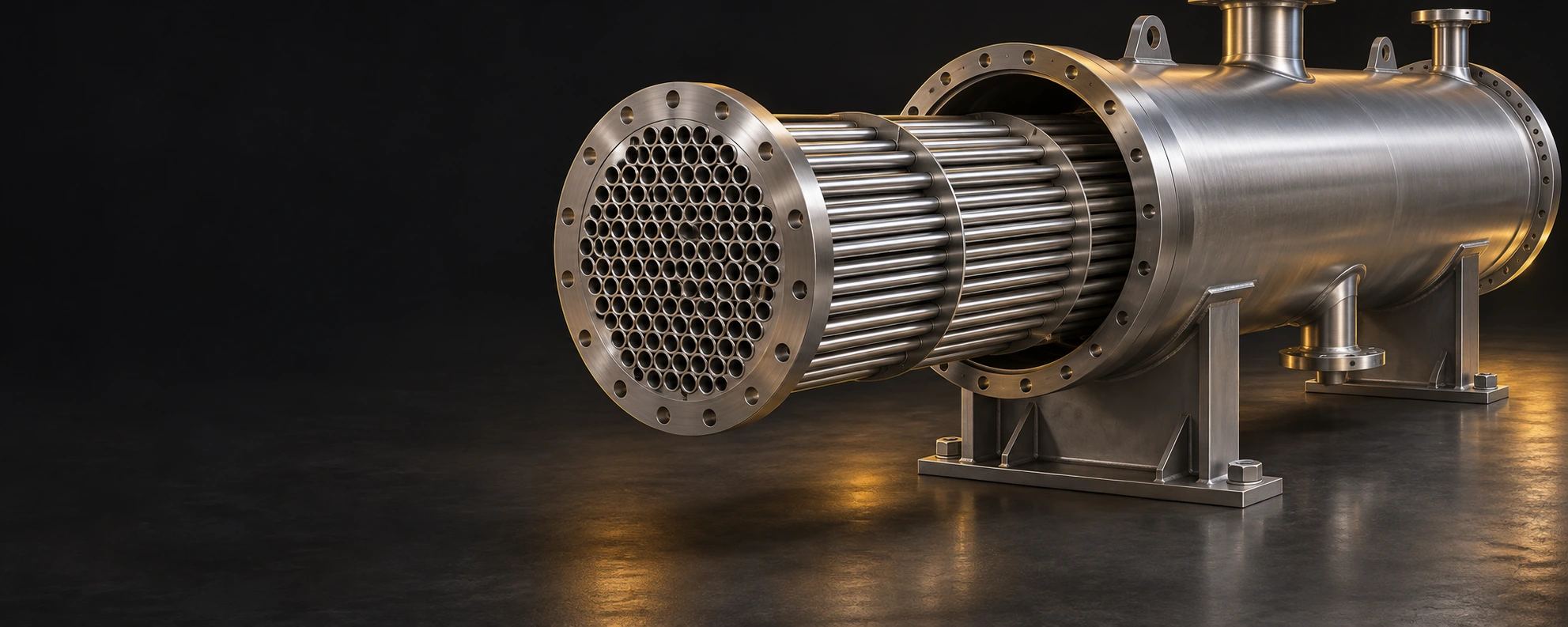
Titanium heat exchangers and replacement bundles for defined process duties. Bring both fluid sides, thermal requirements and mechanical interfaces into one project brief.
Start with the thermal duty and installation constraints. The selected structure, wetted materials and approval requirements are confirmed through project review.
Shell-and-tube exchangers
Shell-and-tube exchangers
Provide both fluid conditions, required duty, allowable pressure drop and the installation envelope. Identify which components require titanium and which have separate material requirements.
Both-side fluid and temperature data
Duty, flow rate and allowable pressure drop
Tube, tubesheet, shell and channel material callouts
Define your heat exchangers
Send the operating conditions and drawing requirements. Materials, feasibility, quantity, lead time and acceptance are confirmed through project review.
Order item
Include in your enquiry
Why it matters
Thermal duty
Required duty and inlet / outlet temperatures
Defines the heat-transfer objective
Both fluids
Composition, concentration, phases and flow rates
Supports thermal and material review
Pressure basis
Operating / design pressure and temperature for each side
Separates service from design requirements
Hydraulic limits
Allowable pressure drop and fouling assumptions
Constrains the selected arrangement
Construction
Type, area basis, envelope, nozzles and maintenance access
Defines fit and serviceability
Wetted materials
Tubes / plates, tubesheets, joints, seals and other parts
Avoids assuming every component is titanium
Code & approval
Applicable code, jurisdiction, certification and witnesses
Defines the equipment acceptance route
Release scope
Drawings, test plan, documents, quantity and delivery
Dimensions, availability and acceptance criteria are confirmed in the quotation and order documents. Product photographs illustrate the supply format.
Start with the grade
Explore a material guide, then tell us the exact designation required by your drawing or purchase specification.
Chinese designations and international names are reference routes, not automatic substitutes. Grade, product specification, condition and acceptance requirements must be agreed together.
The process, operating environment and required outcome help define the structure, materials and acceptance scope.
Seawater cooling and desalination
Titanium heat-transfer surfaces can be considered for seawater duties, with material selection reviewed against temperature, chemistry, crevices and cleaning conditions. Define whether the order is a new exchanger or a replacement bundle for existing equipment.
What to sendSeawater conditions, other-side fluid, duty, flow and equipment interfaces.
Chemical process heating and cooling
Process chemistry can change during concentration, startup or cleaning. Include these conditions in the material review and identify allowable pressure drop, contamination restrictions and the required thermal performance basis.
What to sendFull fluid composition, concentration range, cleaning conditions and thermal datasheet.
Retrofits and maintenance bundles
Replacement projects must preserve the required mechanical interfaces while meeting the specified service and inspection requirements. Identify verified dimensions, undocumented changes and the planned shutdown window before manufacture.
What to sendExisting drawings, verified interfaces, failure history where available and required delivery window.
Agree the duty before the hardware
Thermal performance, mechanical design and material compatibility need one coordinated datasheet. The supplier scope and required approvals should be clear at quotation.
Tube-to-tubesheet fabrication illustration / joint and assembly requirements
TUBE SIDE · SHELL SIDE · NOZZLES · TUBESHEET · MAINTENANCE ENVELOPE
Order geometry schematic; not a dimensional product drawing.
Complete the process datasheet
Provide inlet and outlet targets, flow rates, phase changes, duty and pressure-drop limits for both sides. Agree the thermal design case and performance-verification basis, including the applicable fouling assumptions.
Review all wetted materials
Specify the titanium grade for each applicable component and the materials for gaskets, joints and other wetted parts. Material selection must account for the actual process and cleaning media, not just the word seawater or chemical.
Confirm fabrication and approval scope
Identify the required construction code, design review, welding qualifications, inspection hold points and certification route. ASME or other approval is project-specific and must be confirmed with the qualified manufacturing route.
Define separate acceptance checks
Agree dimensional inspection, joining records, required NDT and pressure / leak tests. Pressure testing establishes its specified acceptance scope; it does not by itself prove the required heat-transfer duty.
Inspection, agreed upfront
Specify the tests and documents that your receiving inspection needs. Scope, sampling and acceptance levels belong in the order.
Dimensional inspection illustration / agreed scope and acceptance
Order documentationTiHubs
Traceable from heat to shipment.
Material identificationGrade + specification
Batch identificationHeat / lot reference
Inspection scopeAgreed tests & results
Shipment identificationMarks + packing list
Illustrative document checklist. Not a certificate or test report.
01Material schedule
Link each wetted component to its approved material and records.
Component BOM + traceability02Approved geometry
Check interfaces, nozzle orientation, envelope and maintenance access.
Approved drawings + dimensions03Joining evidence
Define required procedures, qualifications and joint records.
TiHubs coordinates titanium sourcing through a local manufacturer network. Your specification guides the supplier review, technical discussion and delivery requirements.
Confirm grade, dimensions, state, quantity and the purpose of the stock.
Review the supply route
Discuss manufacturing, finishing, inspection and documentation with the relevant supplier.
Agree the commercial scope
Confirm the quotation, lead time, acceptance requirements and delivery terms.
Coordinate inspection & delivery
Follow the agreed checks, marking, packing and shipment documentation.
Before you order
Answers to the details that make your titanium heat exchangers enquiry easier to review.
TITANIUM HEAT EXCHANGERS · BAOJI SOURCING
Send your specification.
Titanium heat exchangers and replacement bundles for defined process duties. Bring both fluid sides, thermal requirements and mechanical interfaces into one project brief.
You do not need to finalize every detail before contacting us.
TiHubs
Talk to TiHubs
Ask about titanium materials, grades or custom parts.
Enter your email to start chatting.
We use your email to respond to your enquiry. Your conversation is stored on this website.
Our team is away right now. Leave your enquiry and we will follow up by email.