Baoji High-tech Zone, ChinaTitanium sourcing · One contact


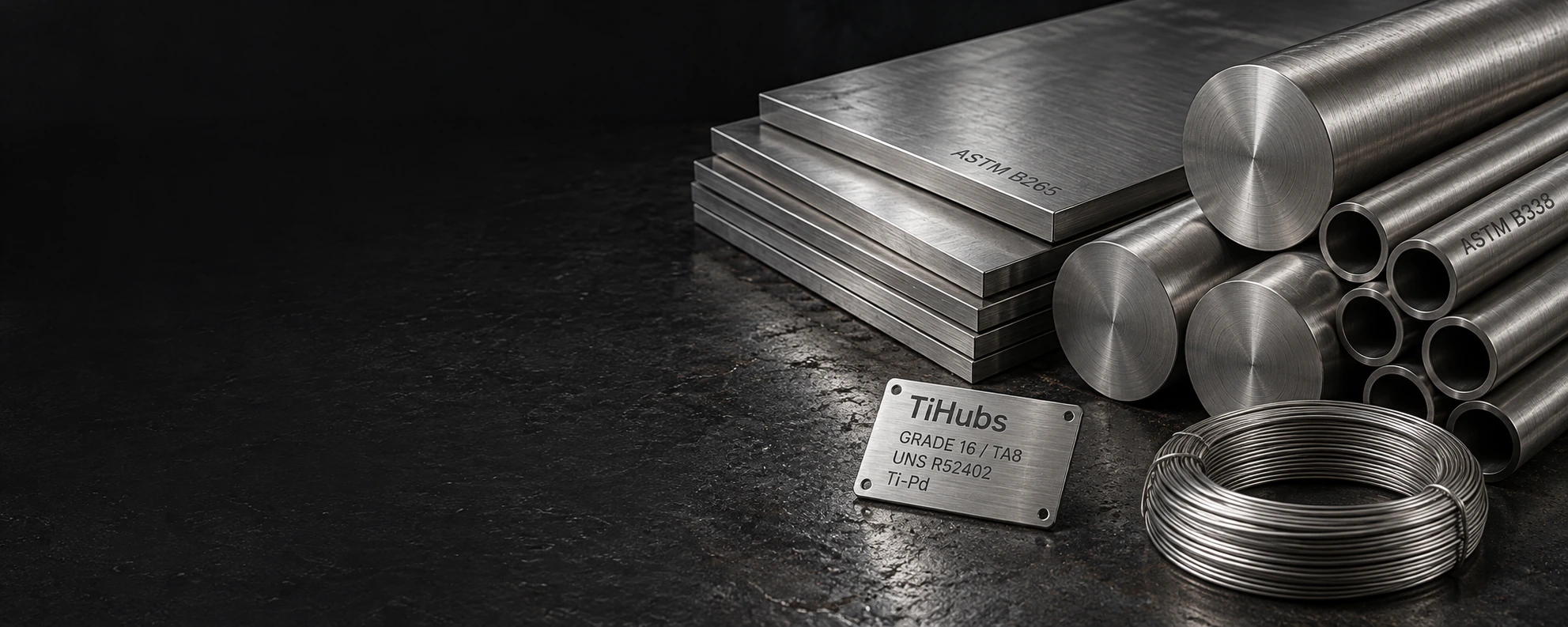
Grade 16 · Gr16 · TA8 · UNS R52402
Grade 16 / TA8 titanium.For chemical corrosion duties.
Source titanium-palladium sheet, bar, tube and drawing-based parts for chemical equipment. We review Gr16 / TA8 requirements for heat exchangers, condensers, evaporators and formed components through one technical and commercial contact in Baoji.
Start with a specification, drawing or application. We’ll help identify the details still needed.
Material review. Supply coordination.
One contact in Baoji, China.
Grade 16 / Gr16 / TA8Ti-Pd · UNS R52402 · 0.04–0.08% palladium
Low-palladium Ti-PdMatch the material to the media, geometry and duty
One contact20 years of founder experience · 100+ Baoji factories
01 / Product forms
Find your
Grade 16 / TA8 product.
Choose a material form or application. Send the dimensions, service conditions and required records so we can match the manufacturing route to your order.
01 / 06
Grade 16 · Gr16 · TA8 · Ti-Pd
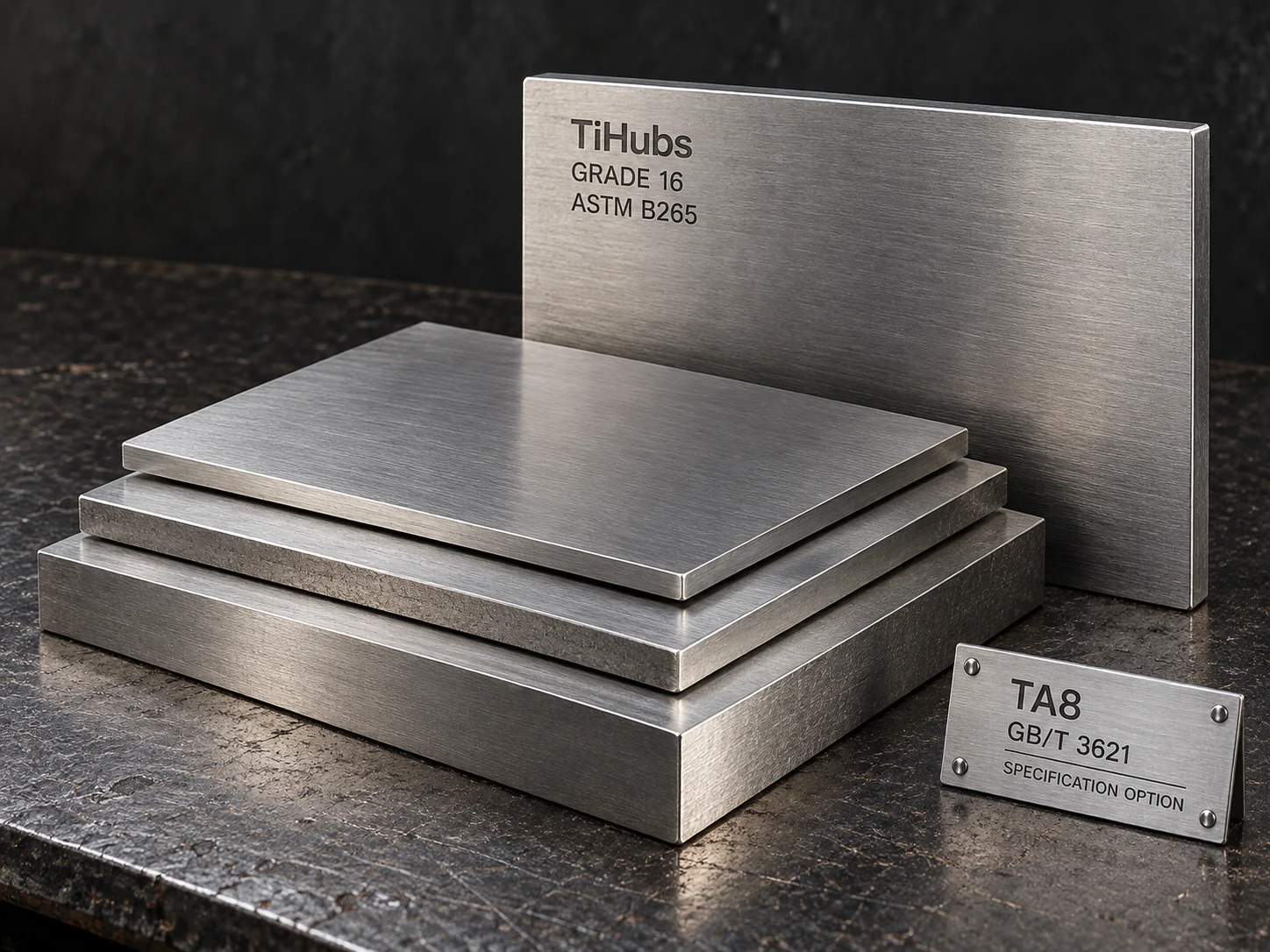
Grade 16 / TA8 titanium sheet & plate
For specified corrosion-resistant linings, shells and heat-transfer components. Include the finished geometry and service conditions when requesting cut blanks or formed parts.
- Specification
- ASTM B265 Grade 16 or GB/T 3621 TA8. Their tensile acceptance requirements differ in the cited files; specify the route and edition explicitly.
- Dimensions
- Thickness × width × length, thickness tolerance, flatness, surface finish, rolling direction and cut-edge condition.
- Forming
- Delivery condition, bend radii, draw depth, minimum finished wall and tooling. Review any sample or forming trial before production.
- Acceptance
- Chemistry including palladium, required tensile tests, heat identity, dimensions and surface. Dual certification requires evidence against both specifications.
02 / 06
Grade 16 · Gr16 · TA8 · Ti-Pd
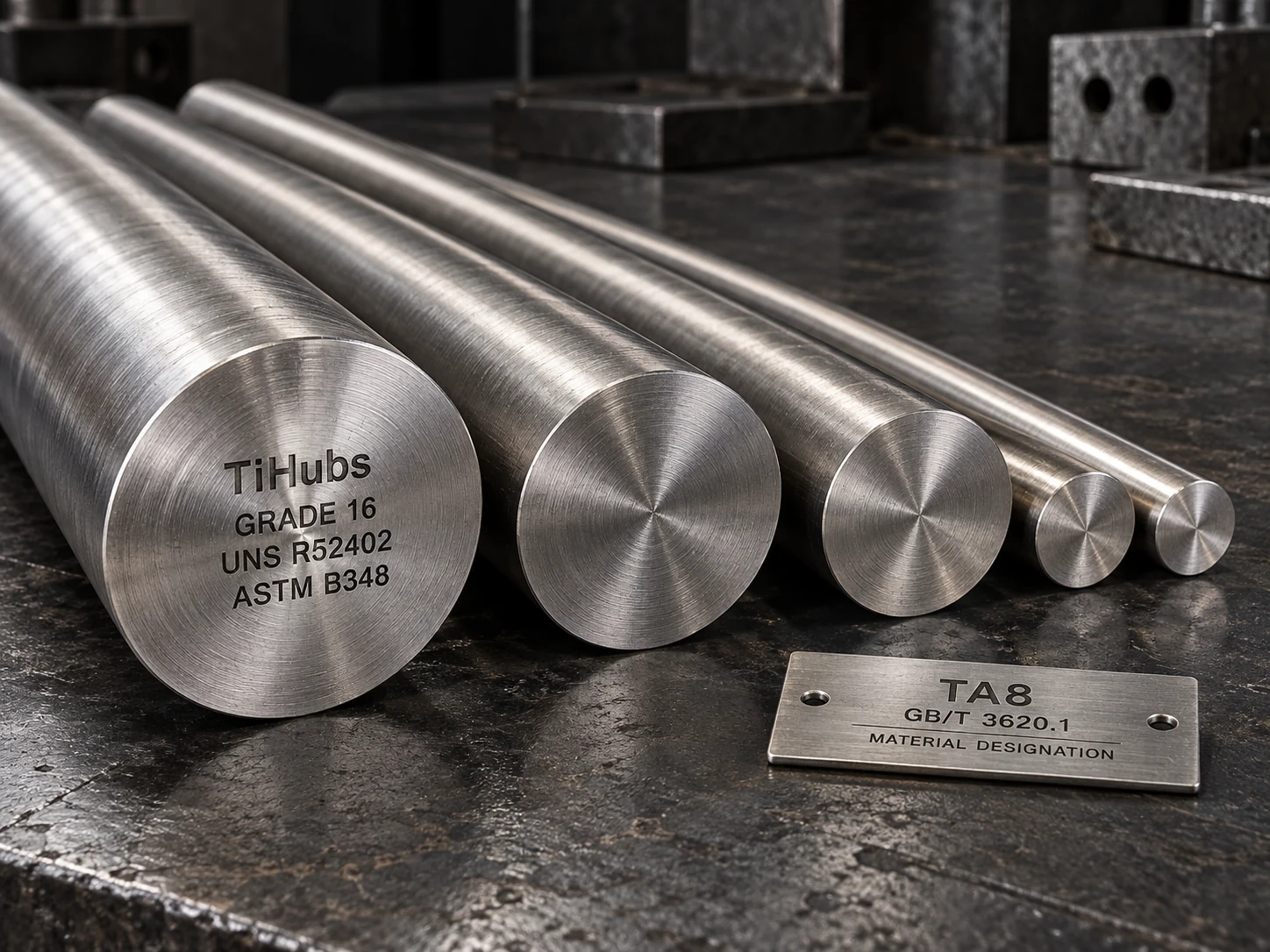
Grade 16 / TA8 titanium bar & rod
Starting stock for specified valve stems, sleeves, connectors and other machined wetted parts. Send the component drawing as well as the raw-material size.
- Specification
- ASTM B348 Grade 16. For TA8, specify GB/T 3620.1 chemistry plus an explicitly agreed bar product specification; GB/T 2965-2023 does not list TA8.
- Dimensions
- Diameter or section × length, straightness, turned or ground surface, machining allowance and quantity by size.
- Condition
- Required delivery condition, surface preparation and any subsequent processing. Do not assume a blank and finished part share the same inspection scope.
- Acceptance
- Palladium-bearing chemistry, specified mechanical properties, heat or lot identity and agreed ultrasonic or surface inspection.
03 / 06
Grade 16 · Gr16 · TA8 · Ti-Pd
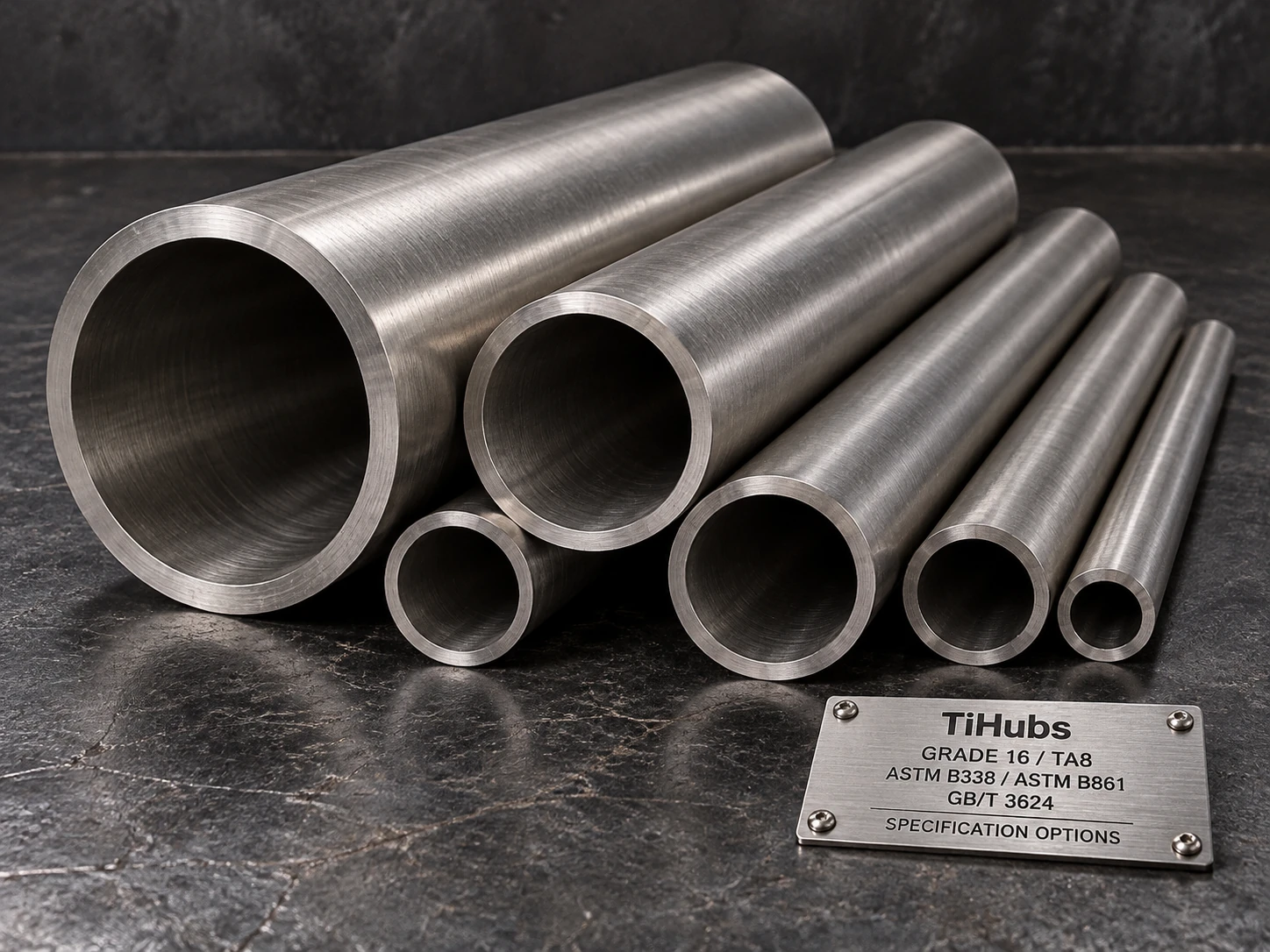
Grade 16 / TA8 seamless tube & pipe
For heat-transfer circuits and process piping selected for the actual corrosive duty. Tube and pipe specifications must be chosen by product scope, not by diameter alone.
- Specification
- ASTM B338 Grade 16 for heat-exchanger tubes; ASTM B861 Grade 16 for seamless pipe; GB/T 3624 TA8 for the Chinese seamless-tube route.
- Dimensions
- Outside diameter × wall × length or the specified pipe size system; wall tolerance, straightness, end preparation and cut lengths.
- Fabrication
- Straight tubes, U-bends or coils; bending radius, ovality and thinning limits, tube-to-tubesheet joints and cleaning access.
- Acceptance
- Applicable pressure or nondestructive electrical tests, dimensional and process tests, heat traceability and agreed post-bending inspection. Do not infer TA8 coverage under GB/T 3625-2007.
04 / 06
Grade 16 · Gr16 · TA8 · Ti-Pd
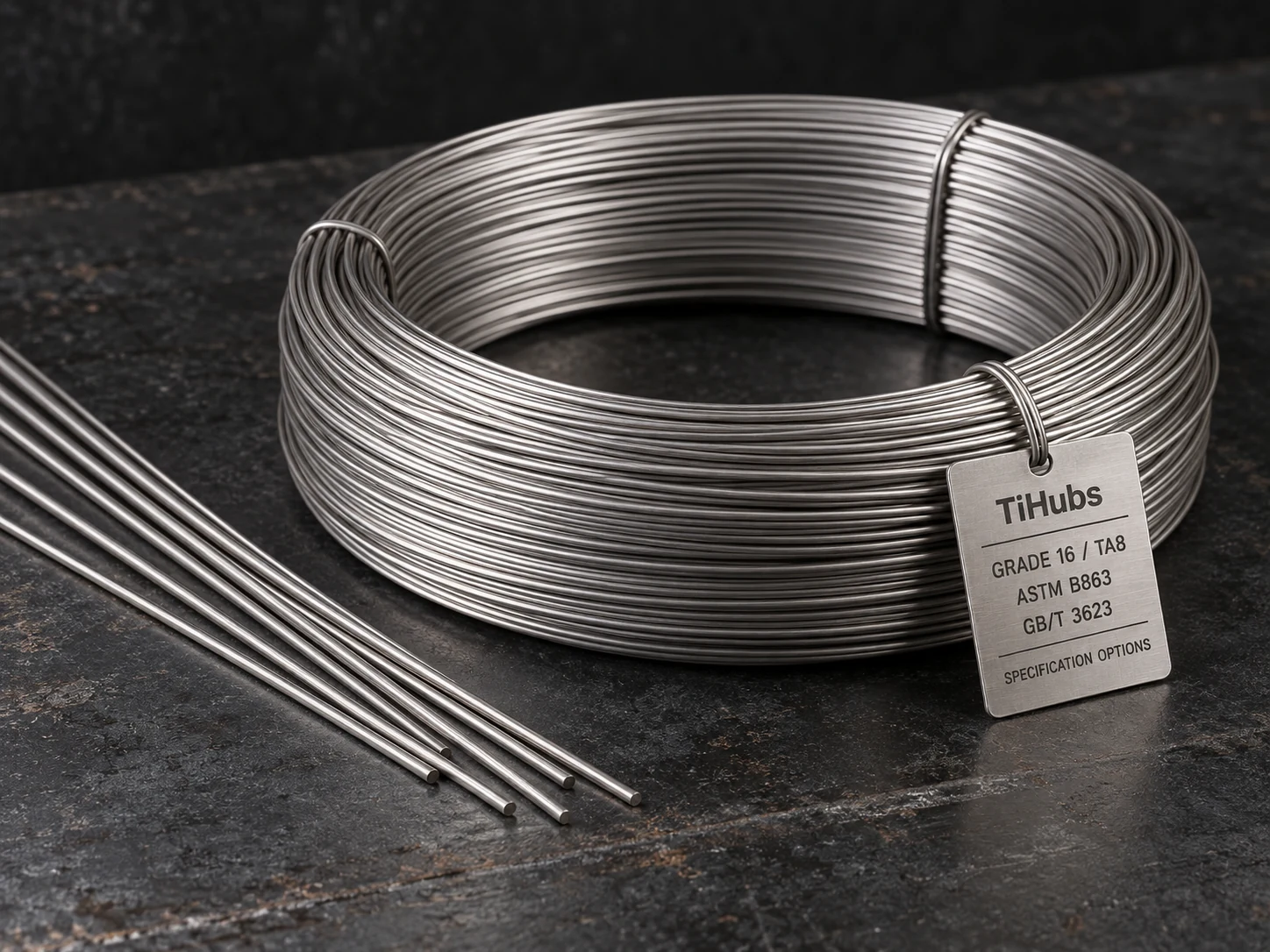
Grade 16 / TA8 titanium wire
Wire for defined fabrication or component requirements, supplied against an agreed product standard. Identify whether the requirement is product wire or a qualified welding consumable.
- Specification
- ASTM B863 Grade 16 or GB/T 3623 TA8 with the specified edition, diameter and delivery condition.
- Supply form
- Coils, spools or straight lengths; diameter tolerance, coil weight, cast or straightness and packaging.
- Surface
- Required finish and cleanliness, handling restrictions and protection against contamination during delivery.
- Acceptance
- Chemistry, mechanical tests where applicable, diameter and surface checks. A welding-filler requirement needs its own consumable classification and specification.
05 / 06
Grade 16 · Gr16 · TA8 · Ti-Pd
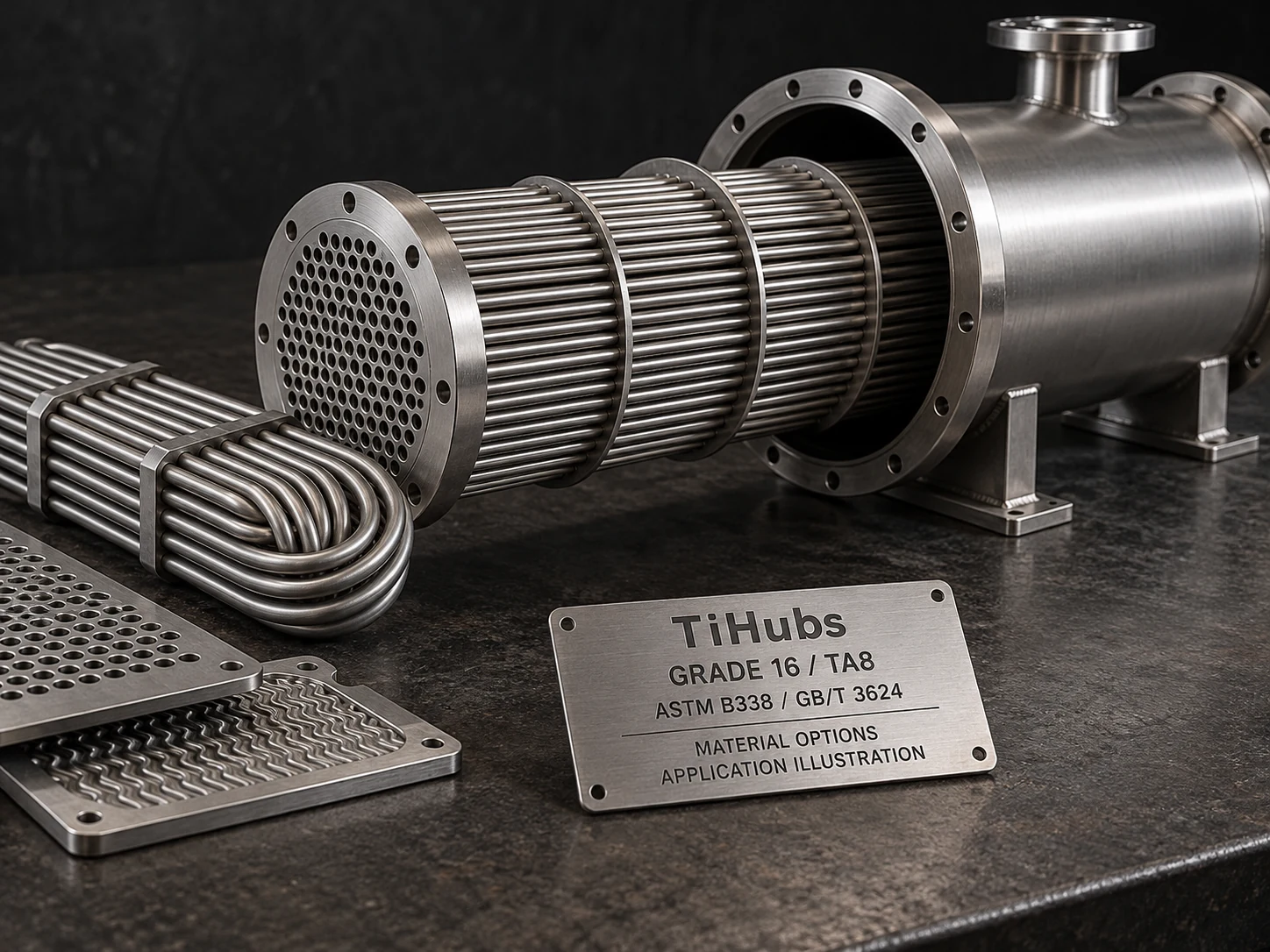
Heat exchangers & chemical-process equipment
Application illustration: material supply and fabrication coordination for selected titanium wetted parts. Define the equipment duty and the supply boundary before comparing proposals.
- Service conditions
- Both-side fluids, concentrations, impurities, pH, metal temperature, pressure, flow, deposits and cleaning cycle.
- Supply boundary
- Tube set, bundle, coil, plate, lining, selected internals or a defined assembly. Identify every wetted material and mating component.
- Manufacturing
- Released drawings, joint design, forming requirements, welding qualifications and inspection hold points.
- Acceptance
- Applicable design and fabrication code, dimensional and integrity tests, material records and final document package. Material standards do not certify finished equipment.
06 / 06
Grade 16 · Gr16 · TA8 · Ti-Pd
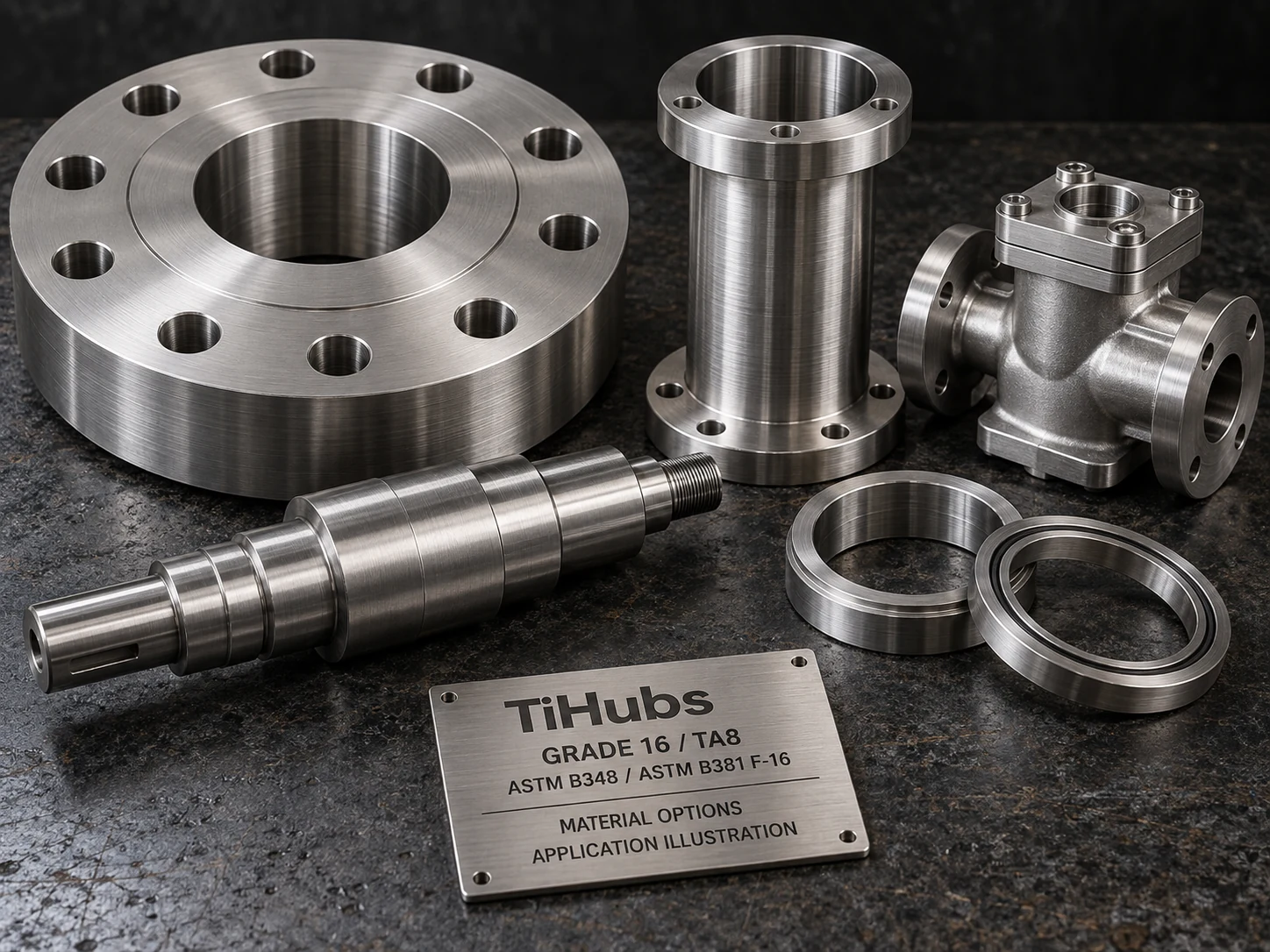
Pump, valve & sealing connection components
Application illustration: machined parts and forging blanks for selected corrosive service. Review pressure, wear and sealing requirements alongside corrosion resistance.
- Starting material
- ASTM B348 Grade 16 bar or ASTM B381 F-16 forgings; GB/T 25137 also defines F-16. Agree a TA8 drawing callout and the controlling product requirements.
- Drawing
- Revision, wetted surfaces, threads, sealing-face finish, concentricity, tolerances and machining allowance.
- Duty
- Fluid chemistry, pressure, temperature, solids, velocity, cavitation risk, sliding contact and dissimilar materials.
- Acceptance
- Material identity, critical dimensions, surface or NDT checks and any separate component pressure or leakage test. State whether the order covers blanks or finished parts.
Images illustrate material forms and application possibilities. Reference markings identify specification options; they do not establish dual certification, stock availability or approval of finished equipment.
Define the shape. Share the service.
These details help turn a material enquiry into a comparable quotation.
01 / Drawing review
Formed shells & linings
Send the finished shape, blank size, radii, minimum wall and surface requirements. Identify welds, bonded interfaces and the areas exposed to the process fluid.
Discuss your drawing02 / Drawing review
Coils, U-bends & plate packs
Include tube or plate drawings, connection details, tooling requirements and post-forming acceptance. State whether the scope is a part, replacement set or assembly.
Discuss your drawing03 / Drawing review
Machined & forged components
Provide rough and finished drawings, critical sealing features and material callout. Specify the required material records and any component-level testing.
Discuss your drawing02 / Material identity
What is
Grade 16 / TA8 titanium?
Grade 16 titanium, also written Gr16, is a titanium-palladium alloy identified as UNS R52402. It contains 0.04–0.08% palladium. TA8 is the Chinese designation for the corresponding nominal low-palladium Ti-Pd chemistry route. Buyers evaluate these materials for selected chemical corrosion duties, including heat-transfer circuits and process-system components.
Order Grade 16 and TA8 against their stated product specifications. Similar designation chemistry does not replace a review of dimensions, condition, mechanical properties, testing and traceability, or establish automatic dual certification.
345MPa
Minimum tensile strength
ASTM B265-08 · Grade 16
275MPa
Minimum 0.2% offset yield strength
ASTM B265-08 · Grade 16
20%
Minimum elongation · 50 mm gauge
ASTM B265-08 · Grade 16
| Property or condition | Reference | Ordering implication |
|---|---|---|
| Reference scope | ASTM B265-08 · Grade 16 | Sheet/plate reference subject to Table 1 footnotes, thickness and ordered condition; these are not equipment design allowables. |
| Yield strength range | 275–450 MPa · ASTM B265-08 | The minimum value is not a permitted operating stress or a finished-component rating. |
| Chinese sheet route | GB/T 3621-2022 · TA8 · M condition · 0.3–25 mm | Listed tensile minimum 400 MPa, proof strength 275–450 MPa and elongation minimum 20%. The ASTM Grade 16 tensile minimum shown above is 345 MPa. |
| Grade 16H | Separate ASTM designation | The cited sheet specification lists a 400 MPa tensile minimum for Grade 16H. This does not make Grade 16, Grade 16H and TA8 automatically interchangeable. |
| Tube and wire requirements | Use the actual product standard | Do not transfer sheet values to every tube, wire or forging. Confirm product form, dimensions, condition, test direction and sampling. |
Source: the supplied ASTM B265-08 and GB/T 3621-2022 files. Values above are product-standard references, not universal values for every Gr16 / TA8 product or equipment design allowables.
ASTM B265-08View PDF ↗GB/T 3621-2022View PDF ↗| Selected element · wt % | ASTM B265-08 · Grade 16 | GB/T 3620.1-2016 · TA8 |
|---|---|---|
| Palladium · Pd | 0.04–0.08 | 0.04–0.08 |
| Oxygen · O | 0.25 max. | 0.25 max. |
| Iron · Fe | 0.30 max. | 0.30 max. |
| Nitrogen · N | 0.03 max. | 0.03 max. |
| Carbon · C | 0.08 max. | 0.08 max. |
| Hydrogen · H | 0.015 max. | 0.015 max. |
| Titanium · Ti | Balance | Balance |
Selected elements only. Review residual elements, analysis tolerances, sampling and all requirements in the specified product standard. Matching principal chemical limits do not by themselves establish matching delivery or inspection requirements.
ASTM B265-08View PDF ↗GB/T 3620.1-2016View PDF ↗Grade 16 / Gr16 and TA8
Grade 16, UNS R52402, and TA8 share the nominal low-palladium titanium chemistry route. Their product standards can impose different mechanical requirements. Specify the exact standard, edition, form and condition; agree substitutions in writing.
Grade 16 and Grade 7 / TA9
Grade 16 contains 0.04–0.08% palladium; Grade 7 contains 0.12–0.25%. Lower palladium content does not establish equal performance in every environment or an automatic replacement route. Review corrosion evidence and project acceptance.
Grade 16 and Grade 2
Grade 16 adds palladium to a titanium base with Grade-2-type interstitial limits. Palladium can improve resistance in certain reducing and crevice conditions; the benefit depends on the actual service. Grade 2 is a separate order designation.
TA8 and TA8-1 are different
TA8-1 belongs to a lower-interstitial Ti-Pd route. Do not shorten TA8-1 to TA8 on drawings, certificates or orders. Confirm the full designation, strength, forming needs and inspection basis.
03 / Chemical corrosion applications
Grade 16 / TA8
in chemical equipment.
Match the material to the medium, geometry and fabrication route. These application reviews show what to define before pricing a Gr16 / TA8 requirement.
Application review / 01
Chemical equipment: define the environment at the metal surface
Grade 16 / TA8 is a low-palladium titanium option for selected corrosive chemical duties. A useful material review goes beyond the name of an acid or salt solution: the exposure at a heated surface, stagnant connection or gasket crevice can differ from the bulk process stream. Supply proposals should connect the corrosion assessment to each wetted part and its manufacturing route.
Products to discuss
Sheet for shells and linings; tube for process or heat-transfer circuits; bar, forgings and drawing-based wetted components. Identify the required grade for each item.
What we need to review
Full fluid composition, concentrations, impurities, pH, temperature, aeration, pressure, flow and crevice geometry. Include startup, shutdown, upset and cleaning conditions, relevant service history and any required corrosion test.
Application review / 02
Heat exchangers and condensers: specify both sides of the duty
For a Gr16 / TA8 heat exchanger, both process-side and utility-side conditions matter. Condensate may differ from the incoming vapor, while deposits and low-flow areas can change local exposure. A replacement tube enquiry should distinguish dimensional replacement from a change in material selection, and identify whether the scope includes bending, bundling or assembly.
Products to discuss
ASTM B338 Grade 16 heat-transfer tubes; TA8 seamless tubes under the agreed Chinese route; U-bends, coils, plates and defined bundle work subject to drawing review.
What we need to review
Tube OD, wall and length; bend radius; tube-to-tubesheet expansion or welding; plate pattern and gasket interface. Define both-side media, design temperatures and pressures, cleaning method and required integrity tests.
Application review / 03
Hot brine systems: review deposits, crevices and cleaning
Palladium-bearing titanium may be evaluated where chloride-containing service raises concern about local corrosion in crevices or under deposits. Grade 16 is not a blanket approval for every hot brine. The selection basis must include the concentrated or stagnant condition, the metal temperature and the geometry at seals, joints and tube connections.
Products to discuss
Heat-transfer tubes, circulation pipe, liners and specified valve or sealing parts for a reviewed brine duty. Identify new systems and replacement components separately.
What we need to review
Salt composition and concentration range, pH, oxygen conditions, deposits, suspended solids, velocity, temperature and cleaning chemicals. Include gasket and joint details and any known previous corrosion locations.
Application review / 04
Evaporators: follow the duty as concentration changes
The feed analysis alone is insufficient for an evaporator material enquiry. Evaporation changes concentration, deposits can alter conditions at a heated wall, and cleaning introduces another chemical exposure. Review Gr16 / TA8 across the operating cycle and specify the supply boundary before quoting heating surfaces or wetted internals.
Products to discuss
Heating tubes, coils, selected plate or lining material and defined evaporator internals. Separate raw-material supply from fabricated parts and complete equipment.
What we need to review
Feed and final composition, concentration range, solids, boiling and wall temperatures, pressure or vacuum, heat flux where known, cleaning agents and duration. Add joint drawings, minimum wall, inspection and design-code responsibilities.
Application review / 05
Leach and hydrometallurgical circuits: review the complete chemistry
Hydrometallurgical streams can combine acids, dissolved salts, oxidizing species and abrasive solids. Their behavior cannot be predicted from the Grade 16 name alone. For a selected titanium duty, use the plant chemistry and operating history to define the material review, especially where a stream changes between leaching, transfer, heating and concentration.
Products to discuss
Specified liners, tube or pipe sections, heating components and drawing-based wetted parts for an engineering-reviewed process duty.
What we need to review
Acid and dissolved-species analysis, oxidation conditions, pH, temperature, solids content and particle behavior. Identify fluoride or other aggressive contaminants where present, velocity, wear locations and the required service or test evidence.
Application review / 06
Pipe, fittings and joints with a consistent order basis
A process line needs compatible material designations and product specifications for pipe, fittings and joints. State whether dimensions follow a pipe schedule or a tube OD-and-wall system. Connections, dead legs and dissimilar-material interfaces should be part of the review, including areas that trap fluid during shutdown or cleaning.
Products to discuss
ASTM B861 Grade 16 seamless pipe, ASTM B862 Grade 16 welded pipe or an agreed TA8 tube route. ASME SB-363 uses WPT16 for the relevant wrought welding fitting route.
What we need to review
Line list, dimensions, lengths, fitting drawings, end preparation, flange interfaces and joint details. Define pressure and temperature, weld inspection, system testing and the controlling piping design code.
Application review / 07
Pump and valve parts: corrosion resistance is one design input
Wetted pump and valve parts also face mechanical loading, sealing contact, sliding wear and potentially cavitation or erosion. A corrosion-resistant grade does not by itself resolve those design conditions. For Gr16 / TA8 parts, discuss the component geometry, mating materials and service alongside the material certificate requirements.
Products to discuss
Bar stock, F-16 forging blanks, sleeves, stems, rings and drawing-based connectors. State whether the scope is a rough blank, machined part or tested component.
What we need to review
Released drawing, wetted surfaces, surface finish, concentricity, threads, pressure, temperature, solids and velocity. Agree NDT, dimensional evidence and any separate leakage or performance test.
Application review / 08
Formed and welded parts: retain the material identity
Grade 16 / TA8 sheet and tube can be reviewed for forming and welding work with defined geometry and process requirements. Raw-material certification must remain traceable through cutting, bending and assembly. Welding consumables and finished weld acceptance need their own specification; Grade 16 product wire is not automatically a qualified filler.
Products to discuss
Sheet blanks, formed shells, U-bends, coils and specified welded subassemblies. Identify free-issued parts, tooling ownership and first-article requirements.
What we need to review
Minimum remaining wall, radii, ovality, surface cleanliness, weld design, shielding and procedure requirements. Agree post-process inspection, acceptance criteria, marking transfer and the records delivered with the parts.
Material references: Alleima Grade 16 datasheet ↗ and ATI corrosion-resistant titanium alloys ↗. These describe material behavior and application considerations. Selection for a particular fluid and finished equipment requires project-specific review.
Chemical-equipment enquiry checklist
Make the corrosion duty part of the order.
A useful specification connects the environment, the supplied parts and the acceptance evidence. Share existing data first; missing details can be clarified.
Define the service envelope
Provide normal, minimum and maximum operating conditions, both-side media, impurities, concentration changes, deposits and cleaning cycles. Include relevant corrosion history or the test evidence your engineering team requires.
Define the supplied boundary
List each wetted item, drawing and material route. Separate raw material, formed or machined parts, welded subassemblies and complete equipment. Identify design-code responsibilities, joints and mating materials.
Define the evidence and milestones
Agree chemistry and heat identity, product-specific mechanical tests, dimensional and integrity checks, welding records where applicable and inspection hold points. State sample, third-party inspection, packaging and delivery requirements.
Example: a useful Grade 16 heat-exchanger tube enquiry
“Grade 16 titanium seamless tubes to ASTM B338-08b; OD × wall × length and quantity; straight or U-bent drawing; both-side media, temperature and pressure; tube-to-tubesheet connection; required material records, integrity tests and post-bending checks; destination and target delivery.”
For TA8, specify the agreed Chinese product route, such as GB/T 3624-2023 for seamless tube, and all equipment-specific requirements. Do not assume GB/T 3625-2007 covers TA8.
Discuss your equipment requirement04 / Standards & documentation
Match the standard
to the product.
Select the product specification, edition and delivery condition. Grade 16, F-16, WPT16 and TA8 belong to defined product routes; use the designation required by the controlling document.
| Product form | ASTM / ASME route | Chinese standard route | Clarify before quotation |
|---|---|---|---|
| Material identity & composition | United StatesTi-Pd · UNS R52402 Use the chemical requirements in the specified ASTM product standard. | ChinaGB/T 3620.1-2016View PDF ↗ TA8 designation and chemistry; apply with the controlling product specification. | Full designation, palladium content, analysis basis and required records. |
| Sheet & plate | United StatesASTM B265-08View PDF ↗ Grade 16 strip, sheet and plate. | ChinaGB/T 3621-2022View PDF ↗ TA8 sheet and plate; note the different tensile minimum in the listed range. | Dimensions, condition, strength, surface, forming direction and acceptance. |
| Bar & rod | United StatesASTM B348-08aView PDF ↗ Grade 16 bars and billets. | ChinaGB/T 3620.1-2016View PDF ↗ TA8 chemistry plus an explicitly agreed bar specification. GB/T 2965-2023 does not list TA8. | Section, condition, tolerance, mechanical tests, surface and inspection. |
| Heat-exchanger & condenser tubes | United StatesASTM B338-08bView PDF ↗ Grade 16; specify seamless or welded construction. | ChinaGB/T 3624-2023View PDF ↗ TA8 seamless tube. GB/T 3625-2007 does not list TA8; confirm the equipment-specific acceptance scope. | OD, wall, length, straight or bent geometry, joints and required integrity tests. |
| Seamless process pipe / tube | United StatesASTM B861-10View PDF ↗ Grade 16 seamless pipe. | ChinaGB/T 3624-2023View PDF ↗ TA8 seamless tube; confirm dimensional system and acceptance basis. | Size, wall, manufacturing route, ends and testing. |
| Welded process pipe / tube | United StatesASTM B862-06b ε1View PDF ↗ Grade 16 welded pipe. | ChinaGB/T 26057-2010View PDF ↗ TA8 welded tube. | Construction, weld inspection, condition and dimensional acceptance. |
| Wire | United StatesASTM B863-19View PDF ↗ Grade 16 product wire; filler requirements are separate. | ChinaGB/T 3623-2022View PDF ↗ TA8 wire. | Diameter, condition, coil or straight supply, finish and intended use. |
| Forgings & component blanks | United StatesASTM B381-08aView PDF ↗ F-16 forging designation; F-16H is a separate route. | ChinaGB/T 25137-2010View PDF ↗ The document defines F-16 and F-16H separately. | Geometry, allowance, heat treatment, sampling and NDT. |
| Wrought welding fittings | United StatesASME SB-363 · 2013View PDF ↗ WPT16 in the supplied ASME SB-363 file. | ChinaDrawing / agreed specification Confirm the actual product specification for a TA8 fitting enquiry. | Fitting type, construction, dimensions, product tests and piping design code. |
Agree the order basis.
These are the supplied file editions. The purchase order must identify the required revision, grade, product form, condition and inspection. Material and product standards do not by themselves establish compliance of a finished pressure vessel, heat exchanger, pump or valve.
Use the file titles shown above. The file named ASME-B363.pdf contains ASME SB-363; its fitting designation is WPT16. Any substitution or dual-certification requirement must be agreed before supply.
05 / Order coordination
Know the scope
before ordering.
Our founder’s 20 years in titanium inform the questions we ask before quotation and the supply options we review with you.
A quotation you can evaluate
Agree the grade, standard edition, dimensions, tolerance, condition and quantity before comparing prices.
- Identify whether inspection, samples and tooling are included.
- Confirm packaging, transport and delivery terms.
- Record items that still need technical confirmation.
Acceptance agreed before supply
Confirm the material certificate, palladium-bearing grade, heat or batch identity, delivery condition, dimensional checks and additional testing before supply starts. For fabricated parts, agree post-forming or weld inspection and the required traceability scope.
Independent inspection can be discussed with its scope, timing, acceptance criteria and cost agreed for the order.
Delivery with clear milestones
Review the proposed lead time, approvals, production sequence and dispatch requirements. For several product forms, coordinate document and packing readiness together.
Material substitutions and technical changes require written approval. A schedule deviation should identify the impact, decisions needed and next steps.
One contact when an issue arises
Contact TiHubs with the order reference, affected items and supporting photos or inspection records.
We record the issue, review it against the agreed requirements and coordinate the next steps with the relevant manufacturing parties.
01 / Material identity
Material records
Grade, standard, test results and heat or batch identity matched to the supplied items.
02 / Agreed acceptance
Inspection records
Dimensional and testing records for the agreed scope, including critical drawing requirements.
03 / Ready for dispatch
Dispatch records
Item identification, packing list, protective packaging and required shipment documents.
06 / Questions before sourcing
Before you specify
Grade 16 / TA8.
A clear material designation is the beginning. Product form, specification revision, material condition and acceptance complete the requirement.
A useful first enquiry
- Product and specificationProduct form, standard edition, dimensions and material condition.
- Order and deliveryQuantity, destination and any required delivery date.
- Acceptance requirementsDrawing revision, inspection, certificates and packaging.
Not every detail is finalized? Send the information you have. We can help identify the questions to resolve before quotation.
What happens next: requirement review, technical clarification, then a supply proposal and quotation.
What is Grade 16 titanium, and what does Gr16 mean?
Grade 16, abbreviated Gr16, is a titanium-palladium alloy identified as UNS R52402. The cited specifications require 0.04–0.08% palladium. It is evaluated for selected chemical corrosion duties, including heat-transfer and process-system components. Specify the product form, standard, edition and delivery condition when ordering.
Is TA8 the Chinese equivalent of Grade 16?
TA8 is the corresponding Chinese nominal low-palladium titanium chemistry designation. It is useful to discuss Grade 16 and TA8 on one page, but matching principal chemistry does not establish identical product requirements. For example, ASTM B265-08 Grade 16 has a 345 MPa tensile minimum, while GB/T 3621-2022 lists 400 MPa for TA8 M-condition sheet in the 0.3–25 mm range. Agree the required route and any dual certification explicitly.
How does Grade 16 differ from Grade 7 / TA9?
Grade 16 contains 0.04–0.08% palladium; Grade 7 contains 0.12–0.25%. Lower palladium content may be relevant to material selection and cost evaluation, but does not prove equal corrosion performance for every duty. Compare the actual environment, product requirements and available test or service evidence before approving substitution.
Are Grade 16, Grade 16H and TA8-1 the same?
No. Grade 16H is a separately specified ASTM route with a higher tensile minimum in the cited sheet standard. TA8-1 is a different lower-interstitial Chinese Ti-Pd designation. Retain the complete grade on drawings, purchase orders and material records; do not infer substitution from similar names.
Where is Grade 16 / TA8 mainly considered?
Its key purchasing focus is selected chemical corrosion-resistant equipment: heat exchangers, condensers, evaporator internals, brine and process piping, and pump, valve or sealing components. Suitability depends on chemistry, concentration, temperature, deposits, crevices and mechanical duty. The listed applications require project-specific selection rather than a universal corrosion guarantee.
Which tube and pipe standards should I specify?
ASTM B338 Grade 16 covers condenser and heat-exchanger tubes, ASTM B861 Grade 16 covers seamless pipe, and ASTM B862 Grade 16 covers welded pipe. Chinese TA8 routes include GB/T 3624 seamless tube and GB/T 26057 welded tube. GB/T 3625-2007 does not list TA8, so do not assume it covers the order. Select the actual product scope, dimensions, edition and tests.
Can Grade 16 wire be ordered as welding filler?
Specify a welding consumable classification and standard when filler is required. ASTM B863 Grade 16 or GB/T 3623 TA8 identifies a product-wire route; that description alone does not establish welding-filler compliance. Share the parent materials, welding procedure requirements, diameter, packaging and acceptance records needed.
What should I send for a quotation and inspection plan?
Send the form or drawing, grade, standard edition, dimensions and tolerance, quantity, destination and required delivery. For equipment parts, add fluid composition, concentrations, operating and design conditions and cleaning cycle. Material certificates, heat identity, dimensional tests, NDT, samples and independent inspection can be agreed with their scope, timing and costs before supply.
What are the MOQ, lead time and process if an order issue arises?
Quantity and timing depend on product form, dimensions, production route, tooling and inspection. TiHubs confirms these with the quotation and agreed milestones. If an issue arises, send the order reference, affected items and evidence. We record it, review it against the agreed requirements and coordinate the next steps with the relevant manufacturing parties.
07 / Your next step
Start with the
requirement you have.
Send the product details, drawing or operating conditions you already know. We will identify missing information and discuss a suitable supply route before quotation.
- Requirement review
- Technical clarification
- Supply proposal and quotation
Combine materials and parts in one enquiry.
Send one list of Gr16 / TA8 forms, sizes and quantities. Include drawing revisions and items that must be supplied or dispatched together.
Share the service and acceptance priorities.
Include media, temperatures, pressures and cleaning conditions, plus the required material records, forming or fabrication checks, destination and timing.
Baoji, China · info@tihubs.com
Start your Grade 16 / TA8 enquiry
Send your material form, drawing or process conditions. We will help clarify the remaining requirements.