Baoji High-tech Zone, ChinaTitanium sourcing · One contact


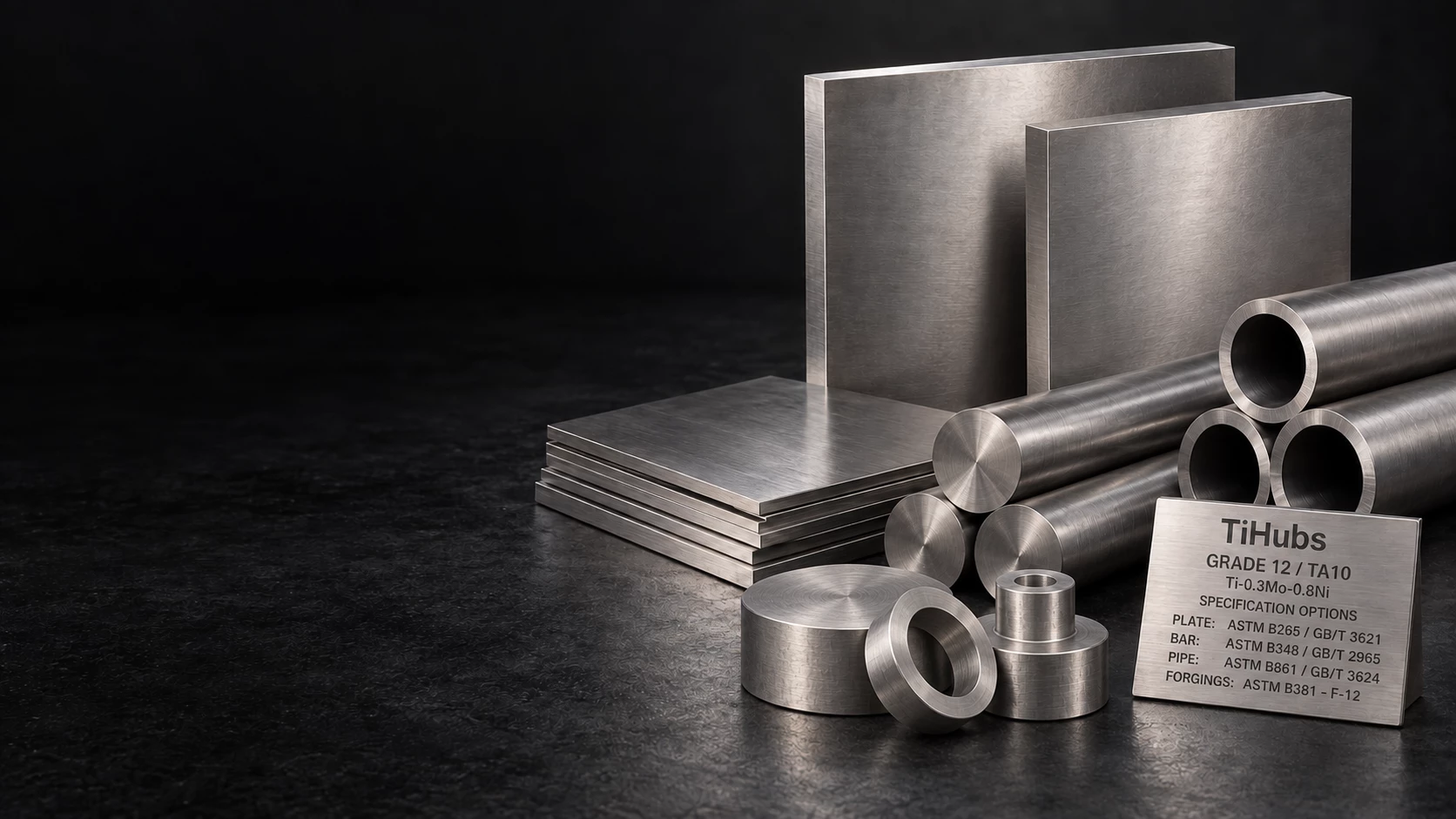
Gr12 · TA10 · Ti-0.3Mo-0.8Ni · UNS R53400
Grade 12 / TA10 titanium.For chemical-process equipment.
Corrosion-resistant titanium for heat exchangers, hot-brine systems and hydrometallurgical equipment. TiHubs coordinates plate, bar, seamless pipe, tube and forging requirements through one technical and commercial contact in Baoji.
Start with a specification, drawing or application. We’ll help identify the details still needed.
Material review. Supply coordination.
One contact in Baoji, China.
Ti-0.3Mo-0.8NiGrade 12 / Gr12 · Chinese designation TA10
ASTM · ASME · GB/TProduct, revision and acceptance agreed for the order
One contact20 years of founder experience · 100+ Baoji factories
01 / Product forms
Find your
Grade 12 / TA10 product.
Select a starting form. We review dimensions, condition, inspection and delivery before confirming a suitable supply route.
01 / 06
Grade 12 / Gr12 · TA10 · Ti-0.3Mo-0.8Ni
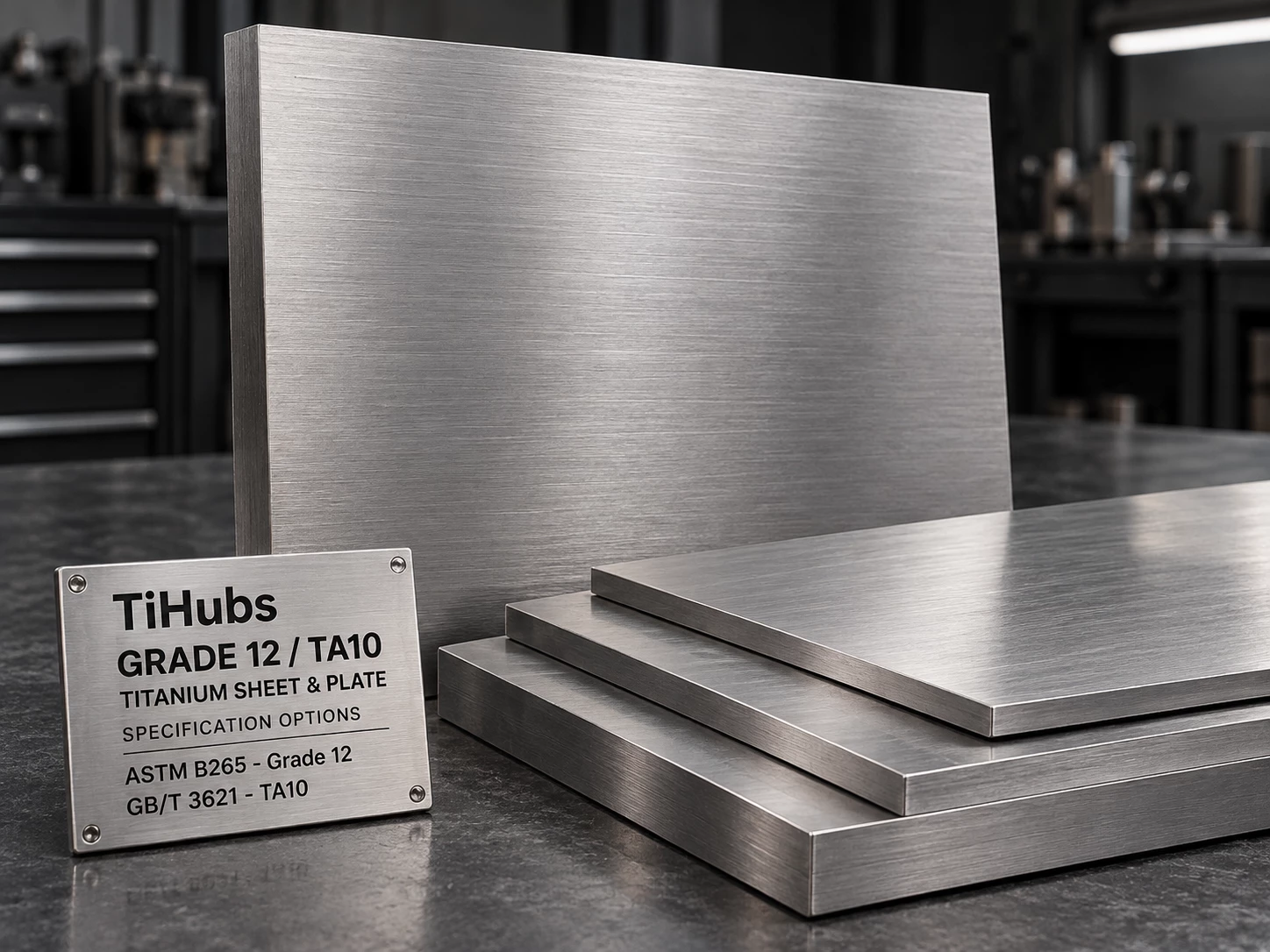
Grade 12 / TA10 titanium sheet & plate
Starting material for chemical-equipment shells, formed sections, tube sheets and drawing-based corrosion-resistant components. Tell us which surfaces contact the process fluid and how the plate will be formed, welded or machined.
- Specification
- ASTM B265-08 Grade 12, or TA10 to GB/T 3621-2022. State the governing revision and any equipment-code material requirements.
- Dimensions
- Thickness × width × length; usable blank size, thickness tolerance, flatness, rolling direction and machining allowance.
- Condition
- Annealed or the condition permitted by the selected specification; agreed surface finish, cut edges and subsequent forming or joining.
- Acceptance
- Heat identification, material records, dimensional checks and specified mechanical or ultrasonic testing. A plate certificate does not certify the completed vessel.
02 / 06
Grade 12 / Gr12 · TA10 · Ti-0.3Mo-0.8Ni
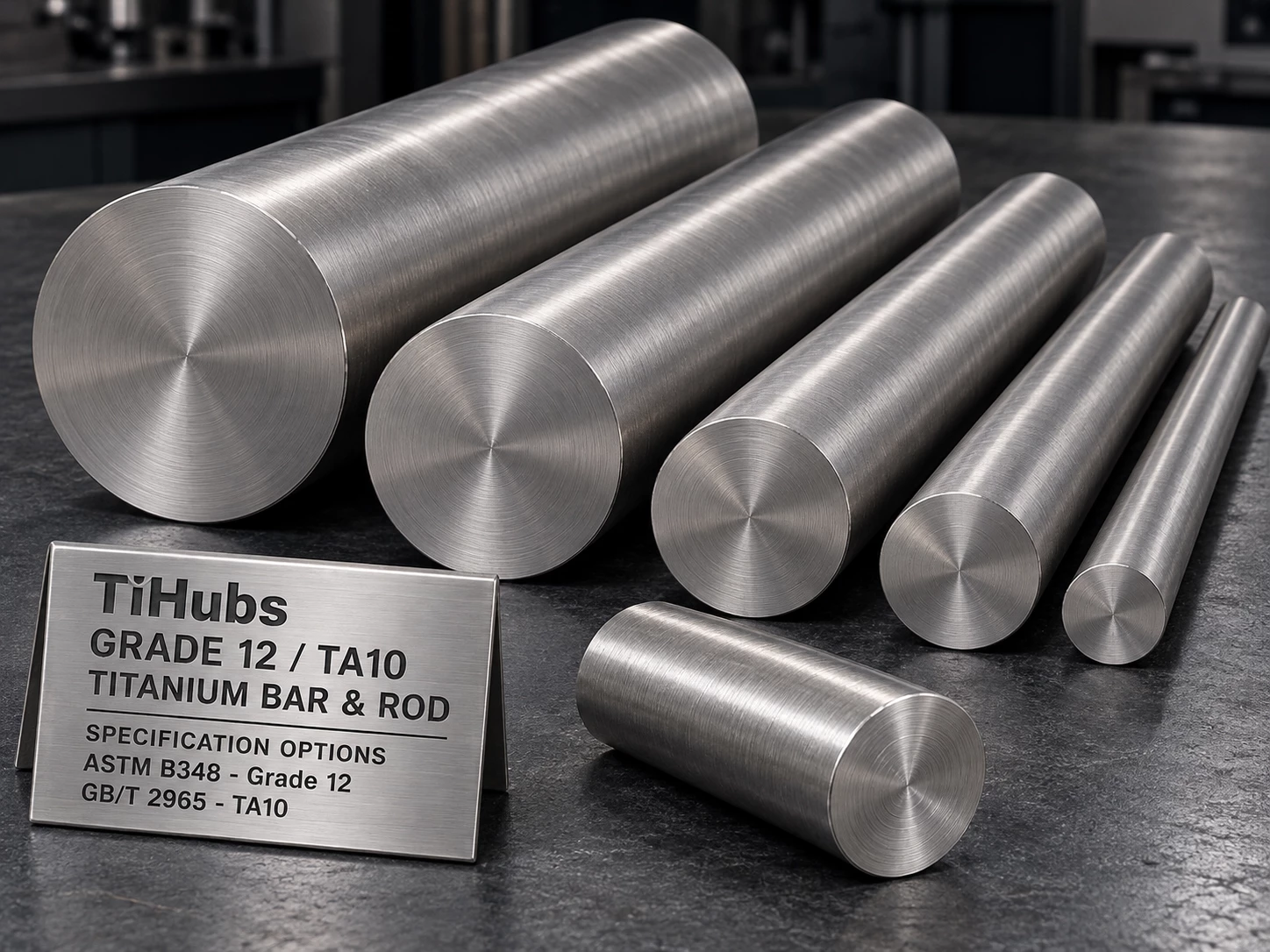
Grade 12 / TA10 titanium bar & rod
Machining stock for sleeves, shafts, connectors and other specified chemical-equipment parts. Match the bar condition and inspection scope to the finished drawing before comparing quotations.
- Specification
- ASTM B348-08a Grade 12 or TA10 to GB/T 2965-2023. Identify bar versus billet and any additional component requirements.
- Dimensions
- Diameter or section × usable length; diameter tolerance, straightness, cut lengths and allowance for machining or sampling.
- Condition
- Agreed delivery condition and turned, ground or other specified surface; identify any subsequent heat treatment.
- Acceptance
- Chemical and mechanical records, heat traceability, dimensions and the agreed NDT scope. Corrosion resistance does not establish wear or sliding-contact performance.
03 / 06
Grade 12 / Gr12 · TA10 · Ti-0.3Mo-0.8Ni
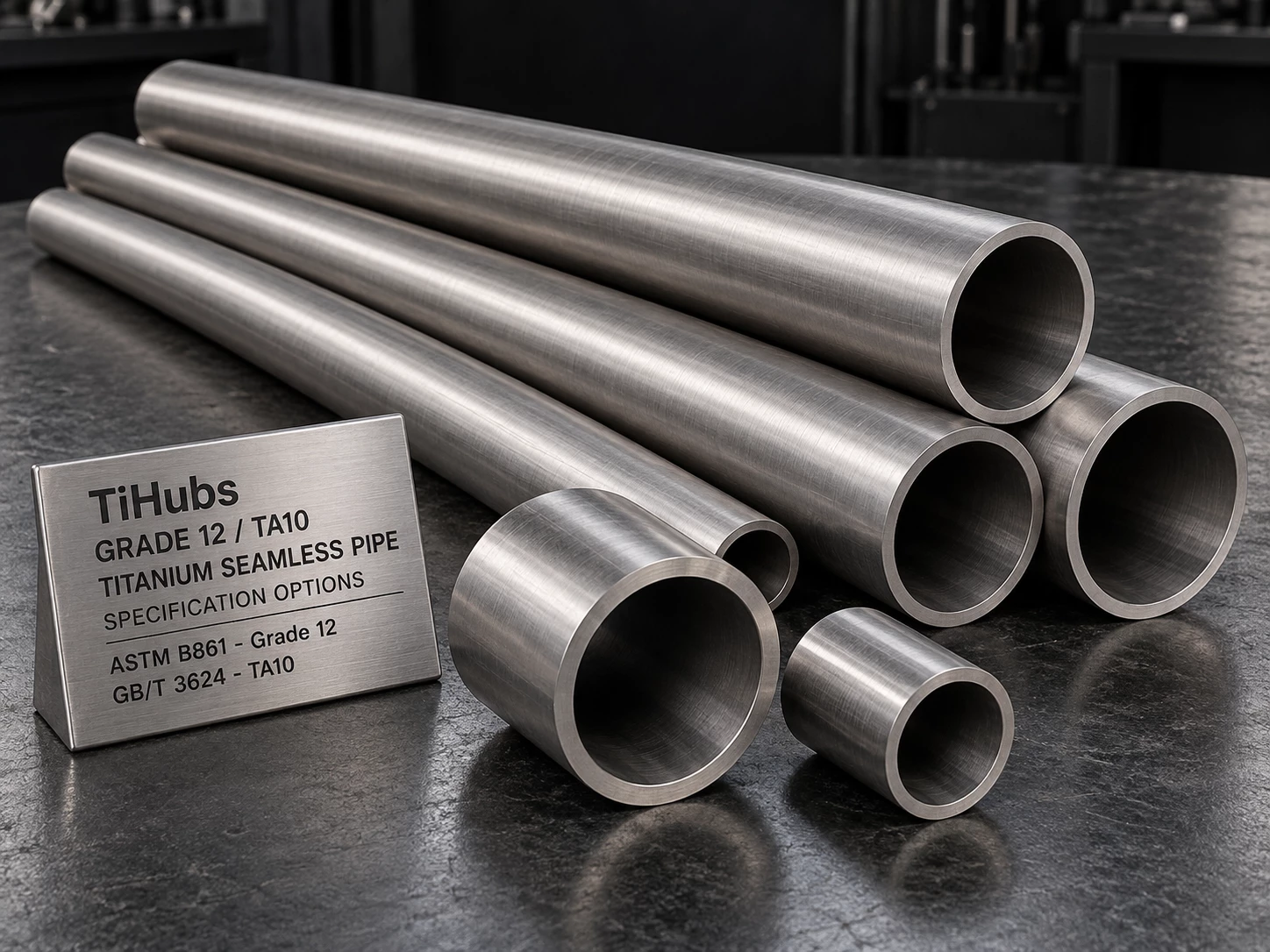
Grade 12 / TA10 titanium seamless pipe
For specified chemical-process lines and circulation systems. Define whether the order is for process pipe or heat-transfer tubing: the dimensional basis, product standard and inspection package differ.
- Specification
- ASTM B861-10 Grade 12 for seamless pipe; TA10 to GB/T 3624-2023 within that standard’s seamless-tube scope. Heat-exchanger tubes use the separately specified route.
- Dimensions
- OD × wall × length, or NPS and schedule where applicable; minimum/nominal wall basis, ID, ovality, straightness and end preparation.
- Condition
- Specified material condition, internal/external surface, cleanliness and any later bending, welding or end forming.
- Acceptance
- Heat/lot records, dimensions and required NDT, hydrostatic or leak tests under the selected specification. Design pressure and temperature remain project inputs.
04 / 06
Grade 12 / Gr12 · TA10 · Ti-0.3Mo-0.8Ni
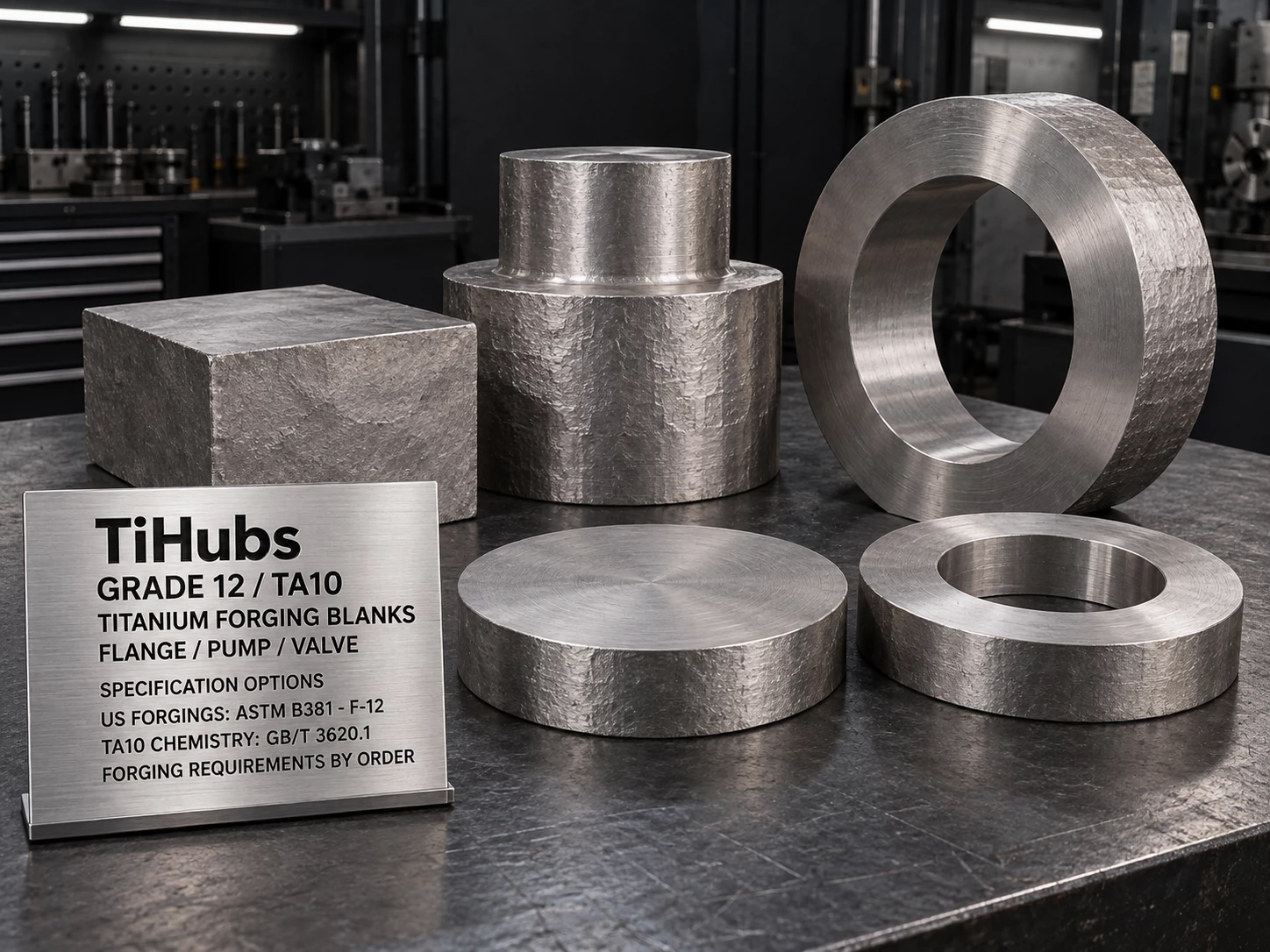
Titanium forgings, flange blanks & pump-valve stock
Grade 12 / TA10 rings, discs, blocks and shaped blanks for subsequent machining. Send both the finished-part drawing and the proposed blank so machining allowance, test locations and acceptance can be discussed together.
- Specification
- ASTM B381-08a F-12, or GB/T 25137-2010 with its F-12 requirements. The supplied GB/T file lists TA10 in its informative designation cross-reference; specify the contractual material route.
- Dimensions
- Ring OD × ID × height; disc diameter × thickness; block dimensions or a controlled forging drawing, with machining and test allowances.
- Condition
- Annealed forging route, agreed surface and rough-machining stage. A flange blank is supplied as material for further manufacture.
- Acceptance
- Heat and forging-lot traceability, chemical/mechanical records, sampling location and required ultrasonic or surface inspection. Finished flange dimensions, pressure rating and valve qualification need separate requirements.
05 / 06
Grade 12 / Gr12 · TA10 · Ti-0.3Mo-0.8Ni
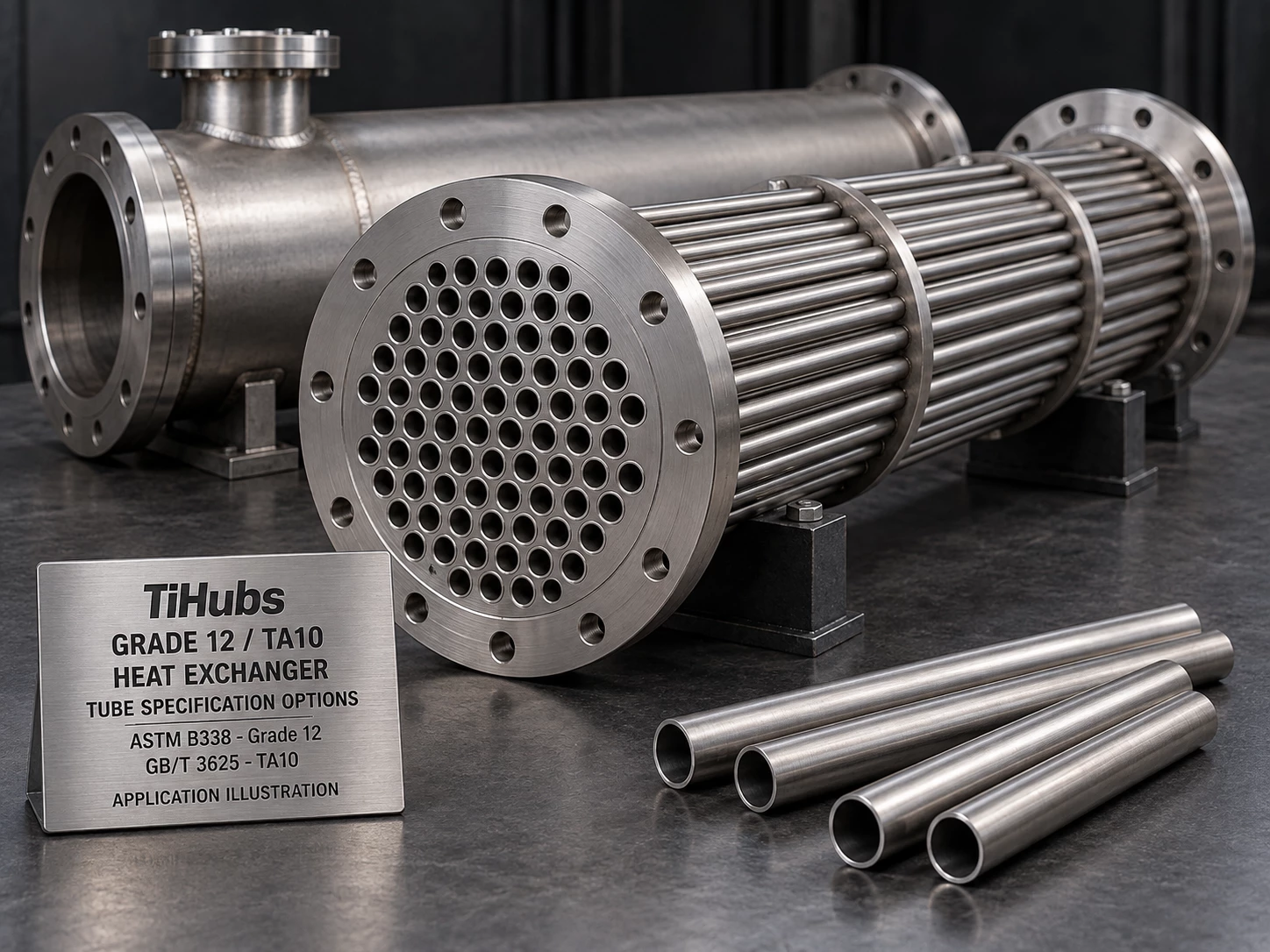
Grade 12 / TA10 heat-exchanger materials
A core application for Ti-Ni-Mo titanium: tubes and related material for chemical-process heat exchange. Define the two fluid circuits, tube-sheet joint and required inspection before selecting the tube or component supply route.
- Specification
- ASTM B338-08b Grade 12 or TA10 to GB/T 3625-2007 for condenser/heat-exchanger tubes. Tube-sheet plate or forgings follow their own product specifications.
- Dimensions
- Tube OD × wall × length, quantity, straightness, end condition and any bend drawing; tube-sheet dimensions and hole/joint requirements where included.
- Condition
- Specified tube condition and surface; identify expanded, welded or combined tube-to-tube-sheet joints and fabrication requirements.
- Acceptance
- Material traceability and agreed dimensional, NDT and pressure/leak-test evidence. State whether you need raw material, parts, a tube bundle or a fabricated assembly.
06 / 06
Grade 12 / Gr12 · TA10 · Ti-0.3Mo-0.8Ni
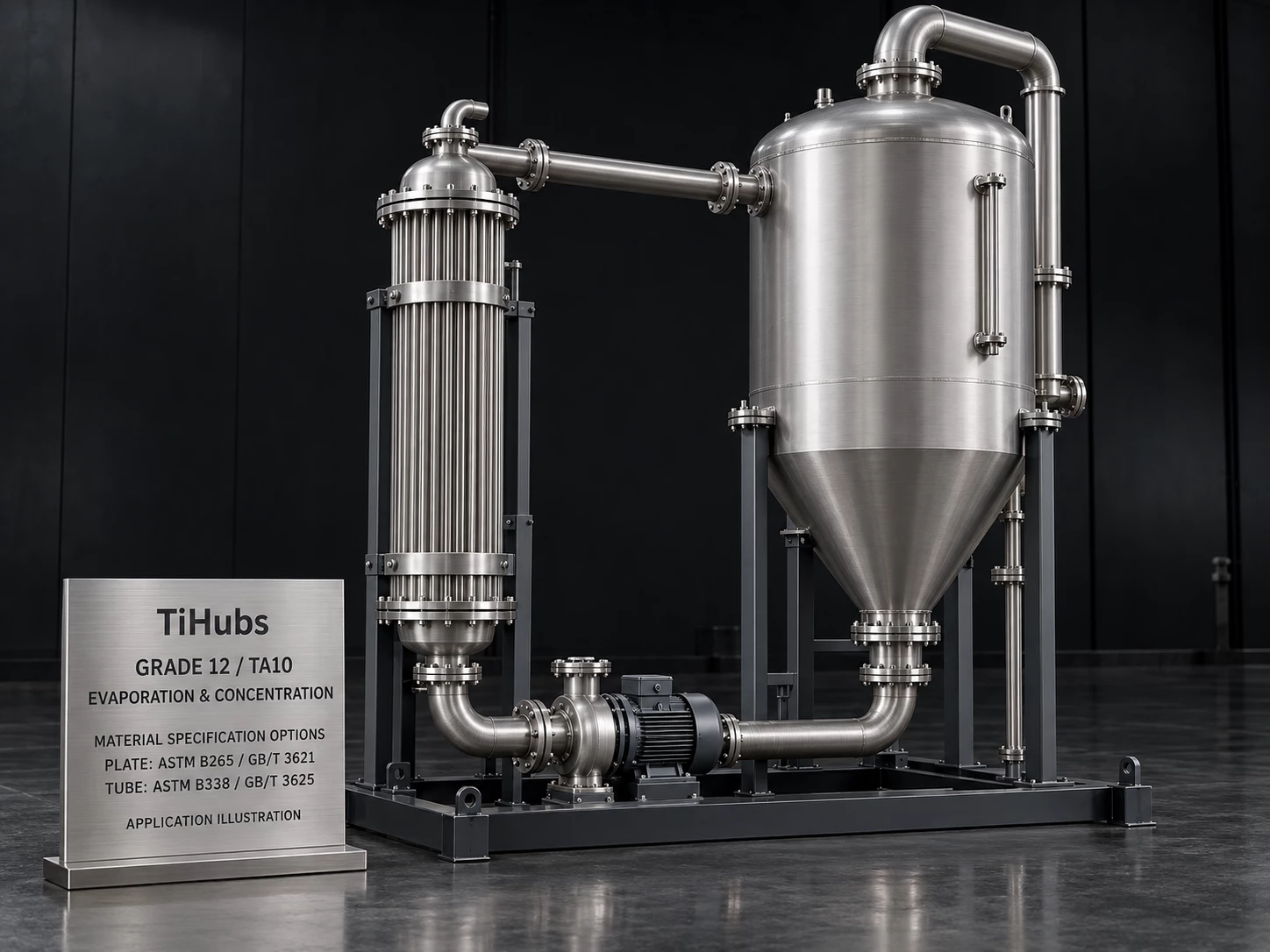
Titanium for evaporation & concentration equipment
Review Grade 12 / TA10 for selected hot-brine and chemical concentration duties. Provide feed, concentrated liquor and cleaning conditions; the material must be evaluated at the most demanding exposure in the cycle.
- Specification
- Define separate standards for heater tubes, vessel plate, circulation pipe and forged blanks. ASTM B265/B338/B861/B381 and the relevant GB/T routes are material options, not a complete evaporator design code.
- Dimensions
- Equipment drawing or material take-off: heater tube schedule, plate blanks, circulation pipe sizes, nozzle interfaces and forged-part dimensions.
- Condition
- State supply stage—raw material, formed parts or an assembly scope for review—plus joining, surface, cleaning and final-condition requirements.
- Acceptance
- Agree process data, design basis, material records, weld/NDT scope and pressure or vacuum testing where applicable. The image is an application illustration, not a stock or performance claim.
Images illustrate material forms and equipment applications. Markings identify specification options; they do not establish stock, dual certification or certification of a completed pressure vessel, evaporator, pump or valve.
Bring the equipment drawing or material schedule.
We help turn a process-equipment requirement into defined material and component enquiries.
01 / Custom requirement
Cut blanks & formed sections
Plate cut to your blank drawing, formed sections or tube sheets for further manufacture. Specify usable dimensions, surface, allowances and the final inspection scope.
02 / Custom requirement
Pipe fittings & connected parts
Elbows, tees, reducers, stub ends and drawing-based connectors can be reviewed with the line specification. Match feedstock, wall, end geometry, welding and inspection requirements.
03 / Custom requirement
One coordinated material schedule
Combine tube, pipe, plate, bar and forged blanks in one enquiry. We review each item’s material route and coordinate documentation, packaging and agreed dispatch priorities.
02 / Material identity
What is Grade 12 / TA10 titanium?
Grade 12 titanium—also written Gr12 or Gr. 12—is the Ti-0.3Mo-0.8Ni alloy, UNS R53400. TA10 is the Chinese designation for the same nominal titanium-molybdenum-nickel alloy family. Its principal applications include chemical-process equipment, heat exchange and selected hot-brine and hydrometallurgical duties.
Specify the designation with the product standard, revision, delivery condition and acceptance requirements. Grade 12 and TA10 are not automatic evidence of dual certification. Chemistry, properties and inspection must meet the route stated in the order.
483MPa
Minimum tensile strength
ASTM B381-08a F-12 forging reference
345MPa
Minimum 0.2% yield strength
ASTM B381-08a F-12 forging reference
18%
Minimum elongation
ASTM B381-08a F-12 forging reference
| Property / condition | Reference | Purchasing implication |
|---|---|---|
| Alloy identity | Ti-0.3Mo-0.8Ni · UNS R53400 | Nickel and molybdenum are intentional alloy additions; Grade 12 is not unalloyed commercially pure titanium. |
| Density | Approximately 4.51 g/cm³ | A preliminary mass-estimation value. Finished mass depends on product dimensions and tolerances. |
| Annealed F-12 forgings | 483 MPa tensile · 345 MPa yield · 18% elongation | Reference from the supplied ASTM B381-08a and GB/T 25137-2010 files. Apply their sampling, test and dimensional provisions. |
| Plate, bar, tube and pipe | Use the selected product specification | Do not transfer the forging reference automatically to every TA10 product or treat it as a design allowable. |
| Corrosion performance | Process-specific assessment | Include temperature, pH, composition, crevices, deposits and cleaning. There is no universal safe concentration or service-temperature limit on this page. |
Sources: TIMET Grade 12 technical data ↗ and the ASTM B381-08a / GB/T 25137-2010 files below. Material properties are not finished-equipment ratings.
| Element | Symbol | ASTM B381-08a F-12 reference, wt % |
|---|---|---|
| Molybdenum | Mo | 0.20–0.40 |
| Nickel | Ni | 0.60–0.90 |
| Iron | Fe | ≤0.30 |
| Oxygen | O | ≤0.25 |
| Carbon | C | ≤0.08 |
| Nitrogen | N | ≤0.03 |
| Hydrogen | H | ≤0.015 |
| Other elements, each | — | ≤0.10 |
| Other elements, total | — | ≤0.40 |
| Titanium | Ti | Balance |
This table reproduces the F-12 chemistry limits from the supplied ASTM B381-08a file. For a TA10 order, use the specified GB/T product standard and its referenced chemistry requirements. GB/T 3620.1 is a designation/composition reference; a shared nominal alloy name does not replace a complete product specification.
| Selection question | How to compare | What to send |
|---|---|---|
| Grade 12 / TA10 versus Grade 2 / TA2 | Grade 12 provides higher strength and improved hot-brine crevice-corrosion behaviour in relevant conditions. Selection still depends on the actual service. | Solution data, temperature, joint/crevice details, design loads and corrosion-review basis. |
| Grade 12 / TA10 versus Grade 7 / TA9 | Ti-Ni-Mo and palladium-bearing titanium are different alloy routes. Neither should be substituted based only on a similar application label. | Required grade, corrosion evidence, product form, condition and approval process for alternatives. |
| ASTM Grade 12 versus Chinese TA10 | The nominal Ti-0.3Mo-0.8Ni family is shared. Product requirements, test basis and contractual records still need review. | Standard system, edition, form, condition, all required limits and any dual-conformity request. |
| Pipe versus heat-exchanger tube | A process pipe purchase and a condenser/heat-exchanger tube purchase have different dimensional and inspection requirements. | Intended service, pipe/tube standard, wall basis, dimensions, joining and required tests. |
| Forging versus finished component | F-12 forging acceptance does not establish the dimensions, pressure rating or performance of a completed flange, pump or valve. | Blank and finished drawings, component design basis, machining, NDT and acceptance criteria. |
Material-selection reference: TIMET Grade 12 ↗. Final material selection and any substitution require the project’s engineering acceptance.
03 / Chemical-process applications
Grade 12 / TA10.
Defined by the process.
Chemical corrosion-resistant equipment is the focus: heat exchangers, hot-brine evaporation and hydrometallurgical systems. Start with the fluid and duty, then define the materials, manufacturing scope and acceptance evidence.
Application review / 01
Grade 12 / TA10 for chemical heat transfer
Shell-and-tube exchangers, coolers and condensers connect corrosion conditions with thermal and mechanical requirements. Gr12 is a material option where the process assessment calls for Ti-Ni-Mo titanium; tube material and tube-sheet joints must be specified together.
Products to discuss
Heat-transfer tubes, tube-sheet plate or forgings, connecting pipe and drawing-based parts. Define whether the order covers materials, components or a reviewed fabrication scope.
What we need to review
Fluids on both sides, concentration, operating/design temperature and pressure, tube dimensions, joining method, cleaning cycle and inspection requirements.
Application review / 02
Hot-brine circulation and evaporation duties
TIMET identifies improved crevice-corrosion behaviour over unalloyed titanium in hot brines. For an evaporation project, assess both feed and concentrated liquor, including startup, shutdown, deposits and cleaning; an average feed analysis is not enough to define the exposure.
Products to discuss
Heater tubes, plate for specified wetted sections, circulation pipe and forged connection blanks. Review complete-equipment enquiries against a defined scope.
What we need to review
Salt composition, feed/final concentration, pH, bulk and heating-side temperatures, boiling or vacuum conditions, solids, deposit formation and cleaning chemicals.
Application review / 03
Material supply for hydrometallurgical equipment
TA10 is identified by BaoTi for chemical and hydrometallurgical equipment. For leach-liquor and process-solution systems, evaluate the actual solution and duty before specifying plate, tubes or piping. Alloy identity alone does not establish suitability for a particular acid mixture.
Products to discuss
Materials for solution heaters/coolers, process vessels, transfer lines, circulation components and drawing-based wetted parts.
What we need to review
Dissolved salts and acids, concentration, oxidizing/reducing conditions, contaminants, temperature, aeration and solids loading; include relevant service history or corrosion-test criteria.
Application review / 04
Plate and forgings for corrosion-resistant equipment
The material purchase must connect to the equipment designer’s drawings and code requirements. Review shell or formed-section dimensions, welded interfaces and the specified condition before committing the supply route.
Products to discuss
Plate blanks, formed sections, tube sheets, nozzle or flange blanks and other defined equipment components.
What we need to review
Wetted/non-wetted boundaries, drawing revision, design code, thickness and allowances, welding, NDT, test coupons and documentation.
Application review / 05
Seamless pipe and fittings for defined process duty
Specify the line service, dimensional system and material standard together. Seamless pipe, heat-exchanger tube and welded tube standards serve different product scopes; a shared Grade 12 or TA10 name does not remove those distinctions.
Products to discuss
Seamless pipe, specified welded pipe/tube, butt-welding fittings and connectors under an agreed material and fabrication scope.
What we need to review
OD or NPS/schedule, wall basis, line class, fluid, design temperature/pressure, end preparation, fitting geometry, joining and examination requirements.
Application review / 06
Forging stock for wetted pump and valve parts
Rings, discs, blocks and stepped blanks can be reviewed as machining stock for corrosion-resistant components. Material strength, corrosion exposure, sliding interfaces and the final-part design must each be addressed.
Products to discuss
F-12 forgings or the agreed Chinese material route; bar stock for sleeves and small parts; flange and connection blanks.
What we need to review
Finished-part and blank drawings, machining allowance, seal/mating surfaces, fluid and duty, heat treatment, sampling locations and NDT acceptance criteria.
Application review / 07
Heat-transfer sections exposed to saline media
Where the designer is reviewing titanium for a warm saline or concentrated-brine circuit, Grade 12’s hot-brine behaviour can be relevant. Evaluate the specific temperature, chemistry, crevices and cleaning regime rather than assuming every seawater system needs the same grade.
Products to discuss
Heat-exchanger tubes, connecting pipe, tube-sheet stock and specified wetted parts.
What we need to review
Water analysis, chloride concentration, temperature range, stagnation, deposits, dissimilar-metal interfaces and required material-selection evidence.
Application review / 08
Coordinate replacement material around the outage
A replacement order needs the original material callout, the observed damage and the current process conditions. We help clarify the supply scope and milestones; any change of grade or manufacturing route needs written agreement.
Products to discuss
Matched tubes, plate, bar, forged blanks and fitting materials for one maintenance or equipment-repair schedule.
What we need to review
Existing drawings and certificates, damaged-part dimensions, failure observations, quantities, inspection hold points and required delivery sequence.
Material/application references: TIMET Grade 12 ↗ · Alleima Grade 12 tube data ↗ · BaoTi TA10 plate applications ↗. The equipment details below are purchasing guidance, not claims of TiHubs project history or approved equipment performance.
Chemical heat exchangers / procurement detail
Define both fluid circuits before ordering titanium.
A useful Grade 12 / TA10 heat-exchanger enquiry links material selection to the actual service and the equipment drawing. We coordinate tube, plate and forging requirements with the relevant manufacturing resources.
Describe the exposure on both sides
Provide fluid composition, concentrations, operating and design temperatures, pressure and any upset conditions for both circuits. Identify which parts are wetted and include cleaning chemicals, deposit concerns and service history. Corrosion suitability belongs in the project review, not in a generic temperature claim.
Specify the tube and the joint
Give tube OD, nominal or minimum wall, straight length, quantity and dimensional tolerances. Add bend geometry where required. State whether tube-to-tube-sheet connections are expanded, welded or combined, and define end condition, surface and interface requirements with the equipment fabricator.
Agree the evidence and supply boundary
Separate raw tube, tube-sheet stock, machined parts, tube bundles and complete assemblies. Define material certificates, heat/lot mapping, dimensional checks, applicable NDT and pressure/leak tests. The selected material standard and the equipment design code must both appear where they apply.
Example RFQ: Grade 12 / TA10 heat-exchanger material
Grade 12 heat-exchanger tube to ASTM B338-08b, or TA10 to the agreed GB/T 3625-2007 route; OD × wall × length and quantity; both process fluids and temperatures; tube-sheet joint details; required material, dimensional, NDT and leak-test records; destination and required date.
Attach the tube schedule and tube-sheet drawing if available. If your project requires an ASME material specification, state it explicitly; an ASTM PDF alone does not establish ASME compliance.
Hot brine / evaporation and concentration
Review the final liquor, not only the feed.
Concentration changes the process exposure. For a heater, separator or circulation circuit, define the most demanding combination of chemistry, temperature and operating stage before selecting Grade 12 / TA10 material.
Map the concentration cycle
Provide feed and target concentrations, principal salts/acids, pH and relevant impurities. Describe boiling or vacuum operation, startup/shutdown and cleaning. The hot-brine performance reported for Grade 12 is a reason to evaluate it, not a universal guarantee for every concentrate.
Locate the critical interfaces
Mark tube-sheet joints, gasketed connections, stagnant branches and areas where deposits may form. Include heating-side conditions and any known local temperature differences. Evaluate crevice exposure, cleaning access and solids-related wear separately; corrosion resistance alone does not establish erosion performance.
Split the package into orderable items
Prepare a material take-off for heater tubes, plate blanks, circulation pipe, flanges and pump/valve blanks. Define standards, dimensions and inspection for each. If an assembly is requested, add the equipment drawing, performance duty, design code and required fabrication/testing scope for feasibility review.
Example RFQ: evaporation and concentration project
Grade 12 / TA10 material package for a brine concentration unit; feed/final solution analysis; operating/design temperatures and pressure or vacuum; heater tube schedule; plate and circulation-pipe list; forging drawings; cleaning conditions; inspection and documentation scope; delivery sequence.
You can start with a process description and preliminary equipment drawing. We help identify the material and purchasing details still needed before quotation.
Hydrometallurgy / process-solution equipment
Connect the solution chemistry to the purchase specification.
For hydrometallurgical heaters, vessels and process lines, the name of the process alone is insufficient. A clear solution analysis and service description make the material enquiry more useful.
Provide the actual solution data
Describe dissolved acids and salts, concentrations, temperature, aeration and oxidizing/reducing conditions. Include impurities and cleaning solutions that may affect the selection. Where the environment is new or uncertain, identify the required corrosion evaluation or coupon-test programme.
Separate corrosion from mechanical duty
State pressure, thermal cycling and any suspended solids, abrasion or impact exposure. Include the location and condition of seals, joints and dissimilar materials. A material that meets a chemistry table still needs review against the specific component and process conditions.
Make the acceptance package traceable
Define material certificates and heat/lot identity, mechanical and dimensional records, required surface/volumetric examination and component marking. For several product forms, agree document matching, packing protection and dispatch readiness before the order is released.
Example RFQ: TA10 hydrometallurgical equipment materials
TA10 or Grade 12 materials for a process-solution heater and circulation line; solution composition and concentration range; temperature/pressure; solids and cleaning details; product schedule and drawing revisions; applicable standards; corrosion-review basis; inspection records and destination.
Material selection remains subject to the project’s engineering acceptance. TiHubs coordinates the supply requirements and the evidence agreed for the order.
04 / Standards & documentation
Match the standard
to the product.
Select the standard for each material form. Grade 12 / Gr12 and TA10 requirements are shown together so your purchasing team can define the product, edition and acceptance basis before quotation.
| Product form | ASTM / ASME route | Chinese standard route | Clarify before quotation |
|---|---|---|---|
| Material identity & composition | United StatesGrade 12 / Gr12 · UNS R53400
Apply the chemistry required by the selected product specification. |
ChinaGB/T 3620.1-2016 View PDF ↗ | TA10 / Ti-0.3Mo-0.8Ni designation; exact product route and acceptance basis. |
| Sheet & plate | United StatesASTM B265-08 View PDF ↗ | ChinaGB/T 3621-2022 View PDF ↗ | Thickness, usable size, condition, flatness, forming/welding needs and inspection. |
| Bar & rod | United StatesASTM B348-08a View PDF ↗ | ChinaGB/T 2965-2023 View PDF ↗ | Section, usable length, condition, surface, machining allowance and required tests. |
| Seamless pipe / tube | United StatesASTM B861-10 View PDF ↗ | ChinaGB/T 3624-2023 View PDF ↗ | Pipe versus tube, dimensional system, wall basis, size scope, condition and test requirements. |
| Heat-exchanger / condenser tubes | United StatesASTM B338-08b View PDF ↗ | ChinaGB/T 3625-2007 View PDF ↗ | Tube geometry, surface, end condition, tube-sheet joint and NDT/pressure/leak-test scope. |
| Forgings & machining blanks | United StatesASTM B381-08a View PDF ↗ | ChinaGB/T 25137-2010 View PDF ↗ | Specify F-12 / the agreed TA10 route, drawing, annealed condition, test locations, allowances and inspection. |
| Welded pipe / tube | United StatesASTM B862-06bε1 View PDF ↗ | ChinaGB/T 26057-2010 View PDF ↗ | Review each standard’s size and manufacturing scope; agree weld examination, condition and testing. |
| Welding fittings | United StatesASME SB-363 · 2013 edition View PDF ↗ | ChinaGB/T 27684-2011 View PDF ↗ | Material/feedstock, fitting type, dimensions, wall, end preparation, manufacturing and examination. |
Specify the revision required by your order. The links retain the editions of the supplied files. GB/T 25137-2010 includes F-12 forging requirements and an informative TA10 cross-reference. A forging or raw-material standard does not establish finished-equipment design compliance.
Scope references: ASTM B381-08a ↗ · GB/T 25137-2010 official directory ↗. The supplied ASME file is labelled SB-363, as stated inside the document.
05 / Order coordination
Know the scope
before ordering.
Our founder’s 20 years in titanium inform the questions we ask before quotation and the supply options we review with you.
A quotation you can evaluate
Agree the grade, standard edition, dimensions, tolerance, condition and quantity before comparing prices.
- Identify whether inspection, samples and tooling are included.
- Confirm packaging, transport and delivery terms.
- Record items that still need technical confirmation.
Acceptance agreed before supply
Confirm the material standard, revision, condition, heat/lot identity and required testing before supply. For chemical-equipment materials, identify dimensional checks, forging test locations, tube examinations and any fabrication or pressure/leak tests included in the scope.
Independent inspection can be arranged by agreement on scope, timing, acceptance criteria and cost. The buyer’s process suitability and equipment-design requirements remain part of the order review.
Delivery with clear milestones
Review the proposed lead time, approvals, production sequence and dispatch requirements. For several product forms, coordinate document and packing readiness together.
Material substitutions and technical changes require written approval. A schedule deviation should identify the impact, decisions needed and next steps.
One contact when an issue arises
Contact TiHubs with the order reference, affected items and supporting photos or inspection records.
We record the issue, review it against the agreed requirements and coordinate the next steps with the relevant manufacturing parties.
01 / Material identity
Material records
Grade, standard, test results and heat or batch identity matched to the supplied items.
02 / Agreed acceptance
Inspection records
Dimensional, mechanical and agreed NDT/test records linked to the supplied materials, forgings or defined fabrication scope.
03 / Ready for dispatch
Dispatch records
Item identification, packing list, protective packaging and required shipment documents.
06 / Questions before sourcing
Before you specify
Grade 12 / TA10.
A clear material designation is the beginning. Product form, specification revision, material condition and acceptance complete the requirement.
A useful first enquiry
- Product and specificationGrade 12 / Gr12 or TA10, product form, standard revision and condition.
- Order and deliveryQuantity, destination and any required delivery date.
- Acceptance requirementsProcess medium and temperature, drawing revision, inspection, material records and packaging.
Not every detail is finalized? Send the information you have. We can help identify the questions to resolve before quotation.
What happens next: requirement review, technical clarification, then a supply proposal and quotation.
What is Grade 12 titanium, and what does Gr12 mean?
Grade 12, Gr12 and Gr. 12 identify the Ti-0.3Mo-0.8Ni titanium alloy, UNS R53400. It contains nominally 0.3% molybdenum and 0.8% nickel and is used in corrosion-resistant chemical-process equipment, including heat-transfer and selected hot-brine duties.
Is TA10 the Chinese designation associated with Grade 12?
TA10 is the Chinese Ti-0.3Mo-0.8Ni alloy designation. Grade 12 and TA10 are presented together because they share the nominal alloy family. Order to the specified product standard, revision, condition and acceptance requirements; substitution or dual conformity requires agreement and supporting records.
Why consider Grade 12 instead of Grade 2 for hot brine?
Grade 12 offers higher strength and improved crevice-corrosion behaviour over unalloyed titanium in relevant hot-brine conditions. Suitability still depends on temperature, pH, solution composition, deposits, crevices and cleaning. It is not a guarantee for every hot salt solution.
Can Grade 12 / TA10 replace Grade 7 / TA9?
Not automatically. Grade 12 is a nickel-molybdenum alloy; Grade 7 is palladium-bearing titanium. Compare corrosion evidence for the actual medium, product properties, fabrication and governing specification. Any material substitution needs engineering and purchasing approval.
What information is needed for heat-exchanger tube pricing?
Send grade and product standard/revision, OD, wall, length, quantity and destination. Include both fluid circuits, temperatures, pressure, tube-sheet connection, surface/end requirements and required dimensional, NDT or pressure/leak-test records. State whether you need raw tubes or a larger fabrication scope.
Can you review materials for evaporation or concentration equipment?
Yes. Provide feed and final-liquor composition, operating/design conditions, cleaning details and the material take-off or equipment drawing. We review heater tubes, plate, circulation pipe and forged blanks item by item. Assembly scope, feasibility, fabrication and testing must be agreed before quotation.
Is TA10 suitable for every hydrometallurgical solution?
No. Suitability depends on the acids, salts, impurities, temperature, aeration, solids and operating cycle. Supply the actual solution analysis and any service or corrosion-test evidence. Material conformity and suitability for a particular process are separate decisions.
Which standard applies to seamless pipe versus heat-exchanger tube?
ASTM B861 covers seamless pipe; ASTM B338 covers seamless and welded tubes for condensers and heat exchangers. Chinese routes include GB/T 3624 for seamless tubes and GB/T 3625 for heat-exchanger/condenser tubes, within their respective scopes. Specify the intended product and dimensional basis.
How should Grade 12 / TA10 forgings be specified?
ASTM B381 uses the forging designation F-12. The supplied GB/T 25137-2010 file also includes F-12 and an informative TA10 cross-reference. Specify the governing forging route, drawing, annealed condition, machining allowance, sampling and inspection. GB/T 3620.1 is a composition reference, not a complete forging purchase specification.
Does a forging standard certify a finished flange, pump or valve?
No. A forging standard defines material requirements. A finished flange or valve additionally needs the relevant component drawing, dimensions, design/pressure requirements, manufacturing and acceptance scope. A material certificate alone does not establish finished-equipment compliance.
What are your MOQ, stock availability and lead time?
These depend on form, size, condition, quantity, tooling and inspection. Send your required quantity and delivery date, even for a trial order. We confirm availability, the quotation basis and proposed milestones after reviewing the requirement; the page is not a live stock list.
Can we arrange samples, material certificates or independent inspection?
Sample requirements, material records and independent inspection can be discussed during quotation. Scope, acceptance criteria, timing and costs are agreed for the order. Final records must identify the supplied heat, lot or components.
Can one enquiry include several product forms?
Yes. Send one schedule for plate, bar, pipe, heat-exchanger tube, forgings and related parts. We clarify each standard and inspection requirement, then coordinate the relevant manufacturing resources, documentation and delivery priorities through one contact.
Who handles an order issue?
TiHubs remains your technical and commercial contact. We record the issue, review it against the agreed requirements and coordinate the next steps with the relevant manufacturing parties. Material substitutions and changes affecting the confirmed scope require written agreement.
07 / Your next step
Start with the
requirement you have.
Send the product details, drawing or operating conditions you already know. We will identify missing information and discuss a suitable supply route before quotation.
- Requirement review
- Technical clarification
- Supply proposal and quotation
Combine several items in one enquiry.
Send a material schedule for plate, bar, pipe, heat-exchanger tube and forged blanks. Include drawings and the intended equipment: exchanger, evaporator, process vessel or pump/valve part.
Share delivery and acceptance priorities.
Include the medium, concentration and temperature, destination, target date, required material records and inspection. For concentration duties, describe both feed and final liquor.
Baoji, China · info@tihubs.com
Start your Grade 12 / TA10 enquiry
Tell us what you need. Details can be clarified after your first enquiry.