Baoji High-tech Zone, ChinaTitanium sourcing · One contact


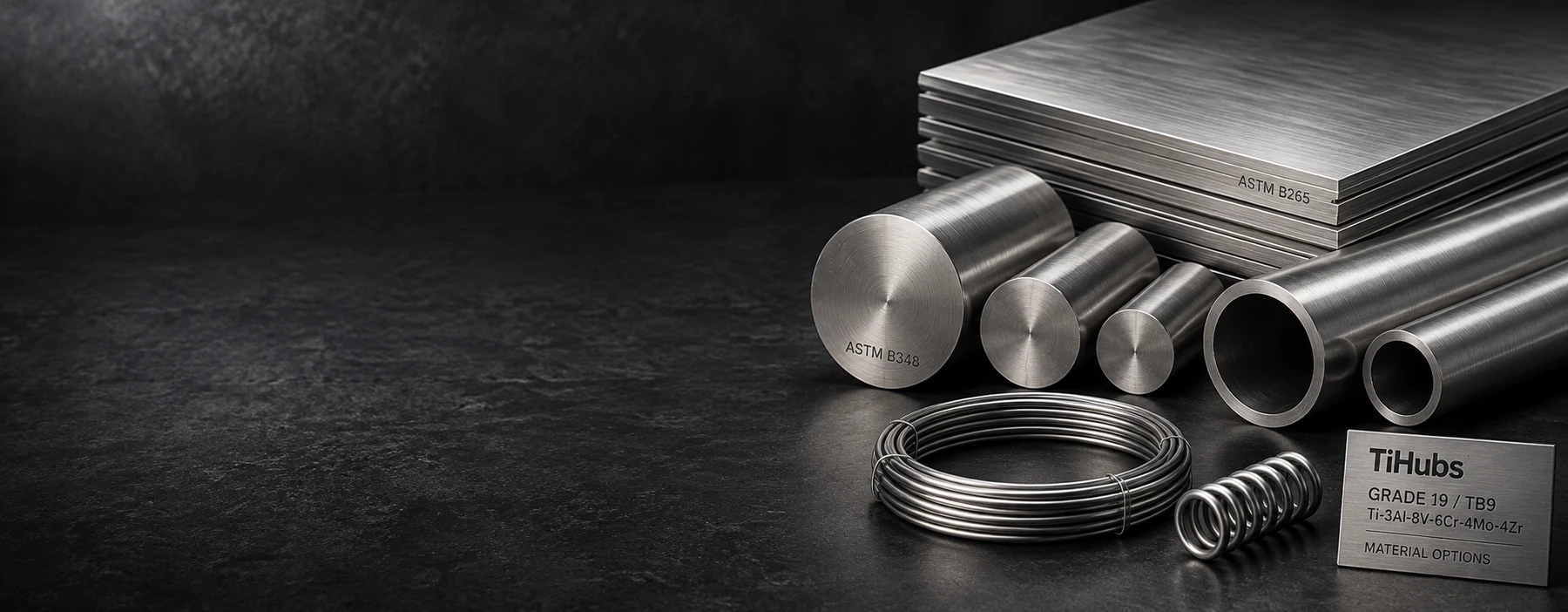
Grade 19 · Gr19 · TB9 · UNS R58640
Grade 19 / TB9 titanium.For springs and high-strength components.
Source Grade 19 / TB9 titanium sheet, bar, pipe and wire for spring stock, precision parts and reviewed downhole applications. TiHubs connects the material, heat-treatment condition and inspection requirements through one contact in Baoji.
Start with a specification, drawing or application. We’ll help identify the details still needed.
Material review. Supply coordination.
One contact in Baoji, China.
Grade 19 / TB9Gr19 · Ti-3Al-8V-6Cr-4Mo-4Zr · UNS R58640
Defined material & conditionMatch the product, process and acceptance requirements
One contact20 years of founder experience · 100+ Baoji factories
01 / Product forms
Find your
Grade 19 / TB9 product.
Choose a material form or application. Send the dimensions, service conditions and required records so we can match the manufacturing route to your order.
01 / 06
Grade 19 / TB9 · Gr19 · Ti-3Al-8V-6Cr-4Mo-4Zr
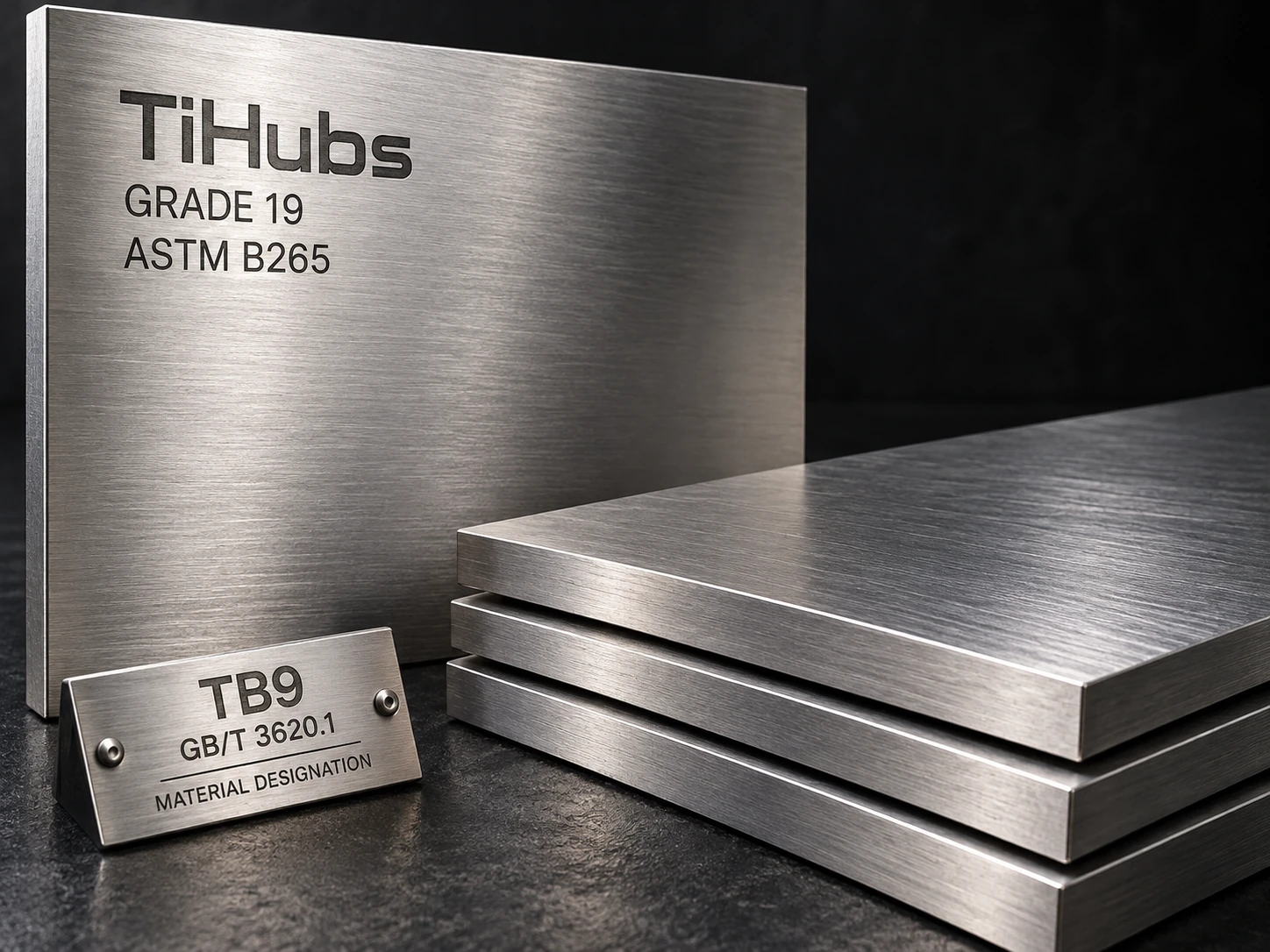
Grade 19 / TB9 titanium sheet & plate
Sheet and plate for drawing-based formed or machined parts. Define the forming condition and the final property requirement together, particularly when the part will be aged after shaping.
- Specification
- ASTM B265 Grade 19, with the required edition and condition. For TB9, agree the product specification alongside GB/T 3620.1 material identity.
- Dimensions
- Thickness × width × length, flatness, rolling direction, surface finish, edge condition and allowance for forming or machining.
- Processing
- Identify solution-treated stock, subsequent forming and the specified aging route. Include trim allowance and final dimensional requirements.
- Acceptance
- Heat identity, chemistry, tensile-test basis, surface and dimensions. State any forming trial, sample approval or final-part inspection.
02 / 06
Grade 19 / TB9 · Gr19 · Ti-3Al-8V-6Cr-4Mo-4Zr
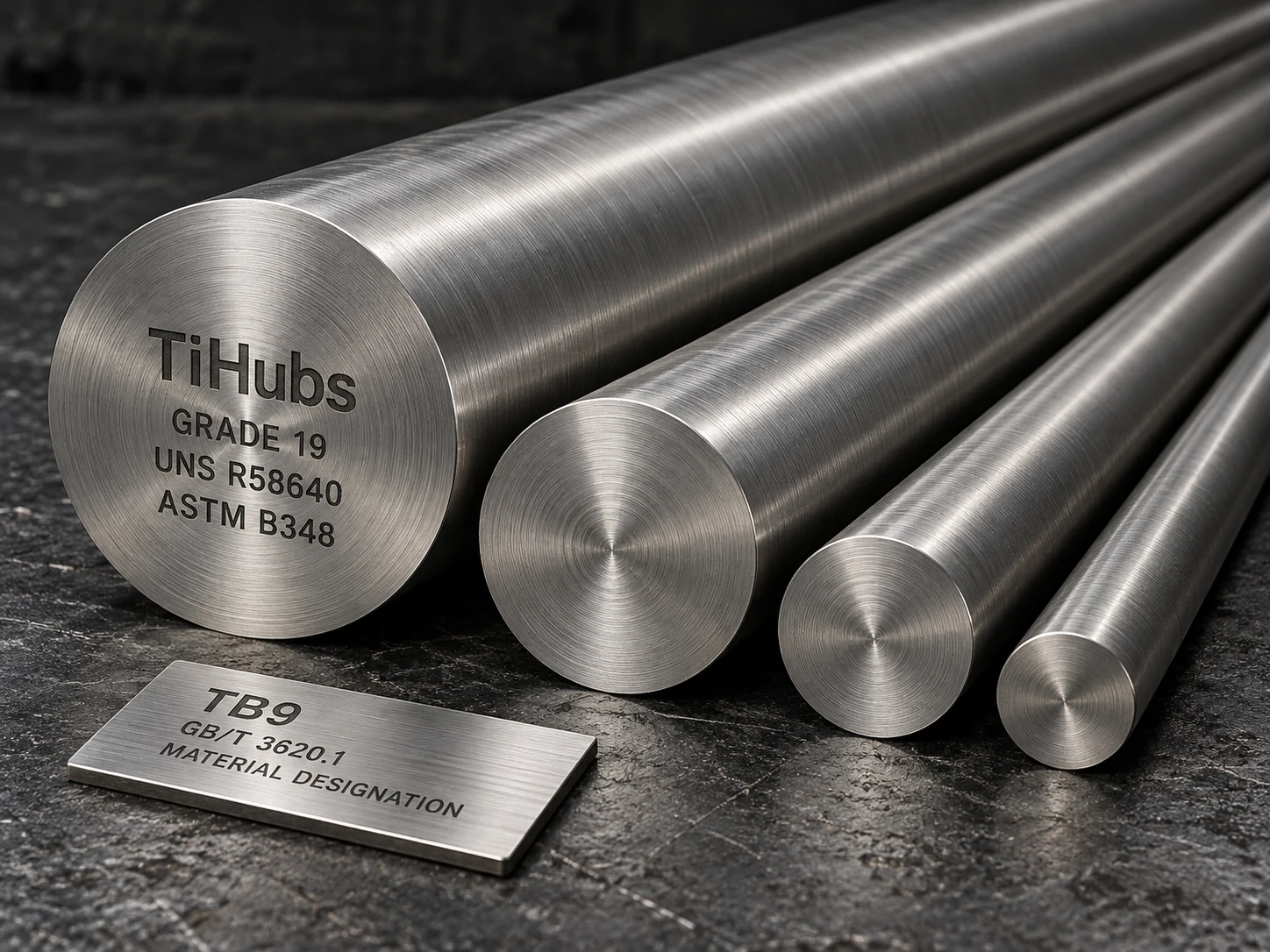
Grade 19 / TB9 titanium bar & rod
Stock for precision fasteners, spring components and high-strength machined parts. Include the final drawing so section size, machining allowance and the heat-treatment sequence can be reviewed.
- Specification
- ASTM B348 Grade 19. AMS 4958 or AMS 6920 may be relevant aerospace options when the drawing calls for their exact scope and revision.
- Dimensions
- Diameter or section × length, straightness, turned or ground finish, machining allowance and quantity by size.
- Condition
- Solution treated, or solution treated and aged to the agreed strength level. A higher tensile target changes the ductility and processing discussion.
- Acceptance
- Required chemistry, mechanical-test location and orientation, heat-treatment records, surface condition and agreed ultrasonic inspection.
03 / 06
Grade 19 / TB9 · Gr19 · Ti-3Al-8V-6Cr-4Mo-4Zr
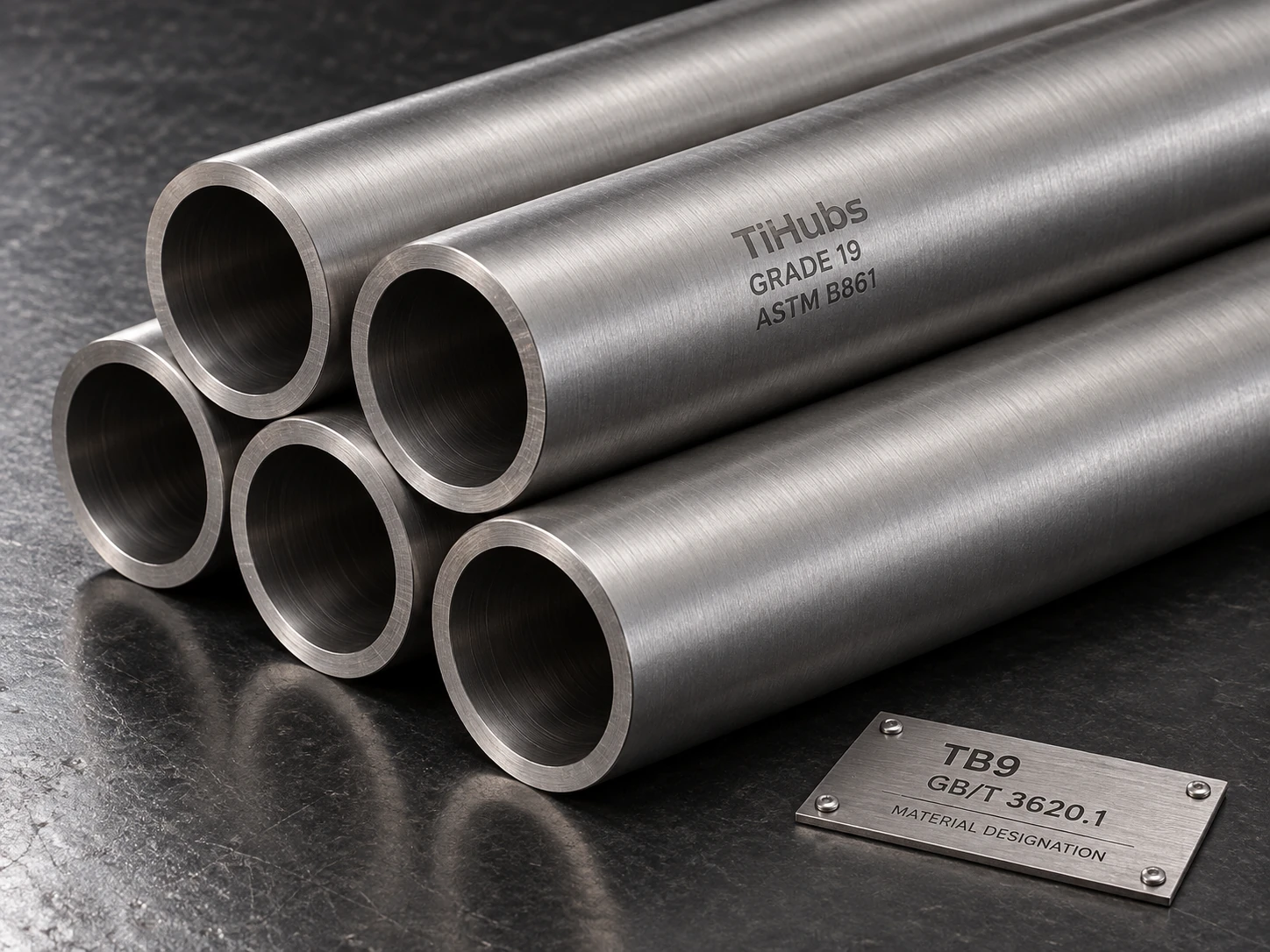
Grade 19 / TB9 seamless pipe & tubular blanks
Specialized hollow material for reviewed engineering and downhole-component requirements. Send the finished bore, wall and connection details, not only a nominal pipe size.
- Specification
- ASTM B861 Grade 19 for the seamless-pipe route. A TB9 tubular order needs an agreed product specification and acceptance basis.
- Dimensions
- OD × wall × length or the specified pipe-size system; bore size, eccentricity, straightness, end preparation and machining envelope.
- Condition
- Specify solution-treated or solution-treated and aged material. Confirm the manufacturing route and practical size range before quotation.
- Acceptance
- Mechanical and dimensional requirements, pressure or NDT scope, thread-related checks where included and traceability through subsequent machining.
04 / 06
Grade 19 / TB9 · Gr19 · Ti-3Al-8V-6Cr-4Mo-4Zr
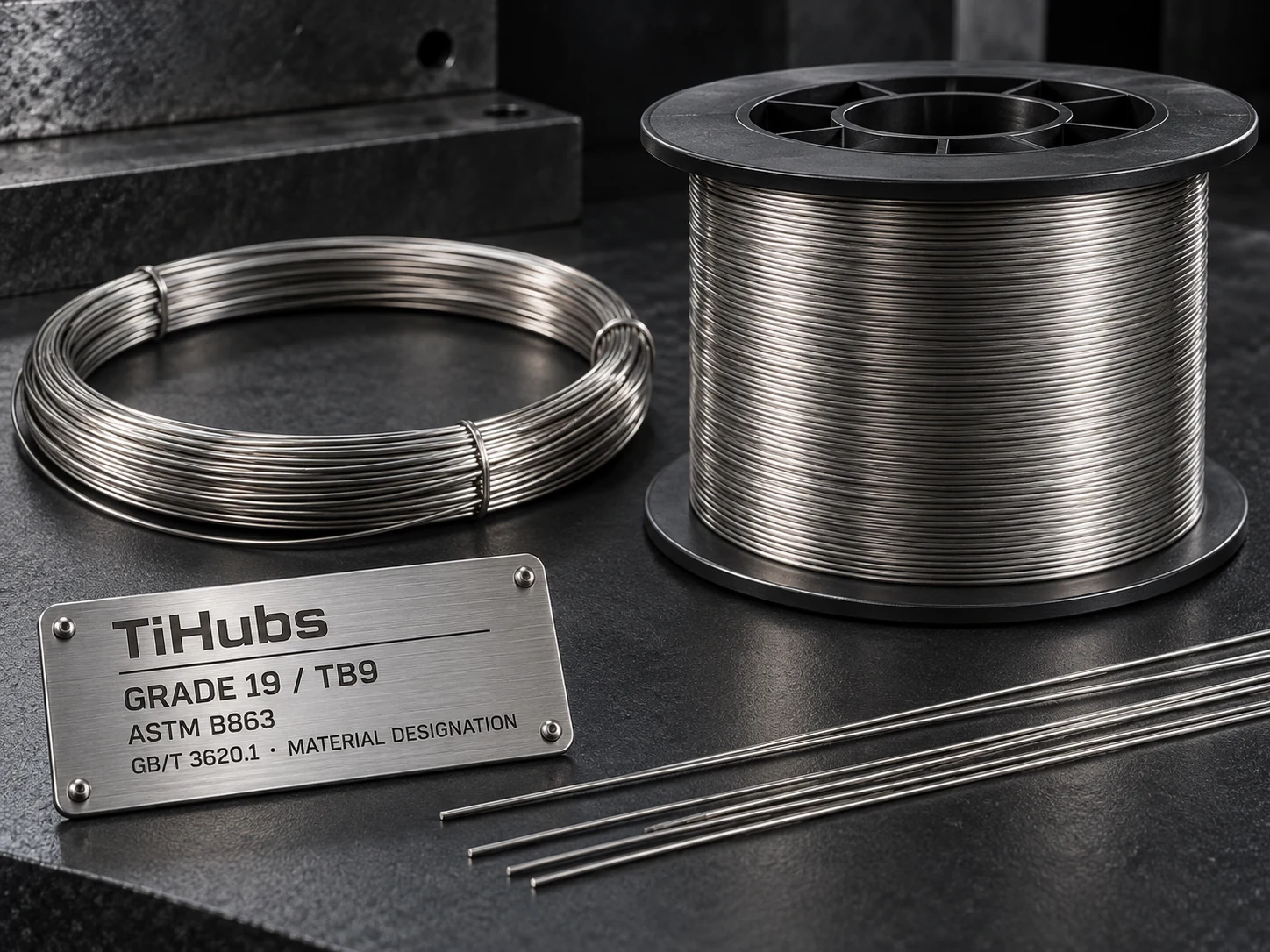
Grade 19 / TB9 titanium wire
Wire and straight stock for defined spring or component production. The purchase should distinguish raw wire properties from the load, fatigue and dimensional requirements of a finished spring.
- Specification
- ASTM B863 Grade 19. For specified aerospace spring stock, review the applicable AMS 4957 revision, diameter and processing requirements.
- Supply form
- Coils, spools or straight lengths; wire diameter and tolerance, coil weight, cast, straightness and packaging.
- Processing
- Cold-work level, starting condition, forming sequence and final aging responsibility. Identify whether TiHubs coordinates stock only or downstream processing.
- Acceptance
- Surface quality, chemistry, agreed mechanical tests and lot identity. Finished-spring proof, load and fatigue tests must be stated separately.
05 / 06
Grade 19 / TB9 · Gr19 · Ti-3Al-8V-6Cr-4Mo-4Zr
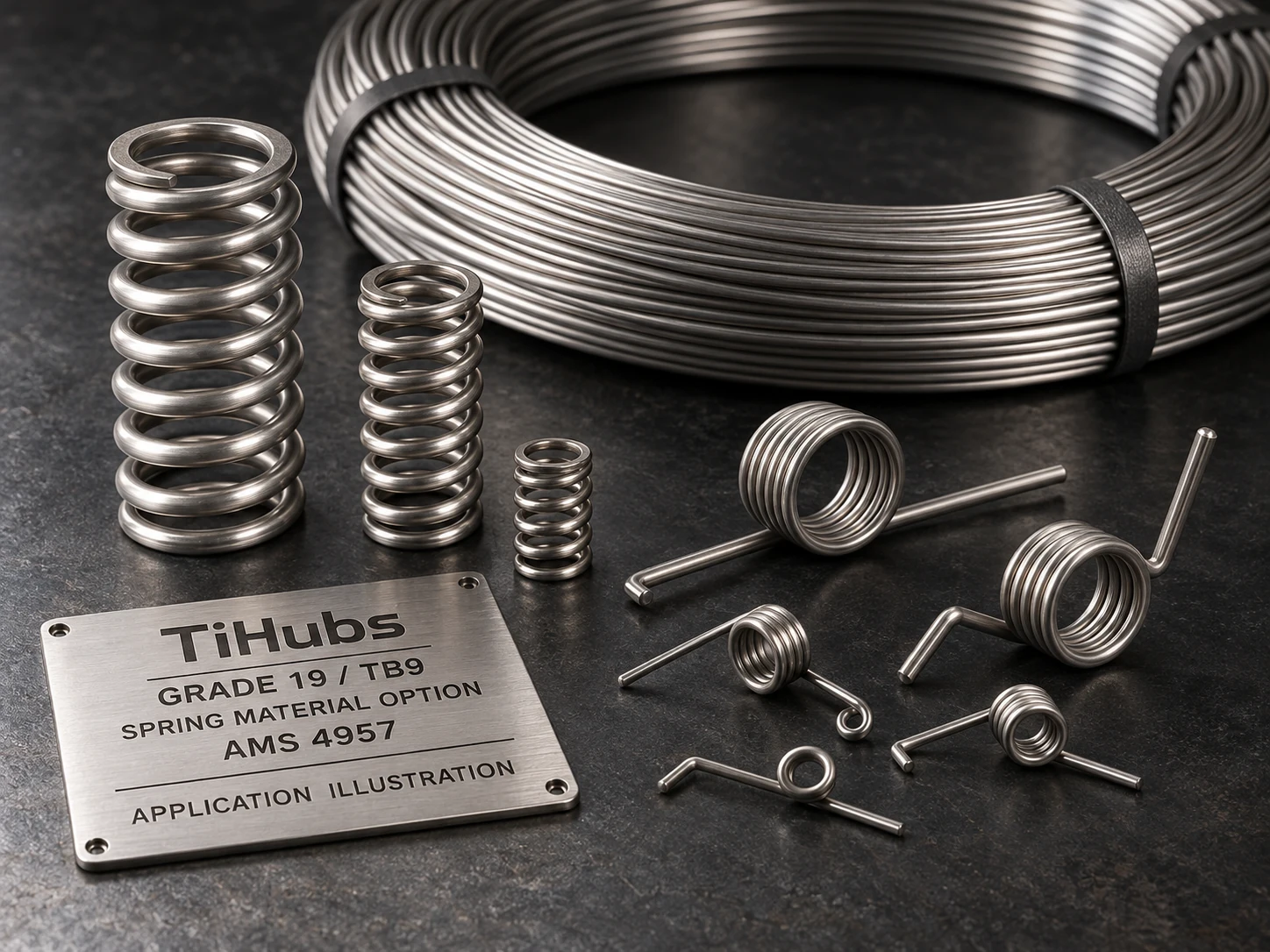
Aerospace spring & elastic-component requirements
Application illustration: spring stock and drawing-based processing coordination for reviewed aerospace requirements. Begin with the required load and movement, then connect them to the material and process specification.
- Geometry
- Spring drawing, wire or strip section, coil dimensions, end details, free length, installed envelope and interfaces.
- Loading
- Working and proof loads, stroke, duty cycles, temperature, fatigue criteria and allowable permanent set.
- Manufacturing
- Source-stock specification, forming route, final aging, surface treatment and any approved special-process requirements.
- Acceptance
- Dimensional and load-deflection evidence, agreed fatigue or proof testing, material records and purchaser approval. Raw-material certification does not qualify the finished spring.
06 / 06
Grade 19 / TB9 · Gr19 · Ti-3Al-8V-6Cr-4Mo-4Zr
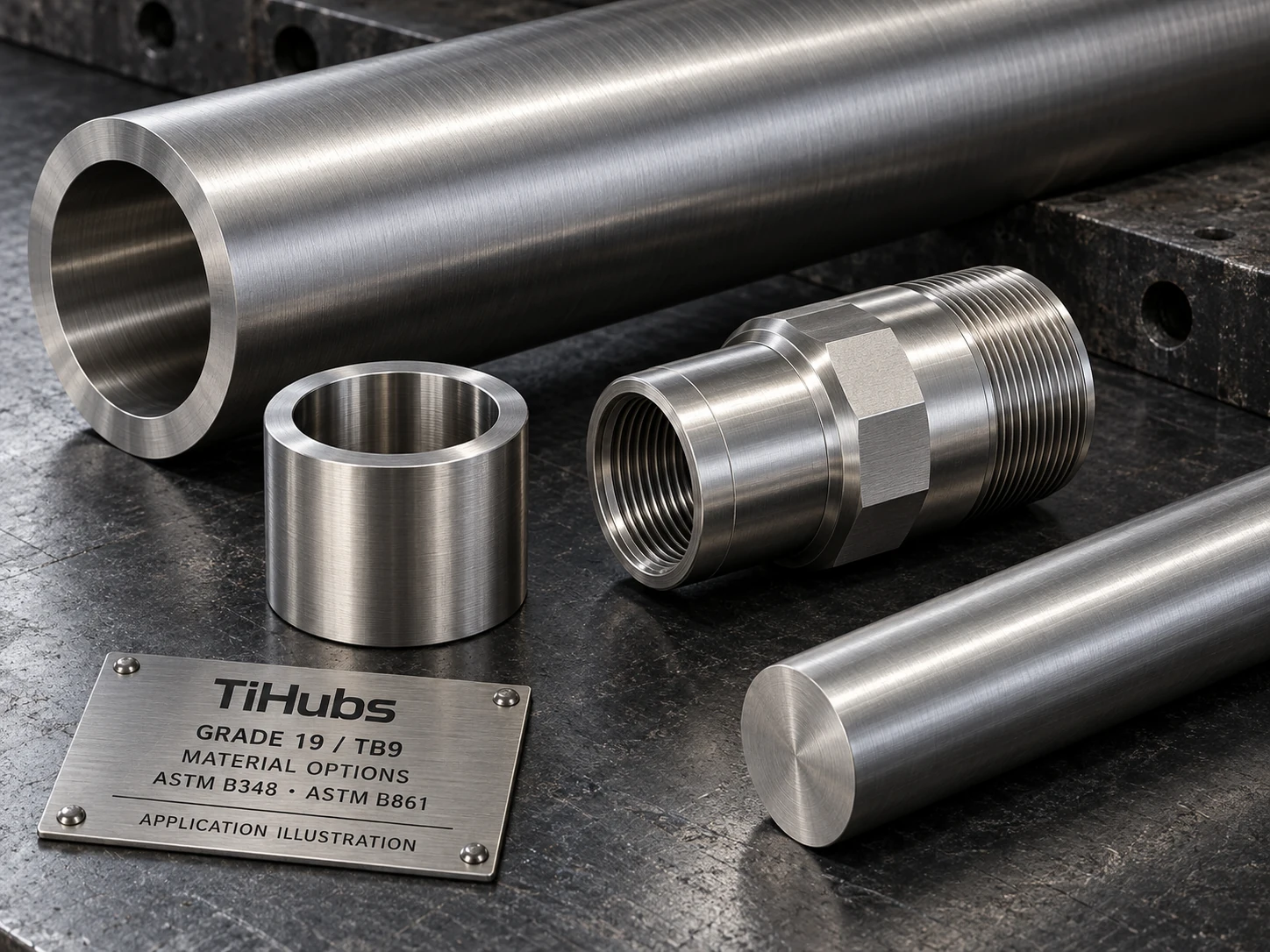
Oil & gas downhole tubular components
Application illustration: tubular blanks, sleeves, connectors and drawing-based parts for a reviewed well environment. Mechanical duty, fluid exposure and connection design must be assessed together.
- Starting material
- ASTM B348 Grade 19 bar, B861 Grade 19 pipe or B381 F-19 forgings, selected for the drawing and required section.
- Environment
- Pressure and temperature range, fluid chemistry, chloride, pH, H₂S and CO₂ where relevant, exposure time and operating changes.
- Interfaces
- Threads, seal contact, bore geometry, mating materials, surface finish and allowance for final machining.
- Acceptance
- Final strength condition, critical dimensions, NDT and specified pressure or leakage tests. Any sour-service qualification or project approval must be explicitly agreed.
Images illustrate material forms and application possibilities. Reference markings identify specification options; they do not establish dual certification, stock availability or finished-component approval.
Define the product. Share the requirement.
These details help turn your enquiry into a comparable quotation.
01 / Requirement review
A drawing-based part
Send the released drawing, final condition, critical features and inspection scope. We will distinguish material, rough blank and finished-part supply.
Discuss your requirement02 / Requirement review
A spring requirement
Start with the geometry, load range, stroke and cycle target. Identify the source-stock specification, forming and aging responsibilities.
Discuss your requirement03 / Requirement review
Several coordinated items
List every form and size with its quantity, condition and document requirements. We can review the supply and dispatch milestones together.
Discuss your requirement02 / Material identity
What is
Grade 19 / TB9 titanium?
Grade 19 / Gr19 / TB9 is a metastable beta titanium alloy. The delivered condition is a central part of the specification: solution-treated stock and aged material must be evaluated against their own product and test requirements.
The values below are purchasing references from the linked files. They are not design allowables, finished-part ratings or a guarantee for every size and condition.
793MPa
Minimum tensile strength · solution-treated sheet
759MPa
Minimum yield strength · solution-treated sheet
15%
Minimum elongation · solution-treated sheet
ASTM B265-08 · Grade 19 · Table 1, including its product and condition footnotes.
| Property or condition | Reference | Ordering implication |
|---|---|---|
| Reference condition | ASTM B265-08 · Grade 19 · solution treated | The three headline values relate to the cited sheet/plate table and its footnotes. Aged sheet properties are agreed between purchaser and supplier. |
| Bar · solution treated | 793 MPa tensile min. · 759 MPa yield min. · 15% elongation min. | ASTM B348-08a reference for the stated section and test basis. Do not transfer these values to every wire, pipe or finished spring. |
| Bar · moderate-strength STA | 930 MPa tensile min. · 897–1,096 MPa yield · 10% elongation min. | The cited bar specification separates this condition from its high-strength aged route. State the required row on the order. |
| Bar · high-strength STA | 1,138 MPa tensile min. · 1,104–1,276 MPa yield · 5% elongation min. | Higher strength is accompanied by a different ductility requirement. Evaluate the finished geometry and duty rather than choosing only the largest number. |
| Section and sampling | Product-specific limits apply | The cited B348 table applies to longitudinal sections up to 76 mm thickness and 64.5 cm² area; properties for larger sections require agreement. |
| Spring acceptance | Material strength and component performance are different | Specify load-deflection, permanent set, surface and fatigue requirements for the finished part when these are part of the order. |
Specify the property basis together with product form, section, direction, sampling and final condition. For aged sheet, agree the required properties before placing the order.
| Element · wt.% | ASTM B348-08a · Grade 19 | GB/T 3620.1-2016 · TB9 |
|---|---|---|
| Aluminum · Al | 3.0–4.0 | 3.0–4.0 |
| Vanadium · V | 7.5–8.5 | 7.5–8.5 |
| Chromium · Cr | 5.5–6.5 | 5.5–6.5 |
| Molybdenum · Mo | 3.5–4.5 | 3.5–4.5 |
| Zirconium · Zr | 3.5–4.5 | 3.5–4.5 |
| Oxygen · O | 0.12 max. | 0.14 max. |
| Iron · Fe | 0.30 max. | 0.30 max. |
| Carbon · C | 0.05 max. | 0.05 max. |
| Nitrogen · N | 0.03 max. | 0.03 max. |
| Hydrogen · H | 0.020 max. | 0.030 max. |
| Titanium · Ti | Balance | Balance |
Principal chemistry and selected limits are shown. The controlling specification includes further analysis and residual-element requirements; apply the complete ordered standard. TB9 and Grade 19 limits for oxygen and hydrogen differ in these files.
Grade 19 / Gr19 / TB9
Grade 19 and TB9 identify the corresponding Ti-3Al-8V-6Cr-4Mo-4Zr material family. Keep the complete product specification, condition and acceptance requirements on the enquiry and purchase order.
Solution treated or aged
Solution treatment and aging are central ordering choices. Identify when forming and machining occur, who performs final aging, and which test results are required in the delivered condition.
Grade 19 and Grade 20
Grade 20 is the palladium-bearing variant, with a separate chemical designation. A requirement for Grade 20 or a qualified corrosion duty should not be quoted as ordinary Grade 19 without review.
Grade 19 and Grade 5
Grade 19 is a metastable beta alloy; Grade 5 is Ti-6Al-4V. They have different chemistry and processing routes. Compare the component duty, specification and finished condition before considering a material change.
03 / Application review
Grade 19 / TB9 for demanding component duties.
Use the application to define the material and process questions. Share the drawing, loads, temperature and acceptance needs so we can review a suitable supply route.
Application review / 01
Aircraft springs: define the load before choosing the stock
Grade 19 / TB9 is considered for spring components where strength, elastic response and weight are evaluated together. A useful enquiry connects the spring drawing with the source-wire or bar requirement and the final processing sequence. TiHubs can coordinate that review so the quotation distinguishes raw stock, a formed sample and a finished component with specified test evidence.
Products to discuss
Wire, straight rod or strip for the stated spring geometry; formed spring samples and production parts only within an agreed manufacturing and inspection scope.
What we need to review
Free and installed dimensions, working stroke, minimum and maximum loads, cycle target, operating temperature and allowable set. Add surface, final aging, proof or fatigue testing and purchaser approval requirements.
Application review / 02
High-strength fasteners: connect material and part acceptance
For a Grade 19 / TB9 fastener enquiry, the material certificate is only one part of the purchasing scope. The drawing must also define the thread, bearing surfaces, dimensional limits and final condition. Identify whether threads are formed before or after the specified heat treatment and whether the order is for machining stock, unfinished blanks or inspected parts.
Products to discuss
Bar, rod and wire for bolts, studs, pins and drawing-based fastener blanks; specified forging stock where the manufacturing route requires it.
What we need to review
Drawing revision, thread designation and class, grip length, head geometry, surface requirements and final mechanical condition. Agree any proof-load, shear, fatigue or dimensional inspection and the lot identification method.
Application review / 03
Downhole components: review the well duty and the connection
Grade 19 has documented specialized use in oil-and-gas tubular and casing-related equipment. Each proposed TB9 / Gr19 component still needs a defined service and acceptance basis. Material selection should account for the combined mechanical load, temperature and fluid exposure, while the quotation should identify whether the scope ends at a tubular blank or includes machining, threading and component testing.
Products to discuss
Seamless pipe, hollow blanks, bar and forgings for sleeves, connectors and drawing-based downhole parts. Confirm the practical size and manufacturing route before committing to the design.
What we need to review
Temperature and pressure envelope, fluid analysis, chloride, pH, H₂S and CO₂ where present, load history and exposure duration. Provide thread and seal drawings, final condition, NDT and any mandatory sour-service qualification.
Application review / 04
Machined parts: plan around the delivered condition
A high-strength material callout does not fully define a machined-part order. The sequence of rough machining, heat treatment and finishing affects the material allowance and the inspection plan. For Grade 19 / TB9, discuss critical features at quotation stage so dimensional evidence and material records refer to the condition in which the part will be accepted.
Products to discuss
Bar or billet, forged blanks and plate for released component drawings. Separate near-net blanks from finish-machined parts and any assembled-item scope.
What we need to review
Datum system, tolerances, bores, threads, notch-sensitive geometry, finish and distortion allowance. Define final aging responsibility, test location, sampling and the records required for the delivered parts.
Application review / 05
Forging blanks: align the grain and machining envelope
When a component is proposed from a Grade 19 forging, agree the blank drawing and final-part envelope together. A useful supply review identifies which surfaces will be removed, where testing is required and how the material will remain traceable after cutting. F-19 product requirements and any drawing-specific process controls should be stated before the forging route is selected.
Products to discuss
ASTM B381 F-19 forgings, bar-derived blanks or forging stock to the specified aerospace or purchaser requirements. Actual shape and section capability are reviewed with the drawing.
What we need to review
Blank dimensions, machining allowance, expected reduction or structure requirements, final condition and inspection class. Include ultrasonic access, sample location, identification transfer and any first-article approval.
Application review / 06
Formed sheet: separate shaping from final strength
Grade 19 / TB9 sheet can be reviewed for parts that are shaped before final aging. The purchase should identify the condition required by the forming operation and the condition required at final acceptance. Bringing the material supplier and processing requirements into the same discussion helps expose missing details before tooling or production quantities are quoted.
Products to discuss
Sheet or strip blanks, bent features and drawing-based formed parts, with a separately defined joining or machining scope where needed.
What we need to review
Thickness, rolling direction, bend or draw geometry, minimum remaining section, trim allowance and surface. Specify the final aging and shape-control requirements, sample quantity, inspection method and approval milestone.
Application review / 07
Motorsport springs: quote against the operating cycle
Grade 19 is also considered for high-performance spring and component work outside aerospace. For a motorsport enquiry, concentrate on the required movement, load, temperature and replacement interval instead of assuming that a titanium part can copy an existing steel geometry. TiHubs can coordinate material and processing discussions around the released design and agreed test scope.
Products to discuss
Wire, rod and drawing-based spring or lightweight component blanks. Distinguish prototype trials from repeated production and identify any tooling or fixture requirements.
What we need to review
Working loads, stroke, cycle profile, temperature, available space, mass target and inspection criteria. Agree which party approves the design, how samples will be evaluated and what evidence is required before the production order.
Application review / 08
Industrial parts: evaluate strength and exposure together
For an industrial TB9 / Grade 19 part, start with both the drawing and the operating environment. A strength-driven alloy choice does not remove the need to review chemical exposure, contact conditions or inspection access. Define the acceptance criteria for the part actually being purchased, especially where the requirement combines a high-strength section with a seal, thread or wetted bore.
Products to discuss
Bar, plate, seamless pipe and drawing-based blanks for engineering-reviewed components. Finished parts, pressure testing and assembly work are separate items in the quotation.
What we need to review
Loads, temperature, fluid composition, pressure, mating materials, sliding or sealing contact and service history. Add critical dimensions, final condition, surface requirements, NDT and any independent inspection hold points.
Technical references: Carpenter Technology · Beta C alloy reference ↗ · SAE · AMS 4957H round bar and wire ↗ · SAE · AMS 4958F bars and rods ↗ · SAE · AMS 6920 forging-stock family ↗
Purchasing checklist
Before a high-strength order is released.
A clear grade name is the starting point. The manufacturing sequence and the condition in which the parts will be accepted complete the order.
Material and condition
Grade, edition, product form, section, source-stock condition and final property level.
Processing and approval
Drawing revision, forming or machining sequence, aging responsibility and sample or first-article decisions.
Evidence and delivery
Test basis, heat and lot identification, dimensional records, packaging and dispatch requirements.
“We need TB9 wire for a spring.”
We would clarify wire diameter and surface, the spring drawing, working loads and cycles, forming and aging responsibility, and the required proof or fatigue evidence before coordinating the supply proposal.
Illustrative requirement review; it is not a published customer case or a claim of qualified spring performance.
Discuss your requirement04 / Standards & documentation
Match the standard
to the product.
Choose the specification by product and delivered condition. The linked files retain their actual editions; aerospace options must follow the revision called out by the drawing.
| Product form | ASTM / AMS / ASME route | Chinese standard route | Clarify before quotation |
|---|---|---|---|
| Material identity & chemistry | United States / technical reference Grade 19 · UNS R58640 · Ti-3Al-8V-6Cr-4Mo-4Zr; use the chemical requirements in the ordered product standard. | ChinaGB/T 3620.1-2016View PDF ↗ TB9 designation and composition. | Full grade, product route, analysis basis and delivered condition. |
| Sheet & plate | United States / technical referenceASTM B265-08View PDF ↗ Solution-treated reference; aged sheet properties require agreement. | ChinaGB/T 3620.1-2016View PDF ↗ TB9 chemistry plus an agreed sheet product specification. | Thickness, rolling direction, forming sequence, final condition and inspection. |
| Bar & rod | United States / technical referenceASTM B348-08aView PDF ↗ Select the applicable ST or STA property row. AMS 4958 / AMS 6920 may be specified separately. | ChinaGB/T 3620.1-2016View PDF ↗ TB9 chemistry plus an agreed bar product specification. | Section, machining allowance, straightness, final strength level and test location. |
| Seamless & welded pipe | United States / technical referenceASTM B861-10View PDF ↗ASTM B862-06b ε1View PDF ↗ Separate seamless and welded routes; both require the ordered condition and tests. | ChinaGB/T 3620.1-2016View PDF ↗ Agree the TB9 tubular product and acceptance requirements. | OD, wall, length, bore, end preparation, manufacturing route and NDT. |
| Wire & spring stock | United States / technical referenceASTM B863-19View PDF ↗ AMS 4957 is a separate aerospace stock option where called out. | ChinaGB/T 3620.1-2016View PDF ↗ Agree the TB9 wire product requirements and processing condition. | Diameter, surface, coil or straight form, forming/aging and finished-spring tests. |
| Forgings & component blanks | United States / technical referenceASTM B381-08aView PDF ↗ F-19 forging route; specify finished-part requirements separately. | ChinaGB/T 3620.1-2016View PDF ↗ Agree TB9 blank and final-part acceptance requirements. | Blank drawing, condition, structure, NDT, machining envelope and traceability. |
| Technical reference | United States / technical referenceBeta C · producer technical dataView PDF ↗ Producer technical information; typical behavior does not replace the purchase specification. | China Use the ordered TB9 documents for acceptance. | Application evidence and process assumptions relevant to the project. |
Agree the order basis.
GB/T 3620.1 is a material designation and composition reference. It does not replace a product specification. AMS catalog links below identify additional aerospace options; no unsupported full-text AMS download is implied.
Use the document edition, product scope and condition specified in the purchase order. Producer technical references support discussion; they do not replace ordered product acceptance requirements.
05 / Order coordination
Know the scope
before ordering.
Our founder’s 20 years in titanium inform the questions we ask before quotation and the supply options we review with you.
A quotation you can evaluate
Agree the grade, standard edition, dimensions, tolerance, condition and quantity before comparing prices.
- Identify whether inspection, samples and tooling are included.
- Confirm packaging, transport and delivery terms.
- Record items that still need technical confirmation.
Acceptance agreed before supply
Confirm the material certificate, full grade, heat or lot identity, delivery condition, dimensional checks and required testing before supply starts. Define any process records, NDT and purchaser approval points for the ordered product.
Independent inspection can be discussed with its scope, timing, acceptance criteria and cost agreed for the order.
Delivery with clear milestones
Review the proposed lead time, approvals, production sequence and dispatch requirements. For several product forms, coordinate document and packing readiness together.
Material substitutions and technical changes require written approval. A schedule deviation should identify the impact, decisions needed and next steps.
One contact when an issue arises
Contact TiHubs with the order reference, affected items and supporting photos or inspection records.
We record the issue, review it against the agreed requirements and coordinate the next steps with the relevant manufacturing parties.
01 / Material identity
Material records
Grade, standard, test results and heat or batch identity matched to the supplied items.
02 / Agreed acceptance
Inspection records
Dimensional and testing records for the agreed scope, including critical drawing requirements.
03 / Ready for dispatch
Dispatch records
Item identification, packing list, protective packaging and required shipment documents.
06 / Questions before sourcing
Before you specify
Grade 19 / TB9.
A clear material designation is the beginning. Product form, specification revision, material condition and acceptance complete the requirement.
A useful first enquiry
- Product and specificationProduct form, standard edition, dimensions and material condition.
- Order and deliveryQuantity, destination and any required delivery date.
- Acceptance requirementsDrawing revision, inspection, certificates and packaging.
Not every detail is finalized? Send the information you have. We can help identify the questions to resolve before quotation.
What happens next: requirement review, technical clarification, then a supply proposal and quotation.
What is Grade 19 titanium, and what does Gr19 mean?
Grade 19, abbreviated Gr19, is the Ti-3Al-8V-6Cr-4Mo-4Zr beta titanium alloy identified as UNS R58640. It is also known as Beta C. TB9 is the corresponding Chinese designation used on this page. State the product form, specification, edition and heat-treatment condition when requesting a quotation.
What are the main Grade 19 / TB9 applications?
The purchasing focus includes aircraft springs, high-strength fasteners, precision machined parts and specialized oil-and-gas tubular components. Motorsport springs and formed or forged engineering parts are additional areas for review. The drawing, operating duty, processing route and acceptance tests define the actual order.
Should I order solution-treated or aged material?
That depends on the manufacturing sequence and final property requirement. Material that must be formed may need a different starting condition from a finished part. State the required delivered condition, final aging responsibility and test basis. The cited bar specification contains separate solution-treated and aged strength levels.
Can you supply finished springs as well as wire?
Send the spring drawing and the required load, movement, cycles, temperature and acceptance criteria. TiHubs can review the material and manufacturing scope with suitable resources. Raw wire, formed samples and finished springs with agreed testing are separate supply scopes; availability and process requirements are confirmed before quotation.
Which standards apply to Grade 19 pipe and forgings?
ASTM B861 includes Grade 19 seamless pipe and ASTM B862 includes Grade 19 welded pipe. ASTM B381 uses F-19 for the forging route. Specify the exact edition, dimensions, delivery condition and required tests. An aerospace drawing or downhole component may impose additional requirements beyond the raw-material standard.
How should I specify TB9 material?
Use the full TB9 designation with the agreed product specification, delivery condition and inspection requirements. GB/T 3620.1 defines the material chemistry. The supplied GB/T 3621-2022, GB/T 2965-2023 and GB/T 3623-2022 files do not list TB9 as a standard product route, so the product acceptance basis needs to be stated explicitly.
Is Grade 19 automatically suitable for sour oil and gas service?
No universal service approval follows from the grade name. Provide the pressure, temperature, fluids, chloride, pH, H₂S and CO₂ where relevant, loading and exposure history. Any required sour-service qualification, corrosion testing or project approval must be included in the review. Grade 20 is a separately designated palladium-bearing alloy.
What information should I send for a quotation?
Send the product form or drawing, Grade 19 or TB9 designation, standard edition, dimensions and tolerances, required condition, quantity and destination. Add the final application and inspection or documentation requirements. Existing information is enough to start; TiHubs will identify the details still needed before preparing the quotation.
Can you arrange samples, inspection and delivery coordination?
Samples and independent inspection can be discussed with their scope, acceptance criteria, timing and cost confirmed for the order. MOQ and lead time depend on the form, dimensions, processing and testing. TiHubs remains the contact for progress, agreed documentation and the review of any reported order issue.
07 / Your next step
Start with the
requirement you have.
Send the product details, drawing or operating conditions you already know. We will identify missing information and discuss a suitable supply route before quotation.
- Requirement review
- Technical clarification
- Supply proposal and quotation
Combine materials and parts in one enquiry.
Send one list of Grade 19 / TB9 forms, sizes and quantities. Include drawing revisions and items that need to be supplied together.
Define the condition and acceptance priorities.
Include the ordered specification, final application, material condition, inspection and documentation, destination and required delivery milestones.
Baoji, China · info@tihubs.com
Start your Grade 19 / TB9 enquiry
Send your material form, drawing or process conditions. We will help clarify the remaining requirements.