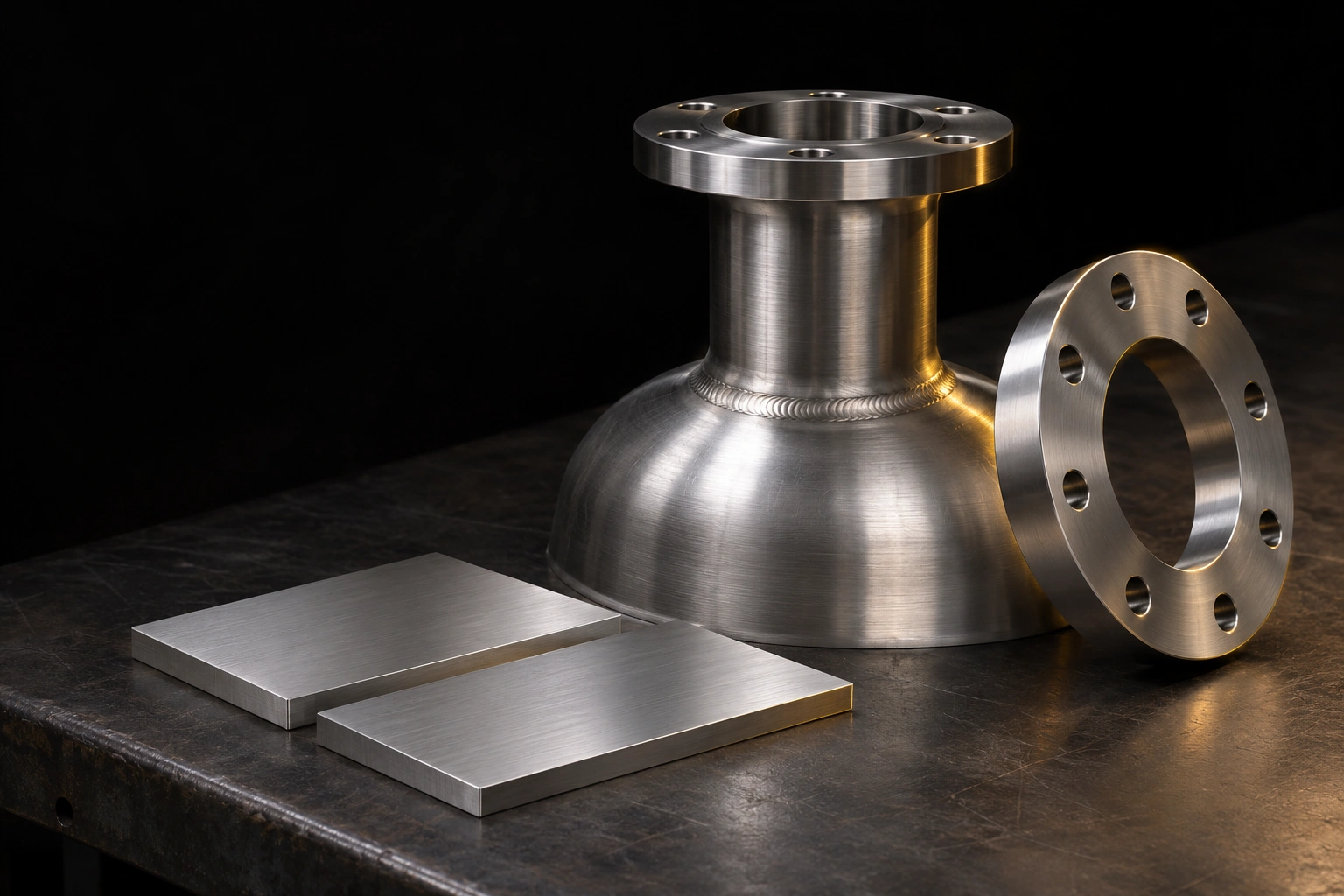
AI illustration. Appearance and labels do not verify material compliance.
Quick answer: Grade 7 is a targeted corrosion choice
For Grade 2 vs Grade 7 titanium, the central question is whether the actual chemical service requires the corrosion behavior of palladium-added titanium. Grade 7 contains a specified palladium addition; it should not be treated as a universal upgrade, a substitute for defining the process, or an automatic mechanical-strength improvement. Confirm the product specification and the evidence supporting the proposed grade.
Prepare a complete service envelope: all media and impurities, concentration ranges, bulk and wall temperatures, flow, crevices, cleaning and abnormal conditions. A short description such as “acid tank” is not enough to approve either material.
01 / Grade comparison
What changes when palladium is added?
Grade 2 is commercially pure titanium. Grade 7 is palladium-added titanium, commonly identified as UNS R52400, with a specified Pd range of 0.12–0.25%. Alleima’s Grade 7 datasheet describes its use in demanding chemical environments and explicitly ties suitability to actual service conditions. Its product-specific data must not be transferred unchanged to another manufacturer’s material. [1]
Titanium’s corrosion behavior depends on its protective surface film and the environment. TIMET discusses the benefit of palladium-bearing grades in selected reducing and crevice conditions, while also identifying limits involving aggressive or unusual chemistry. Fluoride-containing media and dry chlorine are important specialist-review flags; neither grade should be approved for these from a general compatibility table. [2]
Comparison item
Grade 2
Grade 7
Material identity
Commercially pure titanium designation
Palladium-added titanium designation
Purchasing question
Does the evidence support the complete duty?
Does the added-alloy benefit address the identified duty?
Product requirements
Ordered form, standard, condition and dimensions
The same requirements must be defined independently
Mechanical acceptance
Applicable specification and design basis
Do not assume a grade change supplies a strength upgrade
Cost evaluation
Quote the approved material and fabrication scope
Identify alloy premium, availability and any changed processing scope
The useful comparison is not “ordinary titanium versus better titanium.” It is two fully specified alternatives, each with a clear boundary of suitability and a documented release process.
02 / Process chemistry
Write a chemistry description a reviewer can use
List each relevant species and its concentration range, including contaminants and treatment additives. State whether a percentage is by mass, volume or another basis. Include pH where meaningful, but do not use pH as a substitute for composition. Ask process staff to identify oxidizing or reducing conditions and whether those conditions change over time.
Process information
Why it belongs in the enquiry
Main media and concentration range
Establishes the actual chemical mixture
Impurity specification and measured values
Distinguishes clean design chemistry from plant reality
Temperature at relevant locations
Separates bulk liquid from heated wall or local hot spots
Phase and wet/dry conditions
Identifies liquid, vapor, condensation and drying exposure
Flow, solids and deposits
Describes local conditions and cleaning needs
Startup, shutdown and cleaning
Captures exposures absent from the normal operating datasheet
Sampling date and method
Shows whether data represents current operation
If the process supplier treats part of the composition as confidential, arrange a controlled technical review rather than omit the information. A procurement coordinator can collect the required data, but cannot infer unknown chemistry from the product name.
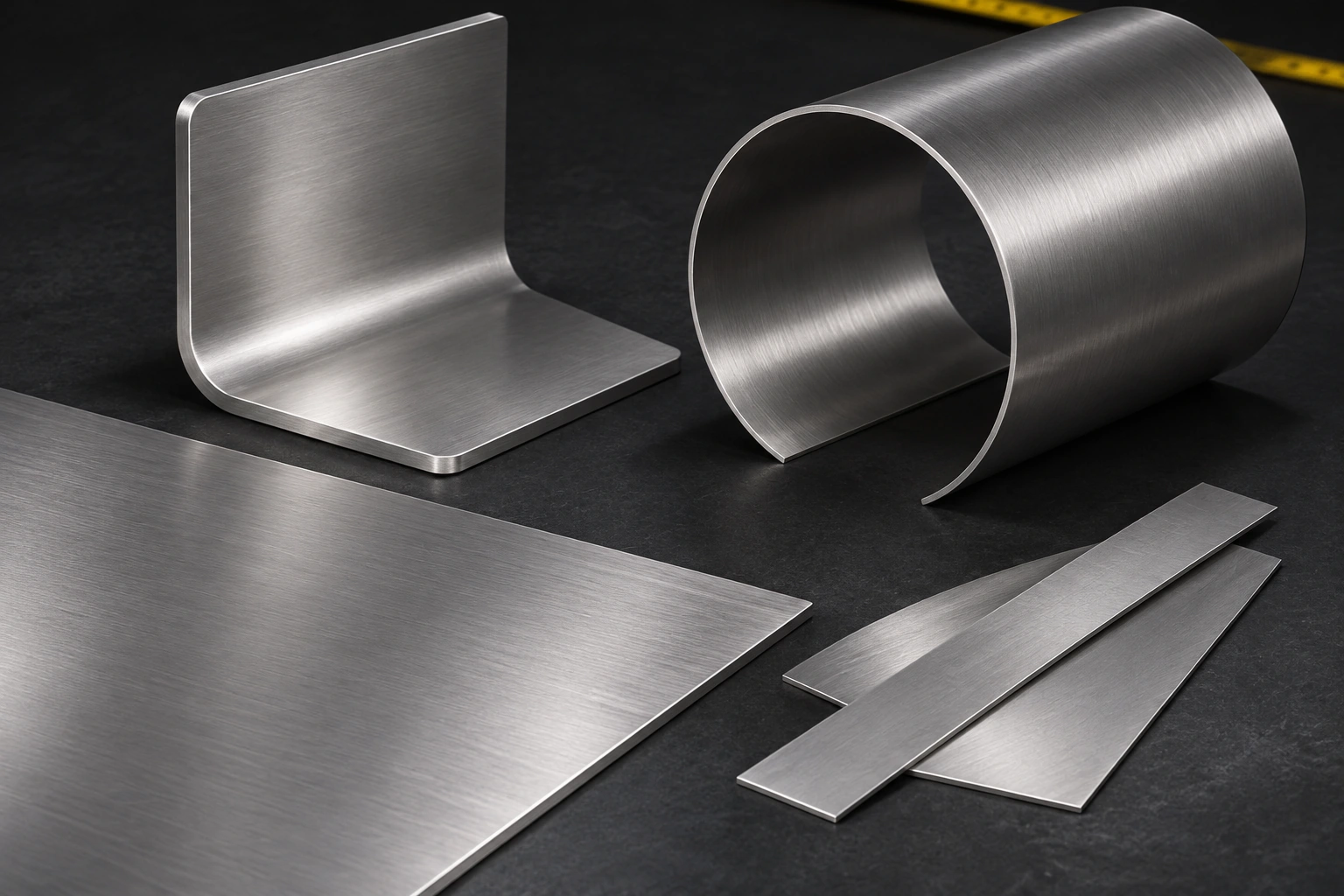
Application detailProduct form matters
Define the plate or sheet specification and condition before fabrication. AI illustration; not production or inspection evidence.
03 / Operating modes
Map normal operation, cleaning and abnormal events
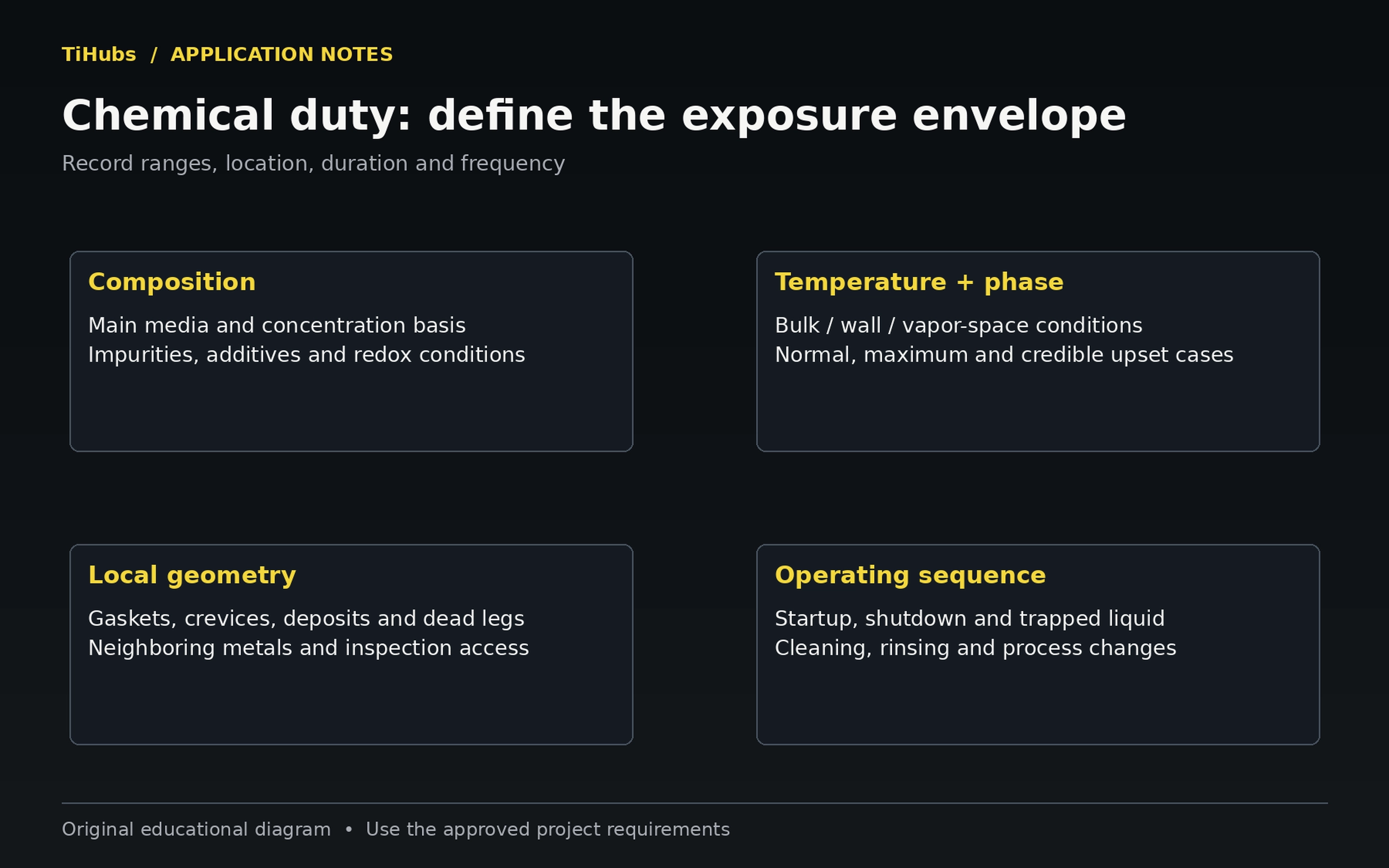
Use a separate row for each operating mode. Record duration, frequency and the component region exposed. A tank wall, vapor-space nozzle, gasketed joint and drain pocket may not experience the same environment even though they belong to one equipment item.
For heating or evaporation, distinguish the measured bulk value from the temperature and concentration conditions expected near the surface. For shutdowns, describe trapped liquid, draining, flushing and the period before restart. For cleaning, provide the approved product or chemical specification and operating procedure to the reviewer.
Do not combine all maximum values into a fictional operating point without explanation. Identify credible combinations and the design cases the engineer must address. Conversely, do not exclude an inconvenient combination simply because it occurs infrequently. The service envelope should represent the actual process and its defined abnormal cases.
Technical buying guideMap the complete chemical exposure
Record composition, location, duration and frequency for each operating mode.
04 / Local conditions
Local geometry can control the decision
Provide a drawing that identifies gasketed joints, lap regions, dead legs, threaded connections, deposits and areas with limited inspection access. A flat corrosion coupon may not represent a shielded joint or deposit-covered region. Ask whether the supporting evidence includes the relevant geometry and surface condition.
The review should also include dissimilar materials, seals, fasteners and any electrical protection arrangement. Replacing a vessel plate with Grade 7 does not automatically qualify every connected component. Identify which items change and which remain in service, and assign responsibility for the interface assessment.
Where geometry can be improved, ask for that option alongside a material change. Removing an unnecessary stagnant pocket or improving inspection access may alter the reliability discussion. The final choice still needs engineering approval; the procurement role is to make the alternatives visible and comparable.
05 / Required evidence
Ask what the corrosion evidence actually represents
A useful report states the material identity and condition, test medium, temperature, duration, specimen arrangement, examination method and result. For field experience, request the service conditions, time in operation, component location and inspection findings. A statement that a grade “has been used successfully” is incomplete without its boundaries.
Evidence
What to verify before relying on it
Published compatibility information
Source, exact chemistry and temperature; whether it is only screening guidance
Laboratory coupon test
Specimen condition, method, duration and whether local attack was assessed
Crevice-oriented evaluation
Geometry and relevance to the proposed joint
Field reference
Actual operating envelope, inspection access and documented history
Existing failed component
Location, orientation, deposits, exposure changes and investigation scope
Do not convert one average corrosion-rate result into a universal wall-loss allowance or a guaranteed equipment life. The test may not represent localized attack, fabrication condition or abnormal operation. Ask the corrosion specialist to state what the result supports and what remains untested.
If testing is required, agree the protocol and acceptance criteria before samples are produced. Include specimen identity, relevant fabrication state, records, sample retention and who can authorize the material decision. A test ordered without a decision rule can produce data without resolving the purchase.
06 / Product requirements
Carry the material decision into the product order
Once a grade is selected, specify the product form and applicable standard: plate, tube, bar, forging or another form. State the edition, delivery condition, dimensions, tolerances and inspection scope. A chemical composition designation alone does not define a finished product requirement.
For fabricated equipment, connect the plate or tube certificate to the cut pieces and weld map. Require the fabrication plan to identify the material, joining procedures, consumables where applicable, inspection stages and final surface condition. Any proposed substitution must be evaluated against both material and fabrication requirements.
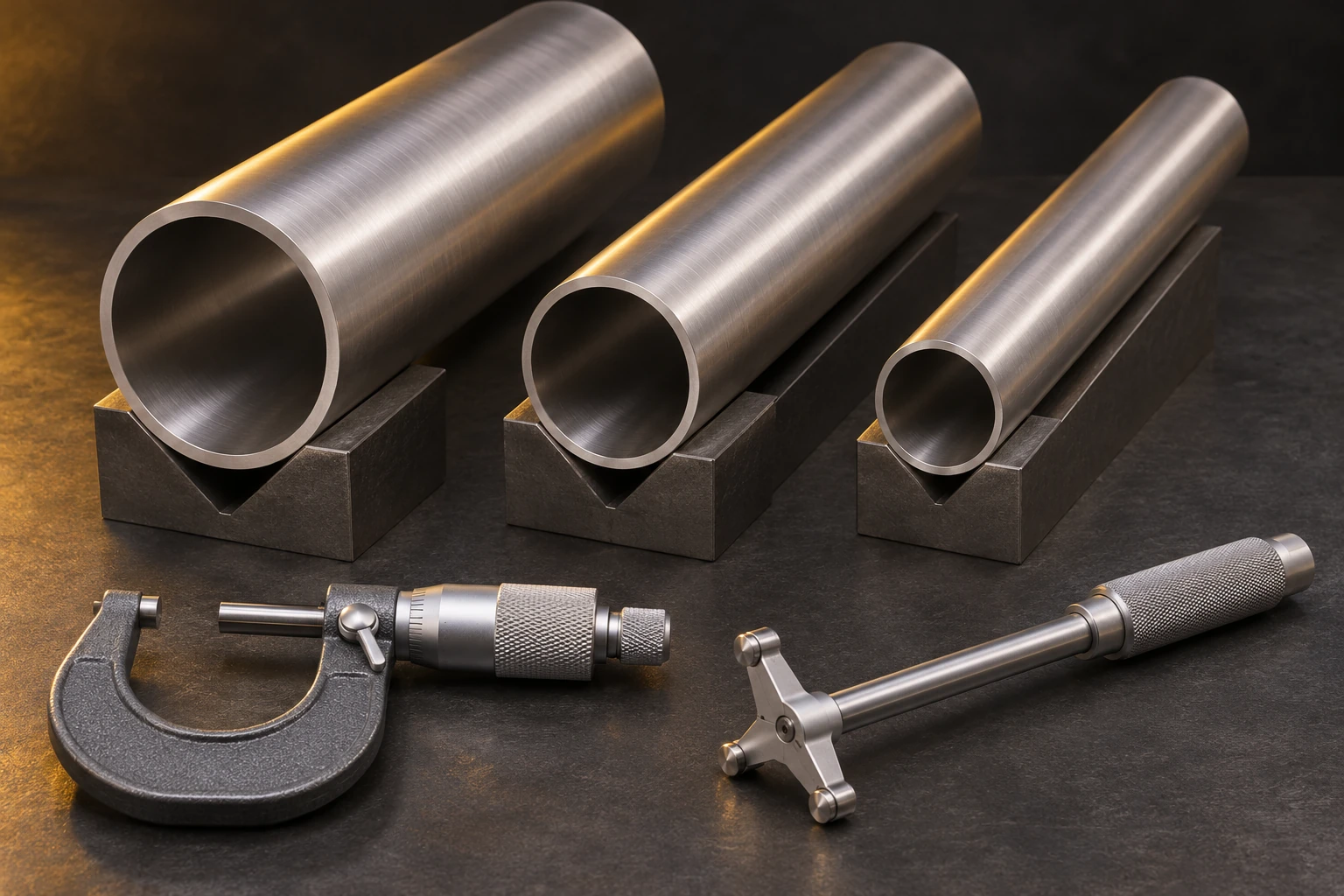
Application detailMeasure against the approved requirement
Record dimensional basis, inspection locations and the identity of the inspected material. AI illustration; not production or inspection evidence.
Where a supplier offers a Chinese designation against a drawing using an ASTM grade, request a clause-by-clause comparison of the complete specifications. Similar naming or chemistry is not enough to establish equivalent product condition, properties, testing or documentation. Approve differences explicitly; do not let a cross-reference table become an automatic substitution instruction.
07 / Selection review
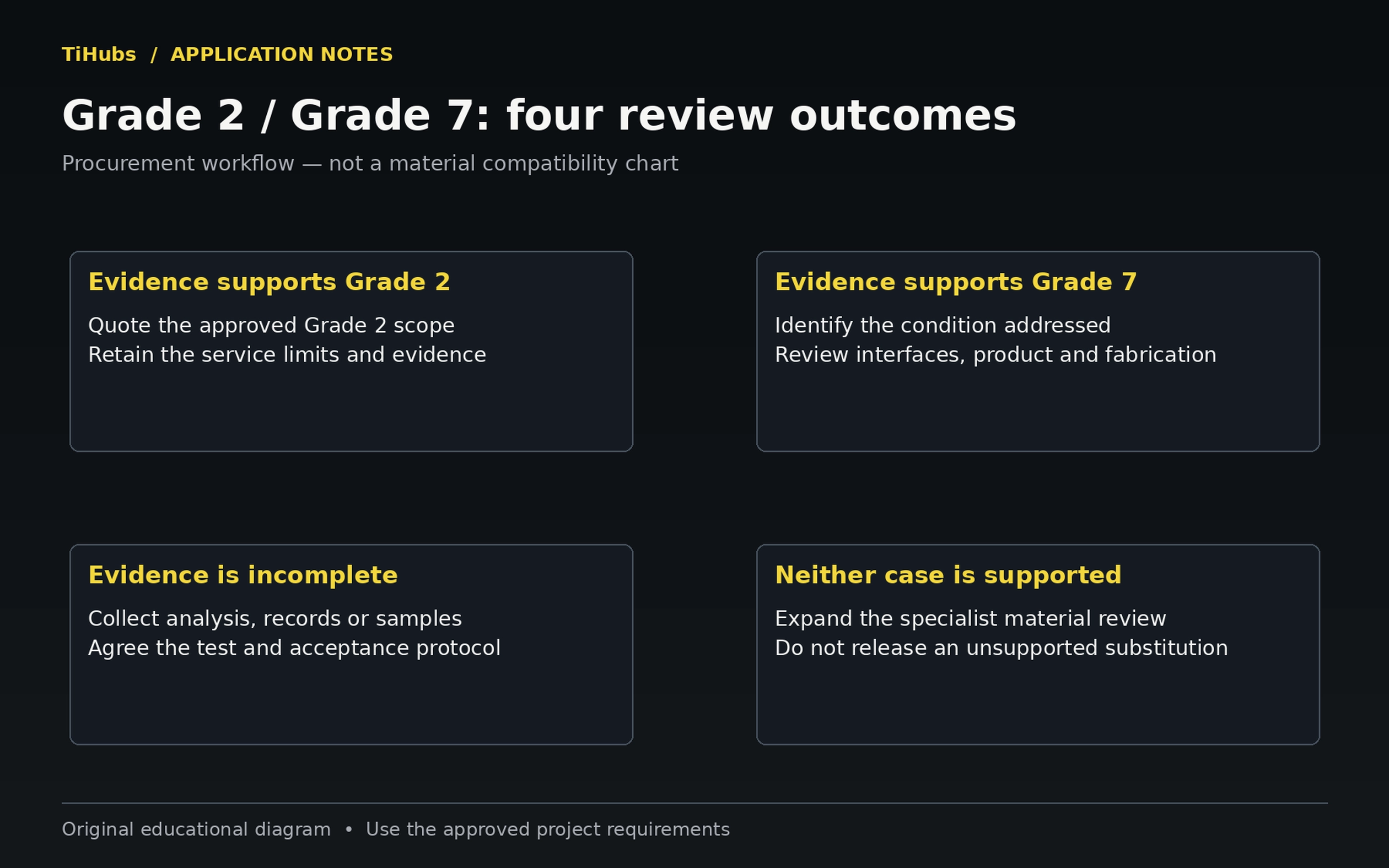
A practical selection review with four outcomes
Use the following matrix to organize the review. It is a purchasing workflow, not a corrosion-resistance chart or a list of approved operating limits.
Review outcome
Next purchasing action
Evidence supports Grade 2 for the complete duty
Quote Grade 2 with the agreed limits and acceptance scope
Evidence supports Grade 7 for a condition that challenges Grade 2
Compare a fully specified Grade 7 proposal and required interface changes
Information is incomplete or evidence is not representative
Obtain missing analysis, records or an agreed test program
Neither proposal has an adequate basis
Refer the design/material choice for broader specialist review
Example: an existing chemical vessel
The operating team requests a Grade 7 replacement after damage near a gasketed connection. Before selecting the new material, collect the joint drawing, damage location, chemistry history, cleaning changes and inspection findings. Ask whether the evidence addresses that specific local condition. A quotation can be prepared with an explicit provisional material basis, but fabrication should follow a released technical specification.
Example: a new multi-product process
The equipment will handle several recipes and cleaning cycles. Build one exposure schedule covering each approved recipe, the changeover sequence and the cleaning procedure. Do not qualify the material using only the least demanding product. If future recipes are outside that envelope, the operating change process should trigger a new material review.
Technical buying guideFour possible review outcomes
A procurement decision framework, not a corrosion-resistance chart.
08 / Cost comparison
Compare Grade 7 cost against the risk it addresses
Request separate pricing for raw material, fabrication, inspection, documentation and delivery. Confirm the quantity basis and dimensions. A Grade 7 quote may differ in availability and manufacturing schedule as well as material cost; ask for the actual project assumptions instead of applying a generic percentage premium.
The business case should identify the specific problem the grade change is intended to reduce. Include maintenance access, planned inspection, spare strategy and the consequence of an unplanned shutdown. If the failure mechanism is unresolved, show that uncertainty in the comparison rather than assigning a guaranteed lifetime improvement.
Compare alternatives over the same evaluation period and operating envelope. A more costly alloy evaluated under ideal conditions cannot fairly be compared with Grade 2 evaluated under the worst possible conditions. Use consistent scenarios and document any different maintenance assumptions.
09 / Release documents
Build a release package, not a collection of certificates
An effective release package links the approved drawing and material specification to the supplied product, its heat/lot, test results and any accepted deviations. The final review should be able to answer: what was required, what was supplied, how was it checked and who accepted any difference?
Approved service envelope and the material-selection basis.
Product standard and edition, exact grade, condition and dimensional schedule.
Material test certificate with heat/lot identity and required results.
Inspection plan, reports and any witness or hold-point release.
Fabrication and joining records within the agreed supply scope.
Deviation register and written approvals linked to the correct revision.
Packing list and identification that preserve the certificate-to-product connection.
When a document is missing, keep the item open. A general company quality certificate is not a replacement for a heat-specific test report. Likewise, a valid raw-material certificate does not resolve an unapproved change in the equipment drawing.
10 / Operating checklist
Build your chemical-service information checklist
Complete all known conditions and mark uncertainties. Include composition ranges and units rather than a single product name. The brief below helps TiHubs coordinate the supply enquiry and identify questions that need the buyer’s process or corrosion specialist before an order is released.
Build your operating-condition checklist
Choose the product and add the information you have. Copy the resulting brief or send your requirements to TiHubs. Submitting an enquiry does not place an order.
11 / FAQs
Frequently asked questions
Is Grade 7 simply a stronger Grade 2?
No. The main comparison here concerns the specified palladium addition and corrosion behavior. Mechanical acceptance must follow the applicable product specification, condition and equipment design.
Does Grade 7 work in every acid?
No. Media composition, concentration, temperature, impurities and local conditions must be reviewed. A generic acid name cannot establish suitability for either grade.
Can pH alone decide the grade?
No. Provide the chemical species, concentrations, impurities and operating modes. Two process streams with the same pH can represent very different material-selection questions.
Should cleaning be included even when it occurs briefly?
Yes. Provide the approved cleaning chemistry, temperature, duration, rinse and frequency. The reviewer needs the complete exposure sequence, including non-production periods.
Is one laboratory corrosion rate enough to predict service life?
No. The result has a defined material, geometry, environment and duration. A specialist must assess whether it represents the equipment and whether localized damage or other mechanisms need separate evaluation.
Can a supplier approve a grade from the enquiry form alone?
The form organizes information; it does not replace the buyer’s engineering approval. Some duties need additional analysis, test evidence or a specialist review before a material can be released.
Can a Grade 2 drawing be filled with Grade 7 without approval?
No. Treat the change as a proposed substitution and review the complete specification, product condition, fabrication and design requirements. Obtain written release from the responsible authority.
What should accompany a failed component sample?
Identify its original location, orientation, heat/lot if known, service duration, operating history and previous cleaning or repair. Preserve the evidence needed for the planned investigation.
12 / Key takeaways
The chemical-equipment decision in five checks
Select against a complete chemistry and operating envelope, not a media label.
Evaluate local joints, deposits and non-production conditions.
Match the supporting corrosion evidence to the actual proposed service.
Carry the grade decision into product, fabrication and traceability requirements.
Price the risk being addressed and retain a written technical release.
TIMET — Corrosion Resistance of Titanium. Technical background on titanium corrosion and alloy selection. Confirm current, project-specific evidence before design release.
The review matrices and examples are original purchasing guidance. No universal chemical concentration or temperature limit is established here. Photographs are AI illustrations, not corrosion-test evidence. References checked November 7, 2026.
Ti
About TiHubs
TiHubs coordinates titanium materials and custom supply from Baoji, China. Our founder’s 20 years in titanium inform a specification-led sourcing approach: clarify the product, manufacturing and acceptance requirements before quotation. Learn about our sourcing role.
Contents
TiHubs
Talk to TiHubs
Ask about titanium materials, grades or custom parts.
Enter your email to start chatting.
We use your email to respond to your enquiry. Your conversation is stored on this website.
Our team is away right now. Leave your enquiry and we will follow up by email.