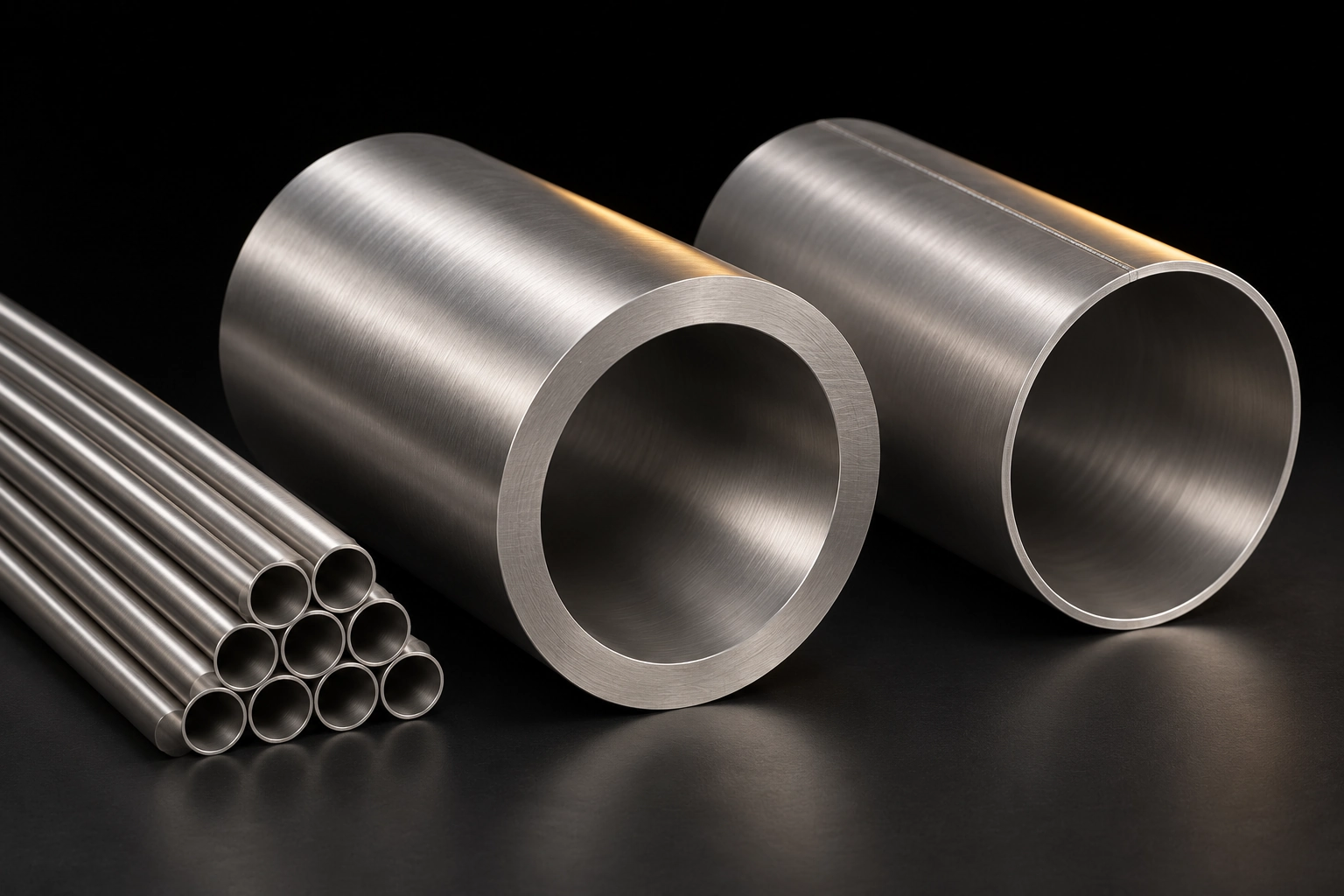
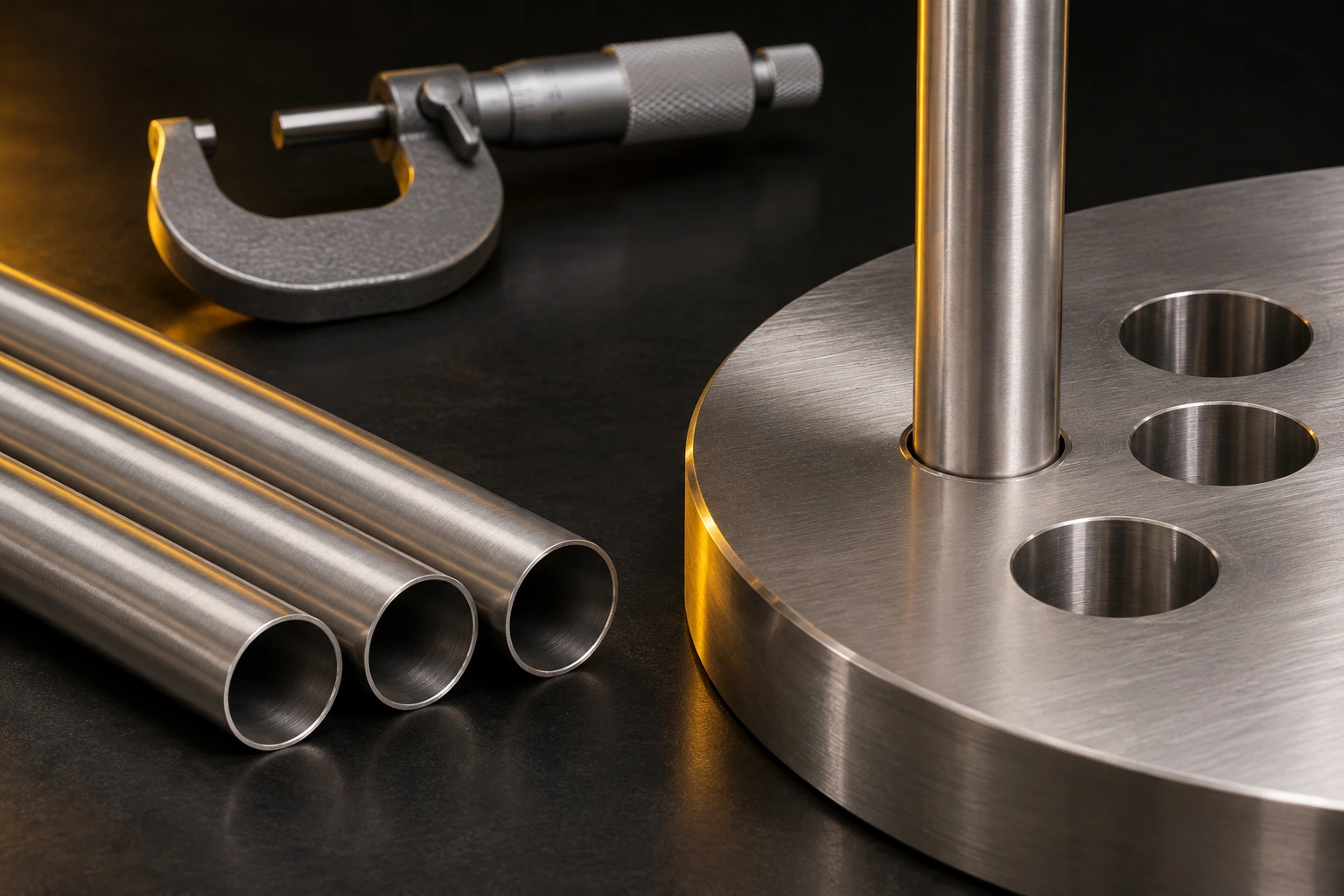
Separate heat-exchanger tubing from seamless and welded pipe, then specify the manufacturing route, dimensions and acceptance evidence the project actually needs.
AI illustration. Appearance and labels do not verify material compliance.
B338, B861 or B862: start with the delivered product
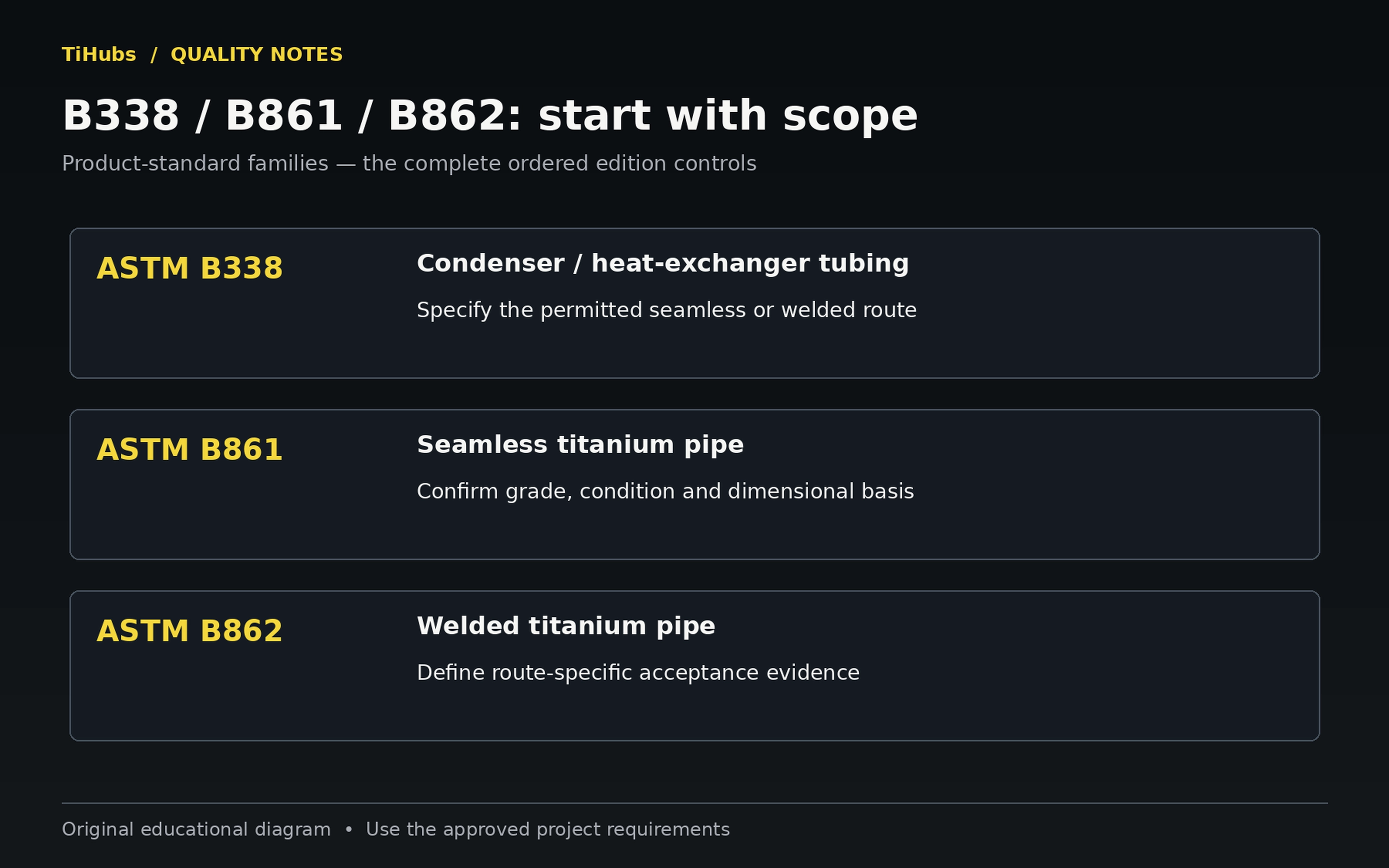
ASTM B338 vs B861 vs B862 is primarily a product-scope and manufacturing-route question. B338 addresses titanium tubing for condensers and heat exchangers. B861 addresses seamless titanium pipe, while B862 addresses welded titanium pipe. The fact that all three products are hollow and may share a grade does not make the specifications interchangeable. [1][2][3]
Choose the specification that fits the engineering requirement, then state the edition, grade, route, delivery condition, dimensions and acceptance requirements. If the drawing and quotation cite different standards, resolve the difference before purchase. A supplier’s statement that its alternative is “equivalent” needs a requirement-by-requirement technical review and written approval.
01 / Scope and evidence
A scope comparison for the purchase order
The specification is part of the product definition. It affects the scope against which manufacturing and inspection evidence is evaluated. A useful comparison therefore begins with what is being supplied and what the equipment documentation requires, rather than with a general ranking of standards as better or worse.
Standard family
Main product scope
Key purchasing question
ASTM B338
Tubes for condensers and heat exchangers, including seamless and welded routes
Is this the required heat-transfer tubing product and route?
ASTM B861
Seamless pipe for corrosion-resisting and elevated-temperature service
Does the ordered pipe form, grade and condition fall within the specification?
ASTM B862
Welded pipe for corrosion-resisting and elevated-temperature service
Are the welded product route and associated acceptance requirements defined?
The publisher listings checked on November 7, 2026 identify B338-17(2026), B861-24 and B862-23. These are reference points, not automatic changes to an existing contract. Use the edition required by the project and identify any proposed revision explicitly. The complete ordered texts, including applicable exceptions and supplementary requirements, govern the supply. [1][2][3]
Inspection planning diagramChoose the tube or pipe specification by scope
Original explanatory diagram. The full ordered edition and approved engineering requirement control.
02 / Equipment requirements
Let the equipment requirement lead the choice
For a replacement heat-exchanger bundle, begin with the equipment drawing, original material specification, tube dimensions and installation requirements. A replacement tube must fit the tubesheet and approved joint arrangement as well as satisfy the material requirement. Similar appearance and nominal grade do not establish dimensional or manufacturing suitability.
For a process piping purchase, begin with the piping specification, line class or project material schedule and the responsible engineer’s approved product basis. Check whether the project specifies seamless or welded construction. A process service description alone does not authorize the supplier to change the route, grade or standard to improve availability.
Some enquiries use “tube” and “pipe” loosely, especially across languages. Translate the requirement into an explicit product description and dimensions. Do not let a translation decide the standard. Ask whether the buyer is ordering heat-transfer tubing, process pipe, a fabricated spool or a finished equipment assembly; the acceptance scope grows as fabrication is added.
An equipment design code and a material product specification also serve different purposes. Material conformity is one part of an engineered assembly’s compliance. Do not imply that a B338, B861 or B862 certificate by itself establishes a pressure rating, validates a joint design or approves the complete system.
03 / Manufacturing route
Specify the manufacturing route as a requirement
“Titanium tube” is insufficient when construction matters. Identify seamless, welded or another expressly permitted and approved route using the terminology of the selected specification. If a supplier proposes additional cold working, heat treatment or finishing, state the final delivery condition and the evidence representing it. Evaluate the offered route against the ordered edition rather than relying on a generic manufacturing description.
Properties and fabrication behavior depend on processing
Condition stated on order and certificate
Is further working or finishing performed?
Final geometry and applicable evidence may differ
Process sequence and final inspection stage
Are tubes supplied straight or formed?
Bending adds geometry and inspection considerations
Drawing, forming scope and post-forming checks
Is supply raw tube/pipe or an assembly?
Welding and assembly add acceptance records
Clear boundary between material and fabrication scope
A seamless route is not proof that a product has no defects. A welded route is not proof that it is unsuitable. Compare the actual construction, required examinations, fabrication constraints and service approval. The route must be supported by the right manufacturing and inspection evidence, not a marketing claim about universal superiority.
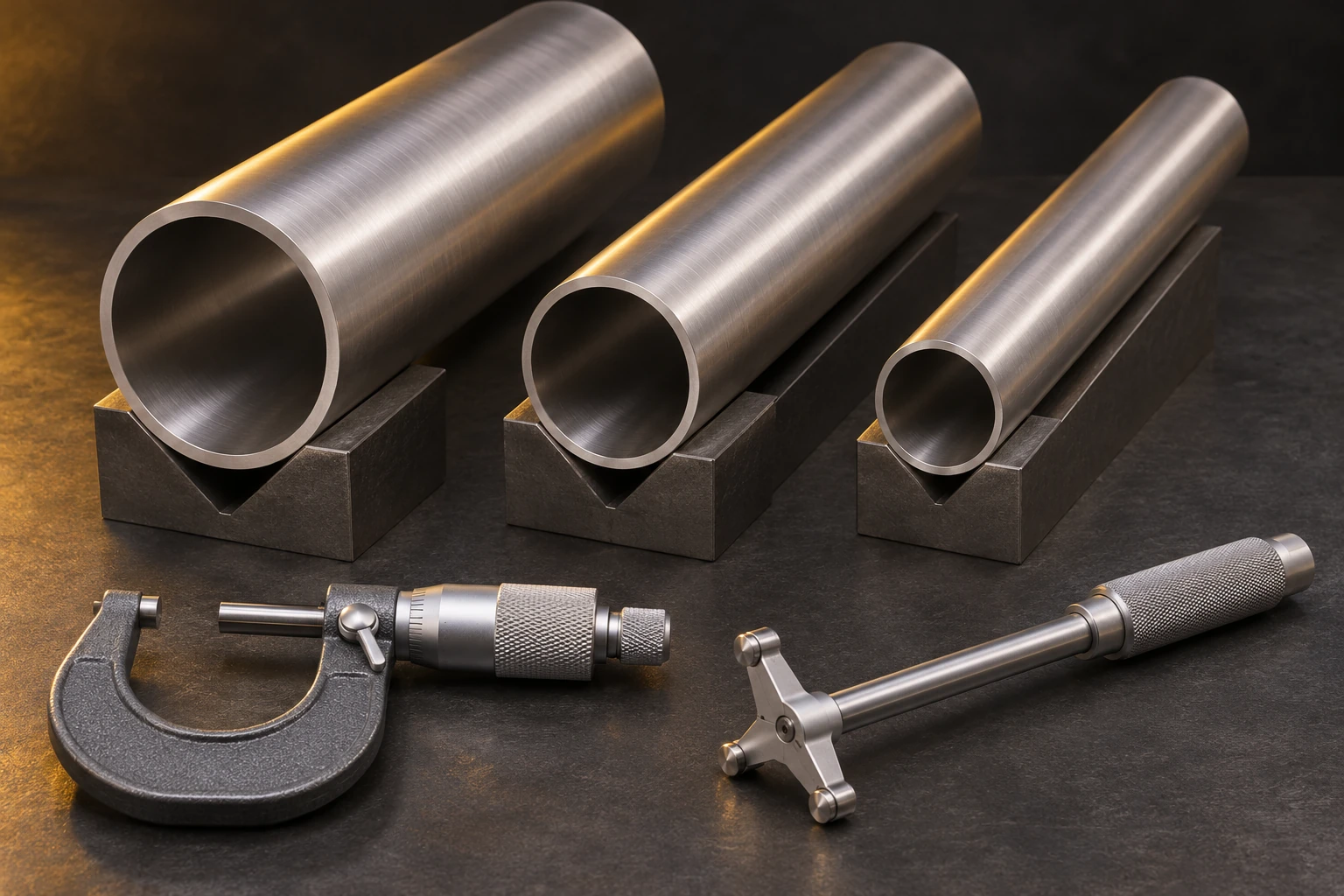
Illustrative product viewTube inspection follows the ordered requirement
AI illustration; not a factory, inspection or compliance record. Agree the dimensional basis, examination scope and traceability before release.
04 / Dimensions and units
Resolve OD, NPS, wall and units before comparing quotations
An outside diameter is a physical dimension. A nominal pipe size is a size designation whose dimensional meaning comes from the applicable system. Do not enter the same number in both fields and assume they describe the same product. Ask the supplier to confirm the offered actual OD and wall dimensions on the quotation.
State whether the wall is nominal, average or minimum as required by the product and project documents. A quotation for a nominal wall cannot be assumed to satisfy an order written around minimum remaining wall. Identify the governing tolerances and their relationship to the wall basis. The drawing should also explain whether any corrosion or machining allowance is part of the specified stock dimension.
An illustrative tube enquiry might read OD 19.05 mm, minimum wall 0.70 mm, straight finished length 6,000 mm, followed by the actual tolerances, grade, route, condition and test requirements. These numbers illustrate the information structure only; they are not a design recommendation or a universal product tolerance.
Dimensional field
Information to record
Size system
Actual OD or NPS with the corresponding dimensional basis
Wall
Numerical thickness, units and nominal/average/minimum basis
Length
Finished length, tolerance, permitted overlength and end allowance
Geometry
Straightness, ovality or other required form criteria
Ends
Cut condition, bevel or square-cut requirement, burrs and protection
Formed tubing
Bend drawing, leg lengths, radius and relevant post-forming acceptance
Keep one agreed unit system for each controlled requirement. Avoid rounding dimensions from an old inch-based drawing into convenient metric stock sizes without approval. Where both units appear, identify which controls and how the other is presented. A small purchasing shortcut can become a large fit-up problem across hundreds of tubes.
05 / Grade and condition
Match grade, condition and certificate scope
Grade names do not float independently of the specification. Confirm that the selected edition includes the exact grade and condition needed for the delivered product. Record the complete designation and any required additional identification. A heat certificate for the starting material is part of the evidence chain, not necessarily the complete certificate for the final tube or pipe.
Check that the reported tests represent the final product condition and the applicable manufacturing/test lot. If starting sheet becomes welded pipe, the sheet certificate alone does not demonstrate every requirement of the delivered pipe. Similarly, a billet certificate does not automatically certify the dimensions, condition and examination of finished seamless pipe.
For a proposed Chinese-grade substitution, compare the complete specifications, grade definitions, condition, product form and acceptance requirements. A commercial cross-reference is a starting point for discussion. If the order requires Grade 2 under an ASTM product specification, a quotation stating only TA2 leaves important requirements unresolved.
06 / Inspection evidence
Turn “tested” into an inspection requirement
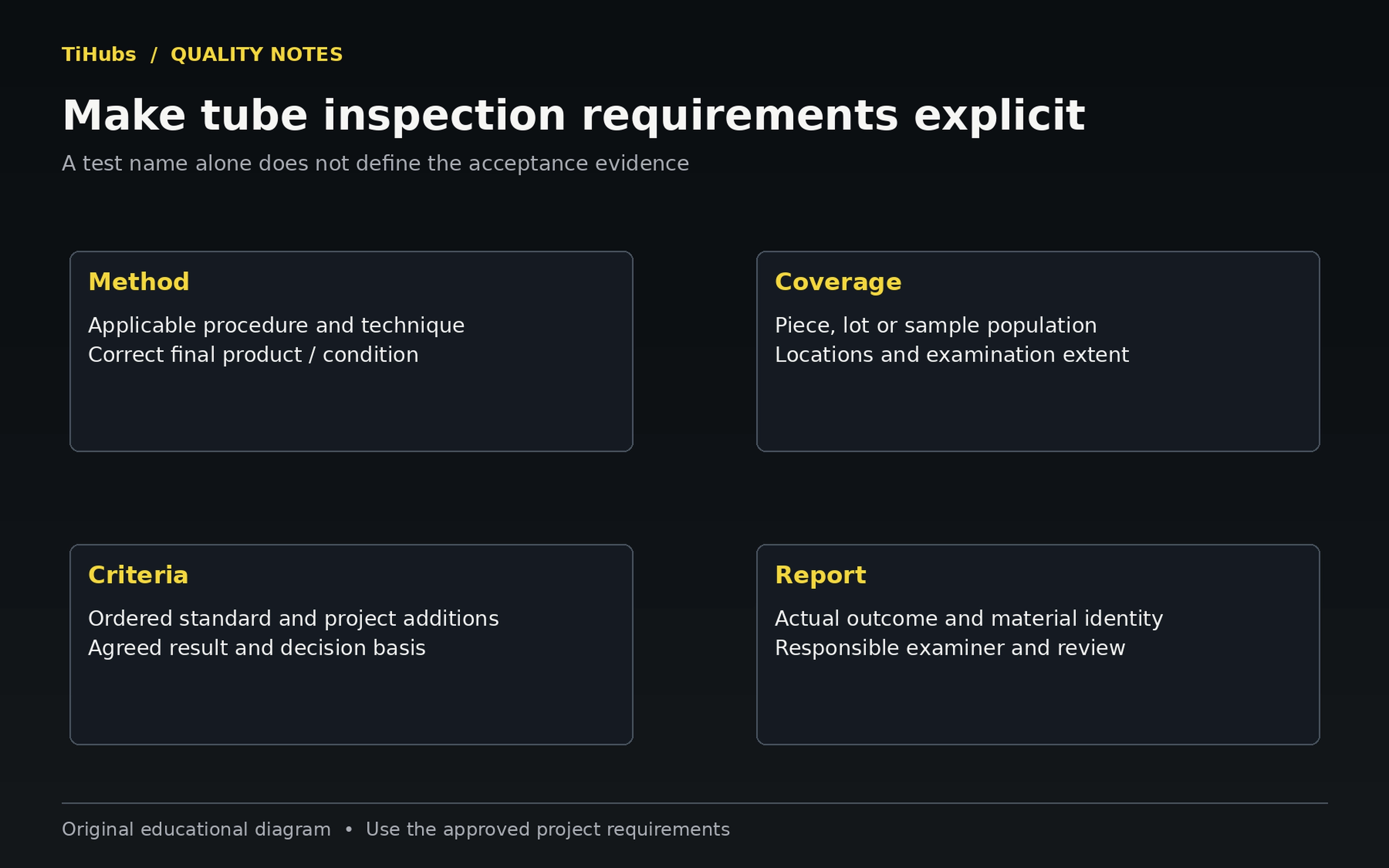
Build a test matrix from the complete ordered specification, project supplements and drawing. For each required activity, identify the method, extent, acceptance criteria, test stage, responsible party and report. The exact requirements can depend on product route, grade, size and edition. Do not create a universal testing package from a short catalogue abstract.
Evidence family
Define in the plan
Avoid accepting only
Chemistry
Applicable analysis, represented heat/lot and required elements
A generic grade-library match
Mechanical properties
Product condition, test lot, specimen basis and required properties
“Strength OK” without results
Product tests
Applicable deformation or other tests required by the specification
A test name without applicability
Nondestructive examination
Technique, coverage, acceptance criteria and report mapping
“100% NDT” without an identified method
Leak/pressure integrity evidence
Applicable procedure, conditions and represented pieces
An unlabeled photograph of a test setup
Dimensions and surface
Measurement locations, tolerance basis and finish criteria
One convenient measurement on one tube
Hydrostatic, electromagnetic and ultrasonic examinations answer different questions. Do not assume one can replace another simply because the supplier offers it as an alternative. Where the selected specification permits alternatives, document the exact basis and buyer choice. Project supplements may add requirements beyond the basic material specification.
Inspection planning diagramSpecify the evidence behind each test
Original explanatory diagram. Method, coverage, acceptance criteria and report identity belong together.
07 / Welded products
Give welded-product evidence a defined place
For welded pipe or tube, clarify which seam-related records the product standard and order require and at what stage examinations occur. If subsequent working, forming or heat treatment is involved, ensure the inspection plan reflects the final supplied scope. Ask the supplier to map records to the product lot and delivered lengths.
Distinguish factory longitudinal seam acceptance from later circumferential installation welds. The pipe or tube certificate does not certify a field weld made after delivery. Installation procedure, welder qualification, joint examination and assembly tests belong to the applicable fabrication and equipment requirements.
Surface color or a smooth seam is not a substitute for the required examination. Photographs can communicate surface condition and identification, but they do not reproduce the capability of a defined test method. If a buyer has specific visual criteria, record them in addition to, not in place of, the required technical evidence.
08 / Replacement orders
For replacement orders, collect more than an old tube
An old tube can provide useful dimensional clues, but wear, corrosion, deposits or previous deformation may make it unsuitable as the sole basis for a new order. Compare measurements with original drawings and records. Identify which dimensions were taken from used material and which are design requirements awaiting confirmation.
Record the tubesheet material and geometry, joint method, tube projection and any installation constraints. Include whether the tube will be expanded, welded or joined by another approved method. The responsible equipment designer should determine compatibility and required joint qualification; a material supplier should not infer those decisions from a photograph.
Ask why replacement is needed. End damage, vibration, fouling, handling damage and material selection questions lead to different investigations. Do not promise that changing a standard or moving from welded to seamless construction will fix an unidentified failure mechanism. Preserve failed samples and relevant service records when an engineering investigation is needed.
Illustrative product viewReplacement tubes must fit the approved assembly
AI illustration; not a factory, inspection or compliance record. Confirm tubesheet and joint requirements with the responsible equipment designer.
09 / Evaluate alternatives
When a quotation offers a different standard
Use a deviation matrix rather than a one-line “equivalent” statement. Compare scope, grade, condition, route, dimensional basis, tests, traceability and documentation. Mark each item as matched, different, missing or not applicable, with the supporting document reference. Assign the review to the person authorized to approve the equipment requirement.
Illustrative case: a buyer requests condenser tubes under B338; the quotation offers Grade 2 seamless pipe under B861 because stock is available. The grade and seamless route do not settle the question. The buyer still needs to reconcile product scope, OD/wall tolerances, delivered condition, applicable examinations and fit with the tubesheet arrangement. Until that review is approved, the quote describes an alternative, not a conforming supply.
Dual certification is also an evidence claim. It requires demonstrated compliance with both stated specifications for the product being supplied, not merely printing two standard numbers on the certificate. Ask which records support each requirement and whether any exclusions remain. If the evidence only supports one specification, state that clearly.
10 / Complete order line
A complete order line has several layers
Use a structured enquiry rather than scattering requirements across email attachments. Identify the controlling order and drawing revision, then list the product specification, exact grade, manufacturing route and condition. Add the dimensional basis, required inspection and certification, quantity and packaging, followed by all approved deviations.
For example: Titanium heat-exchanger tubing; ASTM B338, edition as specified; exact grade; approved route; delivery condition; OD × wall basis × finished length; dimensional tolerances; applicable tests and supplements; traceability and inspection documents; quantity and packing requirements. Fill every field with project-approved information rather than treating the template as a finished specification.
TiHubs can coordinate the offered manufacturing route, mill documents and inspection scope with the supplying factory. A useful quotation should distinguish compliant supply, proposed alternatives and items awaiting engineering clarification. That separation helps buyers compare total scope rather than only unit price.
11 / Build your checklist
Build a tube or pipe specification brief
Use the checklist to state the duty, standard edition, route, dimensional basis and acceptance evidence. If you are replacing old tubes, add the original equipment drawing and identify unresolved measurements. The generated brief can be copied into an enquiry or submitted for a coordinated quotation review.
Build your inspection and acceptance checklist
Choose the product and add the information you have. Copy the resulting brief or send your requirements to TiHubs. Submitting an enquiry does not place an order.
12 / FAQs
Titanium tube and pipe standard FAQs
Is B338 only for seamless tubing?
No. Its scope includes seamless and welded titanium tubing for the stated heat-exchanger and condenser applications. Specify the exact permitted route and relevant requirements in the order.
Is B861 automatically better than B862?
No. They address different manufacturing routes. Suitability depends on the approved design, product requirements, available evidence and service conditions rather than a universal ranking.
Can B862 pipe replace B338 tube if the grade matches?
Only after an authorized review establishes that the proposed product meets the project’s requirements. Matching grade does not establish matching dimensions, construction or acceptance scope.
Should I write OD or NPS?
Use the dimensional basis required by the product and design, and make it explicit. For an NPS-based order, confirm the actual OD and wall associated with the selected size system.
Does nominal wall mean minimum wall?
No. State the required wall basis and applicable tolerance. Do not assume that a nominal-wall quotation meets a minimum-wall requirement.
Is a hydrostatic test enough for every tube order?
No universal answer applies. Use the complete product specification and project inspection plan, including any other examinations required for the selected route and product.
Can two ASTM numbers be listed on one certificate?
They can be claimed only when the delivered product has evidence supporting compliance with both. Request the basis for dual certification rather than accepting the labels alone.
Can an older edition still be used?
Yes, when the contract and applicable project requirements permit it. Identify the exact edition and resolve differences before ordering rather than automatically replacing it with the latest listing.
13 / Key takeaways
What to put on the order
Match the standard to the delivered product and approved equipment requirement.
Define route, condition, actual dimensional basis, wall convention and units.
Map every required test to its method, coverage, acceptance criteria and report.
Treat substitutions and dual certification as technical claims requiring evidence and approval.
Technical references
Technical references and scope
The comparison summarizes published scope information and provides original purchasing guidance. Consult the complete ordered editions for mandatory tests, permitted alternatives, tolerances and supplements.
TiHubs coordinates titanium materials and custom supply from Baoji, China. Our founder’s 20 years in titanium inform a specification-led sourcing approach: clarify the product, manufacturing and acceptance requirements before quotation. Learn about our sourcing role.
Contents
TiHubs
Talk to TiHubs
Ask about titanium materials, grades or custom parts.
Enter your email to start chatting.
We use your email to respond to your enquiry. Your conversation is stored on this website.
Our team is away right now. Leave your enquiry and we will follow up by email.