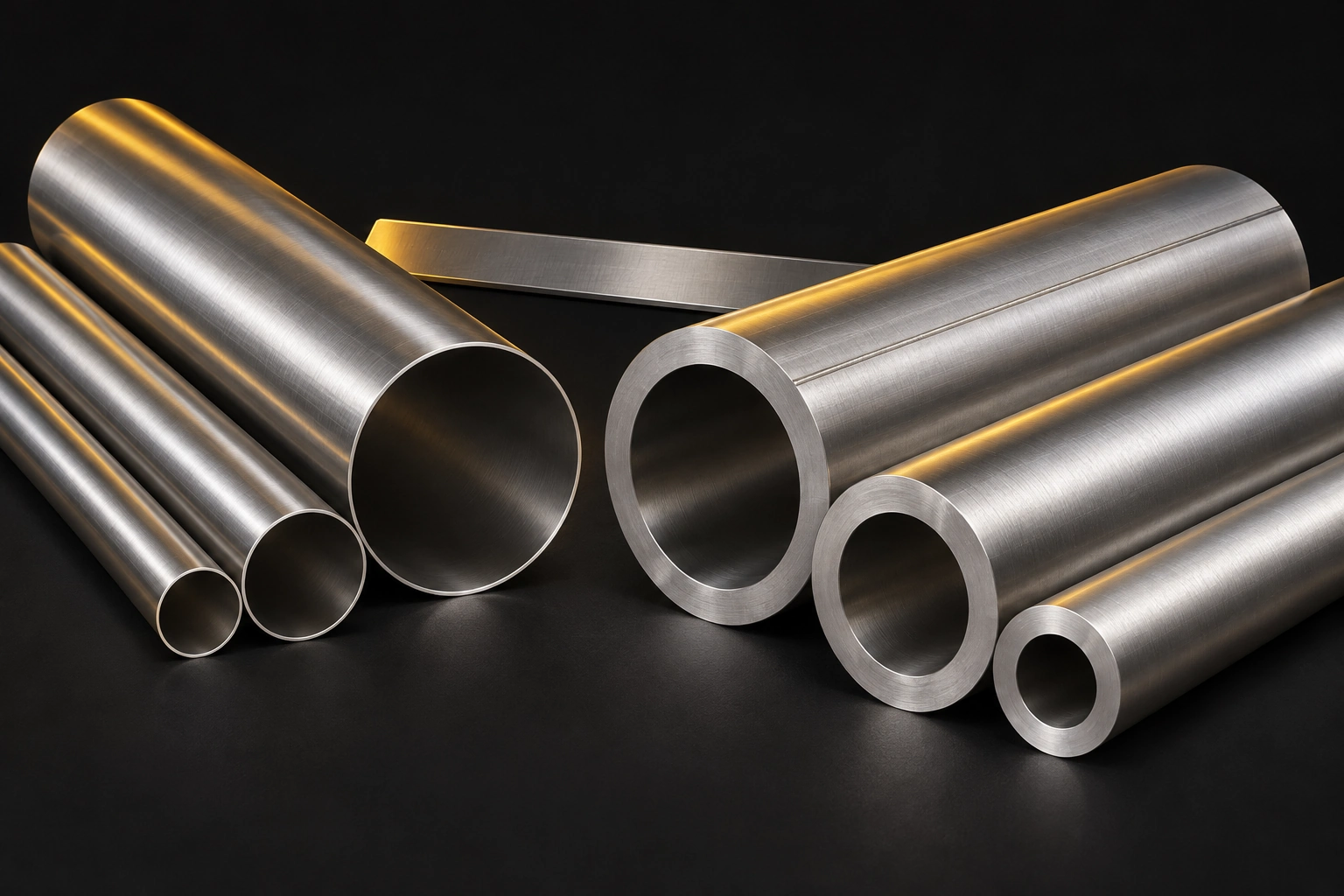
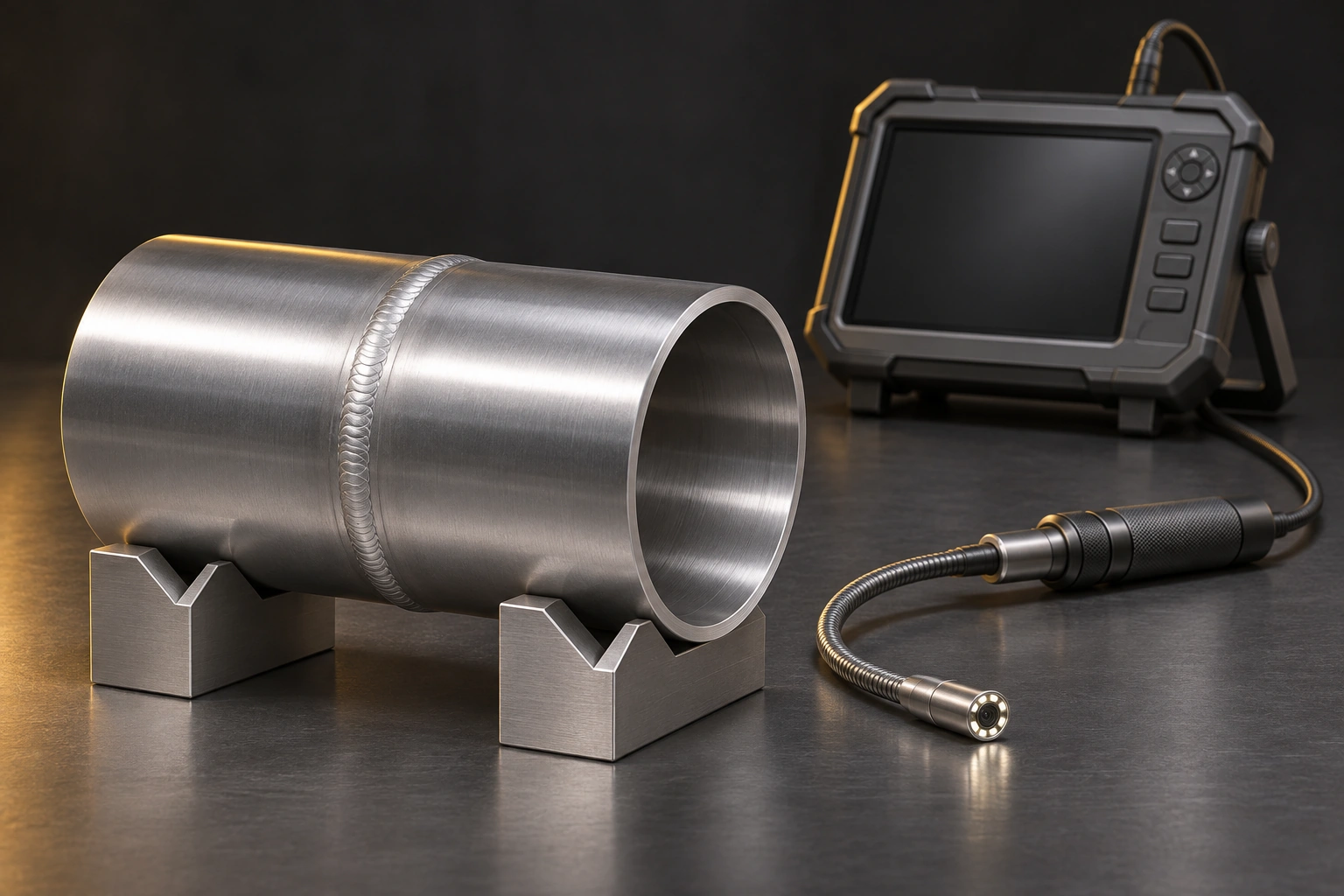
AI illustration. Appearance and labels do not verify material compliance.
Quick Answer
Choose seamless versus welded titanium tube by the required product specification, service, dimensions, manufacturing condition and inspection scope. Seamless construction removes a longitudinal manufacturing weld, but it does not remove the need for material, dimensional and defect verification. Welded tube can be a suitable engineered product when the relevant specification permits its route and its weld processing, tests and records meet the order. Neither route is automatically the cheapest or the best for every size and application.
Before requesting prices, distinguish heat-exchanger tube from pipe, specify whether the wall is nominal or minimum, and identify any code or customer restriction on manufacturing route. Compare offers only after those requirements match.
01 / Tube vs pipe
Start with the product standard, not the route label
Tube and pipe are not interchangeable purchasing descriptions
“Titanium tube” is often used loosely in enquiries. A condenser tube specified by outside diameter and wall thickness is a different purchase definition from piping specified by nominal pipe size and schedule. Confirm the actual dimensions and tolerance system. A nominal size is not a substitute for a dimensional drawing when fit to a tubesheet, socket or instrument connection is critical.
ASTM B338 covers seamless and welded titanium tubing for condensers and heat exchangers. ASTM B861 addresses seamless titanium pipe, while ASTM B862 addresses welded titanium pipe. These are distinct product specifications, not three interchangeable certificates for an otherwise unspecified cylinder. Their grade, condition, manufacturing and testing provisions must be checked against the ordered edition. [1][2][3]
Starting requirement
What to define
What not to assume
Heat-exchanger or condenser tube
Tube specification, OD, wall basis, length and tube-end requirements
That a general pipe certificate covers the tube order
Process piping
Pipe specification, size system, wall/schedule, end preparation and design code
That a familiar OD identifies the correct schedule or tolerance
Precision mechanical tube
Drawing, material/product specification, bore and geometric requirements
That pressure-service testing alone proves dimensional fit
Fabricated spool or assembly
Base product plus joining, fabrication and final inspection requirements
That mill testing covers every later fabrication operation
Keep material grade and route as separate decisions
Grade selection starts with the service and design specification. Route selection starts with what is permitted and available in the required geometry. A supplier should not change Grade 7 to Grade 2, or welded to seamless, simply because a stock item appears similar. Each alternative needs a documented review of the affected requirements.
When sourcing a Chinese designation against an international drawing, preserve the complete designation, product standard and edition on the comparison sheet. Use the TA2 vs Grade 2 guide to structure that review. A cross-reference name is not enough to approve a tube lot.
02 / Manufacturing routes
What the two manufacturing routes change
Seamless: no longitudinal manufacturing seam
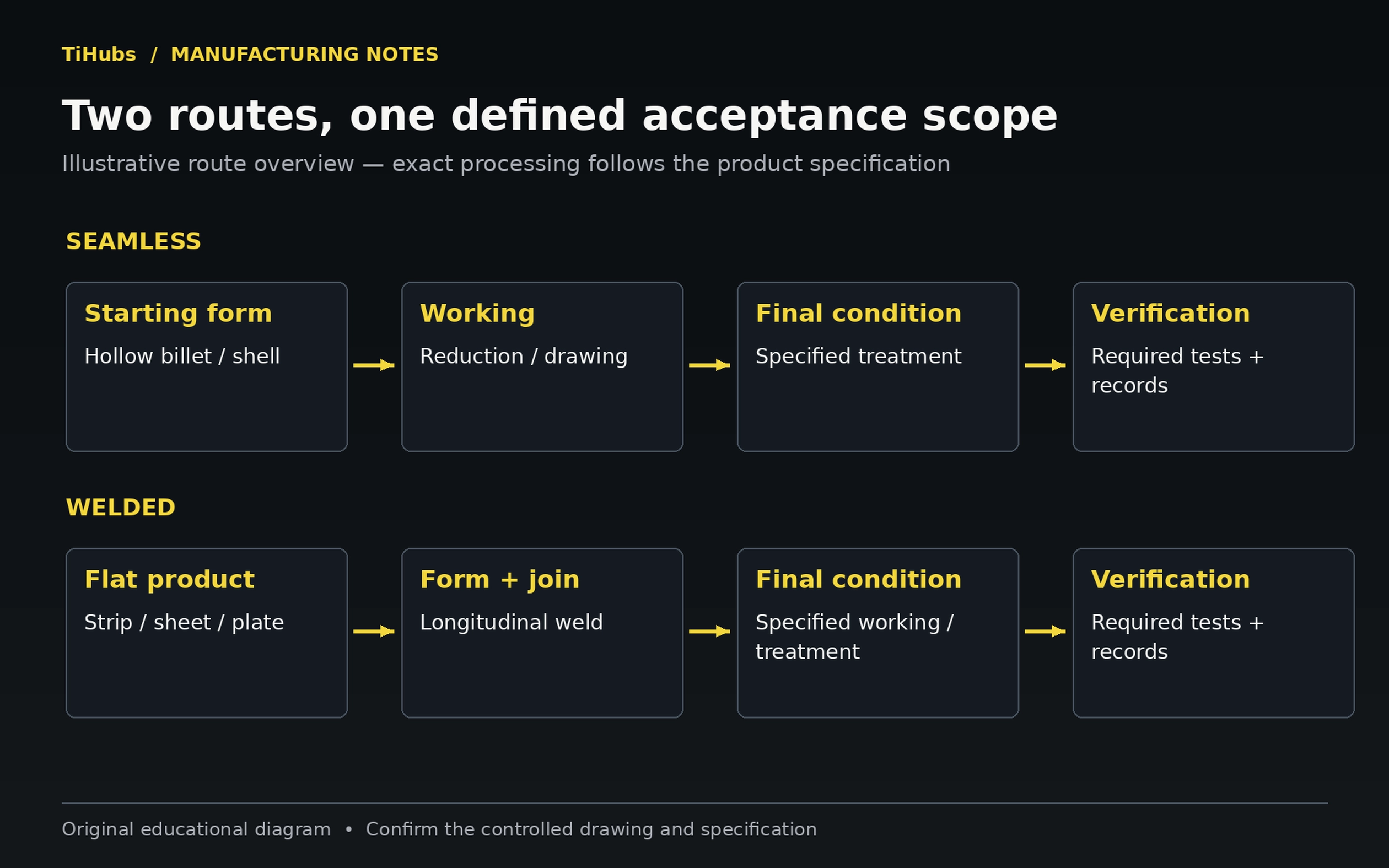
The seamless route develops the tube from a hollow starting form and subsequent working and treatment appropriate to the product. Ask the producer to identify the actual route and final condition. “Seamless” alone does not define dimensional uniformity, surface condition, grain structure, residual stress or the permitted imperfection limits.
For procurement, the important questions are whether the required grade and geometry are available, which operations bring it to final size, and how the final tube is verified. A special size can require a different order quantity and production schedule from a regularly produced size. An absence of seam is one feature of the route, not a blanket guarantee against defects.
Welded: a controlled seam and a specified final product
Welded tube begins with flat product formed and joined along its length. Subsequent processing depends on the applicable specification and manufacturing plan. Some orders may involve further working and heat treatment; others have a different defined route. Ask what condition the finished product is supplied in and how the weld region is addressed.
Do not assume a weld line must remain visibly obvious, or that an inconspicuous line proves a seamless route. Final surface processing can change appearance. Manufacturing records and product identification establish the route. Similarly, a polished exterior does not demonstrate the quality of an internal surface or weld root.
Technical diagramCompare the route and final condition.
Illustrative process overview. Exact operations and acceptance follow the ordered product specification.
Why route descriptions need enough detail
A quotation reading “welded titanium tube, tested” leaves several commercial questions open. Is the quoted material the grade and condition on the drawing? Is final size reached before or after the relevant treatment? Which tests cover the seam, the full tube or a sampled lot? Are the ends suitable for the intended joining operation? Each answer can affect cost and lead time.
Ask for a short manufacturing-route statement rather than a promotional process list. It should describe the product being supplied, identify relevant specification requirements and state any proposed deviations. The buyer does not need the producer’s proprietary operating recipe to understand the compliance scope.
03 / Dimensions & wall
Dimensions that change availability and cost
Specify wall thickness correctly
“1 mm wall” is incomplete unless the tolerance and wall basis are clear. A nominal-wall order and a minimum-wall order can imply different acceptable products. If a design needs a minimum remaining wall, do not assume the negative tolerance on a nominal wall is harmless. The responsible designer should establish the requirement; the supplier should quote it explicitly.
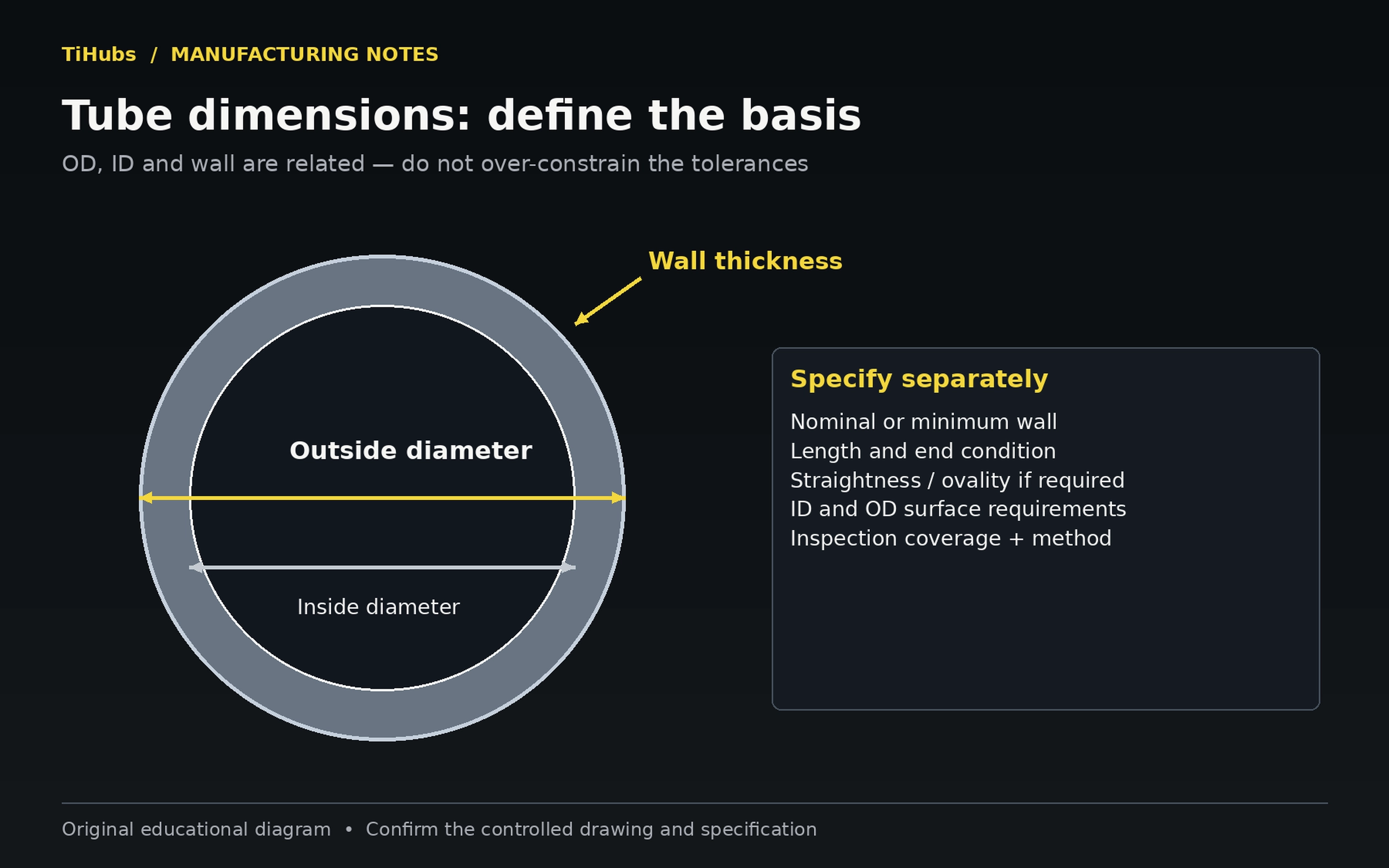
For precision fit, identify whether OD, ID, wall thickness or a combination controls function. These dimensions are related, so avoid over-constraining them with incompatible tolerances. State how ovality, eccentricity and straightness are evaluated where important. A measurement at one cut end cannot establish full-length geometry.
Length and ends can dominate the practical order
Random lengths, fixed lengths and matched lengths create different cutting and yield assumptions. Specify end squareness, burr condition, bevels, end protection and any tube-end finishing needed for assembly. If a tube will be expanded or welded into a tubesheet, define the interface requirements through the approved fabrication plan.
Long, thin-wall tubes can be sensitive to handling and packaging. Confirm supports, bundle protection, lifting arrangements and prevention of internal contamination. For finished or cleaned bores, agree how ends are protected and how the protection is maintained until installation.
Dimensional item
RFQ wording to resolve
Why it matters
Size designation
OD/ID in stated units, or pipe size plus schedule
Prevents different sizing systems being compared
Wall basis
Nominal or minimum, with governing tolerance
Changes acceptable wall and potential material use
Length
Fixed/random, cut allowance and length tolerance
Affects yield, minimum order and packing
Geometry
Ovality, straightness, eccentricity where required
Controls fit and downstream processing
Ends
Square cut, deburred, bevelled or specially prepared
Adds processing and inspection scope
Surface
ID and OD requirements stated separately
Avoids an exterior-only finish assumption
Technical diagramSpecify a consistent dimensional basis.
Original schematic, not to scale. Nominal or minimum wall and the tolerance system must be stated separately.
04 / Total supplied cost
Compare total supplied cost, not a fixed route premium
It is reasonable to ask whether welded tube offers an economical option for an approved application. It is not reasonable to assume that welded is always a fixed percentage cheaper. The result depends on grade, size, wall, quantity, current availability, finishing, inspection and the producer’s route. A stocked seamless size can compare differently from a special welded production run, and vice versa.
Ask for quotation lines that identify material/product price, special sizing or finishing, additional testing, documents, packing and delivery. If one bid includes an extra inspection and another does not, first determine whether that inspection is required. Do not delete an acceptance requirement solely to make a cheaper bid appear equivalent.
Compare quantities on the same basis
Price per kilogram can hide differences in wall basis, cut lengths and permitted tolerance. Price per metre can hide the effect of a different wall thickness. Price per accepted piece is useful for fixed-length assemblies, provided the drawing and delivery scope match. Use a common comparison sheet that includes all three relevant quantities: number of pieces, delivered length and estimated mass.
Account for downstream cost
A lower tube price can lose its advantage if it requires extra straightening, end machining, cleaning or sorting before assembly. Ask the fabricator what tube characteristics affect its production. If the tube is part of a heat exchanger, missed length, damaged ends or an unsuitable surface can create costs well beyond the mill-product price.
Replacement stock and repair strategy also matter. A special size may perform adequately but be difficult to replenish on a maintenance schedule. Discuss availability separately from technical acceptance. Do not convert a convenience concern into an unsupported statement that one route is inherently safer.
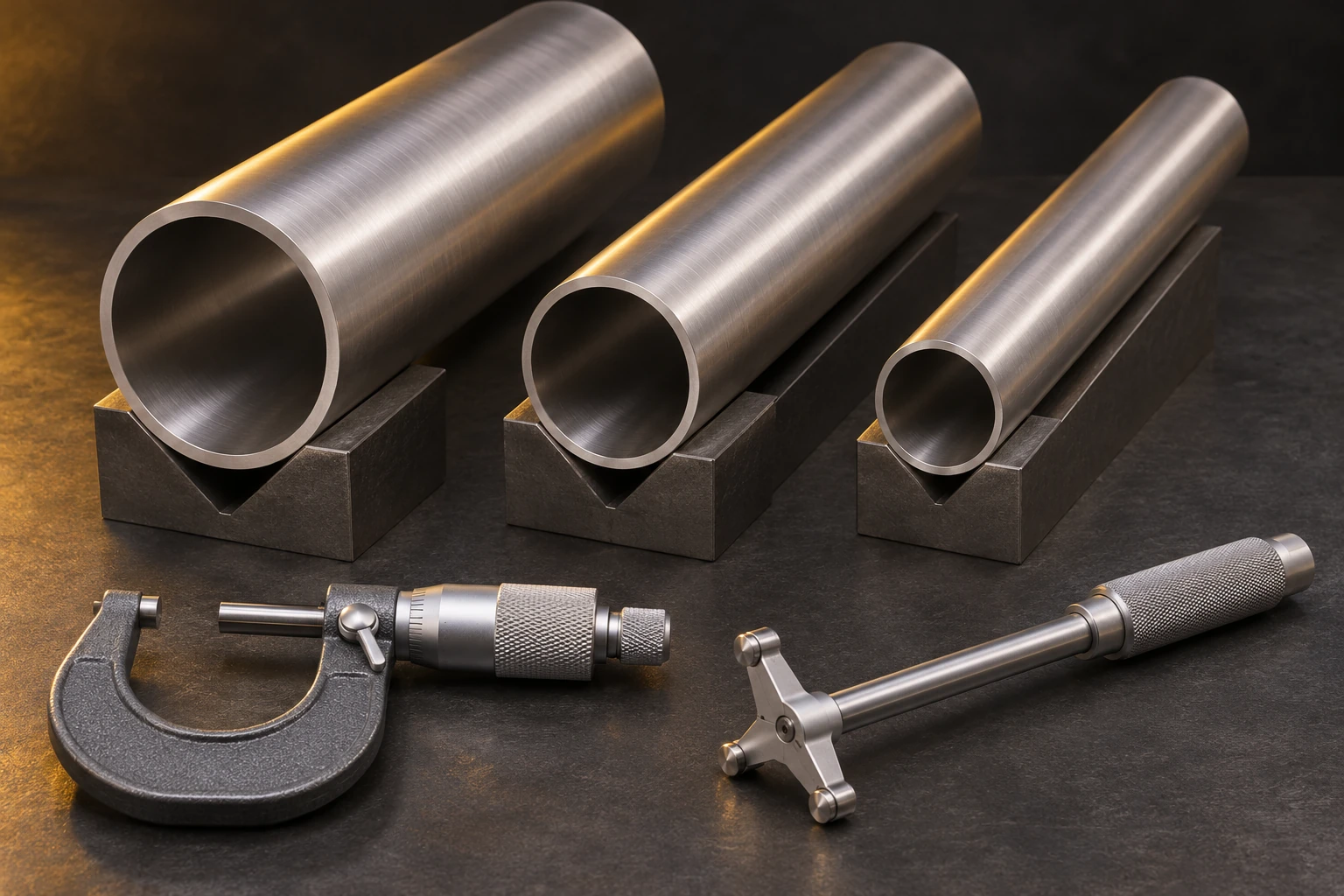
Editorial illustrationDefine the dimensional inspection.
AI-generated illustration. Instrument appearance does not prove a test result, wall tolerance or manufacturing route.
05 / Inspection matrix
Build an inspection matrix around the actual risks
Testing methods answer different questions
The ordered standard and project specification determine which tests are mandatory, their frequency and the acceptance criteria. Additional requirements should state the method, coverage, calibration/reference basis, acceptance standard and reporting. “100% NDT” is not a complete instruction: 100% of what surface or volume, using which method, for which imperfection type?
A pressure or leak test addresses the specified pressure or leak condition. It does not by itself prove all dimensions or detect every possible imperfection. A dimensional report does not establish weld integrity. Material certificates, visual examination, nondestructive examination and mechanical tests each address a different part of the acceptance case.
Requirement area
Question to settle before order
Evidence to request where applicable
Material identity
How is grade/heat linked through production and cutting?
Traceable certificate and identification record
Chemistry and properties
Which specification, condition and lot rules apply?
Required test results with lot identification
Geometry
Which dimensions and coverage control the application?
Dimensional results using agreed methods
Surface and ends
Are ID, OD and ends all covered?
Visual/borescope or other agreed inspection record
Weld region
What examination and process requirements apply?
Required weld-related results and route records
Pressure/leak performance
Which procedure, medium, limits and hold criteria apply?
Test report under the approved specification
Nondestructive examination
What method, extent and acceptance basis apply?
Report with traceability and examination scope
Agree document timing and hold points
For an unfamiliar product or special requirement, review the proposed certificate and inspection plan before production. A blank report format can expose missing fields early: standard edition, tube dimensions, heat/lot number, method, acceptance criterion and responsible authorization. The final report should refer to the actual supplied lot, not a generic example.
If witnessing is required, define the notice period and whether the hold point stops production or shipment. Resolve who can release it. A late request for third-party witness can disrupt an otherwise complete order and may require repeat work. Put it in the enquiry so suppliers price and schedule the same obligation.
Do not confuse mill qualification with assembly qualification
An accepted straight tube can later be bent, cut, joined or cleaned. Those operations introduce additional requirements. Identify what must be rechecked after fabrication, especially final geometry, joint inspection, cleanliness and pressure or leak testing of the assembly. Keep the mill certificate and fabrication records linked but distinct.
06 / Selection scenarios
Three selection scenarios that lead to different questions
Scenario 1: a heat-exchanger retube order
The first questions are the specified tube standard and edition, grade, OD, wall basis, straight length and tube-end interface. Confirm whether the equipment specification permits both routes. Check the required inspection and tube-to-tubesheet joining plan. Compare the delivered tubes on that common basis, including packaging that protects long lengths and tube ends.
Do not change route solely because the original tubes look seam-free in a photograph. Obtain the equipment documentation or a qualified engineering decision. Appearance and historical purchasing shorthand may not define the original requirement accurately.
Scenario 2: a process-piping spool
Start with the design code, material specification, pipe size/wall, service and fabrication drawing. The pipe route is one part of a larger welded assembly. Confirm the required joining procedure, examination, final test, end connections and documentation package. A mill pressure test does not automatically satisfy the completed spool’s acceptance requirements.
Scenario 3: a precision sleeve machined from tube
Here the bore, machining allowance, straightness and consistency may strongly affect machining yield. Ask whether the supplied tube dimensions support the final drawing. Compare the route options only if both meet material and design requirements. A nominally lower stock price may be offset by added bore machining or insufficient wall at the finished feature.
These scenarios show why an effective selection checklist begins with the final function. “Seamless or welded?” becomes answerable after the service, geometry, permitted route and evidence have been defined.
Editorial illustrationPlan access to the required internal regions.
AI-generated illustration. A borescope is an access concept here; the image is not a weld inspection record.
07 / Order release
An order-release checklist for the buyer
Before approval, reconcile the drawing, quotation and purchase order line by line. Record the complete product designation, grade, specification edition, dimensions, condition, manufacturing route and tests. Treat every exclusion as an open item until accepted by the responsible party. Do not rely on a supplier’s general statement that the product is “equivalent.”
For the first delivery, agree the receipt review: packaging condition, piece count and length, identification, document completeness and any required incoming checks. Preserve the connection between cut pieces and their source lot. If a discrepancy appears, segregate the affected material and resolve it through the agreed process before fabrication destroys the original identity.
TiHubs coordinates product requirements, supplier offers and inspection documentation through the Baoji titanium supply network. We can help structure a route comparison, but final suitability and code acceptance follow the customer’s design authority and the approved order requirements.
08 / Build your RFQ
Build your tube RFQ checklist
Include service, specification, grade, dimensions, wall basis, permitted route, quantity, length and inspection scope. If both routes may be considered, ask for separately identified offers under the same acceptance requirements. State any unresolved engineering decision explicitly.
Build your RFQ checklist
Choose the product and add the information you have. Copy the resulting brief or send your requirements to TiHubs. Submitting an enquiry does not place an order.
09 / FAQs
Seamless and welded titanium tube: frequently asked questions
Is seamless titanium tube always stronger?
The route label alone does not establish the accepted properties or design capacity. Grade, condition, geometry, product specification and design rules matter. Compare the applicable requirements and verified results. Do not calculate a pressure rating from the absence of a seam.
Is welded titanium tube always cheaper?
No. Availability, production quantity, size, wall, finishing and testing can change the comparison. Request current offers on the same specification and delivery basis. A fixed percentage saving is unreliable without a defined product and quantity.
Can ASTM B338 welded tube be offered instead of seamless tube?
Only if the order and governing equipment requirements permit the alternative. B338 covering both routes does not authorize a supplier to change a purchase order that specifically requires seamless construction. Resolve the change in writing before manufacture.
Are tube and pipe dimensions interchangeable?
Do not assume so. State actual OD/ID and wall where required, or the applicable nominal pipe size and schedule system. Confirm tolerances and end details. A similar trade description can hide a different dimensional basis.
Does a clean external weld line prove acceptable quality?
No. Appearance is only one observation. Confirm the required manufacturing, property and examination evidence, including internal access where relevant. A finished surface can conceal the visual distinction between routes without changing the actual manufacturing history.
Does a pressure test replace nondestructive examination?
It does not generally answer the same questions. Follow the ordered product standard and design/fabrication specification. If an alternative test is permitted, identify the clause and obtain the required agreement rather than substituting methods informally.
Should I specify minimum wall instead of nominal wall?
Use the basis established by the design and product requirements. If minimum remaining wall is critical, have the responsible engineer define it and the applicable tolerance. The supplier should not be left to infer the design allowance from a bare thickness number.
What documents should accompany a tube delivery?
Agree the package before order: material certificate, heat/lot identification, required property and inspection results, dimensions, route/condition information and any specified conformity or witness records. The documents must identify the supplied product and applicable requirements.
10 / Key takeaways
Choose the route after defining the product
Distinguish heat-exchanger tube, pipe and precision mechanical tube.
Keep grade, manufacturing route, condition and dimensional basis explicit.
Compare nominal/minimum wall, lengths and end preparation on the same basis.
Define each inspection method, coverage and acceptance criterion.
Evaluate supplied and downstream cost; avoid universal route premiums or quality rankings.
Technical references
Technical references and scope
This is a procurement guide, not a pressure-design calculation or a complete reproduction of a product standard. The current public catalog pages identify scope; the controlled edition incorporated into the contract determines the detailed requirements.
TiHubs coordinates titanium materials and custom supply from Baoji, China. Our founder’s 20 years in titanium inform a specification-led sourcing approach: clarify the product, manufacturing and acceptance requirements before quotation. Learn about our sourcing role.
Contents
TiHubs
Talk to TiHubs
Ask about titanium materials, grades or custom parts.
Enter your email to start chatting.
We use your email to respond to your enquiry. Your conversation is stored on this website.
Our team is away right now. Leave your enquiry and we will follow up by email.