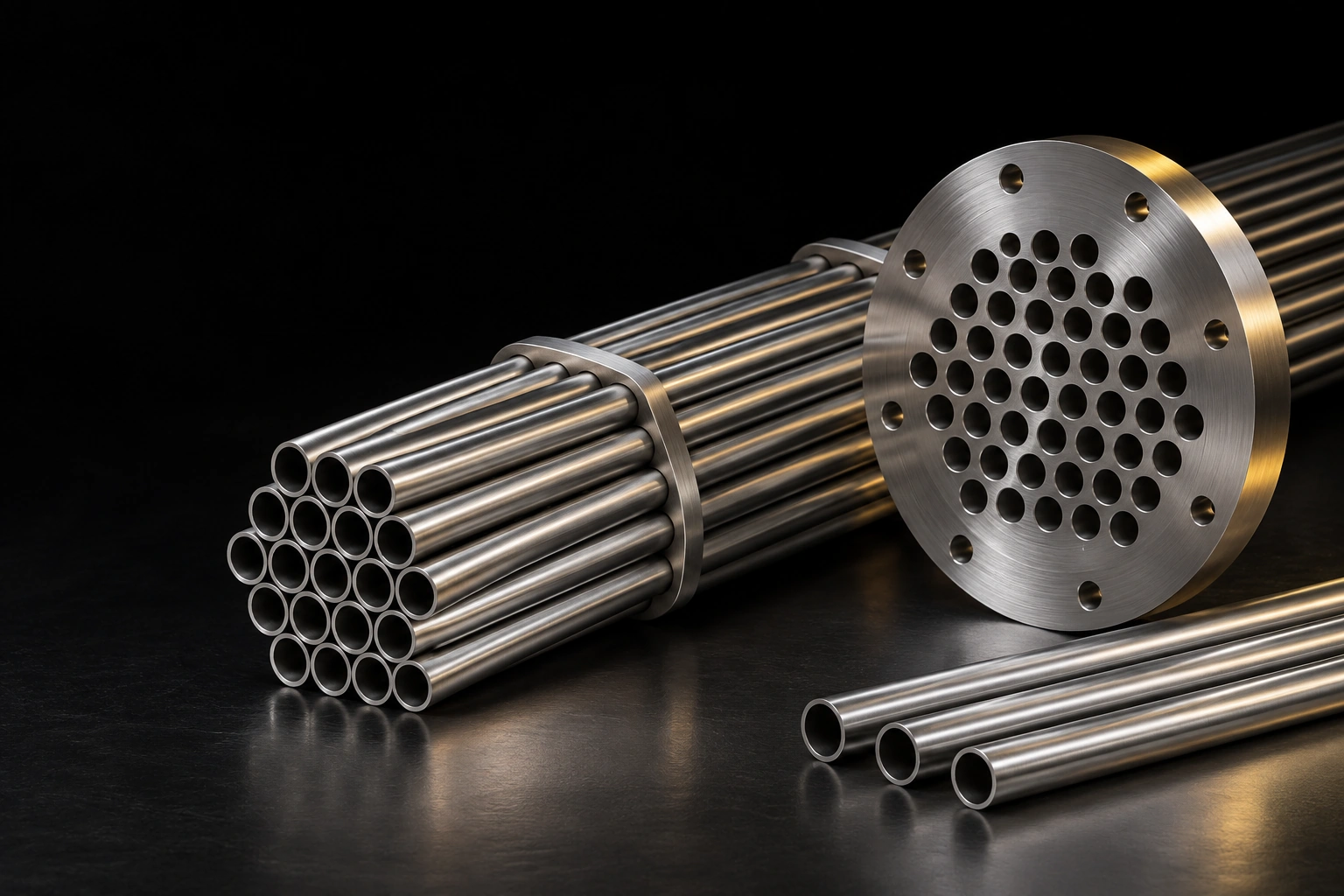
AI illustration. Appearance and labels do not verify material compliance.
Quick answer: a tube size is only the start
Good titanium heat exchanger tube selection connects both-side operating conditions to an approved grade, product specification, dimensional basis, joining arrangement and inspection plan. For a replacement, add the original drawings, tubesheet details and failure history. A used tube’s measured dimensions alone are not a complete purchase specification.
Grade 2 is a useful starting point for many enquiries, but its suitability must be confirmed for the actual service. Specify whether wall thickness is nominal or minimum, whether the tube is straight or U-bent, and who approves the connection to the tubesheet. These details can change both the quotation and the replacement result.
01 / Both-side duty
Describe both sides of the exchanger
Begin with a duty sheet covering tube-side and shell-side fluids. Include composition ranges, contaminants, solids, normal and maximum temperature, pressure, flow and cleaning. Identify which values are operating measurements and which are design requirements. A tube can experience different combinations during startup, shutdown or an upset.
Information
Tube side
Shell side / assembly
Fluid
Composition, concentration basis, analysis date
Other fluid and credible cross-leak consequences
Temperature
Normal, maximum, inlet/outlet
Local wall conditions and thermal cycling where relevant
Pressure
Operating, design, vacuum or transients
Differential-pressure cases and responsible design authority
Flow
Flow rate or velocity, distribution, solids
Vibration/support information and hydraulic constraints
Fouling and cleaning
Deposits, treatment additions, cleaning procedure
Compatibility with the entire joint and seal system
Outages
Longest stagnation, draining and preservation
Restart procedure and inspection access
Avoid assuming that the more corrosive-looking fluid is the only one that matters. A cleaning step, a hot wall or an unexpected mixing event may control material selection. For a new design, ask the equipment designer to resolve the missing boundary conditions before turning a provisional quote into an order.
02 / Product standard
Choose a product standard with the right scope
ASTM B338 covers seamless and welded titanium and titanium-alloy tubes for condensers and heat exchangers. Its current public listing is B338-17(2026) at the time of this article. The applicable edition, grade, route and complete requirements must be stated in the order; a standard number is not a complete inspection schedule. [1]
Do not automatically replace a heat-exchanger tube specification with a pipe specification because the outside diameter looks similar. Ask the supplier to identify the actual product route and specification, then have the buyer review any departure from the drawing. The seamless vs welded titanium tube guide explains how to compare routes without assuming one label resolves every quality question.
The publisher’s latest edition and the contractually required edition are separate facts. An existing exchanger may be controlled by an older approved design package. Record the required edition and use a change-review process if an alternative is proposed. Never silently update an equipment specification because a newer standard exists.
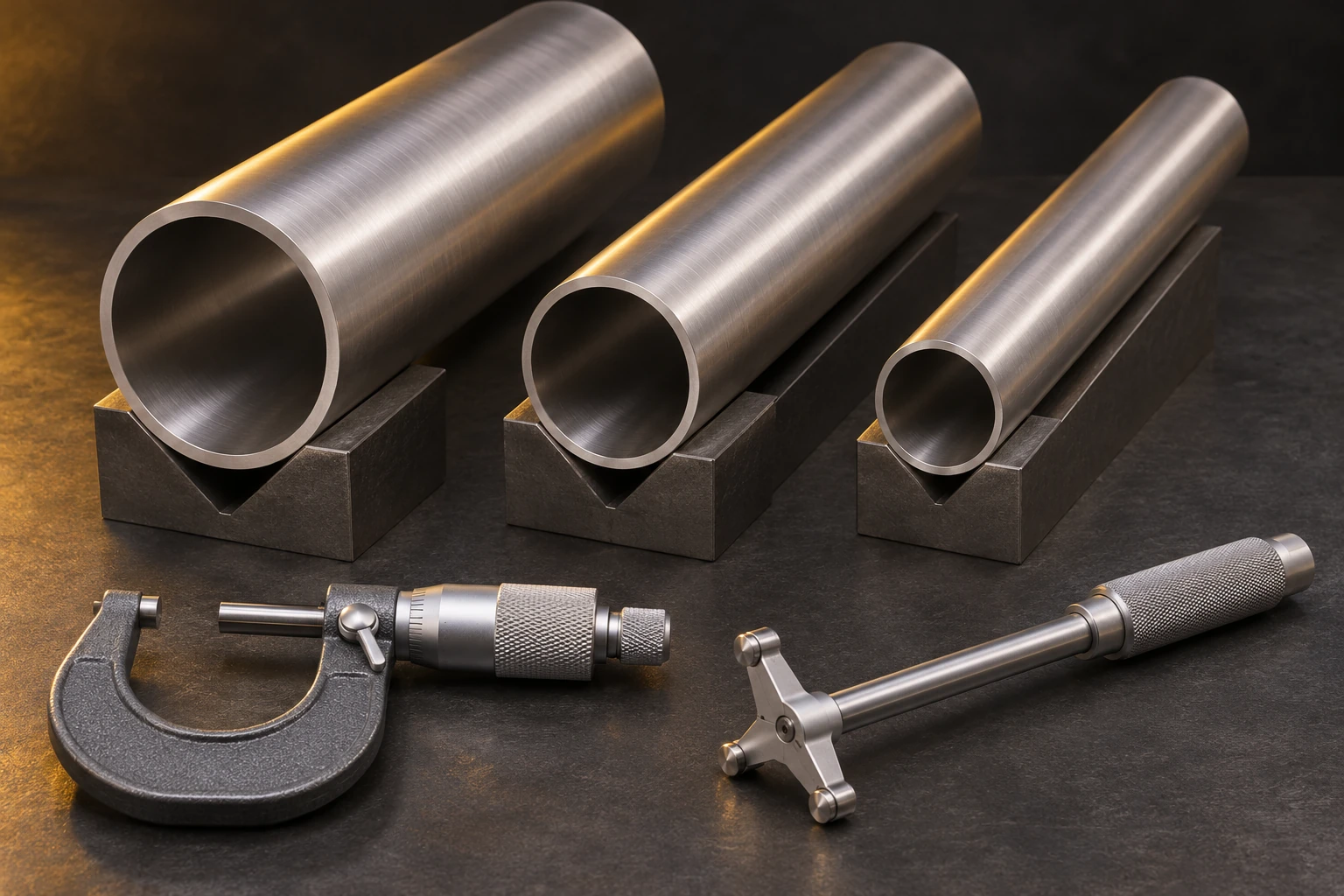
Application detailMeasure against the approved requirement
Record dimensional basis, inspection locations and the identity of the inspected material. AI illustration; not production or inspection evidence.
03 / Dimensions
Define OD, wall and length without ambiguity
State dimensions in one controlled unit system. Identify outside diameter, wall basis, length definition and tolerances. If a secondary unit is shown, label it as a reference conversion and specify which unit controls acceptance.
Dimension
Required clarification
Why it matters
Outside diameter
Nominal size and permitted deviation
Fit with tubesheet holes and tooling
Wall thickness
Minimum wall or nominal wall; tolerance basis
Material quantity, inside diameter and design compliance
Length
Finished straight length, cut allowance or developed length
Installation fit and pricing basis
Straightness / ovality
Drawing or standard requirement and inspection basis
Assembly, fit and agreed acceptance
End condition
Square cut, deburred, chamfered or other drawing detail
Joining and handling
Surface condition
ID/OD requirements, cleanliness and permitted marks
Service, joining and inspection
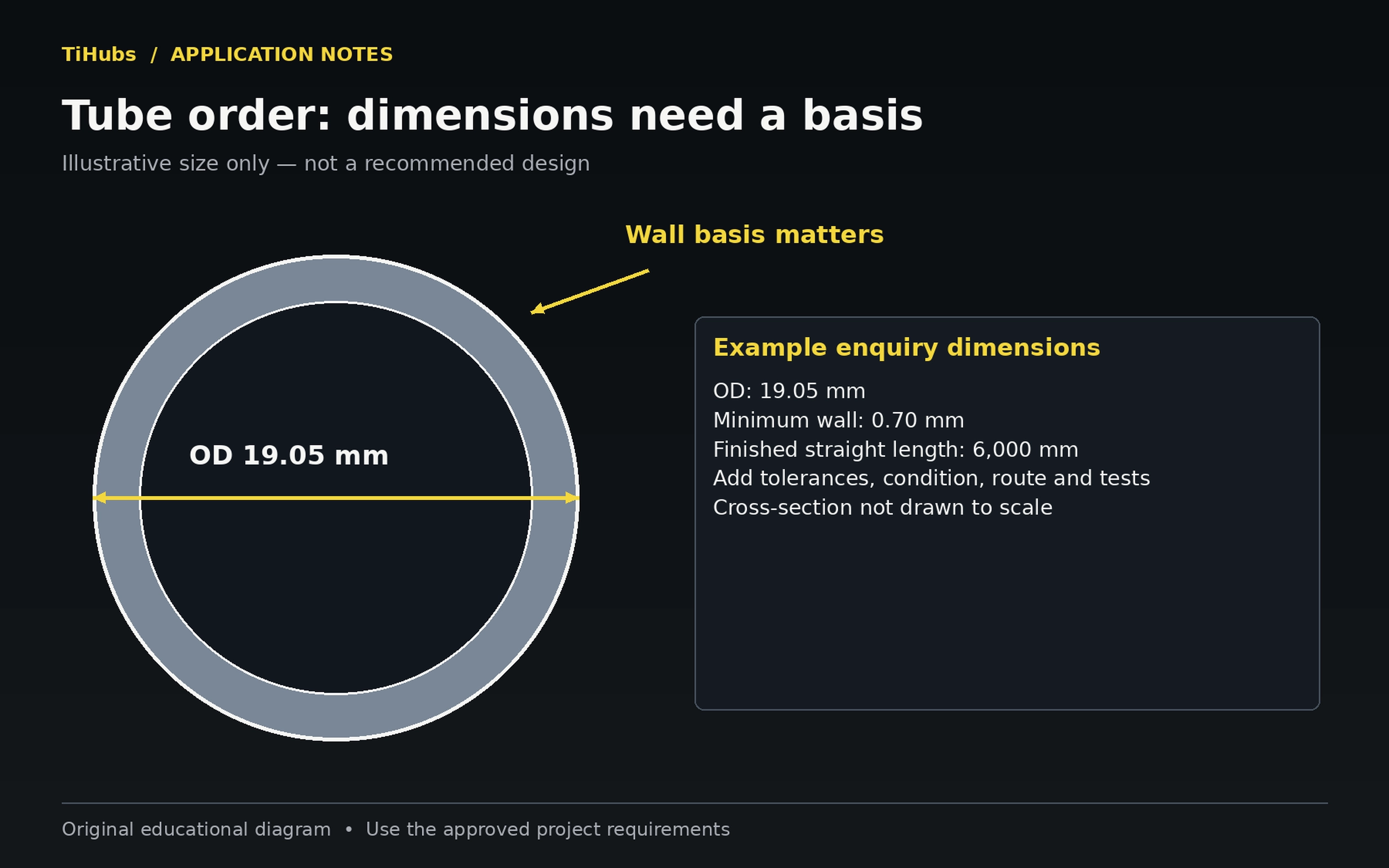
An illustrative enquiry line could read: Grade 2 titanium heat exchanger tube; ASTM B338-17(2026); 19.05 mm OD × 0.70 mm minimum wall × 6,000 mm finished straight length; route, tolerances, condition and tests per the approved purchase specification. These dimensions are examples, not recommended design values or a complete order. The blank requirements still need agreement.
If wall thickness is nominal, the permitted negative tolerance has a different meaning from a guaranteed minimum wall. Do not ask a supplier to infer which one you intend. Where OD, ID and wall are all constrained, review whether the combined limits are physically consistent and necessary.
Technical buying guideDefine every dimensional basis
Illustrative dimensions only. The approved design must determine size, wall and tolerances.
04 / U-tube details
Add the missing information for U-tubes
A U-tube enquiry should include the tube outside diameter and wall basis, bend centerline radius, leg length definition, leg spacing, straight-end requirements and the drawing revision. State whether the order covers straight stock for later bending or completed U-bent tubes.
The drawing should identify the inspection state and any requirements for bend-region dimensions, surface condition and processing. Do not substitute a generic bend-radius rule for approval of the actual grade, condition, tube size and forming route. If several bend radii are needed, issue a quantity schedule for each configuration.
Agree how identification remains connected to each bend group and heat/lot. Packaging should keep the approved shapes identifiable without loading the bends or forcing the legs into a distorted position. A quote for “100 tubes” is ambiguous when it could mean 100 straight lengths, 100 U-tubes or 100 individual legs.
05 / Replacement records
Measure the old installation, not only the old tube
Start with the original datasheet, drawing, bill of materials, material certificate and any approved modifications. Then compare them with the actual equipment. Label each record as original, revised or measured. Record who made the measurement and where it was taken.
Replacement record
What to capture
Old tube
Several OD and wall readings, measurement locations and surface condition
Original size
Drawing nominal values and wall basis, separate from worn measurements
Tube length
Finished cut length, protrusion and access constraints
Tubesheet
Material, hole geometry, tolerances, thickness and condition
Connection
Expanded, welded or combined arrangement; approved joint details
Support arrangement
Baffle/support positions, clearance and known damage locations
Failure map
Leaks, plugs, repairs and removal locations identified on a layout
Installation plan
Removal method, shutdown window, spares and site test requirements
A corroded or mechanically worn wall is evidence about service damage; it is not the required new wall. Likewise, a previously repaired tube end may not represent the original joint geometry. Preserve the distinction in the RFQ so that a supplier cannot mistake a measured remnant for a design dimension.
If records conflict, request an engineering disposition. For example, a drawing may show one wall basis while the available certificate shows another. Resolving that discrepancy before purchase is usually more valuable than obtaining an early price against an uncertain size.
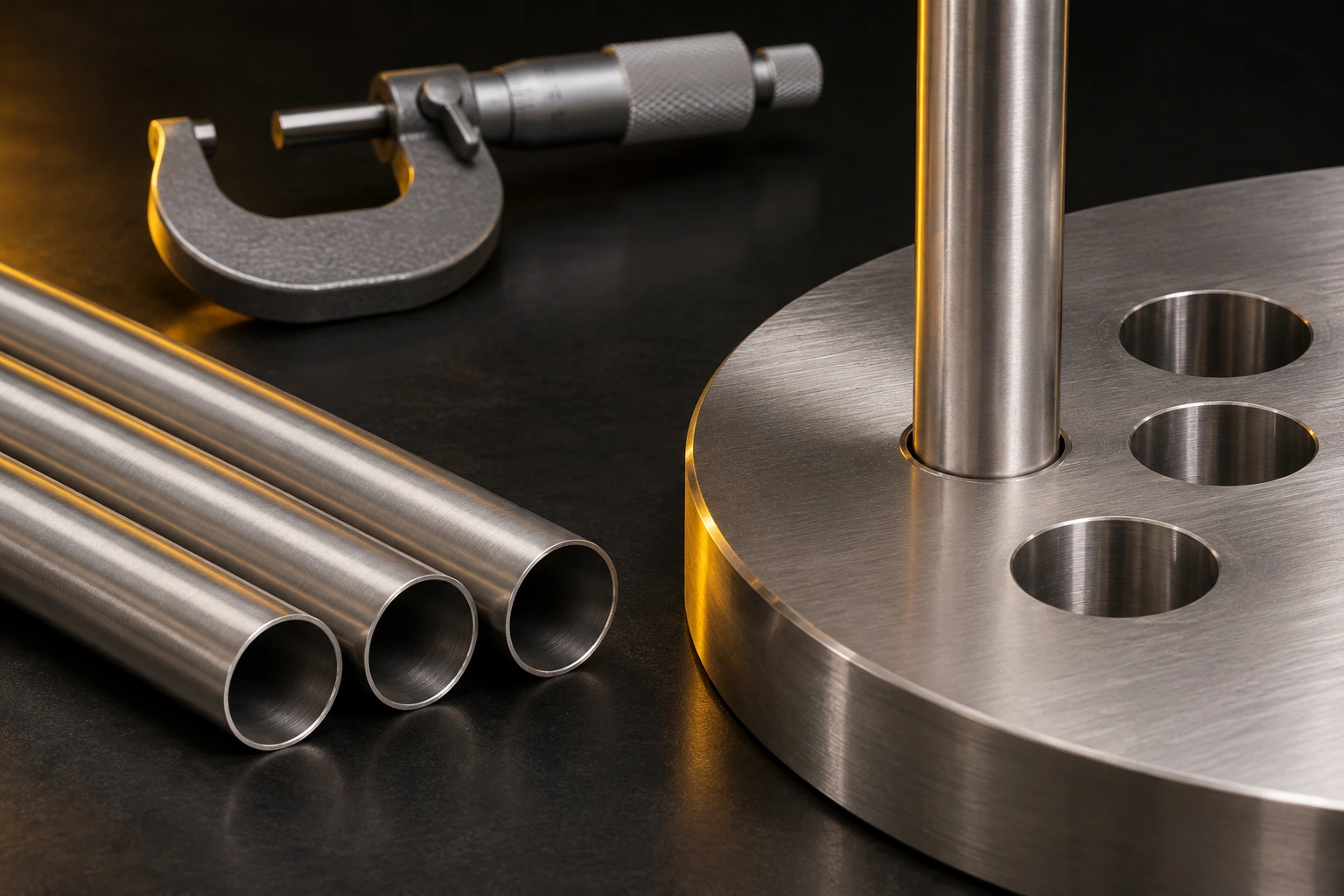
Application detailReview the tube-to-tubesheet interface
Tube supply, joint preparation, installation and assembly acceptance need clearly assigned responsibilities. AI illustration; not production or inspection evidence.
06 / Tubesheet connection
Treat the tube-to-tubesheet connection as its own review
Provide the tubesheet material and controlled hole drawing, proposed tube condition, connection route and the party responsible for installation. The review should address compatibility, fit, procedure qualification, inspection and the effect of the replacement on the existing assembly.
Do not ask the raw-tube supplier to guarantee an installed joint that is outside its scope. Instead, divide responsibilities clearly: tube supply, tubesheet preparation, joint procedure, installation, inspection and final assembly release. If one supplier covers several stages, request the records for each stage rather than a single general statement of conformity.
Where the replacement changes grade, wall, route or condition, ask the equipment engineer whether the existing joint procedure remains applicable. A successful previous installation is useful evidence only within its documented scope. Any trial or first article should represent the actual proposed material and joint arrangement.
07 / Inspection plan
Write a test matrix before placing the order
The purchase order should identify the governing specification and any additional tests, the extent of testing, the method and acceptance criteria, and the required report. Tests required by the ordered standard remain applicable; additional requirements should be stated explicitly. Do not assume every possible test is automatically included in every quote.
Verification category
RFQ question
Required record
Material identity
Which grade, heat and product standard apply?
Traceable material test certificate
Chemistry and properties
Which tests and sampling follow the ordered specification?
Results, limits and specimen/lot basis
Dimensions
Which limits and inspection coverage apply?
Agreed dimensional inspection report
Nondestructive examination
Which method, reference basis, coverage and acceptance criteria?
Procedure identification and results
Leak / pressure testing
Tube-level or assembly-level; method and responsibility?
Scope-specific test report
Surface and ends
Which stage, surfaces and visual/cleanliness criteria?
Inspection record and disposition
Traceability
How are individual tubes or bundles tied to heat/lot?
Marking, packing list and certificate links
Avoid vague phrases such as “100% tested” without naming the test. Full-length coverage, sampling frequency and examination of a particular region are different concepts. If the buyer requires witnessed testing, define the hold point, notice period and release authority before production begins.
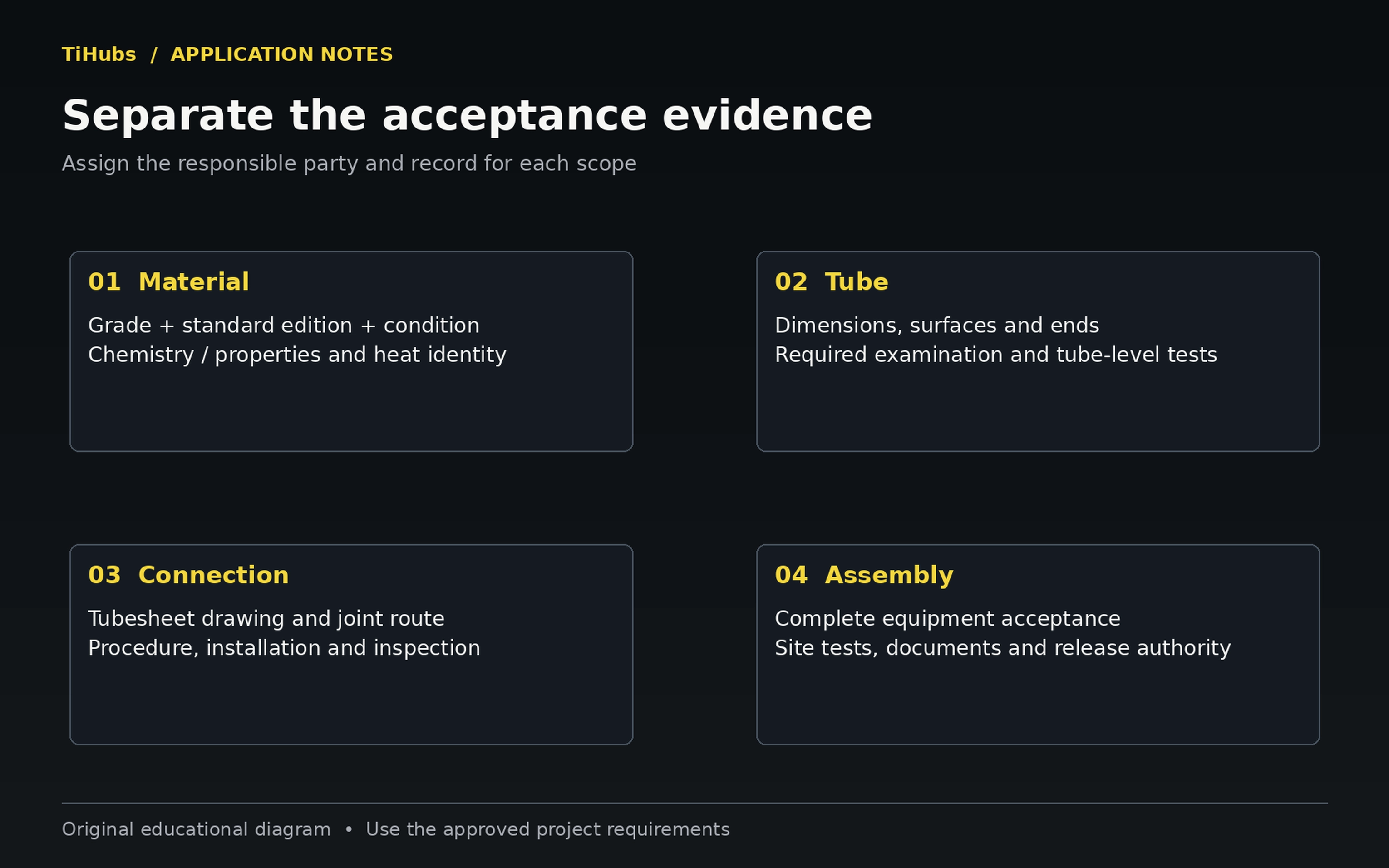
Technical buying guideSeparate material, tube and assembly evidence
Use the ordered specification and a project-specific inspection plan.
08 / Failure history
Use the failure history to improve the replacement scope
Ask where the damage occurred: inlet, tube end, bend, support location, isolated section or throughout the bundle. Record the operating period, affected population, deposit pattern and any change in duty. This helps the engineer decide which additional investigation is useful.
Do not diagnose a mechanism from a single photograph. Preserve a representative damaged sample and its orientation if an investigation is needed. The procurement consequence may be a different inspection emphasis, revised support or connection, a cleaning change, or a material review. Simply ordering a more expensive alloy does not establish that the underlying cause has been addressed.
A practical replacement package contains a tube-location map, a chronological operating summary, the original and revised specifications, and a list of unresolved questions. Ask the supplier to quote confirmed items separately from options that depend on the investigation.
09 / Quote & delivery
Make quotations comparable and installation-ready
Compare quantities in pieces with the agreed finished length, and record any weight basis used for commercial calculation. Separate production quantity, installation spares and test pieces. State whether cutting, bending, end preparation, identification, special cleaning and packing are included.
The delivery plan should work backward from the shutdown: document approval, manufacturing, testing, transport, receiving inspection and site preparation. A single promised dispatch date may hide a late approval dependency. Ask the supplier to identify what must be released by the buyer and when.
For long tubes, specify packaging that supports the length, protects ends and prevents contamination or mixing during transport. Receiving staff need access to labels and certificates without destroying the packing. Include safe unloading and storage requirements in the site plan rather than treating them as an afterthought.
Example: a replacement enquiry with incomplete records
An operator requests 300 tubes “the same as the old ones.” The useful next step is to separate confirmed information from open points: original drawing size, measured old-tube readings, intended new wall basis, tubesheet drawing, service chemistry and leak map. The supplier can issue a provisional commercial estimate with explicit assumptions, while the order waits for technical release of the unresolved items.
This approach keeps the project moving without turning an assumption into a manufacturing instruction. Once the drawing and test schedule are approved, revise the quotation to that exact scope and retain the superseded assumption list for the project record.
10 / Operating checklist
Build your heat exchanger operating-condition checklist
Use the form to capture both fluid sides, the operating envelope and the replacement interfaces. Put the complete size and drawing revision in the dimensions field; state minimum or nominal wall in the requirements. For existing equipment, identify which drawings, certificates and failed samples can be supplied.
Build your operating-condition checklist
Choose the product and add the information you have. Copy the resulting brief or send your requirements to TiHubs. Submitting an enquiry does not place an order.
11 / FAQs
Frequently asked questions
Is Grade 2 always the correct heat exchanger tube grade?
No. It is a common starting point for a material review, not a universal answer. Both fluids, local conditions, cleaning and the approved equipment design determine the required grade.
Should I specify minimum or nominal wall?
Use the basis required by the approved design and product specification. State it explicitly because the tolerance interpretation and quantity of material can differ.
Is ASTM B338 enough to order a tube?
No. Add the edition, grade, route, condition, dimensions, quantity and the agreed inspection and documentation scope. The full standard and purchase requirements must be reviewed together.
Can a welded tube replace a seamless tube?
Only where the governing drawing, specification and engineering review permit it. A proposed route change should be identified as a deviation, with the required manufacturing and inspection evidence.
Can the supplier copy a used tube?
A sample helps, but damage and previous repairs may distort the original requirement. Reconcile measurements with the original design, wall basis, interface details and service history before release.
Does a mill pressure test replace the assembled exchanger test?
No. The test scopes are different. Define the tube-level requirements and the final assembly acceptance separately, including the responsible party and records.
What should an urgent replacement RFQ contain first?
The controlled size and wall basis, quantity, required grade/standard, shutdown date, both-side service data and tubesheet connection information. Mark missing records clearly and identify the approval owner.
Can TiHubs coordinate documents and inspection?
TiHubs can coordinate supply and agreed inspection records through its Baoji network. State the required documents, hold points and acceptance responsibilities at enquiry stage so they can be included in the quotation.
12 / Key takeaways
The replacement order in five checks
Define both fluid sides and operating, shutdown and cleaning conditions.
Specify the product standard, edition, grade, route and delivery condition.
Separate OD, wall basis, length and tolerances with one controlling unit system.
Reconcile old measurements with drawings, tubesheet details and failure history.
Agree inspection, traceability, installation responsibilities and the shutdown delivery plan.
The RFQ schedules and replacement workflow are original procurement guidance, not a pressure-equipment design or a reproduction of ASTM requirements. Illustrative dimensions are not a recommended operating design. AI photographs show component concepts; they are not production or inspection evidence.
Ti
About TiHubs
TiHubs coordinates titanium materials and custom supply from Baoji, China. Our founder’s 20 years in titanium inform a specification-led sourcing approach: clarify the product, manufacturing and acceptance requirements before quotation. Learn about our sourcing role.
Contents
TiHubs
Talk to TiHubs
Ask about titanium materials, grades or custom parts.
Enter your email to start chatting.
We use your email to respond to your enquiry. Your conversation is stored on this website.
Our team is away right now. Leave your enquiry and we will follow up by email.