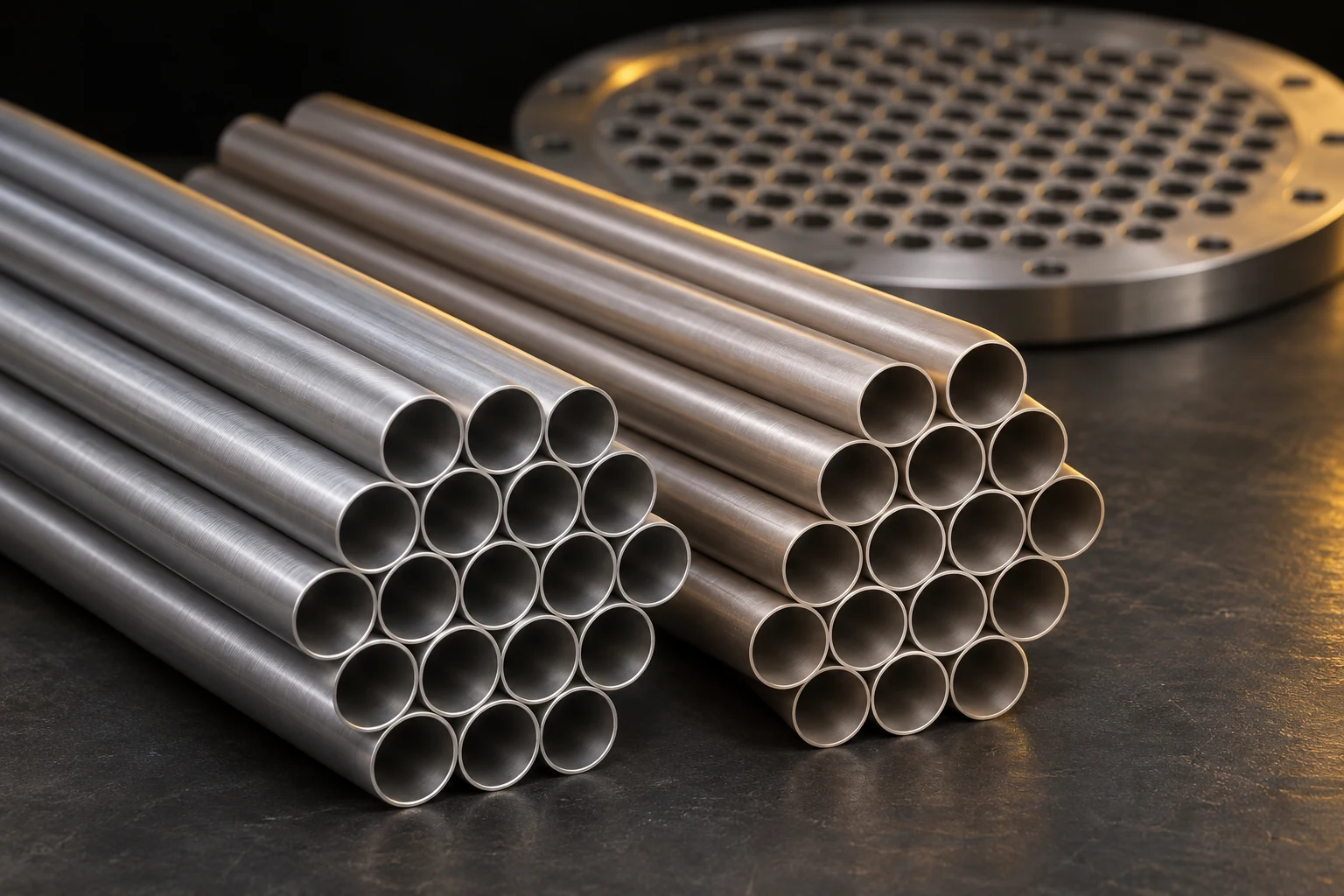
AI illustration; not a production or inspection record.
Quick answer
Titanium can be a candidate for retubing copper-nickel equipment, but it is not a direct substitution based on outside diameter alone. Review thermal duty, wall and bore, water conditions, retained tubesheet metals, joints and supports. Use current project requirements and comparable installed scope; neither a conductivity table nor corrosion resistance alone proves suitability.
01 / The retubing decision
Define the problem before changing the tube alloy
A leaking copper-nickel tube bundle can make titanium look like an obvious upgrade. The purchase is more complicated than replacing one material name on a tube schedule. The existing tubesheet, support arrangement, water chemistry, cleaning system and thermal duty were designed together. A replacement tube must work inside that system, or the project must include the engineering changes needed to create a different compatible system.
Start by identifying why the exchanger is being retubed. Is the problem local tube-end attack, widespread wall loss, vibration damage, leakage at joints or a loss of thermal performance? Preserve inspection findings and operating history rather than treating every leak as proof of inadequate alloy selection. A different material may address one mechanism while leaving a joint problem or operating issue unresolved.
Separate a like-for-like replacement from a conversion. Replacing a specified copper-nickel grade with the same grade and geometry still requires condition and acceptance checks. Converting to titanium adds a materials and equipment review. Mark the proposed changes explicitly: alloy, wall, tube construction, joint method, supports, cleaning or protection. The responsible exchanger engineer can then assess the complete change instead of discovering it after tubes arrive.
Record both sides of the exchanger. Cooling water may determine the tube-side corrosion concern, but shell-side fluid, temperature, pressure and cleaning conditions also matter. Include normal operation, startup, shutdown and credible upset conditions. A statement such as seawater service is not enough to select a titanium grade or establish that an existing copper-nickel system should be replaced.
EPRI’s historical Condenser In-Leakage Guideline, Section 7.8, treats retubing as an engineering and economic evaluation rather than a simple material swap. It highlights changes in flow, support and joint compatibility. The procurement implication is to agree the design review before buying production tubes; the report is not a current approval for a particular exchanger.
Ask for the original tube schedule, material certificates where available, tubesheet drawing and recent inspection map. Check whether the installed bundle still matches those records. Previous repairs, plugged tubes and replacement sections can change the effective configuration. Distinguish measured site information from assumptions on an old drawing so that quotations and engineering calculations use the same baseline.
For a new buyer entering an existing maintenance project, create a short decision record: what failed, what evidence supports that conclusion, which options remain open, and who approves the conversion. That record makes later price comparisons meaningful. Otherwise, one bidder may quote loose titanium tubes while another includes the modifications needed to install them, producing prices that appear comparable but cover different work.
02 / Heat transfer and wall
Thermal conductivity is one part of the rating
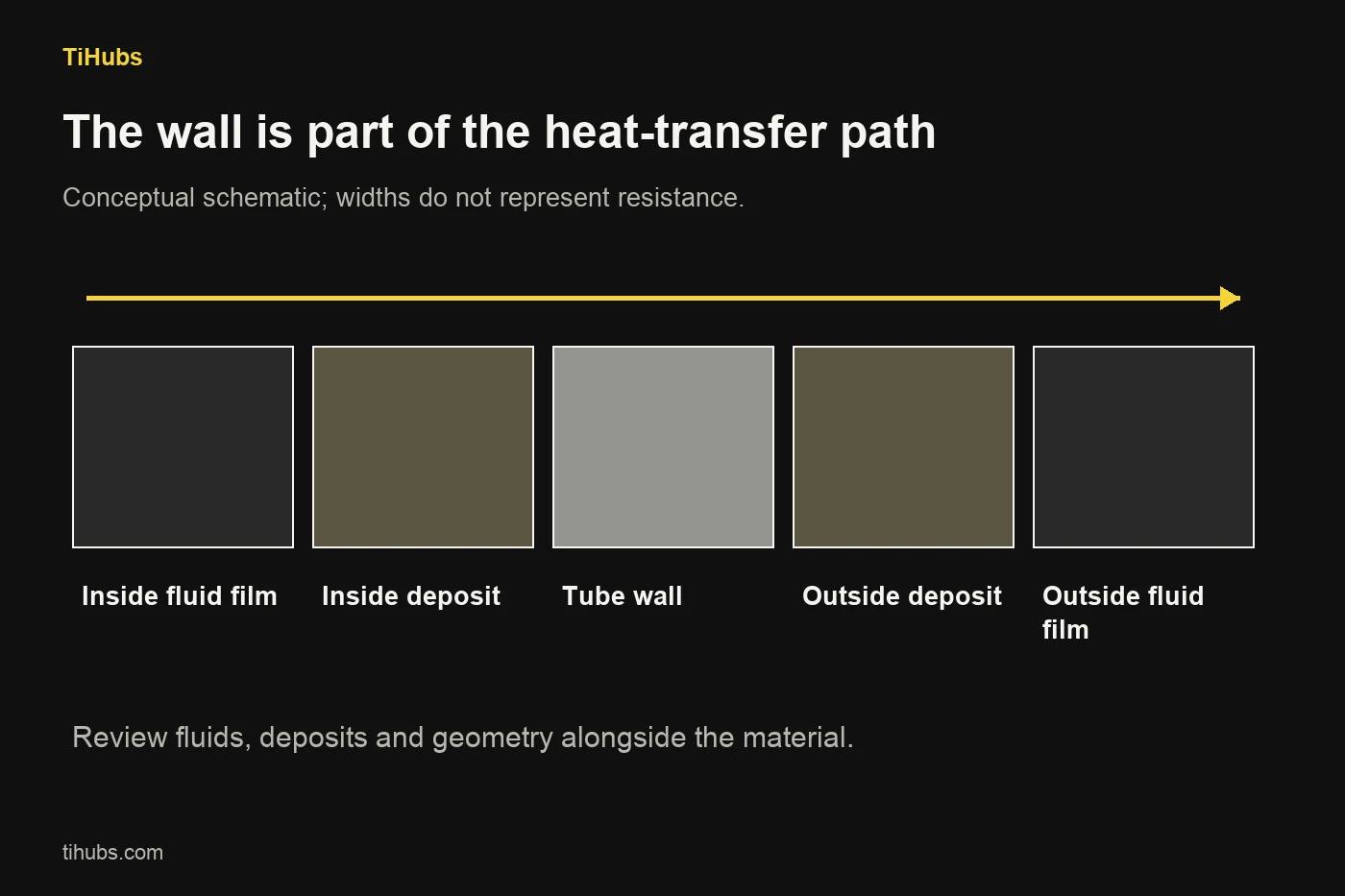
Do not equate the conductivity of the tube metal with the heat exchanger’s overall performance. Heat must pass through fluid-side films, deposits and the tube wall. The engineering rating must use the actual geometry, operating conditions and fouling basis. A metal with higher conductivity does not by itself guarantee the required duty, and a corrosion-resistant tube does not remove every other thermal resistance.
The following values come from one identified source and temperature, rather than combining unrelated internet tables. TIMET’s industrial design handbook, printed page 8, Table 8, lists the source values at 100°F, shown as approximately 38°C. TIMETAL 50A is identified in the handbook as commercially pure Grade 2. These are historical reference data, not guaranteed properties of a supplied batch or design allowables.
Historical reference conductivity at 100°F (approximately 38°C), TIMET Table 8; SI values converted and rounded
Material designation in source
Btu·in/(h·ft²·°F)
Approx. W/(m·K)
TIMETAL 50A / Grade 2 titanium
150
21.6
90-10 copper-nickel
348
50.2
70-30 copper-nickel
204
29.4
The conversion used is 1 Btu·in/(h·ft²·°F) ≈ 0.144228 W/(m·K). The table supports a limited conclusion: at the stated reference condition, the listed copper-nickel materials have higher conductivity than the listed titanium material. It does not calculate exchanger capacity, prove the acceptability of a thinner wall or predict the performance of a fouled operating unit.
A thinner wall can reduce the metal’s thermal resistance, but its minimum thickness must first satisfy the approved mechanical design, manufacturing tolerances and service requirements. Do not select wall thickness by trying to equalise conductivity alone. Internal pressure, external pressure where relevant, handling, joint formation and vibration must be reviewed by the responsible engineer before a tube size becomes a purchase requirement.
Even with unchanged outside diameter, a wall change alters the bore. As a geometry-only example, a 25 mm outside diameter with 1.2 mm wall has a 22.6 mm bore; with 0.7 mm wall, the bore is 23.6 mm. These hypothetical dimensions are not a recommended substitution. They show why retaining the outside diameter does not preserve all hydraulic conditions.
For those example bores, the areas calculated from πD²/4 are approximately 401.15 and 437.44 mm². If the volumetric flow per tube is held constant, the second velocity is about 0.917 times the first. This arithmetic does not predict the actual pump operating point, pressure drop or heat transfer. A real system review must determine the flow distribution and operating conditions after the proposed change.
Ask the rating engineer to report the comparison on a consistent basis: same required duty, documented inlet conditions, tube count, length and fouling assumptions, with changes identified. Keep a clean-condition comparison separate from the expected operating condition. That distinction prevents a supplier’s material-property table from being mistaken for a verified guarantee that the existing exchanger will retain its output after retubing.
Industrial buying guide / 02The wall is one thermal resistance
Conceptual resistance path; no relative resistance or operating performance is implied.
03 / Water chemistry and fouling
Compare the actual service environment
Copper-nickel is not one alloy and titanium is not one grade. Identify the exact existing designation and the proposed replacement specification. The Copper Development Association identifies C70600 as a 10% nickel copper-nickel alloy and C71500 as a 30% nickel alloy. Those family descriptions are not complete chemical acceptance limits or evidence that the two can be substituted without review.
Describe the water source and its variability. Include relevant chemistry records, suspended solids, treatment practice, seasonal temperature and periods of low flow or stagnation. Where contamination is suspected, provide actual observations or analyses rather than merely naming a coastal location. The alloy review should address the service that the exchanger experiences, including abnormal periods, rather than an idealised clean-water condition.
The Nickel Institute’s copper-nickel corrosion guidance discusses flow limits and the effect of polluted water. This means a copper-nickel option should be assessed with its grade, water conditions and operating practice. A general statement that copper-nickel is suitable for seawater is not a substitute for that review, especially where the current failure mechanism remains uncertain.
Distinguish corrosion products, mineral deposits, biological growth and debris blockage. They can affect inspection and operation differently. Titanium corrosion resistance does not mean that a tube is immune to external deposits or biological fouling. Equally, a dirty tube does not establish that its metal is corroding. Sampling and inspection should identify what is present before the maintenance strategy is changed.
Keep the cleaning system in the conversion review. Document the existing method, access, cleaning frequency and acceptance of the resulting surface condition. Confirm compatibility with the proposed tube material, wall and joint arrangement. A maintenance procedure developed for the old bundle should not be transferred automatically because the replacement tubes share its outside diameter. The equipment owner should approve the revised practice where necessary.
For titanium selection, assess the exact fluid and temperature with an appropriate corrosion reference and engineering review. Do not expand a seawater comparison into a claim of resistance to every process chemical. If the shell-side service or cleaning chemistry differs from the water side, keep those environments separate in the assessment. A single label cannot describe the full chemical exposure of the tube.
Request a decision that names the assumptions and unresolved information. If water analysis is unavailable, the offer can identify the missing data without pretending that a grade choice is already validated. If the existing copper-nickel has performed well except for a local mechanical problem, repairing the underlying cause may remain an option. If exposure has changed materially, assess that new condition rather than relying solely on past service.
04 / Tubesheet and joints
Review the metals that remain in the equipment
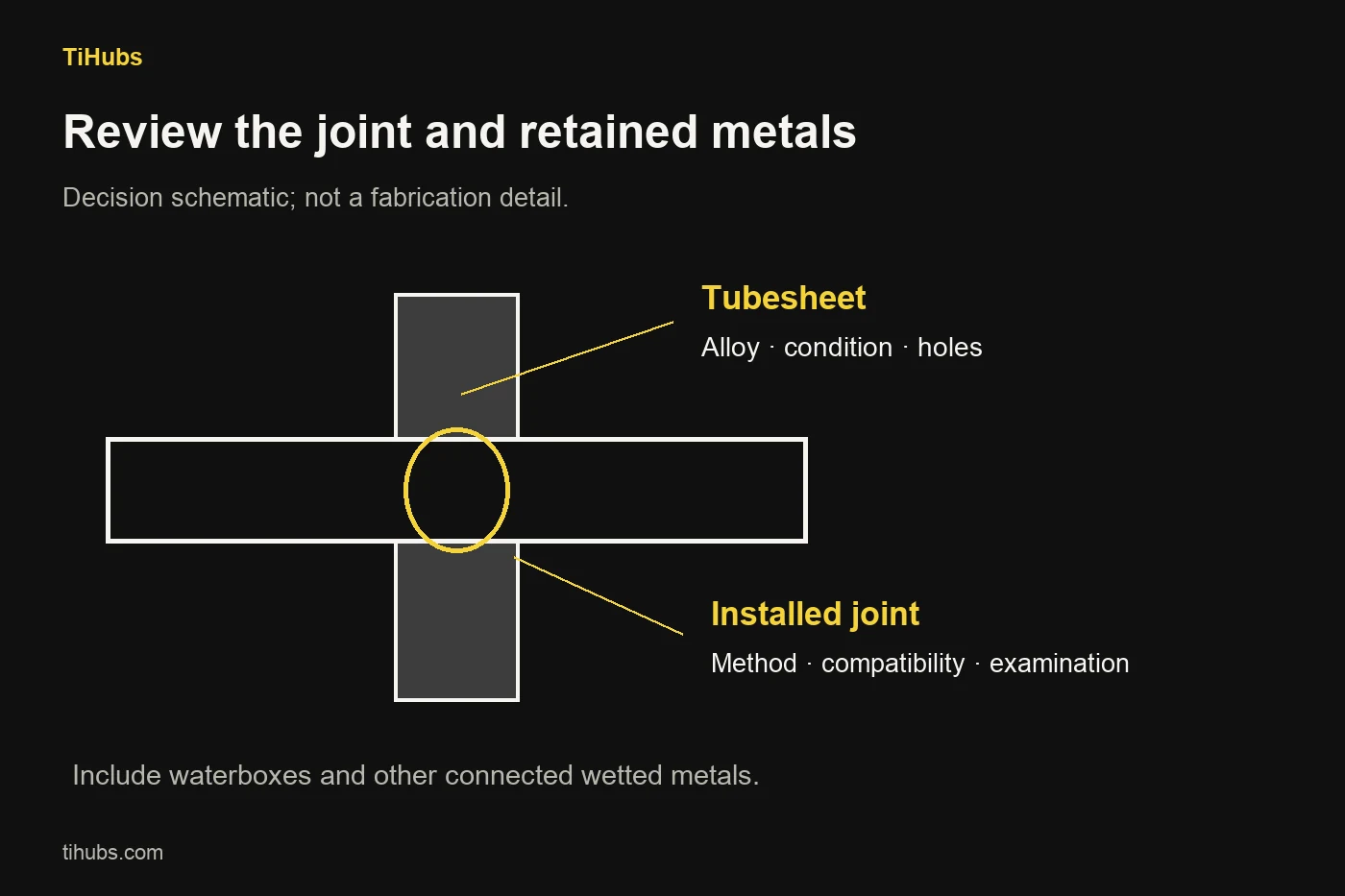
Keeping the old tubesheet is a major design assumption, not a minor purchasing detail. Identify its exact alloy, condition, hole geometry, remaining section and repair history. Confirm whether it is solid, clad or otherwise constructed. The tube-to-tubesheet joint must be compatible with that structure and the pressure boundary requirements. A tube that fits through the hole is not automatically a satisfactory replacement.
Gehring’s published study of condenser galvanic corrosion reports that titanium or stainless tubes coupled with copper-alloy tubesheets can accelerate tubesheet attack under relevant conditions. It identifies water properties and alloy relationships as important factors. This is a reason to assess the retained metals and protection system; it is not evidence that every titanium conversion will suffer the same failure.
Ask the corrosion review to include waterboxes, nozzles and other electrically connected wetted components where relevant. Changing the tube material can alter the relationship among parts that remain. Do not approve a retrofit by reviewing the tubes alone. If coatings, isolation or cathodic protection are proposed, require an engineered design and maintenance plan appropriate to the materials and service, not an improvised addition after installation.
Separate mechanical expansion from welding. If the existing copper-nickel joints are expanded, the titanium conversion still needs a defined expansion procedure and acceptance basis. If welding is proposed, evaluate the actual materials at the joint and the applicable procedure. The words titanium tube do not establish that the existing tubesheet surface is suitable for the intended weld or that an old joint method transfers unchanged.
Inspect the holes after tube removal as the project plan requires. Worn, damaged or previously repaired holes may differ from their nominal drawing dimensions. Agree what happens if the discovered condition lies outside the planned joint design. This is a practical reason to include a hold point and a disposition process: production tubes should not force the team into accepting an incompatible retained component.
Review joint development on representative materials and geometry. A mock-up can help establish the proposed fabrication route when required, but its scope must be clear. Identify tube grade, wall, tubesheet material, hole condition, joining method and examination. Do not treat a successful sample in a new plate as proof that every aged hole in the installed exchanger is acceptable.
Plan final joint verification separately from incoming tube inspection. A mill tube test concerns the product before installation; it does not demonstrate every installed tube-to-tubesheet connection. Specify the assembly examination and leak or pressure testing required by the approved design and applicable rules. Define the stage, coverage, records and responsible party so neither the tube supplier nor installer assumes that the other has included it.
Where the conversion requires a new or modified tubesheet, compare that complete route with retaining copper-nickel. The additional work may still be justified, but it belongs in the schedule and economic assessment. A transparent comparison is more useful than a tube-only price that ignores the largest compatibility issue in the existing equipment.
Industrial buying guide / 04Retained components remain part of the decision
Review tube, tubesheet, joint and connected wetted metals as an equipment system.
05 / Tube specification and inspection
Translate the approved design into a purchase order
After the engineering choice, create a tube schedule that identifies material grade, product specification and revision, manufacturing route, outside diameter, wall basis, length and tolerances. State whether the wall is ordered on a nominal or minimum basis as applicable. Include end condition, straightness and any special features. Do not let a vendor infer these requirements from a sample tube that may already be worn.
ASTM B338 addresses titanium and titanium-alloy condenser and heat-exchanger tubing, including seamless and welded product. ASTM B111/B111M addresses copper and copper-alloy seamless condenser tubing and ferrule stock. The references identify product scope; the controlled edition and ordered options govern actual acceptance. Neither product standard alone approves a complete exchanger conversion.
Information needed for a comparable retubing quotation; design values must come from the approved project
Item
Retain copper-nickel
Convert to titanium
Material
Exact copper-nickel designation and condition
Exact titanium grade and condition
Geometry
Confirm approved replacement dimensions
Approve wall, bore and related equipment changes
Joints
Verify retained holes and replacement procedure
Review material compatibility and joining procedure
Thermal duty
Confirm restored configuration and fouling basis
Rate the revised geometry and operating conditions
Acceptance
Tube records plus installed-assembly verification
Tube records plus conversion and assembly evidence
Do not choose seamless or welded construction by label alone. Identify what the design and project specification permit, and then compare conforming offers. The relevant questions include grade, dimensional capability, ordered examination and documentation. A blanket statement that one route is always superior is less useful than evidence that the offered tube meets the actual service and procurement requirements.
Define the inspection package before the order. It may include material traceability, dimensional checks, mechanical or product tests and the specified non-destructive examination. Require reports to identify the applicable method and acceptance basis. Do not use hydrostatic testing and eddy-current examination as interchangeable phrases; their purpose and the standard’s ordered requirements must be reviewed explicitly.
Address long-tube logistics. State required lengths, allowable end damage, packaging support and unloading arrangements. Confirm that the receiving site can handle the proposed bundle and maintain identification after unpacking. Tubes accepted at the mill can still be damaged during transport or staging. Protecting the approved product is part of the purchase, particularly when a shutdown window leaves little time for replacement material.
Keep spare quantities and contingency lengths separate from the production count. Explain whether spares are intended for installation loss, future maintenance or development samples. Confirm that the same material and documentation requirements apply where needed. This avoids using an undocumented offcut for a critical replacement simply because the original order did not anticipate the additional tube.
Check units at each schedule revision. Do not treat a gauge number as a complete wall requirement without verifying its dimensional meaning and the ordered tolerance. Keep dimensions and the acceptance basis explicit in the final order, especially when drawings, quotations and equipment records use different unit systems.
06 / Outage cost and decision
Compare installed scope and operating assumptions
Compare cost per completed, accepted retubing project, not price per kilogram alone. Different wall dimensions and densities affect the relationship between mass and the required tube count. Ask each bidder to price the same tube schedule or identify every proposed variation. The material invoice is only one part of a project that may include removal, retained-component inspection, modification, installation and final verification.
Separate known costs from estimates. Firm tube prices and transport charges can sit beside budgetary installation or outage costs, but mark them accordingly. Include the date and validity of quotations. Do not publish a universal titanium-to-copper-nickel price ratio: alloy, product route, quantity, dimensions, documentation and market conditions change the result. Obtain current offers for the actual approved scope.
Use plant records when estimating the value of reduced maintenance. Record historical failures, cleaning work, production loss and repair activity, then state which mechanisms the proposed change is expected to address. Do not convert corrosion resistance into an unsupported service-life multiplier. If the evidence supports only a qualitative improvement expectation, retain that uncertainty in the decision instead of inserting a precise payback period.
Consider the outage sequence as well as its nominal duration. Tube delivery, removal, hole inspection, any tubesheet disposition, installation, examination and restart approval create dependencies. Identify which decisions can be completed before shutdown and which depend on exposed equipment condition. A contingency plan should name the available options and responsible reviewers, not merely add an unexplained allowance to the schedule.
Record the final approval basis in a way future maintenance staff can use. Keep the new tube schedule, modified drawings, joint procedure, inspection records and operating assumptions together. If a later replacement order copies only the tube alloy, the original conversion review may be lost. A good handover preserves why the material and geometry were selected and which conditions remain important.
For an initial titanium heat-exchanger tube enquiry, send TiHubs the approved or proposed schedule, quantity, destination, required date and documentation scope. Identify whether this is a tube supply enquiry or part of a wider conversion project. Supply capability and delivery are confirmed in the quotation; the equipment designer or responsible engineer approves the exchanger design and retrofit.
If stainless steel is also being considered, use the separate titanium versus stainless steel seawater guide as an additional starting point. Keep the present comparison centred on the existing copper-nickel equipment. The immediate next step is a complete retubing data package and comparable offers, not selecting a winner from a material name alone.
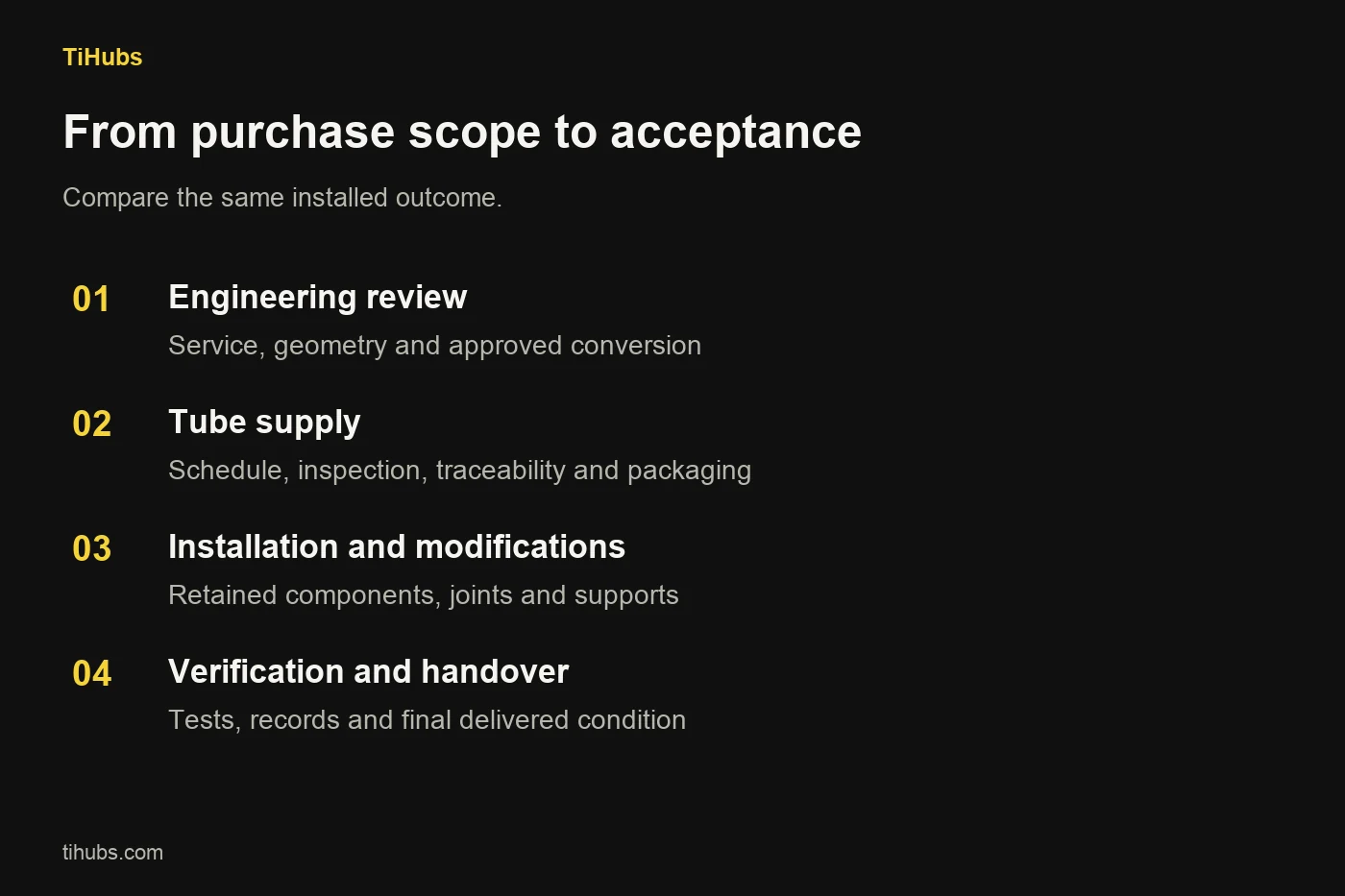
Industrial buying guide / 06Compare a complete installed scope
Separate tube supply, conversion work, installation and final acceptance in the quotation.
07 / Build your RFQ
Prepare a retubing tube enquiry
Provide the existing and proposed tube schedules, the reason for replacement and the status of engineering approval. Identify tube supply separately from installation or equipment modification.
Information to include
Existing alloy, failure findings and service conditions
Proposed grade, product specification, wall basis and dimensions
Tubesheet material, joint method and approved design changes
Inspection, traceability, packaging and spare quantities
Tube count, lengths, destination and shutdown date
Build your RFQ checklist
Choose the product and add the information you have. Copy the resulting brief or send your requirements to TiHubs. Submitting an enquiry does not place an order.
08 / FAQs
Questions buyers ask
Can titanium directly replace copper-nickel tubes?
Only after the equipment review establishes a suitable design and installation route. Outside diameter alone does not address bore, wall, heat transfer, supports or tube-to-tubesheet compatibility. Identify every proposed change and obtain the responsible engineering approval before committing to production material.
Which material has higher thermal conductivity?
In the historical TIMET table reproduced here at approximately 38°C, the listed 90-10 and 70-30 copper-nickel values exceed the listed Grade 2 titanium value. These reference data are not an exchanger rating. Actual duty also depends on geometry, fluid-side conditions and fouling.
Does titanium eliminate tube fouling?
No. Resistance to corrosion does not establish immunity to biological growth, mineral deposits or debris. Identify the deposit mechanism and retain an appropriate cleaning and operating plan. Do not infer the maintenance requirement solely from the name of the tube material.
Can the existing copper-alloy tubesheet remain?
That is a design decision requiring assessment of its material, condition, joint method and galvanic environment. Titanium tubes can affect retained dissimilar metals. Obtain a compatible engineered arrangement and inspection plan; do not assume either universal compatibility or inevitable failure.
Is a thinner titanium wall always acceptable?
No. Wall selection must satisfy the approved mechanical and service requirements, tolerances, joint formation and equipment review. A thinner wall also changes the bore at constant outside diameter. The dimensions used in the calculation example are illustrative, not a recommended retrofit.
What information makes a tube quotation comparable?
The exact approved grade, specification, route, outside diameter, wall basis, length, count, inspection and documentation scope. Add packaging, destination and required date. Identify whether the price covers loose tubes, installation or modifications, and list assumptions and exclusions consistently.
09 / Key takeaways
Keep the purchase requirements connected.
Identify the failure mechanism before changing alloy.
Use conductivity data with their source and temperature.
Review bore, thermal duty and equipment geometry together.
Check retained metals and the installed joint.
Compare the complete accepted retubing scope.
Technical references
Sources and data scope
References reviewed November 15, 2026. Public source summaries support the discussion; the controlled specification, agreed edition and approved project requirements govern acceptance.
TiHubs coordinates titanium material and custom supply enquiries from Baoji, China. Send the product, drawing revision and acceptance requirements so the proposed supply scope can be reviewed. Learn about our sourcing role.
Contents
TiHubs
Talk to TiHubs
Ask about titanium materials, grades or custom parts.
Enter your email to start chatting.
We use your email to respond to your enquiry. Your conversation is stored on this website.
Our team is away right now. Leave your enquiry and we will follow up by email.