Price the sheet you need. Count the usable material.
Understand why titanium sheet quotations change with grade, thickness, size and order scope—and turn a price per kilogram into a meaningful purchasing comparison.
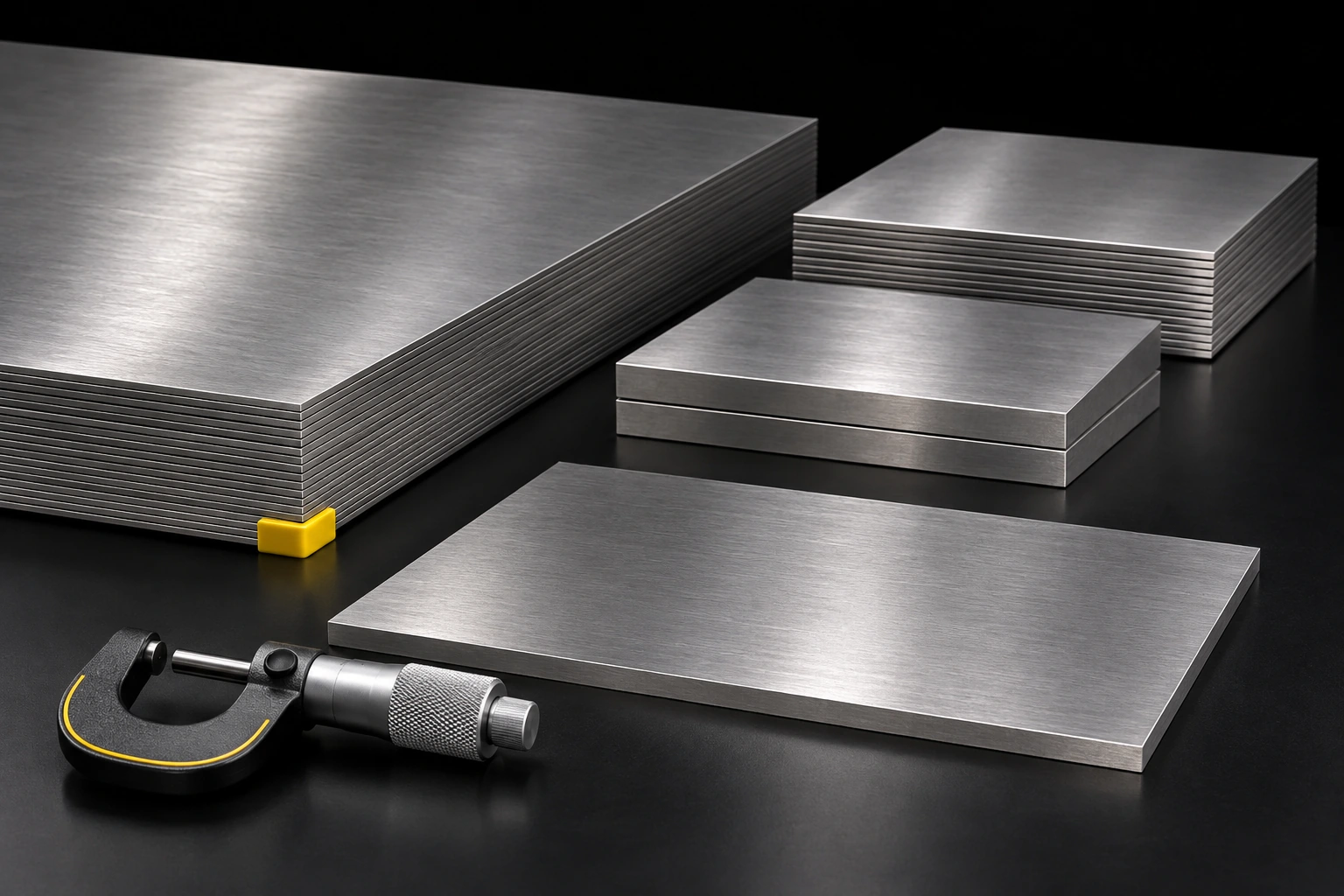
AI illustration. Appearance and labels do not verify material compliance.
What is the price of titanium sheet per kilogram?
There is no single reliable titanium sheet price per kg without a defined product and a dated quotation. Grade 2 and Grade 5 sheet can be offered in different thicknesses, sizes, conditions, quantities and inspection scopes. The price also depends on whether you buy a full sheet, cut blanks or material with additional finishing—and whether the kilogram is actual weight, theoretical weight or consumed starting stock.
For a usable quote, send the grade, specification and edition, condition, thickness × width × length, tolerances, piece count, certificates, destination and required delivery date. Ask the supplier to state the billing basis and every excluded cost. This guide explains how to evaluate that offer; it does not publish a live market range. All monetary examples below are invented arithmetic illustrations, not current TiHubs prices.
01 / Quotation basis
A kilogram price needs a complete product description
An online price can be an indication for a minimum batch, a particular size or an unfinished stock condition. Before using it in a purchasing budget, establish exactly what was offered, when it was offered and what costs were included. A price associated with a large standard sheet may not be available for a small set of narrow blanks with tight flatness requirements.
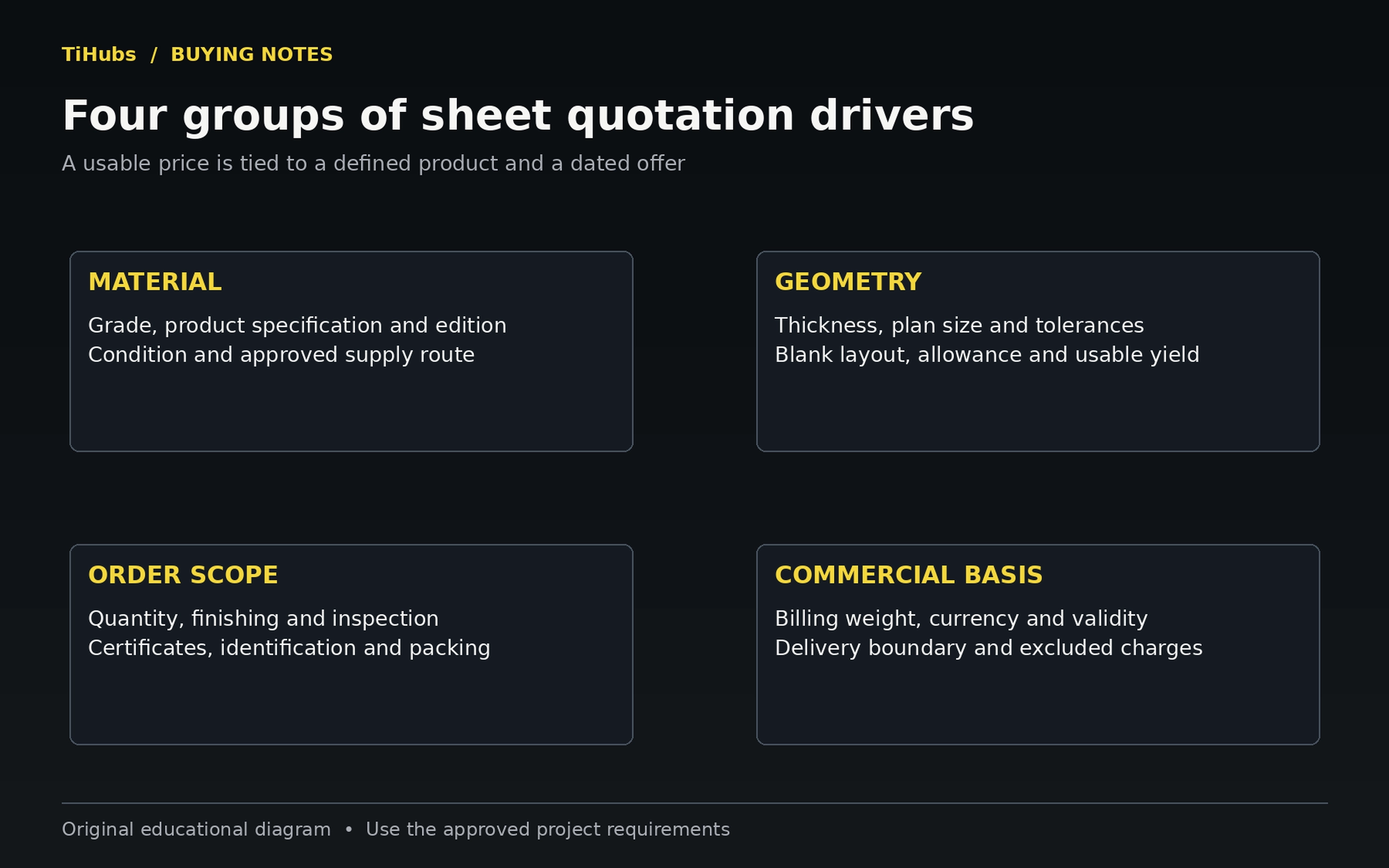
Use a quotation basis with a clear identity: “Grade / product specification and edition / condition / thickness × width × length / dimensional and surface requirements / quantity / document package / delivery basis.” Add the required quotation validity. If any element changes, ask whether the earlier price still applies rather than comparing it with a different product.
ASTM B265 is the titanium strip, sheet and plate specification family, and its published scope covers annealed flat products. [1] The complete ordered edition and the approved project additions define the actual acceptance requirements. A generic claim of ASTM material is not enough to establish every requested tolerance, finish or inspection service.
Purchasing planning diagramDefine what the sheet price includes
Original purchasing diagram. Material, geometry, order scope and commercial basis all belong in the quotation.
02 / Grade 2 and Grade 5
Grade 2 and Grade 5: compare the required material
Grade 2 is commercially pure titanium; Grade 5 is the Ti-6Al-4V alloy family. Their suitability for forming, strength, fabrication and service is an engineering question. Do not select a different grade merely because one available stock quotation is lower. First establish that the proposed material can meet the application and ordered requirements.
Grade-related cost differences can reflect the starting material, rolling and conditioning route, processing difficulty, availability in the required size, and the evidence required by the order. A fixed statement such as “Grade 5 always costs twice as much” is not a dependable buying rule. A small special Grade 2 lot can be more expensive per kilogram than a larger, readily available alloy lot under different conditions.
Use a side-by-side quote only after aligning thickness, plan size, batch, condition, surface, certificates and delivery scope. If the designer is considering both grades, request two explicit alternatives and preserve the assumptions for each. Our Grade 2 and Grade 5 pages provide the material and product context for that discussion.
03 / Thickness
Thickness changes more than the amount of metal
Thickness affects the route needed to make and handle the product, the number of pieces represented by a kilogram, and the practical cutting and flatness requirements. A thin sheet may need different processing and handling from a thicker plate. It is therefore unsafe to estimate one thickness by scaling the kilogram price of another without a supplier review.
State the thickness tolerance and whether it follows the ordered standard or an additional drawing requirement. If you request a tighter range, ask how the supplier will achieve and verify it. A special thickness requirement may require selected stock, additional finishing or a new production route rather than a simple change to the inspection report.
Distinguish sheet thickness from finished-part thickness. If you will machine both faces, define sufficient stock allowance based on the approved process and geometry. Buying material exactly at the finished nominal thickness can leave no room for cleanup. Conversely, unnecessary excess thickness adds purchased mass and machining work that may have no functional value.
04 / Size and layout
Width, length and the usable blank envelope
Plan size affects stock selection and yield. A standard parent sheet may produce your required blanks efficiently, while a slightly larger blank can force a different sheet or leave substantial unusable offcut. Ask for the proposed parent size and a practical cutting layout when yield materially affects the price.
The layout must account for the cutting method, kerf, edge trim, orientation restrictions, clamping or processing allowance and areas excluded by surface criteria. Do not promise a piece count from a simple area ratio. If bend direction or grain orientation matters to the approved manufacturing plan, identify it before nesting; rotating a blank for better yield may not be permitted.
Separate the delivered blank envelope from the final component. Profile-cut, rectangular and machined blanks can be different commercial products even if they contain the same finished shape. Request a quotation for the stage that fits your own production capabilities, then include your remaining operations in the total cost comparison.
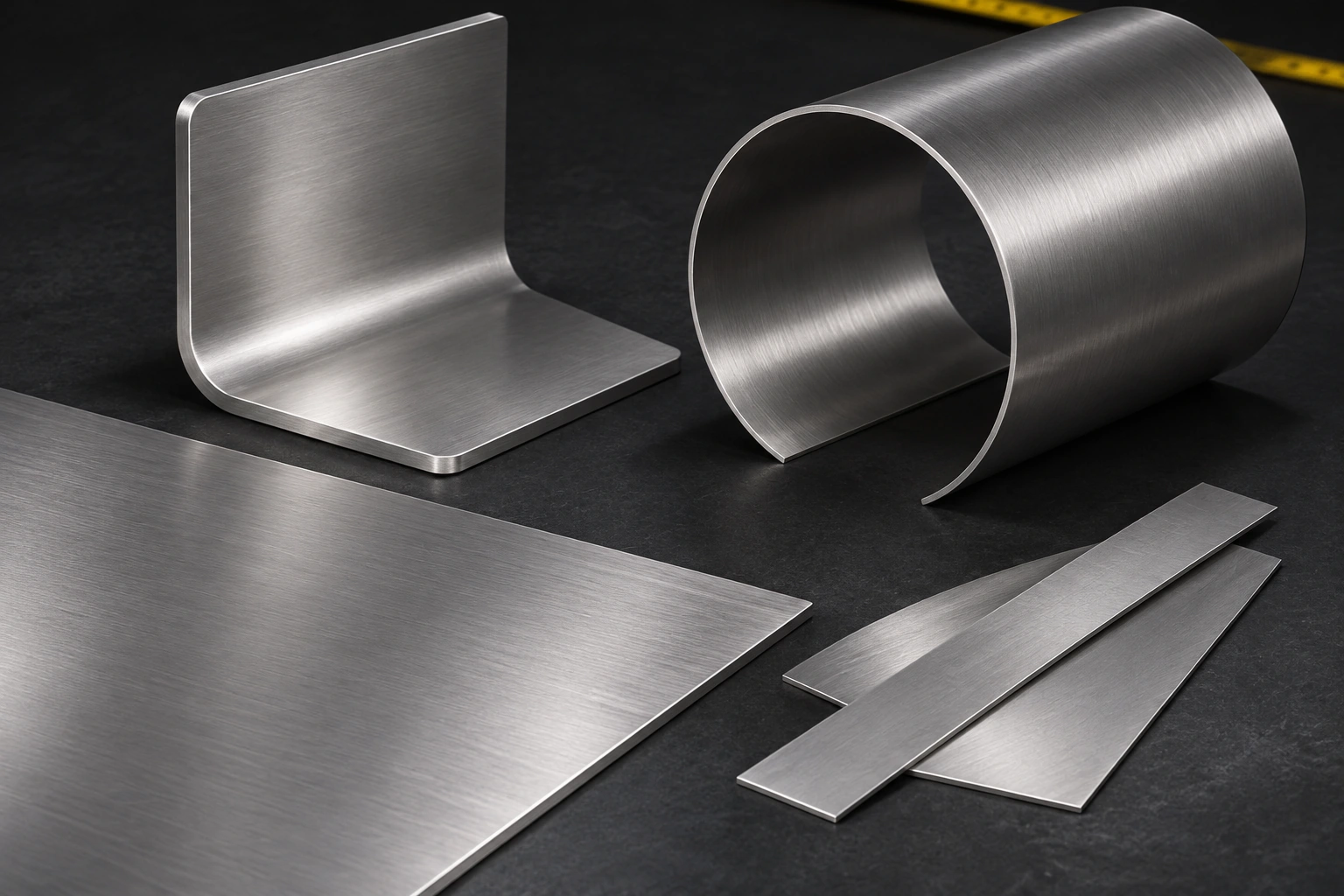
Illustrative product viewConnect the sheet to its next operation
AI illustration; not a factory, certificate or inspection record. State the required sizes, orientation and surface before choosing a supply route.
05 / Quantity and batch
Batch size and fixed charges
A small order can carry a higher cost per kilogram because setup, handling, document review, testing or packing is spread over fewer kilograms. The exact effect depends on the supply route and included services. Ask for the reason behind the minimum instead of treating every MOQ as a mill production minimum.
Request quantity breaks that match realistic purchasing choices: a trial batch, the planned production batch and a justified repeat quantity. Keep the same specification at each break. If a lower unit price requires a full sheet or a larger lot, calculate the cash commitment and the practical use of the remaining material.
Separate confirmed demand from a forecast. A supplier may offer a different arrangement for a committed scheduled-release order, but reservation, ownership, storage and release obligations need agreement. Do not count speculative future demand as guaranteed savings. Material that remains unused is part of the procurement outcome even when its initial kilogram rate was attractive.
06 / Condition and finish
Condition, surface and finishing scope
The delivered condition must be stated in the material requirement and supported by the applicable records. Additional heat treatment, leveling, grinding, polishing, profiling or cleaning can change both the cost and the acceptance plan. Ask which operations are included and which are proposed as optional work.
Define a surface requirement in a way that can be inspected. A process name alone does not establish roughness, waviness, defect limits or cleanliness. If appearance matters, agree representative samples or clearly described criteria. Identify which faces are critical, whether protective film is needed and how it will be removed before the next process.
Consider the order of operations. If a surface will be machined away, an expensive cosmetic finish on that face may offer little value. If the sheet will be used as supplied, scratches or edge damage can reduce usable area. The economical specification is the one that preserves the required function and usable output, with unnecessary work removed through an approved review.
07 / Weight and billing
Actual and theoretical weight: write down the formula
For rectangular sheet, theoretical mass can be estimated as thickness in mm × width in mm × length in mm × density in g/cm³ ÷ 1,000,000. Use a density appropriate to the offered material and agree whether dimensions are nominal or measured. Keep the calculation and rounding rule visible in the quotation.
For context, TIMET lists a typical density of 4.51 g/cm³ for TIMETAL 50A, its Grade 2 product, while ATI lists 4.43 g/cm³ for ATI 6-4 Grade 5. [2][3] These are useful reference values for estimation, not a substitute for the agreed billing convention or dimensional acceptance. Do not infer the material grade from a weight calculation.
Illustrative sheet calculation
Grade 2 basis
Grade 5 basis
Nominal dimensions
2 × 1000 × 2000 mm
2 × 1000 × 2000 mm
Reference density used
4.51 g/cm³
4.43 g/cm³
Calculated nominal mass
18.04 kg
17.72 kg
What the number does not establish
Actual measured weight, tolerances or compliance
Actual measured weight, tolerances or compliance
For actual-weight billing, agree when the material is weighed and how packaging tare is excluded. For theoretical billing, confirm whether the quote uses nominal dimensions, a minimum chargeable thickness or another stated convention. Package gross weight belongs in transport planning; it is not automatically the net material quantity being purchased.
08 / Thickness sensitivity
Why dimensional allowance changes the cost comparison
Suppose the same illustrative Grade 2 sheet is 2.10 mm thick rather than the nominal 2.00 mm, with unchanged plan dimensions. The theoretical mass at 4.51 g/cm³ becomes 18.942 kg, which is 5% higher than 18.04 kg. This is an arithmetic sensitivity example, not a statement that +0.10 mm is permitted by a particular standard or order. Actual acceptance depends on the specified tolerance.
If billing uses actual mass, that additional metal can increase the invoice without increasing sheet area or blank count. If your next operation removes the excess, machining cost may also change. If the thickness is functionally useful and within the order, it may be acceptable. Compare the actual delivered requirement rather than assuming extra weight is always either a benefit or a defect.
This is why buyers should evaluate at least two denominators: price per billable kilogram and cost per accepted sheet, blank or square metre at the required thickness. Each reveals a different aspect of the offer. Use the denominator that matches your production need when deciding between otherwise acceptable quotations.
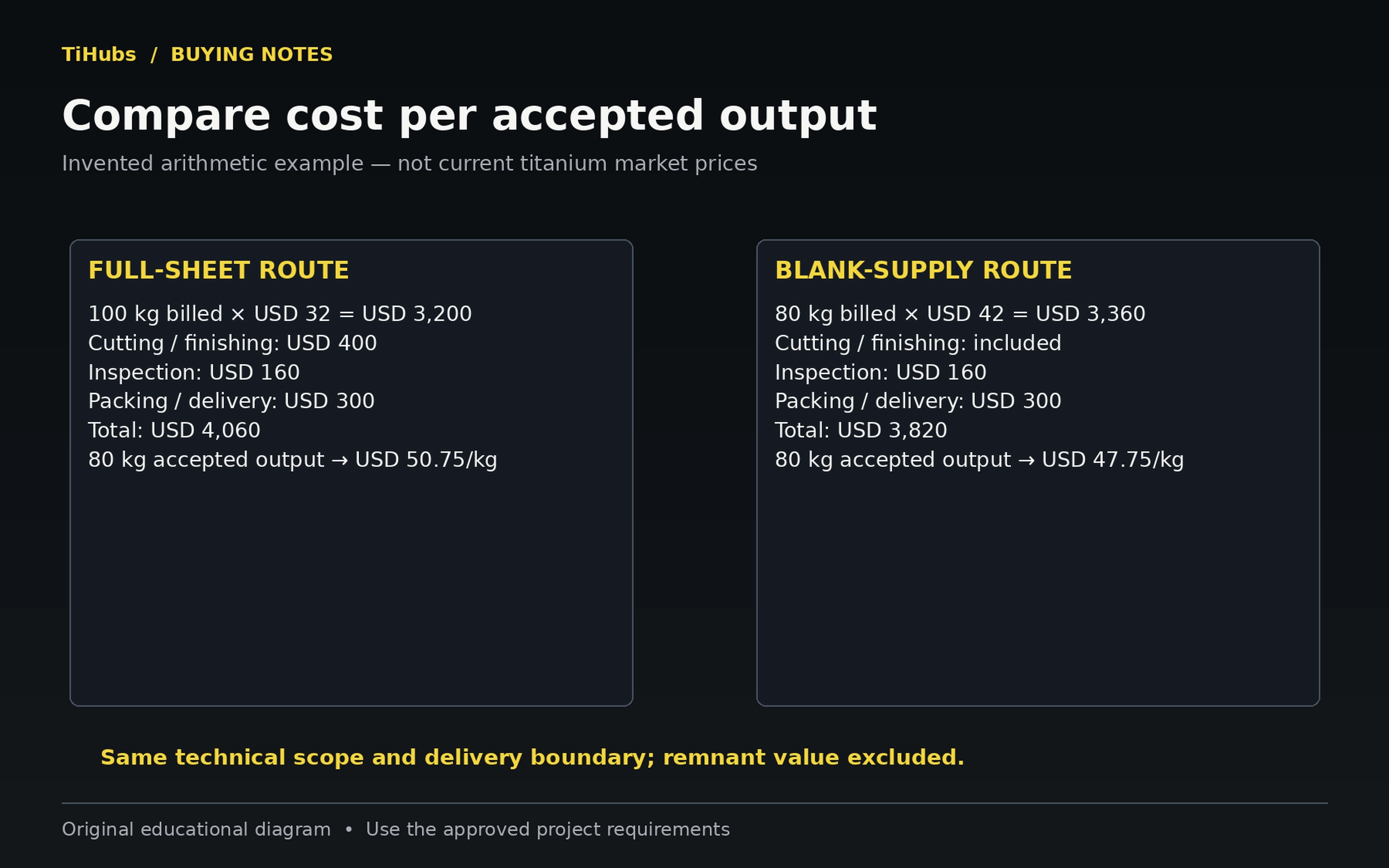
Purchasing planning diagramCompare cost per accepted output
Original purchasing diagram. Invented arithmetic only: the same 80 kg output can have different billing and processing costs.
09 / Yield and remnants
Cutting yield, scrap and remnant ownership
For purchasing analysis, define yield as usable output divided by the particular starting quantity being charged. State both quantities and the stage at which they are measured. Purchased-parent-sheet yield, cut-blank yield and finished-part acceptance yield are different measures. Combining them without explanation can hide where material is lost or rejected.
A useful cost model is material charge + cutting and finishing + required inspection + packing + delivery to the chosen boundary − confirmed credits, divided by accepted usable output. Do not count the same process cost twice if it is already included in the material rate. Treat unconfirmed scrap value or future remnant use as a separate scenario, not guaranteed savings.
If the supplier retains a paid remnant, specify its dimensions, identity, ownership and availability for future use. If it ships with the blanks, include its packing and freight effects. If the supplier owns the scrap under the agreed quote, record that fact. A buyer cannot compare a full-sheet purchase with a blank-only purchase properly until these assumptions are visible.
10 / Inspection scope
Inspection and documentation can change the offer
The quotation should identify the actual material certificate and inspection documents included. Additional examinations, independent inspection, special sampling, report formats or purchaser witness points may add work and elapsed time. Ask for these requirements early; a low stock price may not include the exact evidence your receiving process needs.
Connect every document to the supplied heat, product or test lot and delivered pieces. A supplier offering several stock lots should explain the document package for each. If you require a single heat, explain the reason and confirm feasibility. Do not add that restriction casually and then assume the same inventory and price remain available.
Review the evidence before cutting where the order requires it. Once a parent sheet is subdivided, the identification chain must continue. The titanium mill certificate guide and pre-shipment checklist describe the records that help connect the order to the physical shipment.
11 / Delivery and validity
Packing, delivery terms and quote validity
Sheet faces and corners need protection appropriate to the product and transport route. Ask for package dimensions, count and gross mass before accepting a freight allowance. A large, light sheet package can have a different transport cost from a compact bundle with the same net material mass. Confirm charges with the responsible logistics provider for the actual shipment.
State the delivery rule, named location and edition. ICC’s Incoterms® framework helps define delivery responsibilities, costs and risks; the selected rule must be read with the rest of the commercial agreement. [4] Compare quotations at one boundary rather than treating an ex-works material amount and a destination delivery amount as equivalent.
Record the quotation date, validity, currency and any provisional items. Material availability, processing capacity and freight offers can change. A historic web listing or an expired offer is not a current commitment. Ask for a refreshed quotation against the same approved scope when you are ready to place the order.
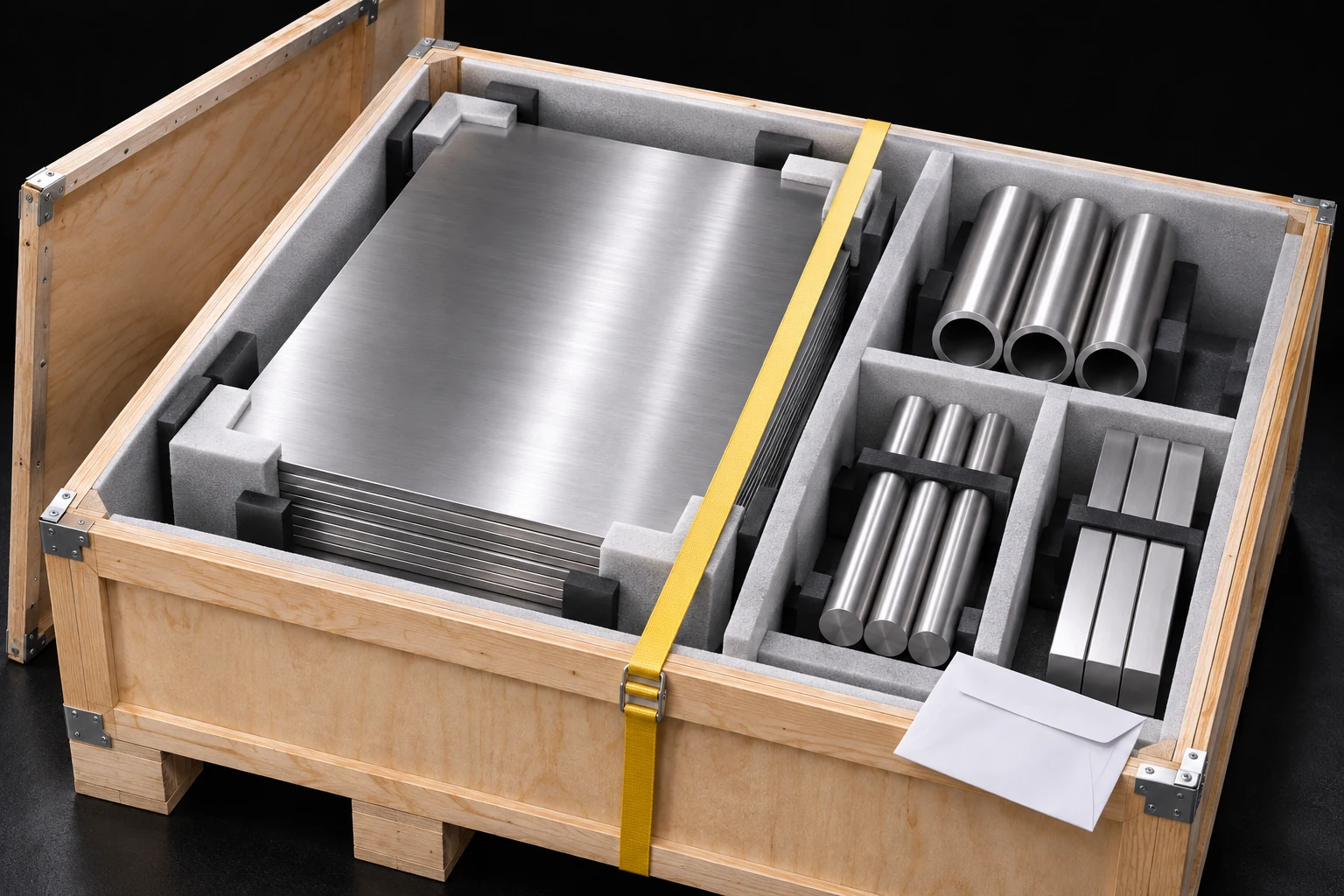
Illustrative product viewInclude protection and packing in the offer
AI illustration; not a factory, certificate or inspection record. Confirm the actual packing design, package map and transport requirements.
12 / Cost example
Worked example: price per kilogram versus usable output
The following invented example compares two ways to obtain 80 kg of equivalent accepted blanks. Both routes meet the same material, geometry and evidence requirements and reach the same delivery boundary. The figures demonstrate the method only; they are not a market range, price forecast or supplier offer.
Cost item
Full-sheet route
Blank-supply route
Material billing
100 kg × USD 32
80 kg × USD 42
Material amount
USD 3,200
USD 3,360
Cutting and agreed finishing
USD 400
Included
Inspection and documents
USD 160
USD 160
Packing and common delivery scope
USD 300
USD 300
Total evaluated amount
USD 4,060
USD 3,820
Accepted output
80 kg
80 kg
Cost per accepted-output kg
USD 50.75
USD 47.75
The blank-supply route has the higher material rate but the lower evaluated total by USD 240. The full-sheet route could still be preferable if its remaining material has a confirmed, valuable use or if it supports a better approved process. Evaluate those benefits explicitly instead of assuming the unused 20 kg is worthless or fully recoverable.
Before relying on the result, verify that both routes truly produce the same piece count, dimensional envelope and acceptance evidence. A low denominator caused by missing pieces is not a saving. The method is designed to reveal assumptions, not to guarantee that one supply route always wins.
13 / Cost options
How to reduce cost without changing an essential requirement
Ask the supplier to quote an approved stock size alongside a special size, or a practical cutting layout alongside your initial layout. Review which dimensions need tight tolerances and which can follow the appropriate stock requirement. Consolidate genuinely compatible sizes or deliveries where this reduces repeated setup and packing work.
Consider a staged purchase when design uncertainty is high: a qualification quantity first, followed by a production batch after the required approval. The trial may cost more per kilogram but prevent a larger unsuitable purchase. Define the qualification purpose and avoid treating a small visual sample as proof of every future production requirement.
Keep alternatives separate from the compliant base offer. A different grade, condition, certificate package or inspection scope can change the engineering and acceptance basis. Cost reduction should come from an approved change or a more efficient route, not an undocumented reduction in what the customer receives.
14 / Build your checklist
Request a sheet quotation with a clear basis
Use the checklist to state your grade, specification, size and piece count, then add the blank plan, weight basis, inspection and delivery requirements. If you need budget options, identify the quantities or approved alternatives to compare. TiHubs can coordinate suitable material and processing sources in Baoji and return a quotation with the important assumptions visible.
Build your purchasing and RFQ checklist
Choose the product and add the information you have. Copy the resulting brief or send your requirements to TiHubs. Submitting an enquiry does not place an order.
15 / FAQs
Titanium sheet pricing FAQs
Can you give one current price for Grade 2 sheet?
A meaningful current price requires a dated quotation for a defined size, quantity, condition and delivery scope. This guide does not publish a live market range. Send the required specification and purchasing basis for an applicable offer.
Is Grade 5 always more expensive than Grade 2?
Do not use an absolute rule across different sizes, batches and supply routes. Compare the same ordered scope and date. Material suitability must be established before using price to choose a grade.
Why can thin sheet have a higher price per kilogram?
The processing, handling, finishing and order-size effects may differ from thicker stock. Ask which route and included services explain the quote. Do not assume a kilogram rate scales directly with thickness.
Does a higher actual weight mean I received more useful material?
Not necessarily. It may reflect a permitted dimensional difference, extra machining allowance or a different billing convention. Compare the received dimensions, piece count and usable envelope with the order.
Should the supplier return every offcut?
Only under the agreed ownership and delivery arrangement. Specify which remnants remain usable and whether they should ship, be held with identification or be treated as supplier-owned scrap under the quote.
Is polished sheet cheaper to fabricate later?
It depends on the downstream process and acceptance requirements. If polishing is removed or damaged during fabrication, it may add little value. Define the required final surface and agree an appropriate processing sequence.
Can a large order guarantee a lower total project cost?
No. A lower unit rate can be offset by unused inventory, storage, additional handling or changed demand. Evaluate a realistic quantity and use plan, including the commitment required to obtain the price break.
What is the fastest way to obtain a useful sheet quote?
Send one controlled requirement containing the grade, product standard and edition, condition, dimensions and tolerances, quantity, document package, destination and required date. Ask for the billing basis, inclusions, exclusions and validity in the reply.
16 / Key takeaways
Price the complete sheet requirement
Obtain a dated quotation for a defined grade, size, condition and quantity.
Record actual or theoretical billing weight and the dimension basis behind it.
Compare cost per usable blank or accepted output as well as price per kilogram.
Keep cutting, evidence, packing and delivery assumptions visible before ordering.
Technical references
References and scope
The cost models and monetary examples are original explanatory tools. They are not market quotations. Reference densities are typical manufacturer data used only to demonstrate mass estimation; the approved specification and agreed billing method control the order.
TiHubs coordinates titanium materials and custom supply from Baoji, China. Our founder’s 20 years in titanium inform a specification-led sourcing approach: clarify the product, manufacturing and acceptance requirements before quotation. Learn about our sourcing role.
Contents
TiHubs
Talk to TiHubs
Ask about titanium materials, grades or custom parts.
Enter your email to start chatting.
We use your email to respond to your enquiry. Your conversation is stored on this website.
Our team is away right now. Leave your enquiry and we will follow up by email.