Separate available inventory from reserved stock and custom production. Understand the minimum order basis, process dependencies and dates behind a deliverable titanium order.
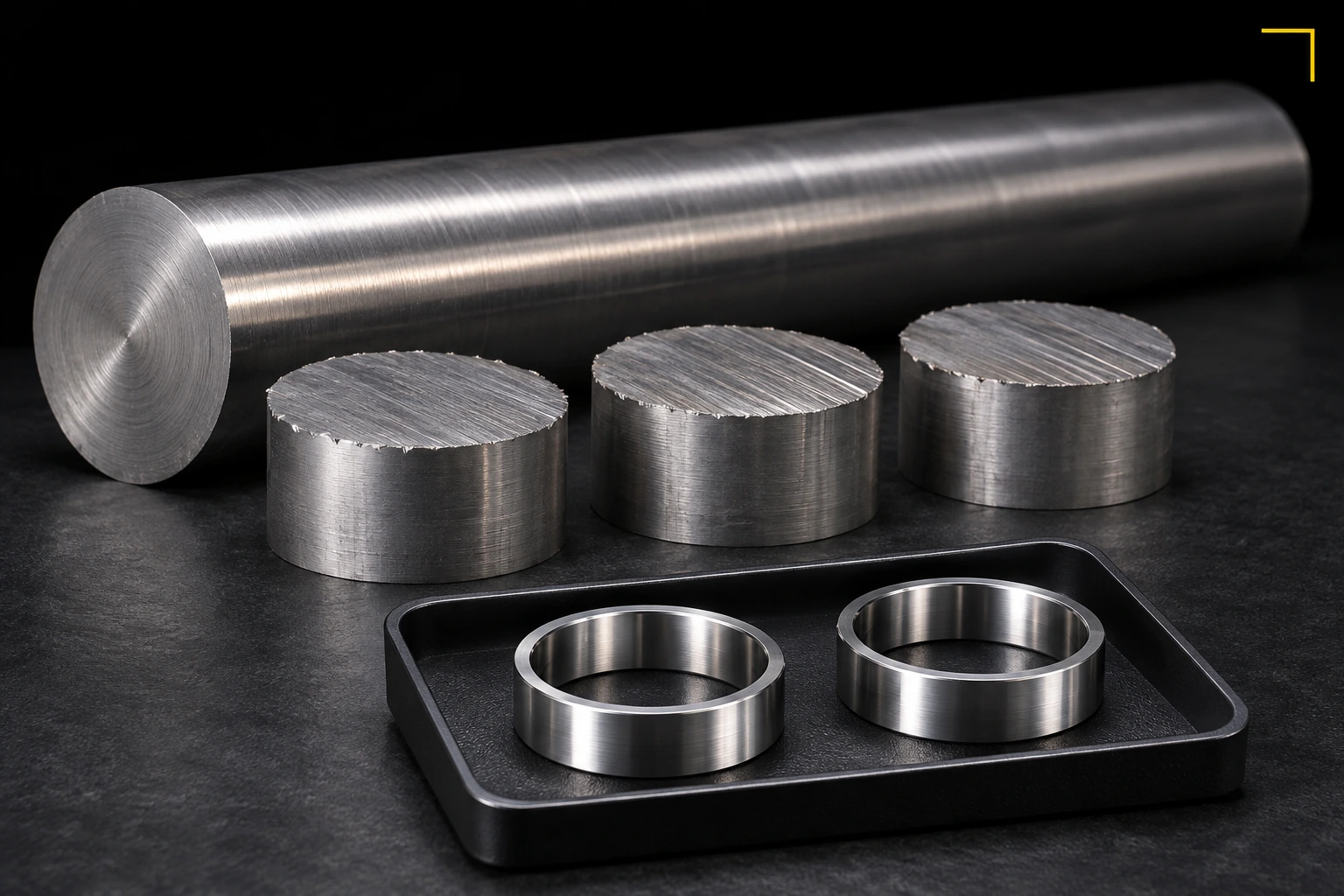
AI illustration. Appearance and labels do not verify material compliance.
What determines titanium MOQ and lead time?
Titanium MOQ and lead time depend on the supply route and the accepted deliverable. Existing certified stock, cut-to-size material and custom production have different constraints. A minimum may relate to one stock length, a full sheet, a processing batch, a machine setup or a minimum invoice—not necessarily a new melt. Lead time must state its start conditions and whether it ends at production completion, inspection release, dispatch or arrival.
Ask four quantity questions: what is physically available, what can be reserved, what can be processed into the required pieces, and what can be released with complete evidence? Then ask for the milestones needed to reach the required delivery point. This guide explains how to obtain those answers; it does not promise a universal MOQ or a fixed number of delivery days.
01 / Supply routes
Start by identifying the supply route
The same titanium grade and nominal size may be offered through several routes. One supplier may hold suitable material; another may need to buy a full parent size and cut it; a third may need new mill production. These are different availability and scheduling propositions. Ask the supplier to name the route behind its quotation.
Route
What may already exist
What still needs confirmation
Stock supply
Identified material in a stated size and condition
Available quantity, documents, reservation, inspection and packing
Cut-to-size supply
Suitable parent sheet, bar or tube
Yield, cutting slot, allowances, identification and final checks
Custom mill production
A proposed production route or starting material
Minimum batch, scheduling, processing, tests and document release
Custom parts
Drawing and proposed material/processing plan
Starting stock, tooling, approvals, machining and part acceptance
A stock offer is not automatically ready for dispatch. A custom offer is not automatically unsuitable for a small project. The correct route depends on your dimensions, evidence requirements, quantity and schedule. Request separate alternatives where more than one route could meet the approved need.
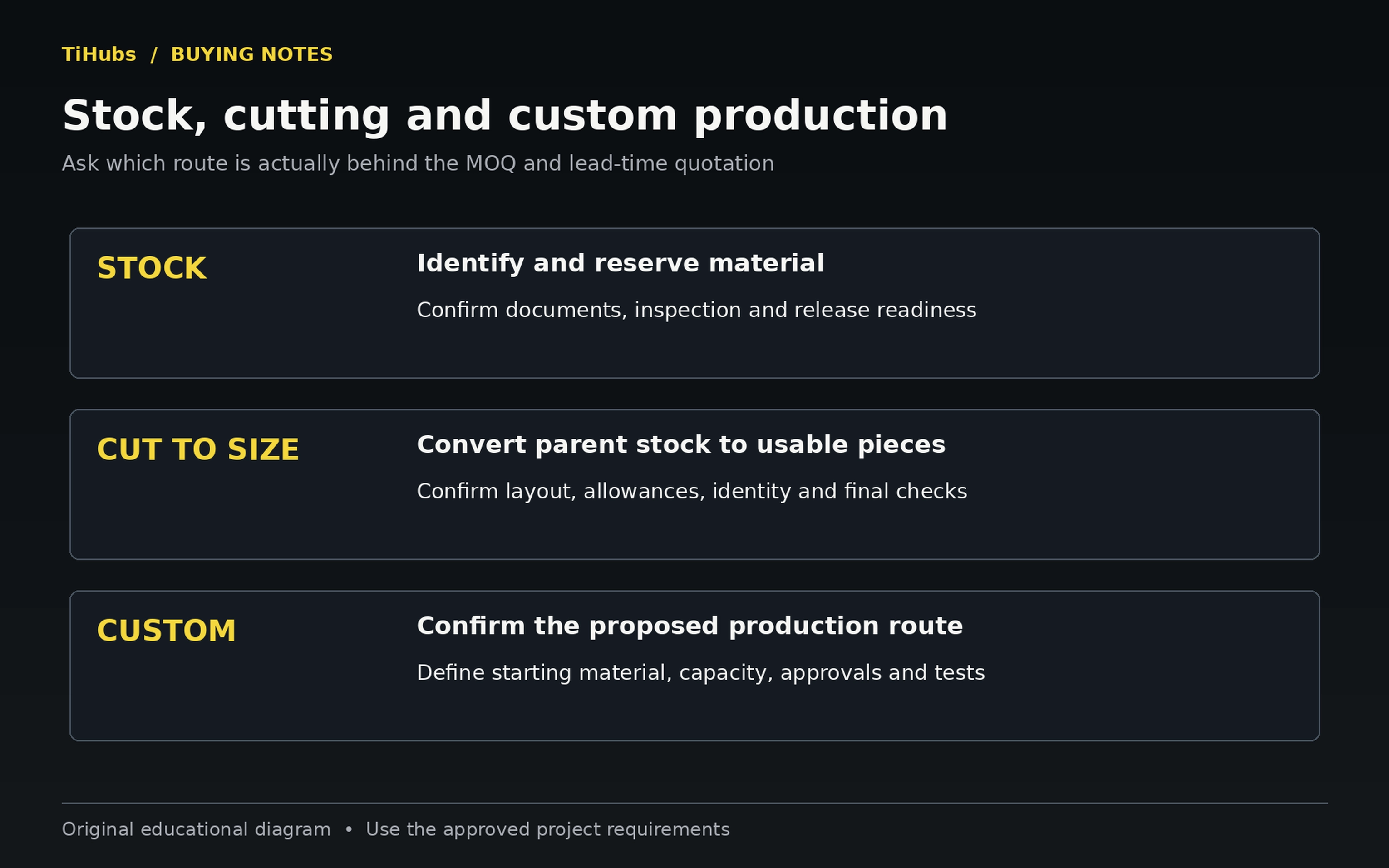
Purchasing planning diagramIdentify the route behind the quotation
Original purchasing diagram. Stock, cutting and custom production have different minimums and dependencies.
02 / Types of minimum
Ask which minimum is being quoted
The word MOQ can conceal different commercial and production constraints. Ask the supplier to identify the actual unit of the minimum and what happens if your requested quantity is below it. A minimum value, minimum kilogram quantity and minimum production batch should not be treated as interchangeable.
Minimum basis
Typical question to ask
Possible purchasing response
Stock unit
Must a complete sheet or length be purchased?
Compare full-unit purchase with a blank-supply offer
Process batch
Which operation creates the minimum?
Review compatible grouping or a different approved route
Setup charge
Can the small quantity be supplied with a separate setup fee?
Compare total cost instead of only the kg rate
Mill production lot
Is a new production campaign required?
Review available approved stock or a staged plan
Minimum invoice
Is the constraint commercial rather than technical?
Request the exact minimum charge and delivered quantity
Finished-part batch
What qualification and recurring work is included?
Separate first-article costs from production pricing
Do not assume the supplier is withholding a universal lower MOQ. Ask for the reason, the options and their consequences. A technically feasible small batch may still require a different price, longer scheduling window or additional material purchase. Keep each alternative’s specification and evidence scope visible.
03 / Available and reserved
Available stock is not the same as reserved stock
Request an inventory description that identifies the material, heat or lot, condition, dimensions, quantity and relevant certificate. Confirm whether the stock is physically held, offered by another source or expected to arrive. A catalogue listing or an earlier inventory sheet is not a reservation for your order.
Then ask how reservation works: what approval or commercial event starts it, which items are allocated, how long the allocation lasts and what happens if the buyer’s decision is delayed. Record the reservation in the order acknowledgement where relevant. If the supplier needs to reconfirm with another source, state that dependency rather than presenting the material as unconditionally available.
Review the documents before relying on the stock for a critical schedule. Existing material may be dimensionally suitable but lack the required condition evidence, test scope or traceability. Some gaps can be resolved legitimately; others cannot be recreated after the fact. A short physical retrieval time does not remove those acceptance questions.
04 / Cut-to-size work
Cut-to-size work introduces a yield and processing schedule
Confirm the parent size, cutting method, finished blank size and allowance. The supplier needs to account for kerf, end trim, edge cleanup, orientation and any excluded areas. Ask for the guaranteed delivered piece count, not only the total parent-stock weight. A material balance is useful only when it connects to the geometry you need.
Include the operations after cutting: deburring, straightening or finishing where specified, dimensional inspection, marking and packing. If the material identity is removed by cutting, the approved identification method must carry the parent-to-piece relationship forward. These activities consume time even when the stock itself is immediately available.
Determine whether remnants ship, remain under controlled storage or become supplier-owned material under the quotation. If a future release depends on a retained remnant, record its usable size and identity. An unidentified piece remaining on a rack is not a reliable inventory commitment for the next order.
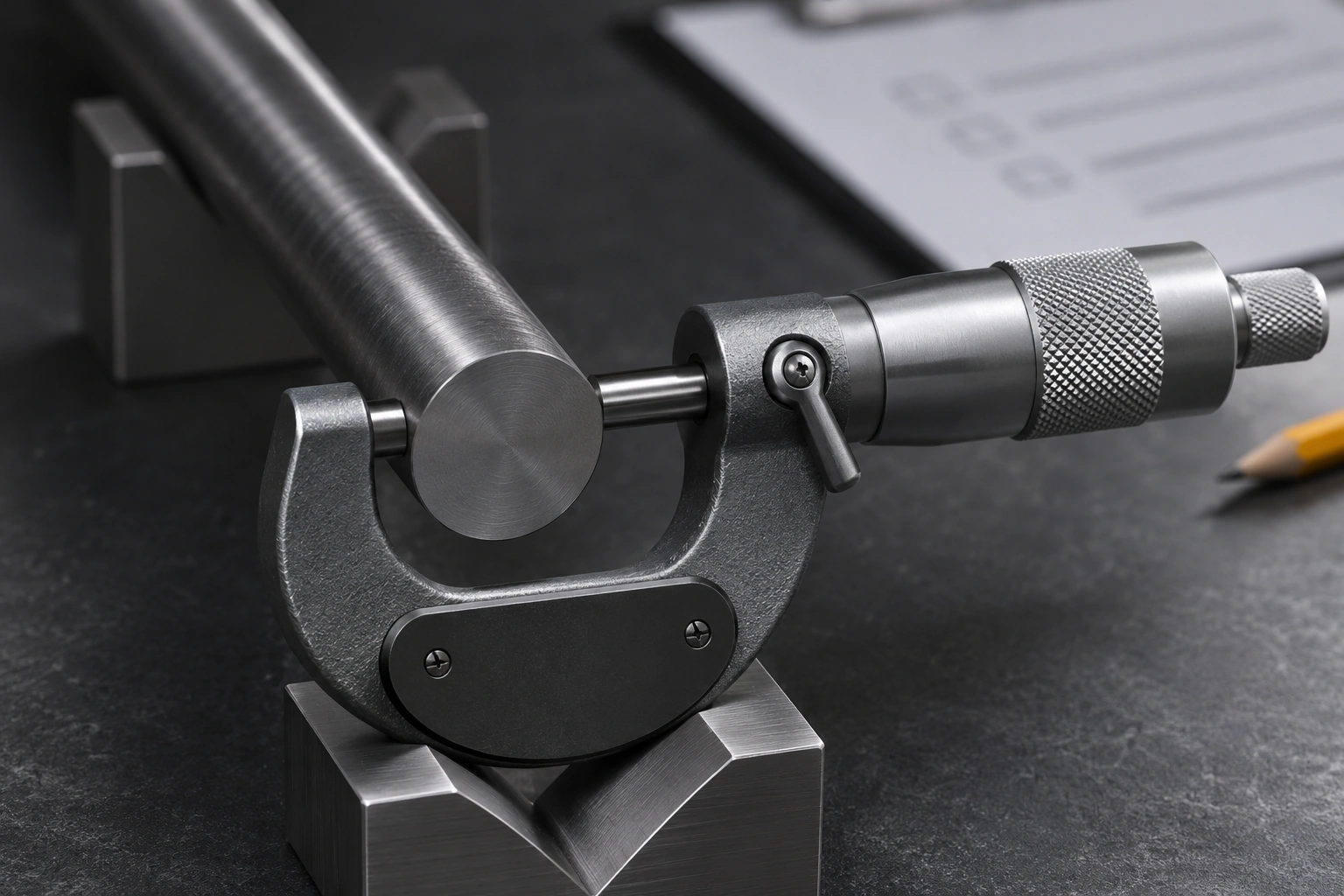
Illustrative product viewDefine the stock-to-part allowance
AI illustration; not a factory, certificate or inspection record. Confirm the usable envelope and the inspection basis before comparing prices.
05 / Custom production
Custom production needs a route, not just a week count
Ask what starting material and production stages are assumed. New sheet, bar, tube or forging supply may depend on different material preparation, forming, heat treatment, finishing and examination steps. Do not describe every custom order as starting from a new melt; the actual starting point should be stated in the proposal.
For each important stage, identify the input needed, the responsible source, the scheduling basis and the evidence produced. Determine which operations are subcontracted and whether their capacity has been confirmed. A quoted processing duration without an available production slot may not describe the same delivery commitment as an allocated order.
Special sizes, a restricted source, additional test requirements, a single-heat condition or a tight acceptance envelope can change the feasible route. Ask for an explanation rather than an unexplained “long lead time.” Where an approved stock alternative exists, compare its full technical and commercial basis separately from the custom production option.
06 / Custom parts
Machined and fabricated parts add approval dependencies
For drawing-based parts, the schedule should include drawing review, material allocation, programming or tooling where needed, first-article requirements, batch processing and final inspection. A quotation made before these questions are closed should identify the unresolved assumptions. A purchase order alone may not authorize production if the drawing package is still incomplete.
State whether the supplier may proceed with batch production before sample approval. If approval is required, include the sample delivery, review and response stages in the plan. Define the evidence needed for approval so the supplier does not send a sample that cannot be evaluated. Keep engineering changes and commercial schedule changes in the same controlled record.
For assemblies, identify purchased components, welding or forming qualifications where applicable, and the sequence of inspection. Material readiness does not mean the assembly is ready. Ask which stage is controlling the schedule and which buyer decisions could move it.
07 / Quantity states
Four quantity states to confirm
Quantity state
Meaning for the buyer
Evidence or commitment to request
Available
Material is reported to exist
Current inventory identity, size, condition and quantity
Reserved
Specific material is allocated to the order
Allocation reference, conditions and expiry if applicable
Processable
The reserved material can yield the required product
Cutting or manufacturing plan and usable piece count
Releasable
The product meets the agreed release conditions
Required results, documents, identification and release decision
These states should be used as explicit questions, not as invented certification categories. A supplier may have ample available stock but too little documented, usable material for your exact order. Conversely, a planned route may produce sufficient quantity but still depend on buyer approval before any stock can be committed.
Ask the supplier to distinguish estimated and guaranteed quantities. If a process has an agreed overrun or underrun allowance, write the range, pricing and approval conditions into the order. Do not allow a broad weight allowance to obscure a minimum piece count needed for assembly or replacement work.
08 / Usable-piece example
Worked example: metres of bar versus usable blanks
Consider an illustrative 6,000 mm parent bar. The cutting plan reserves 20 mm for total end trim and uses a 125 mm blank length plus a 3 mm cutting allowance per blank. On this simplified basis, the usable length is 5,980 mm and 46 blanks fit: 46 × 128 = 5,888 mm. A 47th allocation would require 6,016 mm, exceeding the available length.
These are example planning values, not recommended allowances or a guarantee for a particular saw. The supplier must confirm the real cutting sequence, end condition, tolerances and any test material. If the order requires 100 blanks, two bars produce only 92 under this plan; three are needed even though a simple nominal-length calculation may look more favourable.
Now consider a supplier reporting six bars in stock. If only four are unreserved and have acceptable documents, the immediately releasable plan supports 184 blanks under the same assumptions. An order for 200 blanks needs a fifth suitable bar or another approved route. The statement “36 metres available” does not answer the buyer’s actual quantity question.
Record the proposed remedy: release another approved stock bar, obtain missing legitimate evidence, use a different parent length, or revise the delivery split with buyer approval. Do not assume that nominal inventory automatically converts into accepted delivered pieces.
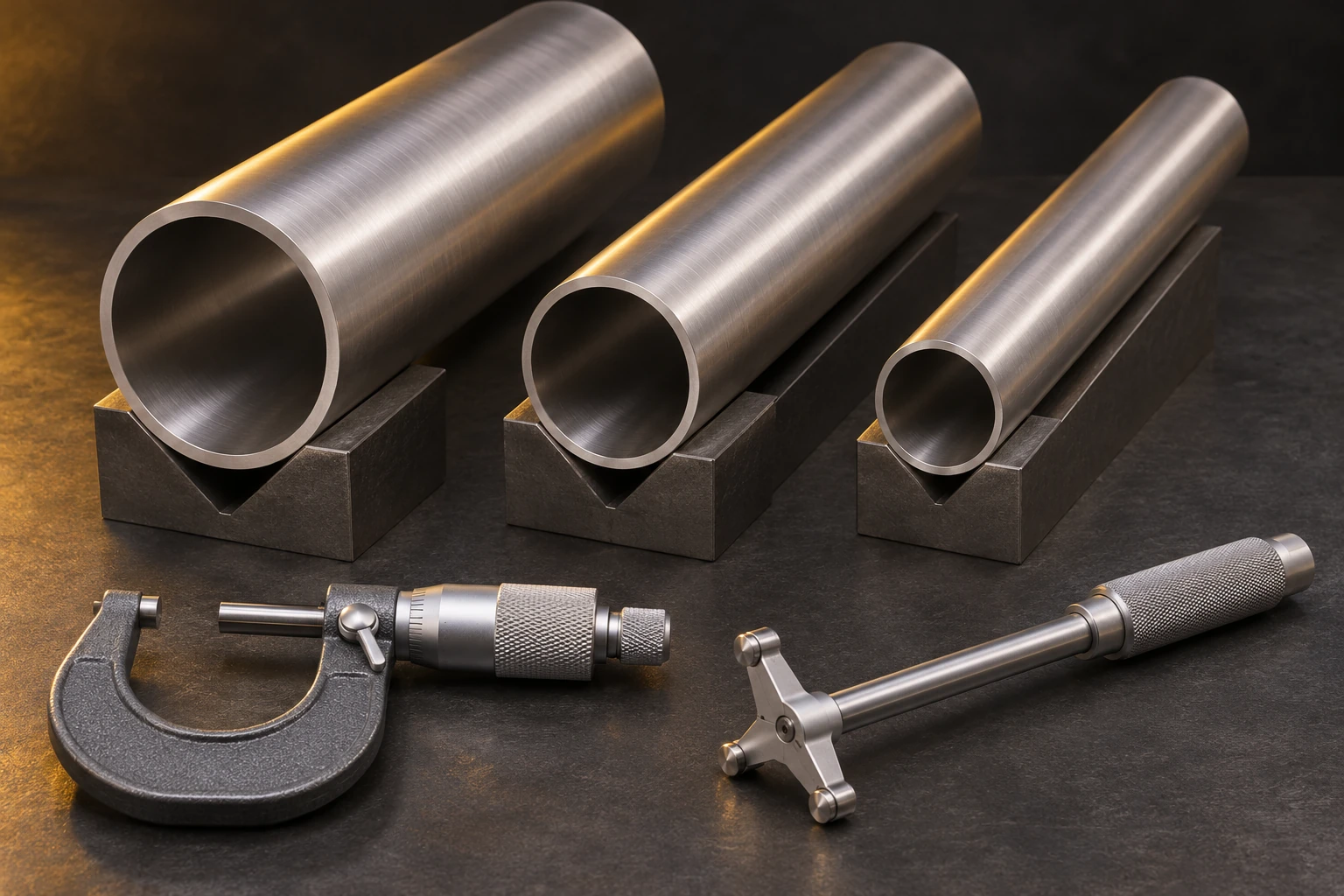
Illustrative product viewDescribe the tube deliverable precisely
AI illustration; not a factory, certificate or inspection record. Specify dimensions, manufacturing route and the evidence needed for release.
09 / Delivery clock
Define the start and finish of lead time
Write the trigger for the quoted lead time. It might be accepted order acknowledgement, agreed payment conditions, approved drawings, confirmed material allocation or sample approval. If several conditions apply, state whether the clock starts only after the last one is complete. Avoid an open-ended phrase such as “after everything is confirmed” without naming the required inputs.
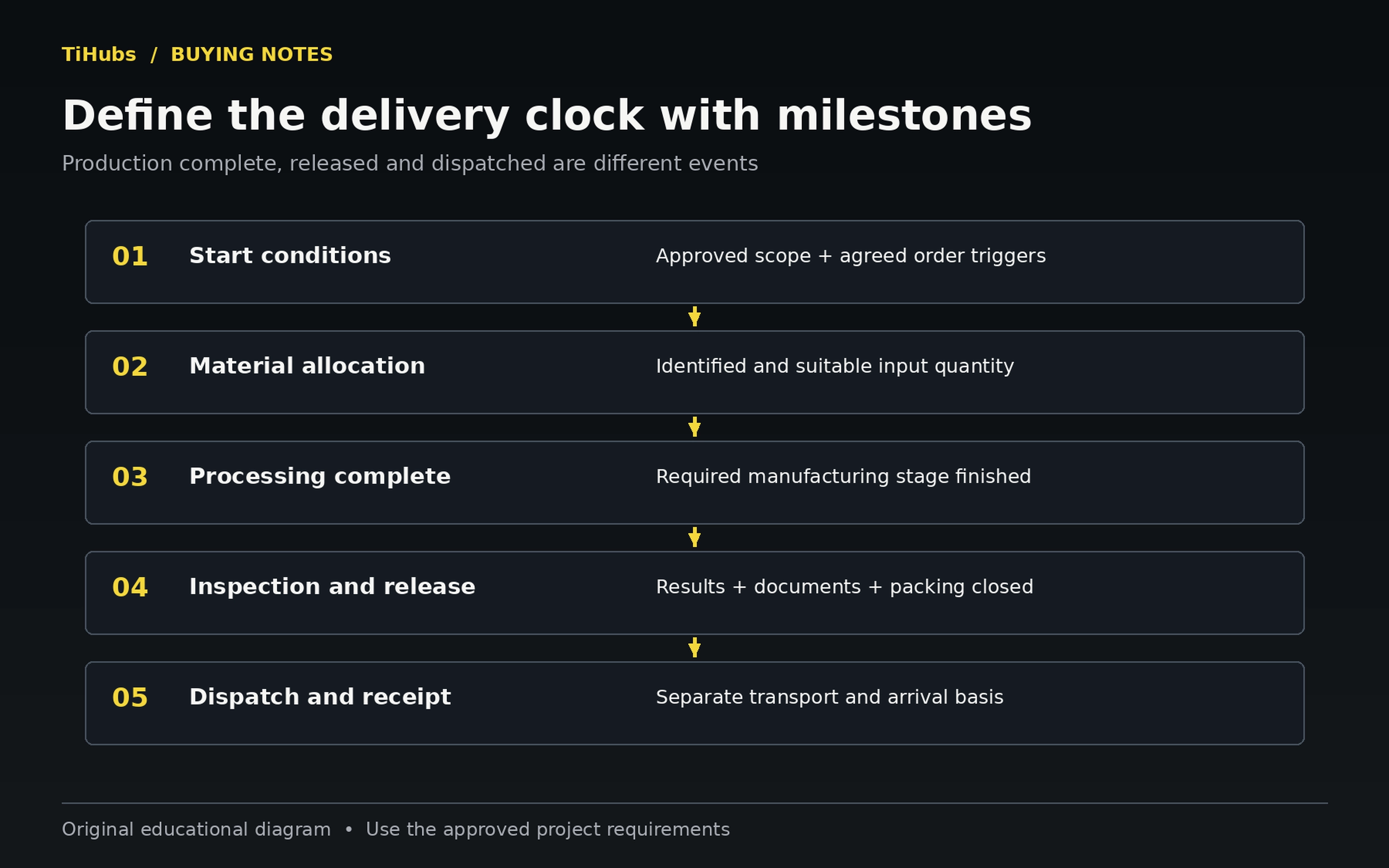
Define the finish with equal care. Production complete, inspection released, packed, ready for collection, dispatched and delivered to the destination are distinct events. A material quotation ending at readiness for collection should not be interpreted as an arrival promise. Ask the supplier to use dated milestones when the project has a fixed installation or production need.
Agree the working calendar and update method for a schedule expressed in working days. Identify planned shutdowns or unavailable inspection dates where they affect the particular order. Do not add a universal holiday delay or assume every supplier has the same calendar. The relevant schedule is the one confirmed for the proposed route.
10 / Milestones
Use a milestone plan with dependencies
Milestone
Evidence of completion
Common dependency to identify
Requirements frozen
Approved RFQ, drawings and exception closure
Buyer engineering decisions
Material allocated
Identified suitable stock or confirmed production input
Source availability and document review
Processing completed
Recorded production stage complete
Capacity, tooling and approved route
Inspection and documents complete
Actual required results and reviewed reports
Sample timing, laboratory work, witness access
Packing and release complete
Protected, identified packages and release record
Closed nonconformities and final documents
Carrier handover
Agreed dispatch evidence
Booking, collection and export arrangements
Destination receipt
Receiving record at the agreed destination
Transit and destination handling
Ask which activities can proceed in parallel and which depend on completed material or approval. The critical sequence may change during the order. For example, document review can sometimes occur while production capacity is being arranged, but a final-product examination cannot be completed before the relevant product exists.
Use milestone updates to identify a decision early. A message saying “on schedule” is less useful than confirmation that the material is allocated, the drawing is approved and the next inspection slot is booked. Keep evidence proportional to the order, but make the controlling dependencies visible.
Purchasing planning diagramMake the delivery clock explicit
Original purchasing diagram. Separate start conditions, allocation, processing, release, dispatch and receipt.
11 / Schedule example
A schedule calculation should expose its assumptions
Here is a deliberately simplified planning example, not a normal TiHubs or industry lead-time promise. Suppose drawing review needs 2 working days, material allocation and document review need 3, processing needs 6, final tests and reports need 4, and packing and release need 1. If all five stages are sequential, the pre-dispatch plan totals 16 working days.
If drawing review and material review can legitimately run together, and both must finish before processing, the same plan becomes max(2, 3) + 6 + 4 + 1 = 14 working days. This improvement comes from an approved parallel sequence. It does not come from omitting tests or assuming reports will appear instantly after production.
Transport and destination activities must be added according to the actual route and delivery commitment. Buyer approval delays or a failed inspection can change the plan. Use the example to ask better scheduling questions; replace every duration with confirmed order-specific information before making a purchasing decision.
12 / Inspection release
Inspection and documents can control dispatch
An order can be physically finished but not releasable. Required test results may still be pending, a dimensional deviation may need disposition, or the final certificate-to-package mapping may be incomplete. Include these activities in the schedule instead of treating them as an administrative step with no duration.
Agree when inspection procedures, sample selection and witness visits must be arranged. Define who reviews results and how quickly the buyer needs to respond to an approval request. If the planned release authority is unavailable, identify a permitted alternative through the normal approval process rather than shipping first and seeking acceptance later.
Do not solve a schedule problem by silently reducing the ordered evidence. If a legitimate alternative examination or delivery split is proposed, have the responsible authority review it and record the decision. The pre-shipment checklist helps define the release package before the deadline becomes urgent.
13 / Dispatch and arrival
Dispatch time and arrival time are different promises
Confirm who arranges collection, main transport, insurance where required, export and import activities, and destination delivery under the selected arrangement. State the rule, edition and named place. Public UK guidance distinguishes rules available for any transport mode from rules reserved for sea and inland-waterway transport; choose a rule suitable for the actual route. [1]
Ask for a transport estimate based on the package count, dimensions, gross mass and route. A provisional estimate made before packing information is known should remain labelled provisional. Long products or special handling can affect the available transport options even when the net titanium weight is modest.
When your requirement is arrival by a fixed date, work backwards from that endpoint and include the agreed release, collection and transport dependencies. Keep the contractual commitment and any planning contingency distinct. A carrier estimate, supplier-ready date and guaranteed site-delivery date are not interchangeable.
14 / Practical alternatives
Ways to improve MOQ or schedule responsibly
Ask whether an approved stock size can meet the requirement with an acceptable allowance, whether compatible lines can share a setup, or whether noncritical finishing can be performed in your own process. Request the cost and evidence consequences of each option. A useful alternative preserves the essential requirements and exposes the remaining work.
Consider a split delivery where a smaller accepted quantity can support the immediate need. Define which pieces, heats or lots go in each shipment, the documents for each release, extra packing and freight charges, and the final completion date. Partial delivery should be an agreed plan, not an unexpected shortage discovered at receiving.
For recurring demand, a controlled reservation or scheduled-release arrangement may help, but it creates commitments that must be understood. State ownership, storage, call-off timing and what happens if the forecast changes. Do not promise a repeat-order lead time based on stock that has not actually been allocated.
15 / Build your checklist
Build your quantity and delivery brief
Enter the required product, usable quantity and delivery target, then identify the supply route and any approval stages. Ask TiHubs to separate material availability, minimum billing, processable output, release requirements and dispatch assumptions. The checklist produces a brief that can be copied or submitted for an order-specific review.
Build your purchasing and RFQ checklist
Choose the product and add the information you have. Copy the resulting brief or send your requirements to TiHubs. Submitting an enquiry does not place an order.
16 / FAQs
Titanium MOQ and lead-time FAQs
Is there one standard minimum order for titanium?
No universal minimum applies to every form and route. Ask whether the quoted minimum is a stock unit, process batch, setup charge, mill lot, part batch or invoice value, and what quantity will actually be delivered.
Does in-stock mean ready to ship today?
Not necessarily. Confirm reservation, dimensions, condition, certificates, inspection, marking and packing. The material may exist without satisfying all release conditions for your order.
Can a small order be made from a larger parent size?
Often a supplier can propose such a route, but it must confirm cutting yield, allowances, document continuity and the minimum billing basis. Compare the total cost and usable piece count, including remnant treatment.
When should the lead-time clock start?
At the trigger explicitly agreed in the quotation and order acknowledgement. Name the required conditions, such as approved drawings and material allocation, and state whether all must be complete before the clock begins.
Can final inspection be skipped to protect the dispatch date?
Do not remove an ordered acceptance requirement without an authorized change. Review legitimate alternatives or a revised delivery plan with the responsible parties and retain the evidence supporting the decision.
Are sample and production lead times the same?
They may differ because qualification, tooling, starting material and batch processes differ. Ask for separate sample and production milestones, including the buyer’s approval period between them where required.
Should I accept an unspecified quantity tolerance?
No. Define the permitted overrun or underrun, price basis and approval conditions. Where a minimum piece count is essential, state it explicitly rather than relying only on a weight range.
What information helps TiHubs confirm a realistic schedule?
Provide the approved specification and drawing revision, required usable pieces, inspection and document scope, approval stages, delivery destination and required endpoint date. Identify which requirements are fixed and which alternatives can be reviewed.
17 / Key takeaways
Confirm quantity and time on the same basis
Identify whether the offer uses stock, cutting, custom material or custom-part production.
Separate available, reserved, processable and releasable quantities.
Define the MOQ basis, delivered piece count and any permitted quantity variation.
State the lead-time trigger, dependencies, release milestone and delivery endpoint.
Technical references
References and scope
This article presents an original planning framework. Inventory, cutting and schedule figures are hypothetical examples, not supplier commitments or standard manufacturing allowances. Actual quantities, production routes and dates require an order-specific review.
TiHubs coordinates titanium materials and custom supply from Baoji, China. Our founder’s 20 years in titanium inform a specification-led sourcing approach: clarify the product, manufacturing and acceptance requirements before quotation. Learn about our sourcing role.
Contents
TiHubs
Talk to TiHubs
Ask about titanium materials, grades or custom parts.
Enter your email to start chatting.
We use your email to respond to your enquiry. Your conversation is stored on this website.
Our team is away right now. Leave your enquiry and we will follow up by email.