AI illustration; not a production or inspection record.
Quick answer
Elemental titanium is commonly listed near 1,668 °C, about 3,034 °F; the Royal Society of Chemistry lists 1,670 °C. Alloys require their own transition data and definitions. A melting reference is not an allowable operating temperature. Assess the grade, condition, load, exposure time, environment and complete assembly before deciding what thermal evidence the purchase needs.
01 / Published melting values
Start with the material and the source definition
The melting point of elemental titanium is commonly reported near 1,668 °C, or about 3,034 °F. That is a useful factual answer, but it is not a complete specification for a titanium alloy, a casting process or a component exposed to heat. Buyers need to know which material the number describes and what decision they intend to make with it.
The reference table preserves the values and labels of the named sources. It does not claim that TiHubs measured these temperatures or that every delivered heat has an identical transition. It also avoids presenting a manufacturer’s liquidus entry as though it were a complete solidus-to-liquidus melting interval. The definition beside the number matters as much as the number itself.
Published reference values; not product acceptance limits or permitted service temperatures.
Reference material
Published value
Source and interpretation
Titanium element
1,668 °C
Geoscience Australia: melting point in its titanium properties table
Titanium element
1,670 °C
Royal Society of Chemistry: melting point in its element fact box
TIMETAL 6-4 family datasheet
1,650–1,660 °C, with ±14 °C as printed
TIMET Table 2: melting (liquidus) point; retain the source notation and scope
Using °F = 1.8 × °C + 32, 1,668 °C converts to 3,034.4 °F. Using K = °C + 273.15 gives 1,941.15 K. Rounding these to about 3,034 °F and 1,941 K is consistent with the original integer Celsius value. The extra digits produced by arithmetic do not establish a more precise experimental melting temperature.
When a specification uses kelvin, do not attach a degree symbol to the unit. Also distinguish an absolute temperature from a temperature difference. These details are easy to lose when a quotation copies a value from another unit system. Keep the original reference, the original unit and any conversion together so the technical review can reconstruct what was intended.
Do not use melting point as incoming identification
A purchase order for Grade 2, Grade 5 or another specified material should be accepted through its agreed material requirements and traceable records, not by attempting to identify stock from a generic melting number. Commercially pure grades are controlled engineering materials, not perfectly pure elemental samples. A similar melting reference cannot establish chemistry, condition, mechanical properties or compliance with the ordered product specification.
If a process genuinely needs transition data for a particular alloy or heat, obtain appropriate material-specific evidence. State the measurement definition and required uncertainty with the process or laboratory specialist. A general reference table is suitable for orientation; it is not a substitute for a process input that controls an important acceptance decision.
02 / Melting and phase changes
Keep solidus, liquidus and beta transus separate
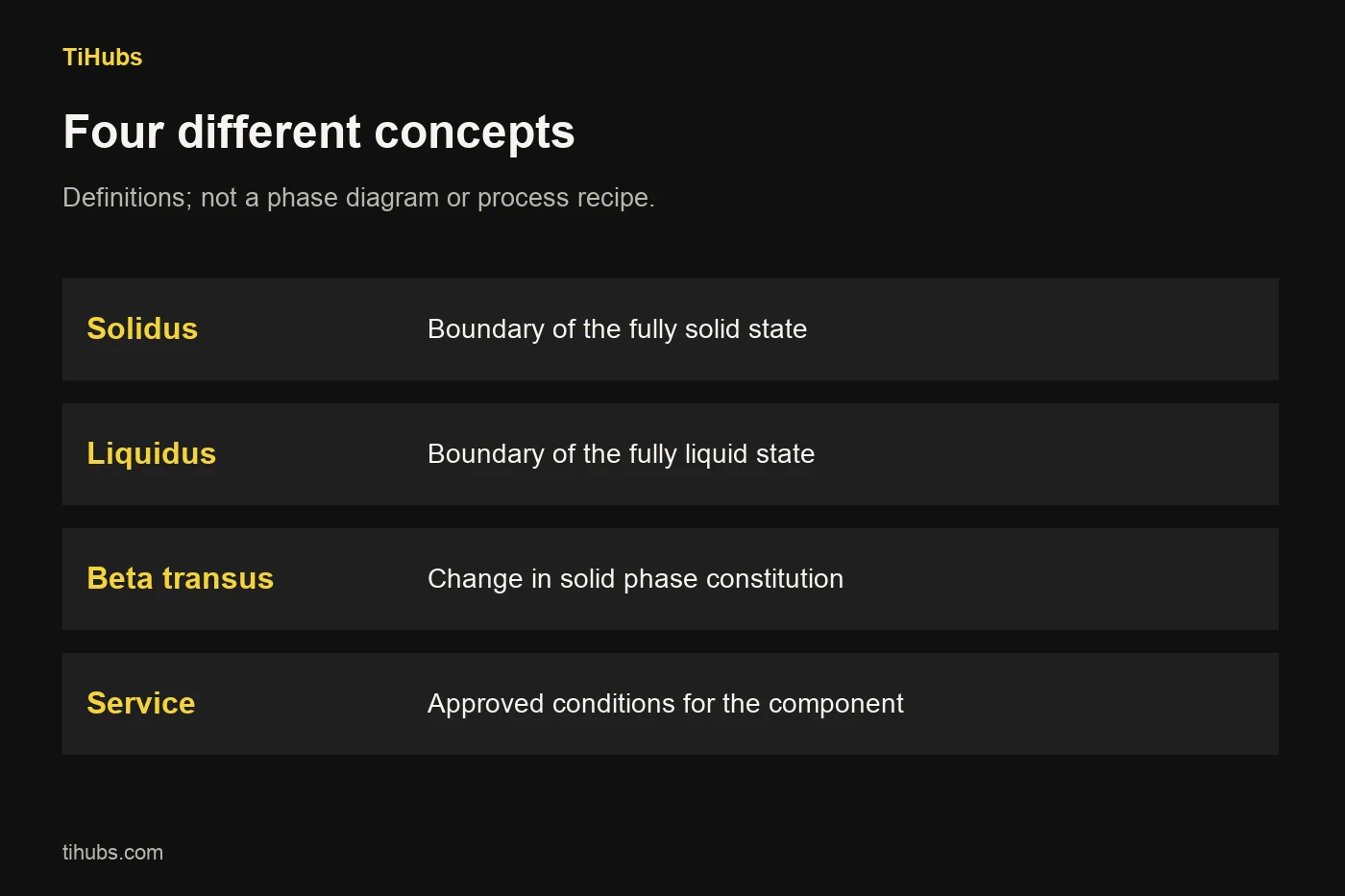
For an alloy, the beginning and completion of melting need not occur at one temperature. The solidus marks the boundary below which the equilibrium material is fully solid; the liquidus marks the boundary above which it is fully liquid. Between those boundaries, solid and liquid can coexist. The relevant values depend on the alloy and the conditions represented by the data.
A range can describe different things
A printed range might represent a melting interval, variation between compositions, a reported liquidus band or another convention. Read the label before choosing an interpretation. In the TIMET reference above, the entry explicitly says liquidus. It must not be relabelled as a solidus–liquidus interval merely because it contains two temperatures. Likewise, the printed ±14 °C is not a contractual tolerance for a TiHubs shipment.
Where data are entered into simulation software, check which quantity the model expects. A thermal model may require more than one transition input and may represent latent heat separately. Copying a convenient melting point into every field can create a plausible-looking calculation with the wrong physical meaning. Retain the source definition and identify any model inputs that remain assumptions.
Beta transus is a solid-state boundary
Beta transus concerns a change in solid phase constitution, not the appearance of a fully molten pool. The same TIMETAL 6-4 table lists a beta-transus reference of 996 ±14 °C, distinctly below its liquidus entry. This comparison illustrates different physical events. It does not prescribe a heat-treatment temperature or demonstrate that every Grade 5 product should be processed at that value.
A component can undergo a consequential microstructural change while remaining solid. Therefore, evidence that a part did not melt is not evidence that its original properties were preserved. The duration, temperature history, material condition and subsequent cooling can matter. For a thermally exposed part, define the properties that must remain acceptable rather than treating visible shape retention as the only criterion.
Melting, boiling and ignition answer different questions
Melting describes the solid-to-liquid transition. Boiling describes a liquid-to-gas transition under stated conditions. Ignition concerns combustion and depends on material form and environment. Do not use the melting point as a fire-safety threshold or as permission to heat fine particles, chips or powder. Industrial thermal processing requires equipment and controls suitable for the actual material and operation.
This guide addresses procurement and interpretation, not a workshop melting procedure. A request for titanium melting feed, cast stock or welded parts should identify the qualified process route and responsible processor. The buyer’s useful contribution is a clear product requirement and acceptance basis, not an assumed furnace setting inferred from a periodic-table value.
Keep process temperatures out of service claims
A controlled manufacturing step may expose material to conditions that would be unsuitable for the finished component in normal service. Conversely, a component’s operating limit may be set by another part of the assembly. Distinguish process temperature, material-transition data and permitted operating conditions in every quotation and drawing note. They should not share an unqualified column headed maximum temperature.
Industrial buying guide / 02Different temperatures describe different events.
Conceptual definitions only. The graphic is not a phase diagram, a heat-treatment recipe or an operating limit.
03 / Working temperature
The part can lose function long before it melts
A high melting point does not establish a high allowable working temperature. A loaded component can become unacceptable because of deformation, time-dependent behaviour, oxidation, fatigue, joint movement or loss of an important material condition while still remaining solid. Which mechanism governs depends on the grade, product, geometry and duty. The service limit comes from the design and its supporting evidence.
Describe temperature as a history
Separate normal operation, startup, shutdown, short excursions and abnormal events. Record duration and frequency as well as the highest temperature. Two parts reaching the same peak can have very different requirements if one experiences a brief transient and the other carries load continuously. A single maximum number cannot communicate that distinction to a material supplier.
Also distinguish the surrounding gas or liquid temperature from the actual metal temperature. Heat transfer, cooling, wall thickness and location affect the component response. State whether a value is measured, calculated or assumed, and where it applies. If the controlling metal temperature is unknown, identify that as a design input to resolve rather than silently treating fluid temperature as a verified part temperature.
Use a duty record instead of a melting-point margin
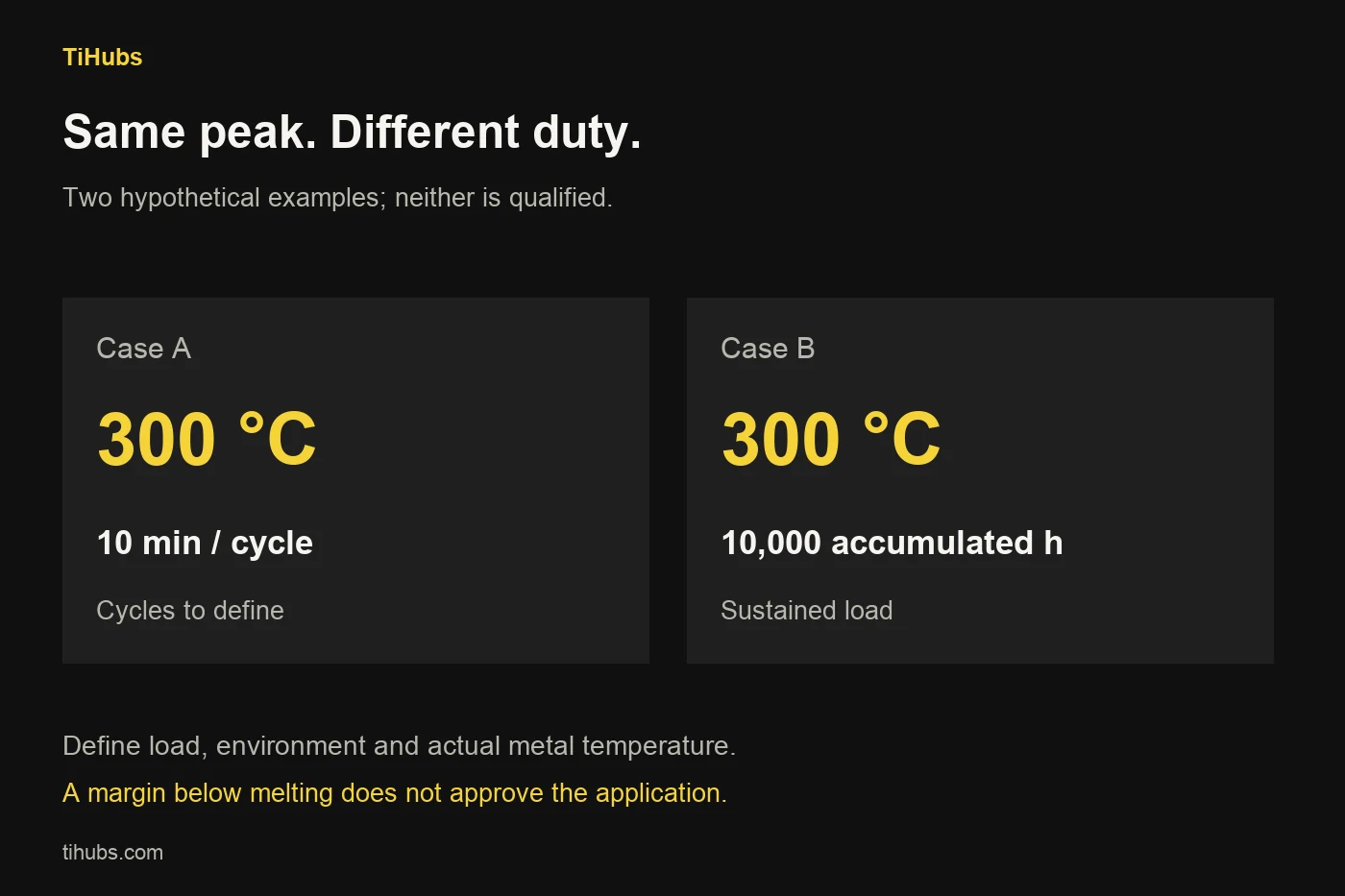
Consider two hypothetical enquiries for the same titanium part. Enquiry A specifies an estimated metal temperature of 300 °C for ten minutes per cycle. Enquiry B specifies 300 °C for 10,000 accumulated hours under a sustained load. Neither is approved by this example. They demonstrate why duration and loading must accompany temperature before the required evidence can be chosen.
Subtracting 300 °C from a melting reference and describing the difference as a safety margin would not assess either enquiry. It ignores the mechanisms that can limit the component below melting. Even a percentage of melting temperature is not a universal design rule; an absolute temperature scale and a justified material model would be required for any analysis that uses such a relationship.
Check dimensions and restraints
Temperature changes can alter fits and load paths without approaching a phase transition. A tube fixed at both ends, a bolted connection and a freely supported sample have different constraints. The titanium thermal-expansion guide explains why both mating dimensions and their temperature histories matter. A low expansion value does not prove that an assembly can accommodate all thermal movement.
Likewise, melting point does not tell you how quickly heat moves through the part. The thermal-conductivity guide distinguishes a material property from the heat-transfer behaviour of an assembly. A surface temperature, average temperature and local hot spot may answer different questions. Define the temperature relevant to the acceptance requirement.
Include the connected components
Seals, coatings, fasteners, supports and mating materials can govern the practical operating envelope. A titanium tube may remain geometrically intact while another element loses its required function. Review the complete assembly and allocate responsibility for that review. A supplier quoting titanium stock cannot infer an undisclosed seal material, pressure cycle or allowable displacement from the grade name alone.
Industrial buying guide / 03The peak temperature is only part of the duty.
Constructed examples show the importance of duration and loading. Neither case is a qualified titanium application.
04 / Melting and fabrication routes
Buy a controlled product route, not a temperature claim
The ability to heat titanium above a transition temperature is not the same as the ability to produce acceptable material. Chemistry, contamination control, solidification, subsequent processing and inspection all contribute to the supplied product. Ask the processor to describe the proposed route and the records supporting it. A furnace-capacity statement alone does not define the quality or suitability of the output.
Melting feed and ingot enquiries
For titanium ingot enquiries, identify the intended downstream use and the controlled chemistry or product requirement. State dimensions, mass or quantity, traceability and any restrictions on the melt route or feed material. An ingot intended for further conversion is a different deliverable from finished bar with its own dimensional and mechanical acceptance requirements.
If an offer includes recycled feed or a proposed alternative route, review its suitability through the applicable specification and process controls. Do not assume that melting erases the significance of unknown input material. Equally, do not reject a permitted route solely because a generic marketing description sounds less premium. Compare the controlled requirements and the evidence that the proposed material will meet them.
Castings need a casting acceptance basis
A titanium casting enquiry should include the finished or as-cast drawing, alloy, machining allowance, relevant inspection and acceptance requirements. Identify which surfaces and dimensions are supplied as cast and which are finished later. The melting reference does not establish internal quality, surface condition, repair permission or the properties of the completed casting.
Agree whether process qualification, first-article review, non-destructive examination or particular records are required. These are separate questions from nominal alloy chemistry. If the quotation excludes machining or inspection that the drawing requires, resolve the scope before comparing price. A low-cost raw casting and an inspected, finished component are not the same deliverable.
Welding is a local thermal process
TWI’s titanium-welding guidance explains the importance of cleanliness and shielding the hot weld region against atmospheric contamination. That process issue is not solved by quoting the base metal’s melting point. The weld, adjacent material and cooling region require an appropriate qualified procedure and acceptance basis.
For purchased welded components, identify material, joint details, filler where applicable, procedure requirements and inspection. Do not treat a photograph of a neat bead as a complete weld-quality record. Colour and appearance can contribute to inspection under the applicable requirements, but they do not replace every examination or qualification needed for the actual component. Avoid inventing a universal colour acceptance rule from an unrelated application.
Separate capability from an offer
A supplier may coordinate several manufacturing routes without having every size or grade in stock. Ask for the proposed source, route, delivered condition and acceptance scope in the quotation. Confirm feasibility and timing for the actual drawing and quantity. This keeps the discussion commercially useful without turning general technical information into an unsupported promise of production capability.
05 / Testing and acceptance
Choose the evidence for the property that controls function
When the concern is hot-service strength, a melting-point statement is the wrong acceptance evidence. When the concern is a process transition, a room-temperature tensile result is also incomplete. Start with the controlling requirement and choose the relevant data or test. The objective is a documented connection between the material delivered and the function that the design expects it to perform.
Short-duration strength and time-dependent response differ
The public scope of ASTM E21 covers elevated-temperature tensile properties such as strength and ductility. The public scope of ASTM E139 addresses creep and rupture under defined loading and temperature conditions. These methods answer different questions. A short tensile test should not be presented as proof of acceptable deformation over a long service life.
Specify the specimen relationship to the product, test condition, sampling and acceptance criterion when additional testing is required. A laboratory report from another grade, condition or product route may be useful background without qualifying the purchased part. Mark the intended role of each document: general reference, design input, representative qualification or shipment acceptance. Those roles should not be silently exchanged.
Keep exposure and post-exposure requirements distinct
A component may need to function while hot, retain properties after cooling, or satisfy both requirements. State which applies. A test conducted only after return to room temperature may not describe the behaviour during exposure. Conversely, an acceptable hot measurement does not automatically establish the later condition. The test programme should match the actual decision rather than simply produce the most familiar certificate.
Where an abnormal thermal event has occurred, retain the known history and identify what remains uncertain. Do not release the component solely because it did not melt or because its external dimensions look unchanged. The responsible engineer should determine whether inspection, analysis or testing is needed. Procurement can support that decision by preserving material identity and obtaining relevant original production records.
State the condition of the supplied material
Heat treatment and prior processing belong with the grade and product specification. If a later manufacturing step changes that condition, define who verifies the finished state. A starting-stock certificate cannot automatically certify properties after an undisclosed thermal process. Record approved processing and substitution requirements with the drawing revision so a repeat order does not accidentally change the evidence basis.
Do not add unnecessary tests simply to make a purchase look more technical. Each requested record should resolve a real requirement or risk identified by the project. Where existing qualified data are sufficient, reference them clearly. Where they are insufficient, agree the missing evidence before production so cost, sample material and delivery timing can be reviewed realistically.
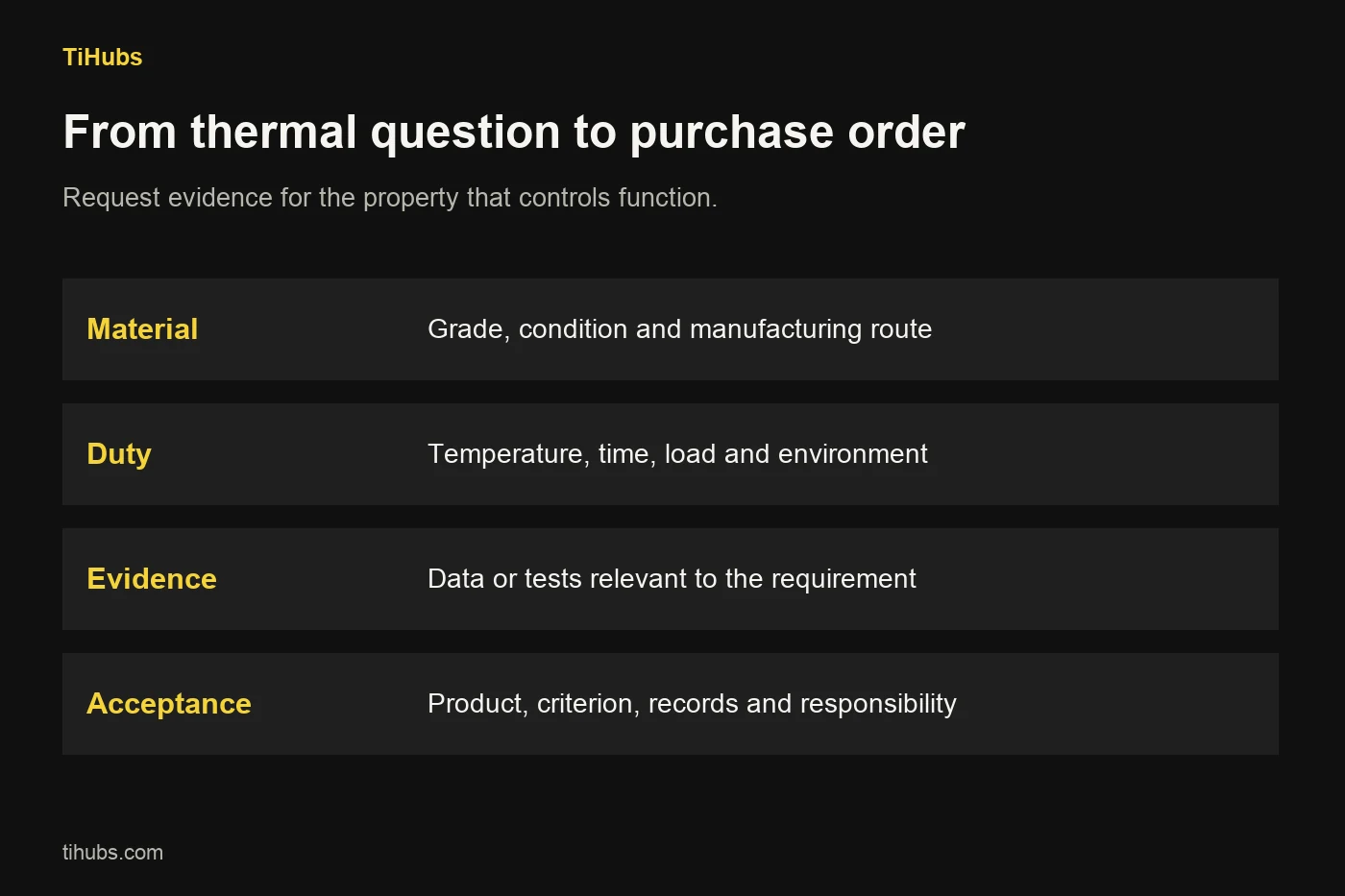
Industrial buying guide / 05Choose evidence for the actual decision.
Original procurement framework; specific tests and acceptance limits must be established for the project.
06 / Product-specific enquiries
Translate the temperature question into a useful RFQ
The best enquiry states what is being purchased and why heat matters to it. For a raw-material order, that may be a downstream manufacturing constraint. For a finished component, it may be an approved service envelope. For a casting or weldment, it may involve both. Keep these purposes separate so the supplier can identify the appropriate route and the boundaries of the quotation.
For exhaust tubing, describe the metal duty
An enquiry for titanium exhaust tubing should include the selected grade, outside diameter, wall, bend geometry, joints and relevant thermal duty. Identify whether the temperature refers to gas or measured metal and describe cycles and support conditions. A high elemental melting point cannot establish the suitability of an arbitrary thin tube for an unspecified exhaust system.
Clarify whether the supplier provides straight lengths, bends, welded sections or a complete assembly. That distinction changes the required drawing, inspection and responsibility for the final installation. The customer should retain the approved design basis, including the relationship between the tube and neighbouring components. Material supply does not automatically include validation of the complete vehicle or equipment system.
For cast and machined parts, identify the final state
State whether the part is accepted before or after machining, heat treatment, coating and assembly. List critical dimensions, material records and required examinations. If the same component can be made by different routes, request a clear description of any proposed alternative and review it against the complete requirement. Similar geometry does not make process histories or acceptance evidence interchangeable.
Compare offers on the same basis
Check grade, condition, specification edition, processing route, inspection, quantity and documentation before comparing price. Ask suppliers to identify exclusions and deviations explicitly. A quotation that includes only stock material should not be compared directly with one that includes representative testing and finished-part acceptance. The difference is scope, not simply a difference in material cost.
Finally, retain the source of any thermal property used in the design record. The reader who later sees a number should know whether it describes an element, an alloy liquidus, a process step or an approved service condition. That discipline turns a basic melting-point query into a traceable procurement decision and reduces the risk of an impressive but irrelevant temperature becoming a product promise.
07 / Build your RFQ
Send the product requirement and thermal context.
Identify whether the order is for melting feed, stock, a casting, a welded item or a finished component. Provide grade, condition, drawing, quantity and acceptance requirements. Where heat matters, state the actual or assumed metal temperature, duration, load, environment and required evidence. TiHubs can review the proposed supply scope; service approval remains tied to the responsible design review.
Information to include
Product form, grade and specification edition
Delivered condition and proposed processing route
Drawing revision, dimensions and quantity
Metal temperature, duration, cycling and load
Environment, connected components and acceptance criteria
Required records, inspection, packaging and destination
Build your RFQ checklist
Choose the product and add the information you have. Copy the resulting brief or send your requirements to TiHubs. Submitting an enquiry does not place an order.
08 / FAQs
Questions buyers ask
What is the melting point of pure titanium?
A commonly reported elemental reference is 1,668 °C, approximately 3,034 °F or 1,941 K. Geoscience Australia lists 1,668 °C, while the Royal Society of Chemistry lists 1,670 °C. Retain the source and definition rather than treating either value as a shipment acceptance limit.
Does Grade 5 titanium melt at exactly the same temperature?
Do not substitute an elemental value for alloy-specific data. The cited TIMETAL 6-4 family table labels its 1,650–1,660 °C entry, with ±14 °C notation, as liquidus. It is not a complete solidus–liquidus interval or a guaranteed transition value for a delivered heat.
Is beta transus the melting point?
No. Beta transus concerns solid phase constitution. The cited 6-4 reference lists 996 ±14 °C for beta transus, separately from liquidus. A solid-state change can affect material condition without visible melting, so the original properties cannot be assumed unchanged merely because the shape remains intact.
Can a titanium part work safely close to its melting point?
Melting point does not establish an operating limit. Strength, deformation, time-dependent response, environment, cycling and connected components may govern at much lower temperatures. Use the approved design basis and applicable evidence for the actual part and duty.
Does a melting-point value prove casting quality?
No. Cast-product acceptance also depends on the specified material, processing, geometry, condition and inspection. Define the relevant casting requirements and evidence. A furnace temperature or alloy name cannot replace acceptance of the supplied product.
What temperature should I put in a supplier enquiry?
State whether it is a manufacturing temperature, fluid temperature or actual metal temperature. Add duration, cycles, loading and environment, and identify estimates as estimates. Include the approved material and drawing requirements so the supplier can review a concrete supply scope.
09 / Key takeaways
Keep the purchase requirements connected.
Keep the source, material and transition definition beside every temperature.
Do not relabel a liquidus range as a complete melting interval.
Separate melting, solid-state changes and allowable operating conditions.
Describe temperature history, loading and the complete assembly.
Specify evidence for the actual product and acceptance decision.
Technical references
Sources and data scope
References reviewed November 17, 2026. Public source summaries support the discussion; the controlled specification, agreed edition and approved project requirements govern acceptance.
TiHubs coordinates titanium material and custom supply enquiries from Baoji, China. Send the product, drawing revision and acceptance requirements so the proposed supply scope can be reviewed. Learn about our sourcing role.
Contents
TiHubs
Talk to TiHubs
Ask about titanium materials, grades or custom parts.
Enter your email to start chatting.
We use your email to respond to your enquiry. Your conversation is stored on this website.
Our team is away right now. Leave your enquiry and we will follow up by email.