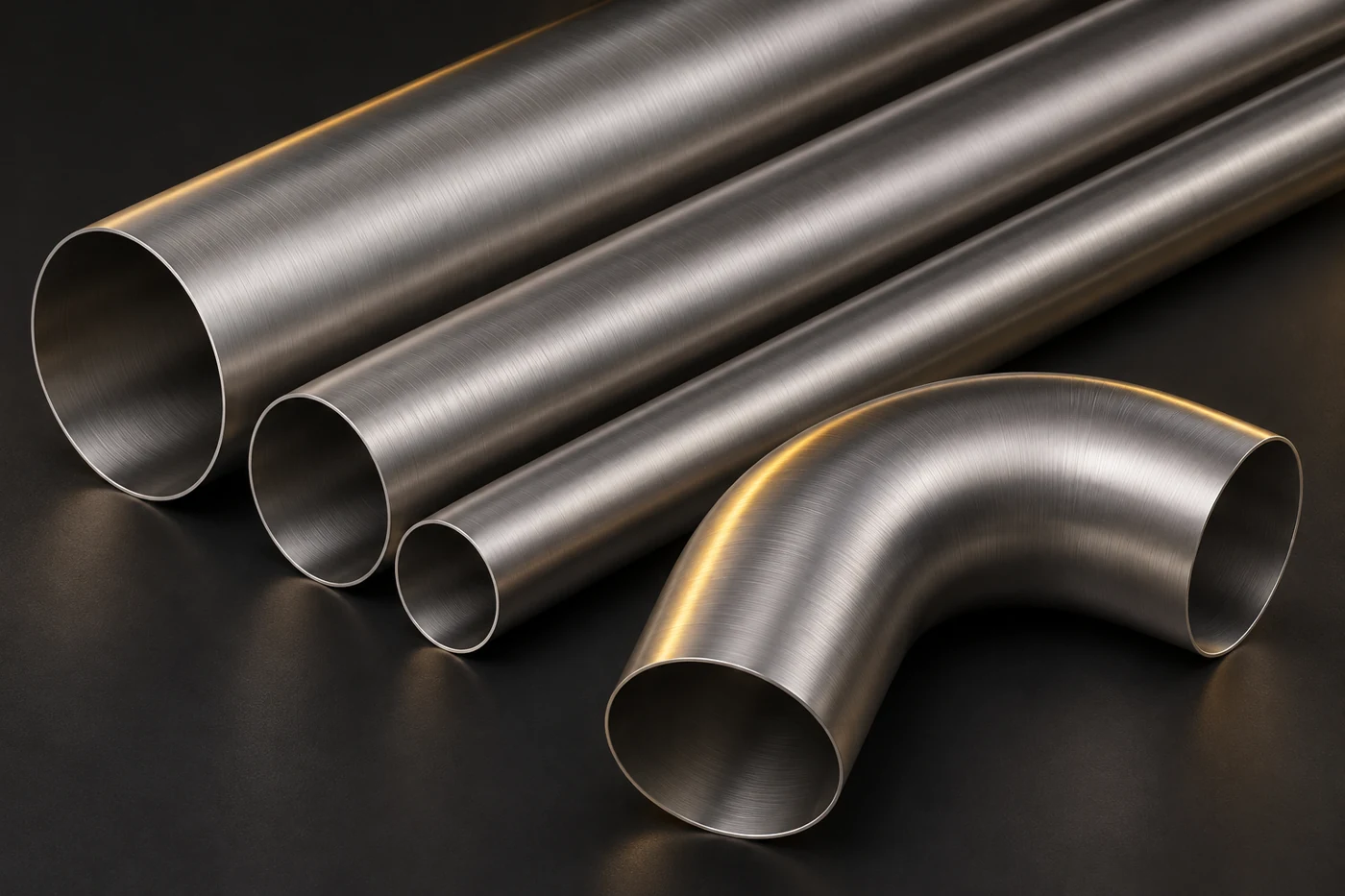
Titanium tubing for exhaust fabrication, specified around your drawing and thermal duty. Review straight lengths, bend geometry, joint preparation and the evidence needed before release.
20 years in titanium100+ Baoji factory connections
Defined geometry. Reviewed duty. Traceable material.
Start with the supplied form
Separate the purchased tube or bend from the completed exhaust system. Each form needs its own geometry and acceptance.
Straight exhaust tube
Straight exhaust tube
Specify outside diameter, wall thickness, cut length and supplied condition for the next fabrication step. Distinguish nominal wall from an agreed minimum. State whether welded tube is permitted and how a seam may be positioned. Straight stock is a material input; the completed exhaust still needs its own fit, durability and performance validation.
OD, wall basis and length
Permitted route and condition
Clean ends and traceable identity
Make the enquiry measurable
Specify what will be delivered and how it will be checked. Size range, quantity and lead time are confirmed for the actual requirement.
Order item
Include in your enquiry
Why it matters
Material
Grade, condition and product specification
Identify the exact supplied material
Tube size
Outside diameter × wall × usable length
Include tolerances and wall basis
Manufacture
Welded or seamless route; seam restrictions
Confirm the actual supply route
Bends
Centreline radius, angle, tangents and orientation
Add ovality and post-bend minimum wall
Ends / joints
Cut angle, mating dimensions and overlap
Control assembly fit and preparation
Duty
Component position, wall temperature and cycling
Gas temperature alone is insufficient
Surface / records
Surface condition, lot traceability and tests
Define methods, coverage and acceptance
Order
Quantity, drawing revision, destination and timing
Confirm scope, feasibility and lead time
Your starting specification.
Grade and condition, OD × wall × length, quantity, straight or bent form, bend radius and angle, joint details, measured wall-temperature duty and drawing revision.
Supply and processing are confirmed per project. No universal temperature limit, service life, power gain or finished-system approval is implied. Images are AI product illustrations, not stock or test evidence.
Select the grade within the design
These are material enquiry options, not stock promises or universal exhaust recommendations. The design authority defines suitability.
Chinese designations and international names are reference routes, not automatic substitutes. Grade, product specification, condition and acceptance requirements must be agreed together.
Position changes temperature, supports, movement and inspection needs. Share the component context before selecting material.
Connecting pipes and mid-pipes
Provide routing, available space, clamp or flange interfaces and support locations. Establish movement allowances through the complete assembly design. A thinner wall changes handling and joint behaviour as well as mass. Do not transfer an existing stainless drawing to titanium by changing only the material callout. General titanium tube supply ↗
What to sendAssembly drawing, OD/wall, interfaces, supports and operating cycle.
Bends and fabricated routing
Define the functional envelope after bending and joining. The outside bend may thin while the section becomes oval; specify acceptance rather than assuming that the starting wall remains everywhere. For a segmented route, control the number and position of joints and the final alignment. Compare proposals against the same finished geometry.
What to sendBend drawing, minimum wall, ovality method and final datums.
Thermally demanding locations
Identify the component location and measured or validated wall-temperature history, including peaks and time at temperature. Commercial exhaust makers use application-specific materials: Akrapovič describes proprietary titanium alloys and system testing. This is evidence of a design process, not evidence that ordinary Grade 2 or Grade 9 can replace those alloys.
What to sendWall-temperature duty, thermal cycles, environment and design approval basis.
Plan forming and joining together
A tube that meets incoming dimensions can still fail a bend or joint requirement. Define the finished condition and inspection stage.
Order geometry schematic; not a dimensional drawing.
Separate gas and metal temperature
Record where and how temperature was determined. Gas temperature is not automatically the tube-wall temperature, and one peak does not describe a full duty cycle. The designer should review oxidation, temperature-dependent properties, cycling and restraint together. Avoid deriving a continuous-use limit from melting point or a room-temperature tensile table.
Control the finished bend
Specify centreline radius rather than leaving inner versus outer radius ambiguous. Include straight tangents and the orientation between successive bends. Agree how ovality and minimum wall are measured, and which locations are inspected. A prototype fit check and a dimensional report answer different questions; decide which evidence the order requires.
Protect the weld and its root
Titanium joining requires controlled cleanliness and shielding, including the root and cooling region where applicable. TWI explains titanium weld contamination and the limits of colour assessment. A silver or colourful appearance alone is not qualification. Specify the governing procedure, personnel requirements and agreed inspection instead of accepting a decorative colour as proof.
Connect component release to system validation
A material certificate and dimensional report can release the ordered tube scope. They do not establish vehicle fit, power, noise, emissions conformity or fatigue life. Assign those system responsibilities explicitly. If the order includes fabricated parts, define the drawing, joining scope, examination, leak-test requirements where applicable and the approval record before production.
Release against the agreed scope
Use the order and drawing as the inspection basis. Keep tube supply evidence separate from system durability and vehicle performance evidence.
Round-tube section / illustrative product view
Order documentationTiHubs
Traceable from heat to shipment.
Material identificationGrade + specification
Batch identificationHeat / lot reference
Inspection scopeAgreed tests & results
Shipment identificationMarks + packing list
Illustrative document checklist. Not a certificate or test report.
01Material identity
Match grade, specification, condition and heat or lot to the order.
Certificate + traceability02Straight dimensions
Check OD, wall basis, length and required straightness.
Method + coverage + limits03Finished bends
Check radius, angle, tangents, ovality and wall at agreed points.
Finished drawing04Ends and surfaces
Inspect burrs, dents, preparation and defined surface condition.
Fabrication-ready scope05Joining scope
Where included, verify the specified procedure and examination records.
Agreed weld acceptance06Protected release
Retain identity through cutting, packing and delivery.
Marks + documents + protection
Check what each reference covers
ASTM B338 covers condenser and heat-exchanger tubing; assigning it to an exhaust does not certify exhaust service. Confirm the actual tube specification and contractual edition. Official B338 scope ↗
Library PDFs may be earlier editions. Check the document cover and your contractual revision. A reference file does not certify a supplied product.
TiHubs coordinates titanium sourcing through a local manufacturer network. Your specification guides the supplier review, technical discussion and delivery requirements.
Confirm grade, dimensions, state, quantity and the purpose of the stock.
Review the supply route
Discuss manufacturing, finishing, inspection and documentation with the relevant supplier.
Agree the commercial scope
Confirm the quotation, lead time, acceptance requirements and delivery terms.
Coordinate inspection & delivery
Follow the agreed checks, marking, packing and shipment documentation.
Before you order
Clarify the tube supply, fabrication and system-validation boundaries before ordering.
TITANIUM EXHAUST TUBING · BAOJI SOURCING
Send your specification.
Titanium tubing for exhaust fabrication, specified around your drawing and thermal duty. Review straight lengths, bend geometry, joint preparation and the evidence needed before release.
You do not need to finalize every detail before contacting us.
TiHubs
Talk to TiHubs
Ask about titanium materials, grades or custom parts.
Enter your email to start chatting.
We use your email to respond to your enquiry. Your conversation is stored on this website.
Our team is away right now. Leave your enquiry and we will follow up by email.