Baoji High-tech Zone, ChinaTitanium sourcing · One contact



TA34 Cryogenic Titanium Alloy · Cryogenic titanium alloy
TA34 Cryogenic Titanium Alloy. Form the stock. Qualify the cold service.
Enquire about TA34 sheet, strip and tube stock for drawing-controlled cryogenic fabrication, with forming, welding and low-temperature acceptance defined as one project.
Start with a specification, drawing or application. We’ll help identify the details still needed.
Material review. Supply coordination.
One contact in Baoji, China.
TA34 Cryogenic Titanium AlloyTA34 · ordered grade chemistry
Cryogenic titanium alloyCryogenic forming stock & welded fabrication
One contact20 years of founder experience · 100+ Baoji factories
01 / Product forms
Find your TA34 product.
Choose a material form or application. Send the dimensions, service conditions and required records so we can match the manufacturing route to your order.
01 / 06
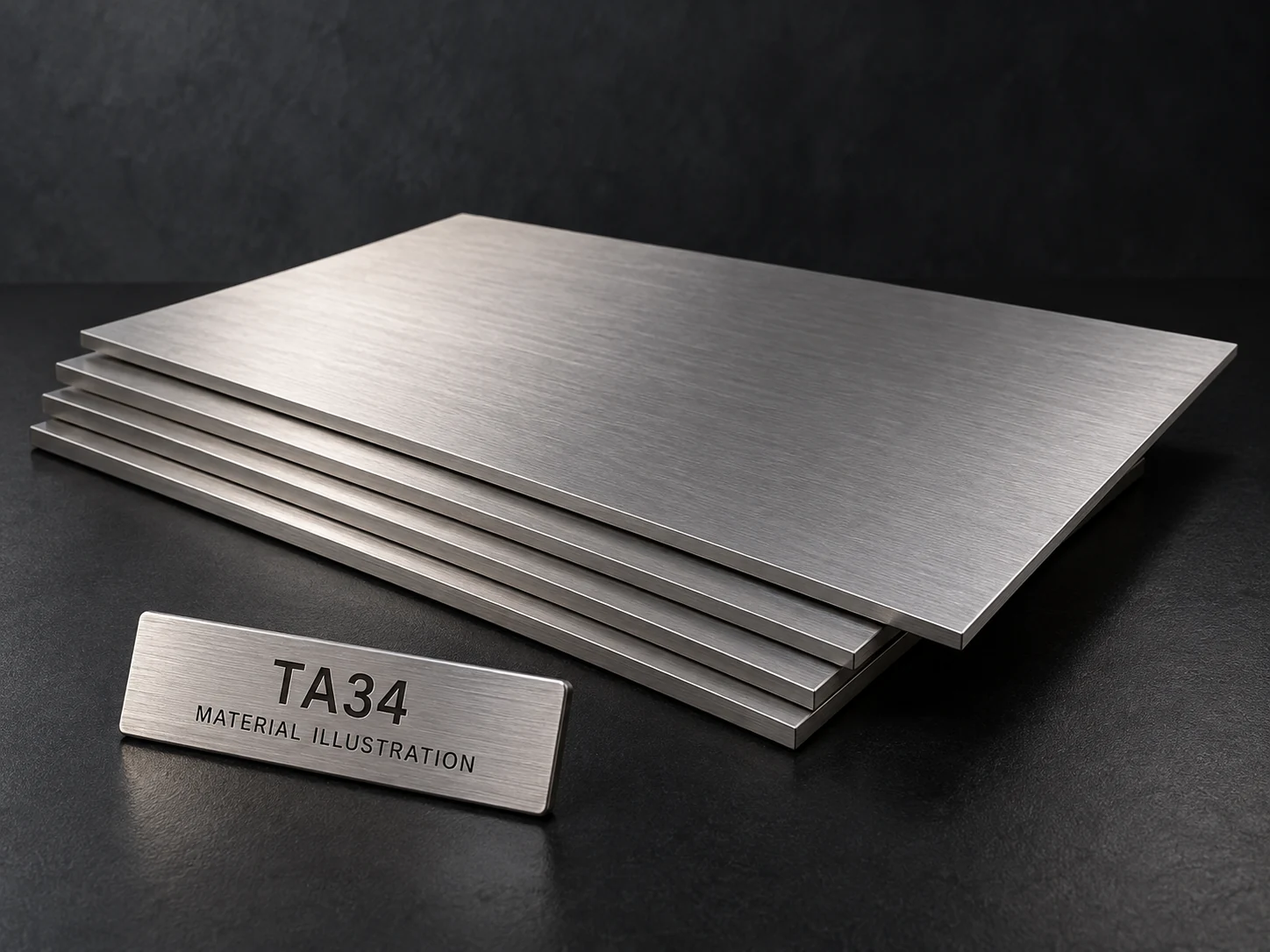
TA34 Cryogenic Titanium Alloy
TA34 cryogenic sheet stock
Flat sheet for formed or welded parts within an approved cryogenic fabrication route.
- Specification
- Approved grade-specific product specification, drawing revision and delivery condition; confirm supply feasibility.
- Size & delivery
- Thickness, width, length, flatness, edge condition and rolling direction.
- Manufacturing review
- Review forming sequence, minimum radii, joining and final condition before ordering.
- Inspection priorities
- Thickness uniformity, surface integrity and directional properties under the agreed specification.
02 / 06
TA34 Cryogenic Titanium Alloy
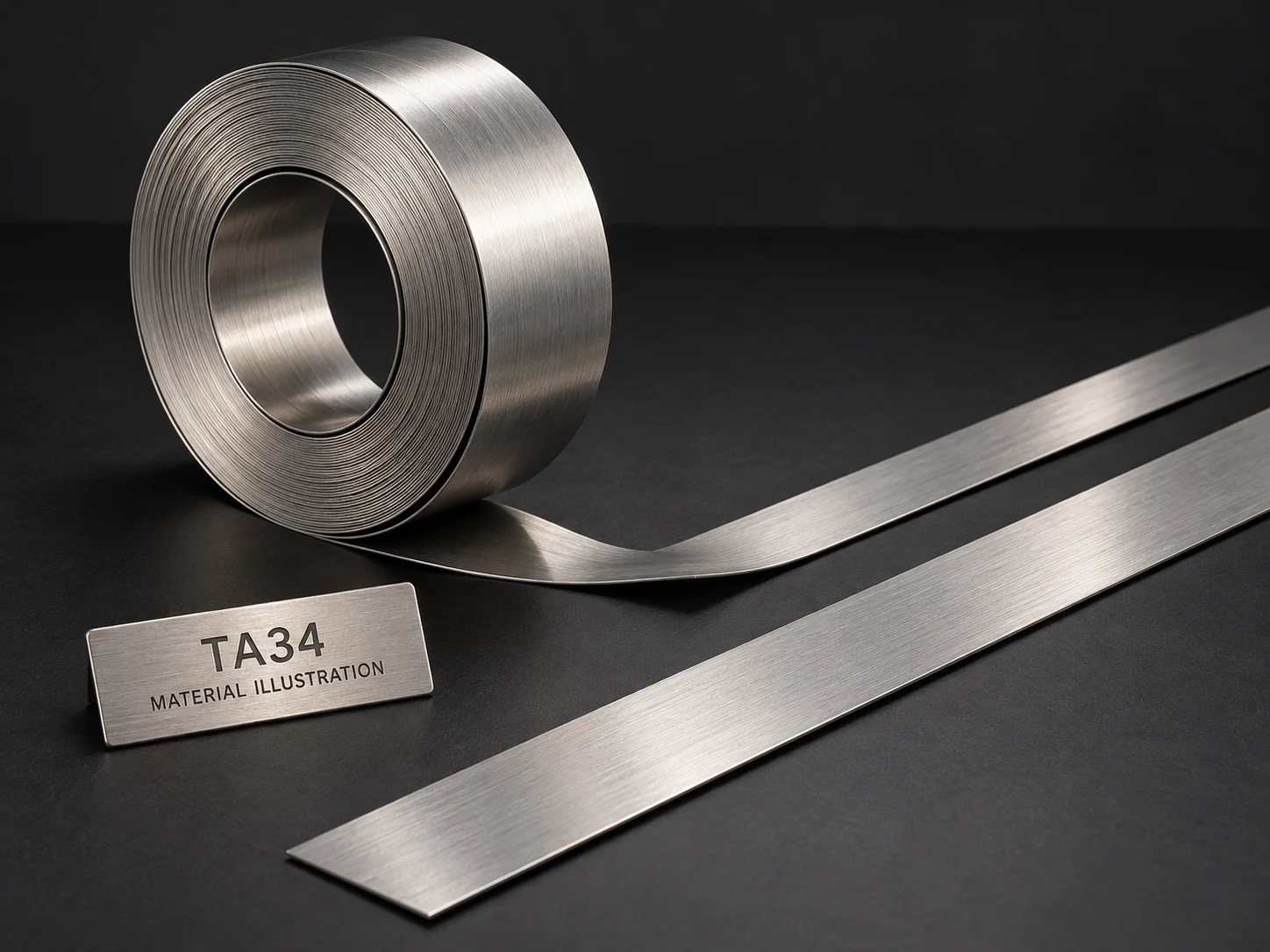
TA34 precision strip
Narrow flat or coiled strip for controlled forming and thin-wall fabrication development.
- Specification
- Approved grade-specific product specification, drawing revision and delivery condition; confirm supply feasibility.
- Size & delivery
- Strip thickness, width, edge finish, camber, coil geometry and usable length.
- Manufacturing review
- State the subsequent bending or rolling route and whether the incoming strip condition is critical.
- Inspection priorities
- Edge quality, consistent section and representative forming response; agree coil handling.
03 / 06
TA34 Cryogenic Titanium Alloy
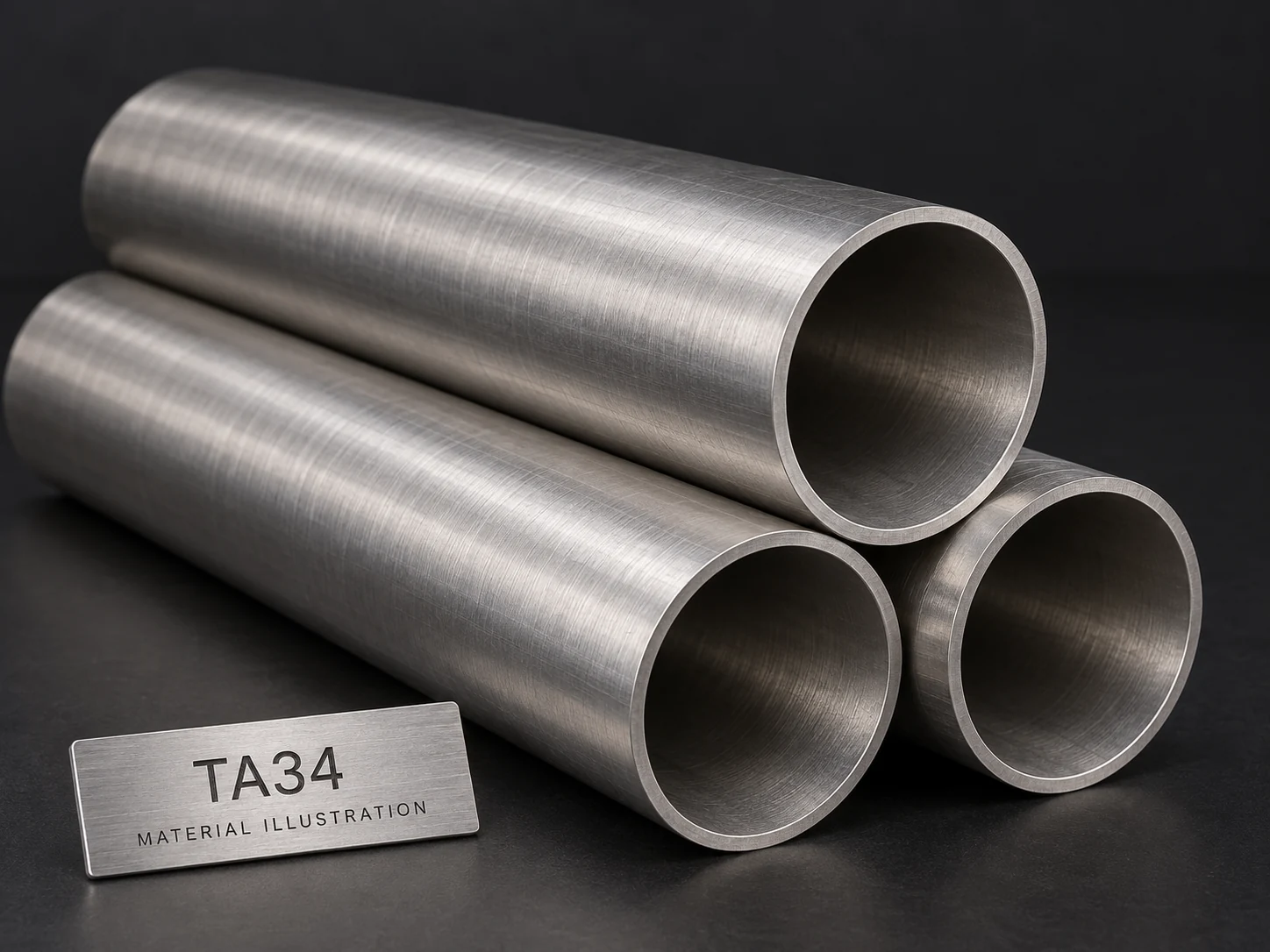
TA34 tubular forming stock
Tube enquiries for cryogenic piping or bellows development under a defined product route.
- Specification
- Approved grade-specific product specification, drawing revision and delivery condition; confirm supply feasibility.
- Size & delivery
- Outer diameter, wall, length, ovality, straightness and internal-surface requirements.
- Manufacturing review
- Confirm the manufacturing route and suitability for the intended forming and joining sequence.
- Inspection priorities
- Wall uniformity, internal and external surface acceptance and specified examination.
04 / 06
TA34 Cryogenic Titanium Alloy
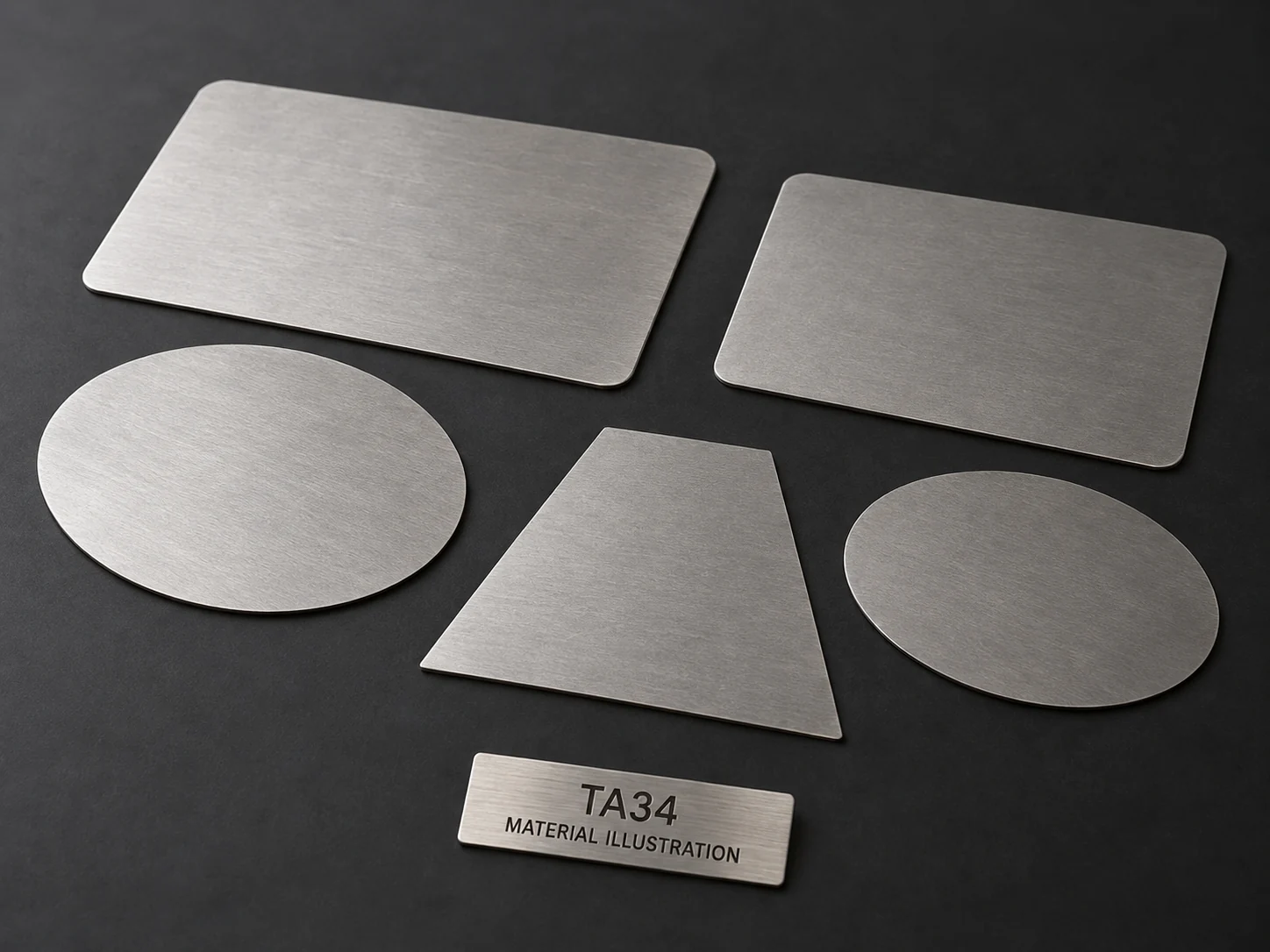
TA34 flat forming blanks
Cut sheet blanks with controlled orientation and allowance for subsequent forming.
- Specification
- Approved grade-specific product specification, drawing revision and delivery condition; confirm supply feasibility.
- Size & delivery
- Developed outline, datums, trim allowance, nesting and rolling-direction marks.
- Manufacturing review
- Review edge preparation and whether forming trials must use the actual production thickness.
- Inspection priorities
- Blank geometry, surface protection and traceability through cutting.
05 / 06
TA34 Cryogenic Titanium Alloy
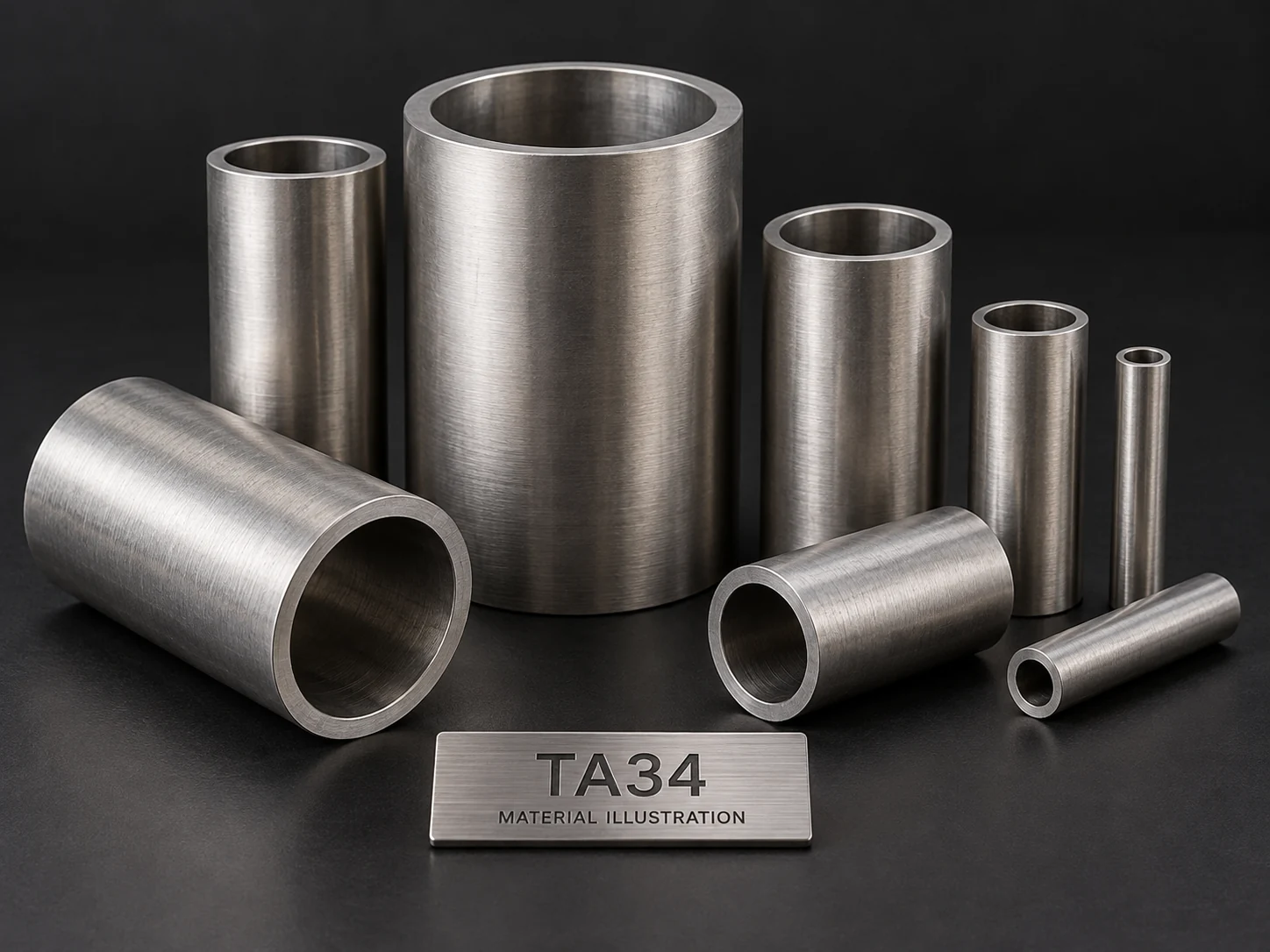
TA34 cut tube sections
Prepared tubular lengths for a specified downstream forming or assembly operation.
- Specification
- Approved grade-specific product specification, drawing revision and delivery condition; confirm supply feasibility.
- Size & delivery
- Section length, wall and diameter limits, end squareness and burr requirements.
- Manufacturing review
- Define end preparation, forming allowance and identification after subdivision.
- Inspection priorities
- Dimensional checks, clean ends, protected bore and retained heat/lot identity.
06 / 06
TA34 Cryogenic Titanium Alloy
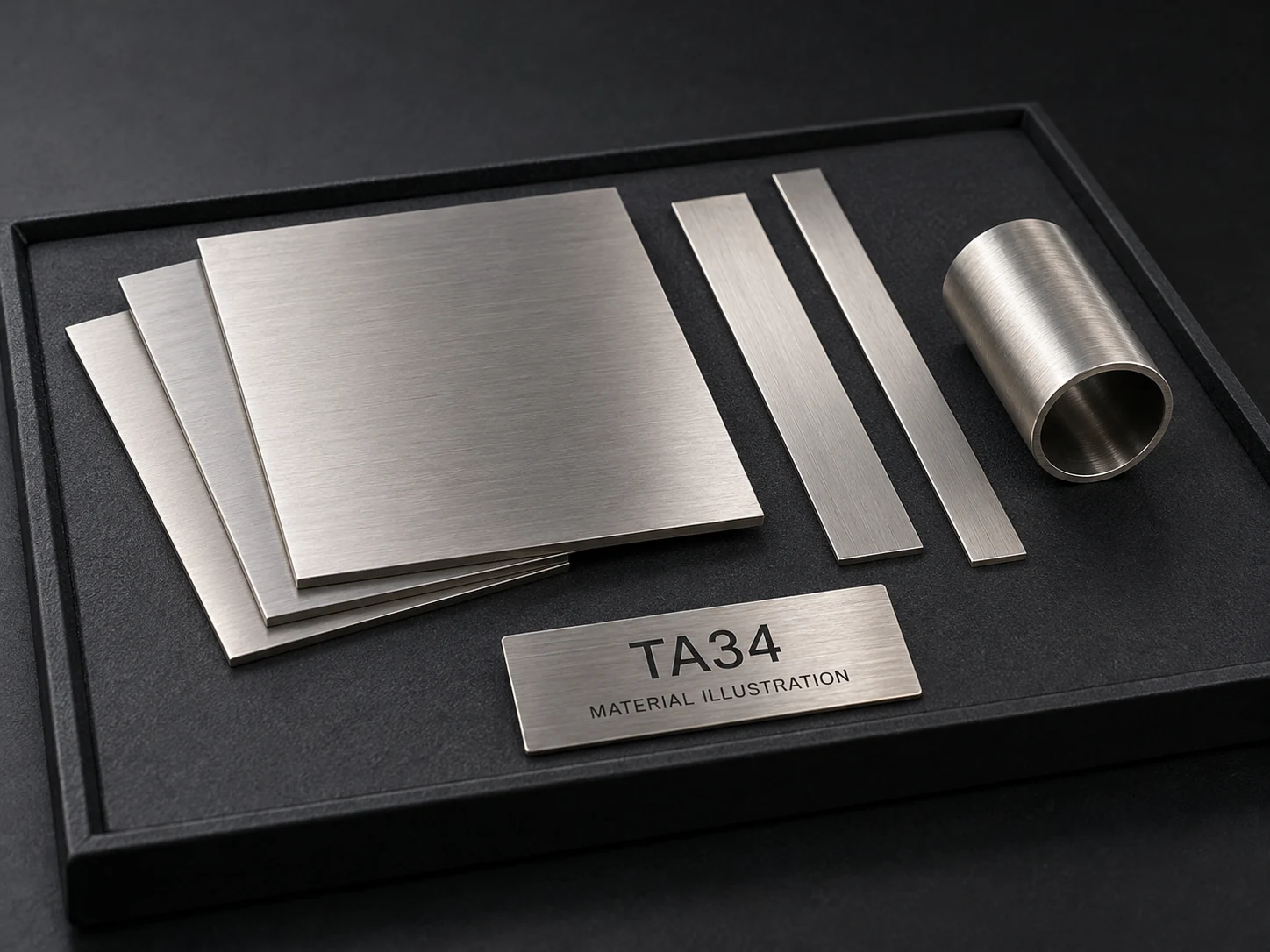
TA34 cryogenic qualification stock
Representative sheet and tube specimens for fabrication and low-temperature tests.
- Specification
- Approved grade-specific product specification, drawing revision and delivery condition; confirm supply feasibility.
- Size & delivery
- Specimen location, direction, thickness and quantity linked to the production lot.
- Manufacturing review
- Plan the material stages to be tested: supplied, formed, welded or fully processed.
- Inspection priorities
- Maintain traceability between specimens, processing records and the final test report.
Images illustrate material forms and application possibilities. Reference markings identify specification options; they do not establish dual certification, stock availability or approval of finished equipment.
Define the shape. Share the service.
These details help turn a material enquiry into a comparable quotation.
01 / Drawing review
Cryogenic welded structures
Sheet, strip and representative joint-test stock. Specify the required material and welded-joint tests at the relevant temperature and condition.
Discuss your drawing02 / Drawing review
Tubular bellows development
Tubular stock and cut lengths for a drawing-controlled bellows process. Evaluate thinning, surface damage and contour after forming; finished bellows need separate fatigue and leak acceptance.
Discuss your drawing03 / Drawing review
Thin-strip forming
TA34 strip, sheet strips and representative trial lengths. Check edge integrity, surface marks, local thinning and springback using representative stock.
Discuss your drawing02 / Material identity
What is TA34 titanium?
TA34 is identified in Chinese primary research as an established low-temperature titanium alloy with useful formability and weldability. Published manufacturing examples include thin strip and tubular bellows forming. This page focuses on incoming stock and fabrication controls for cryogenic projects; a material designation or room-temperature certificate cannot establish the performance of a completed low-temperature assembly.
Specify the exact standard edition, form and delivery condition. Nominal chemistry is only one part of an order; strength, microstructure, dimensional acceptance and traceability also need to be defined.
| Review item | Order basis | What to confirm |
|---|---|---|
| Low-temperature acceptance | Actual service and material stage | Specify test temperature, specimen method, orientation and supplied versus fabricated condition. |
| Forming response | Production thickness and route | Agree bend or forming trials and evaluate thinning, cracking and springback. |
| Welded-joint behavior | Approved joint and procedure | Define parent, filler and heat-affected-zone acceptance; room-temperature results alone do not establish cold service. |
| Thin-wall geometry | Sheet or tube dimensions | Set wall uniformity, profile, flatness, ovality and final minimum wall where applicable. |
| Assembly qualification | Component design requirements | Pressure, leak and bellows-cycle requirements belong to the completed assembly, not the grade designation. |
| Selected element · wt % | Reference composition |
|---|---|
| Grade identity | TA34 |
| Chemical acceptance | Complete ordered grade specification |
| Interstitial elements | Specify all applicable limits and analysis |
| Material stage | State supplied and final fabrication conditions |
No numerical composition limits are reproduced here. Use the complete ordered TA34 specification and heat analysis; composition or results for a different experimental cryogenic alloy must not be attributed to TA34.
TA34 and other cryogenic alloys
TA7ELI and TC4ELI are separate material routes. Compare formability, joining, supplied condition and actual low-temperature acceptance before choosing a replacement.
Room temperature and service temperature
Room-temperature results may support incoming-stock control, but they do not replace the specified tensile, toughness or joint tests at the required service temperature.
Stock and finished assemblies
Tube or sheet acceptance is separate from bellows fatigue, leak tightness, pressure testing and the qualification of a welded cryogenic assembly.
United States reference
No direct US equivalent is claimed. A project drawing that calls for a US grade needs an explicit engineering comparison and approval.
03 / Application priorities
For a finished flexible assembly, review titanium bellows requirements for motion, pressure differential, spring response and leak acceptance. Confirm the exact alloy and qualification basis; a material designation alone does not qualify a bellows.
TA34 in application.
Review each main use through its service conditions, material choice, manufacturing route and acceptance plan. These are sourcing discussions; approved drawings and qualification requirements govern the final component.
Application review / 01
Cryogenic welded structures
The critical purchasing question is which material condition will be present in the completed cold-service assembly. Forming and welding can make incoming-stock results insufficient on their own.
Products & manufacturing
Sheet, strip and representative joint-test stock.
Service & design review
Provide the temperature range, load cases, joint geometry, fabrication sequence and governing design requirements.
Purchase & inspection priorities
Specify the required material and welded-joint tests at the relevant temperature and condition.
Application review / 02
Tubular bellows development
TA34 tubular bellows appear in primary forming research. Bellows performance depends on wall distribution, convolution geometry and the full forming history, not merely the starting alloy.
Products & manufacturing
Tubular stock and cut lengths for a drawing-controlled bellows process.
Service & design review
Define convolution geometry, movement envelope, forming route and pressure, temperature and cycle requirements.
Purchase & inspection priorities
Evaluate thinning, surface damage and contour after forming; finished bellows need separate fatigue and leak acceptance.
Application review / 03
Thin-strip forming
Thin strip requires controlled edges and a repeatable delivered condition. A surface-treatment or bending study does not establish that every strip product meets the same response.
Products & manufacturing
TA34 strip, sheet strips and representative trial lengths.
Service & design review
Supply thickness, strip width, bending direction, tooling geometry and the sequence of any thermal steps.
Purchase & inspection priorities
Check edge integrity, surface marks, local thinning and springback using representative stock.
Application review / 04
Cryogenic piping fabrication
A piping enquiry needs a defined tube route and project approval. The alloy name does not determine a pressure rating or qualify the joining procedure.
Products & manufacturing
Tube stock and cut sections for project-reviewed fabrication.
Service & design review
Provide medium, temperature, pressure, movement, joints and the applicable design and inspection basis.
Purchase & inspection priorities
Agree tube examination and dimensional acceptance separately from system leak, pressure and cold-service tests.
Application review / 05
Formed sheet enclosures
A formed enclosure may need dimensional stability after welding and cooling as well as adequate starting-sheet ductility. Material selection should account for the entire shape-making sequence.
Products & manufacturing
Flat sheet and contour-cut blanks.
Service & design review
State the finished contour, radii, trim lines, joining locations and minimum finished wall.
Purchase & inspection priorities
Inspect critical dimensions and thinning after the agreed process stages, with orientation retained.
Application review / 06
Low-temperature qualification
A low-temperature test is useful only when its temperature, specimen direction and material stage match the approval plan. Published example strengths are not procurement minimums.
Products & manufacturing
Traceable sheet, strip or tube coupon stock from the intended route.
Service & design review
Define test temperature, stabilization practice, specimen standard, sampling and the required mechanical or fracture measurements.
Purchase & inspection priorities
Agree acceptance values with the responsible engineer and link results to the lot and process condition.
Application review / 07
Weld and heat-affected-zone review
A cryogenic welded joint should be evaluated as a joint, including the heat-affected region. Parent-metal chemistry alone cannot demonstrate adequate joint behavior.
Products & manufacturing
Matched parent stock and retained samples for the approved weld trial.
Service & design review
Identify filler, shielding, joint design, heat input controls and any subsequent thermal processing.
Purchase & inspection priorities
Specify weld examination and mechanical tests appropriate to the finished service condition.
Application review / 08
Handling for thin-wall fabrication
Thin sheet and tube can acquire local damage during cutting, transport or storage. Protection should be designed around surfaces that later become highly strained or inaccessible.
Products & manufacturing
Protected sheet blanks, strip coils and capped tube sections.
Service & design review
Identify cosmetic and structural surfaces, prohibited marking areas, packaging contact materials and cleanliness expectations.
Purchase & inspection priorities
Check packages, surfaces, ends and identification on receipt before releasing material for forming.
Material references and applicable product standards are listed below. Select the delivery condition and acceptance plan for the specific product and approved application.
TA34 procurement checklist
Connect the application to the material order.
A useful specification connects the intended component, the supplied stock and the acceptance evidence. Share the drawing and known requirements first.
Define the application
Provide the temperature range, load cases, joint geometry, fabrication sequence and governing design requirements.
Define the supplied stage
Sheet, strip and representative joint-test stock. Distinguish raw stock, converted blanks and finished parts. Define who controls subsequent processing.
Define the acceptance evidence
Specify the required material and welded-joint tests at the relevant temperature and condition.
Example: a useful TA34 material enquiry
TA34 cryogenic sheet stock; required dimensions and quantity; standard and drawing revision; delivery condition; intended downstream process; mechanical, structural and dimensional acceptance; traceability, destination and required date.
Identify the approved product specification and any project-specific qualification. The grade designation and chemistry standard alone do not define component acceptance.
Discuss your material requirement ↗04 / Standards & documentation
Match the standard
to the product.
Choose the specification by product form, material condition and application. Identify the required edition on the order; a chemistry standard alone does not define product acceptance or application approval.
| Product / review | International / project route | Chinese reference | Clarify before quotation |
|---|---|---|---|
| Identity & chemistry | Approved product and project specification | GB/T 3620.1-2016View PDF ↗ | Review the complete chemical limits and product requirements; nominal alloy names do not establish automatic interchangeability. |
| Cryogenic alloy background · CN114657416B | Cryogenic alloy background · CN114657416BPublisher reference ↗ | Compare the complete ordered Chinese requirements | TA34 appears as prior art. The new W-Zr alloy claimed in this patent is not TA34, and its properties must not be transferred to TA34. |
| TA34 strip example · CN117867240A | TA34 strip example · CN117867240APublisher reference ↗ | Compare the complete ordered Chinese requirements | Primary manufacturing example for TA34 strip within a general sheet/strip surface-strengthening method; not an order specification. |
| TA34 bellows forming · CN119794148B | TA34 bellows forming · CN119794148BPublisher reference ↗ | Compare the complete ordered Chinese requirements | Primary tubular-bellows forming examples. Research geometry and processing values do not establish TiHubs capacity or finished-part performance. |
| CN117867240A · English translation | Project and product requirements remain separately defined | CN117867240A · English translationView PDF ↗ | Method and apparatus for surface strengthening of metal sheet/strip. Original publication: 2024-04-12. Complete English reference translation: abstract, 9 claims, all 78 numbered description paragraphs, both experimental examples and all 3 drawings; TA34 strip is Example 2. Original equations retained without correction. Not a material supply specification. English reference translation; original Chinese publication controls. Not a purchase specification. |
| Drawing-based blanks & parts | Approved drawing and controlled manufacturing plan | Agreed product / project specification | Define the supply stage, conversion route, heat treatment, structure, NDT, dimensions and traceability. Material certification is separate from finished component qualification. |
Agree the order basis.
The purchase order must identify the required revision, grade, product form, condition and inspection. Reference documents do not replace design approval, manufacturing qualification or application-specific acceptance.
Request the controlled specification revision for your order. Any substitution, equivalence or dual-certification claim requires a documented comparison and agreement.
05 / Order coordination
Know the scope
before ordering.
Our founder’s 20 years in titanium inform the questions we ask before quotation and the supply options we review with you.
A quotation you can evaluate
Agree the grade, standard edition, dimensions, tolerance, condition and quantity before comparing prices.
- Identify whether inspection, samples and tooling are included.
- Confirm packaging, transport and delivery terms.
- Record items that still need technical confirmation.
Acceptance agreed before supply
Confirm material identity, delivery condition, heat-to-piece traceability, dimensional checks and required testing before production. For converted parts, define inspection after forging, heat treatment and machining, including the specified microstructure and NDT scope.
Independent inspection can be discussed with its scope, timing, acceptance criteria and cost agreed for the order.
Delivery with clear milestones
Review the proposed lead time, approvals, production sequence and dispatch requirements. For several product forms, coordinate document and packing readiness together.
Material substitutions and technical changes require written approval. A schedule deviation should identify the impact, decisions needed and next steps.
One contact when an issue arises
Contact TiHubs with the order reference, affected items and supporting photos or inspection records.
We record the issue, review it against the agreed requirements and coordinate the next steps with the relevant manufacturing parties.
01 / Material identity
Material records
Grade, standard, test results and heat or batch identity matched to the supplied items.
02 / Agreed acceptance
Inspection records
Dimensional and testing records for the agreed scope, including critical drawing requirements.
03 / Ready for dispatch
Dispatch records
Item identification, packing list, protective packaging and required shipment documents.
06 / Questions before sourcing
Before you specify
TA34 Cryogenic Titanium Alloy.
A clear material designation is the beginning. Product form, specification revision, material condition and acceptance complete the requirement.
A useful first enquiry
- Product and specificationProduct form, standard edition, dimensions and material condition.
- Order and deliveryQuantity, destination and any required delivery date.
- Acceptance requirementsDrawing revision, inspection, certificates and packaging.
Not every detail is finalized? Send the information you have. We can help identify the questions to resolve before quotation.
What happens next: requirement review, technical clarification, then a supply proposal and quotation.
What is the main focus of TA34?
This page focuses on stock for cryogenic forming and welded fabrication, with acceptance defined for the actual service temperature and finished material condition.
Does TA34 automatically qualify a component for liquid-hydrogen service?
No. The responsible designer must define and approve material, fabrication, joint and component testing for that service.
Are TA34 sheet, strip and tube interchangeable supply routes?
No. Product form, manufacturing route, condition and inspection differ. State the exact form and subsequent processing.
Can published room-temperature strength replace cryogenic testing?
No. Specify the required low-temperature tests and material stage under the project qualification plan.
Does the bellows research establish a guaranteed cycle life?
No. Finished geometry, wall distribution, operating movement and fabrication history determine the component qualification required.
Why specify rolling direction for blanks?
It preserves the relationship between sheet orientation, forming behavior and directional test results through cutting and fabrication.
Should welded test pieces come from the production lot?
Use the representative material and sampling plan required by the qualification authority; retain heat, thickness and process traceability.
Is there a confirmed US equivalent on this page?
No direct US equivalent is claimed. Any proposed substitution requires a complete specification and application review.
What information is needed for a TA34 quote?
Send form, dimensions, condition, application, temperature and load requirements, forming and welding stages, standards, inspection, quantity and destination.
07 / Your next step
Start with the
requirement you have.
Send the product details, drawing or operating conditions you already know. We will identify missing information and discuss a suitable supply route before quotation.
- Requirement review
- Technical clarification
- Supply proposal and quotation
Combine materials and parts in one enquiry.
Send one list of TA34 forms, sizes and quantities. Include drawing revisions, material conditions and items that must be supplied or dispatched together.
Share the service and acceptance priorities.
Include load and temperature conditions, critical sections, required material records, process qualification, inspection, destination and timing.
Baoji, China · info@tihubs.com
Start your TA34 Cryogenic Titanium Alloy enquiry
Send your material form, drawing or process conditions. We will help clarify the remaining requirements.
TiHubs specification library
CN117867240A · English translation
Method and apparatus for surface strengthening of metal sheet/strip. Original publication: 2024-04-12. Complete English reference translation: abstract, 9 claims, all 78 numbered description paragraphs, both experimental examples and all 3 drawings; TA34 strip is Example 2. Original equations retained without correction. Not a material supply specification. English reference translation; original Chinese publication controls. Not a purchase specification.