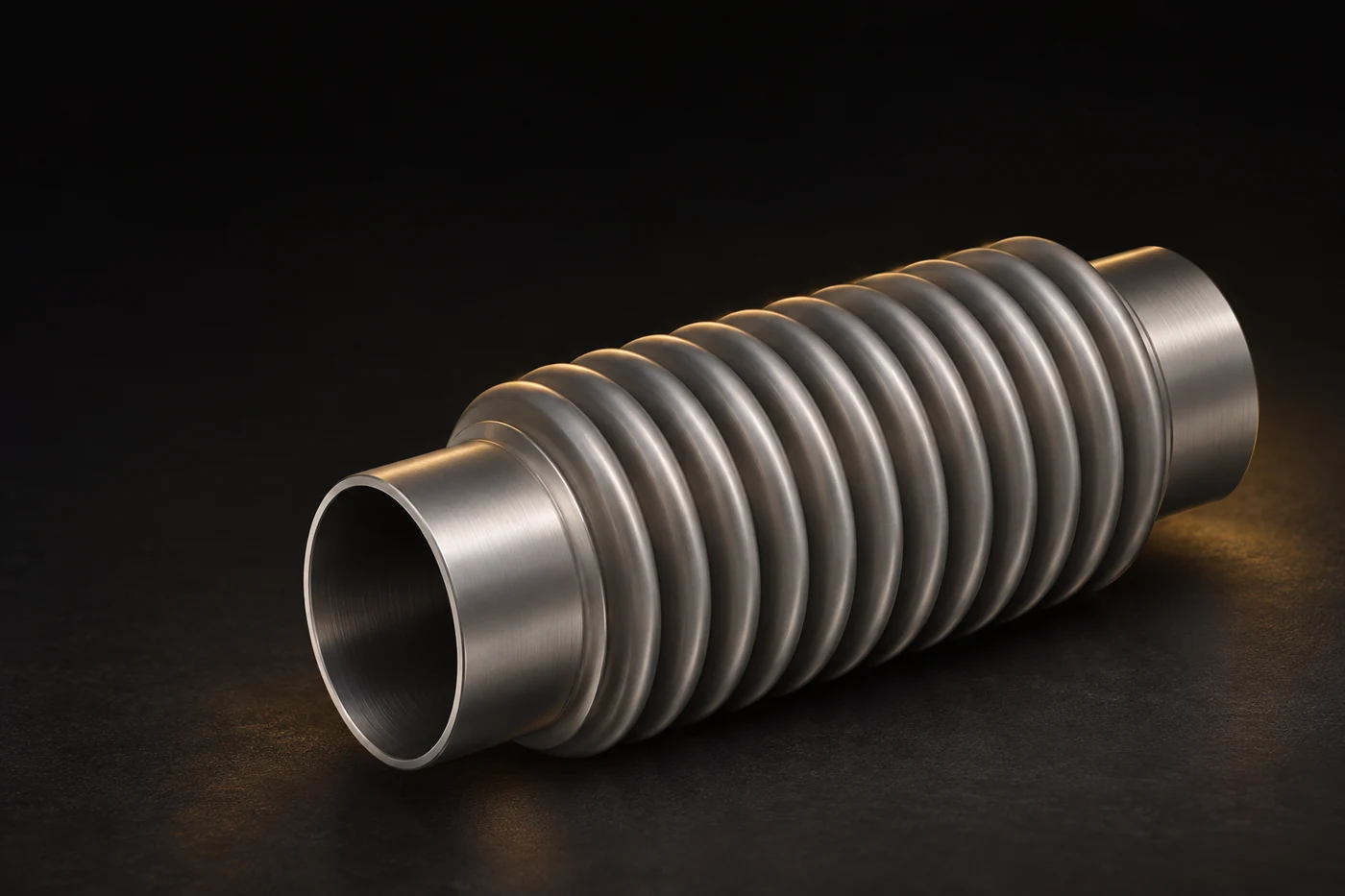
Define the complete operating envelope for a titanium bellows enquiry. Connect movement, pressure differential, temperature, end interfaces and acceptance so the proposed component can be reviewed as an assembly.
20 years in titanium100+ Baoji factory connections
Motion requirements · Defined interfaces · Traceable acceptance
Define the bellows supply scope
Distinguish the flexible element, its manufacturing route and the completed assembly.
Edge-welded bellows enquiries
Edge-welded bellows enquiries
Edge-welded bellows join formed diaphragms at their inner and outer edges. Define the intended motion, material, envelope and end connections before selecting a configuration. The available titanium grade, diaphragm geometry, weld process and qualification must be confirmed for the proposed supply; a published range from another manufacturer is not a TiHubs capability statement.
Diaphragm and weld construction
Motion and pressure envelope
Confirmed supply and test scope
Specify an operating envelope
A diameter and length are not enough to define a functioning bellows.
Order item
Include in your enquiry
Why it matters
Material
Grade, product specification and condition
Confirm the proposed construction
Envelope
Maximum OD, minimum bore and available length
Include moving and installed clearances
Lengths
Free, installed, compressed and extended references
Define the measurement condition
Motion
Axial, lateral and angular displacements
Identify simultaneous load cases
Pressure
Internal and external absolute pressures or clear differential
Identify direction and transients
Temperature and medium
Both sides, limits and operating sequence
Review actual exposure
Force
Required spring rate or force at defined displacement
Separate pressure thrust
Life
Cycle waveform, travel, pressure and temperature
State validation basis
Interfaces
Ends, materials, joints and alignment
Define the completed assembly
Acceptance
Dimensions, leak test and other specified tests
Method, limit, units and records
Your starting specification.
Drawing/revision; titanium grade and condition; construction; envelope and end interfaces; free/installed lengths; axial, lateral and angular motion with simultaneous conditions; internal/external pressures; temperatures and media; spring-force requirement; cycle definition; leak method/limit/units; assembly tests, records, quantity and destination.
Dimensions, material condition, quantity, testing and delivery are confirmed in the quotation and order.
Confirm material and construction together
The grade must be suitable for the actual route and approved service requirements.
Chinese designations and international names are reference routes, not automatic substitutes. Grade, product specification, condition and acceptance requirements must be agreed together.
Start with the required barrier, movement and connection arrangement.
Vacuum and sealed motion interfaces
Define the internal and external environments, movement, final assembly boundary and leak acceptance. A vacuum application needs the actual pressure differential and test conditions, not only the word vacuum. Include cleanliness and joining requirements that apply after the flexible element is attached to its end components.
What to sendPressure on both sides, motion and final leak-test boundary.
Process-equipment movement
Where a bellows forms part of titanium process equipment, provide the approved assembly and the way loads are restrained. Coordinate media compatibility, temperature, movement and adjoining interfaces. The flexible element must be reviewed within its installed arrangement.
What to sendEquipment drawing, service sequence and load restraints.
Material-led development enquiries
If the project specifies a dedicated alloy such as TA34 titanium, preserve the exact material requirement for technical review. Do not treat a grade-page description as qualification of a finished bellows, or assume equivalence to a commercial-purity ASTM grade.
What to sendExact material specification, route and validation requirements.
Build a reviewable bellows requirement
Resolve motion, loads, interfaces and acceptance before comparing quotations.
Conceptual titanium bellows illustration; geometry and operating limits are defined by the approved design.
Specify reference lengths, motion envelope, end connections and available clearances; this sketch is not a design drawing.
Order geometry schematic; not a dimensional drawing.
Start with the function and the assembly boundary
A bellows enquiry should explain what the component must separate, accommodate or transmit. Identify whether the purchase covers a flexible element, an element with end fittings, or a larger assembly. The same external envelope can conceal very different interfaces and test responsibilities. State the assembly drawing and the party responsible for the final design before asking suppliers to confirm performance.
Record what happens on each side of the wall. One side may contain a process fluid while the other sees atmosphere, vacuum or another controlled environment. Include the sequence of operation, not only steady conditions. A component that meets a dimensional sketch still needs an applicable basis for its pressure differential, movement and final acceptance.
Keep development and repeat production distinct. An established drawing with qualified performance calls for conformity to controlled requirements. An early concept may require design review, prototypes and validation before production approval. The quotation should make those stages visible so a price for a prototype is not mistaken for a proven production capability.
Distinguish formed and edge-welded construction
Edge-welded bellows use individual diaphragms joined at alternating inner and outer edges. Formed bellows develop corrugations from a tubular starting shape. These are different construction routes, not interchangeable descriptions of the same manufacturing record. Ask the supplier to identify the proposed route and any longitudinal or other joints relevant to the delivered component.
Both routes require a design appropriate to material, geometry and service. Do not assign a universal fatigue-life, pressure or stroke advantage from the route name alone. A comparison should use the actual proposed assemblies, with the same motion, pressure, temperature, cycle definition and acceptance boundary. Catalogue maxima from different products do not establish a valid side-by-side performance result.
Material availability also belongs in that review. MW Components publishes titanium edge-welded bellows offerings, which establishes that this construction exists commercially. It does not establish TiHubs tooling, dimensions, leak limits or certifications. Confirm the actual proposed manufacturer and supply scope through the quotation and agreed technical documents.
Compare construction, not unrelated catalogue maxima
Construction comparison based on manufacturer descriptions. No universal pressure, stroke or cycle-life ranking is implied.
Question
Formed bellows
Edge-welded bellows
Basic route
Corrugations formed in a tubular starting shape
Formed diaphragms joined at inner and outer edges
Construction record
Starting tube/cylinder and applicable joints
Diaphragm material and edge-joint construction
Interface requirement
Define end geometry and added joints
Define end geometry and added joints
Performance comparison
Use the specified complete operating envelope
Use the same complete operating envelope
Acceptance
Inspect and test the agreed final supply
Inspect and test the agreed final supply
Define motion from clear length and position references
State free length and installed reference length separately. Define compression and extension relative to the identified reference, with minimum and maximum positions where appropriate. A total travel value without its starting position can leave the supplier uncertain whether the motion is compression only, extension only or movement through the free position. Include a simple position sketch.
Describe lateral displacement and angular movement independently of axial travel. Identify whether these occur together and provide the actual extreme combinations. Separate maxima that never occur simultaneously should not be combined accidentally; simultaneous cases must not be evaluated as isolated movements. The design review needs a coherent operating envelope rather than a list of unrelated maximum numbers.
Clarify how the assembly is guided and whether rotation or torsion can occur. Do not assume a bellows intended for axial motion also accepts an undefined twisting load. Identify the intended motion path, connection constraints and any required stops. These details help the supplier assess the proposed assembly without guessing how the buyer plans to install it.
State pressure on both sides and identify its direction
Specify internal and external pressures with their reference. Absolute pressure and gauge pressure must not be mixed in a subtraction without a common basis. Identify the maximum differential, which side is higher, and relevant transient conditions. A vacuum label alone does not quantify the wall loading because the pressure outside the component still matters.
State pressure together with temperature and movement for each relevant operating case. The highest pressure may occur at a different position or temperature from normal motion. Test conditions can also differ from service. Document those cases explicitly so the supplier does not qualify a convenient static condition while leaving the actual moving condition undefined.
Ask how the proposed design addresses the applicable stability and restraint requirements. A pressure-boundary review is more than a material-strength comparison. The completed geometry, supports and operating conditions matter. Keep pressure acceptance attached to the specific assembly rather than applying a number from another diameter, construction or metal.
Separate spring reaction from pressure thrust
The elastic reaction needed to displace a bellows and the force arising from pressure are different contributions. For a linear axial spring model over its applicable range, spring reaction is F = kx, where k is the axial spring rate and x is displacement from the defined reference. This relationship does not by itself describe the entire installed load case.
Pressure thrust is associated with pressure acting over the bellows effective area. A basic expression is Fp = Δp × Ae, using a consistently defined pressure differential and effective area for the design. U.S. Bellows explains why the effective bellows area, rather than an arbitrary pipe-bore area, is used in this context. Obtain the applicable effective area from the actual design.
The following arithmetic separates the concepts; it does not specify a TiHubs component. Real load paths depend on restraints and assembly arrangement. A designer must determine which forces reach equipment and anchors and how they combine. Do not simply add unrelated maxima from separate cases or treat this illustrative calculation as a complete piping analysis.
Illustrative arithmetic with declared assumptions
Arithmetic examples only. Inputs are hypothetical teaching values, not measured data, design limits or TiHubs product ratings.
Quantity
Assumed input
Calculated result
Linear spring reaction
k = 2 N/mm; x = 3 mm
F = 6 N
Pressure thrust
Δp = 0.20 MPa; Ae = 500 mm²
Fp = 100 N
Unit identity
1 MPa = 1 N/mm²
Consistent pressure-area units
The assumed effective area is supplied directly in this example; it has not been inferred from a nominal diameter or a photograph. The two results are different physical contributions. Their treatment in an installed assembly requires the actual signed load cases, restraints and interfaces. No capacity or service-life conclusion follows from these numbers.
Specify spring force at a defined condition
If actuation force matters, state the required force at identified positions or a spring-rate requirement over a defined range. Include measurement direction, reference position, temperature and tolerance as applicable. A single stiffness value without a test condition may not allow receiving inspection to determine whether the delivered part meets the intended requirement.
Ask whether the proposed acceptance uses a force-displacement curve, selected points or another controlled method. Identify preconditioning and the stage of assembly where the test occurs if these are part of the requirement. The purpose is to compare the delivered response with the intended operating condition, not merely attach a spring-rate number to the sales description.
Keep pressure-induced loading separate when defining the measurement. A force measured under differential pressure may include more than elastic reaction. Document the test setup and pressure condition so different laboratories or suppliers do not report incompatible values under the same spring-force heading.
Define a cycle before specifying cycle life
A cycle requirement needs a movement sequence. State starting and ending positions, whether the motion crosses the free position, and relevant pressure and temperature during travel. Include speed, dwell and combined movements where they matter to the application. The phrase one million cycles is not a complete performance requirement without a defined cycle and failure criterion.
Distinguish a calculated design assessment, a qualification test and a production acceptance test. They provide different evidence. A prototype surviving a specified test does not automatically prove every later geometry or process change, while a short production check does not reproduce full life validation. Ask the supplier to identify the evidence proposed for the actual requirement.
Define what constitutes failure or unacceptable change, such as the specified leak criterion or another agreed functional limit. Record sample identity and test conditions. Avoid promising an unlimited life or transferring cycle counts from another alloy, wall thickness or movement range. The qualification basis must remain connected to the controlled configuration.
Make leak acceptance measurable
State the required leak-test method, test medium, limit and units, with the pressure arrangement and inspection stage. A claim of leak-tight supply is incomplete if the buyer cannot identify the boundary, sensitivity and acceptance conditions. A numerical leak limit without units is equally ambiguous and should be resolved before testing or quotation comparison.
Distinguish a leak test from a pressure-strength test. A test intended to detect small leakage does not automatically demonstrate every structural requirement, and a component surviving a pressure exposure does not automatically satisfy a sensitive leak specification. Determine the required tests from the application and approved acceptance plan, with each test serving an explicit purpose.
Identify whether the test covers the bare element or the final assembly, including added end joints. If later operations can affect the boundary, define the required final verification. Record part or lot identity, method and result. Do not copy another manufacturer’s advertised helium limit into a TiHubs product promise without confirmed applicable supply and acceptance.
Review material, temperature and media as a combination
Specify the titanium grade, starting-product requirement and delivered condition. Consider the actual fluid or gas on both sides, temperature limits and operating sequence through the responsible material and design review. Titanium’s reputation for corrosion resistance is not a blanket compatibility statement for every medium or condition. Include contaminants and cleaning exposures relevant to the application.
Confirm material suitability for the proposed manufacturing route. The flexible element and end fittings may have different product forms or requirements, but every material must be identified. A general material certificate does not qualify forming, welding, fatigue or leak performance of the finished bellows. Preserve the distinction between material evidence and assembly evidence.
Avoid material-name confusion during sourcing. Titanium-stabilized stainless steel remains stainless steel; it is not a titanium bellows. Likewise, a locally designated titanium alloy should not be silently relabelled as an ASTM commercial-purity grade. Require exact material identities and an approved basis for any proposed substitution before ordering.
Control end fittings and joining responsibility
Provide end geometry, materials, connection details and alignment requirements in the assembly drawing. Define which joints the supplier completes and which remain for the buyer. Include final dimensions after joining. The flexible element may be correct while the complete assembly still fails its mounting or sealing interface because an end component was omitted from the technical review.
Specify applicable welding and examination requirements through the approved project documents. Keep cleanliness, handling and access requirements connected to the joining sequence. If buyer-supplied parts are used, establish their incoming acceptance and identification. A mismatch in end material or geometry should be resolved before welding rather than treated as an informal workshop adjustment.
Where final assembly occurs elsewhere, define how the supplied bellows is protected and what subsequent verification is required. The responsibility boundary should be explicit in the quotation and inspection plan. A test certificate issued before additional joints are made must not be represented as evidence for those later joints.
Apply standards only where the design scope fits
EJMA publishes standards for metallic bellows-type expansion joints used in piping and vessel installations. That scope is relevant to appropriate expansion-joint projects, but citing EJMA does not automatically establish compliance of every small bellows, actuator or vacuum component. Identify the governing code, standard, edition or revision and its applicability to the actual assembly.
Starting-material standards address a different part of the purchase. For example, a sheet specification may establish material requirements for diaphragms without defining the completed bellows movement, leak rate or life. Keep the order organized so material, assembly design and final acceptance references can be reviewed independently and then connected.
If a supplier proposes a design method or test basis, request the applicable scope and any limitations. Do not infer certification, association membership or approved design status from a reference link on a product page. The accepted technical documents should state what is being supplied and what evidence supports the required performance.
Use inspection records that identify the final configuration
The dimensional report should address the agreed envelope, reference lengths, ends and alignment. Functional reports should state their test conditions and acceptance criteria. Connect results to the part or lot and the drawing revision. A report for a visually similar bellows is not interchangeable evidence when geometry, material or joining details differ.
Specify first-piece review or other approval stages where the project needs them. Resolve deviations before production release and retain the accepted record. If the design changes, assess which prior evidence remains applicable. A change that looks minor in a catalogue image can still affect the controlled configuration and its qualification basis.
For repeat orders, preserve the approved drawing, process-related restrictions and acceptance documents. Do not rely on a remembered catalogue description. Procurement should be able to identify whether an offer is an exact repeat, an approved equivalent or a new proposal requiring review. This distinction supports predictable receiving decisions and clearer supplier accountability.
Protect the component during delivery and installation
Define packaging and handling requirements appropriate to the finished assembly. Protect thin flexible walls, end interfaces and identification. State any cleanliness, end-cover or separate-packaging requirement in the order. A completed inspection does not prevent later handling damage, so acceptance and delivery protection should form one continuous supply scope.
Provide the required installation information, including reference orientation or length and the treatment of any shipping restraints. Identify what must remain and what is removed only under the approved procedure. Do not assume every rod or stop has the same function. The installation instructions for the actual assembly must resolve these details.
At receipt, compare identity, condition and documents before installing. If the component has been bent, overextended or otherwise damaged, obtain the appropriate review rather than attempting an undocumented correction. Keep the delivered configuration identifiable while the issue is resolved so the supplier can assess the actual affected part.
Send an RFQ that allows a meaningful response
Include the drawing and revision, material, construction preference, envelope and ends. Add free and installed references, all motion cases, pressures on both sides, temperature, media, force requirements and a defined cycle. Specify leak acceptance, other tests, records, quantity and destination. Mark unresolved requirements so they become explicit review questions rather than hidden assumptions.
Ask the supplier to separate confirmed conformity, proposed deviations and items requiring development. Compare offers against the same final assembly and acceptance scope. Tooling, prototypes, qualification and production supply may represent different stages; make their deliverables clear. A low initial price is difficult to interpret when essential tests or end components remain outside the quotation.
TiHubs can coordinate titanium bellows enquiries with its Baoji sourcing network and related material or component requirements. The proposed manufacturer, route and acceptance should be confirmed for the project. Send the operating envelope and interface drawing so the response can address the actual procurement task, with open technical points resolved before an order is released.
Test the agreed finished assembly
Connect each inspection result to a specified condition and identifiable part.
Illustrative acceptance map; no measured leak rate, pressure rating or cycle-life result is shown.
Order documentationTiHubs
Traceable from heat to shipment.
Material identificationGrade + specification
Batch identificationHeat / lot reference
Inspection scopeAgreed tests & results
Shipment identificationMarks + packing list
Illustrative document checklist. Not a certificate or test report.
01Configuration
Confirm drawing, material and construction.
Defined assembly02Dimensions
Check envelope, lengths and end interfaces.
Fit and reference03Force response
Use the specified position and test conditions.
Functional acceptance04Leak testing
Record method, boundary, limit and units.
Measurable result05Qualification
Identify cycle definition and applicable evidence.
Controlled scope06Delivery
Protect flexible walls and retain traceability.
Preserved condition
Use sources within their scope
Manufacturer examples explain principles; project documents govern the supplied component.
Library PDFs may be earlier editions. Check the document cover and your contractual revision. A reference file does not certify a supplied product.
EJMA — standards and scope — Metallic bellows expansion-joint reference; applicability and controlled revision must be established for the project.
Baoji. One contact.
TiHubs coordinates titanium sourcing through a local manufacturer network. Your specification guides the supplier review, technical discussion and delivery requirements.
Confirm grade, dimensions, state, quantity and the purpose of the stock.
Review the supply route
Discuss manufacturing, finishing, inspection and documentation with the relevant supplier.
Agree the commercial scope
Confirm the quotation, lead time, acceptance requirements and delivery terms.
Coordinate inspection & delivery
Follow the agreed checks, marking, packing and shipment documentation.
Before you order
Define the assembly, operating envelope and evidence before comparing titanium bellows offers.
TITANIUM BELLOWS · BAOJI SOURCING
Send your specification.
Define the complete operating envelope for a titanium bellows enquiry. Connect movement, pressure differential, temperature, end interfaces and acceptance so the proposed component can be reviewed as an assembly.
You do not need to finalize every detail before contacting us.
TiHubs
Talk to TiHubs
Ask about titanium materials, grades or custom parts.
Enter your email to start chatting.
We use your email to respond to your enquiry. Your conversation is stored on this website.
Our team is away right now. Leave your enquiry and we will follow up by email.