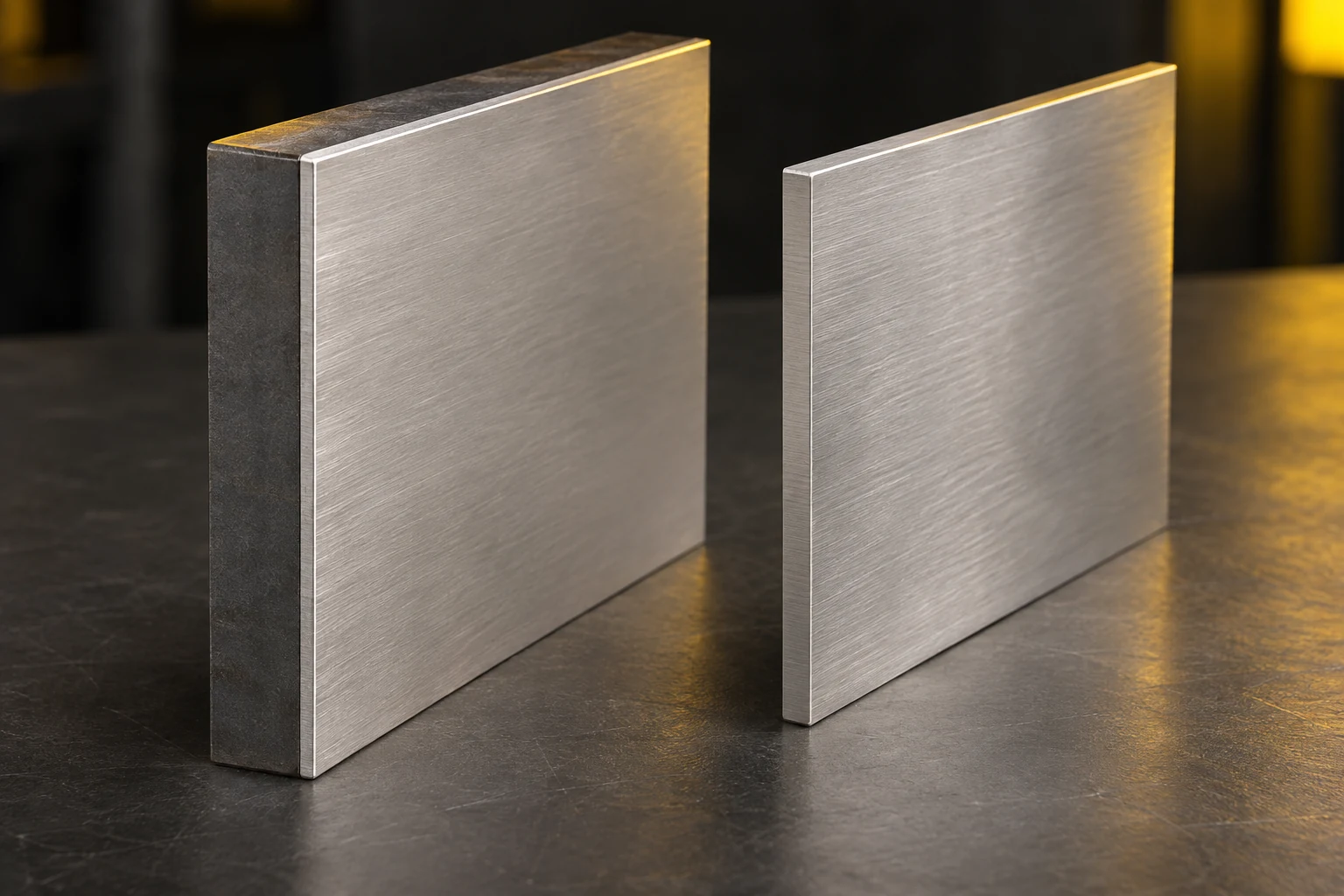
AI illustration; not a production or inspection record.
Quick answer
Compare the approved designs and delivered fabrication scope, not equal plate thicknesses or price per kilogram. Titanium-clad steel introduces separate backing, titanium-layer and bond requirements. Solid titanium avoids the bonded interface but still needs an appropriate grade, thickness, fabrication route and acceptance basis. Neither is an automatic substitute for the other.
01 / Decision basis
Start with the component and the responsibility for its design
A buyer may receive a request for a titanium plate, then discover that another supplier has quoted titanium-clad steel at a substantially different price. The first task is to establish whether the two offers answer the same engineering requirement. A clad plate contains a titanium layer bonded to a backing material. A solid titanium plate has titanium throughout its section. These descriptions identify different constructions, not two interchangeable commercial names for the same product.
Identify the component before discussing substitution: vessel shell, head, tubesheet, cover, liner, wear surface or another item. State which face contacts the process, what the backing encounters and whether edges or penetrations become exposed. Include the proposed manufacturing steps and the governing drawing. A small flat cover and a formed pressure-vessel section can create very different purchasing requirements even when both start as a rectangular plate.
Separate corrosion protection from structural design
NobelClad’s published discussion of titanium-clad equipment describes the titanium surface as corrosion protection and the backing as structural support in the applications discussed. That is useful context, but it does not establish which layers may be credited in your particular calculation. Ask the responsible designer to identify the structural basis, material specifications, corrosion allowance where applicable and treatment of the bonded construction under the project rules.
Do not replace a solid titanium thickness with an equal total clad thickness on a purchasing spreadsheet and assume equivalent strength, stiffness or service capability. The individual materials, construction and approved design govern the answer. Equally, do not assume that a sufficiently thick solid titanium plate automatically resolves every connection or fabrication requirement. The component must fit the complete equipment design and the process conditions.
Use a defined decision gate
Before requesting firm comparable offers, obtain a short design-basis statement from the owner or appointed engineer. It should say whether both constructions are acceptable candidates, which requirements are fixed and which alternatives may be proposed. If only a solid titanium drawing is approved, a clad offer is an engineering alternative requiring review. Mark it that way so a lower price cannot silently become approval for a changed construction.
The useful commercial question is therefore specific: which approved route can deliver this component, with this documentation and fabrication responsibility, at the required time? That question supports a meaningful comparison. A general claim that clad is always cheaper, or that solid titanium is always safer, does not address the dimensions, service, interfaces and supply chain of the actual purchase.
02 / Layer specification
Specify the backing, titanium layer and finished condition separately
A description such as “23 mm titanium-clad plate” is incomplete. It might mean a 20 mm backing with 3 mm titanium, another layer combination, or a total thickness whose allocation is not stated. Write each layer explicitly and identify whether the figures are nominal values, minimum delivered thicknesses or dimensions after fabrication. The distinction becomes particularly important when grinding, forming or machining will remove material after the plate is bonded.
A thickness budget must survive finishing
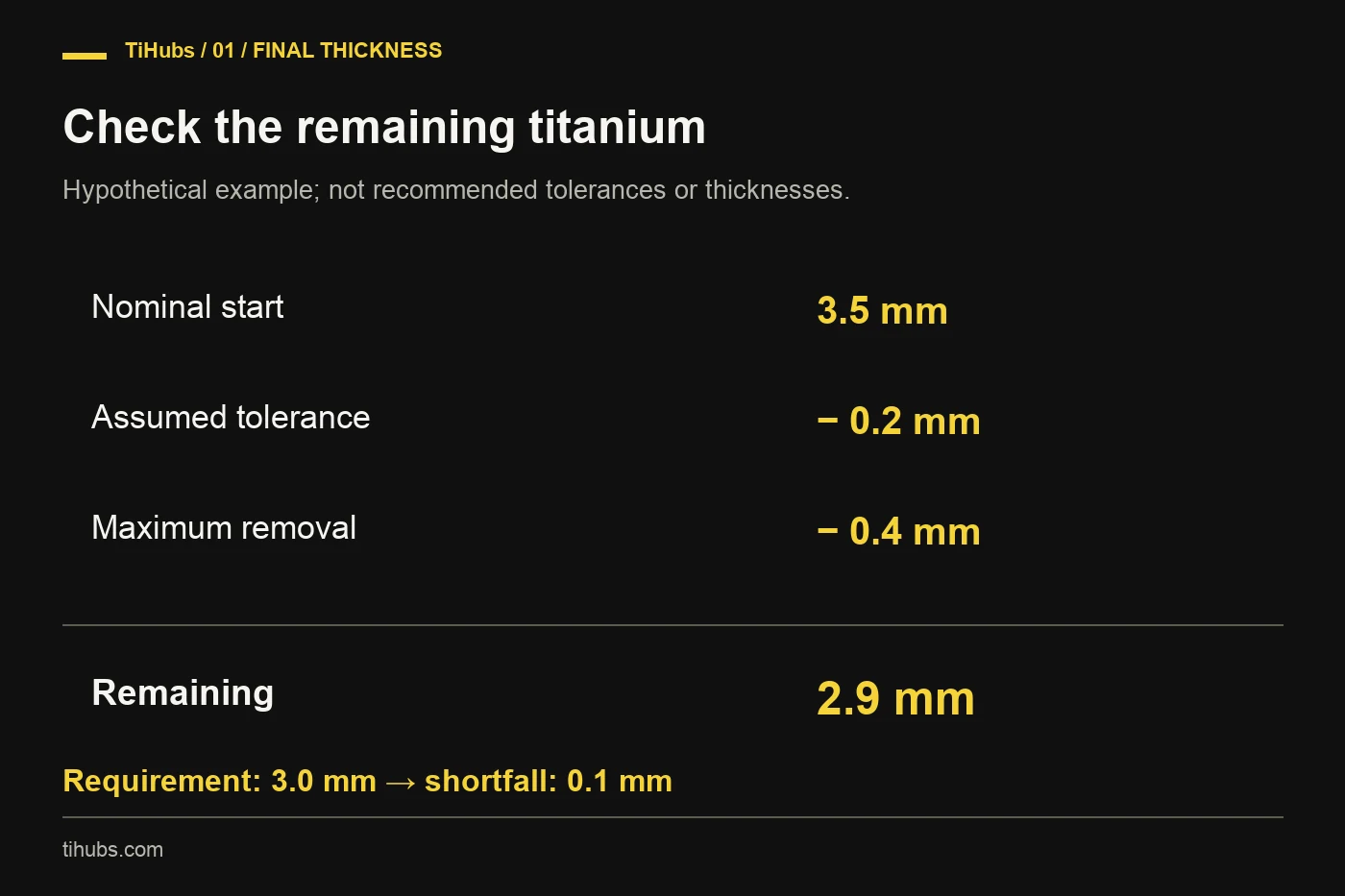
Consider a hypothetical purchase that requires at least 3.0 mm of titanium after the specified finishing operations. A proposed starting layer is 3.5 mm nominal with an assumed negative tolerance of 0.2 mm. If the planned maximum removal is 0.4 mm, the simple worst-case remainder is 3.5 − 0.2 − 0.4 = 2.9 mm. The proposed budget falls short by 0.1 mm. These figures are invented to explain the purchasing check; they are not standard tolerances or recommended cladding thicknesses.
In that example, 3.6 mm nominal would only close the arithmetic under the same assumptions. It would not prove the finished layer everywhere, establish a suitable process allowance or validate the measurement plan. The designer and manufacturer must agree the actual starting material, expected variation, manufacturing losses and verification. A calculation that leaves no allowance for an unconsidered operation is a prompt to review the route, not a release instruction.
Define the state in which dimensions apply
State whether thickness is required after bonding, after surface finishing, after forming or at delivery of a machined component. Specify length, width, squareness, flatness and surface condition on the same basis. If a plate will be trimmed into several parts, identify usable dimensions and excluded edge zones. A larger gross plate does not necessarily yield more acceptable finished pieces when the usable bonded area and processing allowances differ.
The backing needs its own material designation, condition and supporting documents. The titanium layer also needs its own grade and specification. If an intermediate layer is proposed, require it to be identified and reviewed as part of the construction. Do not let a generic phrase such as “equivalent backing” conceal a substitution that changes fabrication, heat treatment, design properties or traceability.
For solid titanium, the plate thickness, flatness and machining-stock guide provides a related way to define usable material. For clad plate, extend that discipline to each layer and the bond. The order should make clear which supplier is responsible for the final thickness after every operation included in the delivery scope, and which subsequent operations remain the buyer’s responsibility.
Use a drawing note or a layer schedule rather than relying on a title alone. For example, the schedule can distinguish backing requirement, titanium minimum at delivery, surface finish, edge preparation and the document used for acceptance. Keep units consistent across the drawing, quotation and inspection report. A reviewer should be able to identify each material and its required final state without inferring missing details from the total thickness.
Hypothetical arithmetic: 3.5 mm nominal minus 0.2 mm assumed negative tolerance and 0.4 mm removal leaves 2.9 mm, below a 3.0 mm requirement.
03 / Bond acceptance
A material certificate and a bond report answer different questions
ASTM’s public scope for B898 covers a base plate with an integrally and continuously bonded reactive or refractory metal layer on one or both sides. Its current listing is B898-20(2026). The purchase should identify the agreed edition and project requirements; the public scope is not a replacement for the controlled specification. A declaration of B898 compliance alone does not explain every inspection choice or additional requirement in your order.
Ask for the inspection basis before comparing the offer
Request the proposed bond examination method, coverage, acceptance criteria, reporting format and stage of examination. Identify any required mechanical bond tests and the relationship between test specimens and delivered plates. The responsible technical team should select the applicable requirements. Avoid copying a test limit from a supplier’s marketing sheet and treating it as a universal requirement for all titanium-clad products.
NobelClad’s product sheet specifically discusses bond examination, bond strength and verification of titanium thickness after finishing. These are useful topics for a purchase review, while its recommended values and procedures belong to its stated scope. The buyer still needs an agreed inspection plan for the actual plate, subsequent processing and project requirements. Record which supplementary requirements or owner specifications apply rather than assuming that every possible test is included.
Make an indication map usable for the next operation
A report marked “accepted” is easier to use when it is traceable to the physical plate, orientation and inspection procedure. Where mapping is required, the report should allow the fabricator to relate recorded locations to the intended cut layout. Agree the coordinate origin and the identification method. If the material is divided, preserve the link between the parent plate, each cut piece and the relevant records.
Consider a hypothetical plate whose planned part requires a 50 mm wide strip near an edge. An inspection report identifies an area requiring exclusion, but the report uses an unmarked opposite corner as its origin. The numerical location may be correct while the fabricator places the exclusion on the wrong side. The purchasing remedy is not a more impressive certificate title; it is consistent identification, orientation and an approved usable-area map before cutting.
Clarify how nonconformities are handled. An indication, local thickness result or surface issue outside the agreed criteria should trigger the defined disposition process. The supplier should not decide unilaterally that a region is acceptable because it appears away from a future weld. Conversely, a buyer should not impose a new criterion after delivery and describe it as part of the original contract. Keep the technical decision, concession if any, and revised cutting plan together.
The mill test certificate guide explains document traceability. For this purchase, retain separate evidence for the backing, titanium material, bonded product and finished component as required. One document may reference several others, but its scope should be clear. A chemistry result establishes neither bond continuity nor the thickness remaining after a later machining operation.
Industrial buying guide / 03Titanium content and total mass are different comparison bases
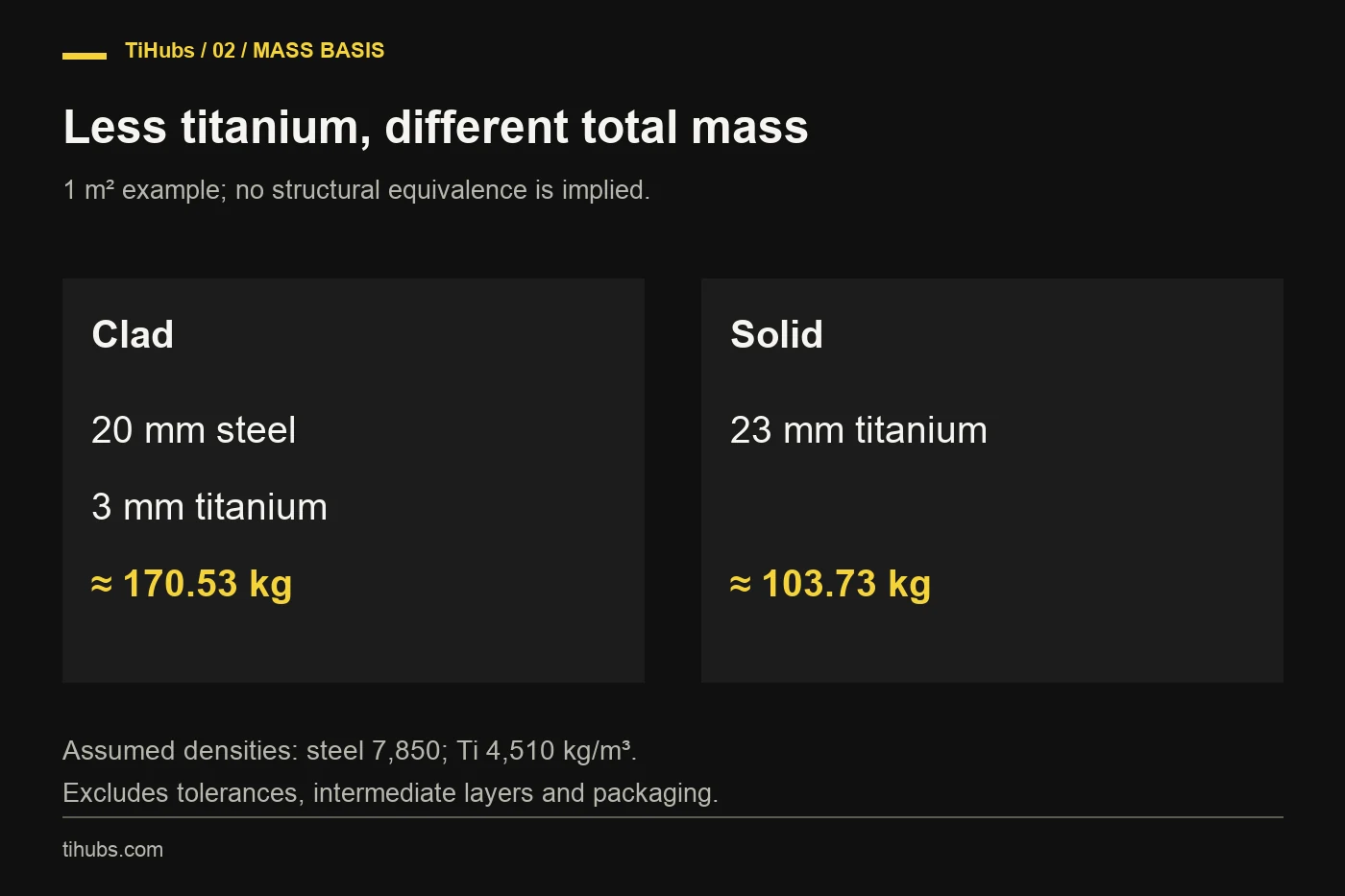
Hypothetical 1 m² plates using assumed rounded densities: 20 mm steel plus 3 mm titanium is about 170.53 kg; 23 mm solid titanium is about 103.73 kg. No design equivalence is implied.
04 / Fabrication boundaries
Price the route that will actually make the component
The fabrication plan can change the comparison more than the plate quotation suggests. List forming, cutting, machining, joining, surface finishing, examinations and any thermal operations. Identify the organization responsible for each step and the point at which the material changes hands. A plate supplier offering a conforming blank and a fabricator offering a finished assembly are pricing different scopes even when both quotations use the same component name.
Review interfaces before releasing material
The published NobelClad equipment discussion highlights the special difficulty of the titanium-to-steel transition during fabrication. Treat joints, edges, nozzles and other penetrations as design details requiring qualified review. Do not issue a purchasing instruction that assumes ordinary direct fusion welding of titanium to steel is an acceptable solution. The approved construction and applicable fabrication procedures must define how the component is made and inspected.
For a tubesheet, identify which surfaces and holes are machined, where the titanium must remain and how the tube attachment is detailed. For a formed shell, identify the permitted manufacturing sequence and inspection after relevant operations. A purchase drawing should not leave the fabricator to infer critical remaining titanium thickness from a general material callout. Show the required final geometry and the surfaces to which acceptance applies.
Changes after bonding need an agreed review path
If a supplier proposes a different sequence, heat treatment, repair or amount of surface removal, ask for the technical consequences and approval route. The effect may involve more than the operation being changed. Material condition, bond verification, dimensions and the final document pack may all need review. Avoid a vague blanket authorization for “normal shop practice” where the project has specific construction requirements.
Identify inspection hold points that prevent irreversible work from overtaking a technical decision. Examples include approval of the cutting layout before subdivision or acceptance of an agreed report before machining a critical surface. A hold point should have a named reviewer, a defined submission and a practical response period. Otherwise it can become either an unexpected delay or a nominal checkpoint that nobody actually uses.
Solid titanium can simplify the absence of a bonded interface, but the buyer still needs appropriate fabrication capability and acceptance evidence. It is not enough to remove bond testing from the spreadsheet and assume the remainder is identical. Reassess joints, structural dimensions, supporting materials, handling and final interfaces under the solid construction. Compare two complete approved routes, each with its own realistic operations and responsibilities.
05 / Cost comparison
Compare a usable delivered component, not a kilogram of unlike material
A cost comparison should begin with technically acceptable alternatives. Once that gate is passed, separate material, processing, examinations, documentation, packaging and transport. Include buyer-supplied operations that remain outside the quotation. State currency, quantity basis, delivery term and whether the quoted dimensions describe a gross plate, a usable blank or a finished component. An unexplained price per kilogram hides too many differences to support a purchasing decision.
Less titanium does not necessarily mean less shipment mass
For a hypothetical one-square-metre plate, assume a 20 mm steel backing plus a 3 mm titanium layer. Use rounded densities of 7,850 kg/m³ for steel and 4,510 kg/m³ for titanium only for this arithmetic example. The backing mass is 157 kg, the titanium layer about 13.53 kg and the combined ideal mass about 170.53 kg. An imaginary 23 mm solid titanium plate of the same area would be about 103.73 kg using that titanium density.
The example illustrates accounting, not design equivalence: the two plates have not been shown to carry the same loads or meet the same service requirement. It excludes intermediate layers, tolerances, surface losses and packaging. The clad option uses less titanium in this example while weighing more overall. That distinction matters when a quotation uses total mass, titanium mass or freight mass without making the basis explicit.
Show the effect of excluded work
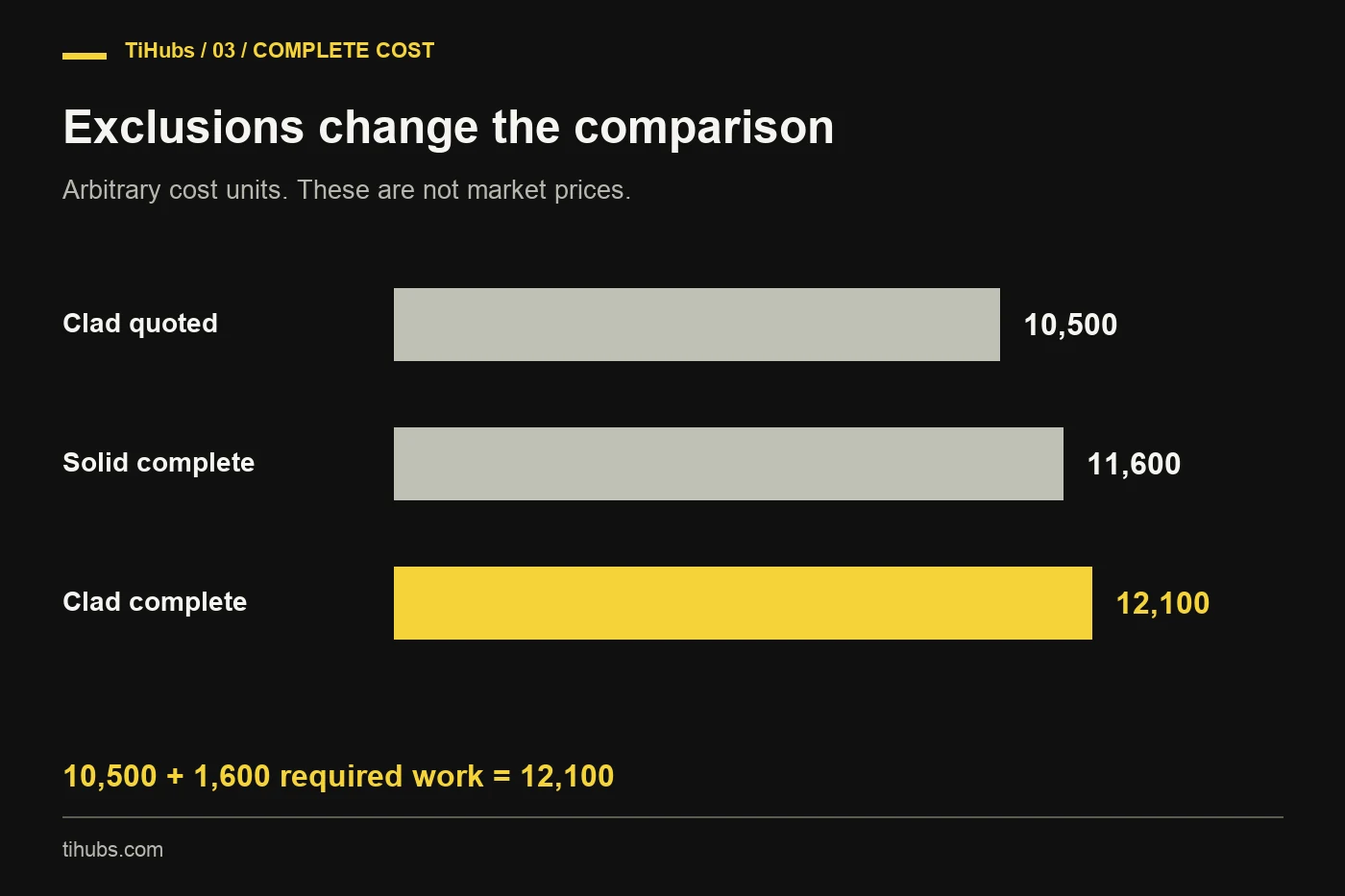
Consider a second hypothetical comparison using arbitrary cost units, not market prices. The clad offer includes material at 6,000, fabrication at 3,000, agreed inspection and documents at 900, and logistics at 600: total 10,500. The solid route includes material at 9,000, fabrication at 1,800, inspection and documents at 400, and logistics at 400: total 11,600. Under these invented assumptions, the clad route is 1,100 lower.
If the clad quotation excludes 1,600 units of required joining and verification, its comparable total becomes 12,100. The commercial ranking reverses. No general conclusion about real titanium prices follows from these figures. Their purpose is to show why missing scope can outweigh a material saving. Use actual supplier offers, approved routes and clearly identified exclusions for the real evaluation.
Lead time needs the same discipline. Separate drawing review, plate procurement, bonding or other production, subsequent fabrication, inspection release and transport. Ask which dates are conditional on approval and which activities can proceed in parallel. A shorter quoted production time is not a shorter project schedule if essential review or finishing is excluded. Keep a documented basis for each alternative and update it when a technical deviation changes the route.
Industrial buying guide / 05Excluded work can reverse the quotation ranking
Arbitrary cost units: clad 10,500 versus solid 11,600. Adding 1,600 of excluded required work raises the clad route to 12,100. These are not market prices.
06 / Purchase release
Turn the chosen route into a clear enquiry and release package
Send the approved component drawing, design-basis statement and material schedule together. Identify whether TiHubs is being asked to supply solid plate, bonded plate, a machined blank or a component with a defined fabrication scope. If an alternative is invited, ask for a separate proposal that identifies every change and the approval needed. This preserves a comparable baseline while allowing a supplier to suggest a practical route.
Resolve ownership of the final checks
Assign responsibility for final titanium thickness, usable dimensions, bond evidence where applicable and the completed component inspection. If the buyer performs subsequent machining, specify the delivered condition and the allowances that the buyer’s approved process requires. If the supplier delivers after machining, the final requirements belong in that supplier’s acceptance scope. An unresolved boundary often appears only when both parties believe the other owns the last check.
Plan receiving inspection around the agreed records and physical identification. Verify that the delivered pieces match the quantity, dimensions, orientation marks and document references. Protect the process-contact surface and avoid losing the distinction between plate faces during storage or subdivision. If packaging hides identification, agree how the receiving team can confirm the contents without compromising the protection required for storage.
Keep future modification possible to assess
Retain the as-delivered drawing, material identities, bond records, approved deviations and relevant fabrication history. A later request to drill an additional hole or remove more material should be checked against those records and the responsible design review. The fact that the original component was accepted does not establish that an undocumented modification preserves its function. Good procurement records make that later decision much more efficient.
Start a titanium-clad plate enquiry with the backing and titanium requirements, final dimensions and inspection scope. If the approved option is solid material, use the titanium plate supply page. TiHubs can review the proposed supply scope and information required for quotation. Availability, manufacturing capability, compliance, price and delivery remain subject to the actual agreed order.
Use a common revision for the commercial comparison
Suppose the first offer prices revision A with an unfinished titanium surface, while a later offer includes revision B with additional machining and a recorded final thickness survey. Their totals cannot be compared fairly until both suppliers confirm the same revision or list the exact differences. Record the date of the technical clarification and attach the accepted scope to the purchase order. A buyer should not have to search an old email thread to determine whether the extra operation was included. When a requirement remains open, show it as an unresolved item with an owner and a decision date. This makes the preliminary estimate useful without presenting an incomplete quotation as a firm equivalent.
07 / Build your RFQ
Build a clad-versus-solid plate enquiry
Identify the approved construction and final delivery state. For alternatives, provide the fixed requirements and name the design questions that must be reviewed before either quotation can be accepted.
Information to include
Component drawing, revision, service and design responsibility.
Backing material, titanium grade and any intermediate layer.
Separate layer thicknesses and minimum titanium after finishing.
Usable dimensions, surface condition, machining and joining scope.
Bond examination, material records, acceptance stage and delivery requirements.
Build your RFQ checklist
Choose the product and add the information you have. Copy the resulting brief or send your requirements to TiHubs. Submitting an enquiry does not place an order.
08 / FAQs
Questions buyers ask
Can titanium-clad steel replace solid titanium at the same thickness?
Not automatically. Equal total thickness does not establish equivalent structural behaviour, corrosion protection at every interface or fabrication suitability. The responsible designer must review the construction under the applicable project requirements before procurement treats it as an approved alternative.
Does B898 compliance prove the finished component is acceptable?
It addresses the supplied bonded plate within the agreed specification scope. A finished component can introduce forming, machining, joints and other requirements. Identify the applicable edition, supplementary requirements and final acceptance evidence rather than treating the plate declaration as approval of the entire equipment.
Should the titanium layer be specified before or after finishing?
State the required condition explicitly. If a minimum is needed after grinding or machining, the starting material and agreed process must preserve that minimum. A nominal starting thickness alone does not establish the remaining titanium everywhere on the delivered component.
Is titanium-clad steel always cheaper?
No universal saving follows from the construction name. Compare technically acceptable routes with the same delivery scope, quantity and commercial basis. Bonded plate, specialist fabrication, inspection, transport and excluded operations can change the result. Use actual quotations instead of a general percentage claim.
Which documents should accompany the material?
Agree traceable records for the backing, titanium layer, bonded product and final operations as applicable. The bond report should identify its procedure, coverage, criteria and relationship to the physical plate. The exact document package follows the order and project requirements.
Can TiHubs quote while the design is still being reviewed?
A clearly labelled preliminary enquiry can identify the likely supply route and missing inputs. State which dimensions and requirements are provisional. A budget discussion should not be mistaken for approval of a changed construction or a commitment to fabricate before the technical basis is settled.
09 / Key takeaways
Keep the purchase requirements connected.
Compare approved component designs rather than equal total thicknesses.
Specify every layer and the final titanium requirement separately.
Connect bond examination and thickness evidence to the physical plate.
Include fabrication interfaces and subsequent operations in the review.
Compare delivered scope and schedule before selecting the lowest price.
Technical references
Sources and data scope
References reviewed November 14, 2026. Public source summaries support the discussion; the controlled specification, agreed edition and approved project requirements govern acceptance.
TiHubs coordinates titanium material and custom supply enquiries from Baoji, China. Send the product, drawing revision and acceptance requirements so the proposed supply scope can be reviewed. Learn about our sourcing role.
Contents
TiHubs
Talk to TiHubs
Ask about titanium materials, grades or custom parts.
Enter your email to start chatting.
We use your email to respond to your enquiry. Your conversation is stored on this website.
Our team is away right now. Leave your enquiry and we will follow up by email.