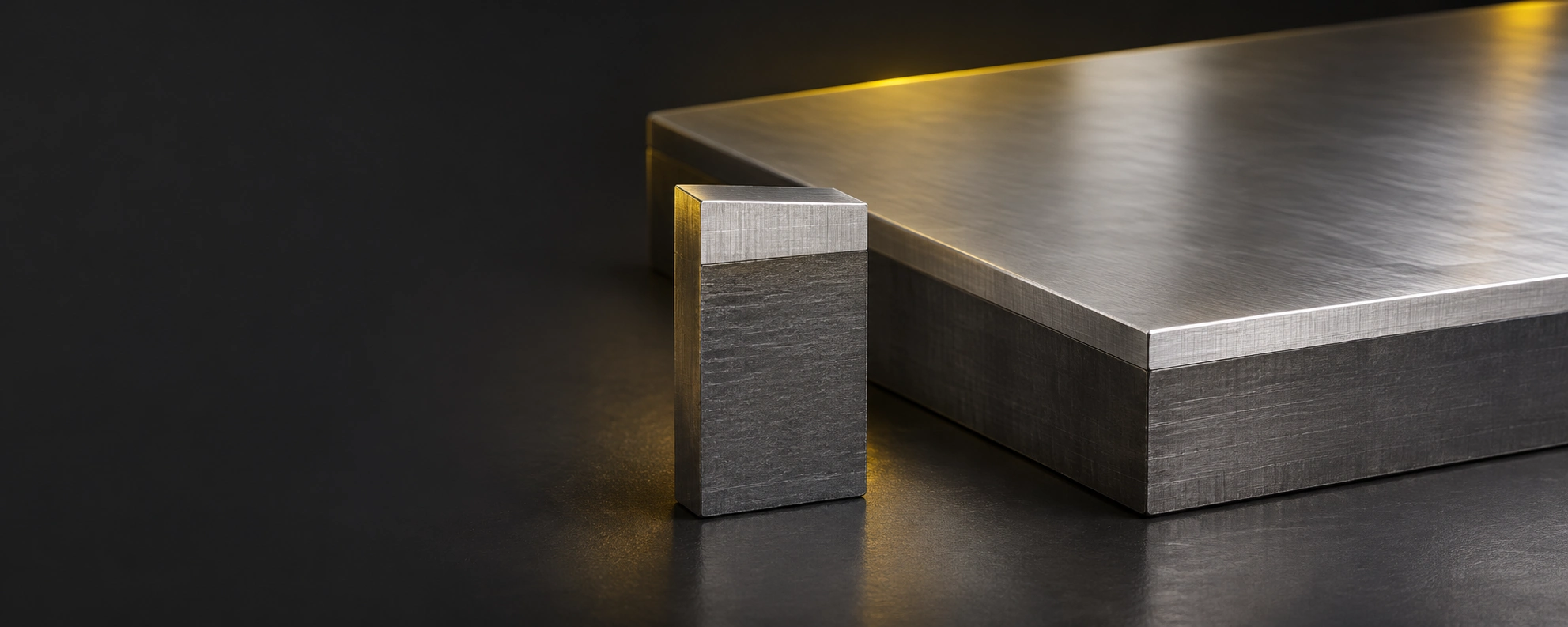
Titanium-clad steel plate for project-defined corrosion-service fabrication. Specify the titanium layer, steel backing and bond acceptance together, with the downstream forming and joining route.
20 years in titanium100+ Baoji factory connections
Layer specification. Bond quality. Fabrication route.
Define the composite plate
A bonded clad plate is one composite product. The cladding, backing and interface each need clear requirements; overall thickness alone is insufficient.
Flat clad panels
Flat clad panels
State the titanium cladding and steel backing specifications separately. Include their individual thickness tolerances, overall panel size and required flatness after the agreed processing route.
Titanium and backing steel grades
Individual layer thicknesses
Panel dimensions and flatness
Define your clad steel plate
Send the operating conditions and drawing requirements. Materials, feasibility, quantity, lead time and acceptance are confirmed through project review.
Order item
Include in your enquiry
Why it matters
Cladding material
Titanium grade, specification and condition
Defines the corrosion-contact layer
Backing material
Steel grade, specification and condition
Defines the structural backing
Layer thicknesses
Cladding, backing and total thickness limits
Prevents ambiguous thickness callouts
Plate geometry
Length, width, outline and flatness
Matches fabrication input
Bond requirements
Required examination, coverage and acceptance
Defines interface quality
Fabrication route
Forming, heat treatment and joining context
Connects delivery to downstream processing
Edges and setbacks
Clad-side orientation, preparation and local details
Controls fabrication interfaces
Acceptance records
Layer identity, bond report, sampling and piece map
Maintains composite traceability
Your starting specification.
Include cladding and steel grades, separate layer thicknesses, panel dimensions, bond acceptance, forming route, edge details and quantity.
Dimensions, availability and acceptance criteria are confirmed in the quotation and order documents. Product photographs illustrate the supply format.
Select the layer combination
The titanium grade and steel specification are separate purchase requirements. Material guides support selection but do not establish bond or equipment acceptance.
Confirm the corrosion assessment and structural design through the responsible project designer. No universal service rating is implied.
Applications, with conditions
The process, operating environment and required outcome help define the structure, materials and acceptance scope.
Corrosion-service vessel fabrication
The equipment designer should define the wetted titanium layer and structural backing with the required fabrication code. A clad-plate certificate does not approve the completed vessel.
What to sendService medium, design basis, layer specifications and fabrication drawings.
Large process panels
Large clad panels require handling, flatness and bond requirements that match the fabrication plan. Clarify the delivery envelope and any limits imposed by forming or transport.
What to sendPanel layout, handling limits, flatness basis and forming sequence.
Replacement composite components
Replacement material should preserve the original layer specification and interface requirements. Confirm drawing revisions and the condition of adjacent components before assuming equivalence.
What to sendExisting drawings, layer callouts, joining details and inspection requirements.
Review both metals and the interface
Agree material, bond and fabrication requirements as one package. Tests on either starting metal alone do not describe the completed composite plate.
Clad plate edge preparation illustration / defined composite geometry
Order geometry schematic; not a dimensional product drawing.
Specify the layer pair
Identify each material and its thickness limits. State whether the ordered dimensions apply before or after surface finishing and conditioning.
Agree interface acceptance
Define the required bond examination method, coverage and acceptance criteria. Include any specified destructive tests and sampling locations.
Coordinate downstream processing
Provide the intended forming, thermal and joining operations. Confirm the responsibilities for procedure review and post-processing acceptance.
Preserve the piece map
Keep parent-plate and cut-piece identity, clad-side orientation and test records together. Protect the cladding face and prepared edges during shipment.
Inspection, agreed upfront
Specify the tests and documents that your receiving inspection needs. Scope, sampling and acceptance levels belong in the order.
Dimensional inspection illustration / agreed scope and acceptance
Order documentationTiHubs
Traceable from heat to shipment.
Material identificationGrade + specification
Batch identificationHeat / lot reference
Inspection scopeAgreed tests & results
Shipment identificationMarks + packing list
Illustrative document checklist. Not a certificate or test report.
01Layer identity
Verify titanium and steel material records.
Two materials + one plate02Thickness
Measure separate layers and total section as specified.
Layer tolerances03Bond examination
Apply the ordered method and coverage.
Interface acceptance04Geometry and flatness
Inspect the delivered panel or blank condition.
Drawing + measurement basis05Edge preparation
Check setbacks, orientation and prepared faces.
Fabrication details06Traceable release
Link the plate map, tests and shipment pieces.
Composite material record
Titanium Clad Steel Plate references
Reference documents for clad steel plate procurement. Confirm product scope, grade, delivery condition and the edition required by your order.
TiHubs coordinates titanium sourcing through a local manufacturer network. Your specification guides the supplier review, technical discussion and delivery requirements.
Confirm grade, dimensions, state, quantity and the purpose of the stock.
Review the supply route
Discuss manufacturing, finishing, inspection and documentation with the relevant supplier.
Agree the commercial scope
Confirm the quotation, lead time, acceptance requirements and delivery terms.
Coordinate inspection & delivery
Follow the agreed checks, marking, packing and shipment documentation.
Before you order
Answers to the details that make your titanium clad steel plate enquiry easier to review.
TITANIUM CLAD STEEL PLATE · BAOJI SOURCING
Send your specification.
Titanium-clad steel plate for project-defined corrosion-service fabrication. Specify the titanium layer, steel backing and bond acceptance together, with the downstream forming and joining route.
You do not need to finalize every detail before contacting us.
TiHubs
Talk to TiHubs
Ask about titanium materials, grades or custom parts.
Enter your email to start chatting.
We use your email to respond to your enquiry. Your conversation is stored on this website.
Our team is away right now. Leave your enquiry and we will follow up by email.