Silicon and identityCreep and fatigueSection and condition
Ti-6242SConfirm silicon requirement
Ti-6246Confirm processing route
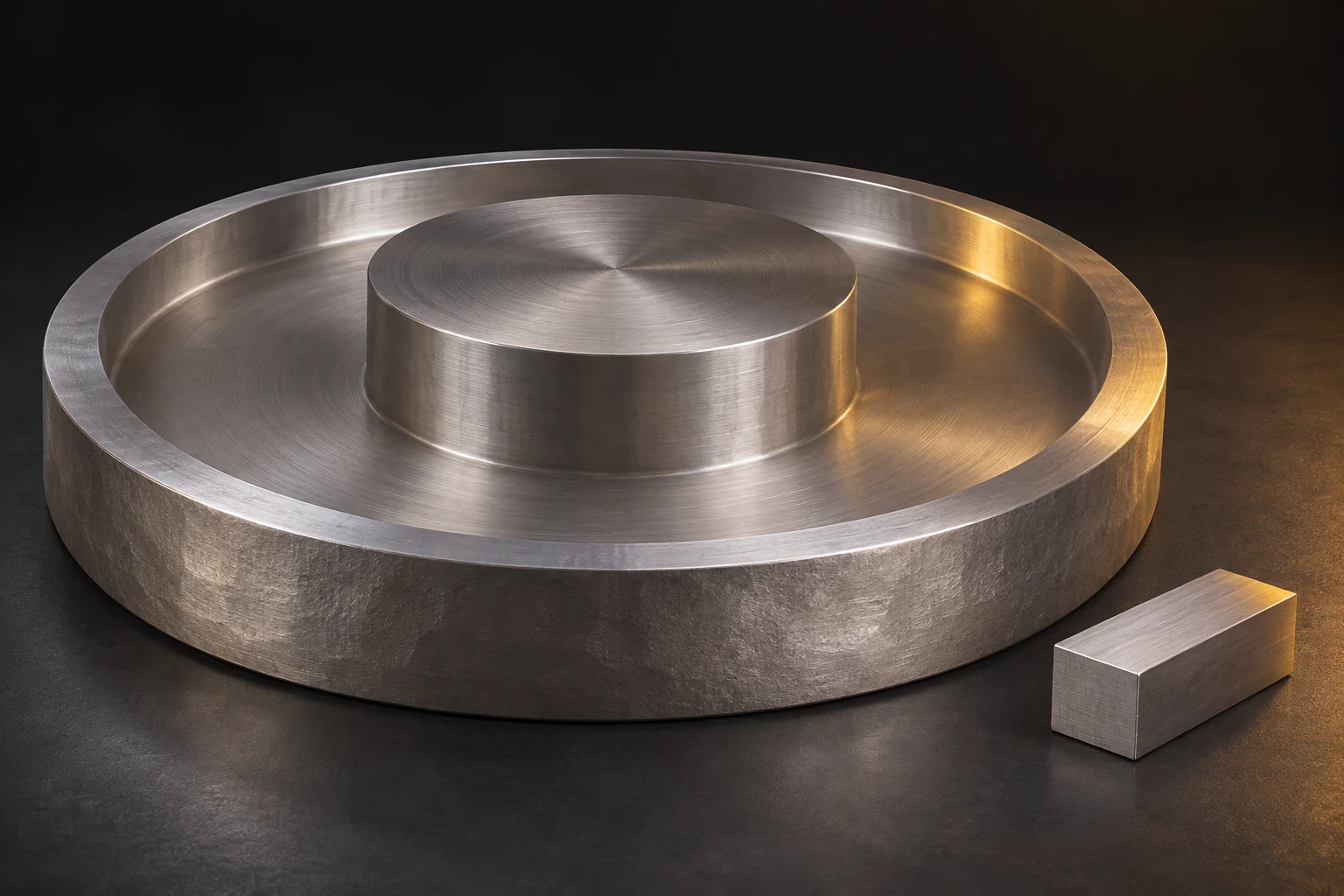
AI illustration; not a production or inspection record.
Quick answer
Compare these alloys as complete product and processing routes. Retain the silicon requirement behind Ti-6242S, define the final condition and match creep, fatigue or tensile evidence to the actual duty. The chemistry table uses identified historical manufacturer columns; it is not a substitute for the current controlled purchase specification.
01 / Start with the duty
Compare complete compressor forging routes
Ti-6242S vs Ti-6246 is a purchasing question about two different titanium alloy routes, often considered in relation to compressor components and other demanding engineered parts. A useful decision starts with the component duty and the required manufacturing condition. It cannot be reduced to whichever supplier publishes the highest tensile strength or the largest temperature number.
The familiar names refer to Ti-6Al-2Sn-4Zr-2Mo with a controlled silicon addition for the S designation, and Ti-6Al-2Sn-4Zr-6Mo respectively. Their shared aluminum, tin and zirconium shorthand can make them look closely interchangeable. The molybdenum difference, silicon requirement, processing history and acceptance basis need to remain visible when an enquiry becomes a quotation.
If an approved drawing already specifies one route, the immediate task is compliant sourcing. An offer for the other alloy is a proposed change, even when the supplier presents it as a performance improvement. If the design remains open, the engineering team must establish the service and qualification basis before purchasing can identify a conforming offer. These are different decision stages.
Describe the actual component rather than only calling it a compressor forging. Include its drawing revision, delivery stage, critical sections and subsequent processing. A billet intended for further forging, a rough forging awaiting thermal processing and a finished machined disc carry different responsibilities. A competitive price for one stage cannot be compared directly with a fully inspected product at another.
Record the operating questions that matter: sustained temperature and stress, cyclic loading, required dimensional stability, fracture-related evidence and applicable environmental exposure. Distinguish normal operation from excursions and start-stop events. A general aerospace application label does not supply these conditions, and a stock certificate does not independently demonstrate suitability for an entire service history.
The Ti-6242S and Ti-6246 material pages provide starting points for a sourcing enquiry. Use them with the controlled material specification and part requirements. Ask which alloy, product and condition can be supplied, what evidence accompanies the offer and which requirements need clarification before an order can be accepted.
This guide organizes that discussion around identity, evidence, forging route and quotation scope. It does not establish a new aircraft material approval or prescribe a heat-treatment cycle. The practical objective is a purchase package that connects the intended component to a verifiable product, without turning useful manufacturer background into an unsupported design guarantee.
02 / Chemistry and naming
Keep the silicon requirement and source columns visible
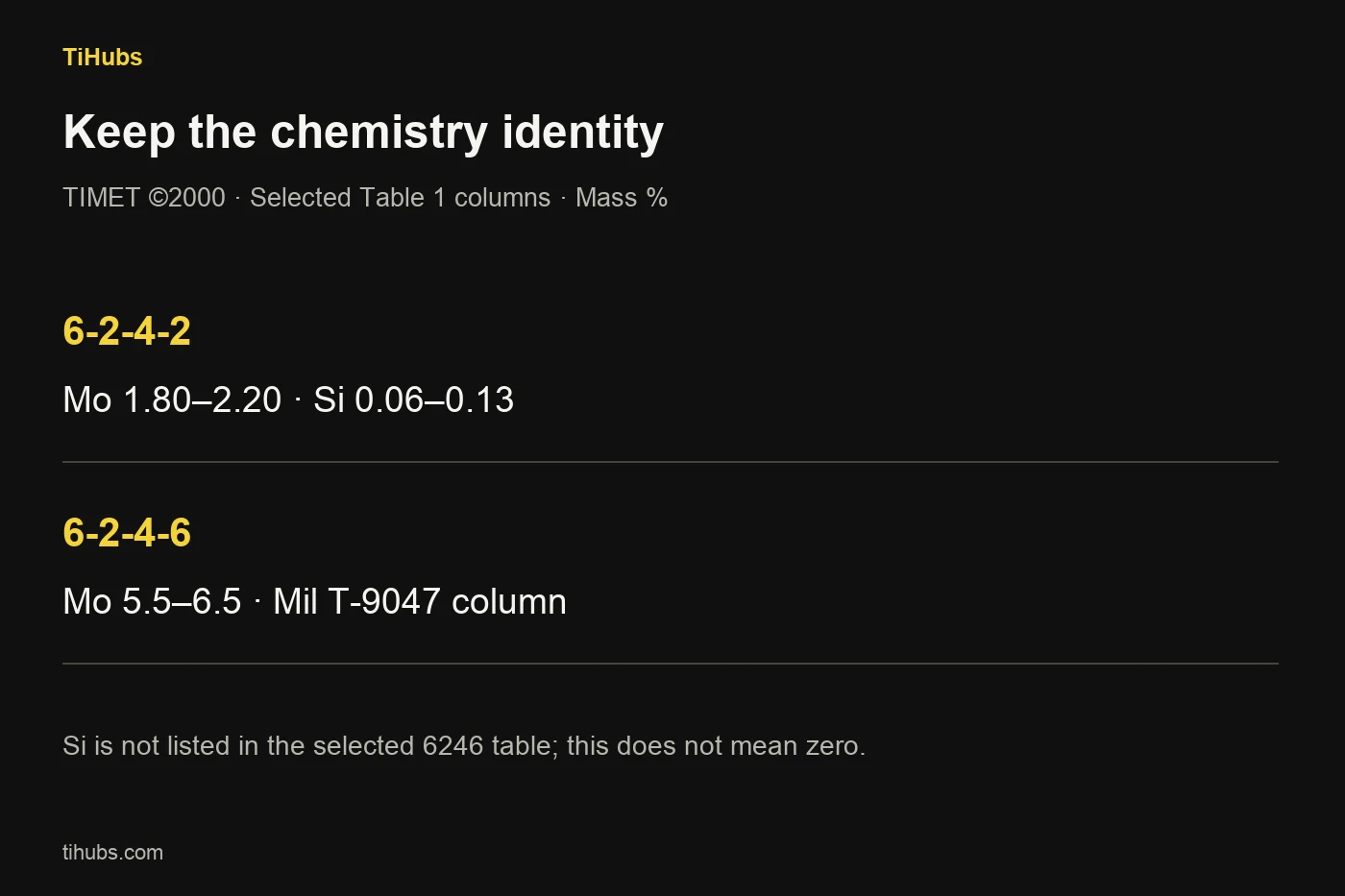
The table below compares selected alloying-element ranges from two TIMET manufacturer datasheets carrying a 2000 copyright. It is a historical source comparison, not a current purchase specification. The Ti-6242 sheet is titled TIMETAL 6-2-4-2 but explicitly includes silicon at 0.06–0.13 mass percent. That makes the cited chemistry silicon-bearing; it does not prove that every commercial item labeled 6242 meets a Ti-6242S order.
Selected TIMET chemistry ranges, mass %; source columns retained
Element
6-2-4-2 datasheet, Table 1
6-2-4-6 datasheet, Table 1, Mil T-9047 column
Aluminum
5.50–6.50
5.5–6.5
Tin
1.80–2.20
1.75–2.25
Zirconium
3.60–4.40
3.6–4.4
Molybdenum
1.80–2.20
5.5–6.5
Silicon
0.06–0.13
Not listed in the selected table
These are selected ranges, not a complete chemical acceptance table. Elements omitted here still require whatever control the applicable specification establishes. “Not listed” does not mean zero silicon, an unlimited allowance or proof that two materials are equivalent. Review the full controlled specification and the actual heat analysis before accepting material.
The Ti-6246 datasheet contains separate Mil T-9047 and AMS 4981 chemistry columns. This comparison consistently uses the former. In particular, the zirconium range should not be taken from one column while other values are presented as though they belong to another. A source citation is useful only when the reader can identify which requirements the numbers represent.
For a Ti-6242S enquiry, retain the S designation, required silicon range and governing specification in the purchase description. Ask the supplier to confirm the exact offered identity. If the certificate or quotation shortens the name to Ti-6242, reconcile it against the controlled chemistry and product requirements rather than accepting or rejecting it on spelling alone.
Neither nominal alloy notation nor this historical table establishes the acceptance limits for a new order. Specification revisions, product scope and customer requirements can differ. Have the buyer and supplier identify the agreed document and edition before reviewing a certificate. Where a contractual requirement differs from background literature, the discrepancy should be resolved explicitly.
The table deliberately avoids a universal strength ranking. The published mechanical tables use different reporting bases, including typical results and specification minima, alongside condition and section distinctions. Placing the largest number from each sheet into a simple two-column contest would conceal those differences. Chemistry supports identity; performance requires its own matched evidence.
Industrial buying guide / 02Preserve the chemistry identity
Selected historical TIMET ranges, mass %. Verify the full current specification; silicon is not listed in the selected Ti-6246 table.
03 / Creep and cyclic duty
Ask separate questions about time, temperature and cycling
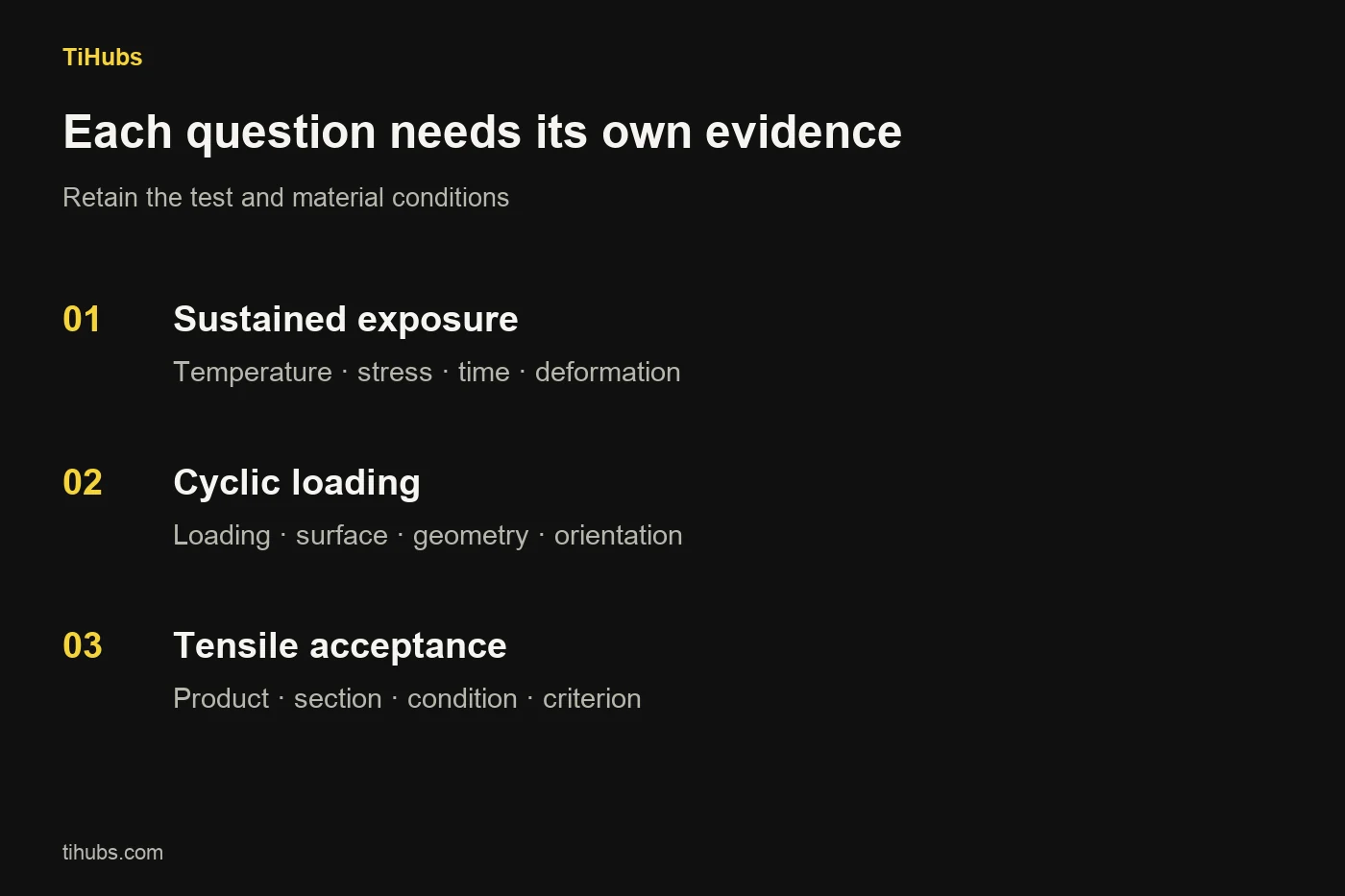
Creep and fatigue describe different aspects of material behavior and require different evidence. A tensile result obtained during a relatively short test cannot by itself establish deformation under sustained load or life under repeated cycling. For a compressor-related purchase, define which mechanism controls the material requirement before requesting comparison data.
For creep-related questions, provide the relevant temperature, stress, exposure duration and acceptable deformation criterion through the engineering specification. State whether the requirement concerns continuous duty, intermittent exposure or a defined sequence. The supplier’s data should identify the alloy, product and thermal condition represented. A curve without those details may be useful background but is insufficient for a direct acceptance decision.
For fatigue, identify the required loading description, temperature and specimen or component basis. Distinguish initiation-life evidence from crack-growth evidence where the project does so. Ask whether the surface, notch condition, orientation and processing route correspond to the intended part. A smooth-specimen result cannot silently become an allowable for a notched production geometry.
TIMET’s Ti-6246 datasheet expressly connects properties to thermomechanical history and discusses different forging conditions. This is a reason to retain the process context, not a reason to assume that any stock carrying the alloy name has every reported benefit. The proposed supply route must establish which condition will actually be delivered and how it will be verified.
A useful technical comparison keeps each result attached to its source, material form, section, heat treatment, test temperature and reporting status. Mark a result as a minimum requirement, a typical value or an actual measurement. Where the source does not provide a condition, record that gap. Do not convert missing context into an assumed room-temperature or longitudinal test.
Separate screening information from qualification evidence. Public datasheets can help identify questions and narrow candidate routes. A component qualification or approved design basis requires the records and review specified by the responsible organization. This distinction allows procurement to use public information constructively while keeping the final decision connected to the actual application.
For example, a buyer comparing two disc-forging proposals may discover that one offer includes a defined final thermal condition while the other covers stock for subsequent processing. The immediate comparison is then about delivery responsibility and the remaining qualification work. The correct next step is to align those scopes, not to choose the offer with the higher isolated tensile value.
Organize supplied reports in an evidence register with one entry for each decision. Record the question, source, represented material, test conditions and the conclusion it can support. A report may answer the chemistry question while leaving fatigue qualification unresolved. Keeping those conclusions separate prevents a well-documented result in one area from creating false confidence in another.
Where two sources disagree, first check whether they describe different conditions, product sizes or reporting conventions. Do not average the numbers or select the more favorable result. Ask which source governs the purchase and retain the explanation in the review record. If the disagreement remains unresolved, the related acceptance decision remains open while other parts of the enquiry can continue.
Industrial buying guide / 03Match each service question to its evidence
Creep, cyclic loading and tensile tests answer different questions and retain their own conditions.
04 / Section and processing
Connect the forging geometry to the final condition
The delivered geometry influences how a forging route should be specified and inspected. Provide the section map or drawing needed to distinguish the hub, web, rim and any other relevant features. A single maximum diameter does not describe all the thicknesses involved, and a gross shipping dimension does not necessarily identify the section used for material acceptance.
Define the state at which dimensions apply. A forged blank, a rough-machined preform and a finished component require different allowances. Identify which party removes the allowance, which surfaces are inspection surfaces and which dimensions must be met after final thermal processing. This prevents machining stock from being confused with material that is already at its release dimensions.
Ask for the processing route required by the controlled specification, including the named condition at delivery. Where a specific forging or thermal history is mandatory, it belongs in the technical agreement rather than an informal email. Do not prescribe a generic cycle copied from a public datasheet and assume it qualifies a different section or manufacturing arrangement.
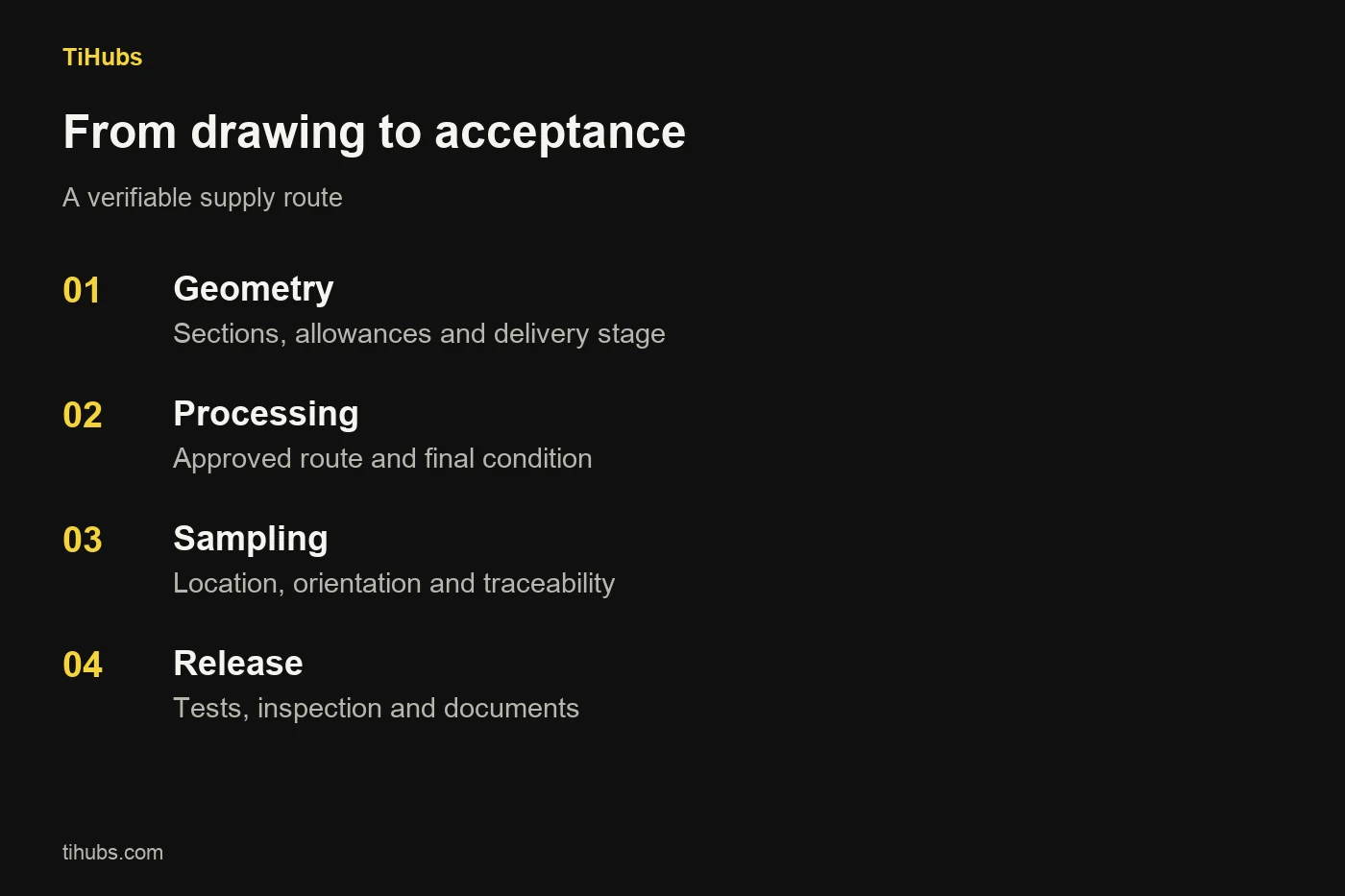
Consider the relationship between processing, sampling and inspection before production. If tests require material at a particular location or direction, the forging plan must provide it. If examination is required at an intermediate stage, the inspection plan should identify that stage and the surface or geometry needed. Adding these requirements after machining can make the original plan unusable.
For specimens, establish whether the acceptance evidence comes from the supplied forging, a prolongation, associated stock or another approved arrangement. Record the location and orientation required by the specification. A certificate should allow the reviewer to connect the test results to the accepted product rather than merely displaying values without a traceable material relationship.
For nondestructive examination, state the method, applicable procedure and acceptance criterion. A generic request for ultrasonic inspection does not define the entire examination scope. The supplier must know which geometry and stage are subject to inspection and what reporting is needed. Where a customer-approved procedure is required, identify that requirement before production begins.
Use a route review to assign responsibility for any later machining, surface treatment or thermal operation. The incoming material certificate covers its stated product and condition. Subsequent processing must be connected to the final component’s requirements through the appropriate records. This is especially important when different businesses perform stock supply, forging, heat treatment and final machining.
Industrial buying guide / 04Connect geometry to final release
The purchase package should link drawing, delivered condition, sampling and final acceptance.
05 / Build the enquiry
Make the two quotations answer the same purchasing question
A complete enquiry begins with exact material identity, product form, dimensions and quantity. Add the governing specification and edition, delivery condition, drawing revision and inspection scope. If Ti-6242S and Ti-6246 are both being evaluated, indicate whether both are approved candidates or whether one is only an alternative under technical review.
Specify the commercial delivery boundary. An offer may include only billet, an unfinished forging, a rough-machined item or a fully documented finished product. List included operations and required subcontract approvals where applicable. This makes it possible to compare the total route without treating a low price for an early production stage as the price of an accepted component.
Request an explicit response to each critical requirement. The supplier should identify compliance, a proposed deviation or information still needed. A statement that material is aerospace quality is not a substitute for confirming the actual specification, source approval and inspection package. Equally, an unresolved technical question should remain visible instead of disappearing into a generic acceptance statement.
For material availability, distinguish stock on hand from a possible production route. Confirm dimensions, condition, quantity and documentation for the specific offer. A catalog listing establishes neither current inventory nor a guaranteed lead time. Ask what production and review steps remain and whether the quoted delivery includes the required tests and record package.
Compare cost using the usable delivered item. Include machining allowance, test material, processing, inspection, documentation and any one-time qualification work. Keep these categories visible so a buyer can see why offers differ. There is no reliable universal Ti-6242S-to-Ti-6246 price ratio that can replace quotations for the actual product and requirements.
Include schedule hold points for technical approval, first-article review or document acceptance where the project requires them. Assign the party responsible for each decision and the information needed to proceed. A production lead time that excludes approval time is a different commitment from an agreed delivery date for released material.
For the enquiry itself, attach the relevant drawing and summarize the service questions that remain open. The supplier can then respond to product availability and required evidence without guessing the application. The goal is not a longer request for its own sake; it is a request that prevents the most expensive assumptions from entering the order unnoticed.
Consider an illustrative deviation register for a disc blank. One offer may match the alloy and dimensions but propose an alternative thermal condition; another may match the condition but exclude a required examination. Record those as separate deviations with their cost, schedule and approval consequences. This makes the bid comparison actionable and prevents a general compliant label from obscuring the exact decision the buyer must make.
06 / Review and release
Turn the comparison into a controlled purchase
Before release, reconcile the material designation across the drawing, requisition, supplier quotation and purchase order. Preserve the silicon requirement for the intended Ti-6242S route and identify the agreed condition for either alloy. If documents use different abbreviations, record the technical equivalence or correction through the responsible review process rather than leaving the receiving team to interpret it.
Check that the proposed product specification covers the ordered form and stage. A specification cited for bars or reforging stock should not be assumed to establish every requirement for a finished compressor component. The contract may need a combination of material, process, drawing and customer requirements, each with a clear role.
Review the inspection plan against the supplied geometry and processing sequence. Confirm sampling, test directions, examination stages and required reports before material is consumed. Where the supplier proposes an alternative test arrangement, obtain the applicable technical review before production rather than treating a certificate issued afterward as automatic approval.
At receipt, connect the physical material to its heat or lot identification and records. Confirm the ordered alloy, condition, dimensions, quantity and documentation. A certificate containing plausible numbers can still refer to the wrong product or lot. Identity and scope checks are therefore part of technical acceptance, alongside reviewing the reported values.
Preserve traceability through subdivision and further processing. If a forging or stock item becomes several parts, maintain the relationship between each part and the original evidence as required by the quality system. Later machining or thermal records should identify the material they affect, so the final release package describes a coherent route.
For a future substitution, revisit the original selection basis. A new supplier, stock form, processing sequence or condition can change what evidence is relevant even if the commercial alloy name remains unchanged. Review the proposed change against the component requirements, rather than relying on an earlier comparison that addressed a different route.
The useful conclusion is therefore conditional and specific: select the alloy and processing route that meets the approved duty, product and acceptance requirements with a supply package that can be verified. Public Ti-6242S and Ti-6246 comparisons can support that work, but the final purchase should state precisely what will be delivered and why its evidence is adequate.
Agree how missing or inconsistent records will be handled at receipt. Identify the review contact and the evidence needed to resolve a discrepancy, and keep affected material identifiable until disposition. This is a practical purchasing arrangement, not a presumption that the product will fail. It ensures that a certificate correction, additional record or technical decision can be connected to the exact item without losing traceability during production pressure.
For repeat orders, distinguish an unchanged part number from an unchanged supply requirement. A drawing can retain its number while its revision, referenced specification or inspection notes change. Request confirmation of the current revision at enquiry and order acknowledgment. A previous successful delivery provides useful history, but it does not remove the need to check what the next purchase actually requires.
When the buyer supplies a certificate for technical discussion, label its role clearly. A sample certificate shows the kind of information available; it does not establish the identity or properties of an unallocated future lot. The final documentation must correspond to the material delivered. This distinction is particularly useful when comparing stock offers with new-production quotations and prevents preliminary paperwork from being mistaken for release evidence.
07 / Build your RFQ
Request a documented forging or stock quotation
Send the exact alloy designation, specification, drawing and delivery stage. Include section sizes, condition, inspection and approval requirements so the response can distinguish available material, additional processing and technical questions that remain open.
Information to include
Ti-6242S silicon requirement or exact Ti-6246 designation
Billet, forging, rough-machined or finished delivery stage
Drawing revision, section sizes and allowances
Final condition, sampling and inspection package
Quantity, approval hold points and delivery destination
Build your RFQ checklist
Choose the product and add the information you have. Copy the resulting brief or send your requirements to TiHubs. Submitting an enquiry does not place an order.
08 / FAQs
Questions buyers ask
Is Ti-6242 always the same purchasing designation as Ti-6242S?
Do not assume equivalence from a shortened name. The cited TIMET 6-2-4-2 sheet contains a defined silicon range, but a commercial label alone does not establish that chemistry. Preserve the exact required designation and verify the offered material against the controlled specification and heat analysis.
Does more molybdenum make Ti-6246 the automatic choice?
No. The selected source table establishes a chemistry difference, not universal superiority. The decision also needs the component duty, product form, thermomechanical history and acceptance basis. Compare the evidence relevant to the approved application rather than converting one alloying difference into an overall performance ranking.
Can a tensile table decide a creep or fatigue requirement?
A tensile result alone cannot establish those behaviors. Request the relevant time, temperature, loading, specimen and condition context for creep or fatigue evidence. The responsible engineering process determines whether the data supports the component and what additional qualification or acceptance work is required.
Why are no universal strength values given for the two alloys?
The public datasets contain different conditions and reporting bases. Typical results, specification minima and lot tests are not interchangeable. A useful numerical comparison needs matching scope and clear limitations; omitting a misleading ranking is more accurate than presenting unmatched values as intrinsic grade properties.
Can billet certification release a finished forging?
It establishes the billet within its stated scope. Forging, thermal processing, machining and final inspection need the records required for the resulting product. Identify responsibility for those stages so that final acceptance does not rely on a certificate for an earlier material condition.
What should a buyer compare besides the material price?
Compare usable geometry, included processing, tests, documentation, approval work and delivery responsibility. Distinguish stock availability from a new production route and include qualification hold points in the schedule. The relevant cost is the accepted supply package, not an assumed price ratio between alloy names.
09 / Key takeaways
Keep the purchase requirements connected.
Retain the silicon requirement and exact Ti-6242S purchasing identity.
Historical chemistry columns support comparison, not current contract acceptance.
Evaluate creep and fatigue with their own conditions and evidence.
Connect forging section, thermal route, sampling and final inspection.
Compare documented, approved supply scopes before price.
Technical references
Sources and data scope
References reviewed November 14, 2026. Public source summaries support the discussion; the controlled specification, agreed edition and approved project requirements govern acceptance.
TiHubs coordinates titanium material and custom supply enquiries from Baoji, China. Send the product, drawing revision and acceptance requirements so the proposed supply scope can be reviewed. Learn about our sourcing role.
Contents
TiHubs
Talk to TiHubs
Ask about titanium materials, grades or custom parts.
Enter your email to start chatting.
We use your email to respond to your enquiry. Your conversation is stored on this website.
Our team is away right now. Leave your enquiry and we will follow up by email.