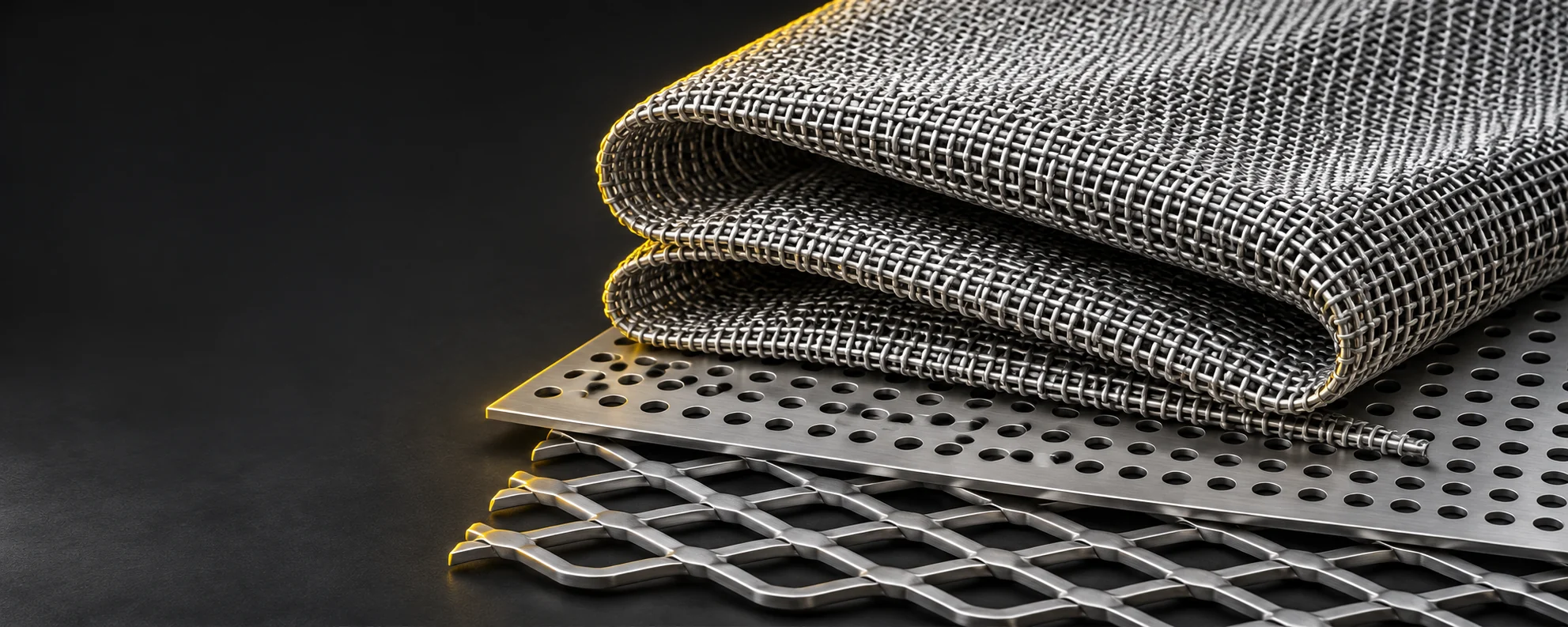
Titanium open-area products for screening, support and process assemblies. Specify the construction and opening geometry first, then agree dimensions, edge treatment and installation requirements.
20 years in titanium100+ Baoji factory connections
Opening geometry. Open area. Installation fit.
Choose the open-area construction
Woven mesh, expanded mesh and perforated sheet have different geometry and mechanical behaviour. A common opening size does not make them interchangeable.
Woven wire mesh
Woven wire mesh
State weave, wire diameter and clear aperture or mesh count with its definition. Include roll or panel dimensions, edge condition and any inspection method for opening consistency.
Weave and wire diameter
Clear opening and count basis
Roll or panel dimensions
Define your mesh & perforated sheet
Send the operating conditions and drawing requirements. Materials, feasibility, quantity, lead time and acceptance are confirmed through project review.
Order item
Include in your enquiry
Why it matters
Construction
Woven, perforated or expanded form
Identifies the manufacturing geometry
Material
Titanium grade, condition and input standard
Defines the material basis
Opening geometry
Aperture / hole / diamond dimensions and tolerance
Controls the passage or pattern
Metal dimensions
Wire diameter, sheet thickness or strand width
Defines the supporting metal section
Open area
Required percentage and calculation basis
Supports flow or coverage review
Delivery geometry
Roll / panel size, orientation and flatness
Fits the installation
Edges and surface
Margins, burr direction, trim and cleanliness
Controls handling and assembly interfaces
Acceptance
Sampling, pattern checks, packing and records
Establishes a reproducible release plan
Your starting specification.
Include woven / perforated / expanded construction, grade, opening pattern, wire or sheet thickness, panel size, edge condition and quantity.
Dimensions, availability and acceptance criteria are confirmed in the quotation and order documents. Product photographs illustrate the supply format.
Start with the grade
Explore a material guide, then tell us the exact designation required by your drawing or purchase specification.
Chinese designations and international names are reference routes, not automatic substitutes. Grade, product specification, condition and acceptance requirements must be agreed together.
The process, operating environment and required outcome help define the structure, materials and acceptance scope.
Screens and support panels
Opening geometry and support arrangement should be reviewed together. An aperture dimension alone does not establish filtration efficiency, pressure capability or resistance to deformation.
What to sendOpening objective, flow direction, support spacing and service environment.
Electrochemical assemblies
Mesh can be reviewed as a substrate or structural component where the design specifies titanium. A bare mesh order does not include catalytic coating or establish anode performance.
What to sendSubstrate drawing, grade, current-collector interfaces and coating responsibility.
Fabricated process internals
Cut or formed panels need margins, fixing points and orientation to be defined. Include the operating medium and cleaning conditions where material suitability requires review.
What to sendAssembly drawing, panel orientation, supports and cleaning conditions.
Specify the pattern before the panel
Use the geometry appropriate to the construction. Confirm whether dimensions describe clear openings, centre-to-centre pitch or overall strand dimensions.
Order geometry schematic; not a dimensional product drawing.
Identify the pattern system
State the construction and its dimension definitions. For woven mesh include wire diameter; for perforated sheet include pitch; for expanded mesh include strand and diamond dimensions.
Define the usable panel
Mark margins, cut outline and orientation. Distinguish overall dimensions from the active open area and note any fixing or forming features.
Agree the service and support context
Provide medium, temperature and loading where relevant. Specify the supporting frame or installation responsibility rather than treating the sheet alone as a rated assembly.
Inspect and protect the pattern
Agree opening checks, edge limits and flatness. Pack rolls or panels to prevent crushed edges and distortion while preserving material identity.
Inspection, agreed upfront
Specify the tests and documents that your receiving inspection needs. Scope, sampling and acceptance levels belong in the order.
Dimensional inspection illustration / agreed scope and acceptance
Order documentationTiHubs
Traceable from heat to shipment.
Material identificationGrade + specification
Batch identificationHeat / lot reference
Inspection scopeAgreed tests & results
Shipment identificationMarks + packing list
Illustrative document checklist. Not a certificate or test report.
01Construction identity
Confirm weave, perforation or expanded pattern.
Pattern designation02Opening dimensions
Check dimensions and pitch on the stated basis.
Tolerance + method03Metal section
Verify wire, sheet or strand dimensions.
Material geometry04Panel shape
Inspect outline, orientation, margins and flatness.
Installation drawing05Edge condition
Check burr side, trim and specified edge treatment.
Assembly acceptance06Packing and records
Protect the pattern from distortion and preserve lot identity.
Protected delivery
Titanium Mesh & Perforated Sheet references
Reference documents for mesh & perforated sheet procurement. Confirm product scope, grade, delivery condition and the edition required by your order.
Library PDFs may be earlier editions. Check the document cover and your contractual revision. A reference file does not certify a supplied product.
TiHubs coordinates titanium sourcing through a local manufacturer network. Your specification guides the supplier review, technical discussion and delivery requirements.
Confirm grade, dimensions, state, quantity and the purpose of the stock.
Review the supply route
Discuss manufacturing, finishing, inspection and documentation with the relevant supplier.
Agree the commercial scope
Confirm the quotation, lead time, acceptance requirements and delivery terms.
Coordinate inspection & delivery
Follow the agreed checks, marking, packing and shipment documentation.
Before you order
Answers to the details that make your titanium mesh & perforated sheet enquiry easier to review.
TITANIUM MESH & PERFORATED SHEET · BAOJI SOURCING
Send your specification.
Titanium open-area products for screening, support and process assemblies. Specify the construction and opening geometry first, then agree dimensions, edge treatment and installation requirements.
You do not need to finalize every detail before contacting us.
TiHubs
Talk to TiHubs
Ask about titanium materials, grades or custom parts.
Enter your email to start chatting.
We use your email to respond to your enquiry. Your conversation is stored on this website.
Our team is away right now. Leave your enquiry and we will follow up by email.