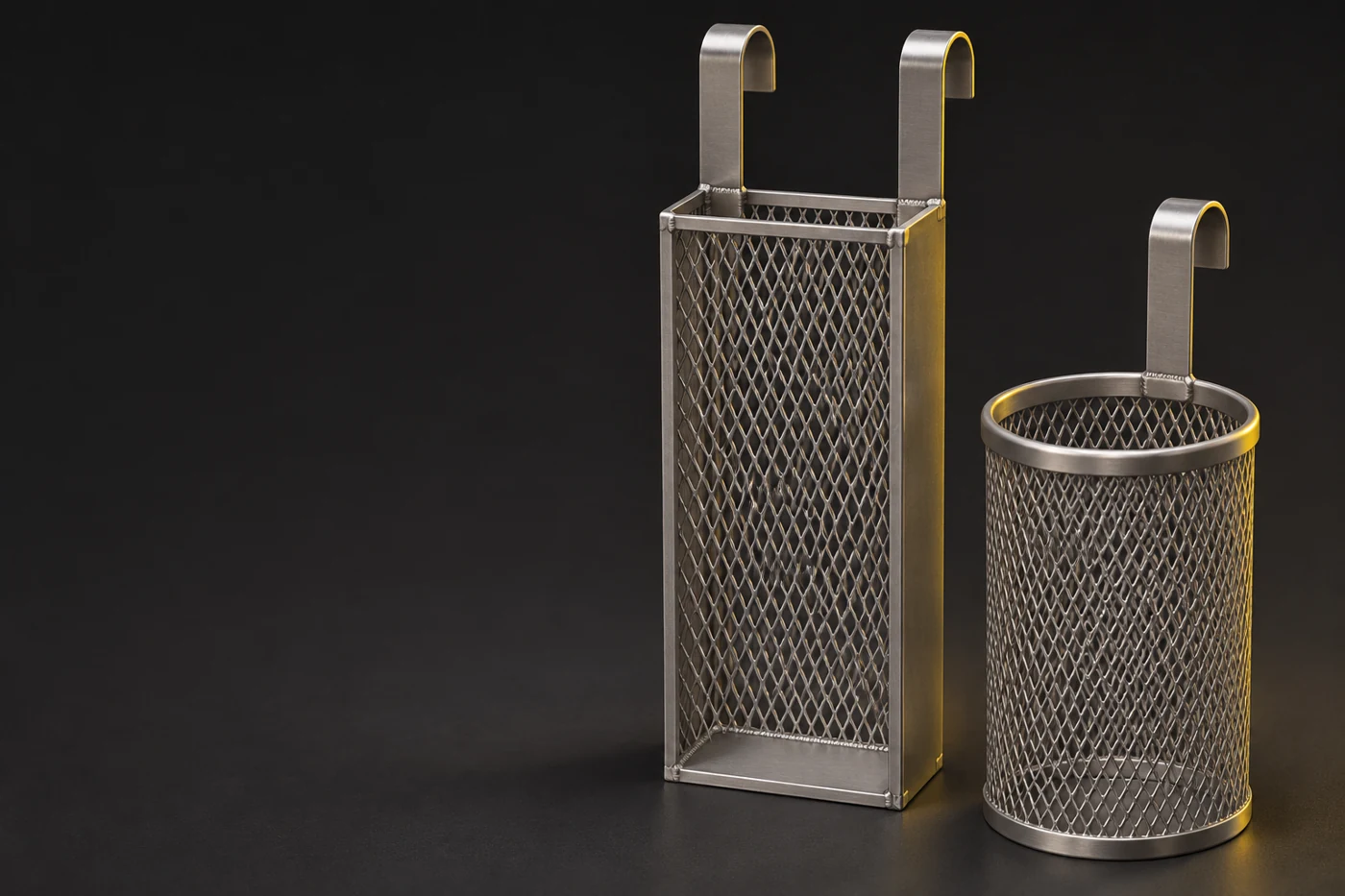
Titanium baskets hold soluble anode material within a defined plating arrangement. Specify the basket geometry, mesh, suspension and electrical contact together with the bath and loading conditions.
20 years in titanium100+ Baoji factory connections
Mesh and loading · Hooks and contact · Tank fit
Choose the basket arrangement
Review shape, openings and suspension against the real tank and soluble-anode material.
Rectangular baskets
Rectangular baskets
Define the outside envelope and the usable loading space separately. Include the front and rear mesh, side construction, bottom detail and reinforcing members. Show the relation to the tank wall, workpiece path and solution level. A rectangular basket that fits an empty tank may still interfere with bags, agitation hardware or the movement of a loaded rack.
Outside and usable dimensions
Side and bottom construction
Tank and rack clearance
Define the complete basket
Include the mechanical and electrical interfaces, not only the outside dimensions.
Order item
Include in your enquiry
Why it matters
Bath
Chemistry, concentration, temperature and contaminants
Confirm suitability with the process requirements
Anode fill
Metal, piece shape and size distribution
Match retention and replenishment needs
Envelope
Body width or diameter, depth and length
Separate outside size and usable space
Mesh
Opening geometry, strand or sheet thickness and orientation
A nominal mesh name can be ambiguous
Suspension
Hook section, bend, spacing and engagement
Match the busbar and loaded basket
Electrical duty
Required current per basket and contact arrangement
Do not infer rating from basket area alone
Structure
Side channels, reinforcing members, bottom and joints
Review the loaded and handled condition
Accessories
Bag material, fit, closure and any loading aids
Define included and excluded items
Inspection
Dimensions, joints, material and agreed functional checks
Identify acceptance method and records
Delivery
Quantity, labeling, protection and destination
Preserve shape and lot identity
Your starting specification.
Bath chemistry and temperature; soluble anode material and piece sizes; tank layout and solution level; basket dimensions; mesh opening and thickness; hooks and busbar; intended current per basket; loading and maintenance conditions; bags, inspection, quantity and destination.
Dimensions, material condition, quantity, testing and delivery are confirmed in the quotation and order.
Confirm the fabrication material
Select the grade and condition required by the approved basket and bath specification. Do not use a grade name as a universal compatibility claim.
Chinese designations and international names are reference routes, not automatic substitutes. Grade, product specification, condition and acceptance requirements must be agreed together.
The same basket outline can have different requirements in different baths and loading arrangements.
Soluble-anode plating lines
Identify the soluble metal, piece form, bath and intended operating arrangement. The basket retains and supports the anode fill; it is not interchangeable with a catalyst-coated electrode. If the project requires an active coated surface instead, review titanium anodes as a separate supply route.
What to sendBath, anode material, pieces and current duty.
Tank upgrades and replacements
Send the existing layout, basket spacing, busbar dimensions and reason for replacement. A worn basket can reveal handling damage or local operating problems, but copying its external dimensions may repeat the underlying issue. Include photographs as context while retaining a controlled drawing for the dimensions that matter.
What to sendLayout, interfaces and observed service problems.
Custom mesh fabrications
Where a standard shape cannot satisfy the tank, define the required envelope and contact arrangement before choosing a mesh format. Review bag clearance, loading access and the path used to lift the basket out. Raw mesh enquiries belong with titanium mesh; this page concerns the completed basket assembly.
What to sendAssembly drawing, mesh definition and handling method.
From tank layout to acceptance
Resolve retention, contact, structural support and operating conditions before comparing quotations.
Illustration of titanium anode baskets; dimensions, mesh and suspension are defined by the approved drawing.
Define body dimensions, openings, bottom, hooks and the busbar interface on one controlled assembly drawing.
Order geometry schematic; not a dimensional drawing.
Distinguish the basket from the active anode
A titanium anode basket is a container and support arrangement for soluble anode material in a specified plating process. It should not be confused with an MMO-coated titanium electrode, a platinized anode or a generic dipping basket. These products can share a titanium substrate while performing different tasks. Start the enquiry by stating whether the deliverable is an empty basket, a basket with accessories or a separate active electrode system.
Identify who supplies the soluble anode material and who defines the bath operation. A basket manufacturer needs the piece form and size range to review retention and loading. The process owner or chemistry supplier provides the relevant operating requirements. Keeping those responsibilities clear prevents a quotation for fabricated titanium from being interpreted as a guarantee of plating performance for an unspecified bath.
List the included items explicitly. Hooks, bags, loading aids and supporting hardware should not disappear into a general description such as complete anode assembly. If a replacement must match an existing arrangement, provide the accepted drawing and identify any proposed change. The product boundary is the starting point for both price comparison and inspection.
Describe the bath and operating arrangement
Provide the bath chemistry, concentration range, temperature and relevant contaminants, together with the soluble anode material. Include normal operation, cleaning and maintenance exposure. A basket selected for one plating process should not be assumed suitable for another merely because both use the same metal fill. The bath supplier’s requirements and the approved equipment design should control the compatibility review.
Technic’s application note highlights the importance of maintaining anode fill relative to the operating solution level and explains how insufficient fill can increase local resistance and contribute to basket damage. Treat this as an operating requirement to resolve with the process owner, not as a substitute for a complete electrical or corrosion assessment. The note also flags fluoride contamination as a possible contributor to severe corrosion.
Record the intended current per basket and the way current is distributed across the array. Identify whether baskets operate continuously or are frequently removed and reloaded. Do not assign an amperage rating from mesh area alone. Contact geometry, conductors, joints, fill and the actual operating conditions all need an agreed basis before the supplier can confirm the proposed construction.
Measure the tank interface before the basket
A useful layout shows the tank wall, busbar, solution level, basket position and workpiece path. Include adjacent baskets, anode bags, agitation equipment and any shields or fixtures that occupy the same space. Mark the access needed to load the basket and the route used to remove it. The drawing should represent the working line, not only the dimensions of an empty tank.
Separate basket body length from overall length including hooks. State whether dimensions are measured to the outside frame, mesh or usable interior. A quote based on overall height can differ materially from one based on immersed body length. Define the datums so the fabricator and receiving inspector measure the same features. If several basket positions differ, identify them as separate items rather than relying on a common nominal size.
Review tolerances against the available clearance. Tight limits on an unimportant external feature may add cost while leaving the hook engagement ambiguous. Prioritize the dimensions that control suspension, bag fit, loading and safe removal. Keep the accepted layout with the purchase record so later orders retain the same installation assumptions.
Define mesh openings without ambiguity
Expanded metal, perforated sheet and other open constructions should be described by their actual geometry. For expanded mesh, identify the opening directions and the dimensions the drawing uses, together with strand dimensions and orientation. For perforated sheet, specify hole geometry, arrangement and sheet thickness. A nominal mesh label can mean different things in different catalogues, so attach a sketch where terminology could be misunderstood.
Compare the opening with the soluble anode pieces over their useful service, not only with fresh pieces at loading. Explain whether small remnants must be retained by the basket, the bag or another approved arrangement. The design must also permit the process conditions required by the bath. Avoid claiming that a larger open area is always better; retention, structural support and the actual flow arrangement need to be considered together.
Specify edge condition and joint locations where they affect handling or bags. An opening dimension measured on a flat sample may not describe a formed corner or a welded transition. Identify which areas are subject to acceptance and whether local departures are permitted. This makes inspection more meaningful than checking one convenient mesh opening and assuming the entire basket is equivalent.
Review hooks as mechanical and electrical interfaces
The hook connects the basket to the support and to the electrical supply arrangement. Provide the busbar section, hook shape, contact location, spacing and engagement. Include the loaded condition and the way the basket is handled. A hook that hangs securely in an unloaded trial may behave differently when the basket is filled, bagged and moved in normal operation.
Ask how the hook and basket conductors are joined and what parts of that construction are inspected. The drawing should distinguish the structural path from any intentionally separate electrical contact feature. Where a special conductor or clad construction is proposed, identify its material boundary and the evidence required. Do not assume that an external appearance establishes the internal construction or its suitability for the bath.
Keep the current-duty review tied to the actual contact arrangement. Contact condition and assembly details can matter as much as a nominal strip dimension. Require the supplier to identify the basis for any stated capability, including limitations or installation conditions. A general current-per-area rule from another design should not become an unsupported rating on the purchase order.
Review the loaded structure and joints
The basket must be reviewed in the condition in which it is filled, suspended and handled. Identify the intended fill material and loading practice, together with any handling equipment. Body reinforcement, side channels, rim, bottom and hook attachment all contribute to the completed structure. A wall thickness alone does not describe the strength of that assembly or establish a permissible filled mass.
Ask the fabricator to identify the joint types and the inspection requirements used at mesh-to-frame, bottom and hook connections. Specify any project restrictions on welding or repair through the drawing and purchase documents. A visual check can identify certain workmanship issues, but it does not establish every structural or electrical characteristic. If a proof or functional test is required, agree its load, fixture, acceptance and relation to service before production.
Review deformation limits where they affect installation. A basket may remain intact while bowing enough to interfere with a bag or adjacent equipment. State which dimensions apply before and after the specified check. Keep the approved test separate from an uncontrolled shop demonstration that cannot be reproduced at receipt.
Specify bags and accessories as separate items
An anode bag should be selected for the process, the material it must retain and the basket arrangement. Identify its material, dimensions, closure and fit through the bath or equipment specification. Include the space needed when the bag is installed and the method used to remove it. Do not assume that a bag made for another basket of similar nominal size will fit the actual hooks, reinforcement and bottom.
Clarify whether the bag is included, supplied by the customer or purchased separately. The same applies to loading chutes, lifting features and other accessories. A basket-only quotation and an equipped assembly quotation should be compared after those differences are visible. Where an accessory contacts the electrolyte, include it in the compatibility review instead of treating it as an unrelated packaging item.
Maintenance access is part of the decision. Explain how bags are inspected, changed and cleaned under the approved operating procedure. The basket design should permit those tasks without unplanned bending or modification. Ask for drawings or samples of unfamiliar accessories before approving a full batch, especially when their fit affects installation across multiple tank positions.
Connect replenishment and maintenance to the design
The loading arrangement should allow the intended anode material to be added and to settle as required by the process. Provide the piece shape and size distribution rather than only the metal name. Identify the loading access and any handling restrictions. A basket that can hold the initial charge may still be awkward to replenish if the opening is obstructed by the busbar, adjacent equipment or a cover.
Agree the operating and maintenance requirements with the process owner. Basket inspection can include the condition of hooks, joints, mesh, bottom and contact surfaces, together with observations of local deformation or deposits. Record where a problem appears and under which operating conditions. Replacing a damaged basket without examining the fill, contact and bath history may reproduce the same service issue.
Keep maintenance observations separate from a supplier warranty conclusion until the cause is understood. Photographs, basket identity, bath records and the operating sequence help distinguish handling damage, a fabrication discrepancy and an application problem. This evidence also improves the next purchase specification by showing which feature or operating requirement needs clearer control.
Build an inspection plan around the drawing
Start with material identity and the controlled assembly drawing. Define the dimensions that affect tank fit, busbar engagement, opening retention and accessory fit. Establish how mesh openings and strand or sheet dimensions will be checked, including the measurement direction. For a formed basket, identify the locations where measurements are taken so supplier and receiving inspection do not compare unrelated areas.
Specify the workmanship checks for edges, joints and reinforcement. If the project requires additional tests, record their methods and acceptance criteria explicitly. A statement that a basket is inspected or electrically tested is incomplete without describing the test and its purpose. Do not use a resistance measurement or a visual weld check as a universal substitute for every mechanical and operating requirement.
Agree sampling, first-piece approval and lot documentation before production. The first-piece record should include the drawing revision and any accepted deviations. If several basket sizes are delivered together, label them clearly and connect each item to its records. Similar-looking baskets with different hook positions can create installation delays even when every individual dimension was manufactured correctly for its own drawing.
Compare construction choices by requirement
Procurement comparison; no unverified current, life or capacity values are shown.
Choice
What must be defined
What should not be assumed
Rectangular versus round
Envelope, loading and suspension
One shape is universally more efficient
Expanded versus perforated
Actual openings, thickness and orientation
A shared nominal mesh label means identical geometry
Basket alone versus equipped assembly
Bags, hooks and accessories included
Every quotation covers the same package
Material grade change
Approved specification and bath review
Higher grade number means better service
Current-duty proposal
Contact arrangement and stated basis
Basket surface area alone establishes a rating
Use this comparison to organize questions, not to rank every basket by one property. A proposal can be attractive for loading access yet require a different bag or suspension arrangement. Another can preserve the existing interface but use a different mesh definition. Ask each supplier to identify deviations against the same drawing so the purchasing team can see the consequence of each alternative.
A clear quotation separates fabrication, optional accessories, sample approval, special checks, documentation and delivery. Confirm whether the price includes accepted finished baskets and whether any development samples are additional. Keep changes in bath duty or current requirements visible; those changes can alter the technical review even when the outside dimensions remain unchanged.
Prepare a repeatable RFQ and receiving record
The enquiry package should combine a basket drawing, a tank-interface sketch and a short operating description. Include quantity, delivery destination and required timing. Mark unresolved details such as the busbar section, mesh opening convention or bag supply. A drawing with clearly identified open points is more useful than a complete-looking specification assembled from unrelated catalogue values.
Before release, confirm the proposed material, geometry, contact arrangement, accessories and inspection scope. For a repeat order, retain the approved revision and identify any change in anode pieces, bath conditions or tank layout. Receiving inspection should reconcile item labels, dimensions, material records and the agreed checks before baskets are placed into service or mixed with existing stock.
TiHubs can review the requirement through its Baoji supplier network using the drawing and process information you provide. The sourcing response should identify the proposed fabrication scope and any remaining technical questions. Confirm the final construction and operating basis with the responsible process team, then keep the accepted specification with the purchase and maintenance records. This creates a practical route from the first enquiry to a repeatable replacement order.
Inspect the functional construction
Connect each check to a drawing feature or agreed operating requirement.
Illustrative basket inspection map; no measured current or structural test results are represented.
Order documentationTiHubs
Traceable from heat to shipment.
Material identificationGrade + specification
Batch identificationHeat / lot reference
Inspection scopeAgreed tests & results
Shipment identificationMarks + packing list
Illustrative document checklist. Not a certificate or test report.
01Material identity
Confirm grade, condition and the fabrication-stock record.
Material scope02Tank fit
Check the body envelope and specified datums.
Installed geometry03Mesh definition
Measure opening and strand or sheet features.
Retention geometry04Suspension
Check hooks, spacing and busbar engagement.
Mechanical interface05Joints and edges
Inspect agreed workmanship and connection features.
Assembly condition06Release package
Connect the basket, drawing revision and inspection record.
Traceable delivery
Keep the references in scope
Material and supplier application references support review; they do not certify a new basket design.
Library PDFs may be earlier editions. Check the document cover and your contractual revision. A reference file does not certify a supplied product.
ASTM B265 — official scope — Sheet, strip and plate material scope; finished assembly requirements are separate.
Baoji. One contact.
TiHubs coordinates titanium sourcing through a local manufacturer network. Your specification guides the supplier review, technical discussion and delivery requirements.
Confirm grade, dimensions, state, quantity and the purpose of the stock.
Review the supply route
Discuss manufacturing, finishing, inspection and documentation with the relevant supplier.
Agree the commercial scope
Confirm the quotation, lead time, acceptance requirements and delivery terms.
Coordinate inspection & delivery
Follow the agreed checks, marking, packing and shipment documentation.
Before you order
Define the basket, the soluble anode fill and the tank interfaces as one procurement package.
TITANIUM ANODE BASKETS · BAOJI SOURCING
Send your specification.
Titanium baskets hold soluble anode material within a defined plating arrangement. Specify the basket geometry, mesh, suspension and electrical contact together with the bath and loading conditions.
You do not need to finalize every detail before contacting us.
TiHubs
Talk to TiHubs
Ask about titanium materials, grades or custom parts.
Enter your email to start chatting.
We use your email to respond to your enquiry. Your conversation is stored on this website.
Our team is away right now. Leave your enquiry and we will follow up by email.