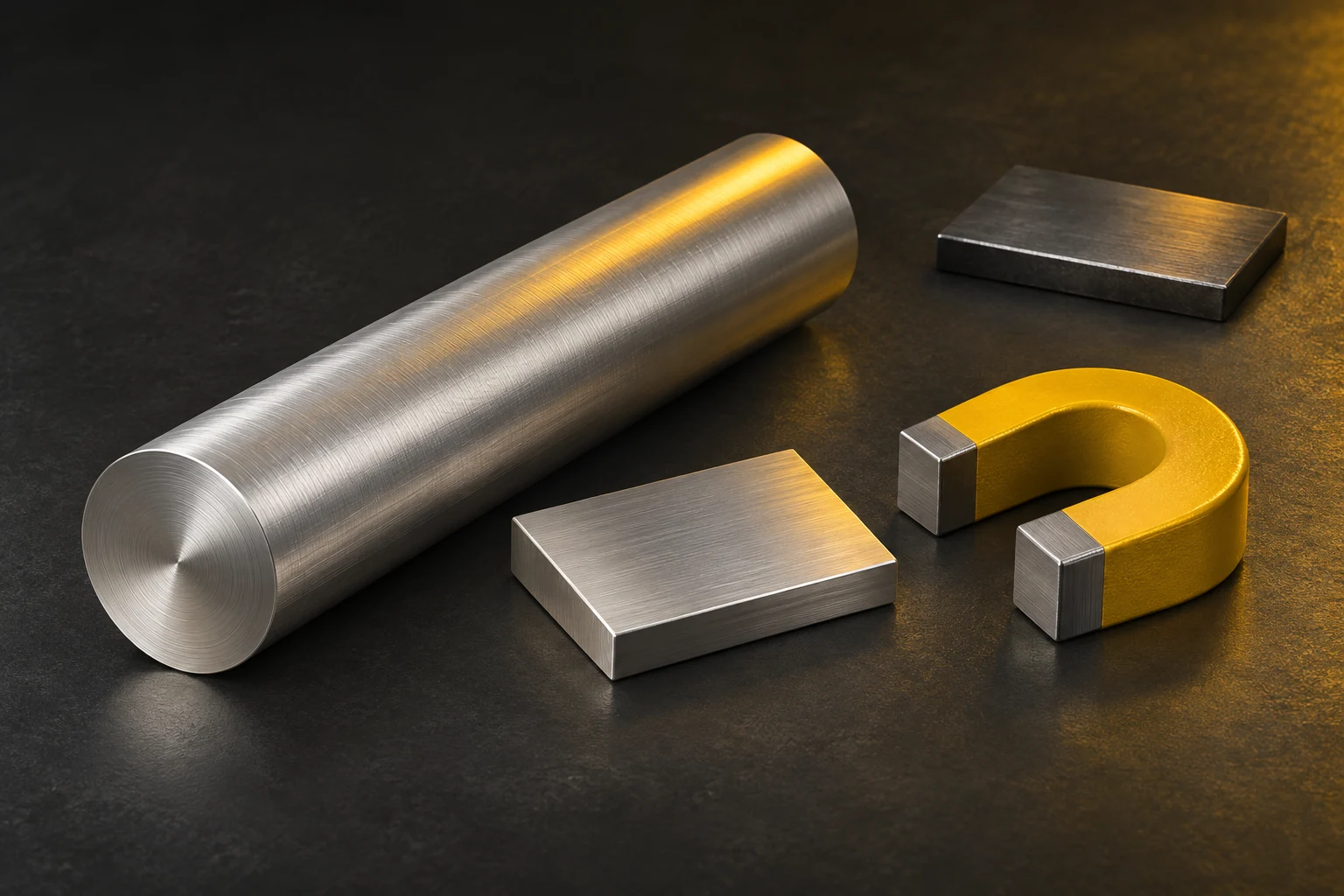
AI illustration; not a production or inspection record.
Quick answer
Titanium is paramagnetic, with a weak magnetic response. Commercially pure titanium and common structural titanium alloys do not show the strong attraction expected from ordinary carbon steel in a workshop magnet check. However, no visible attraction does not prove that an item is titanium or identify its grade. Investigate unexpected attraction, preserve traceability, and use an appropriate test for the requirement you actually need to verify.
01 / Magnetic behaviour
Weak response is not a material certificate
For an ordinary workshop magnet, commercially pure titanium and common structural titanium alloys do not behave like carbon steel. Titanium is paramagnetic: it has a weak response to an applied magnetic field, rather than the strong ferromagnetic behaviour associated with an ordinary steel magnet keeper. The New Zealand geological survey’s titanium commodity report identifies the element as paramagnetic. That distinction answers the basic search question, but it does not identify an unknown piece of stock.
A buyer holding a silver bar normally wants to know something more specific: is this the material on the purchase order? A magnet addresses only a small part of that question. A bar can show no obvious attraction and still be the wrong metal, the wrong titanium grade, an unsuitable delivery condition or an untraceable remnant. The visible response is an observation about the test arrangement, not a complete description of the material.
Separate three meanings of “nonmagnetic”
In everyday conversation, nonmagnetic often means that a small permanent magnet does not visibly stick. In an engineering specification, it may mean a defined upper limit on relative permeability under stated conditions. In a finished system, it may mean that the assembly does not create an unacceptable disturbance at a sensitive location. Those are different requirements. A purchasing document should say which one controls the order instead of expecting every supplier to interpret the same adjective identically.
Relative permeability compares a material’s magnetic response with that of vacuum. It is dimensionless. It is not a percentage of titanium purity, a strength rating or a grade identifier. A number reported without the measurement method and relevant conditions can be less useful than it appears. Equally, the word “nonmagnetic” on a commercial datasheet should not be copied into a certificate as though a finished component had undergone a specified test.
The part being tested matters
A loose coupon, a long bar resting on a steel bench and a complete mechanism do not present the same surroundings. In the mechanism, inserts, springs, bearings, retaining rings and nearby brackets may contribute to the observed response. Before investigating the titanium itself, identify the physical boundary of the item being assessed. Record whether the test concerns raw stock, a machined component, a coated component or an assembly containing other materials.
This is especially important when procurement inherits a drawing note from another product. “Nonmagnetic titanium assembly” could describe a material preference or a verified functional requirement. Ask the design owner to distinguish them. A supplier can then quote the required material and evidence, rather than guessing whether an ordinary material certificate is sufficient or whether a separate magnetic assessment is expected.
For safety-critical or medically regulated equipment, a material description cannot establish the suitability of the complete device. In particular, a magnet check is not an MRI safety assessment. Keep the discussion here within industrial material identification and purchasing; application qualification belongs to the responsible technical authority.
02 / What a magnet establishes
Use a screen for the question it can answer
A magnet can be a convenient screen when a warehouse is looking for an unexpected strongly magnetic item among nominally titanium pieces. Its value is speed and simplicity. Its weakness is that it produces a very limited observation. The result should lead to a defined next step, not become a shortcut around identification, traceability or an agreed acceptance plan.
Observation-to-action framework; not a quantitative permeability test
Observation
What it supports
What it does not establish
No obvious attraction
No visible attraction in that arrangement
Titanium identity, grade, chemistry or conformity
Strong attraction over the whole piece
An unexpected response that needs investigation
The identity of the metal without further evidence
Attraction at one location
A localized source or geometric effect to investigate
That the entire titanium component is the wrong material
Attraction only when assembled
The assembly or surroundings may contribute
That the titanium stock itself failed a requirement
Different response after moving the part
The setup was influential
A change in the material’s grade or chemistry
The table deliberately contains no invented pull-force limits. Magnet strength, shape, air gap, component geometry and the surrounding material affect a visible check. Unless the inspection procedure controls the necessary variables, “it stuck more strongly than yesterday” is not a numerical acceptance result. Preserve the observation, then use an appropriate method for the property that matters.
A negative result has many possible explanations
Imagine two unmarked metal coupons that both show no obvious attraction. The observation has not shown that they have the same composition, much less that either matches a specified titanium grade. This is the central false-confidence risk. Buyers sometimes treat the absence of an obvious steel-like response as positive proof of titanium. The logical step is invalid: eliminating one expected behaviour does not identify every remaining possibility.
The same limitation applies within titanium. A magnet cannot separate Grade 2 from Grade 5, verify an extra-low-interstitial designation or establish annealed versus another supplied condition. These purchasing distinctions require different evidence. Do not add a “magnet passed” column to a receiving sheet if colleagues will interpret it as “material fully approved.” Name the column after the actual observation and preserve the separate release decision.
Keep screening separate from rejection
An unexpected response is a reason to hold the affected material and investigate. It is not, by itself, proof of deliberate misrepresentation. The source may be the stock, an attached item, loose contamination, a test fixture or an identification mistake. Record the heat marking, package label, item quantity and test location before moving anything. That record allows the supplier and buyer to discuss the same evidence.
For repeated incoming lots, agree whether screening is part of the order or an internal warehouse precaution. Define the response to a suspect piece and the person authorized to release the hold. A controlled escalation path is more useful than an informal rule that every employee applies with a different magnet and an undocumented judgment.
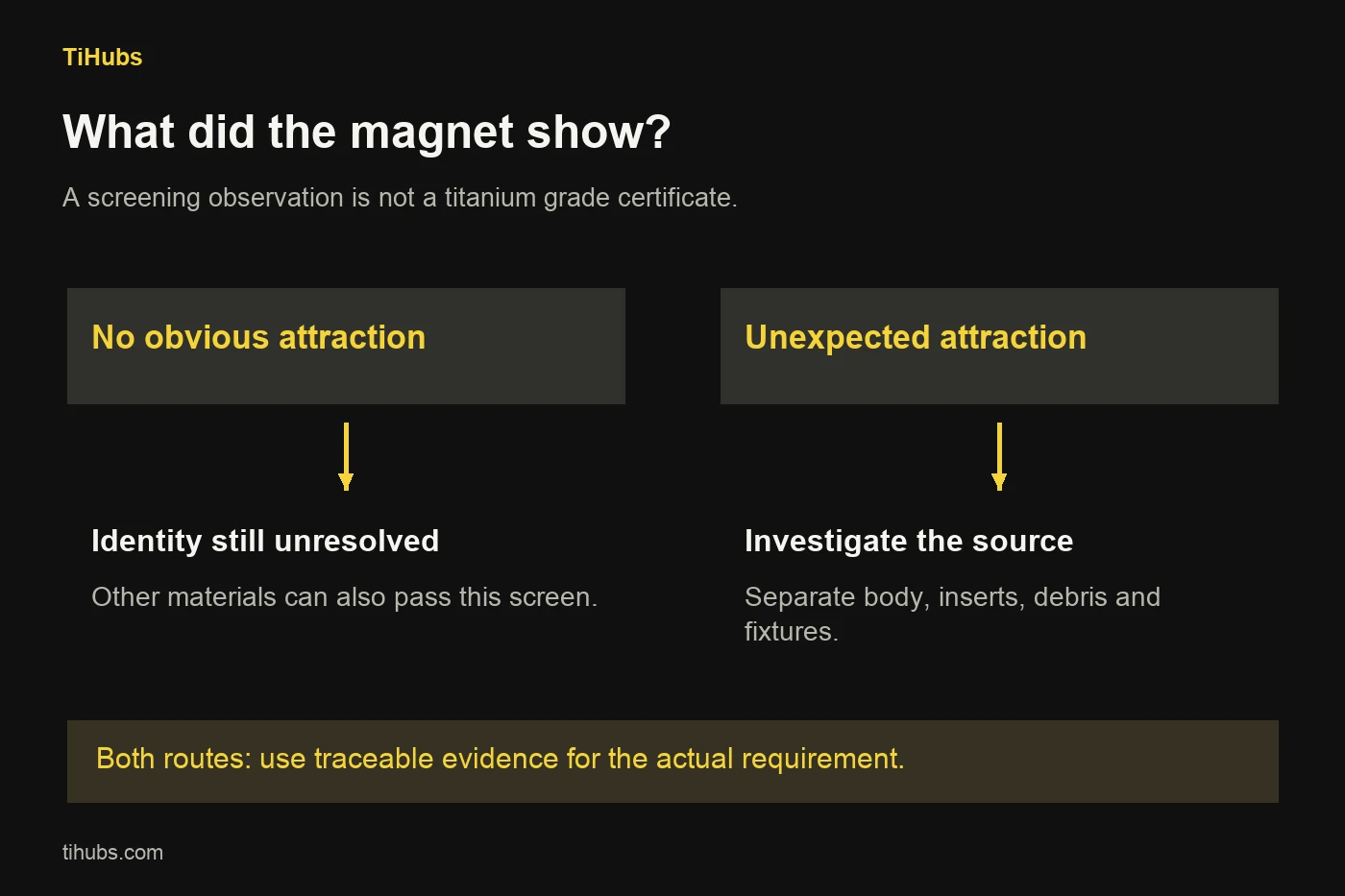
Industrial buying guide / 02An observation is not an identification.
No obvious attraction leaves several material possibilities open. Follow the unresolved question to the appropriate evidence.
03 / Unexpected attraction
Locate the source before changing the conclusion
If nominally titanium stock appears strongly attracted to a magnet, begin with the test arrangement. Move the item away from a steel bench, vise, magnetic base or packaged steel accessories. Use a clean support and identify the specific surface or location being checked. This is an investigative sequence, not a prescribed acceptance test. Its purpose is to avoid assigning the response of the surroundings to the titanium.
Distinguish loose material from the component
Look for attached chips, wire fragments, grinding debris or other visible foreign material. Photograph the original condition before any cleaning. If cleaning is permitted, use the approved method and record what was removed. Do not aggressively grind, acid-clean or otherwise alter a finished surface simply to obtain a different magnet result. Such an intervention can destroy useful evidence and create a separate dimensional or surface-conformity problem.
A locally attracted chip does not prove that the bulk material is ferromagnetic. Conversely, removing a chip does not automatically clear the lot for service. The contamination itself may matter to the required cleanliness or fabrication route. Keep the questions separate: what caused the magnetic observation, and does the delivered product meet its surface and cleanliness requirements? Either question may need additional evidence.
Check the bill of materials on assemblies
A titanium bracket can contain a steel threaded insert, a bearing or a locating pin. A tube assembly can contain a fitting made from a different alloy. Compare the observed location with the drawing and bill of materials. If another material is intentional, assess it against the assembly requirement. If the drawing calls for an all-titanium construction, the same observation asks a different question about the delivered configuration.
Disassembly should follow the approved inspection or maintenance procedure. Do not loosen a calibrated joint or damage a sealed assembly merely to repeat a simple check. Where access is restricted, document the limitation and ask the technical owner how to isolate the source. An uncertain result is preferable to a confident explanation produced after an unauthorized alteration.
Trace an anomaly through the lot
Record whether the issue affects one end, one piece, one package or all items with the same heat identification. Compare markings with the packing list and certificate. Ask whether pieces were cut from a common parent length and how identity was transferred after cutting. A single unexpected piece in a mixed-size shipment suggests a different investigation from a consistent result across an intact, single-heat bundle.
Do not blend suspect pieces into the accepted inventory while waiting for a response. Preserve the separation and the relationship between physical items and photographs. If a laboratory receives a sample, its identifier should connect back to the retained item and shipment. Otherwise an accurate result may answer a question about a sample whose relationship to the disputed lot is unclear.
Finally, write the finding without overstating it: “Localized attraction adjacent to insert A; raw-stock surface elsewhere showed no visible attraction under this check” is useful. “Fake titanium” is a conclusion that requires substantially more evidence. Precise observations help both parties choose the right follow-up test and avoid replacing compliant material for the wrong reason.
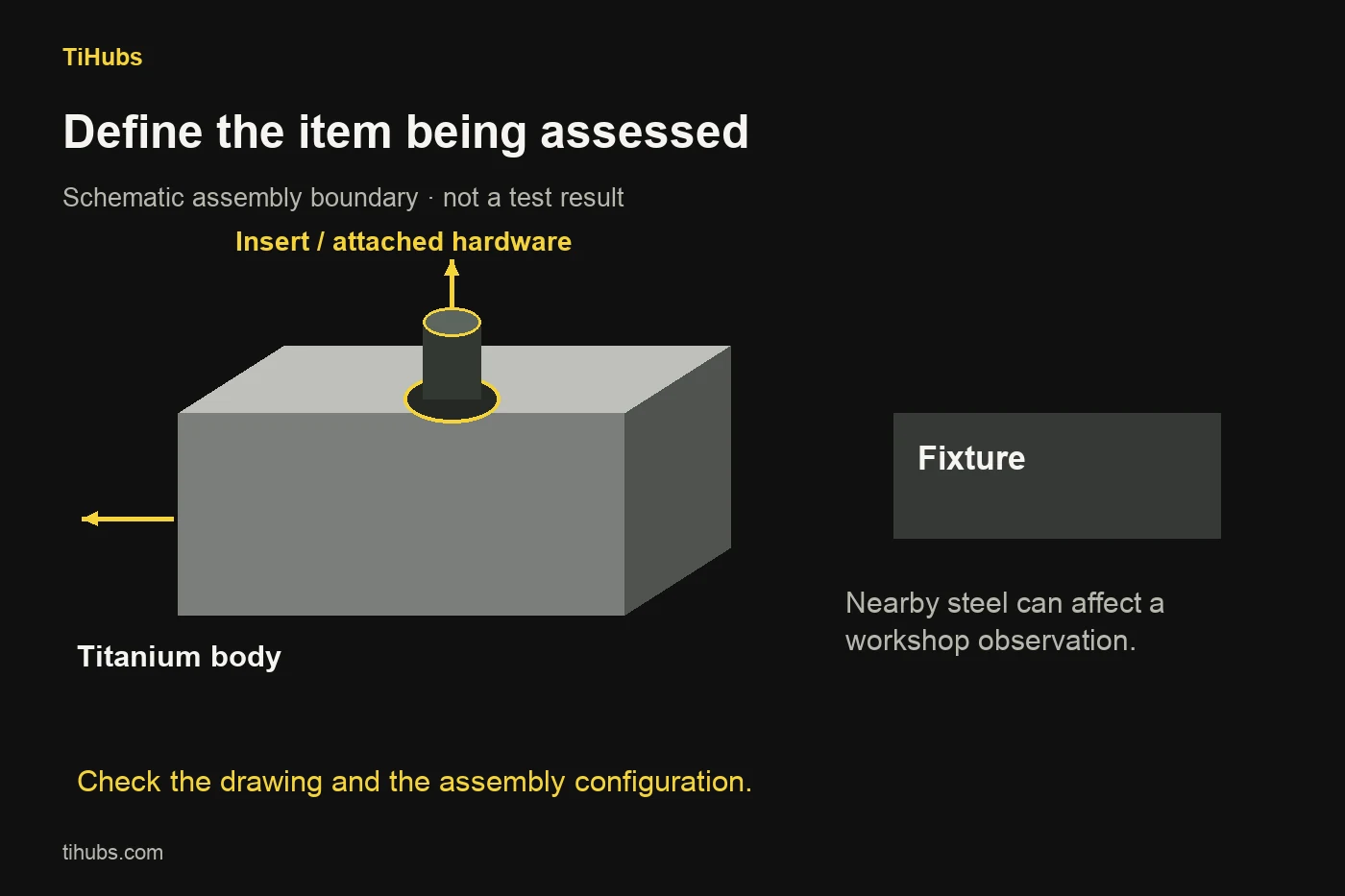
Industrial buying guide / 03Define the boundary of the part.
Body material, attached hardware and the surroundings can represent different sources. Inspect the specified configuration.
04 / Choose the evidence
Match the verification method to the requirement
The next test depends on the unresolved question. Material identity, chemical composition, mechanical properties, surface discontinuities and magnetic behaviour are different characteristics. No single quick check establishes all of them. Start by writing the question in a form a laboratory or supplier can answer, then select the technique and acceptance basis.
For elemental identification, handheld XRF can provide useful alloy information, but its scope has limits. Evident’s XRF guidance explains that ordinary handheld measurements do not determine light elements such as oxygen, nitrogen and carbon. A displayed alloy match therefore cannot verify every titanium grade requirement. Use the TiHubs guide to XRF and titanium grades for that separate identification question.
Choose evidence by the claim being made
Question
Evidence to specify
Important boundary
Is the piece linked to the ordered lot?
Marking, packing list and traceable records
A document without item linkage is incomplete
Does chemistry meet the grade?
Methods covering the required elements and limits
A partial elemental screen is not full chemistry
Does magnetic behaviour meet the application?
Specified method, conditions and acceptance limit
A hand magnet is not an instrument report
Are surface-breaking discontinuities acceptable?
Appropriate examination procedure and criteria
Identity and magnetic response do not answer this
Does the finished assembly perform correctly?
Approved functional or qualification assessment
Parent-stock results do not qualify the assembly
A crack test is not a magnet check
Magnetic-particle examination relies on ferromagnetic material; it is not the normal route for examining titanium. TWI’s method overview identifies that material boundary. Where the requirement concerns surface-breaking discontinuities, the technical owner should select an applicable method, such as a qualified penetrant procedure, with its own preparation and acceptance criteria. A clean magnet observation does not demonstrate freedom from cracks.
Report the stage represented by the sample
A test on incoming bar represents the tested material at that stage. If the delivered product is subsequently machined, assembled or surface-treated, identify which requirements must be rechecked on the finished item. This does not mean every operation requires every test again. It means the inspection plan should state what evidence remains applicable and what later change could invalidate the original conclusion.
Ask the laboratory to identify the sample, method, reported quantity, units where relevant, equipment or procedure reference, and any limitation affecting interpretation. Where a pass/fail statement is requested, supply the acceptance requirement rather than asking the laboratory to invent one. If the result lies near a specified limit, agree how uncertainty and the decision rule will be handled before using the result to accept or reject a costly batch.
The practical benefit is fewer disconnected reports. A useful package connects the question, the exact piece, the test and the decision. A collection of attractive certificates with no common lot identifier may contain valid measurements while still failing to establish conformity of the goods received.
05 / Low-magnetic requirements
Make the magnetic requirement measurable
When titanium is being selected for equipment sensitive to magnetic disturbance, “supply nonmagnetic material” is not a complete order requirement. The design owner should define the property, the acceptance boundary and the state of the delivered item. The supplier can then review whether the requested evidence is available for the proposed size, form and manufacturing route.
The public scope of ASTM A342/A342M-26 describes procedures for weakly magnetic materials. It also distinguishes method capabilities and notes that some methods require the applied field to be specified. Naming the standard alone does not select a suitable method for a particular titanium part. The laboratory must confirm applicability and measurement capability for the required range and geometry.
Start with the deliverable
Specify whether acceptance concerns semi-finished stock, a finished component or an assembly. Identify the surfaces or locations that matter and whether an inaccessible region requires a representative coupon or another agreed approach. A test on a flat sample should not silently stand in for an intricate component when the geometry affects the measurement. Record the agreed relationship between the sample and delivered item.
State the condition at inspection. If the order includes coating, embedded hardware or assembly, identify whether assessment occurs before or after those operations. For a system requirement, define the configuration to be evaluated: installed fasteners, cables, brackets and nearby components may be relevant. The supplier should not have to infer the customer’s operating arrangement from a single isolated part drawing.
Keep material and functional requirements connected
A low magnetic response does not replace strength, fatigue, dimensional or corrosion requirements. A material change intended to improve one property can alter the manufacturing route or another performance constraint. If the drawing already specifies a titanium grade, quote that grade first. Present any proposed alternative separately, with the property it is intended to improve and the evidence needed for approval.
For titanium bar and rod, identify the usable dimensions and condition before arranging special verification. For a machined titanium component, provide the drawing revision and final configuration. Special testing may require sample material, access to particular surfaces or additional lead time. These are quotation inputs, not details to discover after the component is finished.
Agree what happens when evidence is incomplete
A supplier may be able to provide traceable titanium material while being unable to certify a very specific magnetic limit. The correct response is to identify the missing capability and propose an agreed laboratory route, if feasible. Replacing the missing measurement with a generic datasheet or an informal magnet demonstration does not close the requirement. Keep the commercial offer explicit about what is included.
For repeat orders, retain the approved measurement procedure and the relationship between test specimens and production. Review changes that affect that relationship, including a different product form, assembly configuration or examination stage. This preserves the meaning of an accepted first order without pretending that a supplier’s original result automatically covers every future component.
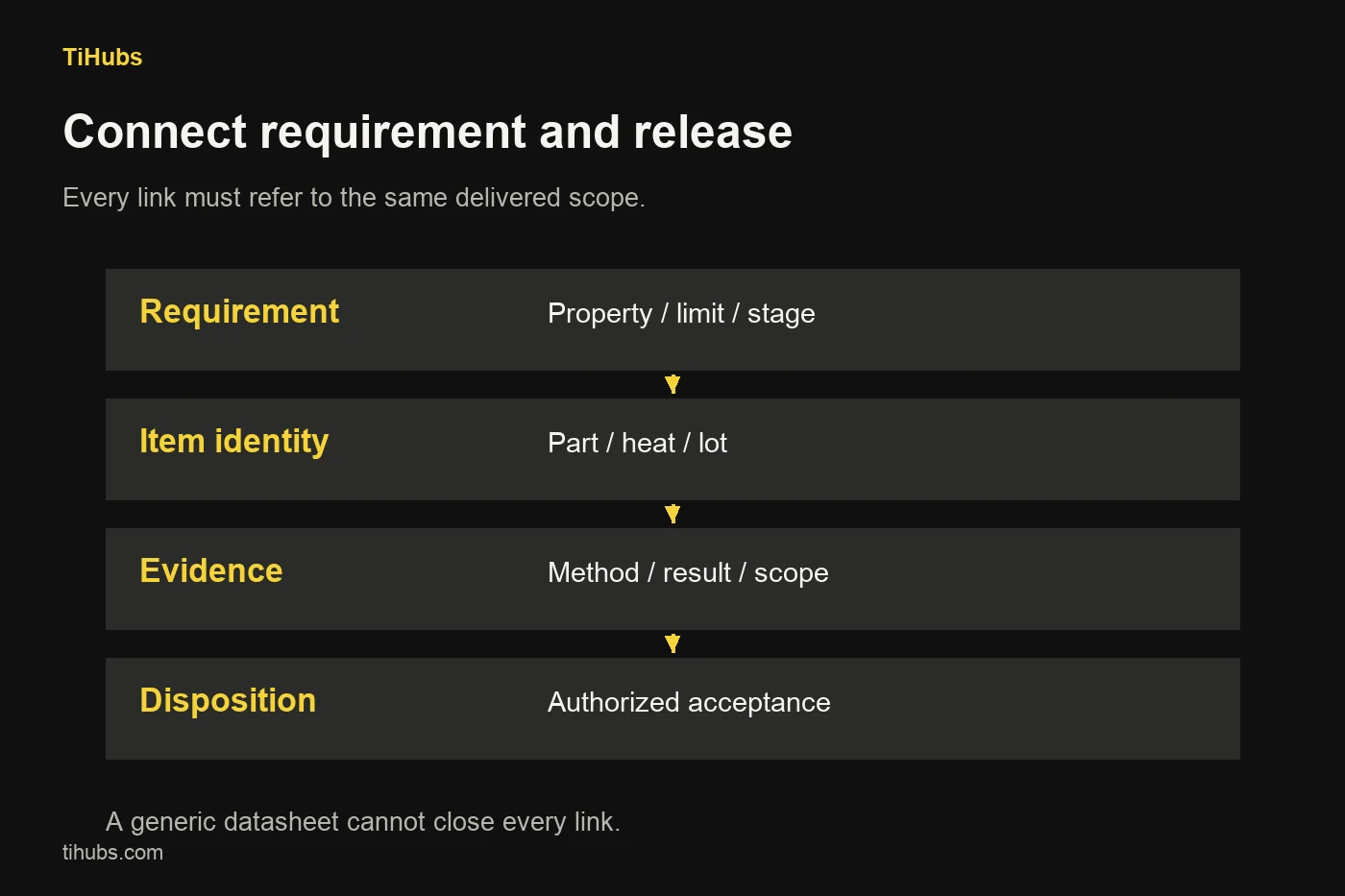
Industrial buying guide / 05Keep the evidence connected.
The requirement, physical item, measurement and disposition must refer to the same delivery scope.
06 / Receiving and enquiry
Resolve the lot before releasing the parts
Consider an illustrative receiving case, not a TiHubs test record. A workshop receives twenty titanium brackets. One attracts a small magnet near a threaded hole. The purchase order specifies a titanium body, while the assembly drawing also lists an insert. The initial task is to reconcile the bracket configuration with the drawing, not to decide from the magnet alone whether the entire delivery is titanium.
The inspector records the item identifier, location and original appearance, keeps the affected part separate, and checks the drawing revision. If the insert is specified and correctly installed, the observed attraction may be consistent with the configuration; the assembly’s own magnetic requirement still needs review. If no insert is permitted, the same finding triggers a configuration discrepancy. Neither path depends on guessing a titanium grade from attraction.
Use a short evidence trail
Identify the order, item, quantity and heat or lot marking.
Record the observation and the physical test arrangement.
Separate the part from nearby magnetic fixtures where permitted.
Check the drawing, bill of materials and supplier documents.
Define the remaining question and the appropriate verification route.
Retain the written disposition before releasing, reworking or replacing the item.
If an elemental check is commissioned, specify where it is to be performed and how the result will be linked to the item. If chemistry beyond the instrument’s scope remains essential, obtain the appropriate evidence. If the issue is a finished-system magnetic limit, involve the responsible engineer and laboratory. The escalation should follow the unresolved requirement, rather than repeatedly applying the same simple screen.
For a new purchase, provide the product form, grade, standard and edition, dimensions, delivered condition, quantity and required records. Add the magnetic requirement only where it has been defined. Describe whether it applies to the raw material or finished assembly and identify who approves the test method. This allows TiHubs to review the proposed supply scope and any need for specialist verification before quotation.
For replacement material, include the original marking and documentation where available, but do not treat an old unmarked sample as a complete specification. The sample can help describe geometry or surface appearance. The approved drawing and material requirements should define the new order. If those are missing, the enquiry should state that identification and engineering review are still required.
The result is a defensible purchasing decision: use a magnet to notice an anomaly, use appropriate evidence to understand it, and release the material against the agreed requirement. That sequence keeps a useful workshop tool in its proper role while preserving the traceability that an industrial titanium order needs.
07 / Build your RFQ
Specify the material and the evidence.
Send the drawing, product form and required grade. If magnetic performance matters, include the defined limit, method or technical contact responsible for agreeing it. Identify whether the requirement concerns stock, a finished part or an assembly so that supply and verification can be reviewed together.
Information to include
Product form, dimensions, quantity and destination
Titanium grade, specification edition and delivery condition
Drawing revision and assembly bill of materials where relevant
Defined magnetic requirement and examination stage, if applicable
Test method, sample relationship and required report scope
Heat or lot identification and the person approving acceptance
Build your RFQ checklist
Choose the product and add the information you have. Copy the resulting brief or send your requirements to TiHubs. Submitting an enquiry does not place an order.
08 / FAQs
Questions buyers ask
Will a normal magnet stick to titanium?
Commercially pure titanium and common structural titanium alloys do not normally show the strong sticking behaviour of ordinary carbon steel. Titanium still has a weak paramagnetic response. A workshop observation depends on the setup and does not provide a measured permeability value or certify the material.
Can a magnet distinguish Grade 2 from Grade 5?
No. Neither grade can be identified reliably by a simple magnet check. Grade verification requires the relevant composition, product and traceability evidence. Do not infer a grade or delivery condition from the absence of obvious attraction.
What if only one area of a titanium part attracts the magnet?
Record the location and inspect the approved configuration. An insert, attached hardware, loose debris or the surrounding fixture may contribute. Preserve evidence before cleaning or disassembly, and use an appropriate follow-up method if the material or configuration remains uncertain.
Does passing the magnet check mean the material is genuine?
No. It means only that the check did not produce the observed response being screened for. Other metals and nonconforming titanium material can also escape that screen. Acceptance should remain tied to the purchase requirement and traceable evidence.
Should titanium receive magnetic-particle inspection?
Magnetic-particle examination requires ferromagnetic material and is not the normal method for titanium. The examination method must match the discontinuity being sought and the material. Surface-breaking indications may require an applicable penetrant procedure with separately defined acceptance criteria.
Can TiHubs quote a special low-magnetic requirement?
Include the exact requirement and the component configuration in the enquiry. TiHubs can review the material supply scope and proposed verification route. Availability of a suitable laboratory method, sample arrangement, lead time and report scope must be confirmed for the project.
09 / Key takeaways
Keep the purchase requirements connected.
Titanium has a weak magnetic response; a hand magnet cannot certify a grade.
Treat unexpected attraction as an observation to investigate, not an immediate material verdict.
Separate the titanium body, attached items and test surroundings.
Select evidence for chemistry, magnetic behaviour or finished function as separate questions.
Release the delivered lot against the agreed requirement and linked records.
Technical references
Sources and data scope
References reviewed November 16, 2026. Public source summaries support the discussion; the controlled specification, agreed edition and approved project requirements govern acceptance.
TWI — What is Magnetic Particle Testing? — Method boundary: magnetic-particle examination concerns ferromagnetic components. It is distinct from material identity verification.
Ti
About TiHubs
TiHubs coordinates titanium material and custom supply enquiries from Baoji, China. Send the product, drawing revision and acceptance requirements so the proposed supply scope can be reviewed. Learn about our sourcing role.
Contents
TiHubs
Talk to TiHubs
Ask about titanium materials, grades or custom parts.
Enter your email to start chatting.
We use your email to respond to your enquiry. Your conversation is stored on this website.
Our team is away right now. Leave your enquiry and we will follow up by email.