A handheld analyzer can support material identification, but its grade name is not a complete titanium compliance decision. Match the test method to the question.
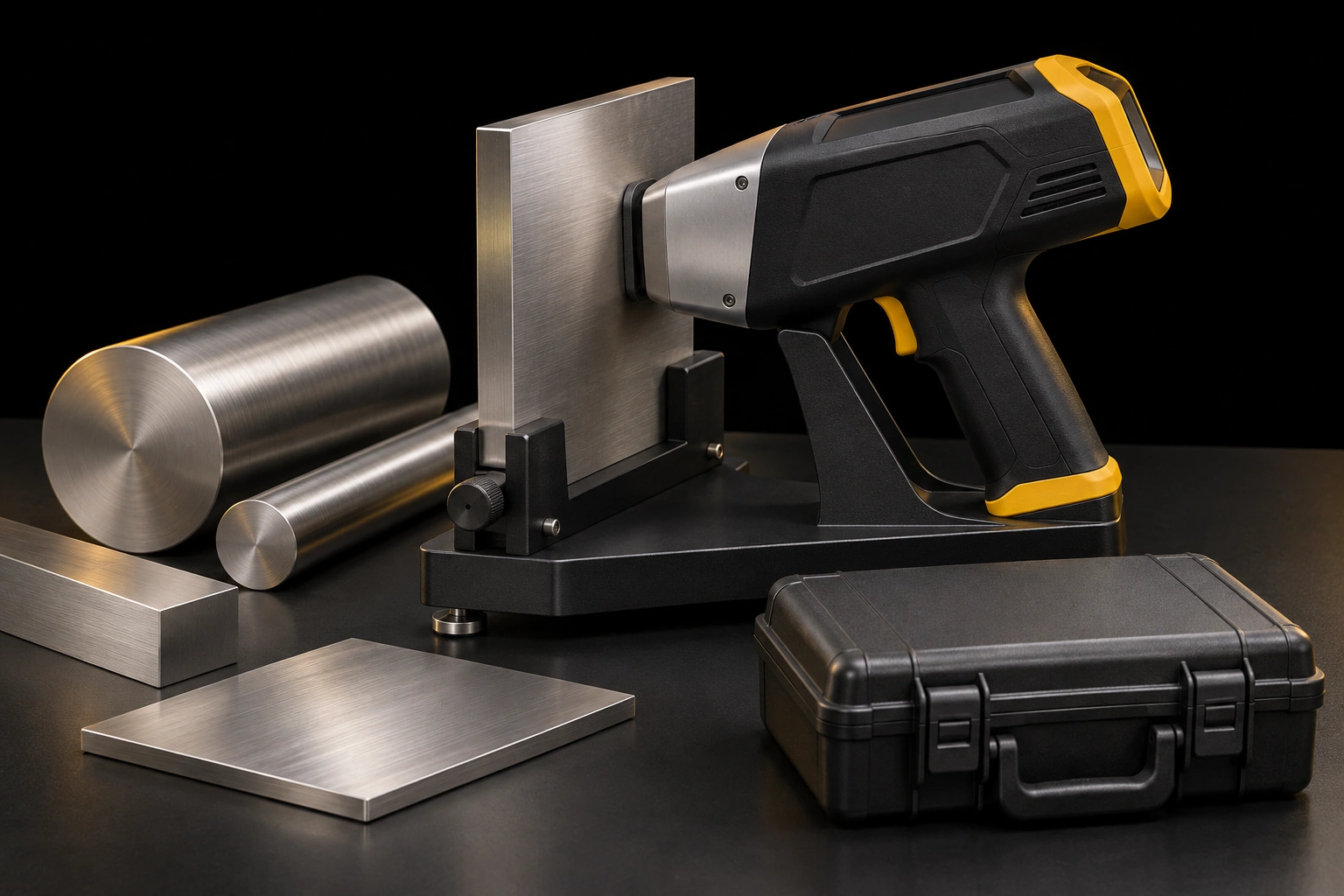
AI illustration. Appearance and labels do not verify material compliance.
Can XRF identify titanium grades?
XRF can support identification of titanium alloy families and detect many material mix-ups, but ordinary handheld XRF cannot verify every titanium grade requirement. Its result depends on the elements the instrument can measure, the method, calibration, sample geometry and surface condition. A displayed grade name is a software match to measured information, not a complete material acceptance certificate.
The key limitation is especially important for commercially pure titanium grades and ELI claims. Oxygen, nitrogen, hydrogen and carbon are outside the direct measurement capability of ordinary handheld XRF. A result consistent with titanium or Ti-6Al-4V therefore does not by itself establish CP Grade 1 versus Grade 2, or Grade 5 versus Grade 23. Appropriate laboratory evidence and traceability are needed to close those questions. [1][2][3]
01 / Scope and evidence
Define the question before choosing the instrument
Positive material identification, or PMI, is an inspection objective. X-ray fluorescence, or XRF, is one analytical technique that can contribute to it. Other methods may be required when the question depends on elements or properties outside XRF’s demonstrated capability. Writing “PMI required” without a defined objective leaves room for different interpretations.
Useful objectives include screening mixed stock for a wrong alloy family, checking measurable alloying elements against a defined requirement, investigating a certificate mismatch or designing a verification plan for unidentified material. These are not the same task. The evidence adequate for rapid sorting may be inadequate for final release under a demanding product specification.
Buyer question
What XRF may contribute
What still needs review
Is this titanium or a clearly different alloy family?
Fast elemental screening
Test validity and connection to each item
Does the alloy contain the expected measurable additions?
Results for supported elements and ranges
Limits, uncertainty and unmeasured elements
Is commercially pure stock Grade 1, 2, 3 or 4?
Partial chemistry information
Required interstitials, properties and documentation
Is Ti-6Al-4V stock ELI material?
Support for the broad alloy family
Required low-interstitial evidence and full specification
Does the part meet the entire order?
One contribution to material verification
Condition, properties, dimensions, processing and traceability
Inspection planning diagramWhat ordinary handheld XRF can support
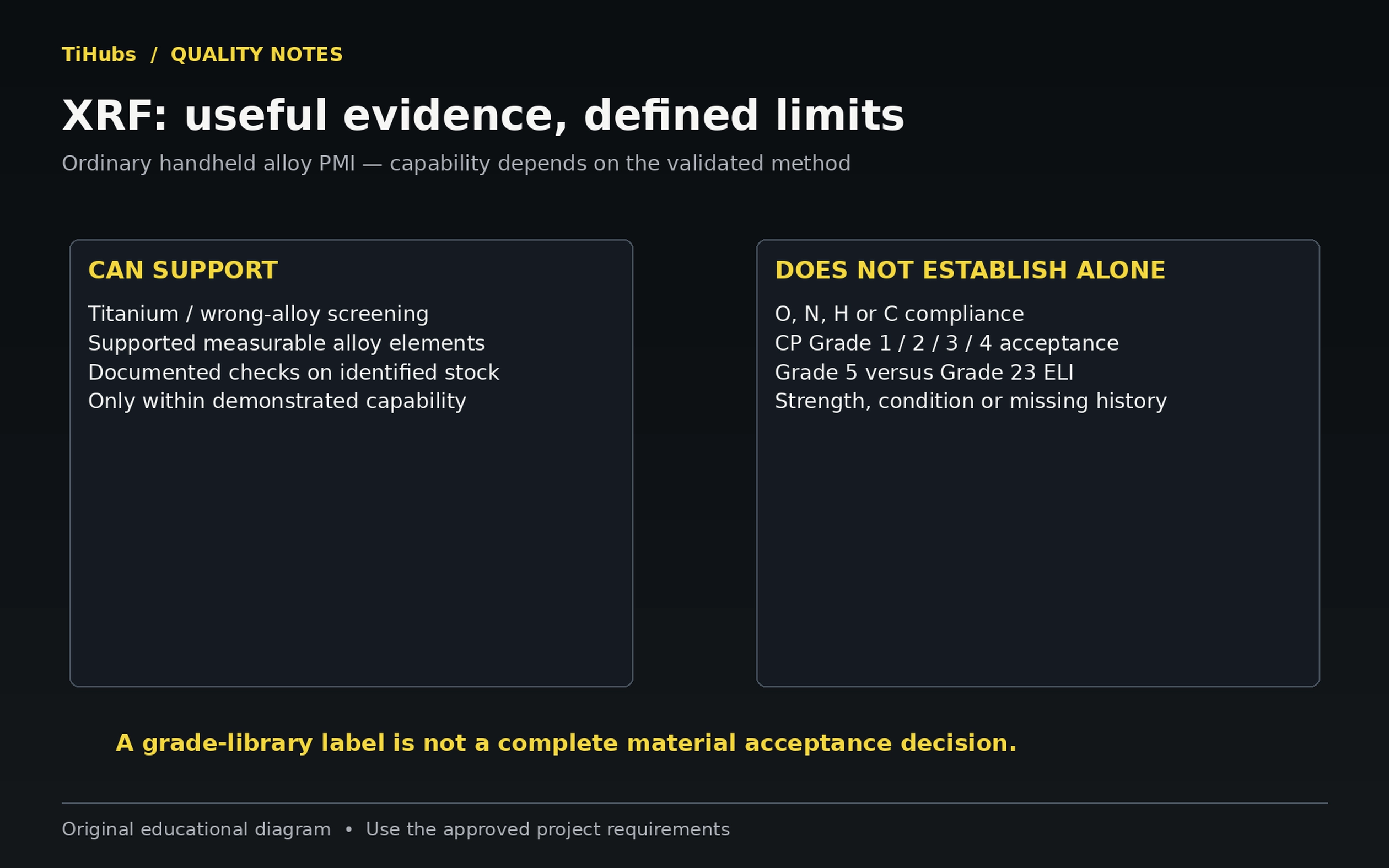
Original explanatory diagram. A library match does not establish unmeasured chemistry, properties or history.
02 / Measurement basis
Separate measured values from the grade-library label
An analyzer reports elemental information and may compare it with a grade library. Review the actual reported elements, values, units and uncertainty or quality indicators, together with the selected mode and measurement conditions. The grade name can be convenient, but it should not hide a missing element or a marginal result.
Evident’s manufacturer guidance describes the elemental-range limitation of handheld XRF and explains that elements lighter than magnesium are not directly measured by the discussed technology. Aluminum and other lighter measurable alloying elements require suitable instrument capability and measurement conditions. Check the specific model, configuration and validated method rather than extending one instrument’s claims to all devices. [1]
The library is also a controlled part of the process. A name may depend on which grades are loaded, the library limits and the software’s match logic. If two candidate grades differ mainly in an unmeasured element, a confident-looking match does not supply the missing measurement. Retain the elemental results and method information, not just a screenshot of the grade name.
Ask the service provider what “pass” means. Is it a family identification, a comparison of selected measurable elements, or a formal decision against a complete requirement? The report should state the scope accurately. A narrow but well-supported conclusion is more useful than an expansive claim the method cannot demonstrate.
03 / CP titanium grades
Why CP titanium grades are a difficult case
Commercially pure titanium grades share titanium as the major constituent. Their requirements include controlled chemistry and mechanical properties that cannot all be established by a handheld XRF reading. Detecting titanium and a small amount of iron does not prove that every required interstitial limit and property requirement is satisfied.
Suppose a handheld report labels a bar “Grade 2,” while the order requires certified Grade 1 sheet for forming. Even before considering the product-form mismatch, the label cannot demonstrate the required oxygen, nitrogen, hydrogen or carbon evidence. Nor can it establish the sheet’s condition or ductility. The buyer needs a specification-based evidence review rather than a second screenshot using a different library setting.
Do not infer CP grade from color, density, magnet response or a simple shop-floor bend either. Such observations may help identify an obvious anomaly, but they do not replace the ordered chemical and mechanical acceptance criteria. The same principle applies to an apparently convincing XRF label: understand what was actually measured.
04 / Grade 5 and ELI
Why Grade 5 and Grade 23 require more than a family match
Grade 5 and Grade 23 are both associated with the Ti-6Al-4V family, while Grade 23 is an extra-low-interstitial designation within its applicable specification. A major-element match is therefore not enough to establish the ELI claim. The exact composition, condition and product requirements must be taken from the ordered specification, not a generic grade comparison.
An unidentified bar that gives an XRF result consistent with Ti-6Al-4V should not be relabeled Grade 23 solely on that basis. Review original source records and obtain suitable testing for required elements and properties where the approved verification plan calls for it. Even a complete new chemical analysis does not automatically recreate missing processing or traceability history.
For medical or other controlled applications, raw-material acceptance is only one part of the approval chain. Do not describe XRF or a material certificate as approval of a finished implant or device. The responsible design and quality authorities determine the applicable material, manufacturing and finished-component requirements.
Illustrative product viewMatch measurements to the identified stock
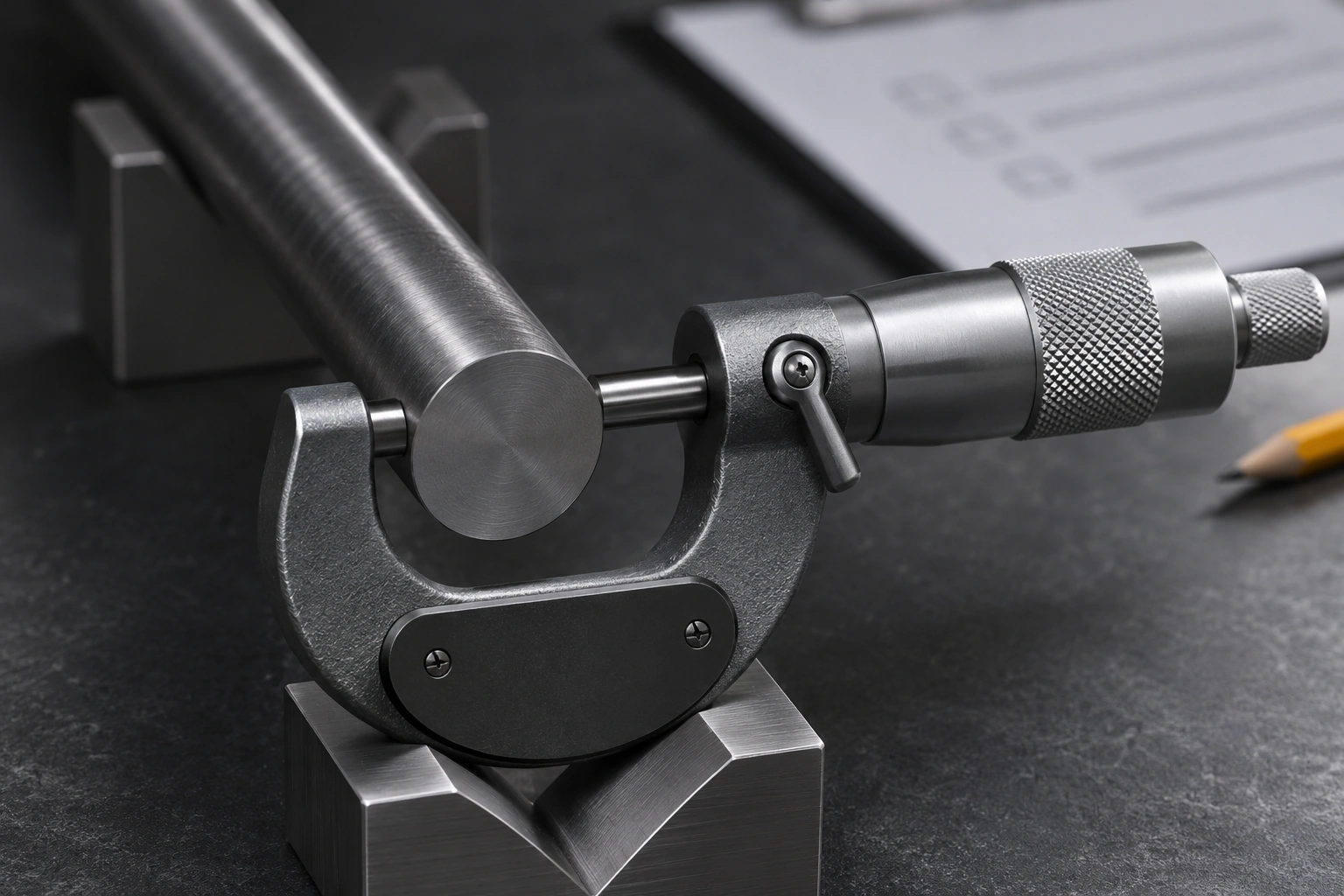
AI illustration; not a factory, inspection or compliance record. Keep instrument results connected to the relevant piece or product lot.
05 / Other titanium alloys
What about palladium-bearing or other titanium alloys?
An alloying addition may provide useful discrimination when the instrument can measure it with adequate performance at the required concentration. That does not justify a universal claim that every handheld analyzer can verify every palladium-bearing titanium grade. Confirm the actual detection and quantification capability, calibration, reference materials and uncertainty around the acceptance range.
When a concentration lies near a requirement boundary, the decision rule matters. A displayed value is not infinitely precise. Establish how uncertainty, rounding and any repeat measurements will be handled before accepting the result. A measurement provider should be able to explain the basis of the comparison and the limitations of the test.
The same approach applies to aluminum, vanadium, molybdenum, nickel and other relevant additions. Do not assume that because an element appears in the result table, the method is fit for the specific contractual limit. Verification requires suitable performance in the actual titanium matrix, concentration range and sample configuration.
06 / Sample and surface
Surface, curvature and access can change the reading
Prepare and present the sample according to the approved method and equipment instructions. Coatings, contamination, oxide layers, roughness or poor contact can affect the relationship between the measured surface and the material being assessed. Document the condition of the test location and any permitted preparation so the report is interpretable.
Curved tubing, narrow wire, small parts and thin sections need special consideration. The measurement spot may not be fully covered, and the geometry may differ from the validated calibration arrangement. The operator should use a method suitable for the sample rather than forcing a flat-plate procedure onto every product form.
Sample issue
Question for the testing provider
Coated or contaminated surface
Does the approved preparation expose representative material?
Small diameter or strong curvature
Is the measurement geometry validated for this product?
Thin material or small piece
Is thickness/spot coverage adequate for the method?
Mixed surface treatments
Which location represents the acceptance question?
Suspected local contamination
Is local screening being distinguished from bulk chemistry?
Operator qualification and radiation controls should follow the equipment instructions and applicable local requirements. A buying guide is not an operating procedure for an X-ray instrument. Request the provider’s controlled method and competence evidence rather than improvising field operation from a product photograph.
07 / Laboratory methods
Choose complementary methods by the missing information
For oxygen and nitrogen in titanium, ASTM E1409 describes an inert-gas-fusion method. ASTM E1447 addresses hydrogen in reactive metals and alloys using inert-gas fusion with the specified detection approaches. Carbon can require an appropriate combustion-based analytical method. The laboratory must confirm method suitability, sample preparation and range for the ordered requirement. [2][3][4]
Spark OES, ICP-based methods or other laboratory techniques may be appropriate for specified metallic elements, depending on the method and titanium matrix. Do not assume that a method’s general name means it covers all required interstitials. Ask the laboratory to identify the exact elements, reporting limits, method validation and sample needs.
Evidence need
Typical route to discuss
Limit to keep visible
Measurable alloy-element screening
Validated XRF or another suitable elemental method
Covers only supported elements and conditions
Oxygen and nitrogen
Appropriate inert-gas-fusion analysis
Sample identity, preparation and method range
Hydrogen
Suitable reactive-metal hydrogen analysis
Sampling and handling can matter
Carbon
Appropriate validated carbon analysis
A generic PMI label does not provide this result
Mechanical properties
Relevant mechanical testing
Chemistry alone does not establish strength or ductility
Heat treatment or product history
Controlled manufacturing records and specified tests
A new chemistry report cannot recreate missing history
Illustrative product viewUse suitable laboratory methods for missing chemistry
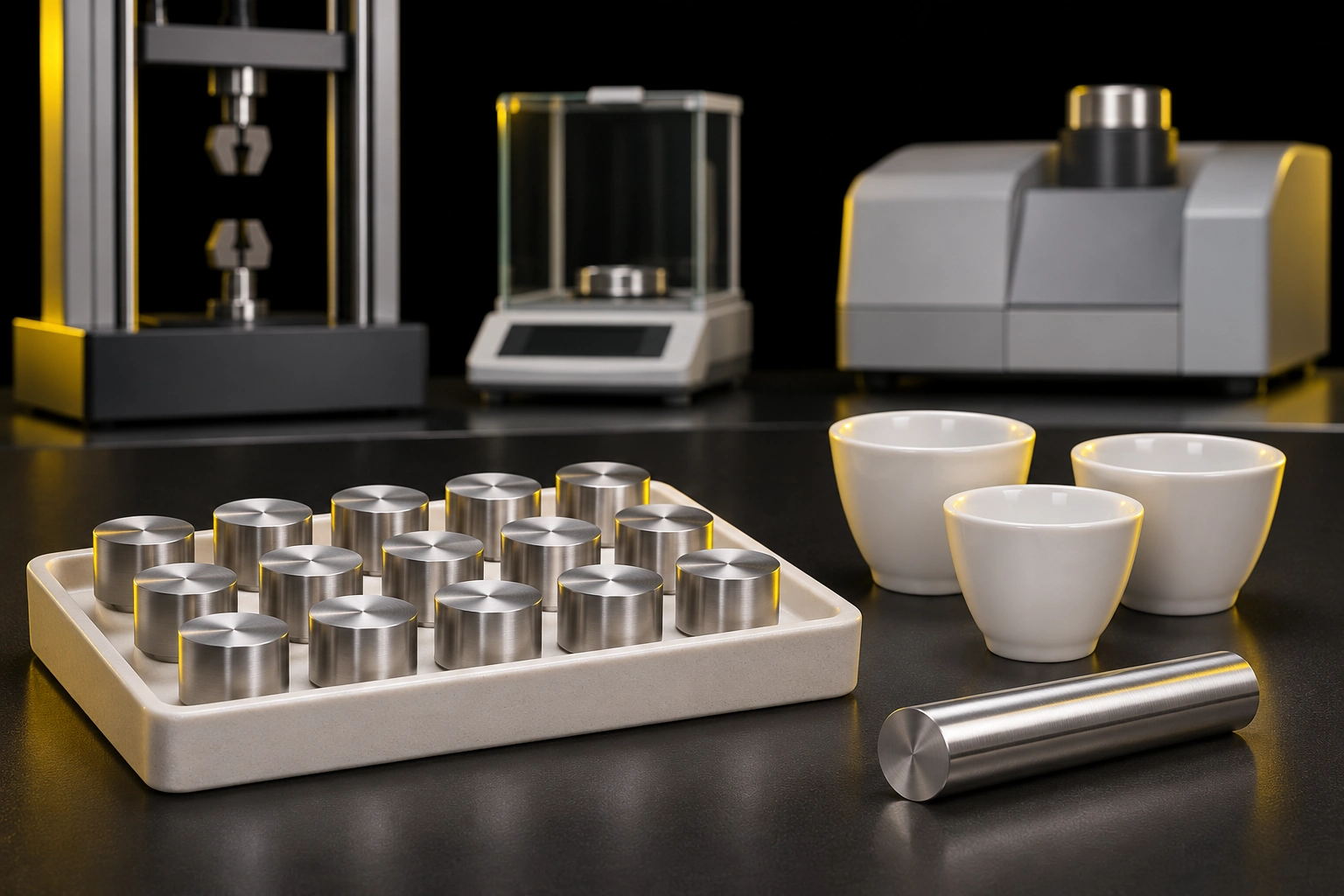
AI illustration; not a factory, inspection or compliance record. Confirm the actual method, sample preparation, matrix and measurement range.
08 / Sampling plan
Make the sampling plan match the risk
Define the population being accepted: a heat, product lot, bundle, individual piece or finished component batch. Then decide what is tested, how locations are selected and how results are linked to that population. A measurement on one convenient piece cannot support an undocumented claim that every item in a mixed shipment was checked.
If the purpose is to find mix-ups, a sample-based plan and a piece-by-piece plan provide different information. The buyer should agree coverage based on the risk, order requirements and available traceability. Do not use “100% PMI” without stating whether it means every piece, every bundle or some other unit and which locations are examined.
For destructive laboratory testing, agree sample selection, size, location, preparation, witness requirements and chain of custody. Mark the parent stock and sample so the relationship remains clear after cutting. Retain records of rejected or unused samples where the plan requires them. A laboratory result is only as useful to shipment acceptance as its documented connection to the material.
09 / PMI reports
What should a useful PMI report contain?
A usable report identifies the test objective and the actual scope of the conclusion. It records the tested item or population, sample location, date, operator, instrument identification, method/mode and relevant calibration or verification information. It should preserve actual elemental results and explain any exclusions or limitations.
Include the acceptance source: standard edition, grade, drawing or agreed screening rule. Identify which required elements were not measured. Where the report states conformity, the decision basis should be clear. The presence of a laboratory accreditation logo does not establish that every requested test is within scope; confirm the relevant activities and methods in the laboratory’s accreditation scope when accreditation is required. [5]
NIST’s traceability guidance also cautions against treating measurement traceability as a label detached from the result. A useful record connects the measurement to an appropriate reference through documented steps and uncertainty. For the buyer, the practical question is whether the reported measurement is suitable for the acceptance decision, not merely whether a sticker is present. [6]
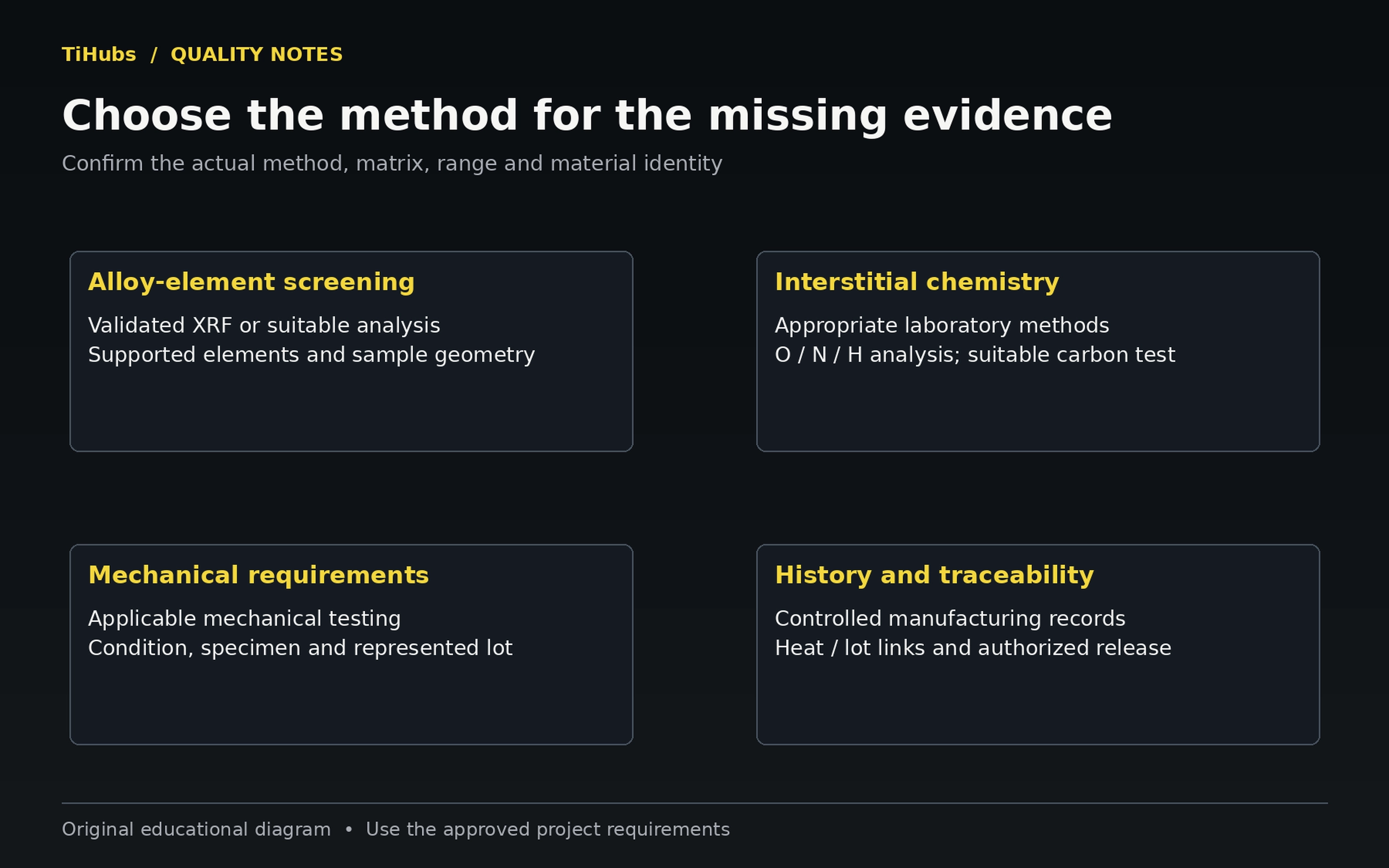
Inspection planning diagramMatch each question to suitable evidence
Original explanatory diagram. Elemental screening, interstitial analysis, properties and history need different evidence.
10 / Worked example
Worked case: two screenshots both say Ti-6Al-4V
A buyer receives two bar lots, one ordered as Grade 5 and one as Grade 23. The supplier provides XRF screenshots showing a Ti-6Al-4V match for both. These results can support a broad alloy-family check, but they do not establish which lot satisfies the ELI requirement.
The review should retain the two lot identities, compare their original certificates with the ordered product specifications and identify the missing interstitial evidence. If supplementary laboratory analysis is needed, sample each relevant population under an agreed plan. Review condition, properties and traceability as separate requirements rather than declaring the problem solved by chemistry alone.
If the original lot link is missing, do not relabel material from the more favorable test result. The authorized quality review must determine whether an approved requalification route is possible or whether replacement is required. Record the exact scope of any disposition so that a limited decision does not become a blanket claim about unrelated stock.
11 / Order requirements
Write a verification requirement that can be priced
Specify the identification objective, product and quantity, target grade and standard edition, sampling coverage, required elements, reporting limits where relevant, acceptance rule and report format. State whether testing must occur before cutting, after processing, before packing or at receiving. Add witness or hold points before the supplier schedules testing.
Ask for a proposed test matrix with three columns: requirement, method and evidence. A gap becomes obvious when a required element has no suitable method or a test result has no material identity. TiHubs can coordinate this review with suppliers and testing providers, while the buyer retains the agreed technical acceptance authority.
12 / Build your checklist
Build a titanium verification brief
Use the checklist to describe the suspected mix-up or grade question, stock identity, required elements and acceptance basis. State what existing certificate and test evidence is available. The generated brief can be copied or submitted for a proposed verification scope.
Build your inspection and acceptance checklist
Choose the product and add the information you have. Copy the resulting brief or send your requirements to TiHubs. Submitting an enquiry does not place an order.
13 / FAQs
Titanium XRF and PMI FAQs
Can handheld XRF tell titanium from stainless steel?
It can often distinguish clearly different alloy families using measured elemental composition, provided the instrument, sample presentation and method are suitable. Record the result and item identity.
Can XRF prove Grade 2 rather than Grade 1?
Not by itself. Required interstitial chemistry and mechanical properties cannot all be established by ordinary handheld XRF. Use the complete specification and appropriate supporting evidence.
Can XRF prove that Grade 5 is Grade 23 ELI?
No. A Ti-6Al-4V family match does not establish the low-interstitial requirements or the complete product acceptance basis for Grade 23.
Does every XRF instrument measure aluminum equally well?
No. Capability depends on instrument configuration, calibration, method and sample conditions. Confirm performance for the actual titanium alloy and required limits.
Is an XRF grade-library match a material certificate?
No. It is an interpretation of measured information. A material acceptance decision also needs the ordered requirements, unmeasured items and traceability to be addressed.
Does laboratory testing restore a missing heat history?
Testing can supply new evidence for the identified sample and approved scope. It does not automatically recreate lost manufacturing or traceability records.
Is one test per bundle enough?
Only if the applicable requirements and agreed sampling plan support that coverage. Define the acceptance population and risk before choosing the number of tests.
What is the best first step for unknown titanium stock?
Segregate and identify the stock, gather available source records and define the intended acceptance question. Then agree a suitable verification or requalification plan before assigning a grade.
14 / Key takeaways
Use the method for the question it can answer
Treat XRF as evidence about measured elements, with defined capability and limits.
Do not use an alloy-family label to establish CP-grade or ELI compliance.
Add suitable laboratory methods, property evidence and records where the requirement needs them.
Preserve sample identity, coverage and the acceptance decision rule in the report.
Technical references
Technical references and scope
This guide concerns ordinary handheld XRF used for alloy PMI. Specialized laboratory systems and other analytical techniques require their own capability assessment. Workflows and cases are illustrative purchasing guidance.
TiHubs coordinates titanium materials and custom supply from Baoji, China. Our founder’s 20 years in titanium inform a specification-led sourcing approach: clarify the product, manufacturing and acceptance requirements before quotation. Learn about our sourcing role.
Contents
TiHubs
Talk to TiHubs
Ask about titanium materials, grades or custom parts.
Enter your email to start chatting.
We use your email to respond to your enquiry. Your conversation is stored on this website.
Our team is away right now. Leave your enquiry and we will follow up by email.