AI illustration; not a production or inspection record.
Quick answer
Neither gas nor plasma atomization is a universal quality guarantee. Identify the actual route, compare lot-specific chemistry and physical measurements using compatible methods, and qualify the powder with the intended machine and post-processing route. Evaluate cost per accepted output, including qualification and controlled reuse, before approving a substitution.
01 / Understand the routes
Start with the actual powder-making process
Gas-atomized versus plasma-atomized titanium powder is a useful sourcing question when a buyer is qualifying a second source, investigating unstable builds or comparing a premium powder with a lower quotation. It becomes misleading when the production-route label is treated as a complete quality specification. The purchase must connect the offered lot to a defined machine, process and finished-part requirement.
This guide focuses on titanium alloy powder for laser powder bed fusion, commonly abbreviated LPBF or L-PBF. Its purchasing framework is not a validated parameter set for a printer. Electron beam powder bed fusion, directed energy deposition and other processes have different feedstock and qualification needs; a successful LPBF comparison should not be transferred to them without review.
Ask what the supplier means by gas atomization
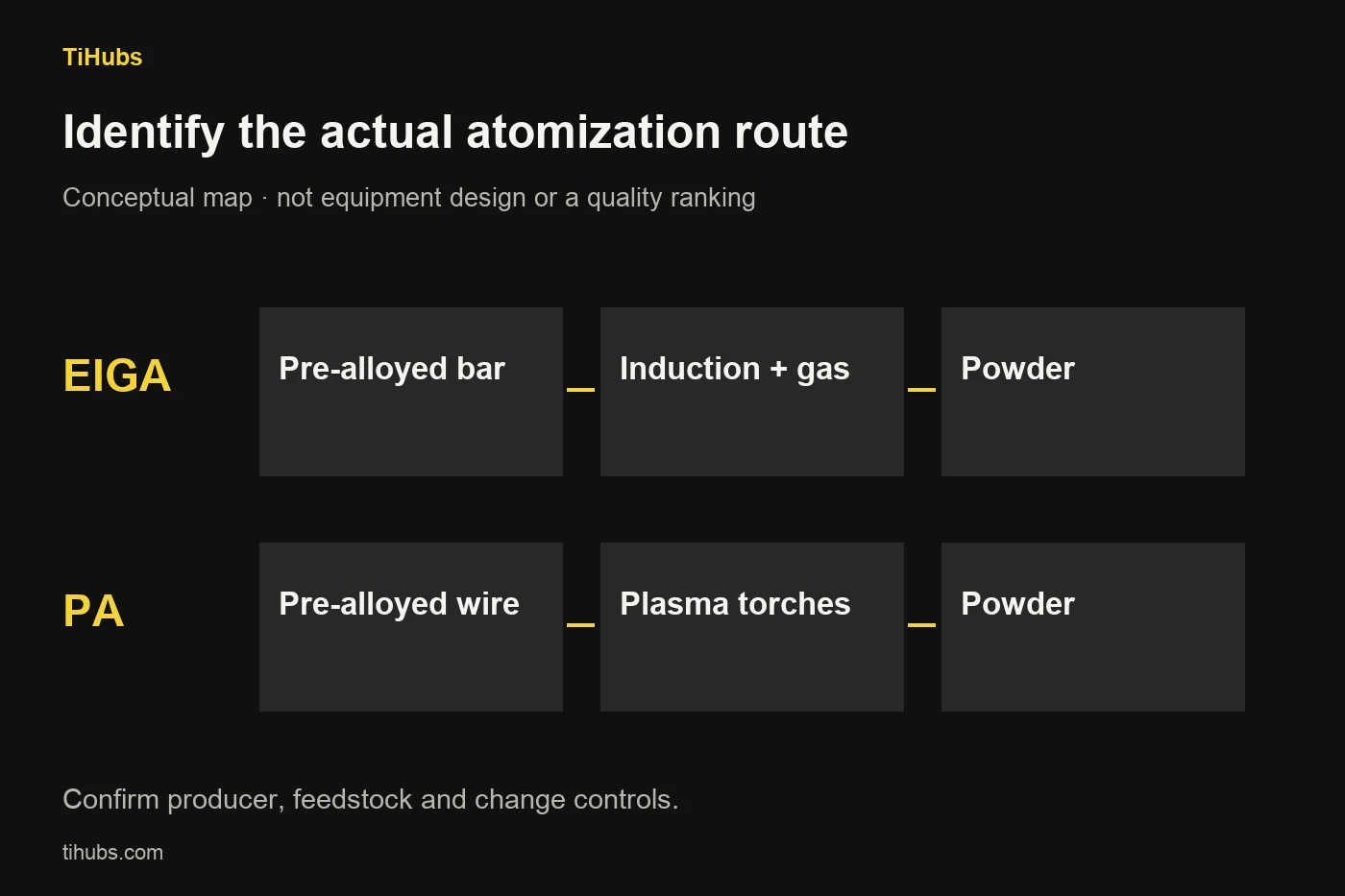
Electrode inert gas atomization, or EIGA, melts pre-alloyed bar by induction and breaks the molten stream into droplets with gas. In wire-fed plasma atomization, plasma torches convert pre-alloyed wire into droplets. These route descriptions are documented in Carpenter Additive’s comparison. EIGA is a specific gas-atomization route, not a synonym for every process sold under the broader GA label.
Write the actual route in the enquiry and confirm it in the supplier’s response. If the vendor changes producer, feedstock preparation or atomization route while retaining a commercial product name, decide whether your approval remains valid. A stable sales description does not necessarily mean an unchanged manufacturing route.
Likewise, the word plasma can describe different operations. Do not assume that wire-fed plasma atomization, plasma spheroidization of existing particles and a plasma rotating electrode process are interchangeable. Ask for a concise manufacturing-route declaration identifying the starting feedstock and the operation that forms the powder. You do not need proprietary equipment settings to establish this basic identity.
Separate a route restriction from a performance requirement
A customer drawing or qualified production plan may mandate a particular source or route. In that case, meeting a few powder tests does not authorize a substitution. Identify the party responsible for approving the change and the evidence it requires. If the route is open, define measurable acceptance requirements so competing offers can be evaluated on the same basis.
Consider two original purchasing scenarios. A production line with a locked material approval needs a controlled substitution study before accepting a cheaper alternative. A development team without an established source can compare candidate powders within a planned process study. The first task protects an existing qualification; the second establishes one. Their schedules, sample quantities and commercial risks differ.
Neither scenario is resolved by declaring one route universally superior. A supplier should provide evidence for the actual powder offered, including the lot identity and test basis. The buyer should explain the intended application and acceptance route. This exchange turns a broad marketing comparison into a reviewable sourcing decision.
Industrial buying guide / 01Specify the route behind the powder label
Conceptual process map: EIGA uses bar feedstock, while the illustrated PA route uses wire. This is not equipment design or a quality ranking.
02 / Shape, pores and measurements
Compare measurements that describe the same thing
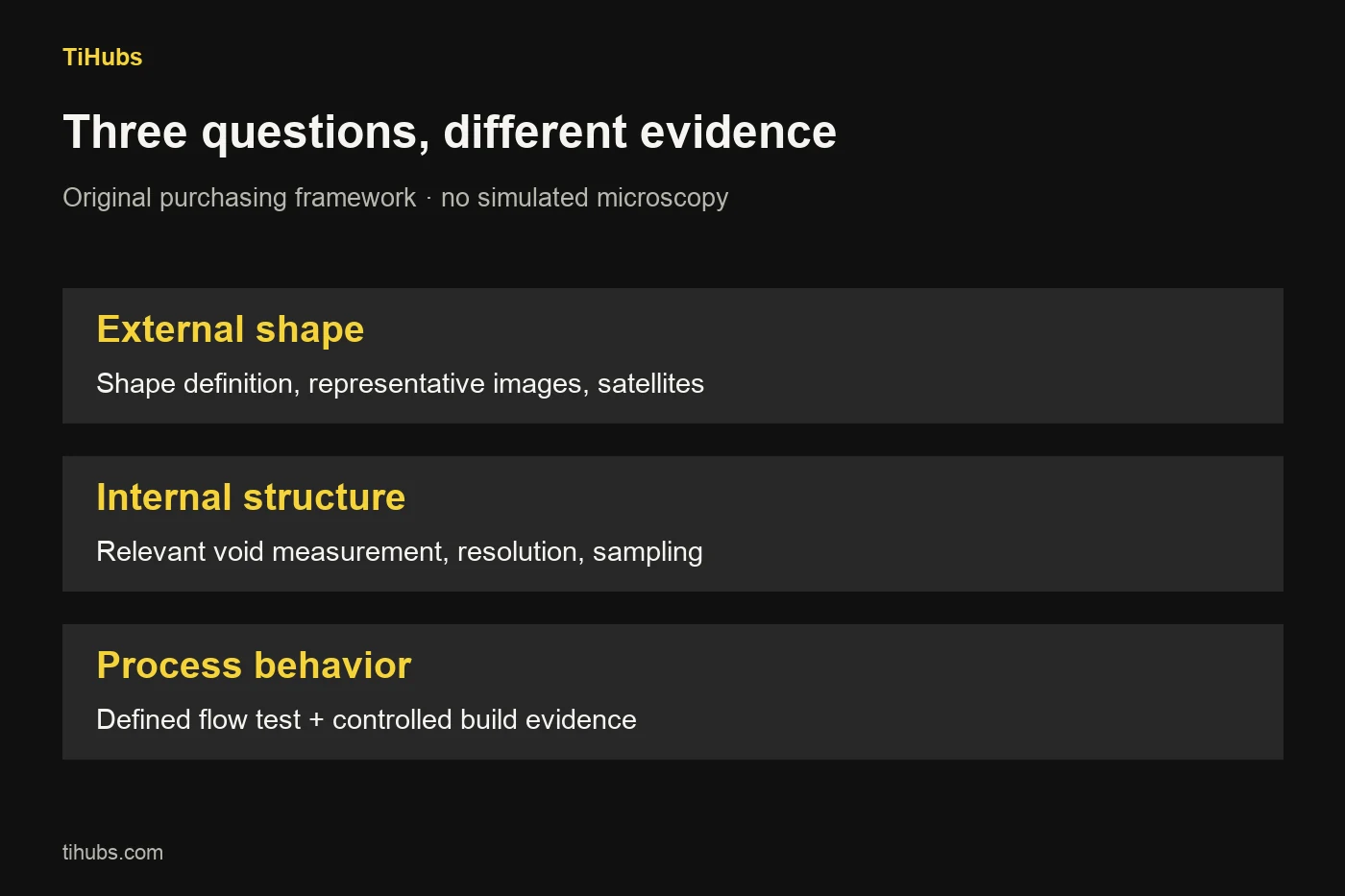
Start the physical comparison with particle-size distribution, shape, satellites or attached particles, agglomeration, internal porosity and powder behavior under relevant test conditions. A photograph of round particles is useful context, but it does not quantify every characteristic. A smooth external surface cannot, by itself, demonstrate the absence of internal voids.
Published data illustrate why the method and sample matter. Brika and Brailovski’s 2020 study compared two Ti-6Al-4V lots using micro-CT, examining approximately 15,000 particles per sample. Selected sphericity values from their Table 2 are reproduced below. The quantities are dimensionless; a sphere has a value of one under the study’s definition.
Two study lots, not route-wide guaranteed properties
Ask whether a reported shape statistic comes from a two-dimensional projection or a three-dimensional reconstruction. Record the definition, instrument, sample preparation and reporting basis. Two results both called sphericity may not be directly comparable. Do not rank suppliers by the largest number until the methods and particle populations are understood.
Request representative fields or distributions rather than a single attractive image. Establish how attached particles and overlapping particles are treated. A result based only on particles the software can easily separate may describe a different population from one that includes agglomerates. The report should make those choices visible enough for the buyer’s technical team to interpret them.
For internal porosity, identify the question being answered. Bulk density, apparent density, tapped density, particle density and a CT-derived internal-void fraction are not interchangeable labels. Ask the laboratory which void spaces its measurement includes and what its resolution can detect. A result should not be advertised as zero porosity simply because the chosen method did not resolve a defect.
Use flow tests as part of a process-relevant comparison
A flow result must retain its test method, mass, conditioning and reporting units. Seconds for one funnel procedure cannot be compared directly with a different apparatus or a dynamic rheology metric. A no-flow result is an observation under that procedure, not a complete diagnosis of how the powder will behave in every recoating system.
NIST’s powder-characterization research uses complementary physical and chemical techniques rather than a single universal quality number. Its studied alloys were stainless steel and cobalt-chrome, so this is a measurement lesson, not titanium-specific acceptance data. For titanium procurement, agree on the methods that support your particular qualification.
Keep the size-distribution comparison consistent as well. A nominal size cut does not prove identical distributions, fines content or oversize tails. Use the separate titanium powder particle-size distribution guide for that detailed review, then bring its results into the route comparison. Avoid attributing a difference to atomization alone when size distributions also changed.
Industrial buying guide / 02Separate external shape, internal structure and process behavior
Original evidence map. One photograph or one flow result cannot answer every powder acceptance question.
03 / Chemistry and reuse
Preserve the link from incoming powder to reused material
Specify the alloy and applicable chemical requirements explicitly. Ti-6Al-4V and Ti-6Al-4V ELI should not be treated as interchangeable order descriptions. Confirm which product or process specification governs the purchase and which additional buyer limits apply. A certificate for wrought feedstock is useful traceability but is not automatically the complete acceptance record for the final powder.
Ask for actual lot analysis rather than nominal composition alone. Identify the sampled material, laboratory method, units and reporting date. Review the required elements together; an acceptable oxygen result does not establish every chemistry requirement. Where the certificate reports a detection limit or an inequality, retain that wording instead of converting it into an exact value.
Sampling determines what the result represents
Define the commercial lot, production batch and container relationship. One shipment may contain several production lots, while a single production lot may be divided into multiple containers. The certificate and sampling plan should explain how the reported analysis represents the material being delivered. A sales order number alone may not provide that technical relationship.
For an incoming comparison, agree how a representative sample is obtained and divided between laboratories if independent testing is needed. Do not assume a convenient scoop from the top of a container represents every part of the lot. Preserve sample identity, handling history and retained material so an unexpected result can be investigated without guessing which powder was tested.
Separate contamination introduced before delivery from changes during your own handling and processing. If an issue appears after a build, compare retained incoming samples, intermediate records and the recovered powder. Without that sequence, the investigation can incorrectly blame atomization for a change introduced during storage, machine operation, recovery or mixing.
A reuse count is not a complete exposure history
Record whether powder is virgin, recovered, blended or supplied under another agreed condition. For reused material, document the relevant build and recovery history, sieving, additions of virgin powder and the identity of blended lots. Two containers marked third reuse can have different proportions of previously exposed material and different process histories.
An original mass-balance example shows the limitation of an average. Mixing 20 kg at 0.10% oxygen with 80 kg at 0.15% gives a calculated weighted mean of 0.14%, assuming no losses, no added oxygen and complete mixing. This arithmetic is not a measured result, a recommended blending recipe or an acceptance limit. It does not establish local homogeneity or the chemistry of a subsequently printed part.
Use that distinction when reviewing a supplier’s reuse claim. A calculated average can support inventory accounting, but it cannot replace the agreed sampling, testing and qualification evidence. Do not approve blending merely to turn an unfavorable result into an acceptable-looking spreadsheet value. The authorized material-control plan must govern reuse and disposition.
Define what triggers review: a changed supplier lot, an unexpected chemistry trend, altered recovery equipment, a deviation from the qualified handling process or a change to the blend policy. The triggers should be specific enough to act on. A fixed universal number of permitted reuse cycles is not established by the route name alone.
For packaging and handling, request the supplier’s current safety data and storage instructions, compatible with the receiving facility’s approved powder-management procedures. Keep container identification intact through subdivision and return to storage. This is part of preserving material condition and traceability, not a substitute for site-specific handling controls.
04 / From powder to part
Qualify the powder, machine and processing combination
Powder acceptance and finished-part qualification answer different questions. The first establishes whether the incoming feedstock meets its defined requirements. The second establishes whether a controlled manufacturing route produces the required part. A powder can pass its incoming tests while still requiring different processing settings from the material already approved on a machine.
In the 2020 Brika and Brailovski comparison, both lots used parameters optimized for the gas-atomized powder. That limits any route-wide performance conclusion. A 2026 study by Hatch and colleagues examined two commercial powders over six builds and identified a need for separate optimization and/or post-processing when substituting its GA powder for PA powder. Neither study establishes a universal winner.
Design the comparison around the actual change
If the goal is a drop-in substitution, first test the candidate under the approved process and define what equivalence means. If the goal is to develop a new optimized route, allow controlled parameter development and record the resulting process separately. Do not present an optimized new route as evidence that an unchanged process can accept any powder.
Keep relevant variables identifiable: powder lot, machine configuration, parameter revision, layer strategy, build layout, atmosphere records, heat treatment, hot isostatic pressing if used, machining and surface finishing. A comparison that changes several of these together can still be useful, but its conclusion belongs to the complete route rather than atomization alone.
Use specimens and features representative of the qualification question. A machined tensile specimen may answer a strength question while leaving as-built surfaces, thin walls, internal channels or fatigue-sensitive features unresolved. Select the required evidence through the component’s engineering and quality plan. Avoid adding tests simply to make a report look extensive, but do not omit a relevant failure mode because another result is favorable.
Look across the build, not only at one convenient coupon
Establish specimen locations and orientations before printing. Record where each specimen came from and preserve that map through post-processing and testing. A passing coupon from one location does not automatically describe every region of a large build. The required spatial coverage depends on the qualified process and part application, rather than a generic number copied from a supplier brochure.
Plan repeats so the comparison can distinguish a consistent result from an isolated successful build. State the number of lots, builds and specimens, how failures will be handled and which acceptance rules apply. Averages can conceal individual failures or position-dependent differences. Report the relevant individual results and variation when the qualification requires them.
Also define the final inspection state. A result after machining or HIP should not be presented as an as-built result. If post-processing is necessary to obtain acceptance, include it in the route, cost and lead time. An additional operation may be a legitimate solution, but it is not free evidence that the original routes were equivalent.
Approve a bounded source change
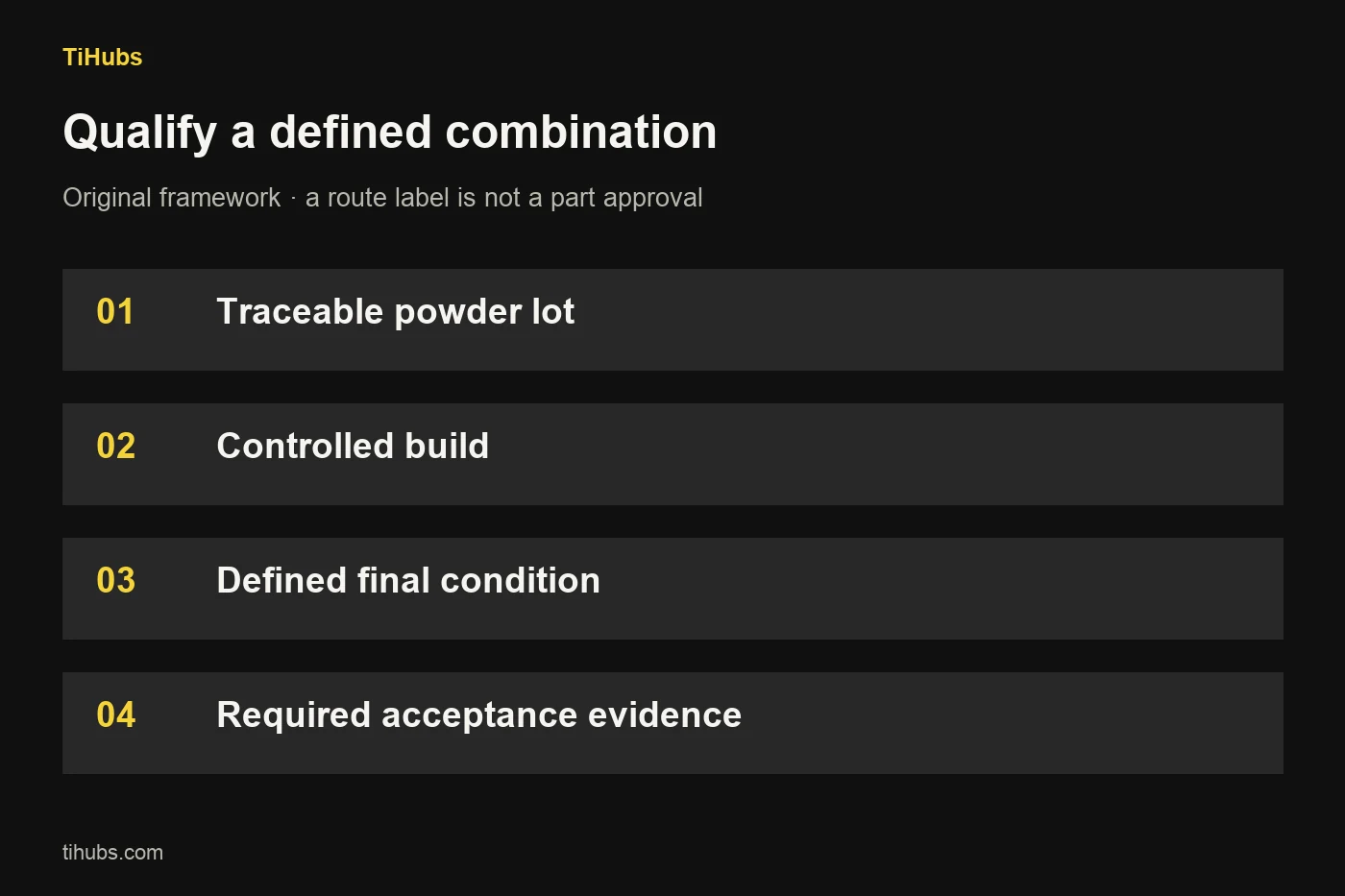
The approval record should identify what was qualified and what remains outside scope. State the powder specification, producer and route, applicable lot controls, process revision and relevant part family or geometry limits. Define which future changes require review. This is more useful than an unrestricted statement that all gas-atomized powder is now interchangeable with all plasma-atomized powder.
For the broader manufacturing decision, see 3D-printed versus CNC-machined titanium. Here, the decision remains within powder sourcing: can this specific alternative support the required manufacturing outcome with an acceptable qualification and control burden?
Industrial buying guide / 04Approve a defined powder and manufacturing combination
Original qualification framework connecting a traceable lot, controlled build, final condition and acceptance evidence.
05 / Cost per accepted output
Normalize the commercial comparison before selecting a route
Price per kilogram is a quotation input, not the final manufacturing cost. Compare the amount of powder consumed, qualified recovery, accepted output, processing time, inspection, post-processing and the cost of introducing the alternative. Keep these terms separate so a lower powder price does not conceal an added operation or reduced accepted yield.
Use a consistent accounting period or production campaign. Powder still available for approved reuse at the end of that period is inventory, not necessarily consumed material. Powder removed from qualified use is a different category. Do not count recoverable stock as both a cost loss and an inventory asset, or credit its recovery twice.
A transparent break-even calculation
For a deliberately simplified original example, let c be powder purchase cost per kilogram and y be accepted output kilograms divided by purchased kilograms, after the chosen inventory adjustment. The powder-only cost per accepted kilogram is c/y. This is an accounting model, not an observed performance difference between atomization routes.
Hypothetical normalization, with no market prices or route assignments
Input or result
Candidate A
Candidate B
Purchased mass assigned to campaign
100 kg
100 kg
Accepted output on the defined basis
80 kg
72 kg
Accepted mass fraction y
0.80
0.72
Powder-only cost per accepted kg
cA / 0.80
cB / 0.72
On this assumed basis, B breaks even on powder-only cost when cB equals 0.90 times cA. It would need a 10% lower purchase price to offset the assumed output difference. This does not predict that either gas or plasma powder has that yield. Replace the assumptions with qualified production data and include all other cost differences before making a sourcing decision.
Add one-time qualification cost separately and allocate it across a justified production quantity. If future volume is uncertain, show more than one volume case. A saving calculated over an optimistic lifetime order can disappear when only a small trial quantity is actually purchased. Keep the commercial forecast distinguishable from a committed order.
Review supply continuity as well. Ask about lot size, repeat-order consistency, documentation timing and notification of manufacturing changes. A second source may have value even when immediate unit cost is similar, but that value depends on an alternative that is technically approved and actually available. An unqualified quotation does not provide the same resilience.
06 / RFQ and acceptance
Turn the comparison into a clear supplier enquiry
Send the exact alloy, intended AM process, machine family where relevant, required particle-size basis, quantity and application category. State whether the route is mandated, open for comparison or proposed as a substitution. Attach the applicable powder specification and identify the party responsible for process approval.
Request the actual producer and atomization route, lot-specific chemistry, physical-characterization methods and results, certificate format, packaging and traceability arrangements. Ask what is included in the offer and what requires separate testing. A supplier should distinguish available evidence from a test it proposes to arrange after an order.
Define sample and production stages. An evaluation sample should be traceable to its lot, with a clear statement of whether later production material will come from the same lot or a separately controlled source. A successful hand-picked sample does not, by itself, establish repeatability of routine deliveries.
Agree on receiving checks and discrepancy handling before shipment. Identify document hold points, retained samples, independent laboratory arrangements and the procedure for conflicting results. Quarantine or hold an unresolved lot under the buyer’s quality system rather than mixing it with approved inventory and losing the ability to investigate.
TiHubs can review a titanium powder enquiry against the stated alloy, process and documentation needs. Confirm the available atomization route, size range, lot evidence and qualification support for the specific offer. This page does not imply that every powder route is stocked or that TiHubs has qualified a particular customer’s printer or finished component.
Make the final decision traceable to the question that started the comparison. If the objective was lower cost, retain the accepted-output calculation and qualification burden. If it was continuity, retain the approved substitution scope. If it was quality improvement, retain the measurements that address the original defect. A route label is useful context; the controlled evidence is what makes the purchase defensible.
07 / Build your RFQ
Prepare a titanium powder comparison enquiry
Describe the powder, process and approval question. Separate incoming-material requirements from the evidence needed to qualify a new source on your production route.
Information to include
Alloy and applicable powder specification
AM process, machine family and substitution scope
Size distribution, chemistry and physical test methods
Sample lot, production lot, reuse and traceability requirements
Quantity, packaging, documents and approval schedule
Build your RFQ checklist
Choose the product and add the information you have. Copy the resulting brief or send your requirements to TiHubs. Submitting an enquiry does not place an order.
08 / FAQs
Questions buyers ask
Is plasma-atomized titanium powder always better?
No universal conclusion follows from the label. Compare the actual lots, measurement methods and qualified manufacturing routes. A study on two commercial powders does not establish guaranteed properties for every supplier or every process using those atomization routes.
Is EIGA the same as all gas atomization?
No. EIGA identifies a specific electrode inert gas atomization route. Ask the supplier to declare the actual powder-making process and starting feedstock rather than relying on a broad gas-atomized description. Treat a route change according to your approved source-control requirements.
Can a higher sphericity number prove better printed parts?
Not by itself. First verify how sphericity was measured and which particles were included. Then assess the complete powder and process combination. Shape data do not replace chemistry, relevant defect characterization or the required finished-part qualification.
Can I substitute powder without changing printer settings?
Only when the applicable approval process supports that substitution. A drop-in comparison and a separately optimized process study answer different questions. Define the intended change and acceptance criteria before testing, and include any necessary post-processing in the approved route.
How many times can titanium powder be reused?
The route name does not establish a universal count. Use the approved material-control plan, relevant exposure and blending history, sampling, testing and process evidence. A reuse number alone does not describe the condition or composition of the actual powder inventory.
Which price should I compare?
Start with purchase price but normalize to accepted output on a consistent inventory basis. Include qualification, processing, inspection, post-processing and unusable material. The arithmetic example in this guide is hypothetical and does not assign a yield or price advantage to either route.
09 / Key takeaways
Keep the purchase requirements connected.
Identify the actual route, including whether GA means EIGA.
Compare equivalent measurement methods and representative lots.
Keep incoming chemistry and reuse history traceable.
Qualify powder together with machine and processing conditions.
Select on accepted-output economics and bounded approval evidence.
Technical references
Sources and data scope
References reviewed November 15, 2026. Public source summaries support the discussion; the controlled specification, agreed edition and approved project requirements govern acceptance.
TiHubs coordinates titanium material and custom supply enquiries from Baoji, China. Send the product, drawing revision and acceptance requirements so the proposed supply scope can be reviewed. Learn about our sourcing role.
Contents
TiHubs
Talk to TiHubs
Ask about titanium materials, grades or custom parts.
Enter your email to start chatting.
We use your email to respond to your enquiry. Your conversation is stored on this website.
Our team is away right now. Leave your enquiry and we will follow up by email.