A nominal size range or one D50 value leaves important questions unanswered. Connect the distribution, test method and lot evidence to your approved process.
AI illustration; not a production or inspection record.
Quick answer
Specify titanium powder particle size distribution as a measured requirement: identify the distribution basis, agreed method, D10, D50 and D90 where relevant, and separate limits for undersize and oversize fractions. Link the report to a defined lot and sampling plan. PSD alone does not establish chemistry, flow, cleanliness or qualification for a particular machine and finished component.
01 / Purchase task
Define what the powder must support before choosing a size label
A buyer may encounter titanium powder described by an alloy name, a nominal range and a process label. Those three descriptions help identify a candidate, but they do not form a complete acceptance specification. Begin with the intended manufacturing route and the requirements already approved by the process owner. Establish whether the enquiry concerns a development trial, replacement feedstock for an existing route or a repeat order against an established baseline.
For a repeat order, identify the material specification, revision and relevant process qualification. For development work, state which variables remain open and what a sample evaluation must determine. A supplier should not have to infer that an attractive quotation for a similar nominal range permits a change in alloy, production route or powder history. Separate alternatives from the requested baseline so the technical team can review them deliberately.
Keep feedstock acceptance separate from component approval
Matching a powder description does not prove that a finished component will meet its drawing. Powder characteristics are inputs to a manufacturing route that also includes equipment, controlled processing and subsequent operations. Ask for the feedstock evidence needed by that route, while retaining the relevant responsibility for process and part validation. Avoid turning a general compatibility statement into a guarantee for every machine, geometry and service requirement.
The buyer also needs to define the supply state. Identify whether the order requires unused powder, a documented blend or another specifically approved condition. A report for the original manufactured powder may not describe material after recovery, handling or blending. If an alternative state is proposed, ask for its identity, history and applicable acceptance evidence. Do not allow an undefined reuse description to replace a controlled requirement.
Start with the real commercial decision
The immediate decision is often whether two quotations are technically comparable. One may quote a nominal size band with a generic datasheet; another may include lot-specific size measurements, chemistry and additional tests. These are different evidence packages. List what is included, what is reported without a limit, and what is actually guaranteed under the proposed order. A reported result and a contractual acceptance requirement serve different purposes.
Use the titanium powder supply page to describe the intended material and the information available. An enquiry can remain useful even when the technical team has not finalized every parameter. Mark unresolved fields explicitly and request a review of the proposed supply scope. This produces a more meaningful response than asking for the smallest possible particles or the lowest price per kilogram without explaining the approved application.
02 / Percentiles
Read D10, D50 and D90 on an identified distribution basis
A percentile describes a point in a distribution, not an absolute particle-size boundary. On a volume basis, Dv50 is the diameter below which half of the measured particle volume lies; Dv10 and Dv90 identify the corresponding ten-percent and ninety-percent points. HORIBA’s explanation distinguishes volume, number and surface-area reporting. Preserve that distinction when requesting data instead of treating every value called D50 as directly comparable.
The same median can hide different widths
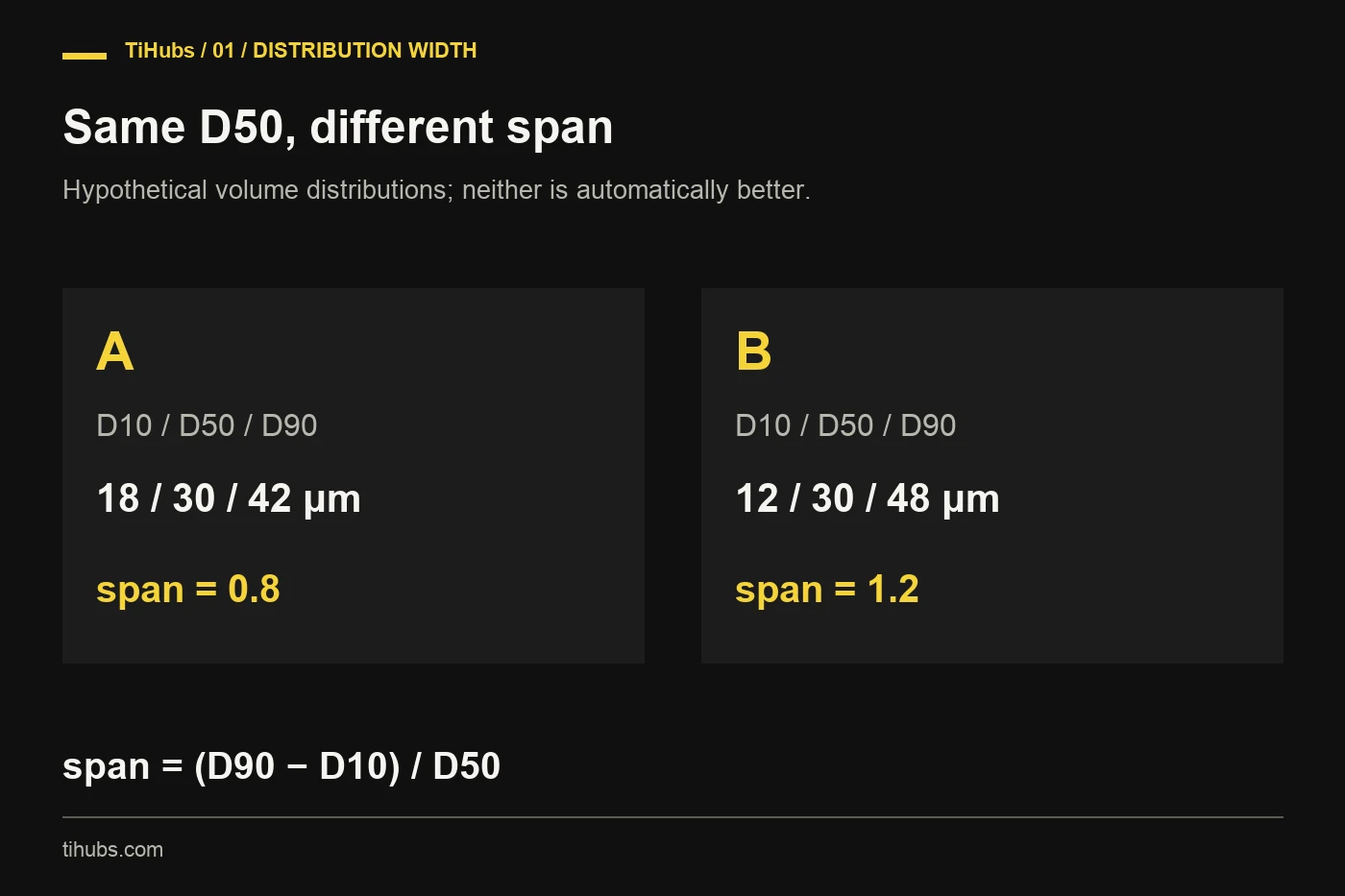
Consider two hypothetical volume distributions. Powder A has D10 = 18 μm, D50 = 30 μm and D90 = 42 μm. Powder B has D10 = 12 μm, D50 = 30 μm and D90 = 48 μm. Both have a median of 30 μm. Using span = (D90 − D10) ÷ D50 gives 0.8 for A and 1.2 for B. These illustrative values show that the same median can accompany a different distribution width.
The calculation does not prove that A is better. The process may require a particular distribution and evidence that it performs consistently within a qualified route. A narrower distribution is not automatically the optimum for every purpose. Use the comparison to identify a difference that a one-number quotation would conceal, then ask whether that difference falls inside the approved material specification.
Number and volume answer different questions
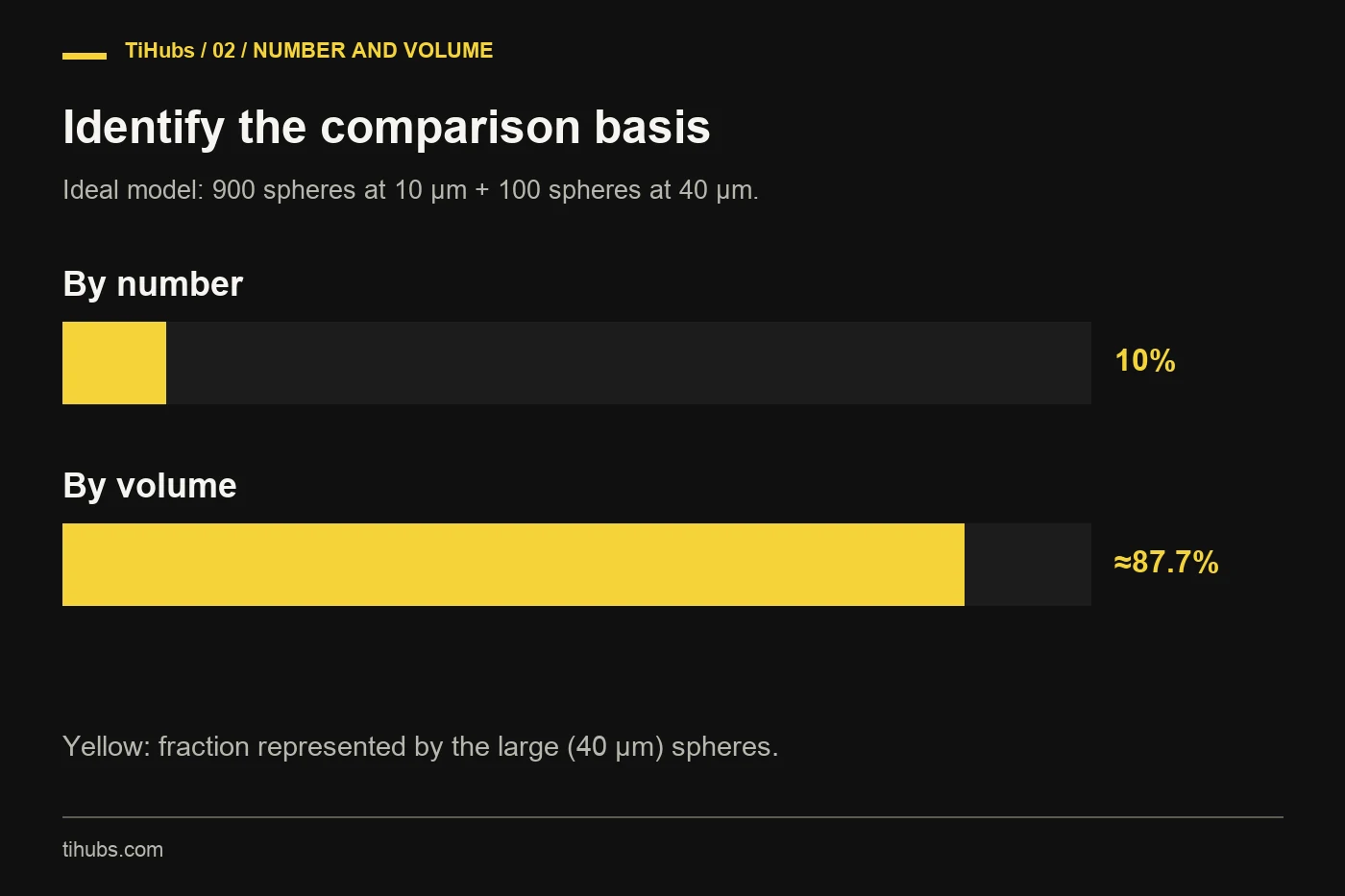
Imagine an idealized population containing 900 spherical particles of 10 μm diameter and 100 spherical particles of 40 μm diameter. The larger particles account for only 10% of the particle count. However, each larger sphere has 4³ = 64 times the volume of a smaller one. Their combined volume share is 6,400 ÷ (900 + 6,400), approximately 87.7%. This deliberately simplified example is not a real powder measurement.
In that discrete model, a number-weighted median falls at 10 μm while a volume-weighted median falls at 40 μm. Neither is an error: they summarize different quantities. Real instrument results require the appropriate measurement model and reporting conventions; the calculation is not a license to convert an arbitrary reported distribution by a shortcut. Ask the laboratory to identify the basis and retain the original result.
A percentile is not a maximum
A D90 of 45 μm does not say that every particle is no larger than 45 μm. It locates a cumulative percentile on the stated basis. If the process has an oversize restriction, specify the permitted fraction above the relevant threshold, the measurement method and the acceptance rule. Likewise, a D10 value does not replace a separate requirement controlling a fine-particle fraction.
When comparing reports, retain units and notation. A missing basis, an unexplained mean or a size value copied without its test context can make a technically precise number commercially ambiguous. Ask whether the quotation describes a nominal product family, a typical result or the actual offered lot. That question is especially useful when a catalogue interval and a laboratory percentile appear to disagree.
Industrial buying guide / 02One median, two distribution widths
Hypothetical volume distributions: A has D10/D50/D90 = 18/30/42 μm and span 0.8; B has 12/30/48 μm and span 1.2. Neither is automatically better.
03 / Methods and tails
Write the tail requirements and the measurement method together
A size range on a product label is shorthand whose meaning needs to be established. It may describe a screening classification, a nominal commercial family or a combination of limits measured by different techniques. Ask the supplier to explain the designation rather than interpreting the lower and upper numbers as guarantees that no particles exist outside them. Put the intended acceptance requirements into the order in measurable terms.
Keep mass fractions and volume fractions visible
Carpenter Additive’s PowderRange Ti64 datasheet separately identifies sieve-based mass fractions, light-scattering volume fractions and reported percentiles. It also lists flow and apparent-density measurements independently. This manufacturer example illustrates how a powder description can contain several distinct measurement bases. Its numerical limits and process guidance are not TiHubs specifications and should not be copied into an unrelated purchase.
For each required characteristic, record the threshold, permitted fraction, units, method and applicable edition. For example, a hypothetical order could require an oversize result to be expressed as a mass fraction retained above an agreed sieve threshold. Another characteristic might be a fine fraction reported by an approved light-scattering procedure. Do not rewrite one as the other simply because both outputs use a percentage sign.
Align the laboratory procedures before arguing about results
Identify the approved method, sample preparation and reporting convention. Where the selected technique requires choices about dispersion, analysis settings or calculation models, those choices need a controlled laboratory procedure. Procurement does not need to invent the operating procedure, but it does need to know whether the supplier and receiving laboratory are applying comparable methods. A disagreement can otherwise reflect different definitions of the measured quantity.
Ask for the report elements needed to interpret the result: sample identity, date, method reference, distribution basis, required percentiles and specified tail values. If the complete distribution curve is necessary to evaluate the qualified baseline, request it in a usable form. A screenshot containing only a median may omit the information that the process team actually needs to assess a proposed change.
Set a rule for borderline results
Suppose an entirely hypothetical fine-fraction limit is 5.0% on the agreed basis, and a laboratory reports 4.9% with a stated uncertainty that extends across the limit. The numerical result alone does not define how conformity will be declared. Agree the applicable decision rule and its treatment of uncertainty before receipt. Do not assume that every near-limit result must automatically pass or fail under all contracts.
Define how a disagreement will be reviewed, including retained samples and any agreed referee laboratory procedure. Repeatedly selecting the most favorable test result is not a controlled acceptance method. Preserve the original results, sample identities and reasons for any repeat measurement. A transparent review can identify sampling differences, a procedural mismatch or an actual material issue without silently changing the purchased requirement.
Industrial buying guide / 03Ten percent by count can dominate volume
Idealized spheres: 900 particles at 10 μm and 100 at 40 μm. The larger particles are 10% by count but approximately 87.7% by volume. Not a real powder measurement.
04 / Sampling and lots
Make the sample represent a defined supply lot
A precise instrument result can still answer the wrong purchasing question if the sample is not connected to the supplied material. Define the production lot or batch represented by each report, the containers included and the approved sampling plan. The relationship between the tested portion and the delivered quantity matters as much as the number of decimal places in the result. Do not treat an unidentified test sample as evidence for an unlimited quantity of powder.
Separate sampling from repeated measurement
Measuring one prepared specimen several times can provide information about that measurement sequence. It does not, by itself, show that several containers have equivalent distributions. Distinguish independent sampling from instrument repeats and record which one the report describes. If the purchase requires evidence across containers or a defined blend, select a sampling plan that addresses that question rather than merely increasing the number of readings on one specimen.
The actual sampling and subdivision procedure should be established by qualified personnel for the material and site. Request the relevant method reference and the traceability of retained portions. Avoid improvising powder handling to obtain a convenient sample. The supplier’s safety data sheet and the facility’s approved handling procedures belong with the delivery information, while the purchasing specification identifies the evidence required for acceptance.
Make blending and changes visible
If the offered material is a blend of identified batches, state how the final blend is defined and tested. Two parent reports are not automatically a report for the final blend. Percentile diameters cannot generally be combined by taking a simple arithmetic average. If two equal masses have D50 values of 25 and 35 μm, that alone does not establish a blend D50 of 30 μm; the complete distributions and the final material need appropriate evaluation.
Require notification of changes relevant to the approved baseline, such as a production route, supply state, specification revision or agreed classification procedure. The controls should be proportionate to the application. A repeat order should not silently become a new development project because the commercial product name remained unchanged while the underlying supply condition changed.
Preserve identity after opening or subdivision
At receiving, connect each container to the delivery lot and report. Record any damaged closure or discrepancy through the agreed review process before releasing the material. If the buyer divides a container or transfers powder into another approved system, preserve the connection to its original identity. Later process observations are difficult to investigate when the relevant feedstock history has been lost.
Agree retention and document availability where they matter to the project. A useful record identifies what was supplied, what was tested, which requirement applied and who released it. It need not contain every possible laboratory measurement. Select the evidence that supports the actual purchase decision, then keep that evidence traceable through the intended manufacturing workflow.
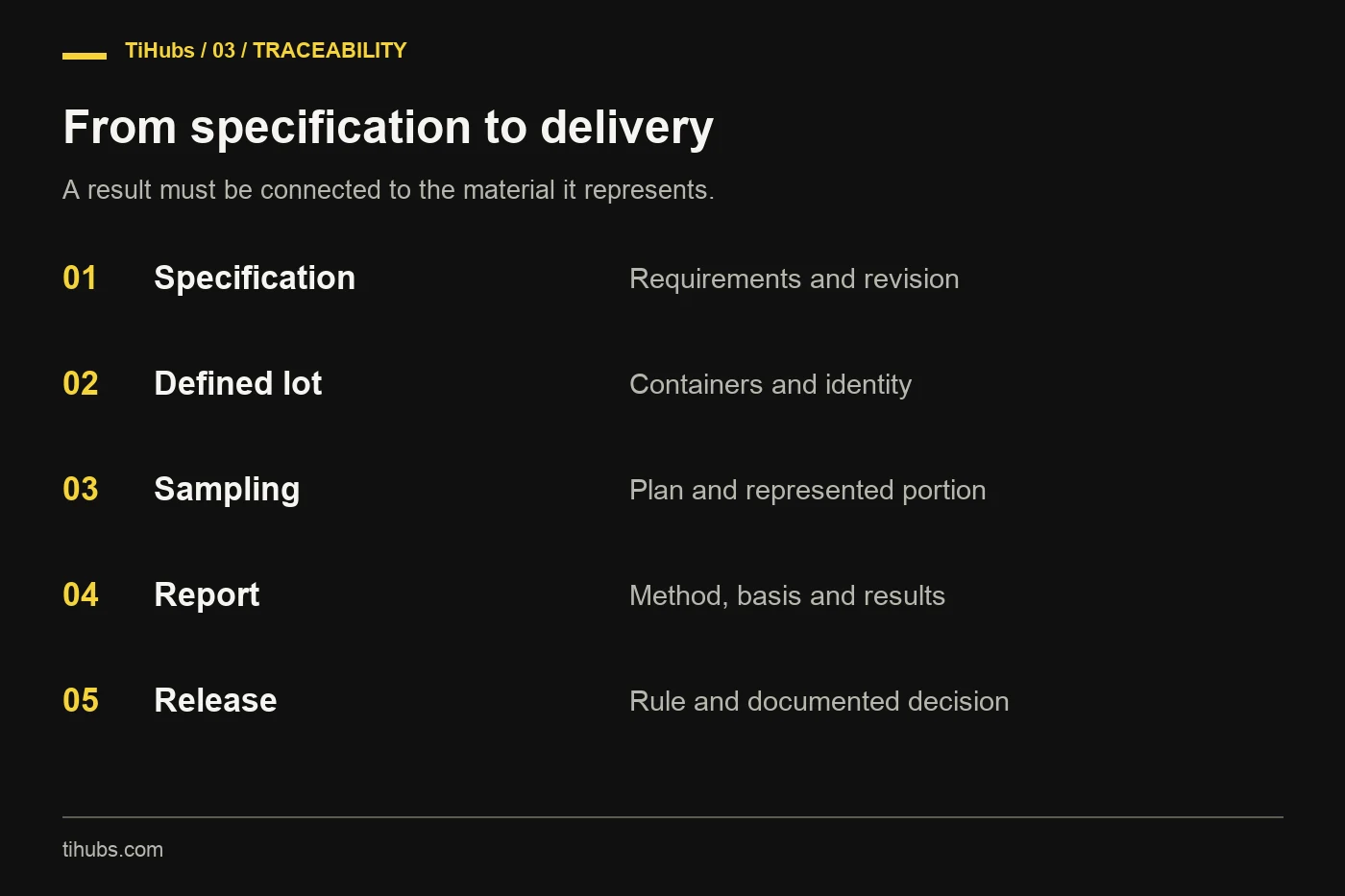
Industrial buying guide / 04Connect requirements to the delivered material
An acceptance record connects the approved specification, defined lot, sampling procedure, laboratory report and release decision. Instrument repeats do not replace representative sampling.
05 / Beyond PSD
Do not ask the size distribution to prove unrelated properties
PSD is one part of powder acceptance. Chemistry, contamination controls, morphology and the physical tests required by the approved process remain separate questions. A powder can match an agreed set of percentiles while differing in another relevant characteristic. Build a requirement matrix that identifies each characteristic, its applicable limit or reporting requirement, the method and the evidence expected for the offered lot.
Keep alloy identity and interstitial requirements explicit
State the material designation and the specification controlling composition. If the application requires particular restrictions on oxygen or other constituents, retain the approved limits and evidence rather than relying on a broad titanium-alloy label. Do not infer chemistry from particle appearance or from a PSD report. The relevant chemical analysis must be linked to the accepted supply scope and material identity.
Similarly, specify the physical tests the process owner actually requires. Apparent density and a flow-test result have their own procedures and meanings. They should not be estimated from D50 or replaced by a photograph of apparently spherical particles. If a powder does not produce a reportable result under a selected method, the report should explain that outcome rather than substitute an undocumented number from another technique.
Use images within their actual scope
Microscopy can support agreed observations about particle shape or visible features, but one selected image is not automatically a quantitative acceptance record for an entire lot. Define the sampling and evaluation procedure if morphology is part of acceptance. Ask how the images relate to the tested lot and which criteria are being assessed. The enlarged particle artwork in this article is illustrative and provides no inspection evidence.
Keep the distinction between a supplier datasheet and a lot certificate. A datasheet can describe a product family and typical characteristics. A certificate identifies the actual supply and the results or declarations required by the order. Neither should be read beyond its stated scope. TiHubs’ material certificate guide explains the importance of connecting documentary evidence with physical delivery.
Validate the proposed alternative at the right level
If a new supplier offers a powder with matching percentiles, review the complete acceptance specification and any process qualification requirements. Identify what can be established from incoming-material evidence and what needs a representative manufacturing evaluation. A promising trial does not erase untested requirements, while a material certificate cannot stand in for component-level validation. Record the actual scope of the approval.
This approach also improves quotation comparison. It reveals whether an apparently lower price excludes a required analysis, qualified supply condition or documentation step. Ask the supplier to itemize the proposed scope and deviations. The buyer can then compare technically aligned offers and make a commercial decision without assuming that similar particle-size labels describe identical products.
06 / RFQ and acceptance
Turn the technical discussion into a comparable quotation
Organize the enquiry into six items: material identity, intended process, PSD requirements, other acceptance characteristics, lot evidence and delivery. Include the specification revision and state whether the quotation is for trials or production. Attach the approved requirement table where available. If a parameter remains unresolved, label it for technical review instead of supplying an arbitrary value merely to complete a form.
Ask for an explicit compliance response
Request confirmation against each required item, with exceptions and proposed alternatives clearly identified. Separate values that the supplier will guarantee from typical or report-only information. Ask whether the price includes the agreed sampling, analysis, certificate and packaging. Identify any minimum order or lead-time assumption in the quotation without treating a general product-page statement as a commitment for the specific requirement.
Compare usable, accepted supply rather than price per kilogram alone. If one offer needs additional laboratory work, qualification material or a different delivery arrangement, include those items in the commercial comparison. Keep hypothetical cost calculations separate from actual quotes. The objective is to make the decision transparent, not to claim that a particular particle-size range is always cheaper or more economical.
Plan receipt before the shipment arrives
Agree the required documents, container identification and release steps. The receiving team should know which discrepancies require review and which characteristics will be checked under the sampling plan. Use the pre-shipment inspection checklist to align the documentary and physical checks with the ordered scope. An inspection report should identify its coverage rather than imply that every possible powder property has been verified.
The enquiry tool below collects a practical starting brief for TiHubs. Provide the alloy, intended process, distribution basis, percentile and tail requirements, other tests, quantity and destination. TiHubs can review the proposed supply scope and information needed for quotation. Final availability, capability, acceptance and delivery depend on the agreed order; the responsible process team retains approval of manufacturing and component performance.
Control the revision used for the comparison
When the technical team changes a limit after receiving quotations, issue the revised requirement to every supplier still under consideration. Record which revision each price and compliance response addresses. A cheaper quotation against an earlier, less demanding requirement is not a valid direct comparison with an updated offer. Retain the final accepted deviation list with the purchase order so receiving personnel do not have to reconstruct the decision from separate messages. This simple revision check also helps prevent a successful trial from being followed by a production order that accidentally refers to an obsolete powder description.
07 / Build your RFQ
Prepare a titanium powder PSD enquiry
Share the approved material and process baseline, then define the size-distribution evidence needed to compare the offered lots.
Information to include
Alloy, specification and revision; intended manufacturing route.
Unused or other approved supply state; lot and container requirements.
Distribution basis, D10/D50/D90 and separate tail limits.
Measurement procedure, sampling, uncertainty decision rule and other tests.
Quantity, packaging, documentation, destination and target date.
Build your RFQ checklist
Choose the product and add the information you have. Copy the resulting brief or send your requirements to TiHubs. Submitting an enquiry does not place an order.
08 / FAQs
Questions buyers ask
Does D90 mean maximum particle size?
No. It is a percentile on the stated distribution basis. It does not mean every particle falls below that diameter. If oversize material must be controlled, specify the relevant threshold, permitted fraction and measurement method separately.
Are two powders with the same D50 equivalent?
Not necessarily. Their distribution widths, tails, chemistry, morphology and other required characteristics may differ. Compare the complete agreed specification and actual lot evidence, then apply the relevant process qualification requirements.
Can mass percent and volume percent be compared directly?
Do not treat them as interchangeable labels. Identify how each quantity was obtained and use the approved comparison method. A percentage without its basis and test procedure is insufficient for a reliable acceptance decision.
Can the D50 values of two batches simply be averaged after blending?
The parent medians alone do not establish the blend median. The full distributions and the final blend require appropriate evaluation. Define the blend identity and sampling plan, and obtain the evidence required for that supplied material.
Does a passing PSD report qualify a powder for my machine?
PSD is only one input. The approved route may also require chemistry, physical tests, supply-history controls and manufacturing validation. A material report should not be treated as a universal machine or finished-component qualification.
What should I send with a powder RFQ?
Provide the alloy and specification, intended process, supply state, PSD basis and limits, other required tests, sampling and documentation, quantity and delivery destination. Mark unresolved requirements for review and request a clear response to any proposed deviations.
09 / Key takeaways
Keep the purchase requirements connected.
Define the manufacturing task and approved supply state.
Read percentiles on a stated distribution basis.
Specify tail fractions separately from D10, D50 and D90.
Connect methods and samples to a defined delivered lot.
Compare the complete acceptance scope before comparing price.
Technical references
Sources and data scope
References reviewed November 14, 2026. Public source summaries support the discussion; the controlled specification, agreed edition and approved project requirements govern acceptance.
TiHubs coordinates titanium material and custom supply enquiries from Baoji, China. Send the product, drawing revision and acceptance requirements so the proposed supply scope can be reviewed. Learn about our sourcing role.
Contents
TiHubs
Talk to TiHubs
Ask about titanium materials, grades or custom parts.
Enter your email to start chatting.
We use your email to respond to your enquiry. Your conversation is stored on this website.
Our team is away right now. Leave your enquiry and we will follow up by email.