AI illustration; not a production or inspection record.
Quick answer
F136 and ISO 5832-3 concern titanium material for implant manufacture, but their names do not establish automatic equivalence. Specify editions and whether both are required; review chemistry, mechanical and metallurgical evidence for the actual form and condition; and preserve lot traceability. A raw-material certificate does not establish finished-device performance, biological evaluation or regulatory authorization.
01 / Standards and editions
Similar alloy names do not establish interchangeable certification
An enquiry for medical titanium often lists ASTM F136 and ISO 5832-3 together. The buyer may need material certified to both, an alternative acceptable under either, or a specific standard already fixed by a device drawing. Those are different purchasing instructions. Resolve which one applies before asking a supplier to confirm equivalence.
This guide concerns raw material used in manufacturing, especially wrought stock and its certification. It does not select an implant for a patient or establish regulatory authorization for a finished device. The useful purchasing task is to connect the specified material requirements to a particular product, manufacturing condition, test record and traceable delivery.
Verified public identifiers and scope, checked November 2026
Item
ASTM F136
ISO 5832-3
Listed edition
F136-26
5832-3:2021, edition 5
Named alloy
Ti-6Al-4V ELI, UNS R56401
Ti-6Al-4V
Published material scope
Wrought, annealed alloy
Wrought alloy
Intended material use
Manufacture of surgical implants; this is not a finished-device approval statement
If both standards are mandatory, write that requirement unambiguously. A slash between two numbers can be interpreted differently by different suppliers. Specify the editions and require a documented conformity statement for both. If an alternative is allowed, identify who approves it and whether the proposed change affects a drawing, qualified manufacturing route or customer requirement.
If the existing drawing fixes an older edition, the appearance of F136-26 in the publisher’s catalogue does not automatically revise the drawing. The buyer’s technical and quality teams should review the contractual and program requirements. Record the approved edition at quotation and release, rather than allowing the supplier and receiver to apply different assumptions.
A supplier’s website may describe stock as Grade 23, Ti6Al4V ELI, implant grade or medical grade. Those terms help identify the intended material family but do not replace the required product certification. Ask which exact specification, edition, product form and condition are supported for the offered lot. A general product page is not a lot-specific acceptance record.
The same discipline applies to ISO 5832-3. Its alloy name alone does not establish that the offered stock meets every F136 ELI requirement. Conversely, a certificate naming F136 does not prove that a separate ISO order requirement has been assessed. Treat equivalence as a technical question to demonstrate, not a synonym supplied by a sales description.
Start the review with the exact deliverable: bar, wire, plate, forging stock or another defined form. State size and delivery condition. A comparison made for one form or section should not be copied to another without checking applicability. The standard number, material and physical product need to describe the same purchase.
02 / Chemistry and units
Review actual analysis, not only an ELI label
Chemical conformity begins with the applicable limits and the reported analysis for the correct material identity. Do not compare a certificate only with a familiar internet chart. Older editions, supplier-specific targets and other titanium product specifications can appear in tables carrying a similar alloy name. The controlled requirement must be the reference for accepting the order.
ELI means extra low interstitial, but that phrase is not a complete chemical specification. Review every required element and any applicable residual-element provisions. Passing one oxygen check does not demonstrate all chemistry requirements, and passing chemistry does not demonstrate all material requirements. Keep the chemical assessment as one defined part of the overall conformity review.
Distinguish limits, results and typical values
A manufacturer’s typical composition describes its product information; a specification limit defines a requirement; an actual analysis reports a measurement associated with the relevant heat or product. These three columns answer different questions. A certificate that prints only allowed ranges without actual results may not provide the evidence your purchase order requires.
Identify the analysis basis. ASTM’s public abstract distinguishes heat-analysis requirements from product-analysis tolerances; those tolerances do not enlarge the specified heat limits. Do not use an allowance intended for one type of analysis to excuse a result from another. The applicable edition and laboratory record should determine how the result is evaluated.
Normalize units without changing the acceptance rule
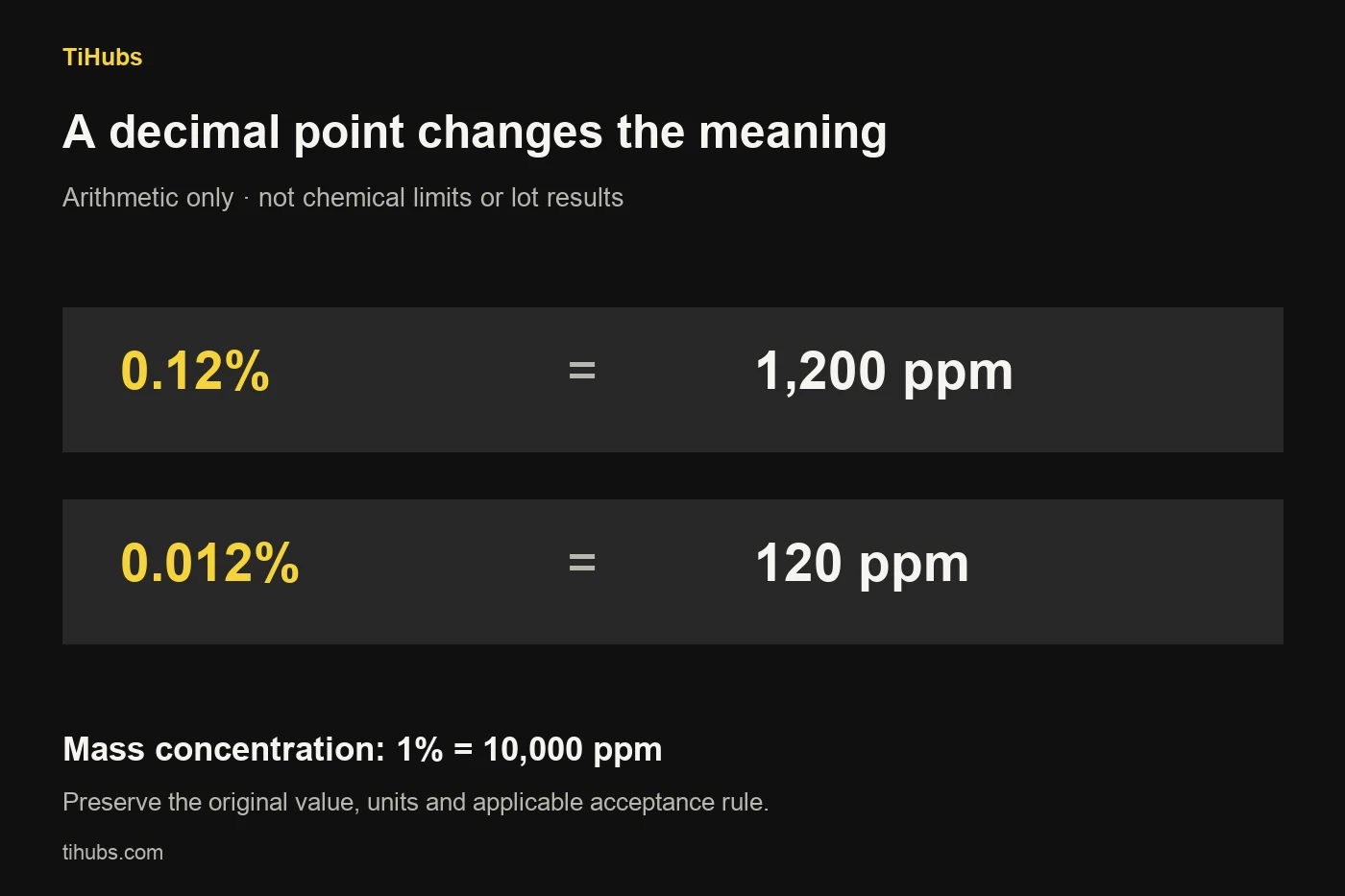
For mass concentration, 1% equals 10,000 parts per million. Therefore 0.12% equals 1,200 ppm, while 0.012% equals 120 ppm. These are arithmetic examples, not reported lot results or limits from either standard. A missing decimal place changes the interpretation by a factor of ten, even though both values can look plausible in a dense certificate.
Record whether percentages are mass-based and whether a ppm value uses the same basis. Preserve the original result and units in the review record. If you add a normalized value for comparison, show the conversion separately. Do not overwrite the supplier’s data or round it until it appears to meet a requirement.
A reported value at the edge of a limit requires the applicable reporting and conformity rules, not an improvised rounding convention. Ask the responsible quality team to resolve uncertainty, significant figures or an ambiguous laboratory statement. More displayed decimal places do not necessarily mean a more accurate measurement, and fewer decimal places do not automatically justify rejection.
Also distinguish measured results from statements such as below the detection limit. Such a statement does not mean zero. If the method or its capability cannot support evaluation of the ordered requirement, identify the issue and resolve it with the laboratory and responsible quality authority before closing the review.
Check which material the analysis represents
Match the heat or lot identification to the supplied stock and its processing records. A test from a different heat with the same alloy name is not evidence for the delivered material. If a distributor supplies cut lengths, preserve the relationship to the original material certificate. A reissued commercial cover sheet should not break that connection.
Where additional chemical testing is required, agree on sampling, method, laboratory and disposition before shipment. Retesting can answer a defined question but should not become a search for a favorable result after an unfavorable one. The agreed quality process must determine how conflicting results are investigated and which evidence supports final acceptance.
Industrial buying guide / 02Check the decimal point before comparing chemistry
Arithmetic examples only: 0.12% equals 1,200 ppm and 0.012% equals 120 ppm by mass. These are not standard limits or lot results.
03 / Mechanical and metallurgical evidence
Match test results to form, size and final condition
A tensile value has meaning only with its specimen and material context. Review the relevant product form, section, final condition, specimen location and orientation, test method and reported properties. A high tensile strength alone does not demonstrate conformity when elongation, yield strength, microstructure or another required characteristic is missing or outside its requirement.
A table of properties for annealed bar should not be used as a universal acceptance table for wire, plate or a subsequently processed component. Ask the supplier to identify which requirement row applies to the actual dimensions and form. Do not select whichever row is easiest to pass, or combine requirements from different rows into an unofficial specification.
The delivered condition must correspond to the evidence
Record the processing state associated with the test sample. If stock is later cold worked, heat treated or otherwise changed, determine whether the original evidence still satisfies the defined delivery requirement. This is a question for the governing specification and approved manufacturing plan. A certificate date alone does not reveal the sequence of processing and testing.
ISO’s public scope notes that a specimen taken from a finished product may not have the same properties specified for the material. This is a useful boundary: raw-stock certification and finished-component verification are related but different tasks. Do not use one as an automatic substitute for the other.
Metallurgical evidence also needs a defined basis. If the applicable requirement calls for microstructure assessment, establish the method, sampling and acceptance reference from the controlled documents. A generic micrograph in a brochure is not a lot-specific examination. Equally, a photograph without identification and interpretation may not demonstrate the required result.
Compare methods as well as numerical limits
For dual certification, determine whether one set of specimens and methods satisfies both standards or whether additional work is needed. Matching numerical values is not enough if sampling, specimen geometry, orientation or test procedures differ. Build the comparison before testing so any required material and specimens are available.
Keep original units and the applicable unit system clear. Conversion can help readers compare values, but it should not create a new acceptance threshold through rounding. If the order and standard use a defined unit system, apply the relevant requirements consistently. A converted summary is a convenience, not authority to mix incompatible acceptance bases.
Review missing results explicitly. Not applicable, not tested, not reported and passed are different statements. A blank cell does not prove compliance or failure. Ask why the item is absent and whether the contract requires it. This is particularly important when a generic certificate template includes fields that apply only to certain forms or sizes.
For a material substitution, examine the complete property and processing basis rather than asking whether the alternative is stronger. Strength is one characteristic within a design and manufacturing system. A higher value does not automatically compensate for a different condition, undocumented microstructure or a missing test required by the customer.
04 / Dual certification
Use a requirement-by-requirement evidence matrix
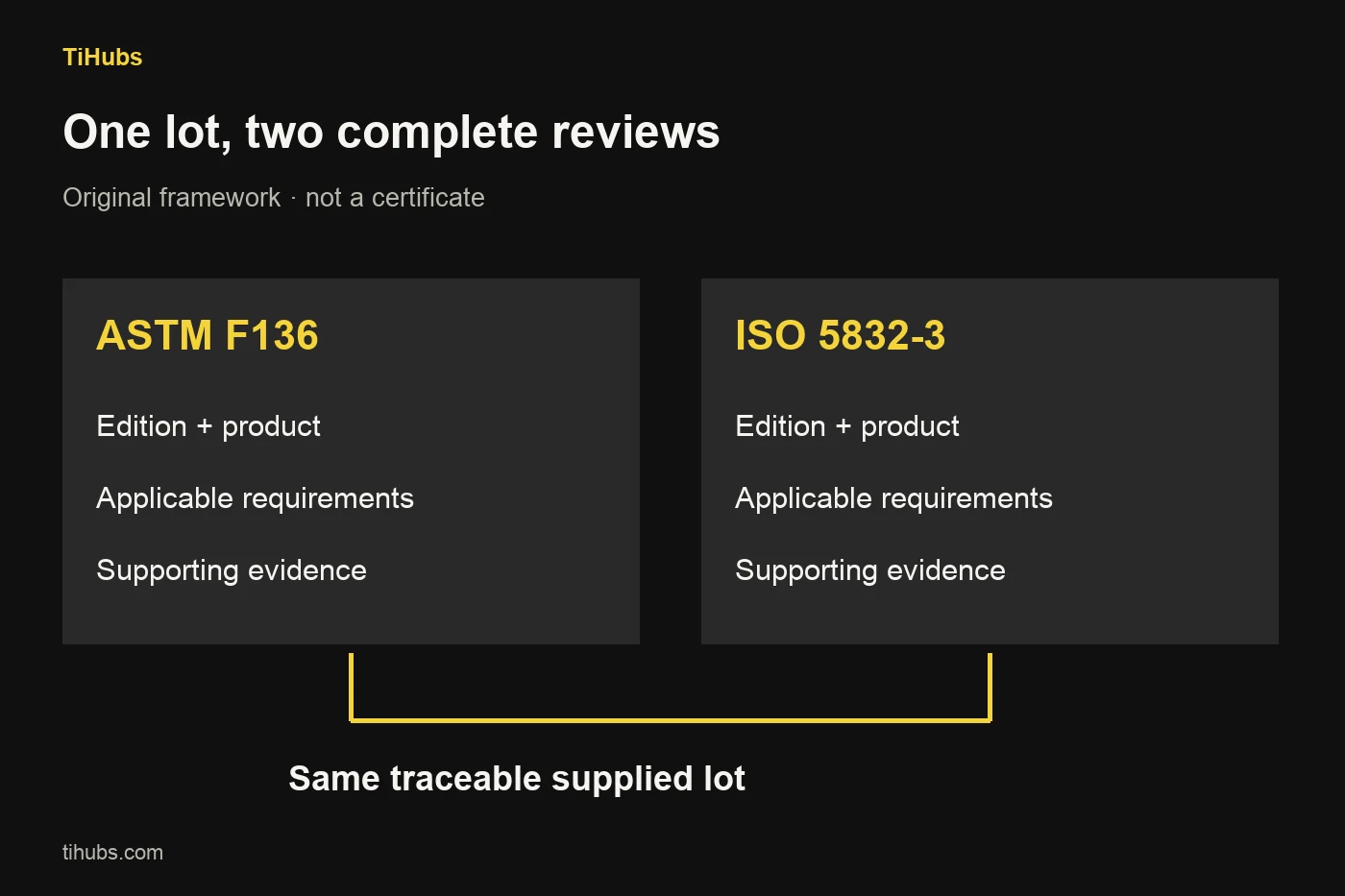
Dual certification should mean that the same supplied material demonstrably meets both specified requirements. It should not mean that the seller copied two standard numbers into a description. Ask the producer or responsible certifying organization to state the applicable editions and confirm the basis for both claims.
Create a matrix with a row for each relevant requirement and columns for each standard, the offered product, evidence reference and review status. Use the controlled standards to populate the actual limits and methods. The original framework below shows the subjects to reconcile without inventing normative values from public abstracts.
Original review framework; fill with the contractually applicable requirements
Review subject
Evidence to reconcile for both standards
Common unresolved gap
Product and condition
Form, size, route and delivery state
Certificate describes a different form or intermediate state
Chemistry
Analysis basis, required elements, units and limits
Only nominal alloy or one selected element reported
Mechanical tests
Applicable requirements, specimen basis and actual results
Values present without the relevant size or orientation
Metallurgy and other tests
Required methods, sampling and documented conclusions
Brochure image used instead of applicable examination
Certification and traceability
Authorized statements linked to the delivered lot
Two standards listed without evidence for both
Resolve gaps before the order becomes production stock
Classify each gap as missing information, additional verification needed or actual nonconformity. These categories lead to different actions. A missing report may be recoverable from the producer. An unperformed test may require material and an approved sampling plan. A failed requirement needs disposition, not a more optimistic certificate format.
If a lot was originally certified to only one standard, do not assume it can never meet the other. Equally, do not assume that a later declaration can be issued without review. The certifying party must assess available production and test evidence and identify any additional work required. The buyer should receive a legitimate, traceable statement rather than editing the original certificate.
Specify who may authorize the final conformity statement and what supporting documents must be delivered. A distributor can provide traceability and commercial documentation, but the responsibilities for original material results and subsequent processing should remain clear. Where the customer requires producer documentation or an approved source, make that requirement visible at enquiry.
Keep exceptions separate from conformity
An accepted deviation is not the same as full conformity to an unchanged requirement. If the governing program allows a deviation, document the affected lot, requirement, approval and permitted use. Do not represent the exception as a general equivalence between the two standards. Future orders should not inherit it unless separately authorized.
A slash in the certificate title is not evidence of dual certification, but neither is a particular visual format mandatory in every case. Review substance: clear standards and editions, appropriate evidence, authorized declaration and traceability to the supplied product. A concise certificate supported by a controlled package can be stronger than an elaborate document with ambiguous claims.
Original review framework. The same supplied lot must support each applicable requirement; shared chemistry alone is insufficient.
05 / Raw stock and finished devices
Preserve the boundary after material acceptance
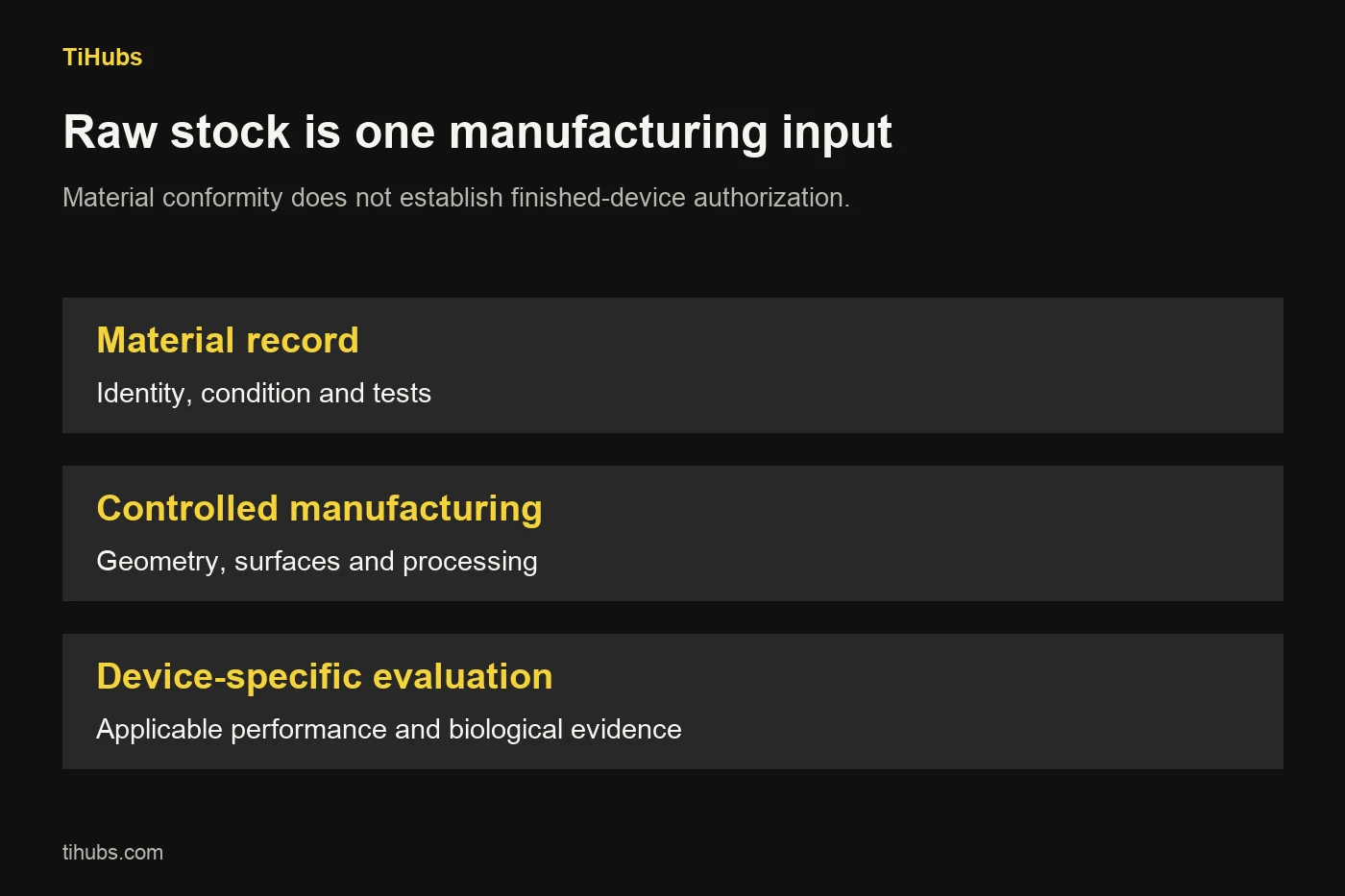
Raw material acceptance is an input to device manufacturing. It does not establish the final geometry, surface, cleanliness, mechanical performance or biological evaluation of a finished device. A supplier should describe precisely what it supplies and certifies. Avoid turning a material specification into a broad claim that every part made from that stock is approved for implantation.
The FDA’s biocompatibility reporting guidance emphasizes evaluation of the final finished device, including manufacturing and relevant processing, and justification of representative test articles. This is why a raw-material certificate alone cannot replace a device-specific evaluation or authorization process.
Downstream operations need their own controls
Machining, forming, joining, surface treatment, cleaning and packaging can introduce requirements beyond those addressed by the stock certificate. The device manufacturer’s approved process determines how these are controlled and verified. Procurement should preserve material identity and communicate relevant downstream needs rather than assuming that certification of the incoming alloy closes every later question.
For example, a hypothetical machining program may require a particular bar diameter, straightness and surface condition to maintain a validated process. A different stock size with the same standard designation can still change setup, material removal or process assumptions. Review the change through the appropriate technical system instead of treating the material name as complete interchangeability.
Another hypothetical case is a change of producer or delivery condition while keeping the same nominal alloy. The new material may satisfy its product standard yet still require review under the buyer’s supplier and process controls. The purpose is to evaluate the actual change, not to assume every source change is unacceptable or that every conforming source is automatically interchangeable.
Document the limits of the supply claim
If the order is for raw bar, the acceptance package should describe raw bar. If additional machining or finishing is included, identify those operations and their separate requirements. Do not let a quotation drift from material supply into a claim of finished-device conformity without the necessary scope, evidence and authorized responsibility.
Standards publication and regulatory recognition are also separate matters. The presence of a new edition in a publisher’s catalogue does not by itself establish its status in a particular regulatory submission. The manufacturer’s qualified regulatory team should verify the applicable recognized edition, transition arrangements and submission basis where relevant. Do not infer those conclusions from this purchasing comparison.
Keep communication specific. A statement that a lot is certified to identified material standards is reviewable. A general promise such as safe for every implant is not supported by that certificate. Accurate boundaries improve supplier credibility because the buyer can see what is demonstrated and which responsibilities remain in the device-manufacturing program.
Industrial buying guide / 05Raw stock is one input to finished-device verification
Material records remain necessary while downstream manufacturing and device-specific evaluation have their own requirements.
06 / RFQ and receiving workflow
Order evidence that can be checked at receipt
Send the specified alloy, product form, dimensions, quantity, final condition and exact standard editions. State whether both standards are mandatory and whether alternatives are permitted. Attach any customer-specific requirements for source approval, testing, traceability, surface condition, packaging or change notification. A clear enquiry reduces the risk of comparing unlike offers.
Define the certificate language and how any translation will be handled. Keep the original authorized record available and preserve identifiers, units and qualification wording in the translated copy. A translated summary should not broaden a conformity statement or omit a limitation that affects acceptance.
Request a representative certificate format for review when useful, with any unrelated customer information removed by the supplier. A sample format helps identify missing fields but is not evidence for the future lot. The delivered package must contain the actual authorized records linked to the supplied material.
Agree on document review timing. If certificates require approval before shipment, make it a defined hold point and include review time in the schedule. If additional testing is required, establish who arranges it, how specimens are identified and what happens if results do not meet the order. Avoid discovering these commercial responsibilities after production is complete.
At receipt, reconcile physical identification, packing list, producer certificate, any distributor documentation and additional test reports. Confirm that cut lengths or subdivisions remain traceable. Review quantity, dimensions, condition and approved exceptions as well as the standard names. Do not release unresolved material into a controlled manufacturing process merely because the chemistry column looks familiar.
TiHubs can review enquiries for titanium surgical-implant raw stock and Grade 23 material. Confirm the required forms, editions, certificates, testing and source qualifications for the actual order. This enquiry route does not imply that every product is stocked with dual certification or that TiHubs approves finished medical devices.
For a different alloy-family decision, see ASTM F67 versus F136. For the distinction between conventional and ELI Ti6Al4V, see Grade 5 versus Grade 23. This article’s purpose is narrower: verify what F136 and ISO 5832-3 certification actually supports for the material being purchased.
Complete the purchase with a recorded conclusion for each requirement and a clear release decision. Preserve the evidence for repeat orders and change review. The strongest dual-standard supply arrangement is one in which the buyer can trace every claimed requirement to the correct product and record, without relying on a broad medical-grade label.
07 / Build your RFQ
Prepare a dual-standard titanium stock enquiry
State the required editions and whether both standards are mandatory. Include the physical stock and evidence requirements so the offered certification can be reviewed before release.
Information to include
Alloy, form, dimensions, quantity and delivery condition
Exact ASTM and ISO editions; dual requirement or permitted alternative
Chemistry, mechanical, metallurgical and additional test requirements
Producer documentation, source approvals and lot traceability
Document hold points, packaging and change-notification requirements
Build your RFQ checklist
Choose the product and add the information you have. Copy the resulting brief or send your requirements to TiHubs. Submitting an enquiry does not place an order.
08 / FAQs
Questions buyers ask
Are ASTM F136 and ISO 5832-3 automatically equivalent?
No. Confirm the applicable editions and all requirements for the actual product and condition. Similar alloy names or overlapping chemistry do not establish complete conformity. If both are required, obtain a legitimate statement and evidence supporting both for the delivered lot.
Does Grade 23 automatically mean ASTM F136 certified?
No. Grade and alloy descriptions do not replace product certification. Ask which standard, edition, form and condition are supported by the actual lot records. A general product listing or typical-property sheet cannot establish conformity of the supplied stock.
Can a lot be certified to both standards?
It may be, when the responsible certifying organization demonstrates that the same supplied material satisfies both applicable requirements. Review form, condition, chemistry, tests, methods, sampling and documentation. Two numbers printed on a sales certificate are not enough by themselves.
Should an older drawing automatically change to F136-26?
No. Review the drawing, contract and applicable program requirements through the authorized change process. The publisher lists F136-26, but that fact alone does not revise an existing order or establish the regulatory basis of a finished device.
Does a material certificate approve a finished implant?
No. Raw-stock conformity is one input to manufacturing. Final geometry, processing, surface condition, performance and biological evaluation require their own applicable controls and evidence. Material certification should not be presented as universal finished-device approval.
What if a certificate has missing or inconsistent fields?
Hold the affected acceptance decision and seek a traceable clarification or correction from the responsible issuer. Distinguish missing information, unperformed testing and actual nonconformity. Do not edit signed results or infer a pass from a blank cell.
09 / Key takeaways
Keep the purchase requirements connected.
Write the edition and dual-standard requirement explicitly.
Separate chemistry limits, actual analysis and typical values.
Match mechanical evidence to form, size and condition.
Reconcile all requirements before claiming dual certification.
Keep raw-material conformity distinct from finished-device approval.
Technical references
Sources and data scope
References reviewed November 15, 2026. Public source summaries support the discussion; the controlled specification, agreed edition and approved project requirements govern acceptance.
TiHubs coordinates titanium material and custom supply enquiries from Baoji, China. Send the product, drawing revision and acceptance requirements so the proposed supply scope can be reviewed. Learn about our sourcing role.
Contents
TiHubs
Talk to TiHubs
Ask about titanium materials, grades or custom parts.
Enter your email to start chatting.
We use your email to respond to your enquiry. Your conversation is stored on this website.
Our team is away right now. Leave your enquiry and we will follow up by email.