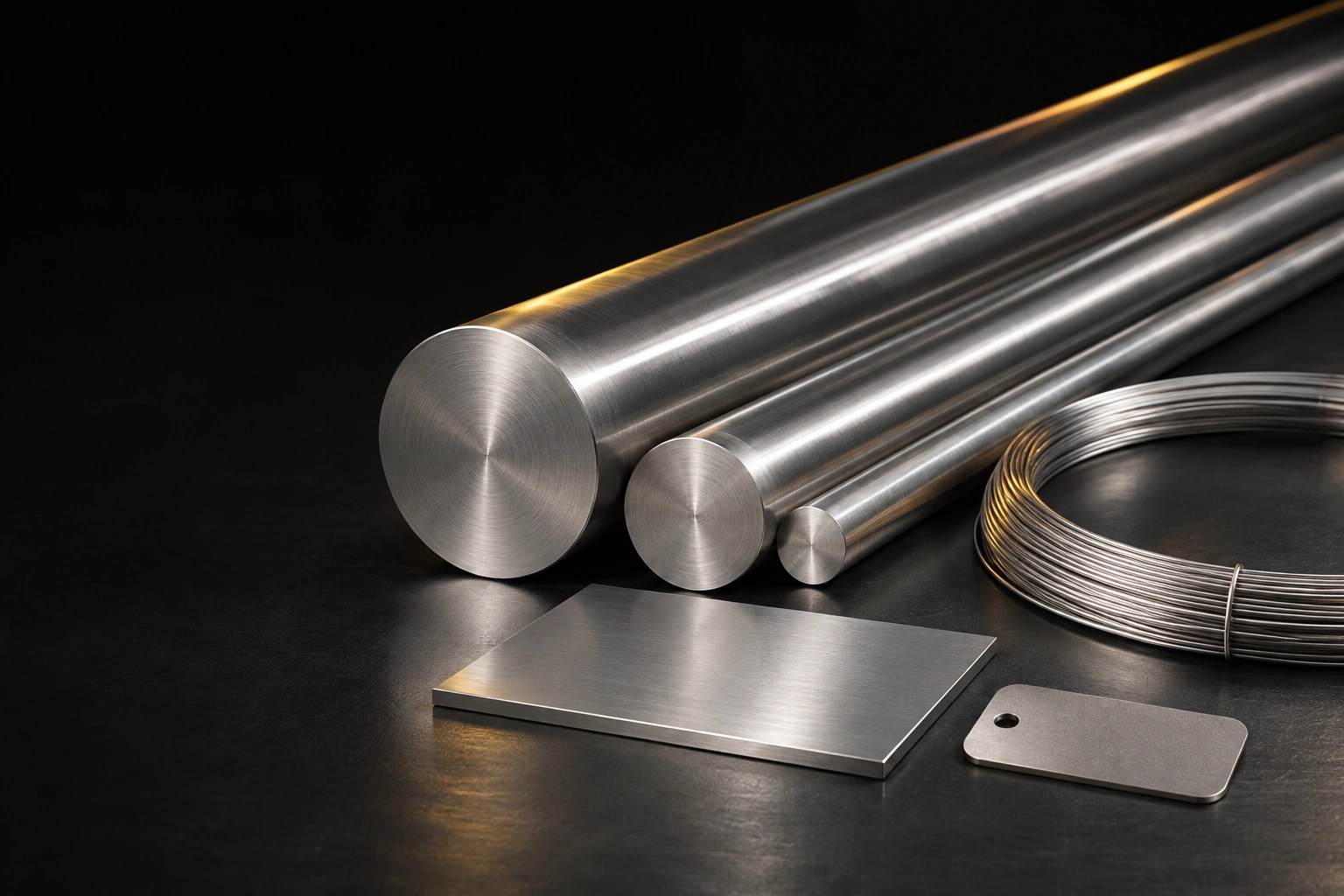
AI illustration. Appearance and labels do not verify material compliance.
Quick answer: F67 and F136 specify different materials
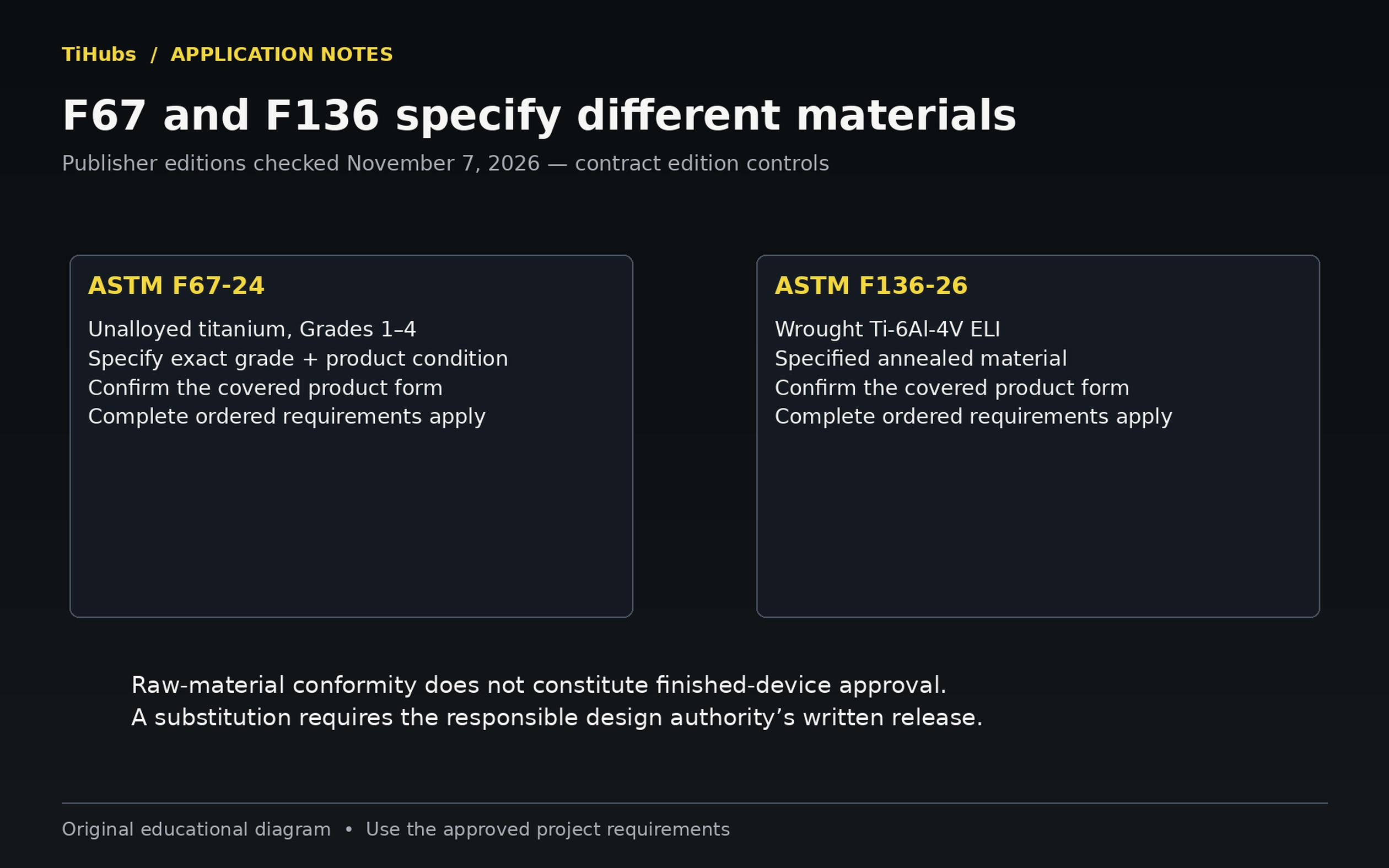
For ASTM F67 vs F136 titanium, start with the controlled drawing and material specification. F67 covers unalloyed titanium grades; F136 covers wrought Ti-6Al-4V ELI in its specified condition and product forms. They are not interchangeable buying descriptions, and neither standard by itself approves a finished medical device.
The purchase must connect the exact material, standard edition, product form, delivery condition and required test evidence to an uninterrupted heat/lot traceability chain. Any alternative needs the responsible design authority’s written approval. A general request for “medical titanium” leaves too many requirements undefined.
01 / Standard comparison
What the two ASTM specifications cover
ASTM’s current public listings identify F67-24 for unalloyed titanium and F136-26 for wrought Ti-6Al-4V ELI. F67 includes four unalloyed grades; F136 identifies UNS R56401 and an annealed wrought material. Confirm the complete ordered edition for detailed requirements rather than relying on a public abstract. [1][2]
Item
ASTM F67
ASTM F136
Material family
Unalloyed titanium, Grades 1–4
Ti-6Al-4V ELI alloy
Current publisher listing checked
F67-24
F136-26
Required purchase identification
Exact F67 grade and product condition
Exact F136 designation and required condition
Publicly listed product forms
Strip, sheet, plate, bar, billet, forging and wire
Strip, sheet, plate, bar, forging bar and wire
Release basis
Complete ordered specification plus drawing/purchase requirements
Complete ordered specification plus drawing/purchase requirements
Product-form wording matters. Do not assume that titanium powder, additive-manufactured parts or tube automatically falls under a specification because the chemistry sounds familiar. Ask the design authority to identify the applicable specification for the actual supplied form and manufacturing route.
02 / Design requirements
Let the controlled design determine the material
A purchasing team should not select F136 because it sounds more advanced, or F67 because the component seems simple. The material is part of the approved component design. Required properties, manufacturing route, surface condition and other design inputs must be assessed by the responsible technical team.
Check that the drawing, bill of materials, purchase specification and supplier quotation refer to the same material and revision. Where they disagree, raise a clarification before release. A purchase order should not silently resolve an engineering conflict by adopting whichever description appears in the quotation.
Document
Check for consistency
Drawing
Material designation, condition, revision and special notes
Material specification
Standard edition, grade, product form and additional requirements
Purchase order
Quantity, dimensions, tests, traceability and release documents
Supplier quotation
Exact offered material and every stated deviation
Receiving plan
Inspection criteria linked to the approved requirements
For a proposed alternative, request a documented comparison and the design authority’s disposition. Keep commercial availability separate from technical approval: readily available stock is not automatically an acceptable substitute.
Application detailIdentity and dimensions are separate checks
Tie dimensional records to the correct stock, heat or lot and drawing revision. AI illustration; not production or inspection evidence.
03 / Edition control
Separate publisher edition, contract edition and recognition
Three version questions may coexist: what the standards publisher currently lists, what the controlled design requires, and what a destination regulator recognizes for a particular purpose. Record each separately. A current publisher edition does not automatically update the device manufacturer’s design file or a regulatory recognition entry.
FDA’s recognized-standards database provides version-specific records. For example, its F67 entry identifies the recognized edition and associated information. The device manufacturer’s regulatory team should verify the applicable record and transition conditions for the intended submission; do not infer recognition of one edition from recognition of another. [3]
If the supplier proposes stock certified to a different edition, request a review of the relevant changes and the contract’s permitted alternatives. The order should name the accepted edition explicitly. Retain the written disposition with the material release package.
Publisher editions checked November 7, 2026. Use the complete contractually required specification.
04 / Product condition
Specify the product and condition you will actually receive
State whether the order is for bar, sheet, plate, wire or another approved form; include size, dimensional tolerances, surface condition and delivery condition. Identify whether stock will be machined, formed or otherwise processed after receipt. The required condition should be the one defined by the controlled specification, not a supplier’s unstated stock default.
Where properties or tests depend on product size, orientation or condition, use the applicable specification and approved requirements. Do not apply one generic internet strength table to every diameter and product route. Ask the supplier to identify the test basis and the relationship between the tested lot and the delivered material.
Purchase field
Example of a useful requirement
Material
Exact standard, edition and grade/designation
Form and size
Approved product form and controlled dimensional schedule
Condition
Explicit condition from the governing specification
Surface
Defined finish, permitted defects and cleanliness requirements
Test evidence
Required chemistry, mechanical and other specified results
Identity
Heat/lot marking and cut-piece traceability requirements
Changes
Written approval before any specified substitution or deviation
A sample order should use the same clarity as a production order. If qualification material differs from later production stock, record the difference and have the responsible team determine whether further evaluation is required.
05 / Certificates
Read a certificate as evidence, not as a label
Check the issuing organization, product description, standard edition, material designation, heat/lot, dimensions or quantity scope, test results and required authorization. Confirm that the certificate belongs to the material actually shipped. A certificate with correct-looking chemistry but no reliable product link is not a complete traceability record.
Review results against the ordered requirements, including units, test methods and the stated sampling basis where required. If a result or document is missing, raise a nonconformance or clarification under the buyer’s process rather than assume a blank means compliant.
A supplier’s quality-management certificate addresses a different question from a heat-specific material test report. Likewise, a requested inspection-document designation does not establish finished-device approval. The purchase order must identify what each document is intended to prove.
Evidence
What it can support within its scope
What it does not establish alone
Material test report
Reported results tied to identified material
Finished-device conformity
Supplier quality certificate
A certified management-system scope
Results for the delivered heat/lot
Dimensional report
Specified measurements at the stated stage
Chemistry or complete material identity
Traceability record
Connection between material and subsequent lots
Acceptance of every manufacturing process
Device release record
Approved release within the manufacturer’s system
A substitute for missing underlying evidence
06 / Heat-to-part records
Keep the heat-to-part connection through cutting and machining
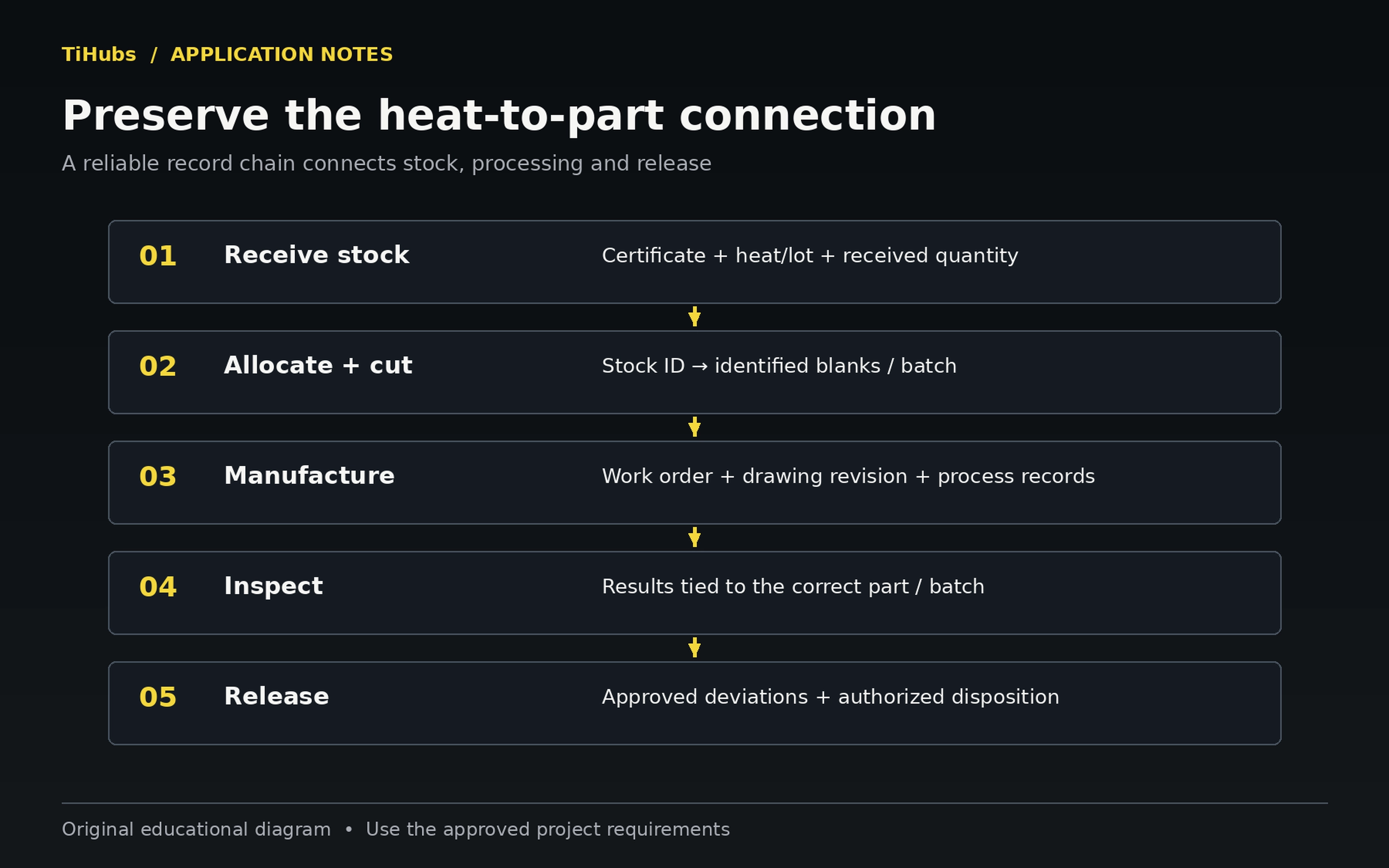
Define how the original material identity transfers to cut lengths, blanks, work orders and finished batches. The method can use controlled labels, travelers, electronic records or another approved system; what matters is that the connection remains reliable and auditable.
Before cutting, record the source heat/lot, stock identity, dimensions and allocation. After cutting, preserve the link without mixing unidentifiable remnants. For machining, connect the work order and drawing revision to the allocated material and the resulting part batch. Handle rework, scrap and returned material under the same identification rules.
Technical buying guideKeep the heat-to-part connection
Every transfer should preserve identity and link to the approved record.
Stage
Record to retain
Receipt
Supplier, certificate, heat/lot and received quantity
Stock allocation
Stock identity and the job or batch receiving it
Cutting
Cut-piece identity, quantity and marking transfer
Manufacturing
Work order, drawing revision and relevant process records
Inspection
Results tied to the correct part or batch
Release
Accepted deviations and authorized final disposition
Plan this before ordering if the supplier will cut stock to length. Otherwise the buyer may receive convenient small pieces with a certificate but no sufficiently controlled way to determine which pieces belong to which heat.
07 / Receiving checks
Choose receiving checks that answer the right questions
The receiving plan should identify document review, identity checks, dimensions, surface condition and any specified independent testing. Define sampling and acceptance criteria according to the controlled purchase requirements and the buyer’s quality system.
Do not assume a handheld alloy-identification result proves full conformity with every chemistry limit. Ask which elements and concentration ranges the actual method can determine, and how it is validated for the required decision. Where full chemistry verification is needed, specify an appropriate laboratory method and traceable sample plan.
Keep material identity, mechanical properties and surface condition as distinct checks. One successful test cannot substitute for an unrelated requirement. If material is quarantined while a discrepancy is resolved, preserve its identification and prevent unintended production use.
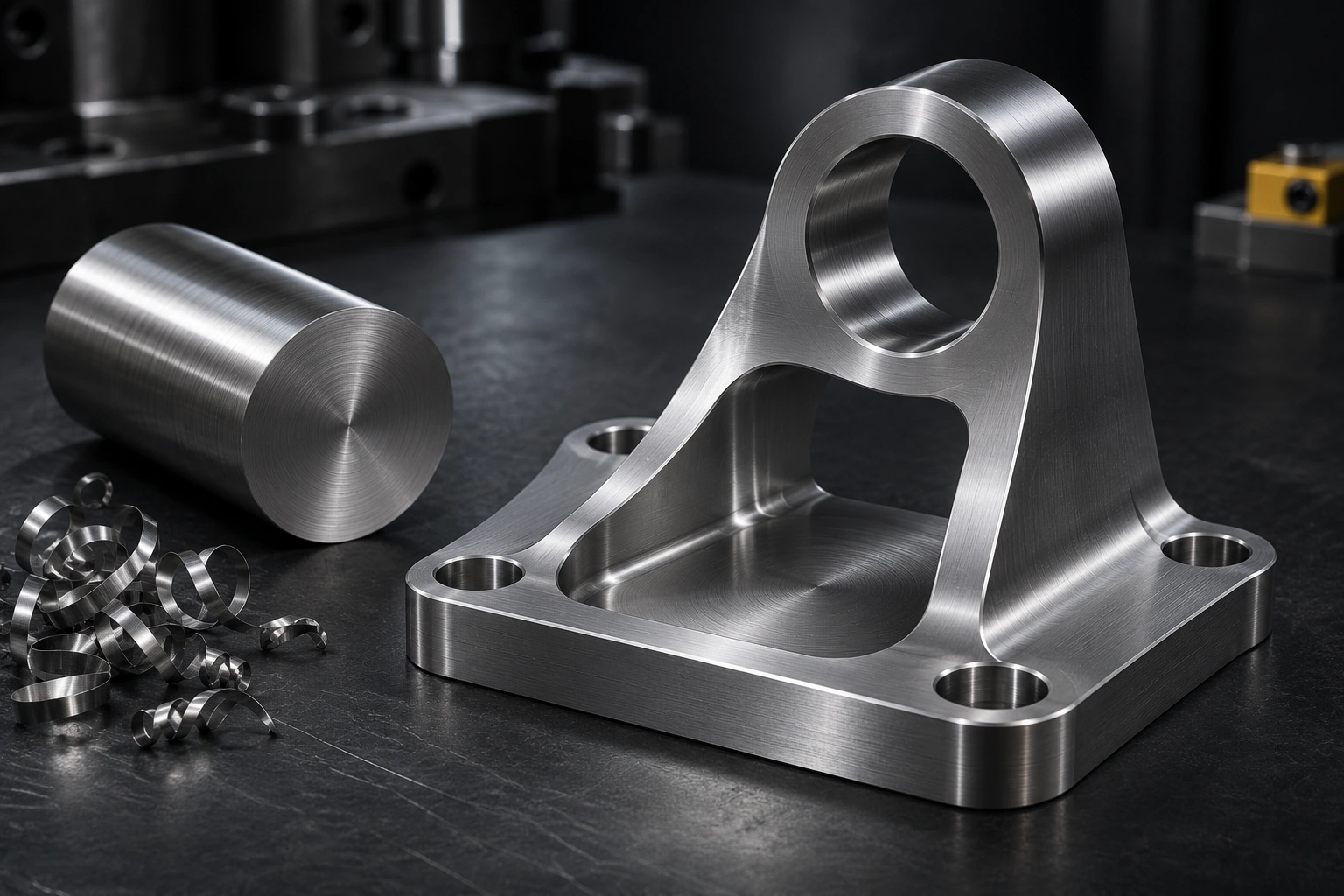
Application detailConnect incoming material to the work order
Illustrates a manufacturing stage only; it does not establish medical qualification or alloy conformity. AI illustration; not production or inspection evidence.
08 / Final-device boundary
Raw-material conformity is only one stage
FDA explains that biocompatibility assessment concerns the device in its final finished form, including relevant manufacturing processes and sterilization where applicable. It does not clear or approve individual raw materials as finished devices. Processing residues, surface changes and component interactions can therefore matter beyond the incoming metal certificate. [4]
For procurement, this means the raw-material scope must be explicit and connected to the device manufacturer’s downstream controls. State any required surface or cleanliness condition at delivery, protection during transport and documentation needed for subsequent processing. Do not describe ordinary stock as sterile, implant-ready or approved for all medical uses.
The device manufacturer should determine which changes to material source, processing or surface condition require evaluation. The supplier should follow agreed notification and approval requirements rather than substitute a superficially similar product after qualification.
09 / Substitutions
Handle Grade 23, Grade 5 and Chinese designations carefully
Commercial grade names are useful for discussion, but the order needs the complete specification. A quote using “Grade 23,” “ELI,” a Chinese designation or a general Ti-6Al-4V description must be reconciled with the exact required product and standard. Similar chemistry does not automatically establish the full condition, properties, tests or documentation required by the design.
If an alternative is proposed, build a comparison covering designation, standard editions, product form, delivery condition, all required properties, inspection and traceability. Identify each difference as a deviation and obtain the authorized disposition. Do not turn a cross-reference table into a release instruction.
Example: lower-cost alloy stock offered against an F136 drawing
The supplier offers readily available Ti-6Al-4V bar with a different certification basis. The buyer requests the exact offered specification and results, then refers the differences to the design authority. Until approval is documented, the original F136 requirement remains controlling. A lower price or a matching alloy family is not a complete equivalence case.
Example: unalloyed titanium with the grade omitted
An enquiry says only “ASTM F67 bar.” The supplier should ask which unalloyed grade, condition, edition and dimensions are required. The buyer should resolve the omission in the controlled documents rather than let a stock selection define the component material.
10 / Supplier controls
A supplier review that supports repeatable orders
Ask how the supplier controls material identity, document review, segregation, cutting, subcontracted processing and changes. Request the evidence relevant to the supplied scope rather than a generic promise of medical quality. For repeat orders, confirm which specification revision and qualification basis remain applicable.
Agree document delivery and review timing. If the buyer must approve certificates or inspection results before shipment, make that a defined hold point. Include the process for nonconforming material, replacement and correction of documentation without losing the original record trail.
For TiHubs enquiries, identify whether the requested scope is raw stock, cut blanks or a further processed component. This allows supply and inspection coordination to be quoted against the actual requirements while preserving the device manufacturer’s design and release responsibilities.
11 / Operating checklist
Build your medical-material procurement checklist
Use this checklist for component and manufacturing requirements, not patient information. Enter the controlled material standard and edition, product form, delivery condition, planned processing and traceability needs. The resulting brief helps prevent an incomplete “medical titanium” enquiry from becoming an ambiguous purchase order.
Build your operating-condition checklist
Choose the product and add the information you have. Copy the resulting brief or send your requirements to TiHubs. Submitting an enquiry does not place an order.
12 / FAQs
Frequently asked questions
Is F136 a replacement for F67?
No. They specify different material families. A change requires review against the controlled component design and written approval from the responsible authority.
Does F67 identify one titanium grade?
No. The specification covers four unalloyed grades. State the exact required grade along with the edition, product form and condition.
Does an F136 certificate make a finished part medically approved?
No. Raw-material conformity is only one input. The device manufacturer’s design, manufacturing, biological evaluation and regulatory responsibilities remain separate.
Can powder or tube be ordered under these standards automatically?
No. Check the actual scope and obtain the applicable product specification from the design authority. Similar chemistry does not make every product form covered.
Should the newest ASTM edition always be used?
Use the edition required by the approved design and contract. If a different edition is proposed, review and document the change; regulatory recognition may also be version-specific.
Is a supplier quality certificate enough for material acceptance?
No. Request the required material-specific reports and traceability. A management-system certificate does not replace results for the delivered heat or lot.
Can an alloy identification check prove complete conformity?
Only within the validated scope of that method. Full material acceptance may require chemistry, mechanical, metallurgical, dimensional and documentation checks defined by the order.
What is the most important traceability rule for cut blanks?
Preserve a reliable link from every controlled blank or batch back to the source material and certificate. Agree the marking-transfer and record method before cutting begins.
13 / Key takeaways
The medical-material order in five checks
Start from the controlled design and exact material specification.
Verify edition, product form, delivery condition and additional requirements.
Review material-specific evidence and preserve the heat-to-part chain.
Keep raw-material acceptance separate from finished-device approval.
Require written release for substitutions and controlled changes.
This is procurement guidance for raw materials, not a clinical recommendation, device design or regulatory approval determination. Consult the complete controlled specifications and the responsible engineering, quality and regulatory teams. Images are AI illustrations, not certification evidence.
Ti
About TiHubs
TiHubs coordinates titanium materials and custom supply from Baoji, China. Our founder’s 20 years in titanium inform a specification-led sourcing approach: clarify the product, manufacturing and acceptance requirements before quotation. Learn about our sourcing role.
Contents
TiHubs
Talk to TiHubs
Ask about titanium materials, grades or custom parts.
Enter your email to start chatting.
We use your email to respond to your enquiry. Your conversation is stored on this website.
Our team is away right now. Leave your enquiry and we will follow up by email.