Material propertiesTemperature / geometry / evidence
ConductivityA material property
Thermal performanceA complete heat path
AI illustration; not a production or inspection record.
Quick answer
Titanium thermal conductivity depends on composition, condition and temperature. The Japan Titanium Society lists 17 W/(m·K) for general CP titanium and 7.5 W/(m·K) for Ti-6Al-4V at 20°C. Those reference values are not guarantees for every supplied product. Use the appropriate dataset with the actual wall, heat path and service requirements.
Thermal conductivity describes a material, not an entire component
Titanium thermal conductivity is the material property that connects a temperature gradient to conductive heat flow. It is commonly written as k or λ and expressed in W/(m·K). A larger value means more heat can pass through an otherwise identical conduction path for the same temperature difference. It does not, by itself, describe how quickly a complete assembly cools, the maximum temperature it can withstand or how efficiently a heat exchanger operates.
For a buyer, the useful first question is why this property matters to the purchase. A thin wall separating two fluids, a bracket connecting a hot component to a frame and a plate supporting a heat source have different heat-flow paths. Before searching for a better number, identify the direction of heat flow, the dimensions along that path and the temperatures that the material actually experiences.
Keep four different properties separate
Thermal conductivity describes conduction. Specific heat capacity describes the energy needed to raise a unit mass by a unit temperature. Thermal diffusivity relates conduction to stored heat and helps describe transient temperature response. Thermal expansion describes dimensional change with temperature. A material can have relatively low conductivity and still become hot; low conductivity is not a certificate of insulation or safe touch temperature.
The distinction matters in a quotation. If the problem is that a support moves during heating, a conductivity value alone cannot resolve thermal expansion and restraint. If the problem is slow cooldown, geometry, stored energy and heat exchange at the surface matter. If the problem is a temperature drop across a wall, conductivity and wall thickness become directly relevant. Name the actual performance question so the supplier does not answer a different one.
Interpret the units before comparing values
The metre in W/(m·K) belongs to a material property; it does not mean the quoted product must be one metre long. A temperature difference of one kelvin equals a difference of one degree Celsius, although absolute temperature scales differ. Keep conductivity distinct from a heat-transfer coefficient expressed in W/(m²·K), and from thermal resistance expressed in K/W. Those quantities cannot be compared by looking only at their numerical sizes.
A purchasing spreadsheet should therefore retain a column for the quantity and its unit, not merely a heading called thermal performance. Include the source, material designation and stated temperature beside every value. This simple record prevents a conductivity number from being silently replaced with a heat-transfer coefficient when information arrives from a different supplier or equipment designer.
02 / Verified reference values
Compare named materials and stated temperatures
The following table gives selected reference values from the Japan Titanium Society’s physical-property table. Its conductivity row explicitly states 20°C. The CP titanium entry is a general commercial-purity category, not a guaranteed result for every ASTM Grade 2 lot. These values support material screening; they are not TiHubs measurements or contractual acceptance limits.
Selected Japan Titanium Society reference values at 20°C
Material as identified by the source
Thermal conductivity, W/(m·K)
Scope
CP titanium
17
General commercial-purity category
Ti-6Al-4V
7.5
Named α–β alloy
SUS304 stainless steel
16
Named stainless grade
Aluminium 1100-H18
220
Named alloy and temper
Pure copper
394
Source’s pure-copper category
Source: Japan Titanium Society — physical properties. The comparison shows why titanium cannot be assigned a single universal conductivity. Preserve the categories rather than relabelling general CP titanium as a specific certified grade or treating all aluminium tempers as identical.
Why another reputable datasheet can show a different number
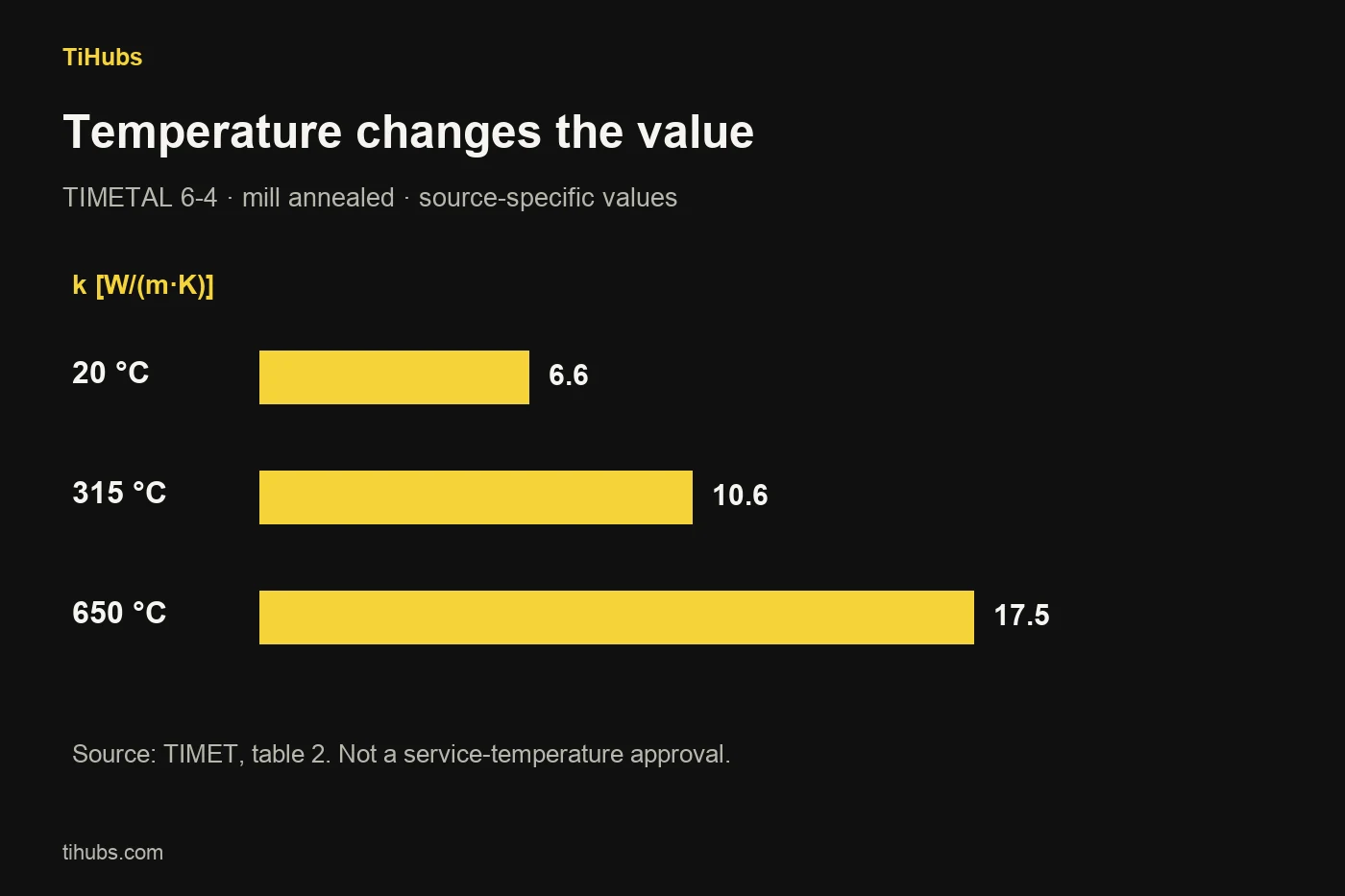
TIMET’s TIMETAL 6-4 datasheet lists mill-annealed conductivity of 6.6 W/(m·K) at 20°C, 10.6 at 315°C and 17.5 at 650°C. The source-specific 20°C value differs from the general alloy value above. Do not average the two, erase their conditions or conclude that one supplier’s material is defective. A design needs an appropriate controlled dataset for its actual material and condition.
TIMETAL 6-4: mill-annealed values from TIMET table 2
Temperature
Conductivity, W/(m·K)
20°C
6.6
315°C
10.6
650°C
17.5
Source: TIMETAL 6-4 datasheet, table 2. A property reported at 650°C does not establish an allowable continuous service temperature. Strength, environment, time, load and the applicable design rules require separate assessment.
A Grade 2 enquiry needs more than a copied CP value
Identify the product specification and supplied condition first. If thermal performance is a binding requirement, agree the property source or measurement requirement with the design owner and supplier. Avoid writing only high thermal conductivity on a purchase order. That phrase has no defined threshold, temperature, method or acceptance basis, and different reviewers can interpret it differently.
Industrial buying guide / 02Temperature belongs beside the value.
TIMET mill-annealed reference values; a high-temperature property is not a service-temperature approval.
03 / Calculate the relevant path
Wall thickness can change the comparison
For a simplified flat wall with steady one-dimensional conduction, constant conductivity and uniform area, thermal resistance is R = L/(kA). Here L is thickness along the heat path in metres, A is area in square metres and k is conductivity in W/(m·K). Heat flow is Q = ΔT/R under those assumptions. Real components may need cylindrical, multidimensional or temperature-dependent analysis instead.
A transparent illustration, not a tested product claim
Take a hypothetical 1 mm wall and 0.01 m² area, with no surface-film or contact resistance. Using the general CP titanium reference k = 17 gives R = 0.001/(17 × 0.01), approximately 0.00588 K/W. Using the same source’s Ti-6Al-4V reference k = 7.5 gives approximately 0.0133 K/W. These are calculated wall resistances for identical geometry, not results from a TiHubs heat-transfer test.
If the Ti-6Al-4V wall were hypothetically reduced to 0.5 mm with the same area, its calculated resistance would become approximately 0.00667 K/W. The example shows why thickness belongs in the comparison. It does not authorize the thinner wall: pressure, handling, fatigue, joining, erosion and applicable minimum-thickness requirements must still be satisfied by the responsible designer.
Use the dimension along the heat path
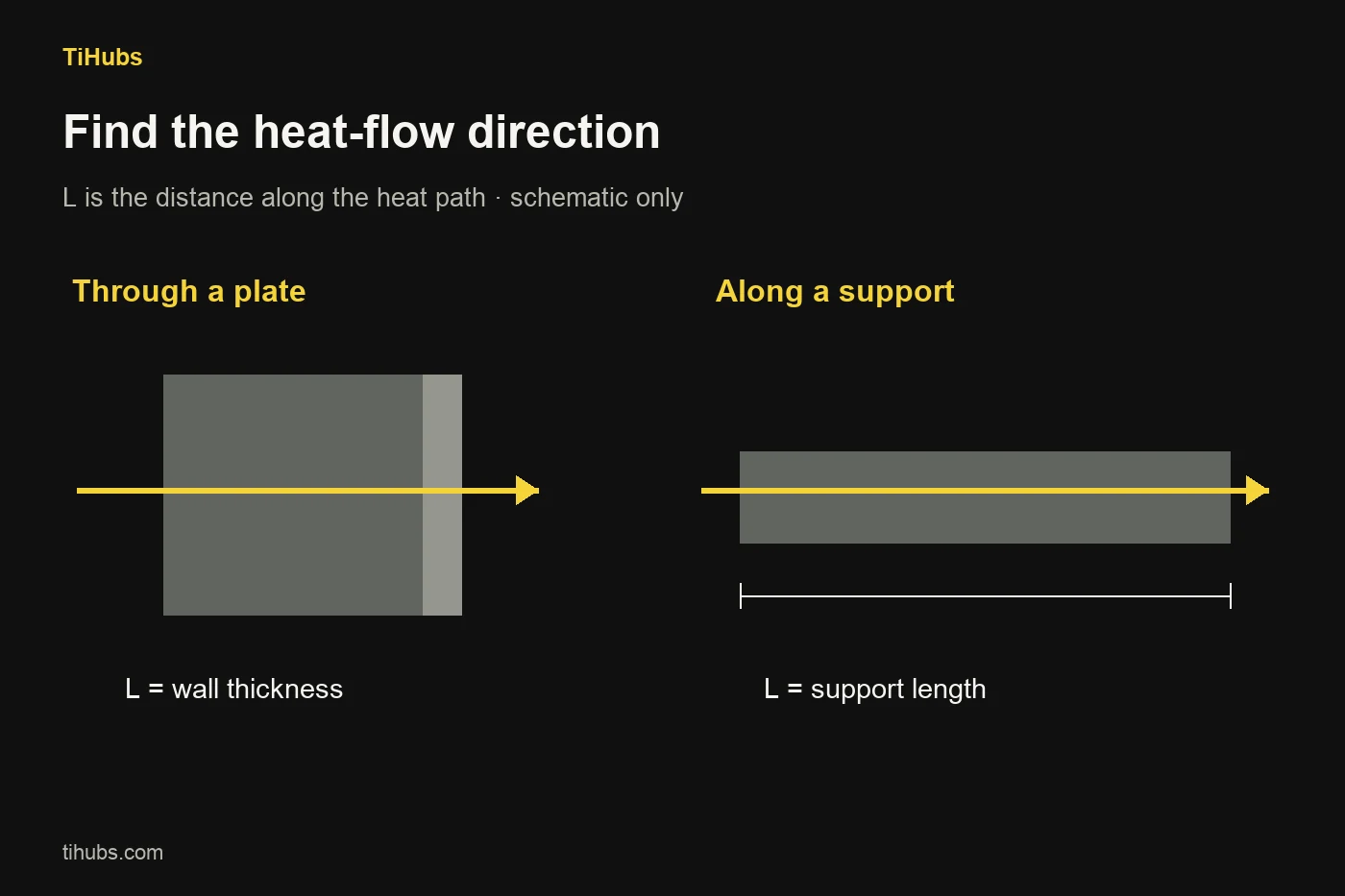
For heat passing through a sheet, L is the thickness. For heat travelling along a narrow support, L can be the support length and A its cross section. Using the sheet thickness for an in-plane heat-flow problem produces the wrong model even if the material value is correct. Show the heat source, heat sink and contact locations on the drawing before selecting the calculation.
Round tubes add another distinction. Radial conduction through a cylindrical wall is not exactly the same geometry as a flat plate. A thin-wall approximation may be appropriate in a justified design model, but the buyer should not assume it without knowing the diameter-to-wall relationship and required accuracy. Keep the material property separate from the engineer’s chosen geometry model.
Carry tolerances into the performance question
If wall thickness affects both thermal resistance and mechanical acceptance, specify its purchasing basis clearly. Nominal wall, average wall and minimum wall are different concepts. Define tolerances, measurement locations and the condition after any forming. A wall that changes during bending or machining should be assessed at the stage relevant to the final function.
For material sourcing, send the approved thickness and tolerance rather than asking a supplier to reduce the wall until a spreadsheet target is achieved. TiHubs can review titanium sheet or titanium heat-exchanger tubes against the defined order. Thermal design approval and supply feasibility remain separate decisions that must eventually agree.
Industrial buying guide / 03Choose the correct path length.
The dimension along heat flow changes with the component function. These sketches are not design drawings.
04 / From material to assembly
The lowest conductivity is not always the controlling resistance
A heat path can include several resistances in series: a fluid boundary layer, deposits, the metal wall, a contact interface and another fluid boundary layer. Improving one contribution changes the total only by its share of the original total. This is why a large difference in conductivity does not automatically produce the same percentage difference in equipment performance.
Ask where the temperature drop occurs
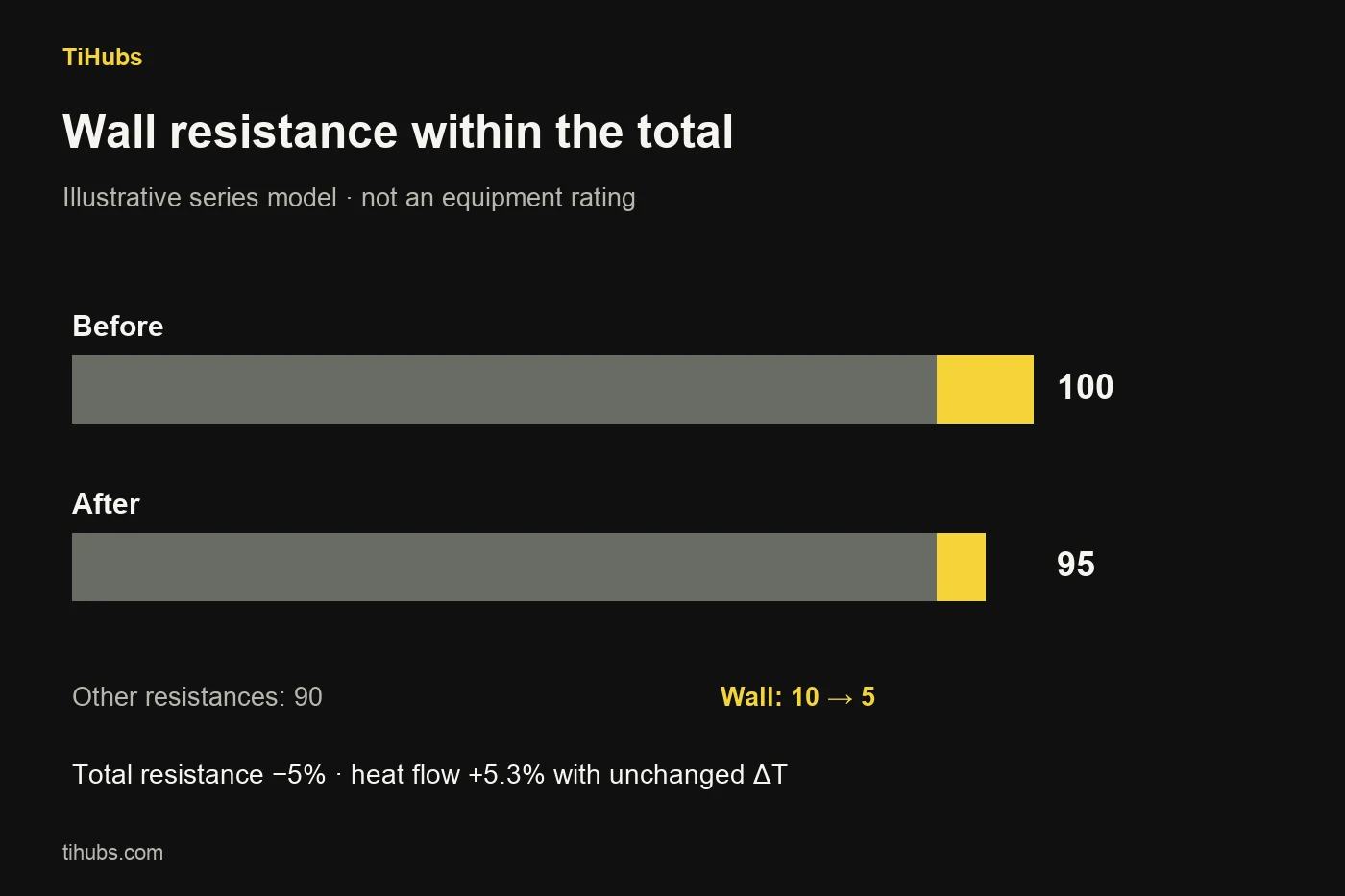
Consider an illustrative resistance budget in which the metal wall accounts for 10% of the total and everything else accounts for 90%. Halving only the wall resistance changes the total from 100% to 95%. Under unchanged boundary temperatures in that simplified series model, heat flow increases by about 5.3%, not 100%. This is arithmetic about an assumed budget; it is not a typical rating for titanium equipment.
The practical task is to establish the actual budget. A designer may use calculations, validated simulation or appropriate measurements to identify the controlling contribution. The purchasing team can help by preserving the assumed wall, surface, contact and operating conditions in the specification. If those conditions change between bids, the original thermal comparison may no longer describe either proposal.
Surfaces and interfaces deserve their own requirements
A bolted plate or thermal interface introduces contact conditions that bulk conductivity cannot describe alone. Contact area, flatness, pressure, intervening materials and surface condition can matter. Avoid inferring an assembly’s contact resistance from the alloy datasheet. Where a joint’s thermal performance is critical, define the assembly configuration and the evidence needed to verify it.
Likewise, a fluid-side problem may be governed by flow distribution, fouling or an operating condition outside the intended range. Buying a different alloy without identifying the cause can add cost while leaving the controlling resistance unchanged. A material substitution should follow the equipment assessment, not replace that assessment.
Corrosion and manufacturability remain part of selection
A higher-conductivity material is useful only if it also meets the environment and design requirements. Conversely, a lower-conductivity titanium grade may still be selected for a particular service when the whole design supports it. Do not describe corrosion resistance as unlimited or assume a thinner titanium wall is always permissible. Verify the medium, temperature, contamination, joints and governing design basis.
Industrial buying guide / 04Improve the resistance that matters.
Hypothetical series model: halving a 10% wall contribution reduces total resistance by 5%, not 50%.
05 / Verify the data
Choose evidence that matches the decision
Not every order needs a special conductivity test. For an established design, an approved material specification and controlled design dataset may be sufficient. A new thermal function, an unusual processing route or a contractual property limit may require additional evidence. Decide what uncertainty the test must resolve before requesting a report; a test without a decision criterion can be expensive and still inconclusive.
Distinguish identity from a measured property
A chemical analysis identifies composition within its method’s capabilities. A tensile report addresses specified mechanical properties. Neither automatically demonstrates a measured conductivity value. Read the actual certificate fields rather than assuming that a material test certificate contains every published property of the alloy. If conductivity is required, state it separately with the necessary conditions and acceptance rule.
Identify whether the required result represents one sample, one heat, one product location or a complete manufacturing lot. Sampling should be meaningful for the decision and practical for the supplied product. A small coupon tested in a laboratory does not automatically establish the assembled component’s thermal performance, especially when joints, contacts or coatings dominate its behaviour.
Know what the laboratory directly measures
NETZSCH describes the flash method and the relationship k = aρcₚ, where a is thermal diffusivity, ρ density and cₚ specific heat capacity. Conductivity may be calculated from these inputs. Ask which quantities were measured, which were supplied from other data and how units and temperature were handled. A calculated result is useful when its inputs and method are appropriate.
The laboratory request should identify material condition, specimen origin, orientation where relevant, test temperatures and reporting requirements. Ask for measurement uncertainty and the applicable method. Do not invent a universal tolerance from the number of decimal places displayed by an instrument. Resolution, repeatability, uncertainty and an agreed product tolerance are different concepts.
Evaluate sensitivity before adding a test
Suppose a design calculation changes little when conductivity is varied over a defensible reference range, while the unknown contact resistance changes the result substantially. A more precise bulk-material measurement may not resolve the main uncertainty. Conversely, if a small conductivity change determines whether a tightly constrained component meets its target, better material-specific data may be justified. Ask the designer which input controls the decision before assigning a laboratory budget.
A useful sensitivity review keeps geometry and boundary conditions visible. Change one assumption at a time, record the resulting temperature or heat-flow change and identify which assumptions need stronger evidence. Do not present the most favourable combination of uncertain inputs as a guaranteed result. The purpose is to choose the next useful verification step, not to manufacture confidence through extra decimal places.
When a test is commissioned, agree how its result will enter the design record. State who reviews an unexpected value, whether repeat measurements are needed and which order requirement controls release. This avoids a situation where material has been manufactured but neither party knows whether a laboratory result constitutes acceptance, further investigation or rejection.
Manage temperature and condition consistently
A room-temperature result may support a room-temperature model while leaving high-temperature performance unresolved. If the application spans a temperature range, the design owner should define the required data coverage and whether interpolation is acceptable. Avoid extrapolating a line indefinitely from a few published points, particularly across changes in material condition or physical behaviour.
Keep the tested state connected to the delivered state. A coupon removed before a significant later process may not represent the final product in the way the project requires. Record the heat or lot, specimen preparation, treatment history and stage of sampling. If a later change affects the approved basis, review whether the existing evidence remains applicable rather than assuming all previous reports transfer automatically.
06 / Turn data into an order
Write a thermal requirement that can be reviewed
Start the enquiry with the component’s role and the approved material designation. State whether you are buying stock, a formed tube, a machined component or an assembly. Include the drawing revision, dimensions, tolerances, quantity and destination. Then explain whether conductivity is background design information, a specified minimum or maximum, or a property that still needs engineering evaluation.
Separate three possible purchasing situations
In a routine material order, the design already uses an accepted dataset and the purchase requires the correct grade, condition and dimensions. The supplier’s job is to meet that defined scope. In a property-controlled order, conductivity itself becomes an acceptance requirement, so the temperature, method, sampling and acceptance limit must be agreed. In a development enquiry, the data may still be under review; describe that uncertainty instead of pretending the performance target has already been qualified.
These situations should not share an identical commercial description. A quote including special laboratory work and traceable specimens covers more than a quote for certified standard stock. Ask suppliers to identify what is included and what needs clarification. Compare the same delivery and evidence scope before interpreting a price difference as a material-quality difference.
Use a short but complete requirement statement
A useful statement identifies the product and grade, the delivered condition, the heat-flow geometry, the relevant temperature range and the evidence required. Where a numerical criterion is specified, name its source or approved basis. If the design owner has not finalized the criterion, mark it for review. Avoid giving the supplier an unexplained value copied from a search result and expecting that value to define the whole order.
For a replacement tube, check that the drawing reflects the actual installed interface and approved wall. For a new plate or thermal support, identify whether heat crosses the thickness or travels along the part. For an assembly, separate bulk-material requirements from contact and system requirements. These distinctions make a first technical discussion productive without requiring the purchasing team to perform the entire thermal design.
Keep later changes visible
If a proposal changes the grade, wall, condition or manufacturing route, review both the thermal calculation and the other design requirements. A change that improves one property can affect strength, forming, joining, corrosion suitability or availability. The authorized design owner should approve the final combination, and the quotation should identify the exact revision being supplied.
The practical outcome is a traceable chain from reference data to design assumptions, from those assumptions to a controlled drawing, and from the drawing to delivered evidence. That chain is more useful than selecting the highest conductivity in a table. It tells the buyer which titanium product is needed, why its dimensions matter and what must be verified before the material is released for use.
07 / Build your RFQ
Specify the product and the thermal question.
Send the approved grade and condition, drawing revision, heat-flow direction and temperature range. State whether conductivity is reference information or an acceptance requirement. Include any testing, sampling and reporting needs separately from ordinary material documentation.
Information to include
Product form, grade, specification and condition
Drawing revision, wall and dimensional tolerances
Heat-flow direction and relevant temperatures
Reference dataset or approved property criterion
Measurement method, sampling and uncertainty if required
Quantity, destination, delivery and approval responsibilities
Build your RFQ checklist
Choose the product and add the information you have. Copy the resulting brief or send your requirements to TiHubs. Submitting an enquiry does not place an order.
08 / FAQs
Questions buyers ask
Is titanium a good conductor of heat?
It conducts heat, but its conductivity is much lower than pure copper in the cited reference table. Whether it is suitable depends on the grade, geometry and full heat path. Good or poor without a specific comparison is not a useful purchasing criterion.
What value should I use for Grade 2?
Use an approved dataset for the relevant material and condition. A general CP titanium reference is not automatically a guaranteed Grade 2 acceptance value. If conductivity is contractual, define temperature, method, sampling and acceptance with the design owner and supplier.
Why do Ti-6Al-4V tables show 6.6 and 7.5?
They are source-specific values with different levels of material and condition detail. TIMET gives 6.6 W/(m·K) at 20°C for mill-annealed material; the Japan Titanium Society gives 7.5 for its general alloy entry. Preserve the source and scope rather than averaging them.
Does a thinner wall always improve the design?
It lowers the wall resistance in the simplified conduction model, but the wall must still satisfy mechanical, fabrication and service requirements. The example calculation is not authorization to reduce an approved thickness.
Does low conductivity make titanium a thermal insulator?
No. The complete component can become hot, and other paths such as contacts, convection and radiation affect the result. Evaluate the actual thermal function and surface temperatures rather than assigning an insulation claim from one material property.
Can a material certificate prove thermal conductivity?
Only if it actually reports the agreed property under the required conditions and is connected to the supplied material. Chemical and tensile results alone do not establish a measured conductivity. Define additional testing only where it answers a real project requirement.
09 / Key takeaways
Keep the purchase requirements connected.
Retain material identity, condition, temperature and source with every value.
Separate conductivity from diffusivity, heat capacity and thermal expansion.
Calculate the actual heat path with approved geometry and tolerances.
Assess the wall within the complete thermal-resistance budget.
Specify evidence that matches the purchase and the design decision.
Technical references
Sources and data scope
References reviewed November 16, 2026. Public source summaries support the discussion; the controlled specification, agreed edition and approved project requirements govern acceptance.
TiHubs coordinates titanium material and custom supply enquiries from Baoji, China. Send the product, drawing revision and acceptance requirements so the proposed supply scope can be reviewed. Learn about our sourcing role.
Contents
TiHubs
Talk to TiHubs
Ask about titanium materials, grades or custom parts.
Enter your email to start chatting.
We use your email to respond to your enquiry. Your conversation is stored on this website.
Our team is away right now. Leave your enquiry and we will follow up by email.