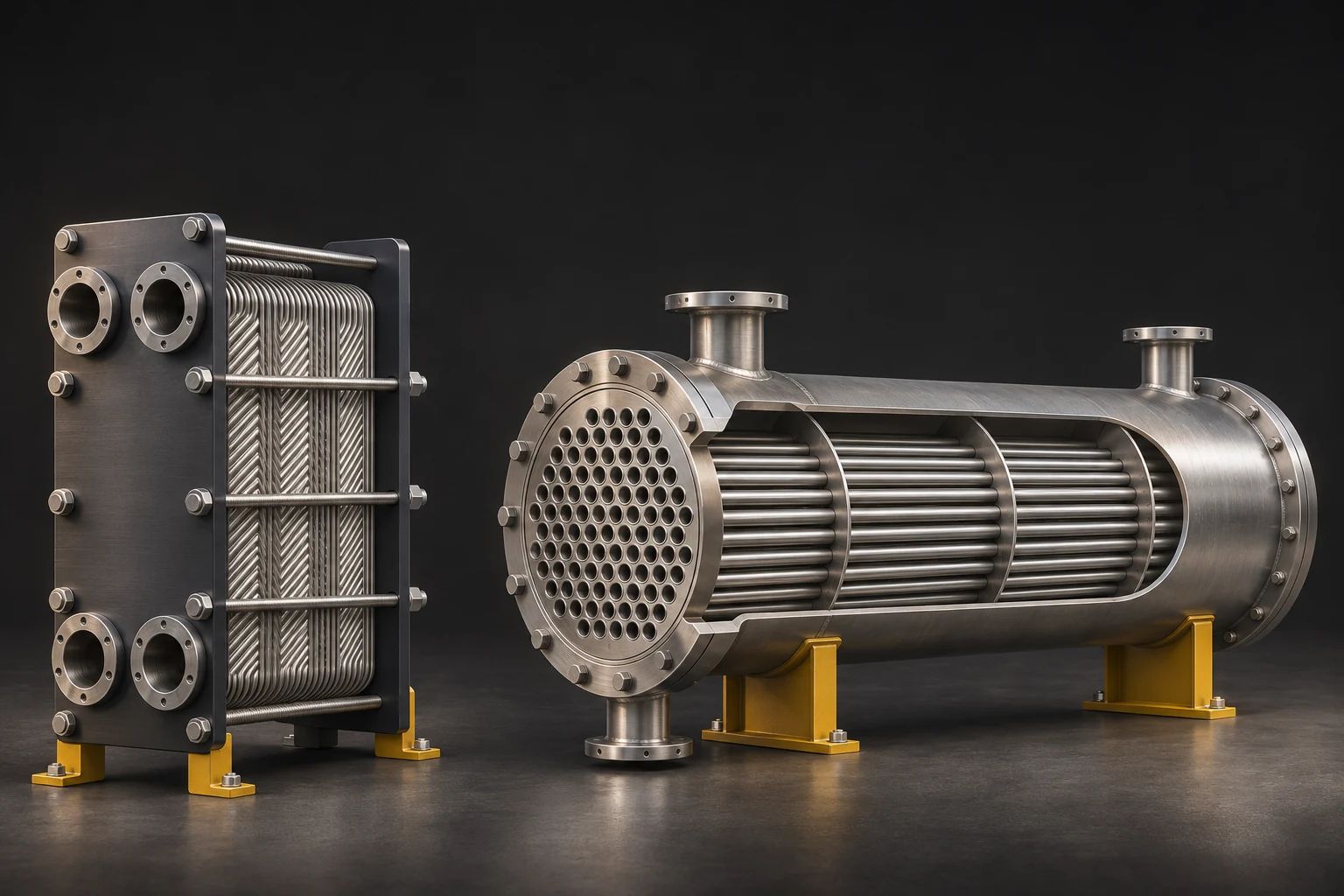
AI illustration; not a production or inspection record.
Quick answer
Choose against the actual operating envelope. A gasketed titanium plate-and-frame exchanger can offer a compact, openable arrangement; a shell-and-tube unit offers different flow paths and maintenance options. Neither architecture is universally better. Compare rated duty and pressure loss, all wetted materials, fouling and cleaning, mechanical limits and the service space required by the specific design.
01 / Define the equipment
Compare two architectures against the same service
A seawater cooling project can receive two plausible offers: a compact titanium plate heat exchanger and a shell-and-tube unit with titanium tubes. Comparing their advertised kilowatt ratings does not establish which one will work. A rating belongs to specified fluids, flow rates, temperatures and pressure losses. The first procurement task is to place both offers on the same operating basis.
Here, plate heat exchanger means an openable, gasketed plate-and-frame design. Brazed, fully welded and semi-welded plate exchangers have different sealing and maintenance arrangements and need separate evaluation. Shell-and-tube describes a family that includes fixed-tubesheet and removable-bundle constructions. A statement about one member of either family should not become a promise for every design.
Construction comparison; actual ratings and access depend on the offered design
Decision
Gasketed titanium plate-and-frame
Shell-and-tube with titanium tubes
Heat-transfer boundary
Formed plates separate alternating fluid channels
Tube walls separate tube-side and shell-side fluids
Opening for maintenance
Plate pack opens after the specified release and disassembly procedure
Access depends on heads, tubesheets and whether the bundle is removable
Sealing review
Plate gaskets, port seals and their compounds
Tube-to-tubesheet joints, head seals and other pressure-boundary connections
Solids review
Channel and port geometry, particle size and fiber behavior
Tube bore, headers, baffles and the selected fluid side
Capacity changes
Possible plate changes only within a reviewed frame, hydraulic and thermal configuration
Changes require review of the specific bundle and vessel arrangement
Pressure and temperature
Use the model’s combined design limits and gasket compatibility
Use the assembly’s design limits and construction details
Separate the design point from the operating envelope
Specify normal operation, maximum load, minimum flow, startup, shutdown and seasonal extremes. A cooler sized for winter seawater may miss the required outlet temperature in summer. A unit selected at full flow may behave differently when a control valve reduces one stream. Ask the designer to rate the relevant operating cases, not merely to increase the nominal capacity by an unexplained percentage.
Decide which quantity is actually controlled. If the process requires a maximum hot-side outlet temperature, state it together with the worst available coolant temperature and flow. If heat recovery is the objective, define the useful recovered heat and the downstream temperature requirement. These two projects can select different equipment even when their nominal heat loads are similar.
Record installation and maintenance constraints before requesting a layout. Available floor area, lifting access, connection orientation and shutdown duration affect the usable solution. The footprint printed on a drawing excludes much of the space needed to open a plate pack or withdraw a bundle. Include both operating space and service space in the comparison.
02 / Check the thermal duty
Use a heat balance before comparing advertised capacity
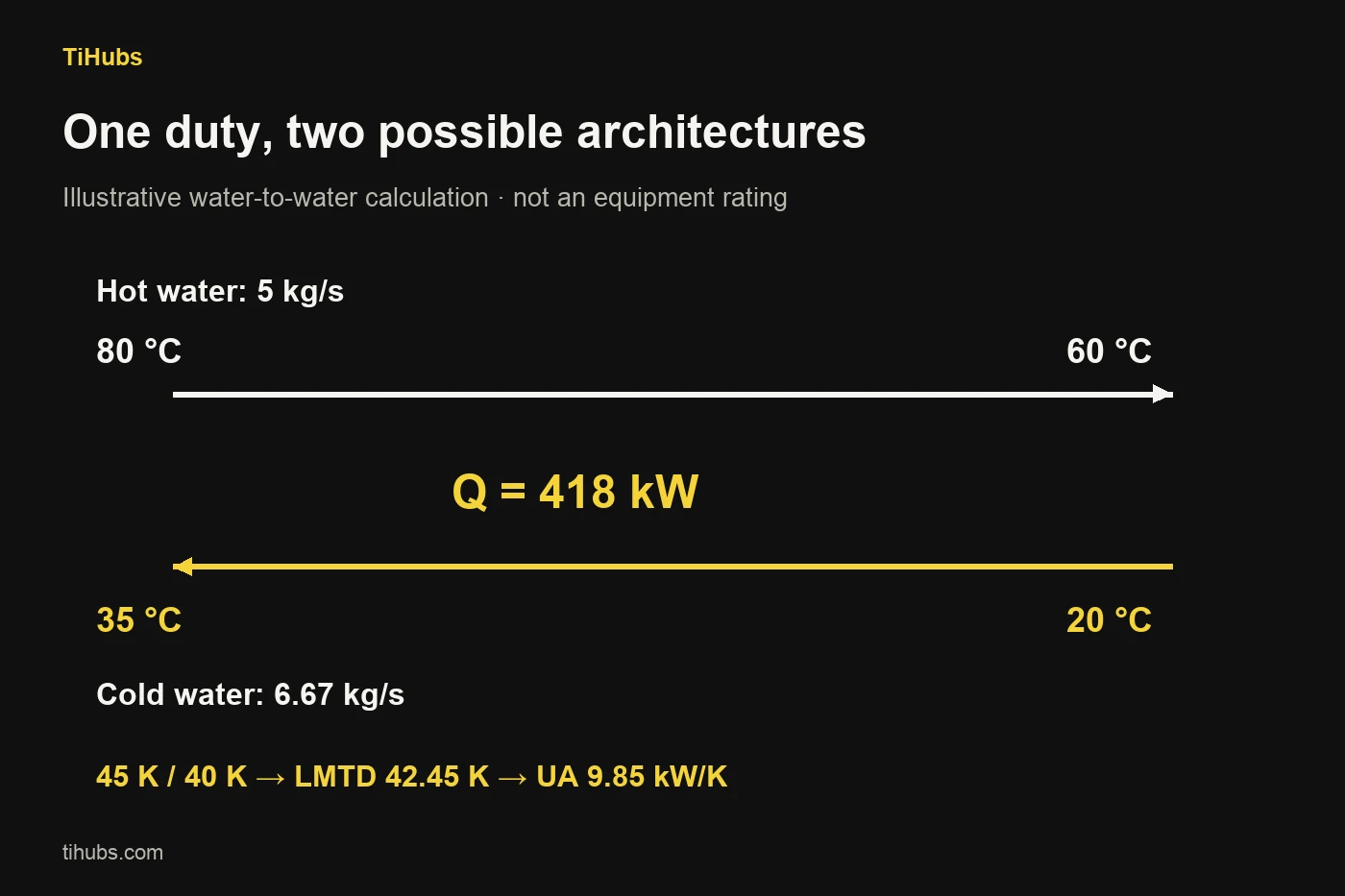
Consider an educational water-to-water example, not a product rating or a TiHubs test. Assume steady operation, negligible external heat loss, no phase change and a constant specific heat of 4.18 kJ/(kg·K) for both streams. Hot water enters at 80 °C and leaves at 60 °C at 5 kg/s. Cold water enters at 20 °C and must leave at 35 °C.
Original worked example; assumptions must be replaced by actual fluid properties for design
Quantity
Calculation
Result
Heat transferred
5 × 4.18 × (80 − 60)
418 kW
Required cold-water mass flow
418 ÷ [4.18 × (35 − 20)]
6.67 kg/s, rounded
Countercurrent terminal differences
80 − 35; 60 − 20
45 K; 40 K
Log mean temperature difference
(45 − 40) ÷ ln(45/40)
42.45 K, rounded
Required UA for ideal countercurrent flow
418 ÷ 42.45
9.85 kW/K, rounded
The heat-balance and logarithmic-mean-temperature-difference method is described in Alfa Laval’s calculation guide. This example determines a thermal requirement, not a plate count or tube area. U is the overall heat-transfer coefficient and A is the associated heat-transfer area. Actual selection also needs hydraulic calculations and the appropriate flow-arrangement treatment; a multipass shell-and-tube arrangement may require a correction factor or another suitable rating method.
Why titanium conductivity does not settle the comparison
Heat crosses a fluid-side film, the metal wall and another fluid-side film, with additional resistance where deposits form. Plate thickness, tube wall, flow distribution and fluid behavior all affect the result. Comparing only the conductivity of titanium with another metal ignores these other resistances. Comparing two titanium exchangers by metal conductivity alone ignores almost the entire equipment design.
Do not insert a convenient generic U value to produce an apparently precise area. Ask each supplier to state the proposed surface, flow arrangement, clean and design performance, and the treatment of fouling or margin. If one offer uses clean conditions and the other includes a defined fouling allowance, their quoted areas are not directly comparable. More area is not automatically evidence of better engineering.
A close temperature approach can make the required conductance increase sharply. In the example, changing the coolant inlet while holding every other target fixed changes the terminal temperature differences and therefore the thermal driving force. The designer must check the revised balance and feasible flow arrangement. A catalogue statement about close approach cannot replace that calculation for the actual fluids.
Require units beside every flow value. Kilograms per second and cubic meters per hour are not interchangeable without density. For glycol mixtures, oils, brines or process solutions, identify composition and properties over the operating range. A water-based rating may substantially misrepresent another fluid’s heat capacity, viscosity and pressure loss. If the process condenses or boils, use a phase-change design basis rather than this single-phase example.
The useful purchasing output is a duty sheet that both suppliers can sign against: temperatures, flows, fluid properties, load and relevant operating cases. Any inconsistency should be resolved before selection. Four specified temperatures, two specified flows and an independently specified load can overconstrain the problem; the numbers must satisfy the same energy balance.
Industrial buying guide / 02One heat balance, two architecture candidates
Original water-to-water example: 418 kW with 45 K and 40 K countercurrent terminal differences. It defines a duty, not an equipment rating.
03 / Pressure loss and fouling
Evaluate the channels as part of the pumping system
The allowable pressure drop is an input, not an afterthought. A thermally suitable exchanger can be unusable if the installed pump cannot deliver the required flow through it. State the pressure-loss budget separately for each side and distinguish the exchanger’s loss from the losses in connecting pipework, valves and strainers. Agree which connection-to-connection boundary the supplier’s value represents.
Corrugated plate channels can promote mixing and heat transfer, but the hydraulic cost depends on geometry and flow. A shell-and-tube designer also balances tube velocity, number of passes, shell-side arrangement and pressure loss. Neither design has an inherent right to consume more pumping power simply because its heat-transfer surface is smaller. Compare the offered configurations at the required operating points.
A transparent pumping example
For an incompressible stream, hydraulic power is volumetric flow multiplied by pressure loss. As a separate illustrative assumption, take 0.010 m³/s and an exchanger pressure loss of 50 kPa. Hydraulic power is 500 W. At an assumed combined pump-and-motor efficiency of 60%, electrical input associated with that loss is approximately 833 W. At 8,000 operating hours, that is about 6,667 kWh. These are calculation assumptions, not typical ratings for either exchanger.
This simple estimate helps expose an omitted operating cost, but it is not a complete pump-system model. Actual efficiency and flow change with the operating point, control strategy and other system losses. Use the plant’s expected hours and energy tariff, and evaluate both streams where relevant. Do not present the example as a guaranteed saving from one architecture.
Describe what can obstruct the flow
Seawater quality is more informative than the word seawater alone. Identify suspended solids, particle-size distribution, fibers, biological loading and the upstream filtration arrangement. A narrow channel may be vulnerable to a contaminant that passes the existing strainer. A tube entrance or header can also collect debris. Choose the flow passage and protection arrangement against the actual contamination, not a general reputation for handling dirty water.
Specialized wide-gap plate designs exist for fibrous fluids and coarse particles; Alfa Laval’s WideGap description is one manufacturer example. Their existence does not mean every plate pattern handles the same solids, nor does it confirm titanium availability in every model. Ask for the offered channel geometry, material option and operating basis.
Fouling changes more than a single thermal number. Deposits can reduce heat transfer and restrict flow, while a changed flow distribution can affect local conditions. Establish clean commissioning baselines for flow, temperatures and pressure difference. Trend measurements at comparable operating conditions; otherwise a seasonal inlet-temperature change can be mistaken for a loss of exchanger performance.
Provide a plan for strainer inspection and cleaning as well as exchanger maintenance. A blocked upstream strainer may reduce flow before the exchanger itself needs cleaning. Measurements on both components help distinguish the causes. The maintenance trigger should relate to process performance and hydraulic behavior, with intervention limits defined by the equipment and operating team.
04 / Wetted materials and seals
A titanium heat-transfer surface is not the whole assembly
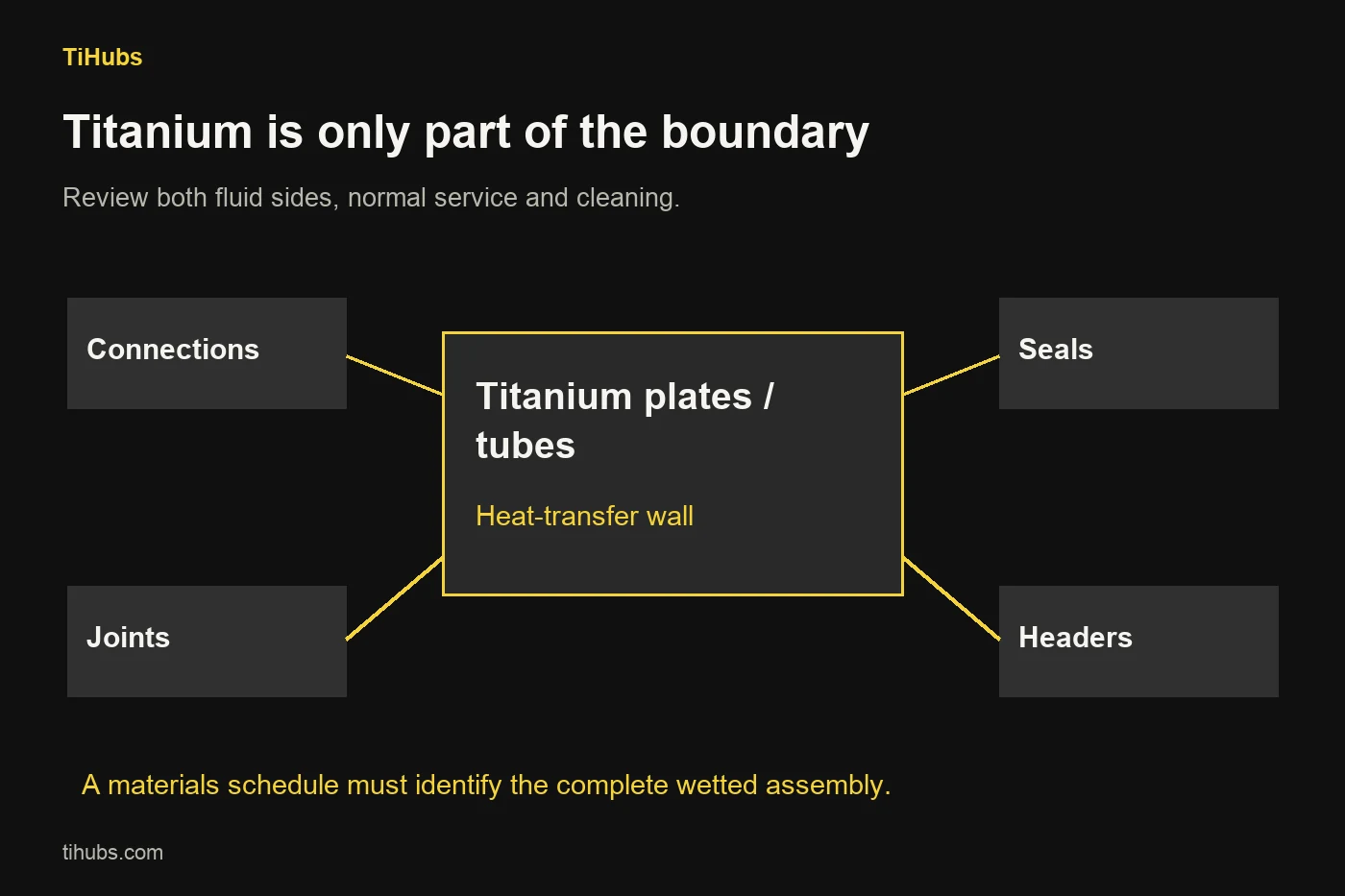
The phrase titanium heat exchanger often describes its plates or tubes. It does not prove that every wetted component is titanium. Request a materials schedule identifying each side’s plates or tubes, tubesheets, headers, nozzles, linings, gaskets and other wetted details. A corrosion-resistant heat-transfer wall cannot compensate for an unsuitable connection exposed to the same process fluid.
Keep material selection linked to the full chemical and temperature envelope, including cleaning and shutdown. A metal compatible with normal service may face a different environment during cleaning or stagnant storage. List process contaminants and cleaning-agent concentrations, temperatures and exposure durations for the responsible designer’s review. Do not turn a broad seawater suitability statement into approval for every chemical mixture.
Review elastomers as engineered components
For a gasketed plate unit, the compound must suit the fluids and thermal cycle. A generic family name such as EPDM or NBR is not the complete specification: formulation, supplier designation and application approval matter. Request the manufacturer’s material recommendation for the actual service. The maximum pressure and maximum temperature printed separately in a brochure may not be simultaneously permissible.
Cleaning compatibility belongs in the same review as process compatibility. A cleaning solution contacts plates, gaskets and potentially adhesive or other components. A procedure that removes deposits but damages a seal is not a successful maintenance method. Alfa Laval’s cleaning guidance distinguishes mechanical cleaning and cleaning in place and emphasizes compatibility with the exchanger materials.
For shell-and-tube equipment, ask how tubes connect to the tubesheets and what inspection establishes the required joint integrity. Expanded, welded or combined arrangements should be evaluated within the actual design and fabrication requirements. The presence of titanium tubes alone does not describe the joint design, tubesheet material or pressure-boundary qualification.
Make the consequence of leakage explicit
Identify whether an internal leak would contaminate a valuable product, introduce coolant into a process or create another unacceptable condition. Pressure hierarchy, detection, isolation and any required separation arrangement should be engineered for that consequence. Do not assume that an external gasket leak is the only possible failure mode of a plate exchanger or that tubes eliminate cross-contamination risk.
Where contamination prevention is critical, ask the equipment designer which construction and monitoring arrangement meet the requirement. Double-wall or other protective arrangements are specific design choices, not properties automatically included with titanium. Record the accepted solution and its inspection basis in the purchase specification rather than relying on a general claim of leak safety.
Temperature transients and differential pressure also deserve attention. Starting one side while the other is isolated can create a different mechanical condition from steady operation. The supplier should provide permissible operating sequences and limits. The plant’s controls, relief provisions and operating instructions need to support those limits; purchasing a higher nominal capacity does not resolve a transient-pressure problem.
Industrial buying guide / 04Review the whole wetted boundary
Titanium plates or tubes are only part of the materials review. Connections, joints and seals also need an agreed compatibility basis.
05 / Maintenance and lifecycle
Buy access, spare parts and recoverable performance
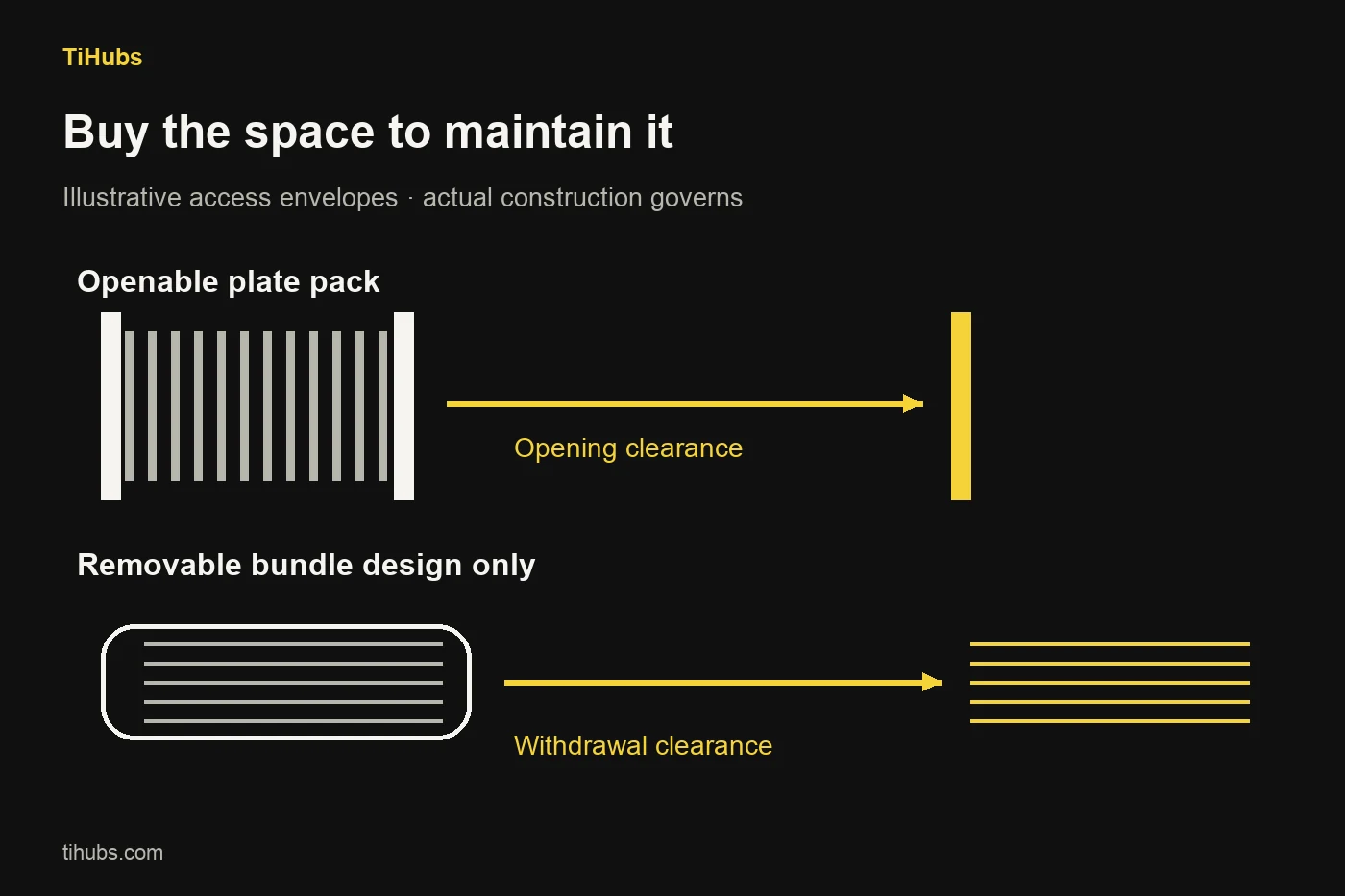
An exchanger’s maintenance advantage exists only if the installation allows the intended work. A gasketed plate pack needs space to move the pressure plate and separate plates safely. A removable tube bundle needs withdrawal and handling space. A fixed-tubesheet arrangement has different access limitations. Review a maintenance drawing with the people who will perform the work before freezing the surrounding pipework.
Specify isolation, draining, venting and access requirements in the installation plan. These are project-specific engineering responsibilities, but the equipment supplier must provide the information needed to complete them. A compact unit can still be expensive to service if adjacent equipment prevents opening it or if all connecting pipework must be removed for routine work.
Compare the actual service operation
For a plate pack, ask about the cleaning method, plate inspection, gasket replacement, correct plate sequence and closing dimension. Confirm who supplies replacement plates and gaskets, how the model and plate pattern are identified, and whether local service is available. Similar-looking plates are not necessarily interchangeable. Keep the manufacturer’s assembly information with the equipment record.
For shell-and-tube equipment, distinguish tube-side access from shell-side access. A removable head may expose tube entrances without making the external tube surfaces accessible. Determine whether the specified deposit can be removed by the available cleaning route. A claim that the exchanger is easy to clean should name the surface being cleaned and the access actually provided.
Repair options need a design review. Removing plates, changing the plate arrangement or plugging tubes can alter heat-transfer area, flow distribution and pressure loss. A repaired unit should be assessed against the required duty and any applicable mechanical limits before return to service. The ability to make a physical repair does not prove that the original thermal performance remains available.
Use a lifecycle comparison with visible assumptions
Compare purchase price, installation, pumping energy, planned service, consumables, spare inventory and the economic consequence of downtime over the same evaluation period. Use plant-specific values and show uncertain assumptions as ranges. Avoid a universal payback claim based on a manufacturer’s unrelated example. A lower purchase price can be attractive when the service is mild and maintenance is easy; a more expensive configuration can be justified when it avoids a defined operational constraint.
Separate an equipment warranty from a performance guarantee. Identify the conditions under which a thermal guarantee applies, the measurement boundary, instrument requirements and treatment of tolerances. A warranty against manufacturing defects does not necessarily promise a particular outlet temperature under unspecified process conditions. Resolve the distinction in the commercial and technical offer.
Plan for changing duty. Adding plates may be possible within a suitable frame, but connections, allowable pressure loss and the new temperature program still need review. Likewise, a shell-and-tube upgrade may require more than substituting a different bundle. Ask for the credible upgrade envelope and its assumptions instead of buying an undefined future-proof label.
Industrial buying guide / 05Reserve the space needed to maintain it
Illustrative service envelopes, not dimensional drawings. Check plate-pack opening or bundle withdrawal against the actual equipment design.
06 / Enquiry and acceptance
Turn the comparison into an actionable purchase specification
Send one duty sheet to both suppliers. Include fluid identity and composition on each side; normal and limiting temperatures; flow ranges; heat duty; pressure and allowable pressure loss; contamination; cleaning regime; and installation constraints. Mark which values are fixed requirements and which can be optimized. This prevents a supplier from solving an easier problem than the one the plant actually has.
Request a thermal selection sheet, materials schedule, general arrangement drawing and clearly defined inspection and documentation scope. Ask for assumptions and exclusions beside the price. If one proposal omits strainers, mating connections, insulation or spare gaskets, identify those differences before calculating installed cost. A shorter equipment list is not necessarily a less expensive functioning system.
For titanium components, identify the required grade, product specification, dimensions and material traceability. Tube wall and plate thickness belong to the approved design, not a purchasing shortcut. The titanium heat-exchanger tube selection guide addresses tube procurement in more detail; this comparison remains focused on equipment architecture and operating fit.
Define receiving and commissioning checks before shipment. Verify equipment identity, connections, supplied materials documentation and agreed factory inspection records. At commissioning, record actual temperatures, flows and pressure losses at stable conditions. If the duty differs from the guaranteed basis, have the designer reconcile the conditions before declaring success or failure from a single outlet-temperature reading.
TiHubs can review enquiries for titanium heat exchangers and titanium heat-exchanger tubes. Send the duty and drawing requirements so the supply scope can be confirmed. Model availability, pressure-vessel requirements, materials, testing and delivery must be agreed for the actual project; this article does not certify a particular assembly.
The best choice is the offer that meets the required thermal and hydraulic cases, uses compatible wetted materials, can be maintained at the site and provides the agreed evidence. That may be a gasketed plate design or a shell-and-tube design. The purchasing record should explain the choice through those conditions, making the decision useful when the plant later changes its coolant, production rate or maintenance strategy.
07 / Build your RFQ
Prepare a duty-based heat exchanger enquiry
Provide the process conditions on both sides and identify the fixed constraints. A complete duty sheet lets the proposed equipment and titanium supply be reviewed against the same operating problem.
Information to include
Both fluids, composition, contamination and cleaning regime
Inlet and outlet temperatures, flow ranges and heat duty
Operating and design pressures; allowable pressure loss per side
Space, connection orientation and maintenance clearance
Required materials, inspection, documentation and delivery
Build your RFQ checklist
Choose the product and add the information you have. Copy the resulting brief or send your requirements to TiHubs. Submitting an enquiry does not place an order.
08 / FAQs
Questions buyers ask
Is a titanium plate exchanger always more efficient?
No universal efficiency percentage decides the purchase. Compare the required heat load and temperature program at the permitted pressure loss. Plate geometry can support compact heat transfer, but the offered configuration must be rated for the actual fluids, fouling assumptions and operating cases.
Does a titanium heat exchanger contain only titanium?
Not necessarily. The term may describe the plates or tubes. Request a complete wetted-materials schedule for both fluid sides, including connections, tubesheets, headers and seals. The whole assembly must suit the process and cleaning conditions.
Can every shell-and-tube bundle be removed?
No. Bundle removal depends on construction. A removable head may provide tube-side access while leaving shell-side surfaces difficult to reach. Check the actual maintenance drawing and the space needed for the intended cleaning or repair operation.
Can adding plates increase capacity without other changes?
Only after reviewing the configuration. Frame capacity, plate arrangement, connections, flow distribution and pressure loss constrain an expansion. The revised duty must be rated; a larger plate count alone does not guarantee the required outlet temperature.
Can the 418 kW calculation size my exchanger?
It illustrates a heat balance under explicitly stated water properties and idealized assumptions. It does not select area, plate count, tube arrangement or pressure rating. Actual selection needs the real fluids, hydraulic limits, fouling basis and appropriate thermal and mechanical design.
What should be compared first in two quotations?
Check that both use the same fluids, temperatures, flow rates, heat load and allowable pressure losses. Then compare materials, operating limits, maintenance access and the supplied documentation. Price comparisons become useful only after the technical and supply boundaries are aligned.
09 / Key takeaways
Keep the purchase requirements connected.
Define the architecture precisely and rate the relevant operating cases.
Balance heat duty before comparing surface area or advertised capacity.
Include pressure loss, contamination and cleaning in the selection.
Review every wetted material and the consequences of internal leakage.
Compare installed and maintained equipment against one agreed duty sheet.
Technical references
Sources and data scope
References reviewed November 15, 2026. Public source summaries support the discussion; the controlled specification, agreed edition and approved project requirements govern acceptance.
Alfa Laval — WideGap — Example of specialized plate geometry for fibrous fluids and coarse particles; not a universal material or performance guarantee.
Thermex — What is a heat exchanger? — Manufacturer explanation of plate and shell-and-tube construction, including fixed and floating tube-stack arrangements.
Ti
About TiHubs
TiHubs coordinates titanium material and custom supply enquiries from Baoji, China. Send the product, drawing revision and acceptance requirements so the proposed supply scope can be reviewed. Learn about our sourcing role.
Contents
TiHubs
Talk to TiHubs
Ask about titanium materials, grades or custom parts.
Enter your email to start chatting.
We use your email to respond to your enquiry. Your conversation is stored on this website.
Our team is away right now. Leave your enquiry and we will follow up by email.