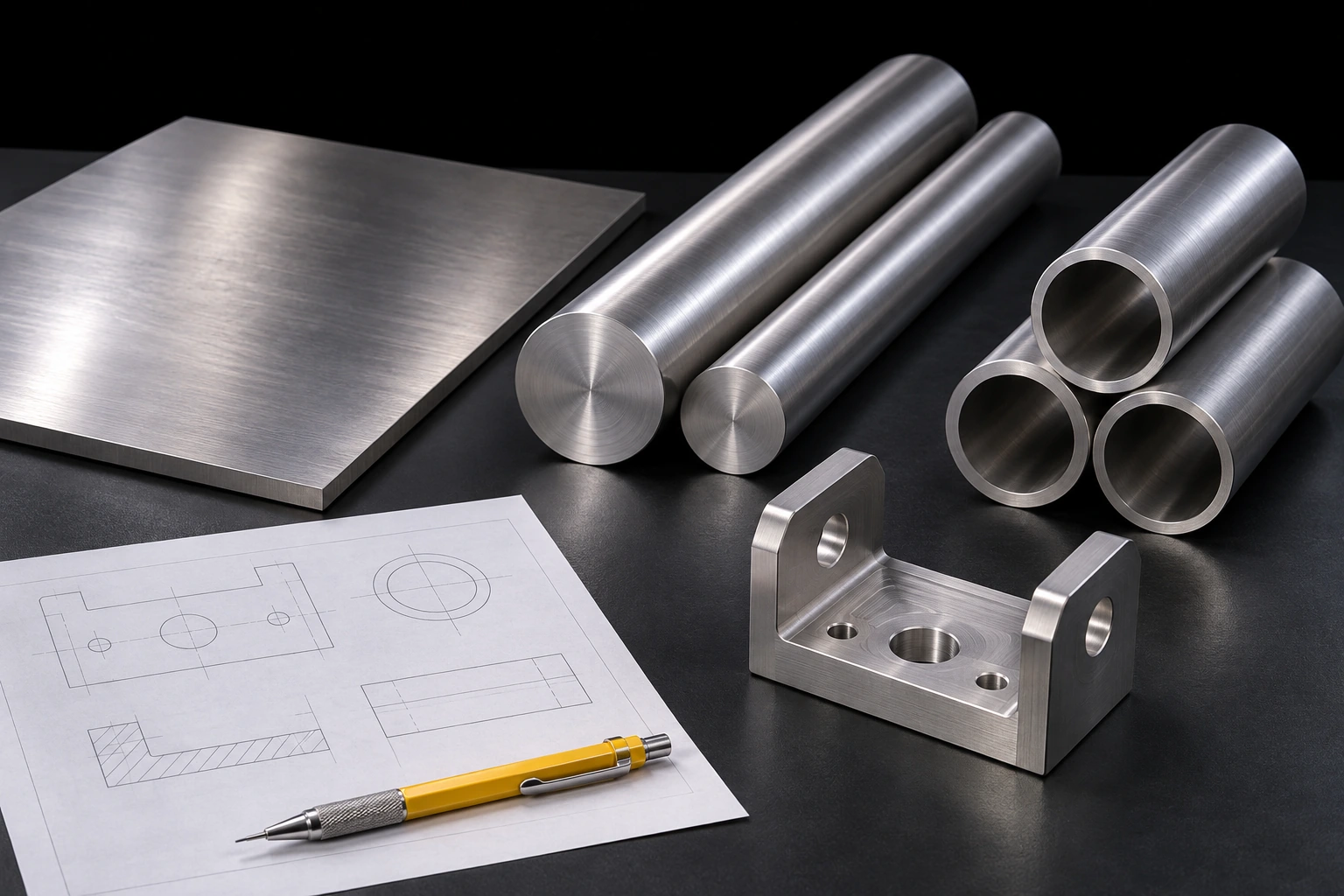
A practical enquiry structure for titanium sheet, bar, tube and drawing-based parts. Separate confirmed requirements from open questions and request a comparable supplier response.
AI illustration. Appearance and labels do not verify material compliance.
What belongs in a titanium RFQ?
A useful titanium RFQ template defines the delivered product, material basis, dimensions or drawing revision, quantity, acceptance evidence and delivery requirement. It also tells the supplier how to respond: confirm compliance, identify deviations, list exclusions and state the conditions behind price and lead time. An enquiry is ready for a firm quotation when its open questions are visible and the important assumptions have been agreed.
Start with the common template below, then add the sheet, bar, tube or custom-part module. If a requirement is unknown, write “review required” and explain the intended use or constraint. Do not guess a material grade, a tolerance or a test merely to fill every field. A budget estimate based on assumptions and a firm offer against an approved specification are different outputs.
01 / RFQ purpose
Decide what you want the supplier to deliver
An RFQ can request a budget estimate, a technical feasibility review, a sample proposal or a production quotation. State the purpose at the top. The amount of information needed for each stage differs, and the supplier should identify which parts of its response remain provisional. A price obtained before the drawing is complete should not quietly become the final production baseline.
Define the delivery stage. “Titanium ring” could mean a forged blank with machining stock, a rough-machined ring, or a fully inspected finished component. “Titanium tube” could mean straight stock, cut lengths, bent tubes or a fabricated assembly. Include a short plain-language description as well as the formal drawing or standard.
Give the RFQ a reference number, revision and response deadline. Use line numbers for separate materials or sizes. Ask the supplier to keep those identifiers in its quotation so that purchasing, engineering and inspection can discuss the same item without relying on attachment order or informal names.
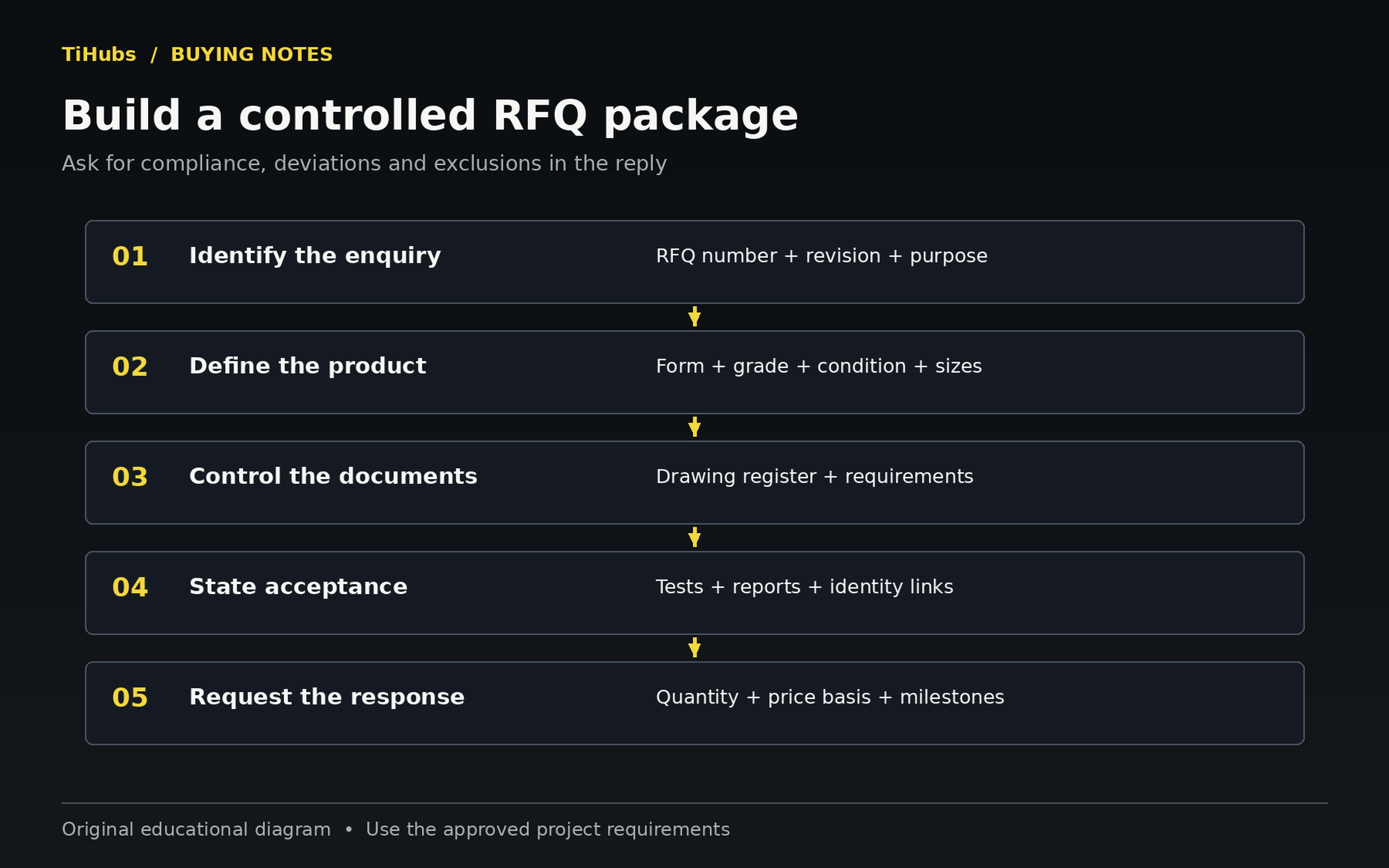
Purchasing planning diagramBuild a controlled enquiry package
Original purchasing diagram. Connect the RFQ, drawings, material requirements, evidence and supplier response.
02 / Common RFQ template
The common RFQ template
Field
Information to provide
If it is not yet known
Enquiry identity
RFQ reference, revision, date, contact and response deadline
Assign a reference before requesting revisions
Purpose
Budget, feasibility, sample or production quotation
Ask for a staged response
Delivered product
Product form and stock, blank or finished stage
Describe the function and required output
Material
Grade, product standard, edition and condition
Request a separately identified proposal
Geometry
Dimensions with units, drawing and revision
List confirmed dimensions and unresolved interfaces
Critical characteristics
Tight tolerances, datum requirements, surface, cleanliness
Identify what affects fit or function
Quantity
Pieces and/or kg, trial batch and repeat demand
Separate a forecast from a committed quantity
Evidence
Certificate type, actual test data, inspection reports, traceability
Ask what is included and what needs additional work
Delivery
Destination, required date, requested delivery rule and named place
Use the table as a controlled input record, not a list of demands copied into every order. Some products need additional application-specific requirements; others can be bought efficiently against a clear stock specification. The responsible designer or purchaser should decide which requirements are mandatory.
03 / Material basis
Specify the material without creating contradictions
Record the complete grade and product specification, including the edition required by the project. A chemical alloy family is only one part of the material definition. The delivered form, condition, mechanical requirements, examination scope and documentation also matter. ASTM’s flat-product, bar/billet and heat-exchanger-tube specifications cover different product scopes. [1][2][3]
If a drawing and purchase specification disagree, flag the conflict before asking for a firm price. Identify which document has authority and who can resolve the inconsistency. Do not ask a supplier to “meet both” when the requirements are incompatible or describe different product stages. A written clarification is more useful than a hidden assumption.
When Chinese material designations are proposed, keep the requested designation and the offered designation in separate fields. Ask for the compliance basis rather than a renamed certificate. If an alternative is technically acceptable, record the approval and keep its quotation separate from the original requirement until the purchasing baseline is revised.
04 / Sheet and plate
Module A: titanium sheet and plate
For flat products, the useful question is what material must arrive ready for your next process. State whether you want full mill sheets, rectangular cut blanks, profiles, formed parts or machined plate. Include thickness, width and length in a consistent order, with units. Distinguish the nominal stock thickness from any finished thickness after machining or forming.
Sheet / plate RFQ field
Fill-in structure
Material basis
[Grade] / [product specification and edition] / [condition]
[Pieces per size] / [estimated kg if useful] / [repeat schedule if applicable]
Dimensional requirements
[Thickness tolerance] / [width and length tolerances] / [flatness and squareness basis]
Downstream process
[Bending, stamping, welding or machining] / [orientation requirement if specified]
Surface and edges
[Required finish] / [acceptance criteria] / [burr and edge treatment]
Cutting and yield
[Profile or nesting file] / [allowance] / [remnant ownership]
Evidence and packing
[Certificates and reports] / [heat-to-piece map] / [face and corner protection]
ASTM B265 is a flat-product specification; its scope includes annealed titanium strip, sheet and plate. [1] Refer to the complete ordered edition for requirements. Do not assume a generic “ASTM titanium” statement includes a chosen flatness class, special surface limit or customer inspection plan.
A useful illustrative line is: “Grade 2 sheet, ASTM B265, project-approved edition stated in the purchase specification; annealed; 2.0 × 500 × 1000 mm rectangular blanks; 20 pieces; tolerances and surface acceptance per drawing S-101 revision C; provide the ordered material certificate and a heat-to-blank identification list.” The dimensions and drawing reference are examples, not recommended design values. Add the actual application-specific requirements before sending.
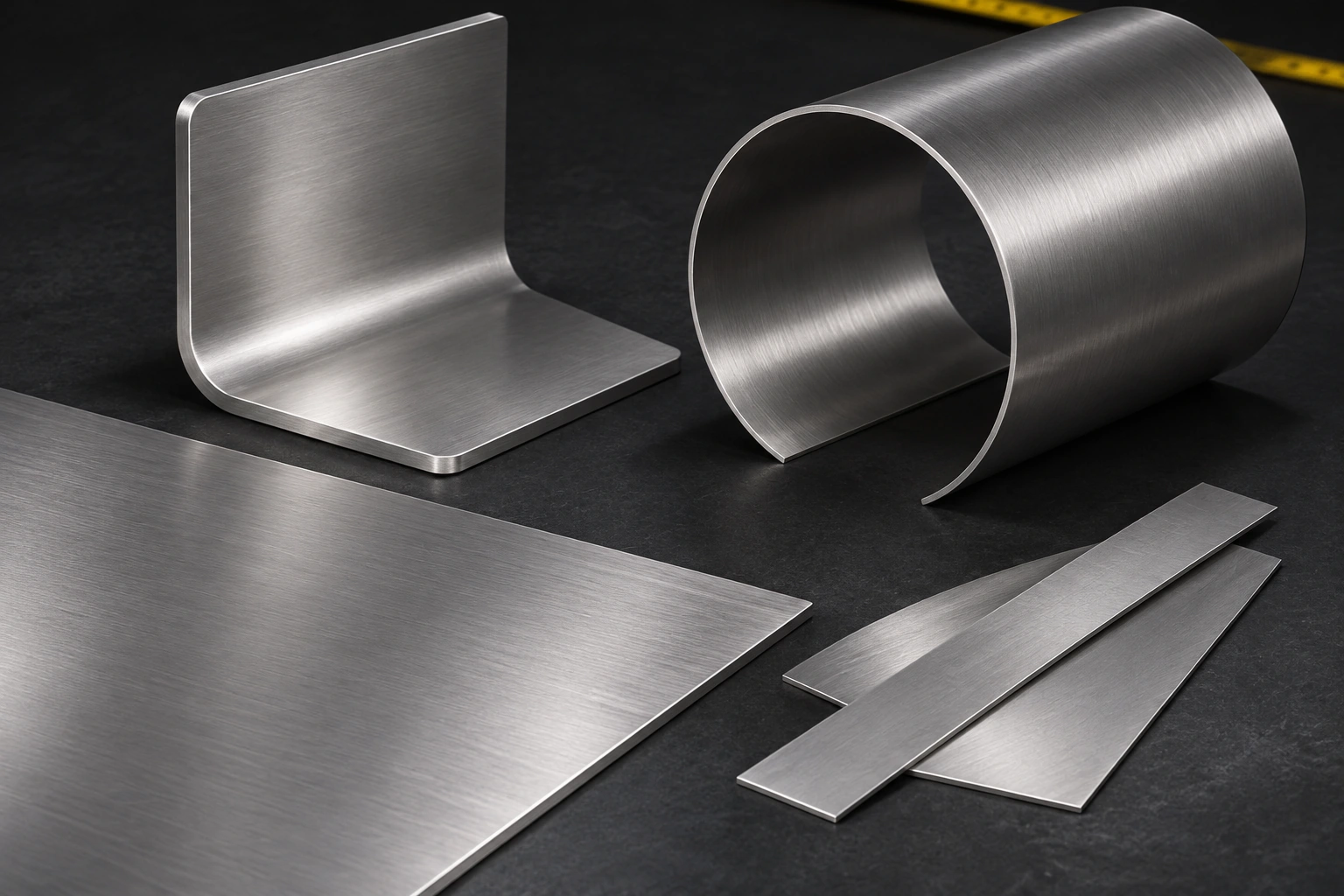
Illustrative product viewConnect the sheet to its next operation
AI illustration; not a factory, certificate or inspection record. State the required sizes, orientation and surface before choosing a supply route.
05 / Bar and rod
Module B: titanium bar and rod
For bar, specify the section, diameter or across-flats dimension, length, delivered condition and surface. State whether the supplier is quoting full lengths, cut billets, centerless-ground stock or machined blanks. A diameter that is adequate for a rough machining blank may not be the accepted diameter for a finished shaft.
Bar / rod RFQ field
Fill-in structure
Material basis
[Grade] / [bar or billet specification and edition] / [condition]
Cross-section
[Round, square, hexagonal or drawing-defined] / [dimension and tolerance]
[Heat and lot control] / [piece or bundle marking] / [packing]
ASTM B348/B348M addresses titanium bars and billets. [2] Confirm which product stage is actually offered. If a component is to be forged or machined from the stock, the starting material certificate does not automatically establish acceptance of the finished part.
For repeated machined blanks, include the finished component envelope and the required stock allowance as separate information. Ask whether the quoted length includes saw-cut cleanup, test material or end discard. State if all blanks must come from one heat or if multiple approved heats are acceptable; an unnecessary single-heat restriction can limit otherwise suitable supply.
06 / Tube and pipe
Module C: titanium tube and pipe
Tube enquiries need a dimensional basis as well as a material basis. Specify outside diameter, wall thickness and length, and say whether wall is nominal, minimum or otherwise defined by the project. For pipe, identify the applicable size and wall designation and any required dimensional standard. Do not mix OD-based tube dimensions with a nominal pipe designation without an explicit conversion and approval.
Tube / pipe RFQ field
Fill-in structure
Service and product
[Heat-exchanger tube, process pipe or other product] / [new equipment or replacement]
Material
[Grade] / [specification and edition] / [condition]
Manufacturing route
[Seamless, welded or permitted alternatives] / [approval conditions]
ASTM B338 covers tubing for condensers and heat exchangers. [3] It should not be substituted automatically for a general pipe requirement. If the choice between B338, B861 and B862 is unresolved, state the equipment context and request a review of the proposed specification, not simply the cheapest available tube.
Replacement work needs extra information: existing drawings, measured dimensions, tubesheet and joint details where relevant, evidence of service problems, and confirmation of what is being retained. A sample can reveal geometry, but it may not identify the original material condition or design requirement. Keep the responsible equipment engineer involved in approving changes.
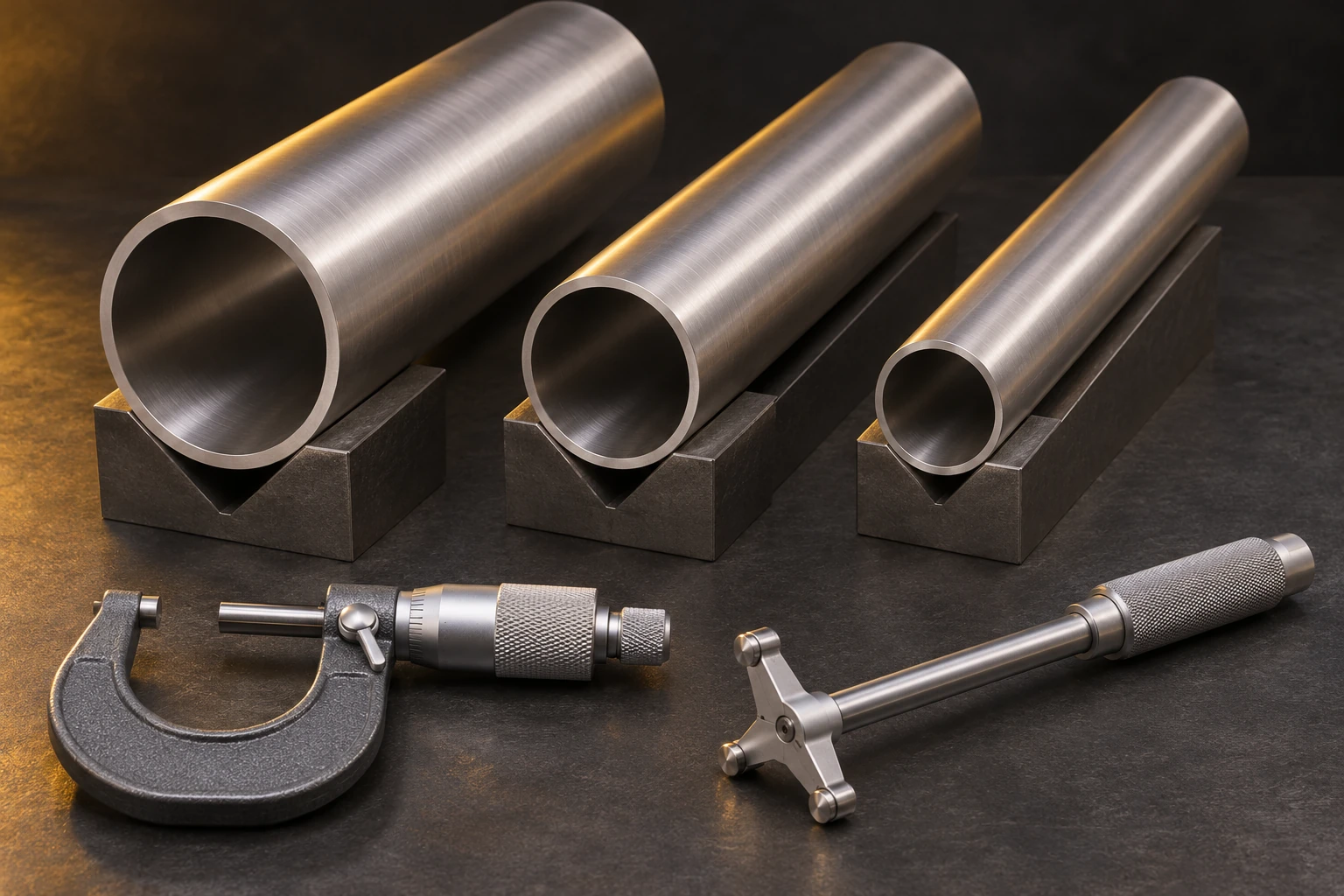
Illustrative product viewDescribe the tube deliverable precisely
AI illustration; not a factory, certificate or inspection record. Specify dimensions, manufacturing route and the evidence needed for release.
07 / Custom parts
Module D: drawing-based titanium parts
For custom parts, provide a controlled drawing package rather than a photograph alone. The drawing should identify the part number, revision, units, material basis, datum structure, tolerances, surface requirements and relevant notes. A 3D model helps define geometry; it does not necessarily contain every manufacturing and acceptance instruction.
Custom-part RFQ field
Fill-in structure
File control
[Drawing number/revision] / [2D file] / [3D model format and version]
Supply stage
[Finished component, rough part or blank] / [operations included]
Material route
[Grade and specification] / [condition] / [starting stock or forging requirements]
[Tooling arrangements if applicable] / [packing] / [delivery schedule]
Identify the governing GD&T or drawing convention and edition when the design relies on it. Avoid mixing conventions or leaving a supplier to infer a datum from a model view. Explain which dimensions are functional so the supplier can raise manufacturability questions without silently loosening the drawing.
Ask for proposed manufacturing changes as separate, marked suggestions. A larger internal radius, a different blank size or a revised finish may reduce cost, but each change needs engineering approval. A supplier’s quotation should not itself authorize a design modification. Our CNC cost guide explains common cost drivers.
08 / Drawing package
Keep the file package controlled
Create a file register listing each attachment, its revision and its role. State whether the 2D drawing or 3D model controls when a conflict exists, and identify any separate material or inspection specification. Remove superseded files from the active RFQ package while retaining them in your own revision history. A folder containing three plausible “final” drawings invites different interpretations.
Use readable dimensioned views and sufficient detail for inaccessible features, threads, edge requirements and inspection. If the supplier must develop a manufacturing drawing from your concept, quote that engineering activity separately and identify the approval stage before production. Do not treat an illustration as a fully defined manufacturing instruction.
Share only information needed for the enquiry and use your organization’s approved method for confidential drawings. The public checklist below accepts a written brief; it does not require you to post proprietary design files publicly. Ask TiHubs to confirm an appropriate document-transfer channel where controlled files are needed.
09 / Acceptance evidence
Turn quality requirements into a deliverable package
List the documents you expect with the material or parts. Identify the required certificate type, actual test results, dimensional reports, agreed examinations and any independent inspection. State how each record must connect to the heat, product lot, piece or part number. A list of certificate names without a material identity link is difficult to use at receiving.
For special inspection, define method, coverage, criteria, timing and reporting. Ask who supplies the procedure and who can approve it. A witness point may need booking before the relevant manufacturing stage; an inspection added after processing may be expensive or impossible to reproduce meaningfully. Decide these points before the supplier promises a delivery date.
Separate qualification from batch acceptance. A first article may establish that a process can make the drawing, while ongoing production still needs the agreed inspection controls. A successful sample does not waive requirements for later material. Record which changes—such as source, process, drawing or tooling changes—require further review.
10 / Commercial basis
Make the price and delivery response comparable
Ask for unit price, total price, currency, validity, quantity breaks and the billing basis. Separate material, processing, tests, tooling, packing and transport charges where useful. State whether you need actual-weight pricing, theoretical-weight pricing or a price per accepted piece, and ask the supplier to identify any minimum billing quantity.
Specify the requested delivery rule with its named place and edition, and ask the supplier to state any alternative. Incoterms® rules address delivery responsibilities and the allocation of certain costs and risks; they do not replace the rest of the order. [4] Have the appropriate commercial and logistics staff agree the complete arrangement.
Request milestone dates rather than only a single week count. Clarify the start trigger, material allocation, drawing or sample approvals, testing, release, ready-for-dispatch date and transport assumptions. If you require a delivery date at your site, distinguish it from the date the material becomes available at the supplier.
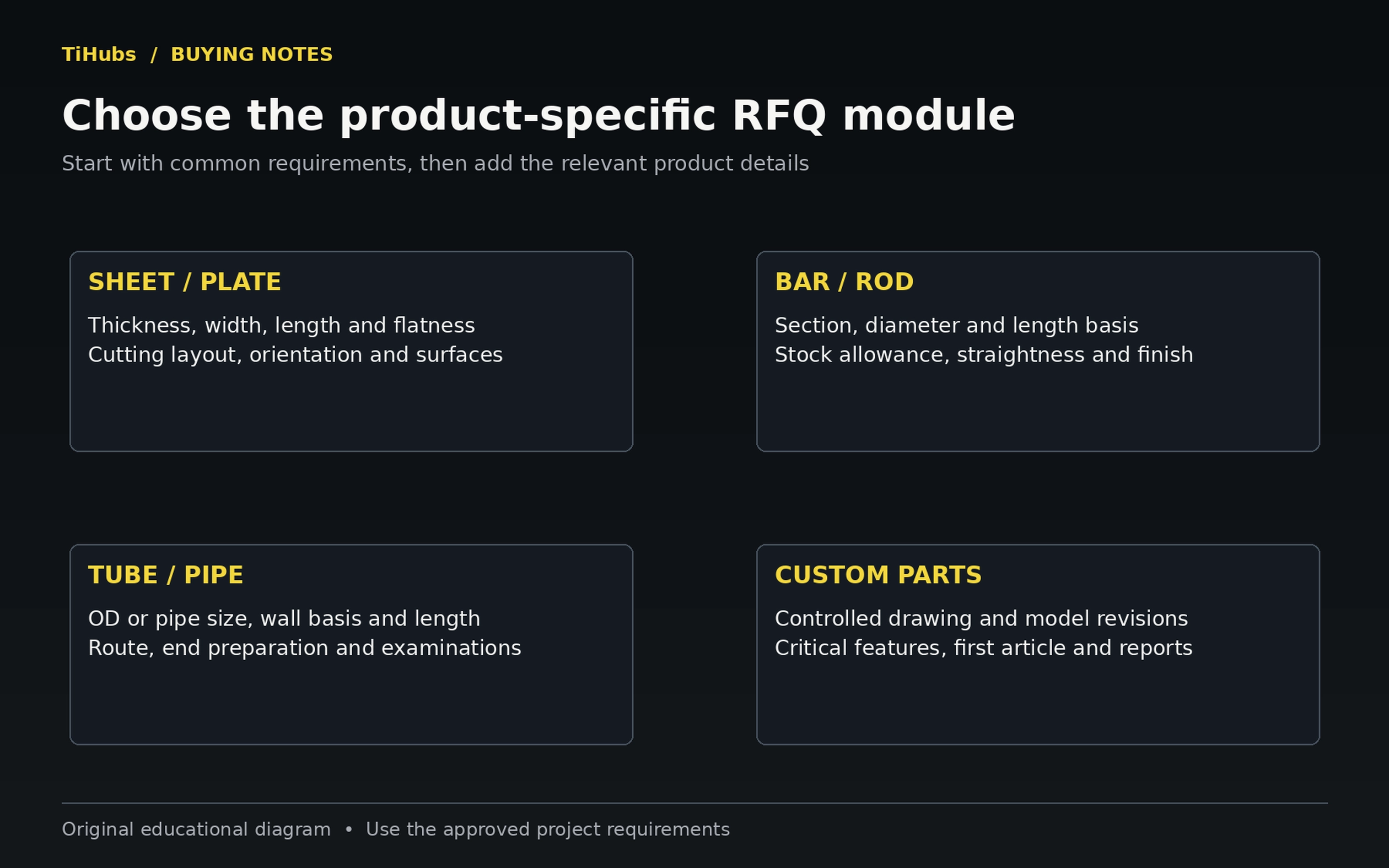
Purchasing planning diagramAdd the right product-specific details
Original purchasing diagram. Sheet, bar, tube and custom parts need different geometry and acceptance inputs.
11 / Supplier response
Ask the supplier to reply in a structured format
Supplier response item
Required response
RFQ and drawing revision
Confirm the exact package reviewed
Compliance
Confirm each line or identify the specific difference
Alternatives
Price separately and explain required approval
Source and route
Identify the proposed supply and processing basis to the agreed disclosure level
Quantity and billing
State delivered pieces, weight basis, minimum and permitted variation
Price and exclusions
List inclusions, separate charges, validity and unresolved allowances
Evidence
Confirm certificates, reports, traceability and release stages
Schedule
State start conditions and milestone dates
Open questions
Give a numbered clarification list with the decision needed
This structure reduces the chance that a supplier replies with only a kilogram price and a generic lead time. It also exposes disagreements early. If the supplier cannot confirm an item, ask for the reason and a proposed route to resolve it rather than converting an unknown into an assumed “yes.”
12 / Worked example
Worked example: turning a vague enquiry into a quoteable package
The starting message is: “Please quote Grade 5 rods for CNC parts, 100 kg, urgent.” It does not identify the product standard, condition, diameter, cut length, machining allowance, inspection scope or the meaning of urgent. Several suppliers could answer honestly while quoting different products.
A better first revision states the product and the missing decisions: “RFQ R-204 revision A, budget-to-firm review. Grade 5 round bar for machined parts; requested product specification and edition in attachment M-204; condition to that specification; 40 mm nominal stock diameter; 60 cut blanks at the length and allowance shown on drawing B-204 revision B; required inspection documents and dimensional report in Q-204. Confirm whether the proposed stock provides the required usable envelope. Quote delivered pieces and state actual/theoretical billing basis. Required ready-for-dispatch date: [date]; destination: [place].”
Those dimensions and identifiers are illustrative. The important improvement is the relationship between stock, finished requirements, quantity and evidence. If the documents are still incomplete, the supplier should return a budget estimate with assumptions and a clarification list. Once the buyer resolves the list, issue the approved revision for a firm quotation and order acknowledgement.
13 / Order handoff
Use the RFQ again when the order is confirmed
Before placing the order, reconcile the final quotation with the RFQ and approved deviations. Check that changed quantities did not alter the heat requirement, inspection cost or delivery plan. Bring the approved requirements into the purchase order or its controlled attachments so that production and receiving work from the same baseline.
After acknowledgement, use a change register. Record the request, reason, effect on cost and schedule, technical approval and revised document list. A clear RFQ reduces early emails, but it also creates a durable record for later decisions. This is particularly useful when material, cutting, machining and inspection involve several organizations.
TiHubs coordinates specification-led titanium supply from Baoji. Sending the product module, drawing register and acceptance requirements together helps us identify suitable supply routes and return a consolidated response with open questions and alternatives clearly stated.
14 / Build your checklist
Build your titanium RFQ now
Select the product and enter the confirmed material, geometry, quantity and delivery information. Use the four additional fields to summarize your drawing package, critical characteristics, quality evidence and requested supplier response. Write “review required” where needed. Copy the resulting brief for your records or submit it to TiHubs.
Build your purchasing and RFQ checklist
Choose the product and add the information you have. Copy the resulting brief or send your requirements to TiHubs. Submitting an enquiry does not place an order.
15 / FAQs
Titanium RFQ template FAQs
Can I request a quotation before choosing the grade?
Yes, as a feasibility or budget enquiry. Describe the service, constraints and responsible design decision. Ask for proposed material options and their assumptions. Do not treat a supplier suggestion as an approved engineering substitution.
Is a 3D model enough for a CNC quotation?
It may support an initial estimate, but a controlled drawing or equivalent specification is normally needed to define tolerances, datums, material, surfaces and inspection. Identify which file governs any conflict.
Should I specify the latest standard edition automatically?
Use the edition required and approved for the project. A quotation should identify the edition it offers. Changes from an existing project basis need review rather than an automatic replacement of the date.
Do I need to provide both pieces and kilograms?
Provide the quantity your operation actually needs and any useful weight estimate. For fixed blanks or components, piece count is often essential. Ask the supplier to state the separate billing-weight calculation if pricing uses kilograms.
Can one RFQ cover different product forms?
Yes. Use separate line numbers and the relevant product modules. Keep each line’s material, quantity, evidence and delivery requirements distinct, then request a consolidated commercial response if that suits the project.
How should alternatives be quoted?
Keep the requested requirement visible, then list each proposed alternative, its reason, cost and schedule effect, and the approval needed. Do not merge an unapproved alternative into the compliant base offer.
Does a sample order need an inspection plan?
It needs a clear purpose and acceptance basis. State what the sample is meant to demonstrate and what report is required. A visual sample, a material test coupon and a first article answer different questions.
Does submitting this checklist place an order?
No. It starts an enquiry. The final technical scope, quotation, commercial conditions and order acknowledgement still need to be agreed through the normal purchasing process.
16 / Key takeaways
What makes an RFQ useful
Define the delivered stage and use the correct product-specific module.
Keep material, drawing, quantity and acceptance requirements in one controlled package.
Mark unknowns and require a structured compliance-and-deviation response.
Carry the approved RFQ baseline into the order, change record and receiving checks.
Technical references
References and scope
These templates are original purchasing aids, not complete design or product specifications. Example dimensions and identifiers are illustrative. The responsible project team must establish the applicable engineering, inspection and commercial requirements.
TiHubs coordinates titanium materials and custom supply from Baoji, China. Our founder’s 20 years in titanium inform a specification-led sourcing approach: clarify the product, manufacturing and acceptance requirements before quotation. Learn about our sourcing role.
Contents
TiHubs
Talk to TiHubs
Ask about titanium materials, grades or custom parts.
Enter your email to start chatting.
We use your email to respond to your enquiry. Your conversation is stored on this website.
Our team is away right now. Leave your enquiry and we will follow up by email.