Titanium galvanic corrosion. Review the whole joint.
A titanium part can remain sound while a connected metal is attacked. Connect material selection, wet exposure and protective details to the purchase specification.
AI illustration; not a production or inspection record.
Quick answer
Galvanic corrosion can occur when dissimilar metals are electrically connected in a conductive electrolyte. Passive titanium often acts as the cathodic member in seawater, so the connected metal may suffer additional attack. Assess the actual materials, exposed areas, wetting and protection. A galvanic series screens combinations; it does not establish a corrosion rate, service life or universal safe pairing.
01 / How the couple forms
Assess the joint, not titanium in isolation
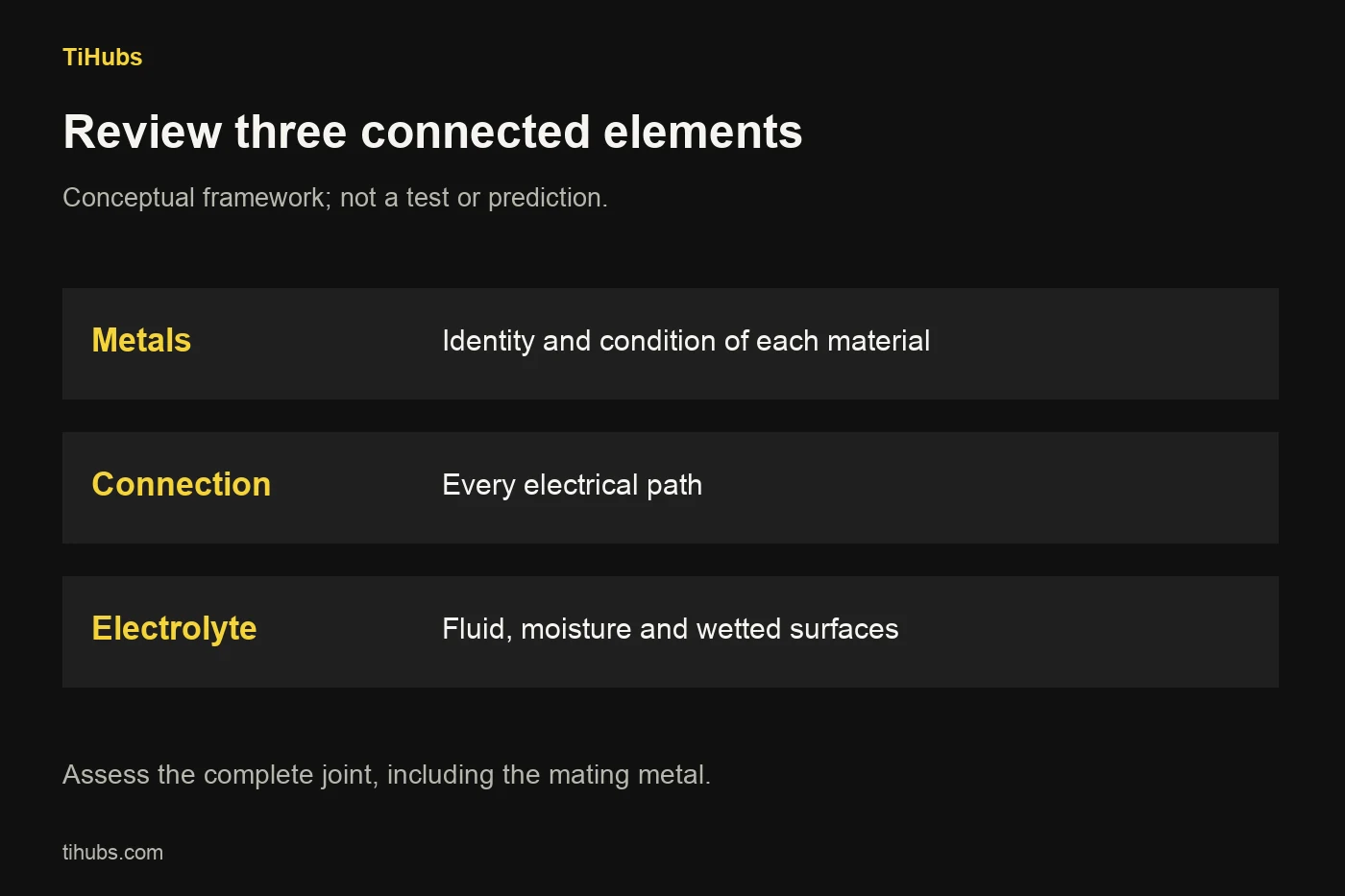
Titanium galvanic corrosion is an assembly question. A titanium component can remain visually sound while a connected metal suffers additional attack. Buying a corrosion-resistant fastener therefore does not, by itself, establish a corrosion-resistant joint. The useful starting point is a drawing of the complete connection, with the materials, electrical paths and expected wet surfaces identified.
TWI’s galvanic-corrosion guidance describes the necessary combination: dissimilar metals, electrical connection and a conductive electrolyte. The anodic member can corrode faster than it would uncoupled. In practical procurement, those conditions become three questions: what touches what, where can current pass, and what liquid or moisture can connect the exposed surfaces?
Trace more than the obvious contact
A washer between two plates may interrupt one contact while a bolt shank, thread, bracket or grounding connection supplies another. Review the entire electrical path rather than treating one insulating part as proof of isolation. Conversely, an assembly drawing that shows touching components does not tell you whether the contact is electrically continuous after the specified finish and installation. The relevant condition must be established, not inferred from a simplified sketch.
The electrolyte is equally important. A dry indoor assembly and the same joint repeatedly wetted by conductive process liquid are different exposure cases. Describe immersion, spray, condensation, drainage and drying separately. If cleaning introduces a liquid that differs from the normal service fluid, include that stage. A design reviewed only for normal operation can overlook the condition under which the joint actually becomes wet.
Why titanium’s own appearance can be misleading
TIMET’s corrosion manual explains that passive titanium commonly acts as the cathodic member in seawater couples, potentially accelerating attack on the other metal. It also discusses circumstances involving loss of passivity or cathodic hydrogen effects. This is conditional behaviour, not a rule that titanium is always unaffected in every fluid or at every electrical potential.
Inspection should therefore include the connected component and the interface, not only the titanium surface. A photograph showing a clean bolt head may omit damage beneath a washer, on the adjoining plate or inside an inaccessible connection. Specify the area that matters to function and the access needed to inspect it. Where dismantling is required, plan that before a test or service inspection begins.
Keep different damage mechanisms separate
Galvanic corrosion, crevice corrosion and mechanical wear can involve the same joint, but they are not interchangeable diagnoses. A stain or a local defect does not identify its cause by itself. Preserve material identity, service history and the location of damage before selecting a remedy. The broader guide to titanium corrosion and rust addresses titanium’s own surface behaviour; this article focuses on the purchasing decisions created by a mixed-metal connection.
For a supplier enquiry, write the problem as an assembly requirement: for example, titanium fasteners connecting a specified plate alloy in a stated wet environment. That description is much more useful than asking for a universally corrosion-proof titanium grade. It directs the discussion toward the component that needs protection and the evidence required to support the proposed connection.
Industrial buying guide / 01Identify all three parts of the system.
Conceptual review framework; it is not a tested assembly or a measured electrochemical circuit.
02 / Reading compatibility information
A galvanic series is a screening tool, not a service-life chart
A galvanic series orders materials by their behaviour in a particular environment and condition. Before using one, read the electrolyte, temperature and surface-state information. Do not silently substitute a different solution, a different alloy condition or a different wetting regime. A position on a chart cannot define the life of an assembled component without further information about the actual system.
Do not convert separation into a corrosion rate
A greater separation in a suitable series can flag a combination for investigation, but it does not provide a thickness-loss rate or an approved lifetime. Current distribution, reaction kinetics, electrical continuity and the environment affect the result. A purchasing table that labels every titanium–aluminium pair unsafe and every titanium–stainless pair safe would hide the conditions the engineer actually needs to assess.
The table below is an original review framework, not a measured compatibility ranking. It deliberately contains no invented corrosion rates, universal voltage limits or service-life estimates. Its purpose is to turn common assembly descriptions into the information needed for a technically meaningful enquiry. The underlying mechanism is supported by the TWI and TIMET references; each project still requires its own assessment.
Procurement review questions; not a safe/unsafe compatibility chart.
Proposed connection
Information to identify
Question to resolve
Titanium with aluminium alloy
Exact alloy, finish, exposed areas and wetting
Which member is vulnerable under the specified exposure, and how is it protected?
Titanium with carbon steel
Coating coverage, defects, drainage and inspection access
Does the connection concentrate attack at an exposed steel area?
Titanium with stainless steel
Stainless grade, surface state, crevice geometry and fluid
Is the proposed pair supported for the actual joint and environment?
Titanium with copper alloy
Specific alloy, liquid chemistry, flow and area relationship
What representative evidence supports the proposed combination?
Titanium in a protected or electrically biased system
Protection design, electrical connections and operating potential basis
Has the titanium-specific response been assessed within the complete protection system?
Name the actual materials
Use full alloy designations and relevant surface conditions. Stainless steel, aluminium and brass are families, not complete material specifications. Identify plating, conversion treatment, paint or other layers where they affect exposure or contact. A quotation offering an unspecified equivalent may change the corrosion question even when the external component dimensions remain unchanged.
Likewise, identify the titanium grade and condition required for the part’s mechanical and environmental duty. Changing titanium grade is not an automatic solution to attack on a connected material. The design owner should approve any substitution after reviewing the complete requirement. For marine comparisons, the titanium versus stainless steel in seawater guide provides additional context without replacing joint-specific evaluation.
Ask what evidence the claim actually covers
A statement that a material performs well in a fluid may concern an isolated coupon, not a coupled assembly. A successful past application may differ in geometry, exposure duration, maintenance or acceptance criteria. Ask for the relevant conditions and distinguish reference experience from a controlled qualification. The aim is not to demand unnecessary testing, but to avoid treating unlike cases as equivalent evidence.
03 / Area and local exposure
Review the exposed area, including defects and hidden surfaces
The relative exposed areas of the anodic and cathodic members can strongly influence a galvanic couple. A small vulnerable area connected to a much larger cathodic surface deserves particular attention. The relevant area is the area participating in the electrochemical system under the stated conditions; it is not automatically the total metal area shown on a bill of materials.
A numerical illustration without a corrosion prediction
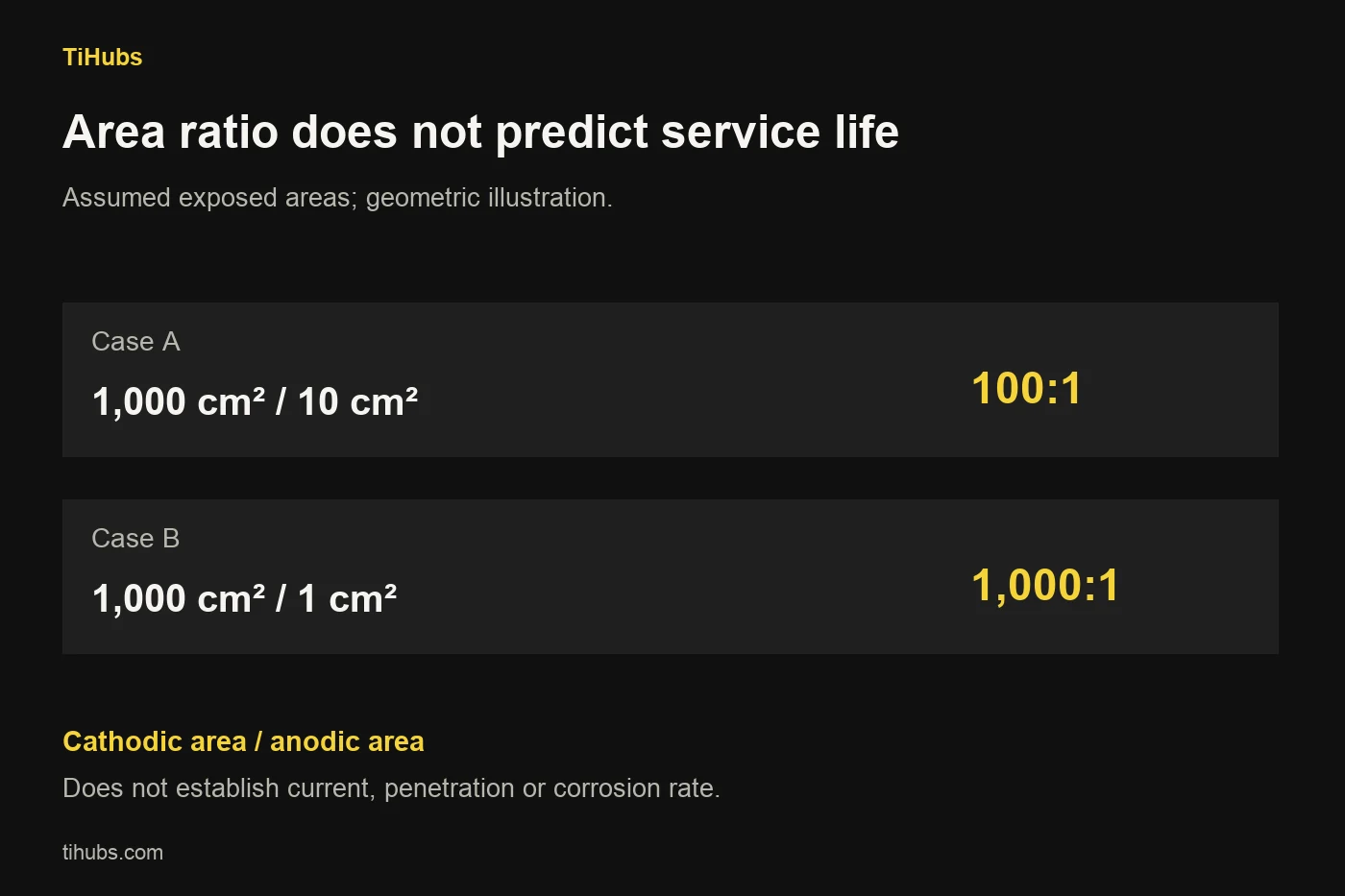
Suppose a hypothetical assembly has 1,000 cm² of exposed cathodic surface and 10 cm² of exposed anodic surface. The area ratio is 100:1. If a coating change reduces the exposed anodic area to 1 cm² while the cathodic exposure remains 1,000 cm², the geometric ratio becomes 1,000:1. These numbers only illustrate an area calculation. They do not establish galvanic current, penetration rate or remaining life.
This distinction matters because a larger ratio can look like a straightforward multiplier in a spreadsheet. It is not valid to multiply an uncoupled corrosion rate by that ratio and call the result a measured or qualified coupled rate. The electrochemical response and geometry need appropriate analysis or representative evidence. Keep any assumed area and exposure boundary visible in the calculation record.
Review fastener and panel arrangements separately
A small titanium fastener in a large adjoining structure and a large titanium surface connected to a small vulnerable insert are different geometrical cases. The labels small and large are still insufficient without considering what becomes wet and electrically connected. A water film confined to an interface may create a different participating area from full immersion of the entire assembly.
For titanium bolts, identify the head, washer, shank, thread and mating surfaces on the drawing. Show which surfaces are exposed, sealed, coated or insulated. Specify whether the joint is disassembled during maintenance and whether replacement hardware must preserve the original isolation arrangement. A maintenance substitution can recreate a conductive path that the original design intentionally interrupted.
Account for coating defects as a design question
A coating is not simply an on/off property. Edges, holes, scratches and installation damage may determine where metal is exposed. Review the condition represented by the qualification: new coating, permitted defects, aged condition or a particular maintenance state. Do not assume that a visually continuous finish remains an effective electrical or environmental barrier throughout service.
Where protective performance is important, specify inspection and repair responsibilities. Identify acceptable defects, handling precautions, touch-up requirements and the point at which the assembly must be reassessed. Those requirements belong in the supply and installation scope, not only in an informal discussion between a buyer and a sales contact. A coating supplier’s general brochure does not define the finished joint’s acceptance.
Use the area review to improve the enquiry
Attach an annotated drawing rather than a single photograph when practical. Mark the relevant surfaces and explain how wetting changes during operation, cleaning and shutdown. If participating areas cannot yet be estimated, identify that as an open engineering item. An explicit uncertainty is more useful than an unsupported ratio presented as a precise input to a corrosion-life calculation.
Industrial buying guide / 03An area ratio is not a corrosion rate.
Assumed exposed areas illustrate ratios of 100:1 and 1,000:1. No current, penetration or lifetime is predicted.
04 / Isolation and protection
Specify the protection as part of the assembly
Preventive measures should address the actual electrical and environmental paths. Depending on the application, the design may use material selection, electrical isolation, coating, sealing, drainage or a reviewed protection system. There is no universal washer, finish or titanium grade that establishes an acceptable joint in every environment. State the intended function of each protective element and the evidence used to accept it.
Make an isolation stack complete
An insulating washer beneath a bolt head addresses that contact only. The shank may also need separation from a hole, and the opposite side or thread may provide continuity. Review sleeves, washers, gaskets and all parallel conductive paths together. Show their positions on the drawing so assembly personnel do not interpret a list of insulating parts differently from the design owner.
The insulating material must also suit the mechanical and environmental duty. Thickness, compression, temperature response, chemical compatibility and installation damage can affect its role. A component selected only for electrical resistance may not satisfy the clamping or sealing requirement. The relevant specialist should establish the accepted material and installation details rather than leaving the supplier to choose an unspecified plastic alternative.
Define what a continuity check proves
If the project requires an electrical-isolation check, define the assembly state, measurement locations, method and acceptance criterion. An initial result does not automatically demonstrate isolation after loading, thermal cycling or maintenance. Decide whether those conditions need separate verification. Preserve the result with the assembly identity instead of recording only a generic statement that insulating hardware was included.
Coordinate coating, sealing and drainage
Coating strategy should be reviewed for the complete couple and the expected defect condition. TWI discusses coating both members as one prevention approach. Do not turn that guidance into a promise that any two coated parts are compatible. The coating system, substrate preparation, coverage, permitted damage and service environment still determine what is being supplied and evaluated.
Sealing and drainage address where electrolyte can enter or remain. Specify the relevant interfaces, sealant compatibility, installation sequence and inspection access. A seal that conceals an interface also changes how that area can be checked later. Consider whether the proposed maintenance procedure can detect or repair a failed barrier without damaging the underlying component or losing traceability.
Avoid unreviewed electrical changes
Some assemblies have intentional grounding, cathodic protection or other electrical requirements. Isolation cannot be added casually if it conflicts with those functions. Conversely, a new grounding strap can defeat an existing isolation plan. Route changes through the responsible design review and identify the approved configuration on the drawing. Mechanical, corrosion and electrical requirements must describe the same assembly.
Where titanium is part of an electrically protected system, use a titanium-specific engineering assessment. The presence of a protection system elsewhere does not establish the safe condition of every connected component. Do not adopt a generic potential threshold from an unrelated application. Ask who controls the system, what conditions were reviewed and how operation outside the approved envelope is detected.
05 / Representative verification
Choose evidence that represents the purchased connection
A material certificate establishes only the information within its stated scope. It does not prove the performance of a mixed-metal joint assembled later. Start by defining the decision: selection between materials, evaluation of an isolation arrangement, qualification of a coating process or acceptance of production hardware. Different decisions may require different evidence, and not every purchase needs a new corrosion programme.
Write the exposure before choosing a test
Describe the fluid, concentration where relevant, temperature, flow, wetting cycle, contamination and duration that matter to the project. Add geometry, contact arrangement, surface preparation and representative defects. A convenient laboratory exposure is useful only when its relationship to the intended decision is understood. A generic test duration cannot be converted into years of field service without a defensible correlation.
The public scope of ASTM G71 addresses galvanic-corrosion testing of metal pairs in electrolytes under low-flow conditions. That scope does not cover every erosion, cavitation or high-flow service question. Refer to the controlled method and agree the complete protocol with a suitable laboratory. Naming a standard is not the same as defining the specimen, acceptance limit or relevance to the assembly.
Preserve the comparison basis
A test plan may need uncoupled controls and coupled specimens so the effect of coupling can be evaluated. The appropriate design belongs to the laboratory and project review. Record the material heats or lots, surface preparation, exposed areas and electrical arrangement. If a proposed alternative changes more than one variable, identify that explicitly so a favourable result is not attributed to the wrong change.
Decide how the outcome will be assessed. Overall mass change, local penetration, appearance, electrical measurements and functional performance answer different questions. A small average loss can conceal a local defect at a critical interface. Conversely, a visible stain may not quantify structural loss. Agree the observations relevant to function and the method for examining surfaces hidden during exposure.
Separate qualification from shipment acceptance
A representative qualification can support an approved design or process without proving that every subsequent assembly was made correctly. Production acceptance may therefore focus on material identity, coating coverage, hardware configuration, dimensions and agreed checks. Keep the qualified configuration linked to the actual shipment. An unapproved coating supplier or replacement washer can change the basis on which the earlier result was accepted.
For tubing connections, identify which material is exposed internally and externally, and how joints connect to the surrounding system. An isolated titanium tube coupon does not reproduce every tube-to-tubesheet or support interface. Supply the relevant interface drawing and distinguish material procurement from fabrication and assembly qualification.
Define changes that require review
Write down which substitutions require approval: alloy, coating system, insulation material, geometry, assembly method or service environment. Maintain the relevant report and drawing revision with that list. This makes future repeat orders more reliable because the purchasing team can recognize when an apparently minor change affects the original evidence. It also prevents a historical test report from becoming a blanket approval for unrelated products.
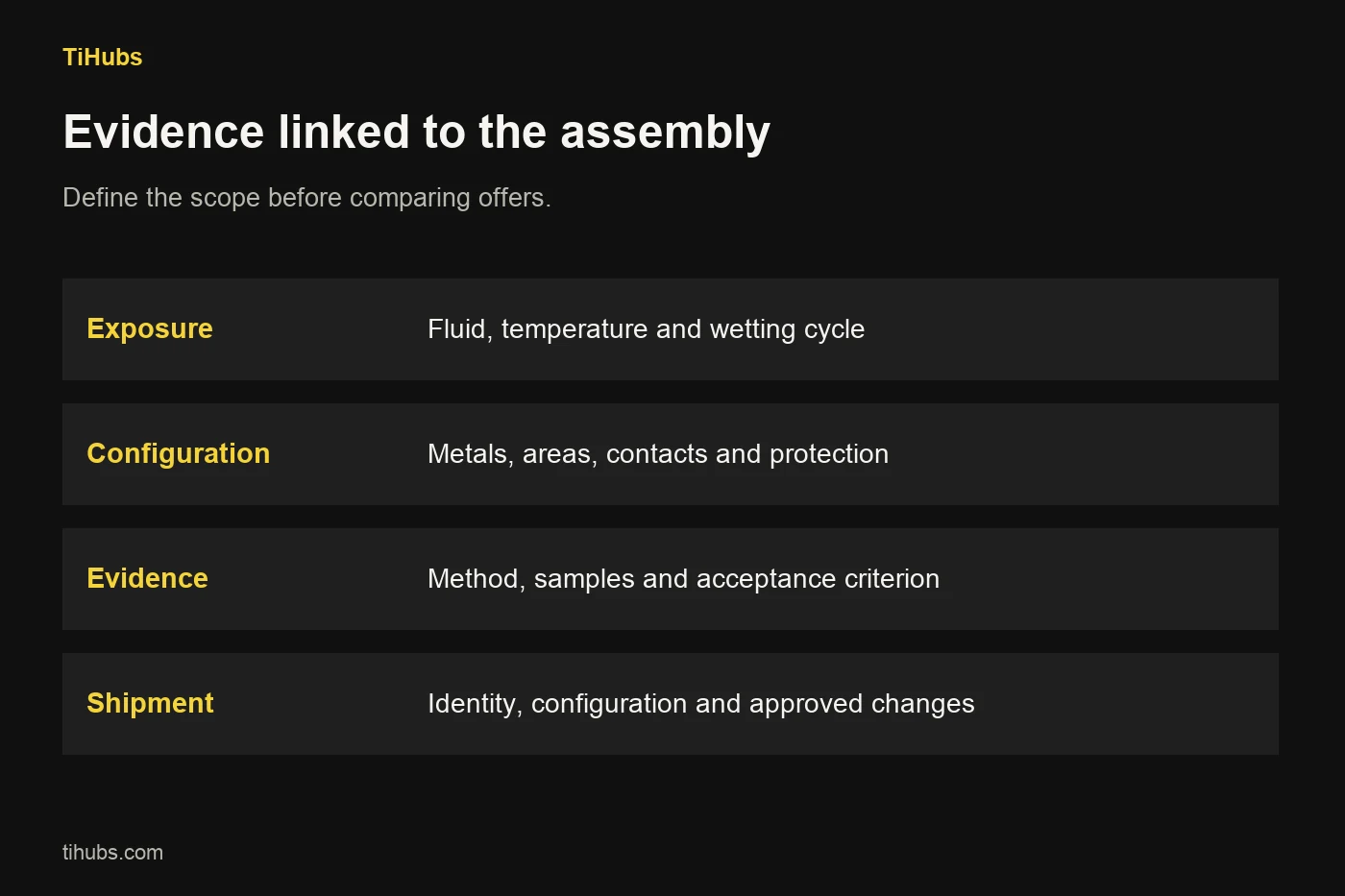
Industrial buying guide / 05Keep the evidence connected to the configuration.
An original procurement checklist. The project defines the applicable verification and acceptance requirements.
06 / Purchasing and acceptance
Turn the corrosion review into a comparable supply scope
A useful request for quotation separates the titanium item, the mating items and the assembly responsibilities. State whether TiHubs is being asked to supply stock, finished hardware, a coated component or a complete drawing-controlled assembly. Include the approved material specification and condition, dimensions, quantity, delivery destination and traceability requirements. Add the joint context where it changes the acceptance or processing scope.
Give each requirement an owner
The component supplier may control material and dimensions, a finisher may apply a coating, and the customer may assemble and operate the joint. Identify who confirms compatibility, approves substitutions, specifies installation and accepts the final configuration. Without that allocation, each party can meet its own narrow description while the complete joint remains insufficiently defined. A clear responsibility record helps expose that gap before material is purchased.
Request deviations in writing. If an offer changes an insulating material, finish, mating alloy or inspection method, ask for the proposed change and its consequences rather than accepting an unexplained equivalent. Commercial comparison should use the same acceptance basis. A lower price achieved by omitting inspection or protective hardware is a different scope, not necessarily a more efficient source for the same requirement.
Make the delivery record useful
Connect material records, finished-part identification and packaging to the approved order. Where a protected surface or insulating component can be damaged in transit, define handling and packing expectations. Provide installation information for the approved configuration and identify replacement items. A well-labelled bag of hardware is useful only if the receiving team can connect it to the drawing and know which substitutions are prohibited.
When investigating an existing problem, retain the failed components if practical and record the as-found arrangement before cleaning or replacing parts. Provide photographs with scale, material identities, wetting history and changes in service. Avoid requesting a new titanium grade as the only corrective action until the mechanism has been assessed. The most effective supply change may concern the mating material, isolation, coating, geometry or maintenance rather than titanium itself.
The purchasing objective is a connection whose material, protection and verification requirements can be understood and checked. A generic compatibility label cannot deliver that outcome. A defined assembly, supported evidence and an agreed change process give the buyer a practical basis for sourcing, receiving and maintaining the supplied components.
07 / Build your RFQ
Describe the titanium item and the complete connection.
Send the material and drawing requirements together with mating alloys, surface treatments, exposure and the approved protection arrangement. Identify whether the enquiry covers individual components or an assembly, and which party owns compatibility review, installation and final acceptance. TiHubs can review the proposed supply scope against that information.
Information to include
Titanium and mating material designations
Drawing revision, interfaces and electrical paths
Fluid, temperature, wetting, cleaning and maintenance
Exposed areas, coatings, insulation and permitted defects
Required qualification and production acceptance evidence
Quantity, traceability, packaging and destination
Build your RFQ checklist
Choose the product and add the information you have. Copy the resulting brief or send your requirements to TiHubs. Submitting an enquiry does not place an order.
08 / FAQs
Questions buyers ask
Can titanium cause corrosion of another metal?
In a suitable galvanic couple, passive titanium can be the cathodic member while the other material experiences increased attack. The result depends on the electrolyte, electrical connection, material states, exposed areas and other conditions. A titanium component remaining clean does not prove that its connected component is protected.
Are titanium and stainless steel always compatible?
No universal answer applies to every grade, fluid and joint. Identify the stainless grade, surface condition, geometry and exposure, then review relevant evidence. General performance of either material separately is not sufficient to qualify an assembled connection.
Does an insulating washer eliminate the problem?
Only if the complete isolation arrangement interrupts the relevant electrical paths and remains suitable in service. The shank, thread, opposite face or another connection can bypass a washer. Mechanical, chemical and temperature requirements also matter to the insulating components.
Can I calculate service life from an area ratio?
No. Area ratio is one input to a galvanic assessment, not a corrosion-rate equation. A geometric example does not establish current, local penetration or lifetime. Use appropriate analysis or representative evidence and retain the actual exposure and assembly conditions.
Should every order include a galvanic-corrosion test?
Not necessarily. Existing applicable evidence and an approved design may be sufficient. Testing should answer a defined question with representative materials, exposure, geometry and acceptance criteria. Shipment checks must still verify the approved configuration and required material records.
Will changing from Grade 2 to Grade 5 solve the joint problem?
A grade change is not an automatic remedy for attack on the mating material. Review the mechanism, mechanical requirement and protection arrangement before approving a substitution. The complete assembly may require changes to isolation, coating, geometry or the connected material instead.
09 / Key takeaways
Keep the purchase requirements connected.
Assess both components and every electrical and wetting path.
Use environment-specific reference information without inventing corrosion rates.
Review exposed areas and defects, not only nominal part size.
Specify isolation and protection as an approved assembly arrangement.
Connect representative evidence, shipment acceptance and change control.
Technical references
Sources and data scope
References reviewed November 17, 2026. Public source summaries support the discussion; the controlled specification, agreed edition and approved project requirements govern acceptance.
TIMET — Corrosion resistance of titanium — Manufacturer discussion of galvanic behaviour, passivity and conditional hydrogen effects; actual-environment assessment remains necessary.
TiHubs coordinates titanium material and custom supply enquiries from Baoji, China. Send the product, drawing revision and acceptance requirements so the proposed supply scope can be reviewed. Learn about our sourcing role.
Contents
TiHubs
Talk to TiHubs
Ask about titanium materials, grades or custom parts.
Enter your email to start chatting.
We use your email to respond to your enquiry. Your conversation is stored on this website.
Our team is away right now. Leave your enquiry and we will follow up by email.