AI illustration; not a production or inspection record.
Quick answer
Titanium conducts electricity, but its conductivity is far below pure copper in the cited 20°C reference data. General CP titanium and Ti-6Al-4V also differ. Use resistivity for the specified material with the actual current path, and evaluate contact resistance separately. A continuity result or bulk-property table does not establish an allowable current.
01 / Conductivity and resistance
Titanium conducts electricity, but the purchase needs a clearer question
Titanium is electrically conductive. The useful engineering question is how much resistance the specified material and component introduce into the intended current path. A simple yes or no answer cannot select a current-carrying part, an electrode substrate or a corrosion-resistant connection. Grade, geometry, contacts, temperature and the surrounding environment all belong in that decision.
Electrical conductivity, usually written σ, describes how readily current flows through a material under the stated conditions. Electrical resistivity, ρ, describes the opposite tendency and is its reciprocal: σ = 1/ρ. Conductivity is commonly expressed in S/m or MS/m, while resistivity may be given in Ω·m or μΩ·m. A component’s resistance in ohms is a different quantity because it includes geometry.
Keep the material and the assembly separate
A short thick titanium part and a long thin titanium wire do not have the same resistance merely because they share an alloy. A bolted contact can add resistance that is not described by the bulk-material value. A coated electrode can involve surface and electrochemical behaviour beyond the metal substrate. Establish which part of the path the requested number is meant to describe.
That distinction prevents two common purchasing errors. The first is rejecting titanium for every electrical application because it conducts less readily than copper. The second is assuming that any titanium component is suitable because a continuity meter responds. The appropriate choice must satisfy the complete function, including the voltage drop, heat generation, environment and acceptance requirements.
Check units before interpreting a comparison
One μΩ·m equals 10⁻⁶ Ω·m. Numerically, the reciprocal of resistivity in μΩ·m gives conductivity in MS/m. This is a unit conversion, not a new test result. Keep the original resistivity and the derived conductivity distinguishable in a data sheet so a reviewer can reconstruct the calculation and see the precision of the original input.
Percent-conductivity figures also need a reference convention. A percentage relative to a particular copper value should not be silently labelled with a different standard. If an order uses a defined reference system, specify it and its temperature. A number without that basis can make two otherwise compatible supplier reports appear inconsistent, or conceal a real difference that should be reviewed.
02 / Verified material data
Use the same temperature and preserve the source categories
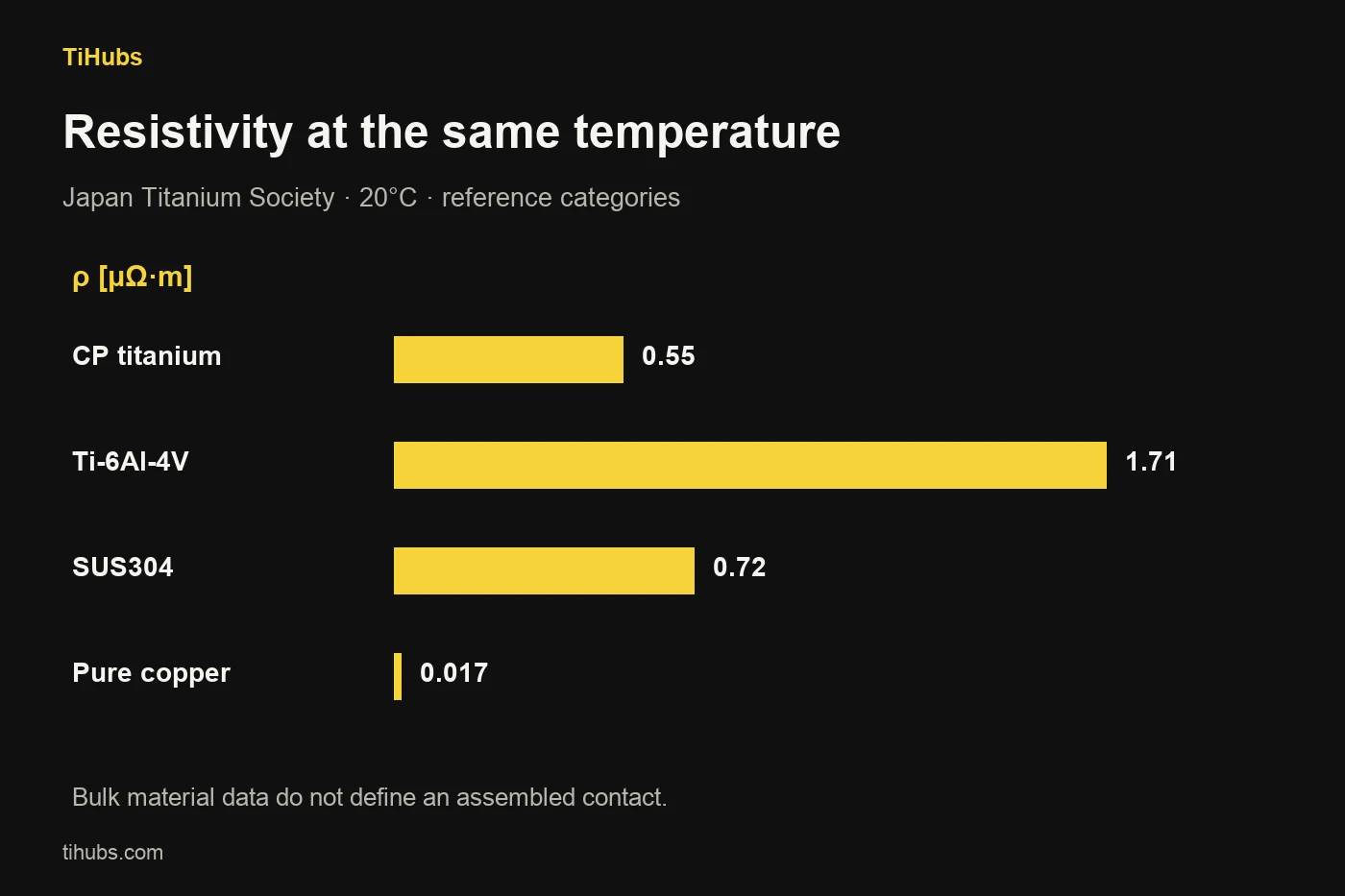
The Japan Titanium Society publishes the following selected resistivity values in its physical-property table at 20°C. The conductivity column below is calculated as the reciprocal and rounded for readability. The CP titanium row is a general commercial-purity category, not a certificate for every Grade 2 product. The values are reference data, not TiHubs measurements or finished-component ratings.
Source resistivity at 20°C and reciprocal conductivity
Material identified by the source
Resistivity, μΩ·m
Calculated conductivity, MS/m
CP titanium
0.55
1.82
Ti-6Al-4V
1.71
0.585
SUS304 stainless steel
0.72
1.39
Pure copper
0.017
58.8
Source: Japan Titanium Society — physical properties, electrical-resistivity row. For example, 1/0.55 is approximately 1.82. The calculation does not add accuracy beyond the published input. These categories should not be expanded into claims about every titanium grade, stainless family or copper product.
Alloy identity changes the answer
The titanium entries differ substantially within this source. It is therefore misleading to attach one conductivity number to an enquiry that merely says titanium. State the approved grade and supplied condition, then identify the dataset accepted for the design. If a supplier proposes an alternative material, require an explicit review rather than assuming the electrical result transfers with the general metal name.
Room-temperature mechanical strength is not a shortcut to conductivity. A stronger alloy is not automatically the better electrical path, just as lower resistivity does not establish adequate strength or corrosion suitability. Keep those requirements in separate columns until the design review combines them. This avoids turning a single favourable property into a general recommendation.
Temperature labels are part of the data
For comparison, TIMET’s TIMETAL 6-4 sheet lists resistivity of 1.68 μΩ·m at 0°C. That is not a 20°C value and should not be relabelled to fit the table above. The original TIMET table 2 retains its own temperature conditions. Preserve them when deciding which data belong in a model.
If the component operates over a temperature range, ask the design owner which temperature-dependent data are required. Do not invent a universal correction factor or extrapolate indefinitely from one reference point. Where conductivity itself is a contractual property, the order needs a temperature, method, sampling basis and acceptance criterion, not only an alloy designation and a copied number.
Industrial buying guide / 02Keep temperature and identity with the number.
Japan Titanium Society reference categories; conductivity is the reciprocal of the listed resistivity, not a separate measurement.
03 / Resistance and heating
Calculate a defined current path before comparing parts
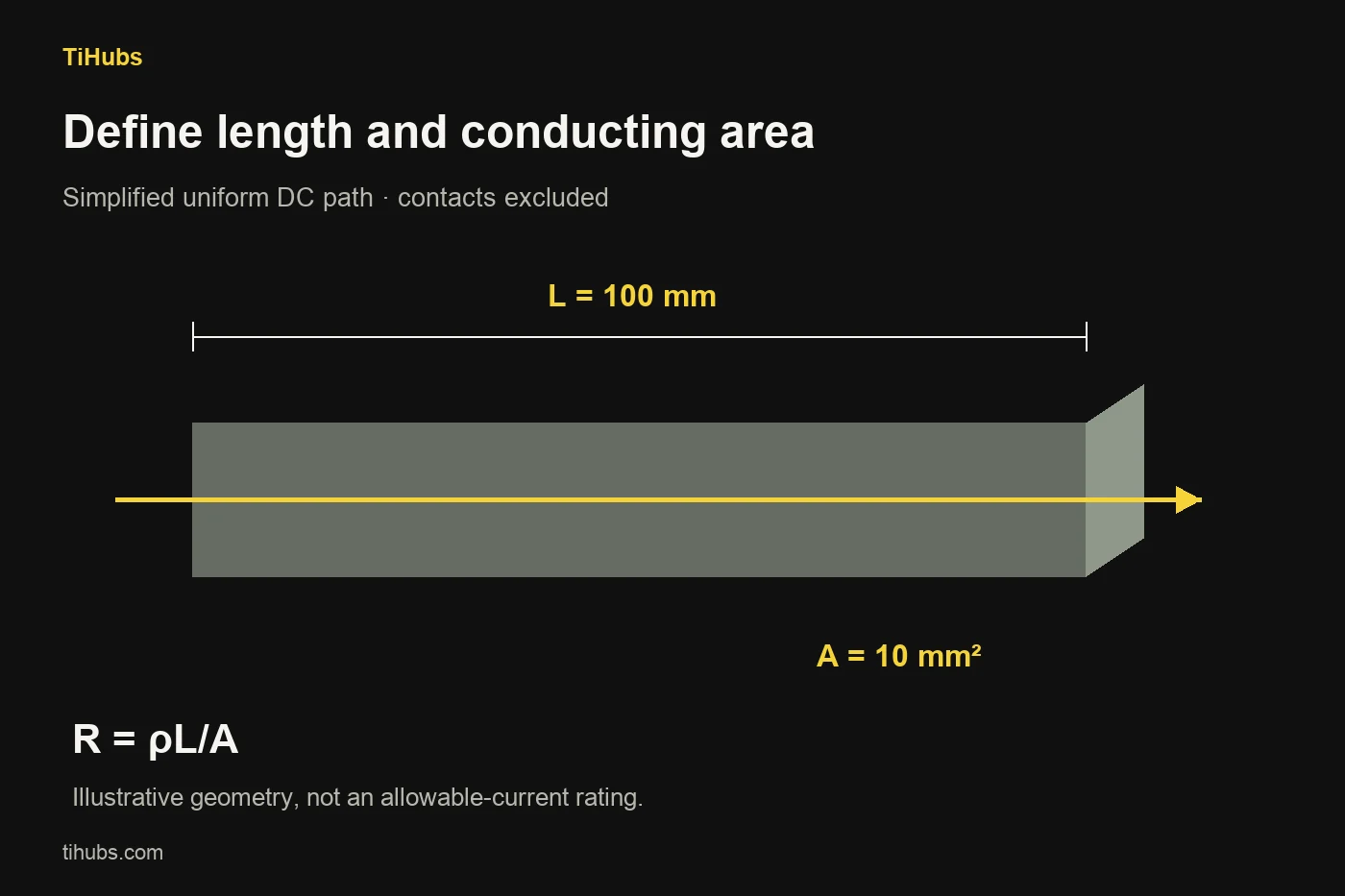
For a uniform straight conductor in a simplified DC model, bulk resistance is R = ρL/A. L is the path length in metres and A is cross-sectional area normal to the current in square metres. This model assumes the stated resistivity applies and excludes contact resistance and more complex current distributions. It is useful for understanding geometry, not for assigning a universal current rating.
A reproducible calculation
Consider a hypothetical straight segment 100 mm long with a 10 mm² cross section. Convert the dimensions to 0.1 m and 10 × 10⁻⁶ m². Using the reference resistivities above gives 0.0055 Ω for CP titanium, 0.0171 Ω for Ti-6Al-4V and 0.00017 Ω for pure copper. These are calculated values for equal geometry at the reference conditions, not measured TiHubs products.
Illustrative 100 mm × 10 mm² path; contacts excluded
Reference material
Calculated resistance
Calculated I²R at an assumed 10 A
CP titanium
5.5 mΩ
0.55 W
Ti-6Al-4V
17.1 mΩ
1.71 W
Pure copper
0.17 mΩ
0.017 W
The assumed 10 A is an arithmetic input, not an allowable current. The model uses P = I²R for resistive heating. It does not calculate the resulting temperature, safe touch condition, insulation requirement or life. Those outcomes require the complete electrical and thermal design, including heat removal and temperature-dependent behaviour.
Length and area can outweigh a material label
Within this simplified model, doubling length doubles resistance and doubling area halves it. For a round solid section, area depends on the square of diameter, so a diameter change is not a one-for-one area change. For a hollow or irregular section, use the actual conducting area rather than the outside envelope. Holes, necks and interfaces may require a more detailed current-distribution model.
If mass, stiffness or space limits require different geometry for each material, compare those approved designs separately. Equal-geometry arithmetic is a transparent starting point, but it does not prove equal function. A titanium part cannot be declared electrically equivalent to copper merely by matching one bulk resistance while ignoring its contacts, mechanical loading or environmental requirements.
A resistance calculation is not an ampacity table
Current capacity depends on the permitted temperature and the system’s ability to remove heat, along with joints, insulation, duty and applicable requirements. A short current pulse and continuous operation create different thermal questions. AC operation can introduce additional frequency-dependent effects and current distribution that a simple DC resistance calculation does not address. Identify the actual service instead of asking for one universal amps-per-size value.
Industrial buying guide / 03Resistance belongs to a defined path.
R = ρL/A for the stated simplified DC geometry; this is not a current-capacity rating.
04 / Surface and contact
Bulk conductivity does not describe a titanium joint
The current path through an assembled component includes interfaces. Titanium’s passive surface is central to its corrosion behaviour, but the interface can behave differently from the underlying metal electrically. A bulk resistivity value therefore cannot establish the voltage drop across a bolted, pressed or coated contact. The two questions need separate data and acceptance requirements.
Why a conductive metal can have a difficult contact
Nippon Steel’s technical report on automotive titanium applications explains this distinction in fuel-cell separators: titanium itself conducts electricity, while the passive surface film presents high electrical resistance and contact performance requires attention. That application-specific observation does not supply a universal contact-resistance value for every titanium joint.
For a real connection, identify mating material, surface condition, contact geometry and the approved assembly method. State whether a coating or surface treatment is part of the design. If the joint must remain stable after thermal cycling or environmental exposure, the initial resistance alone may not demonstrate the required durability. The test sequence should reflect the agreed service and acceptance scope.
Do not turn a surface treatment into a generic cure
A treatment selected to reduce contact resistance can introduce other requirements for adhesion, thickness, compatibility and service stability. A supplier should not alter the surface merely to make one initial electrical measurement look better. Define the approved process and evidence through the design owner. Surface preparation for one environment should not be transferred automatically to another.
Similarly, cleaning a contact can change the measured result without establishing a durable design. The order should identify the delivered surface state and whether any final preparation occurs during assembly. Record which party performs that step and which condition is used for acceptance. Otherwise the supplier and buyer may measure different surfaces and believe the material itself has changed.
Build a resistance budget for the jointed path
As an explicitly hypothetical example, combine the earlier 5.5 mΩ CP titanium segment with two contacts assumed to contribute 2 mΩ each. The series total becomes 9.5 mΩ. The contact numbers are invented calculation inputs, not measured titanium-joint values. They show why accepting only the bulk segment can leave a substantial part of the assembled resistance unverified.
If those contacts change during service, replacing the bulk-material value in the spreadsheet does not explain the change. The investigation needs measurements across defined regions of the assembly, with a consistent temperature and configuration. Keep the resistance budget visible so the design owner can decide which interface needs qualification and which material data are already sufficient.
Electrode and substrate enquiries need their own scope
A titanium substrate in an electrochemical component is not selected from bulk conductivity alone. Geometry, current distribution, surface system, medium and duty belong in the evaluation. If the enquiry concerns titanium anodes, describe the intended process and approved coating requirements through the dedicated product review. This article does not prescribe an electrochemical coating or cell-operating recipe.
For an uncoated bar or machined connection, keep the metal supply separate from finished-joint qualification. A supplier may demonstrate the specified grade and dimensions while the assembled contact still requires system testing. Assign responsibility for that test explicitly rather than expecting a material certificate to certify a joint that did not exist when the certificate was issued.
05 / Measure the intended quantity
A continuity beep is not a resistivity certificate
A continuity check can indicate that a path conducts under the instrument’s conditions. It does not identify the alloy, quantify bulk resistivity accurately or establish current capacity. If a purchasing decision depends on resistance, specify the measured quantity and the relevant configuration. The measurement must separate the material question from leads, contacts and specimen geometry.
Understand two-wire and four-wire methods
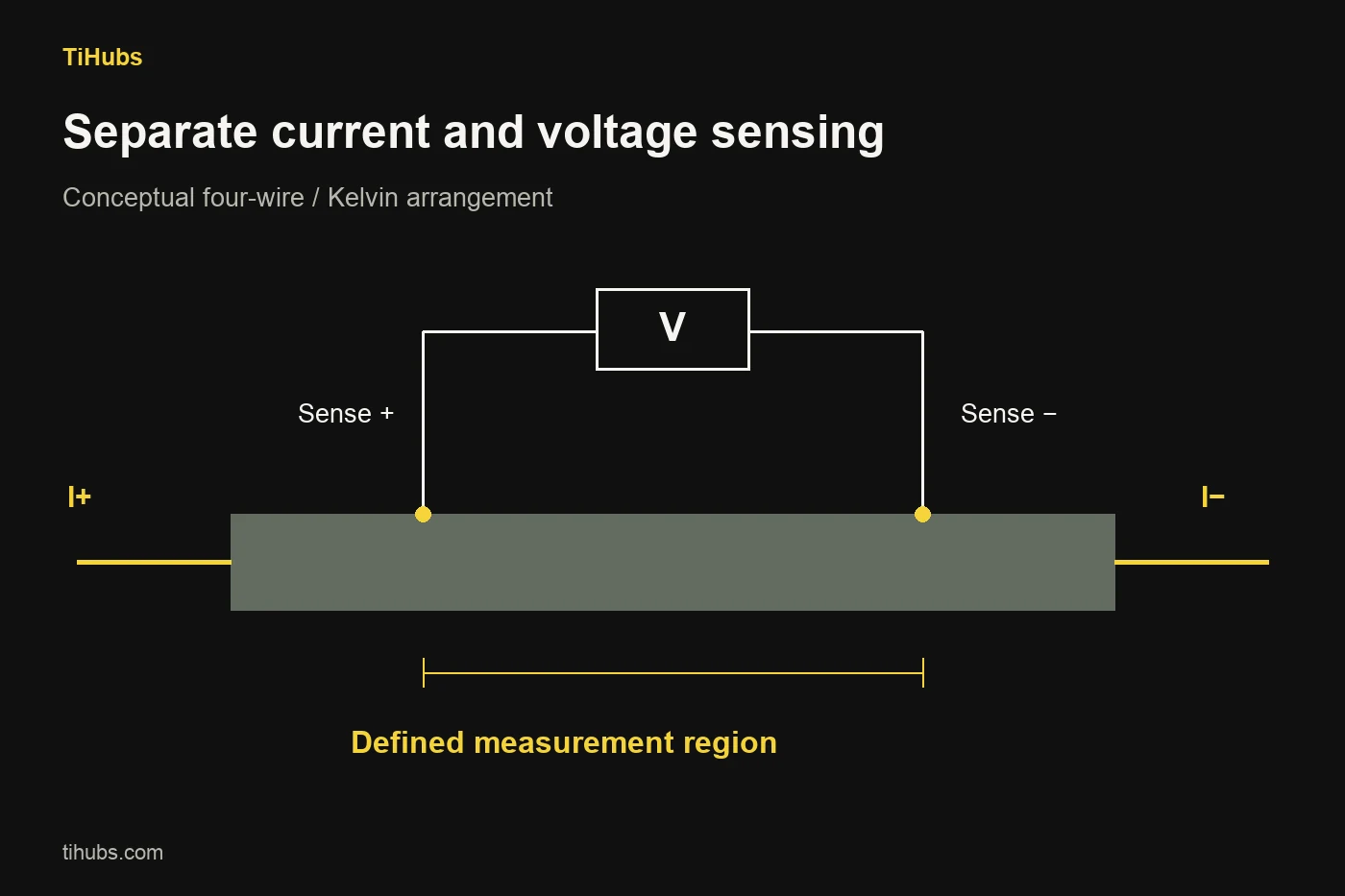
Keithley’s comparison of two-wire and four-wire measurements explains that lead resistance contributes to a two-wire low-resistance measurement. A Kelvin arrangement uses one pair of connections to carry current and another to sense voltage across the intended test region. The sensing locations matter because they define what portion of the path is included.
Four-wire measurement does not automatically convert an arbitrary component into a bulk-resistivity specimen. To infer ρ from R, the geometry and current path must be appropriate for the calculation. If the intended measurement includes a joint, place the sense connections to include that joint deliberately. If the intended measurement excludes lead drops, do not accidentally include extra lead length inside the sensing boundary.
Control the specimen and measurement conditions
Record material identity, supplied condition, dimensions, temperature and surface state. State the measurement method and required uncertainty. The test current itself can create heating, especially in a small or resistive specimen; the laboratory should use an appropriate procedure. A reading that drifts during the test may need investigation rather than being rounded into a single attractive value.
Dimensions also contribute uncertainty when resistance is converted to resistivity. If area is calculated from a measured diameter, the diameter’s uncertainty affects the area calculation. If the section is not uniform, a single nominal dimension may not represent the entire sensed length. Agree the specimen definition and measurement locations rather than relying only on the precision displayed by the electrical instrument.
Check for unintended current paths
A conductive fixture or another connected component can create a parallel path and make a measurement represent the network rather than the intended specimen. A good numerical repeatability does not correct that mismatch. The qualified test setup should define the electrical boundary, fixture contribution and connection arrangement before a result is interpreted as material or joint evidence.
Record the configuration with a clear diagram or photograph where useful. The report should allow another reviewer to understand the current connections, sensing locations and specimen dimensions without reconstructing the test from informal messages. This is especially valuable when a buyer and supplier use different equipment to verify the same contractual limit.
Specify what the report represents
Distinguish a reference dataset, an individual specimen result and a delivered-lot acceptance report. A report should identify the heat or lot and the sampling basis where those are contractual requirements. Define whether actual values, uncertainty and method details are required. A statement that material is electrically conductive is not equivalent to a numerical property report.
For contacts, report the assembled configuration and any conditioning or exposure included in the test. The initial result and the result after an agreed service simulation are different evidence. Do not use an accelerated test to claim an unlimited life without a justified relationship to service. Keep the acceptance criterion attached to the specified test rather than expanding its meaning after the result is known.
Industrial buying guide / 05Measure the region you mean to accept.
Separate sensing connections reduce lead-drop effects; their locations define the measured region.
06 / Specify the supply
Match the electrical function to the material order
Begin with the product and its role in the current path. State whether you need titanium stock, a machined conductor, a contact component, an electrode substrate or a complete assembly. Identify the approved grade, product specification, condition, dimensions and drawing revision. Then describe which electrical characteristic must be controlled and which data remain part of the design review.
Separate reference data from a contractual limit
In a standard material enquiry, the design may use an approved reference value while the purchase controls grade, condition and dimensions. In a property-controlled order, resistivity or resistance becomes an acceptance requirement with defined temperature, method and sampling. In a development project, the acceptable value may still be unresolved. Label those situations clearly so suppliers can quote the correct evidence and avoid implying qualification that has not occurred.
A maximum component resistance needs a defined sensing boundary and assembly state. A bulk-resistivity criterion needs an appropriate specimen and geometry basis. A contact-resistance criterion needs mating surfaces and assembly conditions. These requirements are related, but they are not interchangeable. A quotation should identify exactly which one it addresses.
Include the non-electrical constraints
Share the medium, temperature range, mechanical loads and dimensional interfaces relevant to the approved design. If a coating, joining operation or special cleaning is required, identify it separately. The lowest resistivity in a table is not automatically the material that meets the application. Conversely, choosing titanium for corrosion or mass reasons does not remove the need to evaluate electrical losses and contacts.
For material sourcing, TiHubs can review titanium bar and rod against the specified grade and dimensions. If a machined or treated component is required, provide the controlled drawing and acceptance scope. Availability, manufacturing route, testing and delivery terms need project confirmation; a property discussion is not a promise that every configuration is already qualified or stocked.
Agree how borderline results are handled
If a measured value is close to a contractual limit, the reporting precision and decision rule should already be agreed. Rounding a displayed result is not a substitute for evaluating measurement uncertainty. Define who reviews the result, whether repeat measurements are permitted and what conditions must remain unchanged. A supplier and buyer using different acceptance rules can reach different conclusions from the same data.
Keep specimen-level and lot-level decisions separate. An average of several results does not automatically permit an individual nonconforming component when the order limits each part. Conversely, a sampling plan should not be reinterpreted as full inspection after delivery. State the agreed coverage and decision basis so the electrical requirement remains understandable throughout the supply chain.
Compare equivalent commercial scopes
A stock quote with ordinary material records and an assembly quote with electrical testing cover different work. Separate material, processing, surface treatment, inspection and documentation where useful. State initial quantity and repeat forecast independently, along with destination and required date. A meaningful comparison uses the same delivered function and evidence rather than only the price per kilogram.
Before release, connect the approved design to the order and connect the order to the delivered evidence. If the grade, section, surface or joint changes, review the electrical assumptions as well as mechanical and environmental requirements. The useful answer to titanium electrical conductivity is this complete, traceable decision: the right material, a defined current path and verification that measures what the application actually needs.
07 / Build your RFQ
Specify the electrical role and evidence.
Send the approved titanium grade, condition, drawing and current-path geometry. State whether the criterion concerns bulk resistivity, component resistance or an assembled contact. Include temperature, measurement configuration, sampling and any required surface or environmental conditioning.
Information to include
Product role, grade, specification and condition
Drawing revision and conducting geometry
Bulk, component or contact criterion
Temperature, duty and relevant service constraints
Measurement boundary, method, sampling and report
Surface process, quantity, destination and delivery
Build your RFQ checklist
Choose the product and add the information you have. Copy the resulting brief or send your requirements to TiHubs. Submitting an enquiry does not place an order.
08 / FAQs
Questions buyers ask
Does titanium conduct electricity?
Yes. It is an electrically conductive metal, but the actual resistance depends on grade, temperature, geometry and interfaces. Conductive does not mean equivalent to copper or suitable for every current-carrying application.
What is titanium conductivity in S/m?
Using the cited general CP resistivity of 0.55 μΩ·m at 20°C gives approximately 1.82 × 10⁶ S/m. The Ti-6Al-4V reference of 1.71 μΩ·m gives approximately 0.585 × 10⁶ S/m. These reciprocal calculations retain the source categories and are not lot guarantees.
Is titanium a better conductor than stainless steel?
The comparison must name the materials. In the cited table, general CP titanium has lower resistivity than SUS304, while Ti-6Al-4V has higher resistivity. A single ranking for all titanium and stainless grades would be misleading.
Can I calculate the current rating from resistivity?
Not from resistivity alone. Geometry gives a simplified resistance, but allowable current also depends on heating, heat removal, contacts, duty and the applicable system requirements. The example current in this article is only a calculation input.
Why can a titanium contact have high resistance?
The interface includes the surface film and actual contact conditions, which are different from the bulk metal. Define mating material, surface process, assembly and service evidence. A bulk-property certificate does not certify the completed joint.
Does a four-wire test prove the alloy grade?
No. It can improve an appropriate resistance measurement, but it does not replace material identification or a controlled specimen definition. To infer bulk resistivity, the geometry, sensing boundary, temperature and method must also be suitable.
09 / Key takeaways
Keep the purchase requirements connected.
Titanium conducts, but the grade and temperature determine the reference resistivity.
Keep calculated conductivity distinct from measured source data.
Use geometry to calculate resistance without inventing current ratings.
Evaluate the contact surface separately from the bulk metal.
Define a measurement and acceptance scope that matches the product function.
Technical references
Sources and data scope
References reviewed November 16, 2026. Public source summaries support the discussion; the controlled specification, agreed edition and approved project requirements govern acceptance.
TiHubs coordinates titanium material and custom supply enquiries from Baoji, China. Send the product, drawing revision and acceptance requirements so the proposed supply scope can be reviewed. Learn about our sourcing role.
Contents
TiHubs
Talk to TiHubs
Ask about titanium materials, grades or custom parts.
Enter your email to start chatting.
We use your email to respond to your enquiry. Your conversation is stored on this website.
Our team is away right now. Leave your enquiry and we will follow up by email.