Forming conditionBlank and geometryFinal acceptance
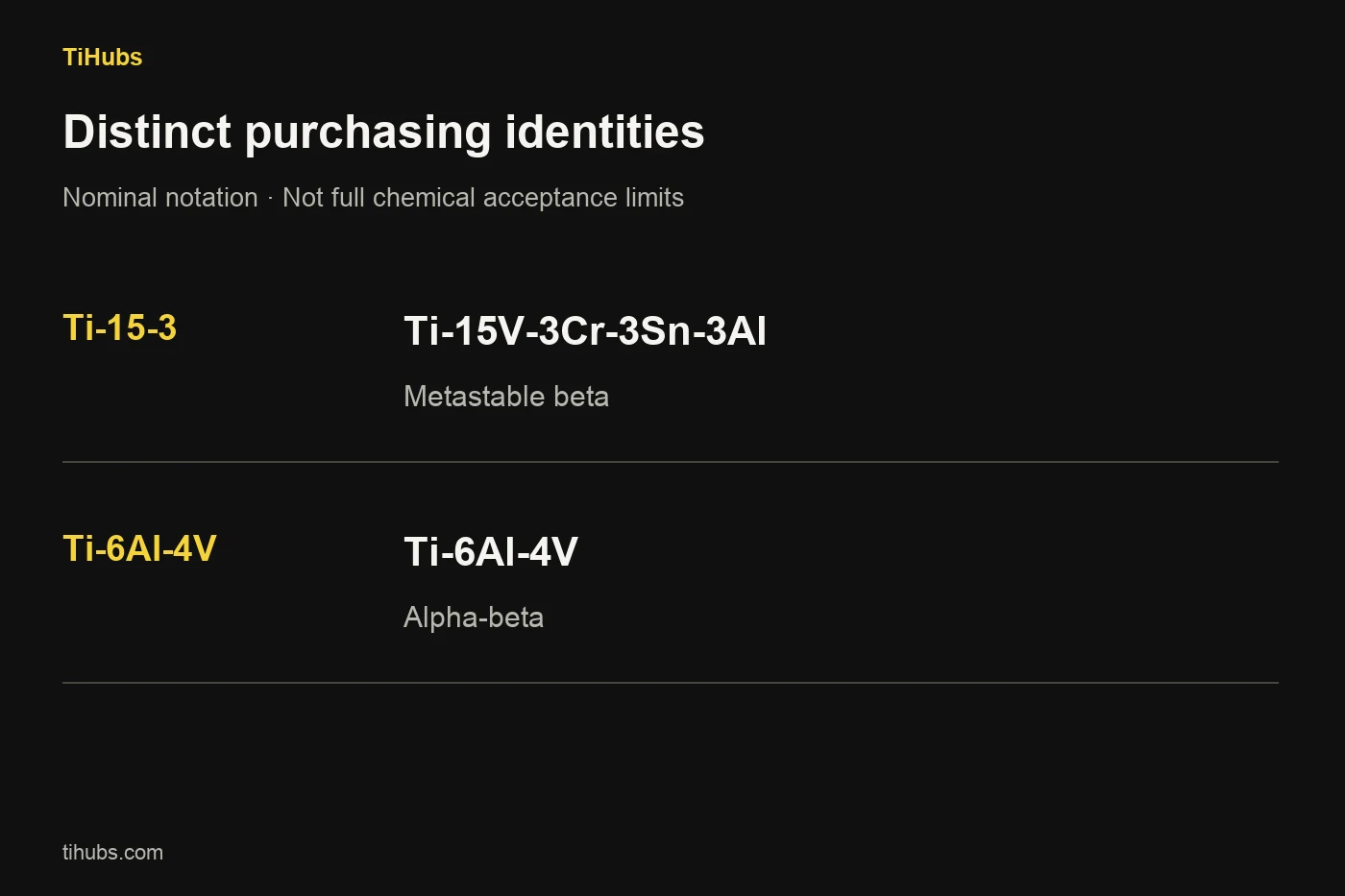
Ti-15-3Ti-15V-3Cr-3Sn-3Al
Ti-6Al-4VAlpha-beta alloy
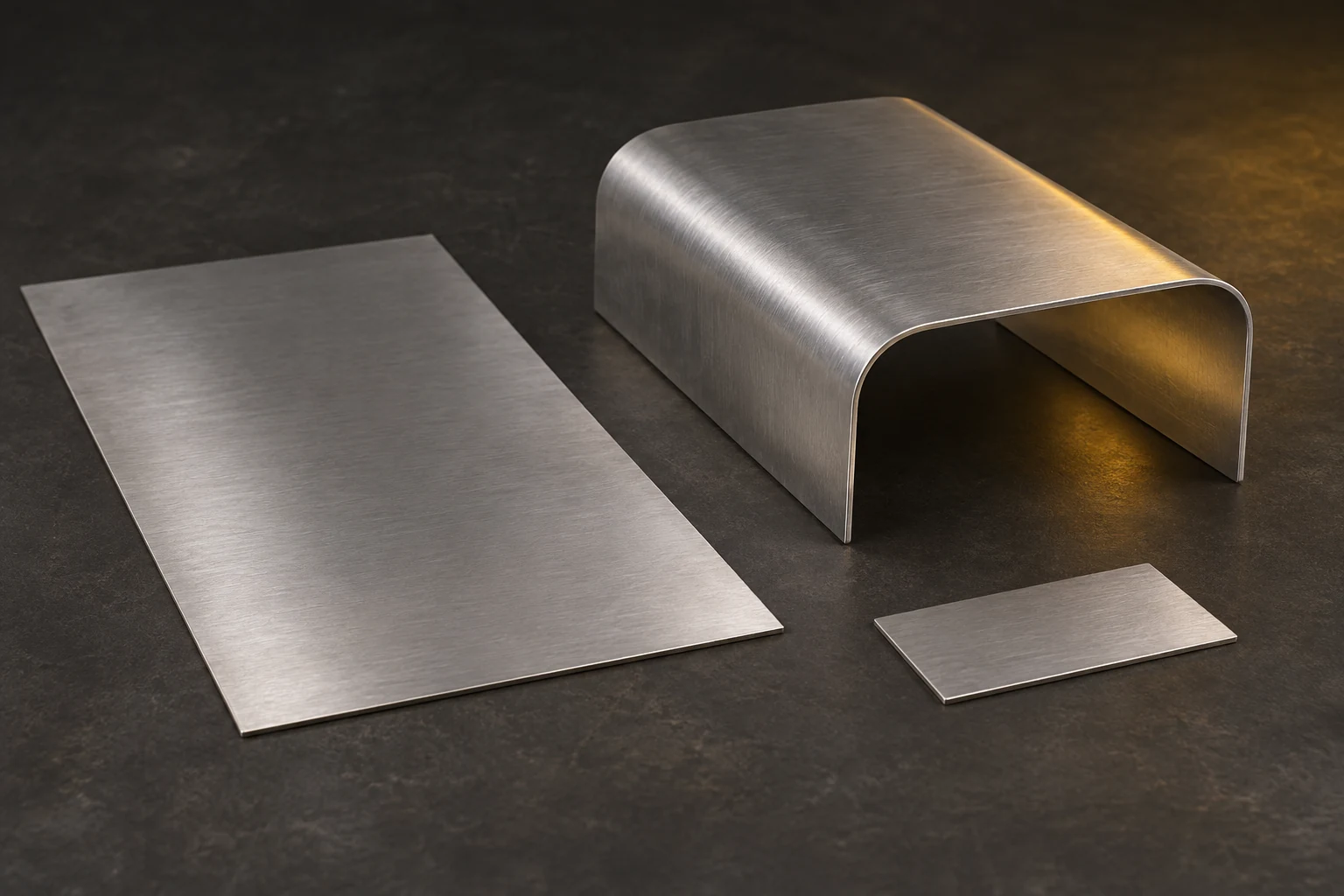
AI illustration; not a production or inspection record.
Quick answer
Ti-15-3 is a metastable-beta alloy whose solution-treated forming state and aged final state must be distinguished. Compare it with the approved Ti-6Al-4V route using the actual sheet thickness, geometry, process sequence and acceptance requirements. Historical aged-strip numbers do not establish incoming-sheet properties or a universal cross-alloy ranking.
01 / The sheet decision
Compare the route from flat stock to accepted part
Ti-15-3 vs Ti-6Al-4V is most useful as a formed-sheet purchasing comparison when the buyer needs a bracket, channel, duct detail or another thin component made through a defined manufacturing route. The question is not only which alloy can meet the final load requirement. It is also which material condition can be formed, processed and verified into the required geometry.
Ti-15-3 is shorthand for Ti-15V-3Cr-3Sn-3Al, a metastable-beta titanium alloy in the TIMET manufacturer description. Ti-6Al-4V is an alpha-beta alloy. TIMET distinguishes the cold-forming capability of solution-treated Ti-15-3 from the high-strength aged condition. That distinction is the starting point for the enquiry: the material state used during forming may differ from the state required at final delivery.
If an approved drawing names Ti-6Al-4V, a proposal to use Ti-15-3 is a material and process change that needs the applicable engineering review. If a new design is still being developed, purchasing can compare available sheet or strip routes while the responsible team establishes the final requirements. Neither an easy forming demonstration nor an attractive stock price independently approves the alternative.
Describe the intended purchased item precisely. Flat sheet, slit strip, cut blanks, formed parts awaiting aging and finished inspected components are different supply scopes. A quotation for solution-treated stock does not include every operation required to deliver an aged finished bracket unless those operations are explicitly part of the offer.
Identify the manufacturing question that drives the comparison. The buyer may be trying to achieve a tight geometric feature, reduce rejected blanks, control final dimensions or clarify responsibility for heat treatment. State that question in the enquiry so that the supplier can address the actual constraint rather than responding with a general alloy brochure.
Use the Ti-15-3 and Ti-6Al-4V Grade 5 pages as starting points for material identity. For product requirements, include the titanium sheet dimensions, condition and drawing. Ask which portions of the forming and final acceptance route the supplier is proposing to deliver.
A good selection connects the incoming sheet, the forming operation, later thermal or finishing steps and the final inspection. The following comparison therefore separates identity, condition-dependent evidence, blank preparation and process responsibility. This creates a purchasing basis that is more actionable than a list of unrelated maximum strengths or generic claims about bendability.
02 / Identity and data
Keep nominal composition separate from aged-strip requirements
The nominal identity table is based on the two TIMET manufacturer datasheets. The numbers in the alloy names are nominal mass percentages for the named additions, not a full chemical acceptance specification. Elements not shown in the shorthand are not automatically absent. The ordered product must meet the complete controlled chemistry requirement.
Nominal alloy identities; not complete chemical limits
Item
Ti-15-3
Ti-6Al-4V
Full nominal notation
Ti-15V-3Cr-3Sn-3Al
Ti-6Al-4V
Named additions, mass %
15 V; 3 Cr; 3 Sn; 3 Al
6 Al; 4 V
Manufacturer classification
Metastable beta
Alpha-beta
The following historical extract illustrates why the Ti-15-3 final state must be specified. TIMET’s sheet, carrying a 2000 copyright, gives minimum tensile requirements for strip after different aging conditions. These entries are not a direct comparison with Ti-6Al-4V and do not prescribe the production cycle for a new component.
TIMET Table 4: selected historical minimum strip properties after aging
Aging entry shown
Minimum UTS
Minimum 0.2% yield
Minimum elongation
8 h at 1000°F (538°C)
1000 MPa
965 MPa
7%
8 h at 925°F (496°C)
1172 MPa
1103 MPa
5%
16 h at 900°F (482°C)
1241 MPa
1172 MPa
5%
The source identifies prior solution treatment at 1450°F (790°C), followed by air cooling. Table 4 does not state the particular strip thickness, test temperature, specimen direction or elongation gauge-length basis. Those omissions remain omissions here. The current agreed specification and approved process must supply the requirements applicable to an actual order.
The values show different requirements within the same alloy and product description. They should not be assigned to solution-treated incoming sheet or to every formed component. Likewise, comparing the highest aged Ti-15-3 entry with an unrelated annealed Ti-6Al-4V value would not establish a fair cross-alloy ranking. Both datasets need matching product and test context.
When evaluating a supplier’s table, identify whether it contains minimum requirements, typical results or measurements from the offered lot. Keep the test conditions and source attached. If an important detail is missing, ask for the relevant specification or report rather than filling the gap with an assumption that makes the comparison look complete.
Use published forming comparisons with similar discipline. A bend-radius or springback number requires a material state, thickness, direction, tool and test basis before it can guide production. This guide does not turn a historical brochure value into a tooling instruction. The buyer needs evidence representative of the actual stock and part geometry.
Nominal notation supports identification; complete chemical acceptance requires the controlled product specification.
03 / Forming and final state
Specify two material states when the route requires them
For a route that forms Ti-15-3 in the solution-treated condition and then ages it, the enquiry should name both stages. State the incoming condition, the approved subsequent processing and the required final properties. This prevents the supplier from quoting material that is attractive for one operation but does not match the overall manufacturing plan.
For Ti-6Al-4V, use the forming and thermal route established for the actual product and geometry. Do not assume that the process used for Ti-15-3 transfers directly to the alpha-beta alloy. If the comparison includes a different forming temperature or sequence, identify that difference explicitly and include its equipment, handling and verification consequences in the review.
Separate the material supplier’s responsibility from the fabricator’s. A stock certificate establishes the incoming material within its stated scope. It does not automatically certify the properties after forming and aging by another party. The purchase and process documents should identify who performs each operation and who releases the resulting final state.
Agree the sequence of cutting, forming, thermal processing, trimming, joining and final finishing as applicable. The order of operations can be part of the qualified route. A quote that omits a later step may appear cheaper while transferring substantial work and responsibility to the buyer. Make that boundary visible before comparing commercial offers.
Plan dimensional inspection at the stages that answer the requirement. The as-formed geometry and the final geometry after later processing are separate observations. Where the project controls distortion or requires fixtures, define the approved arrangement and final tolerance basis. Do not promise a universal distortion percentage for either alloy; use the actual process and representative evidence.
If a supplier proposes delivering parts before the final thermal operation, identify the interim acceptance and the remaining work. State how the buyer will maintain identification and verify the final product. If the supplier delivers completed parts, include the final condition and record package in the quotation so the receiving team can assess the full requirement.
A useful review question is: at which stage is each property or dimension established? Answer it for the incoming sheet, the formed shape and the final component. This simple mapping exposes gaps where a requirement is assumed to be covered by a certificate or measurement from an earlier state.
For a revised route, document why the change is proposed and which previous qualification evidence remains applicable. A different aging condition, stock thickness or forming sequence can require review even when the alloy name remains unchanged. Preserve the connection between the approved process and the product being purchased.
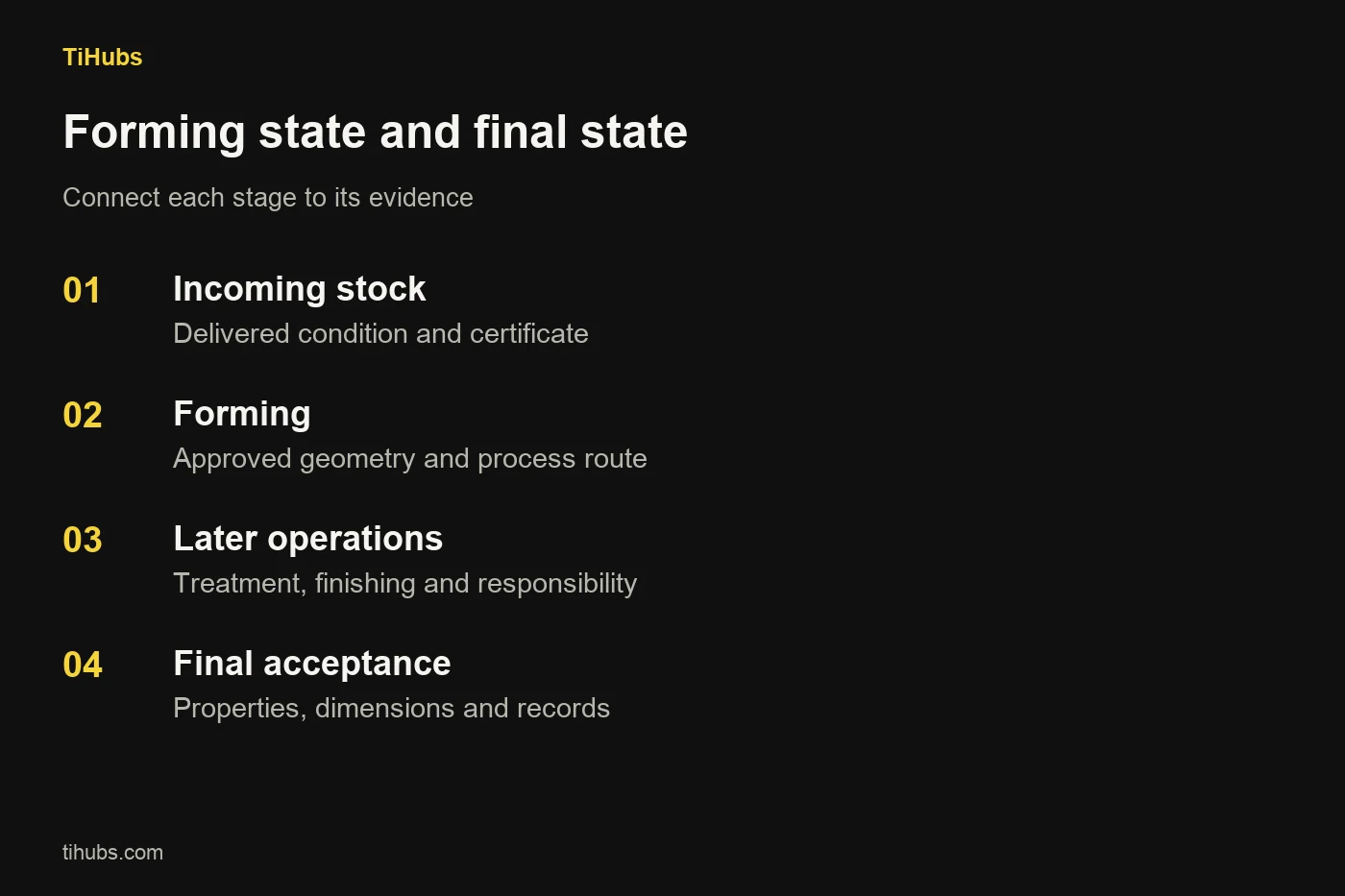
Industrial buying guide / 03Separate forming and final states
The incoming certificate, forming operation and final verification cover different stages of the route.
04 / Blank and forming
Make the sheet enquiry usable on the production floor
Define thickness, width, length, tolerances, flatness and surface requirements for sheet. For strip, include the required width, edge condition and supplied format. For cut blanks, provide the blank drawing or agreed cutting allowance. A nominal thickness alone does not describe enough information for a meaningful formed-part quotation.
Identify orientation where the drawing or process requires it. The relationship between rolling direction, blank layout and forming features should be preserved through cutting and identification. Do not assume that a nesting change is purely commercial if it changes a controlled direction. Ask how the proposed layout maintains the required relationship.
Describe the relevant bends and formed features with the drawing rather than a generic request for good formability. Include radii, angles, transitions and the tolerance basis needed by the manufacturer. A forming trial should represent the actual material state and geometry sufficiently to answer the decision being made.
Keep bend feasibility separate from springback compensation. Producing a bend without an unacceptable defect does not by itself establish the final angle or dimensional repeatability. Tooling and process development should address both questions where they matter. The buyer should know whether this work is included in the offer or remains a separate qualification activity.
Agree edge preparation and surface handling according to the approved manufacturing requirements. A cut edge, a burr or a surface mark may be relevant to subsequent operations and acceptance. State the required delivered condition rather than assuming that every stock-cutting method produces an equivalent forming blank.
For prototype material, ask whether the sample has the same alloy, condition, thickness and relevant surface state as planned production stock. If it differs, record what the trial can and cannot establish. A successful prototype made from conveniently available material should not silently qualify a different production supply route.
For nested blanks, evaluate usable yield using the actual layout and required orientation. Include trim margins, test coupons and any handling requirements that consume material. Avoid fixed claims about material savings between alloys. The relevant yield is the output of the agreed part and process arrangement, not a universal property of the grade.
When several parts are cut from a sheet, maintain the required identification relationship through forming and subsequent processing. The final records should connect the parts to their source material and process history. This is easier to plan before cutting than to reconstruct after unmarked blanks have moved through different workstations.
Define the trial record before the first blank is formed. Include material identification, thickness, incoming state, blank orientation, tooling reference and the dimensions to be assessed. Photograph or document the relevant features as the quality plan requires. The record should let the team distinguish a material-related observation from a change in setup or measurement method.
For a trial that precedes final thermal processing, retain measurements both before and after the required later operations. This helps the team locate the stage at which a dimensional difference appears. It does not by itself establish the cause, but it creates a more useful basis for a process review than a single final pass-or-fail statement.
If the blank drawing and finished-part drawing differ, identify which document governs the supplier’s scope. Record any approved allowance or orientation requirement in the order. Otherwise, the supplier may deliver an accurately cut blank that still does not support the buyer’s planned forming and trimming route.
When a production batch contains several sheet lots, keep the required lot relationships available during the trial and acceptance review. This allows a result or discrepancy to be connected to the material actually used. Do not merge results into a general alloy conclusion without checking whether the stock and processing conditions are comparable.
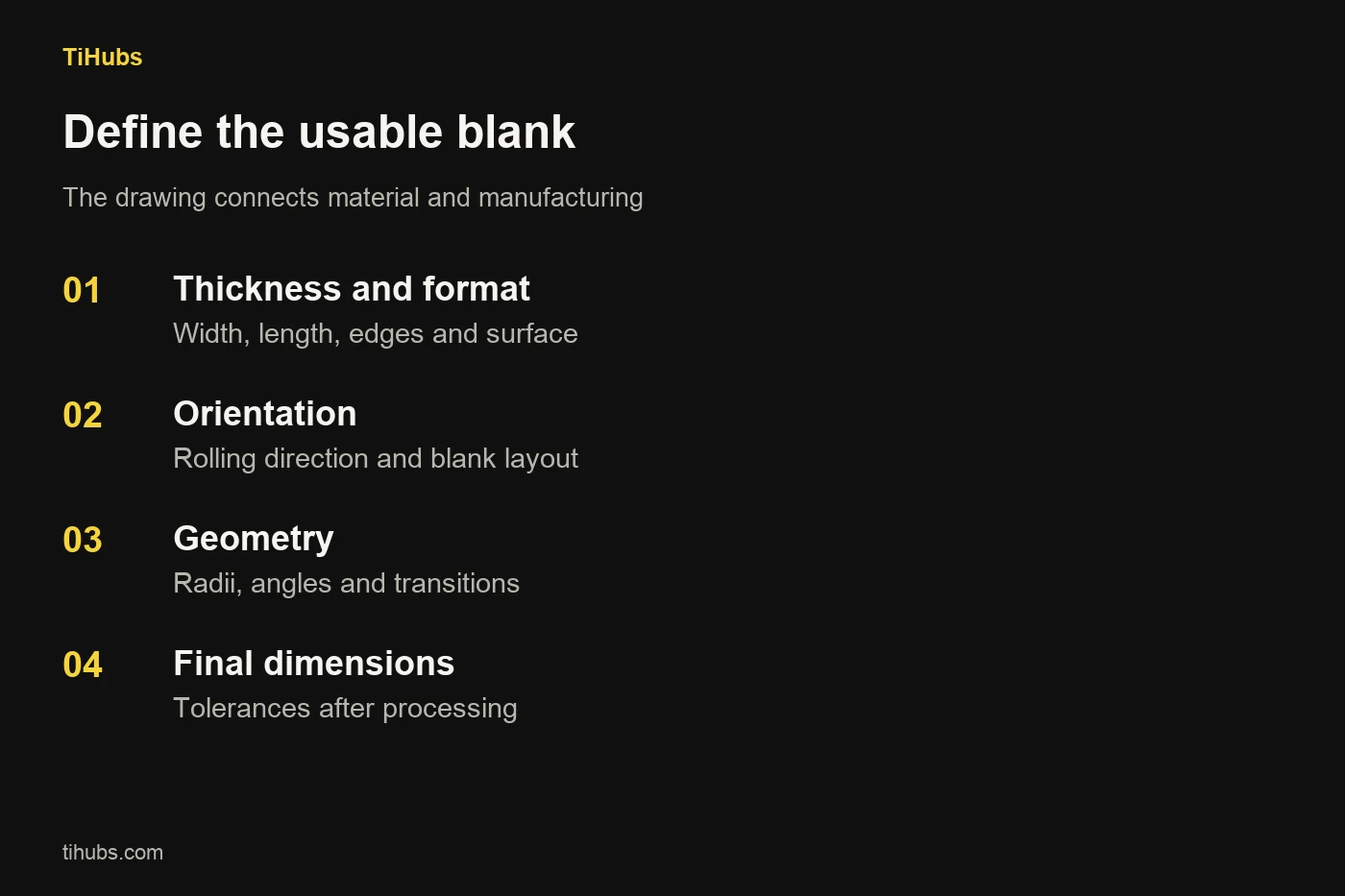
Industrial buying guide / 04Define the usable blank
Thickness, orientation, geometry and final tolerance belong together in the enquiry.
05 / Verification and release
Verify the final state and the final geometry
Build the inspection plan around the delivered scope. Flat stock needs the records and dimensional checks required for that product. A formed and aged component needs the additional verification specified for the resulting part. A supplier’s general statement that material is certified should be translated into the actual documents and tests included in the offer.
For chemical identity, check the complete specification rather than only the nominal name. For mechanical evidence, identify the product, condition, specimen and test basis. For dimensions, identify whether results represent stock, an intermediate shape or the finished item. These three checks prevent different kinds of evidence from being used outside their scope.
Where mechanical tests are required after processing, define the approved sampling arrangement and its relationship to production parts. Do not assume that an incoming mill result establishes the condition after another business performs aging. The responsible process should determine the required verification and connect it to the final release package.
For joining or further assembly, retain the applicable process and component requirements. A material forming comparison does not independently qualify a weld or an assembly. If the supplier’s quotation includes joining, identify the procedure, inspection and final condition within that scope. If it excludes joining, make the handover requirements clear.
Review surface and dimensional results after the operations specified by the drawing. A part can meet an intermediate geometry while still needing final verification. Define how approved corrections, rework or deviations are handled, and ensure the final records identify the accepted condition rather than an earlier unsuccessful attempt.
At receipt, match the supplied items to the order, material identification and record package. If the delivery is stock for later processing, preserve the incoming condition and traceability information for the fabricator. If it is a completed component, confirm the final condition, dimensions and required release evidence before production use.
For incomplete records, identify the exact missing requirement and the party responsible for resolution. A certificate correction, additional test record and engineering deviation are different actions. Keeping them distinct helps the buyer resolve the issue without mistaking a document edit for proof of a technical condition.
Retain the approved route for repeat orders. Changes in sheet source, condition, thickness, blank orientation or processing sequence should be reviewed against the established basis. Previous successful parts are useful evidence, but they do not automatically validate every later variation with the same alloy description.
Prepare a simple acceptance record that separates stock requirements, process records and final-part measurements. For each item, identify the governing document, responsible party and evidence delivered. If the order stops at cut blanks, the final forming checks belong to a later stage; if it covers finished parts, those checks should appear in the supplier’s agreed scope. This makes the delivery boundary visible to both purchasing and inspection.
For a repeat order, confirm the current drawing revision and whether the approved blank layout or forming sequence has changed. A familiar part number can still refer to revised tolerances or process notes. Request acknowledgment of those changes before production begins. The previous route provides a useful starting point, but the new order must describe the requirement actually being released.
Retain the approved trial and first-article records with the production requirement. They help explain why the selected stock condition, orientation and process sequence were accepted. If a later proposal changes one of those items, the reviewer can identify which evidence remains relevant and what additional check is needed.
06 / Quotation and purchase
Compare completed manufacturing routes and usable output
Ask suppliers to price a common requirement set: alloy, specification edition, product form, condition, dimensions, quantity and documentation. For formed parts, add drawing revision, manufacturing stages and final acceptance. Where two routes remain under evaluation, identify their approval status and request clear separation of conforming scope and proposed alternatives.
Compare material and processing costs together. A stock price advantage may be offset by blank preparation, forming development, thermal processing, fixtures, inspection or finishing. Conversely, a more expensive starting product may reduce work in a particular approved route. The decision requires actual quotations for the part, not a universal price claim for Ti-15-3 or Ti-6Al-4V.
Separate one-time development from recurring production. Tooling, first-article work and representative trials may have different economics from repeat orders. Ask how these items are priced and what qualification evidence they produce. A low unit price without the necessary development scope does not describe the full cost of starting production.
Check availability for the exact thickness, width, condition and required documents. A published historical gauge range does not establish current inventory. If a supplier proposes another size or format, assess its effect on blank layout, handling, downstream processing and acceptance before treating it as an equivalent replacement.
Align the schedule with technical hold points. A forming trial, process approval or document review may need completion before production can proceed. Assign responsibility and define the evidence needed for release. Distinguish material dispatch from delivery of finished, accepted parts when several operations or processors are involved.
Consider an illustrative enquiry for a formed channel. One supplier offers solution-treated Ti-15-3 blanks, while another offers finished Ti-6Al-4V parts. These are not comparable bids until forming, final thermal condition, dimensional inspection and documentation are brought to a common boundary. The example illustrates a scope issue; it is not a reported customer result or a claim that either route is inherently cheaper.
Before order release, reconcile the drawing, quotation and acknowledgment. Confirm both the forming condition and final state where they differ, plus the responsibilities for each operation. Record approved deviations explicitly. The result should be a purchase description that a supplier can manufacture against and a receiving team can verify without relying on assumptions from earlier discussions.
The useful choice is therefore the alloy and manufacturing route that satisfies the approved geometry and final requirements with a verifiable supply package. Ti-15-3 deserves evaluation when its solution-treated forming route fits the project; Ti-6Al-4V may remain the approved or suitable basis in others. The comparison becomes valuable when it identifies the next evidence, quotation or process decision needed for the actual part.
07 / Build your RFQ
Send the sheet and forming requirement
Provide the alloy, specification, sheet or blank dimensions and drawing revision. Identify the forming condition, required final state, included operations and inspection so the quotation describes the complete route you intend to purchase.
Information to include
Exact alloy, product specification and edition
Thickness, width, blank layout and orientation
Forming geometry, tolerance and drawing revision
Incoming condition, final state and process responsibility
Quantity, trials, inspection and delivery destination
Build your RFQ checklist
Choose the product and add the information you have. Copy the resulting brief or send your requirements to TiHubs. Submitting an enquiry does not place an order.
08 / FAQs
Questions buyers ask
What is the full alloy name behind Ti-15-3?
Ti-15-3 denotes nominal Ti-15V-3Cr-3Sn-3Al. TIMET identifies it as a metastable-beta titanium alloy. The shorthand is not a complete chemistry specification; use the controlled product requirements to establish permitted composition and acceptance of the actual supplied lot.
Should Ti-15-3 be purchased in the final aged state for forming?
That depends on the approved process. A route based on forming solution-treated material and aging afterward needs both states specified. Do not order only by the highest final strength value and assume that the resulting incoming condition suits the planned forming operation.
Can the historical aged-strip table determine the production cycle?
No. It illustrates condition-dependent requirements in the manufacturer source. Its missing thickness and test details remain limitations, and it is not a current controlled process instruction. Use the agreed specification and approved manufacturing route for the actual part and material.
Is a published bend radius enough to design the tool?
A usable forming basis needs material state, thickness, direction, geometry and process context. A brochure number does not independently establish springback compensation or dimensional repeatability. Use representative evidence and the applicable manufacturing requirements before transferring a result to production tooling.
Does incoming sheet certification cover the finished aged component?
It covers the incoming product within its stated scope. Forming, aging and other operations require the verification specified for the final part. Assign process and release responsibilities so that the completed component is supported by evidence for its actual condition.
Which route has the lower purchase cost?
Compare quotations for the same delivery boundary and usable output. Include blank yield, tooling, trials, forming, treatment, inspection and finishing where relevant. Stock prices alone cannot establish the cost of an accepted formed part, and historical supplier statements do not prove current pricing.
09 / Key takeaways
Keep the purchase requirements connected.
Keep Ti-15-3 and Ti-6Al-4V identities distinct.
Specify forming condition and final state separately when needed.
Retain the conditions and limitations of historical numerical tables.
Connect blank orientation, forming geometry and final dimensional checks.
Compare complete manufacturing and documentation scopes.
Technical references
Sources and data scope
References reviewed November 14, 2026. Public source summaries support the discussion; the controlled specification, agreed edition and approved project requirements govern acceptance.
TIMET — TIMETAL 6-4 — Manufacturer source for nominal alloy identity and alpha-beta classification. Its unrelated property contexts are not combined into an unmatched strength ranking.
Ti
About TiHubs
TiHubs coordinates titanium material and custom supply enquiries from Baoji, China. Send the product, drawing revision and acceptance requirements so the proposed supply scope can be reviewed. Learn about our sourcing role.
Contents
TiHubs
Talk to TiHubs
Ask about titanium materials, grades or custom parts.
Enter your email to start chatting.
We use your email to respond to your enquiry. Your conversation is stored on this website.
Our team is away right now. Leave your enquiry and we will follow up by email.