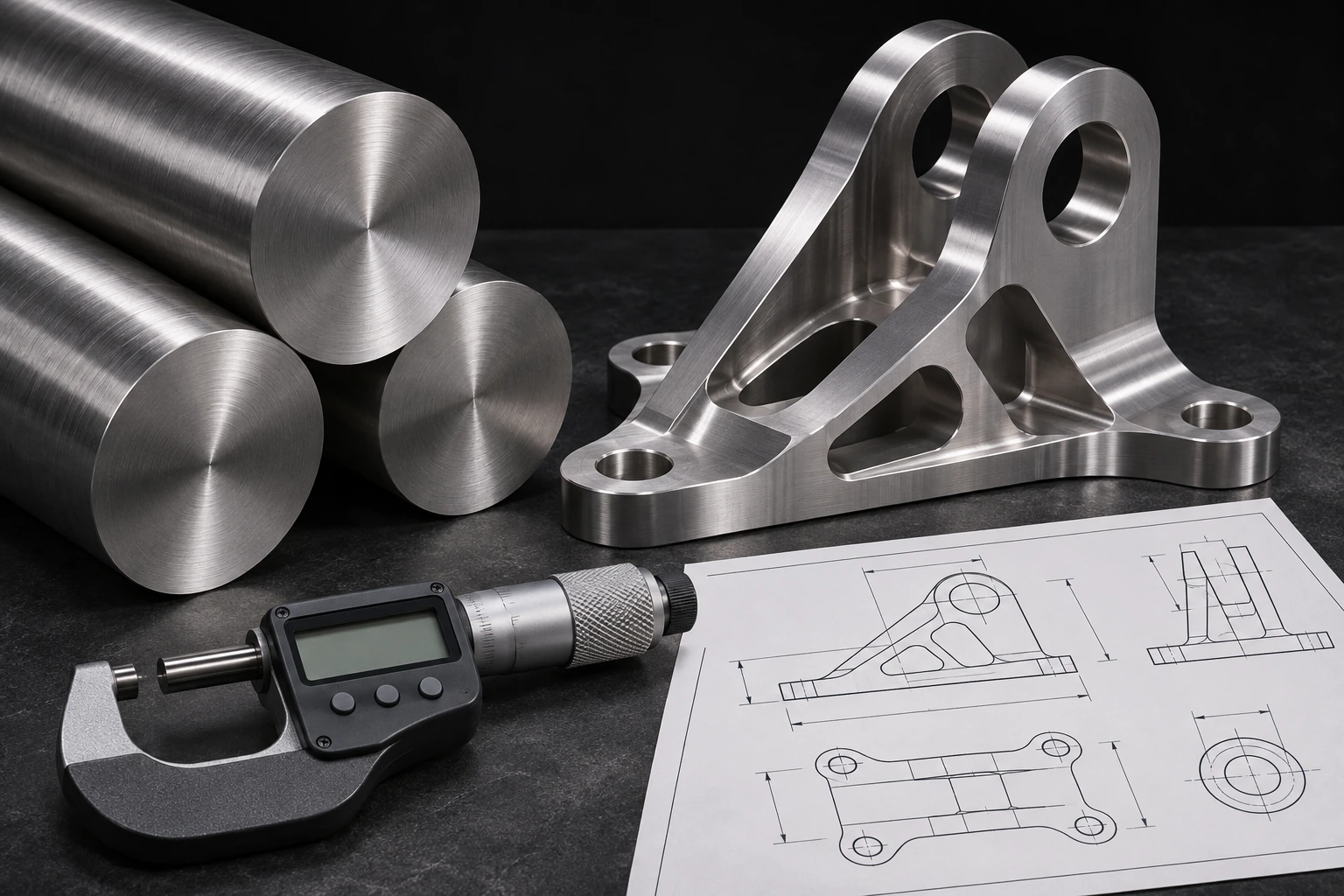
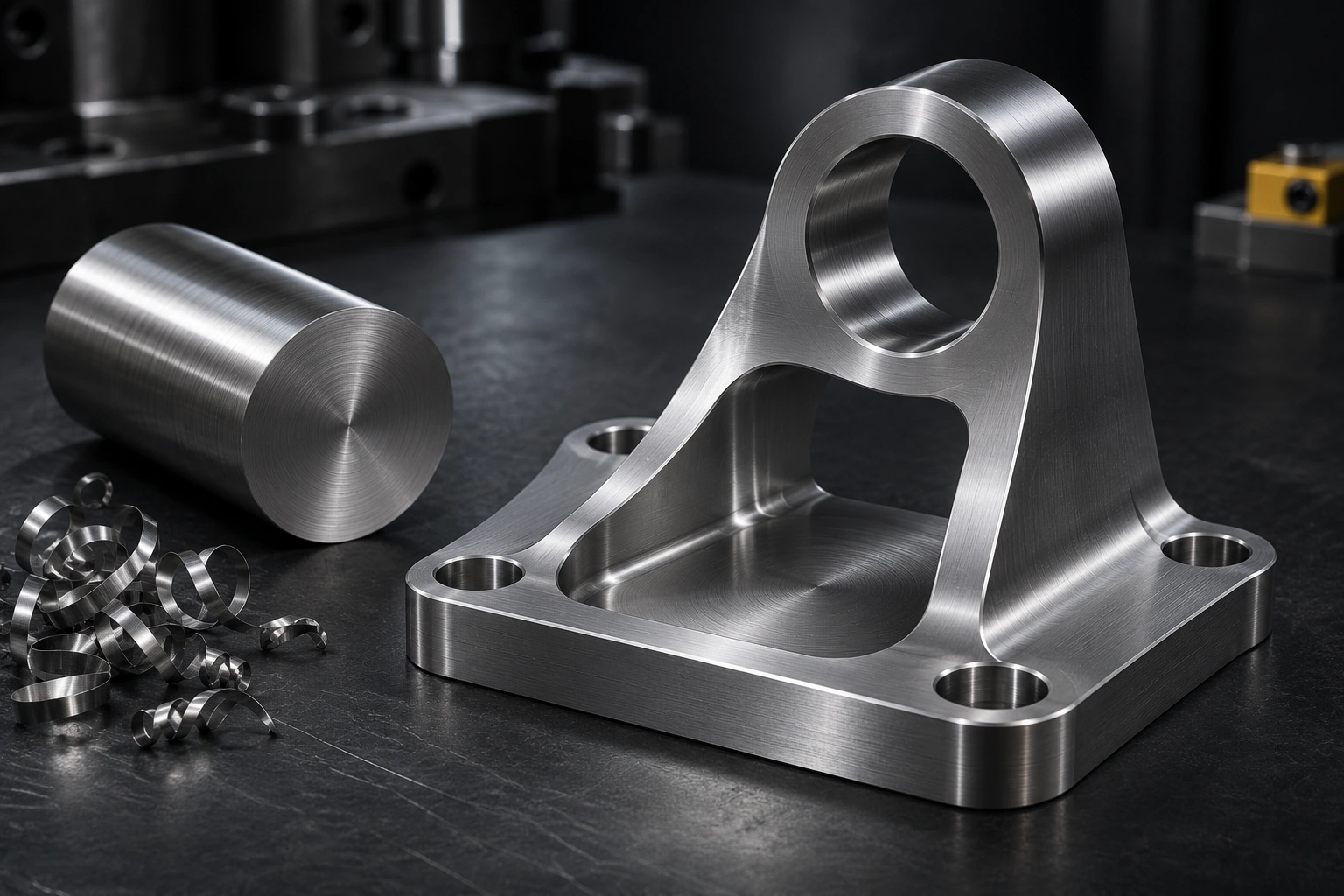
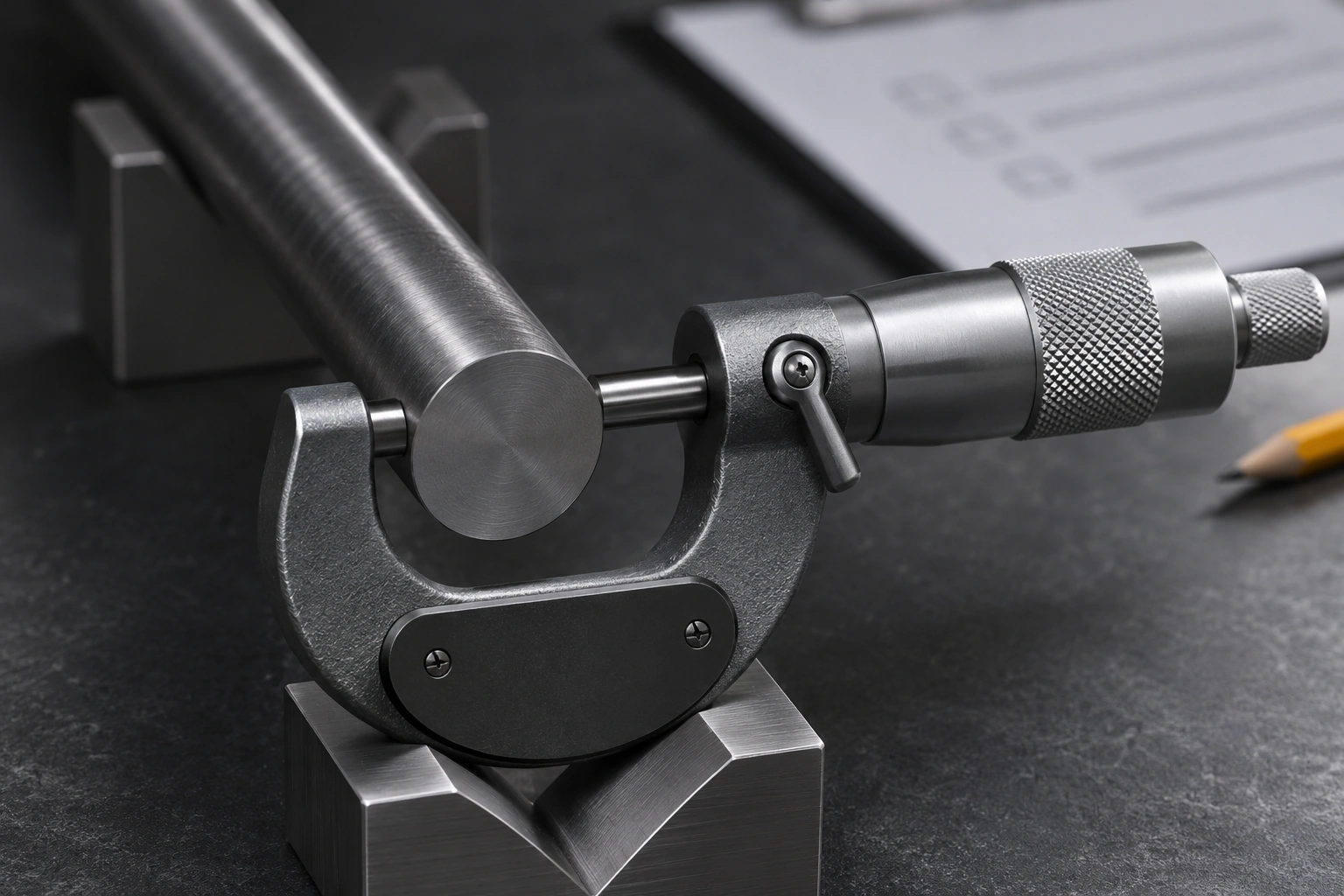
AI illustration. Appearance and labels do not verify material compliance.
Quick Answer
TC4 and Grade 5 belong to the Ti-6Al-4V alloy family, but the names alone do not establish order equivalence. If a drawing requires Grade 5 and a quotation offers TC4, compare the complete standards and editions, product form, delivery condition, chemistry, mechanical properties, inspection scope and traceability. Release the order only when the supplier can demonstrate the specified compliance or the responsible design owner has approved a documented alternative.
01 / The purchasing question
The same alloy family is only the starting point.
The most useful TC4 vs Grade 5 titanium comparison starts with a real purchasing problem: a buyer sends a drawing for a machined component, receives an attractive TC4 quotation, and is told that TC4 is the Chinese equivalent. That statement may identify a sensible sourcing candidate. It does not yet answer what material will arrive, which requirements apply, or how incoming inspection will accept it.
Grade 5 is commonly identified as Ti-6Al-4V and UNS R56400. ASTM B348/B348M covers titanium bar and billet; ASTM B265 covers strip, sheet and plate. These product specifications do different jobs from a designation-and-composition document such as GB/T 3620.1-2016. A chemistry designation is not a complete product purchase specification.[1][2][3]
Your purchase order therefore needs to connect three things: the design requirement, the offered manufacturing route, and the evidence delivered with the material. If one of those connections is missing, a cross-reference table cannot fill the gap. A supplier may be able to supply material meeting both specified sets of requirements, but that capability must be confirmed for the actual product, size, condition and batch.
Product definitionStart with the product.
Define the form, condition and manufacturing requirements before comparing grades.
Acceptance evidenceConnect the records.
Dimensions, material identity and the agreed inspection scope belong together.
AI-generated editorial illustrations show product and inspection concepts. They are not production records or evidence of a particular material grade.
What “equivalent” can mean in a quotation
Ask the supplier which claim is being made. “Same alloy family” means a useful broad comparison. “Comparable chemistry” means the composition requirements or actual analysis have been compared. “Complies with both specifications” is a much larger claim involving the applicable product requirements and records. “Approved substitute” means someone with authority over the design has accepted a defined deviation. These phrases should not be used interchangeably.
Quotation statement
What it establishes
What you still need
TC4 / Ti-6Al-4V
The offered alloy designation
Complete standard, edition, product and condition
TC4 equivalent to Grade 5
A proposed cross-reference
Written requirement-by-requirement comparison
Chemistry meets Grade 5
A claim about composition
Applicable limits, actual heat analysis and remaining product requirements
Dual compliant
A claim that two specifications are met
Both editions, complete evidence and any exclusions
Accepted alternative
A specific substitution decision
Written approval reference and its exact scope
Start with the requirement that controls acceptance
Read the drawing title block, material note, general specification and purchase order together. Record their revision numbers. A material note that says only “Grade 5 titanium” is less complete than one that specifies a product standard, edition and condition. Do not let the quotation silently supply missing design decisions. Ask the buyer’s engineering or quality team to resolve those gaps before selecting stock.
Where the drawing calls for an AMS specification, compare against that exact AMS document. A bar offered to a general ASTM specification does not become AMS compliant because its nominal alloy is the same. Likewise, an ASTM material order should not be reduced to a GB/T chemistry reference during commercial negotiation. Preserve the original requirement in a clearly labelled column and record the offered requirement alongside it.
02 / Requirements
Build a comparison that can be approved.
Use one controlled worksheet for the review. Give each line a status—confirmed, evidence pending, deviation proposed, or not applicable—and name the document that closes it. Avoid a single “equivalent: yes” checkbox: it conceals the specific uncertainty that the buyer needs to resolve.
The TC4 / Grade 5 order checklist
Review item
Buyer requirement
Supplier response to request
Full designation
Exact drawing wording, including suffixes
Exact designation on the proposed mill certificate
Standards and editions
Product specification plus additional requirements
All offered standards, editions and exclusions
Product form
Bar, sheet, plate, forging, wire or finished part
Manufacturing route and starting-stock form
Delivery condition
Required heat treatment or condition
Process condition and records available
Chemistry
Every required element and analysis basis
Actual heat analysis; product analysis if required
Mechanical properties
Applicable size range, direction and test method
Results, specimen identification and sampling basis
Dimensions and surface
Ordered size, tolerances, finish and allowance
Inspection method and proposed supply dimensions
Additional examination
Specified metallography or NDT, where applicable
Procedure, coverage, acceptance level and reporting
Traceability
Heat/lot-to-piece identification
Marking, cutting transfer and packing-list method
Documents
Certificate type, language and review stage
Sample format and final deliverable list
Deviations
Approval required before production
Separate written list, including “none” if applicable
Compare actual chemistry without stopping there
Ti-6Al-4V describes the nominal aluminium and vanadium alloying concept. Acceptance depends on the permitted ranges and limits in the ordered specification, including elements present in much smaller amounts. A supplier’s generic datasheet is useful for screening; the heat-specific analysis is the record for the offered material. ATI’s published Grade 5 data illustrate this distinction between alloy identity and specified composition. [4]
Do not compare only aluminium and vanadium. Create a row for every element required by the governing documents and record whether the result is a heat analysis or a product analysis. Copy the limits from the controlled specification used for the order, rather than from a marketing comparison. Check units, decimal places and any applicable analysis tolerances. A value shown as “balance” does not provide the other missing results.
A successful chemistry comparison closes only the chemistry portion. It does not establish that the material was processed, sampled or tested under the required product standard. If the certificate lists only a Chinese specification, ask whether the mill can explicitly certify the target specification and provide the supporting records. Do not edit the certificate heading yourself to create the appearance of compliance.
Condition and section size can change the answer
A quotation for annealed bar is not automatically a quotation for solution-treated-and-aged material. A property measured in one section size does not establish the properties of every larger section or a differently processed part. TIMET describes Ti-6Al-4V properties as dependent on its microstructure and thermomechanical history. [5]
For purchasing, convert that principle into explicit questions: what is the final delivered condition; when was the relevant heat treatment performed; which section size and test direction do the results represent; and what subsequent operations are planned? If the part maker will heat treat after machining, define who owns that process and which final properties must be verified. Avoid quoting an unfinished stock condition as if it were final-part acceptance.
Keep product-form requirements separate
For bar, agree diameter or section, length, straightness, surface condition and machining allowance. For sheet or plate, agree thickness, flatness, surface, edge condition and required test direction. For a forging, compare the forging specification and approved processing route, rather than treating a bar certificate as the complete evidence for the finished forging. B265 and B348/B348M are useful examples of why the product form belongs in the order. [2][3]
For a machined part, separate the starting-stock certificate from the finished dimensional report. The stock certificate cannot confirm the finished bore size, surface roughness or positional tolerance. The inspection report cannot replace material traceability. Put both deliverables into the quotation so that neither becomes an unexpected extra after production.
03 / Acceptance and cost
Close the evidence gap before comparing prices.
The cheapest quotation is meaningful only after its scope is clear. A TC4 offer may differ from a Grade 5 offer because of stock availability, size allowance, test scope, document requirements or delivery terms. Treat these as line items to compare, not as proof that one designation is inherently cheaper or inferior.
A practical drawing-to-quotation example
Consider an illustrative order for a batch of machined brackets. The drawing calls for Grade 5 bar to a specified ASTM edition, in a defined condition. The quotation lists “TC4 bar, equivalent material” and includes machining. The commercial team should pause the material release and ask for the proposed bar specification, heat-specific certificate, applicable property results and a written deviation statement.
There are three possible outcomes. First, the supplier demonstrates that the selected material and records meet the original order requirements; the quotation is corrected to state that scope. Second, the supplier identifies differences and offers an alternative; the design owner decides whether to approve it and records the approval. Third, the supplier cannot provide enough evidence; the buyer selects another supply route. None of these outcomes is resolved by changing “TC4” to “Grade 5” on an invoice.
Decision gate
Release when
Hold when
Specification review
All controlling documents and revisions are agreed
Drawing and quotation cite different or incomplete requirements
Material allocation
Proposed heat/lot and document scope are acceptable
Certificate is generic or unrelated to the allocated material
Production release
Deviations are closed and inspection stages agreed
Approval is verbal, conditional or missing
Shipment release
Final records match goods and order
Heat numbers, dimensions or required reports do not reconcile
Read the mill test certificate as a linked record
Check the issuing organization, certificate number, issue date, full designation, standard edition, product form, dimensions, condition and heat or lot identifier. Then check the reported tests against the actual order. A certificate with convincing formatting but no connection to the delivered pieces does not close traceability. Ask for a sample certificate format early, while recognizing that a sample is not the final batch record.
Agree how identity survives cutting and machining. If one long bar is divided into many blanks, the supplier needs a practical way to connect those blanks with the parent heat. The method may involve approved marking, tagged containers or a controlled traveller, depending on the order. Specify what must remain legible after finishing and what information appears on the packing list. Resolve mixed-heat deliveries before they reach incoming inspection.
Add tests to answer a requirement, not to decorate a quotation
If ultrasonic examination, metallography or independent laboratory testing is required, state the procedure or standard, acceptance criteria, coverage, sampling and reporting responsibility. “UT tested” without those details is difficult to evaluate. Do not assume that every Grade 5 or TC4 product requires the same supplementary tests; the product specification, design and contract determine the scope.
Portable alloy identification can be useful for screening some mix-ups, but acceptance should not be based on an instrument name alone. Ask whether the method measures every element and property needed for the decision, with suitable limits and traceability. A chemical spot check does not establish heat treatment, mechanical properties or complete product-standard compliance. Where a gap exists, agree the appropriate test and its limitations before accepting the lot.
Compare the cost of the same deliverable
Ask for material, cutting, machining, inspection, documentation, packing and freight to be identified where they affect the comparison. Confirm whether quoted dimensions are raw stock or finished dimensions. Clarify minimum order quantity, usable length, cut loss and ownership of remnants. A low price per kilogram can produce a higher cost per accepted component if the stock allowance or inspection scope is unsuitable.
Set a document-review deadline before shipment. If final records are first reviewed after the goods have left the supplier, a simple missing result can become a transport and schedule problem. For a repeat order, retain the approved comparison and update it when the drawing, standard, size, mill route or condition changes. Previous approval should not silently cover a different requirement.
04 / Build your RFQ
Turn the review into a clear RFQ.
TiHubs coordinates titanium sourcing from Baoji, with one contact for the agreed material, manufacturing and inspection scope. Send the controlling drawing and specification references, identify the TC4 offer you want reviewed, and state whether an alternative is permitted. We can coordinate clarification and quotation through the local supply network; technical substitution approval remains with the responsible buyer or design authority.
Use the checklist below to organize what is known and flag what still needs confirmation. Include the drawing revision, required standard edition, product form, condition, quantity and destination. If you require both Chinese and international compliance, name both requirements explicitly. A blank requirement is a question to close, not permission for the supplier to choose any convenient option.
Build your RFQ checklist
Choose the product and add the information you have. Copy the resulting brief or send your requirements to TiHubs. Submitting an enquiry does not place an order.
“Please quote the material and product requirements stated on the attached drawing and specification list. If TC4 is proposed against a Grade 5 requirement, provide a written comparison and identify all deviations. Confirm the delivery condition, inspection scope, heat/lot traceability and certificate deliverables. Do not substitute material or begin production against an unapproved deviation.”
Keep the approved response with the order. This gives procurement, production and incoming inspection the same acceptance basis and reduces the chance that a commercial shorthand becomes an unintended technical change.
05 / FAQ
Questions buyers ask about TC4 and Grade 5.
Is TC4 exactly the same as Grade 5?
TC4 is commonly compared with Grade 5 within the Ti-6Al-4V family. That is a starting point for review, not a universal equivalence statement. The complete product standards, editions, condition and supporting records determine whether a specific supply meets your order.
Can TC4 be supplied against a Grade 5 drawing?
It may be possible when the actual supply demonstrably meets the drawing and purchase requirements, or when a defined alternative is formally approved. Ask the supplier to state the compliance basis in writing before the order is released.
Does matching aluminium and vanadium prove equivalence?
No. The required chemistry includes more than the nominal alloying elements, and chemistry is only one part of product acceptance. Condition, properties, dimensions, inspection and traceability must also be addressed.
Is a mill certificate enough?
It is an essential record when required, but its content and connection to the goods matter. A certificate must identify the relevant heat/lot and provide the required evidence. Additional finished-part or supplementary inspection records may be needed.
Can a distributor issue a new Grade 5 label?
A replacement label is not new technical evidence. Any certification or marking must accurately reflect the supporting records and agreed requirements. Resolve the original compliance question before relabelling material for an order.
Should every order request dual certification?
Only if both specifications are needed and achievable for the actual product. Specify both editions and clarify the full scope. Unnecessary certification demands can add work without resolving the requirement that actually controls the part.
Who approves a material substitution?
The party authorized by the design and contract should approve it. Procurement can coordinate the comparison, but a supplier’s assurance or a cross-reference chart should not replace the required technical approval.
Is TC4 always less expensive?
There is no useful fixed discount that applies to every order. Compare equivalent product, condition, dimensions, quantity, inspection, documents and delivery terms. Ask for a dated quotation for the actual scope.
06 / Key takeaways
Approve the requirements, then release the order.
Record the full specification. Grade names alone leave the acceptance basis incomplete.
Compare the product and condition. Bar, plate, forging and finished part requirements are not interchangeable.
Review actual evidence. Connect chemistry and property results to the allocated heat or lot.
Close deviations in writing. State who approves them and when production may start.
Preserve traceability through delivery. The certificate, piece identity and packing list must reconcile.
Technical references
Sources and data scope
Technical references checked November 7, 2026. The standards listed below establish document scope; use the complete controlled editions specified for the order when assessing conformity. The review worksheet and examples are TiHubs purchasing guidance, not a declaration that the two standards are identical.
TiHubs coordinates titanium materials and custom supply from Baoji, China. Our founder’s 20 years in titanium inform a specification-led sourcing approach: clarify the product, manufacturing and acceptance requirements before quotation. Learn about our sourcing role.
Contents
TiHubs
Talk to TiHubs
Ask about titanium materials, grades or custom parts.
Enter your email to start chatting.
We use your email to respond to your enquiry. Your conversation is stored on this website.
Our team is away right now. Leave your enquiry and we will follow up by email.