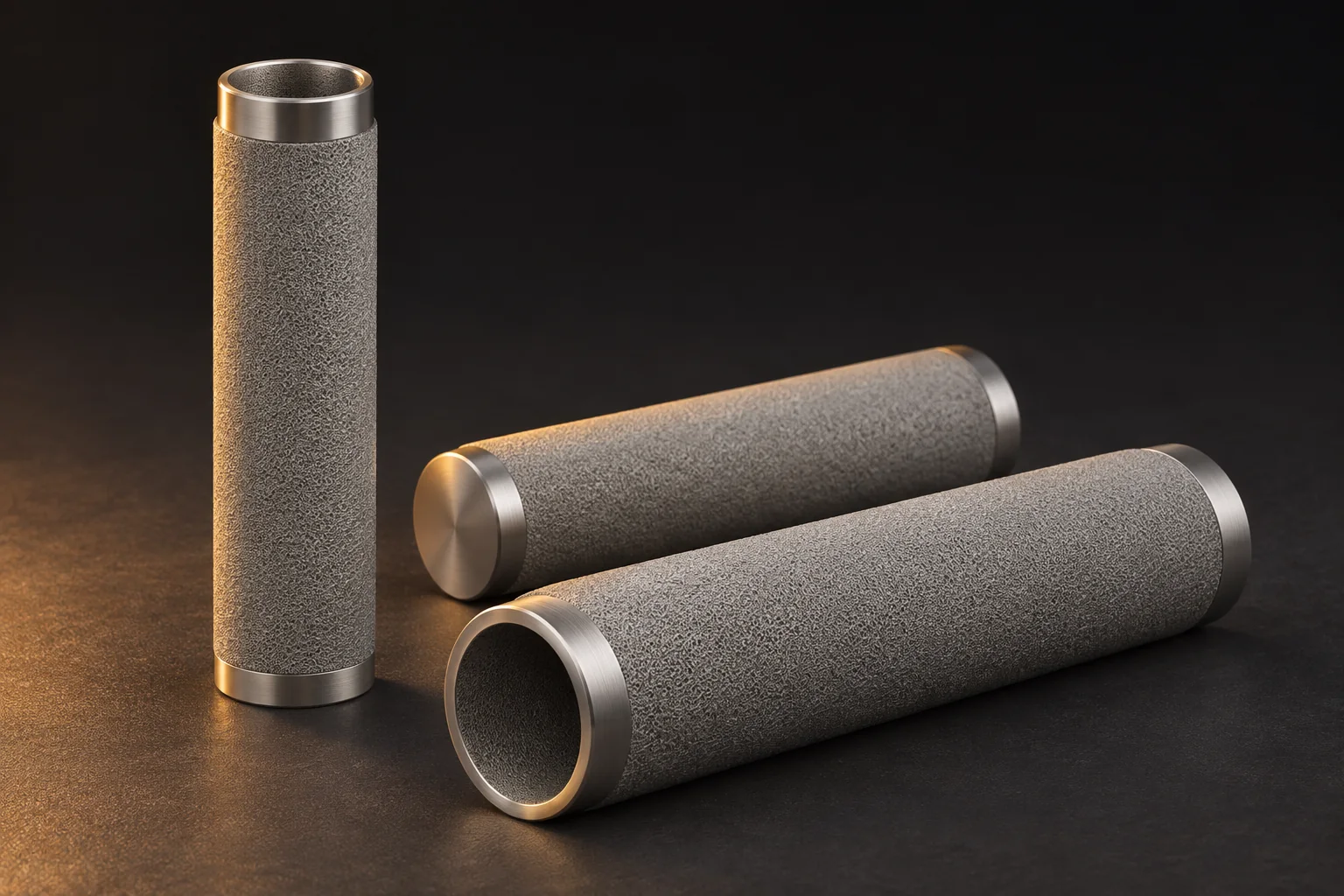
AI illustration; not a production or inspection record.
Quick answer
Select a sintered titanium filter cartridge by the required particle-removal result and operating conditions, not a micron number alone. Define the particle size, removal efficiency, test basis, liquid or gas, flow and temperature. Then confirm effective filtration area, clean and terminal pressure drop, forward and reverse differential-pressure limits, housing connections and cleaning method. A bubble-point result is a quality-control characteristic; it does not by itself establish the cartridge’s filtration grade or field performance.
01 / Filtration duty
Start with what must be removed and what must pass
A request for a “ten-micron titanium filter” sounds specific, but it can describe several different purchases. One process must protect a nozzle from occasional coarse particles. Another must recover a valuable catalyst from a slurry. A third needs a defined downstream particle count throughout a production run. The same nominal micron label does not show that one cartridge will meet all three objectives. Write the required process result before selecting a catalogue grade.
Describe the feed and the acceptable filtrate
State whether the service is liquid or gas, the fluid composition, operating and start-up temperatures, flow range and pressure conditions. Describe the solids where information is available: particle-size distribution, concentration, shape, tendency to agglomerate and whether they are hard, soft or deformable. A representative process sample and test history can be more valuable than an isolated nominal particle size. Identify which constituents are intended to pass and which must be retained.
Define success in a measurable way. This might be a downstream particle-count limit at specified sizes, a recovery target for a process solid, or a validated protective function for downstream equipment. State the sampling point and operating interval. A clean-start sample and a sample taken after several hours of loading may answer different questions. If the process currently works with another element, provide its identification and operating data without assuming that its trade designation fully describes performance.
Separate cartridge replacement from system redesign
For a replacement, document the existing housing and installation interfaces. For a new duty, identify whether you are buying filter elements only, a housing with elements, or a complete filtration package. A cartridge supplier cannot infer available pump head, vessel design, controls and cleaning facilities from a sketch of the element. Put system-level requirements with the party responsible for system design, and identify the cartridge information that party needs to make its decision.
Titanium is a material choice, not a universal compatibility guarantee. State the actual process and cleaning chemistry, including contaminants and concentration ranges that may affect selection. The end caps, welded joints, seals and other wetted parts also require review. An element with a titanium porous body can still depend on a nonmetallic seal with a different temperature or chemical limit. Ask for the complete wetted-material scope rather than evaluating the porous cylinder alone.
The titanium filter product page introduces the supply form. This guide addresses the next purchasing task: converting a duty into evidence that allows competing proposals to be compared. Keep unknown inputs visible in the enquiry. If the required removal result has not yet been defined, request a feasibility review or agreed trial rather than pretending that a finer-looking micron number resolves the uncertainty.
02 / Retention rating
Compare particle size together with efficiency
A micron rating needs a definition. It may describe a manufacturer’s media grade, a nominal retention designation, a stated efficiency at a particular particle size or another measured property. Ask exactly what the number represents and under which test conditions it was established. Terms such as “nominal” and “absolute” are not enough by themselves to make two suppliers’ ratings equivalent. The comparison needs the associated efficiency, challenge material, fluid and method.
Small efficiency differences can mean large differences downstream
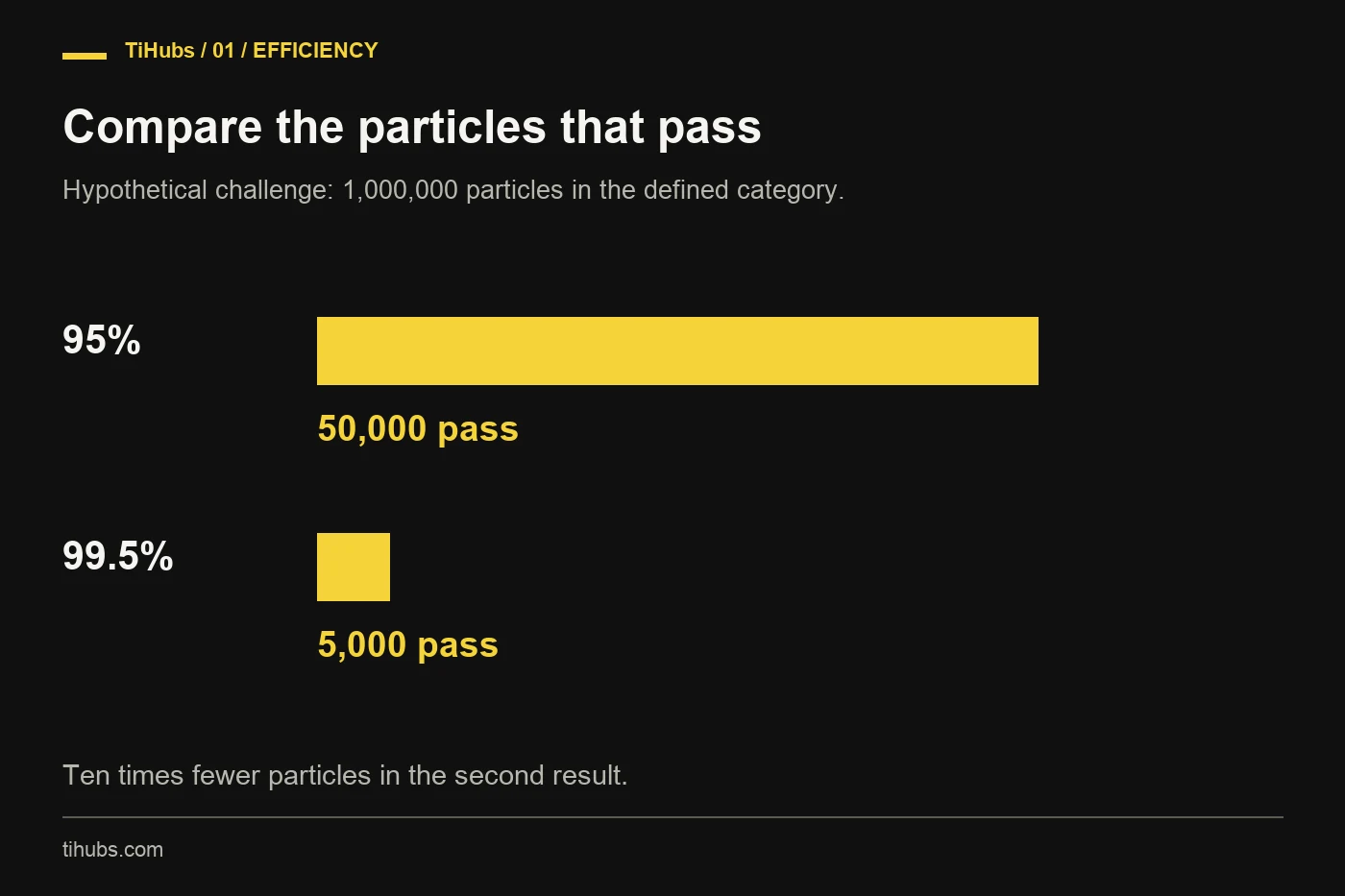
Consider a hypothetical count-based challenge containing 1,000,000 particles in the specified size category. At 95% removal, 50,000 pass downstream. At 99.5% removal, 5,000 pass. Both results might appear beside the same size label in different proposals, but the second permits one tenth as many particles in this simplified example. The arithmetic does not predict a real cartridge’s performance; it explains why the efficiency belongs beside the particle size in the purchase requirement.
The count basis matters. A removal percentage by mass does not necessarily imply the same percentage by particle count, because a small number of large particles can contribute much of the mass. Ask whether the reported result is cumulative above a specified size or refers to a defined size interval. Record the sampling and counting method and whether the result describes a single pass, repeated circulation or another test arrangement. Otherwise, apparently precise percentages can conceal incompatible measurements.
Eaton’s LOFMET titanium-cartridge data sheet is a useful example of a manufacturer reporting retention alongside efficiency and describing its laboratory test basis. Those values apply to that product and its stated conditions; they are not TiHubs specifications. For your enquiry, request the corresponding evidence for the actual proposed element and clarify how a process trial will address differences between laboratory conditions and the intended feed.
Bubble point answers a different question
ISO 4003 describes bubble-test pore-size determination for permeable sintered materials and identifies it as a quality-control test, not a direct definition of filter grade or exact pore-size distribution. A supplier’s bubble-point record can therefore be useful without being a substitute for particle-retention evidence. Ask what acceptance role the test has in the proposed manufacturing and release plan.
A useful comparison sheet has separate entries for media designation, particle size, removal efficiency, test method, test fluid and any integrity or bubble-point criteria. Do not place all these properties in one cell labelled “accuracy.” If a supplier provides only the nominal grade, treat the performance comparison as incomplete. Obtain the missing basis or arrange an agreed trial before concluding that two elements are interchangeable. For applications requiring a specific validated biological or cleanliness outcome, a general porous-metal rating alone is insufficient evidence.
Industrial buying guide / 02Compare what passes downstream
Hypothetical count-based example: from 1,000,000 challenged particles, 95% removal leaves 50,000 and 99.5% leaves 5,000. No product performance is claimed.
03 / Area and flow
Calculate usable area before comparing cartridge counts
Cartridge length and diameter help establish how much medium is available, but the gross outside surface is not always the effective filtration area. End fittings, weld regions, seals and masked sections can reduce the active length. Some configurations use a different flow path or a supported structure that changes the usable area. Ask the supplier to state the area basis and the direction of flow for the proposed element.
A simple cylinder illustrates the calculation
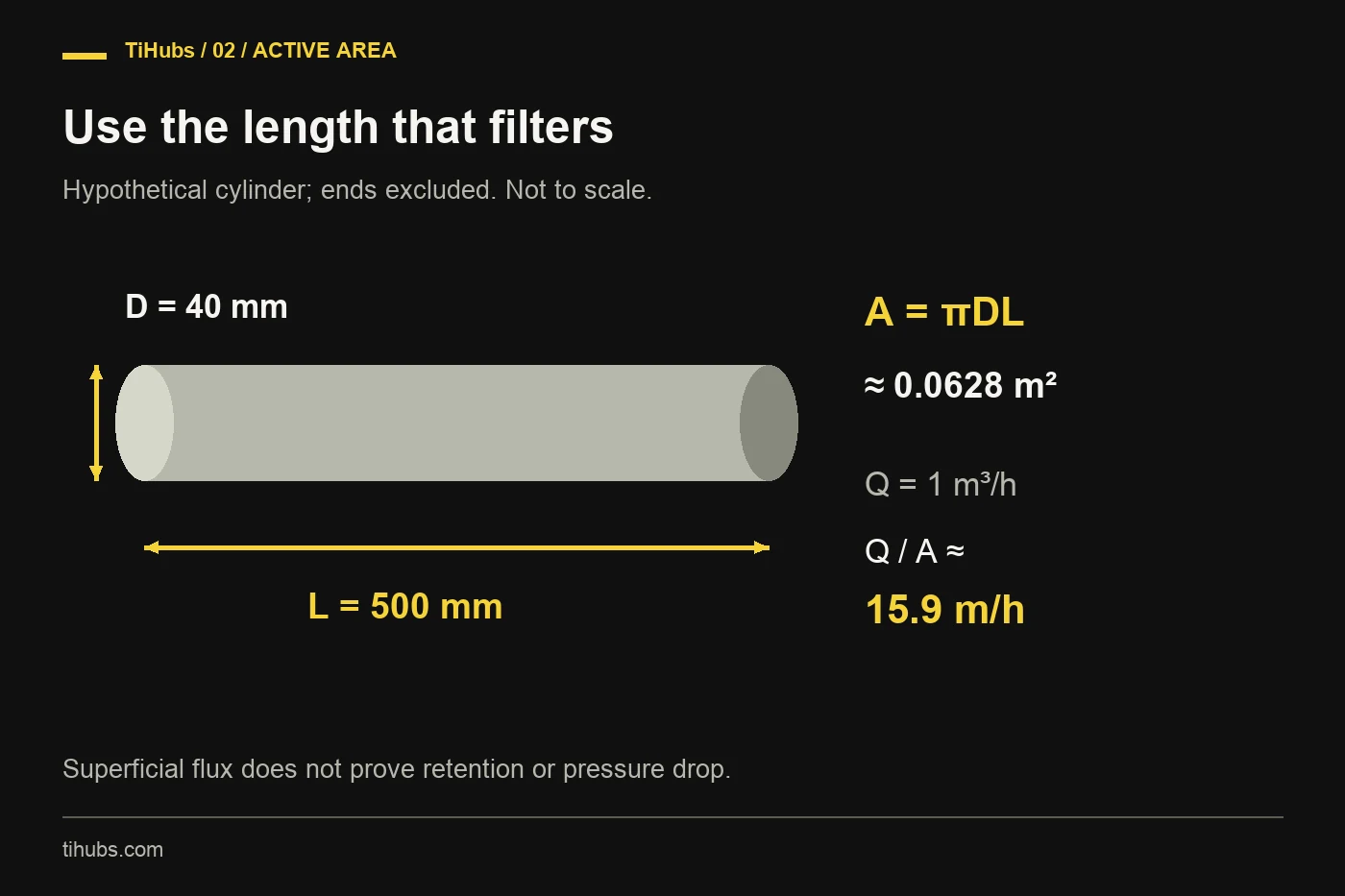
For a hypothetical plain cylindrical element with a 40 mm outside diameter and 500 mm active length, the outside lateral area is π × 0.040 × 0.500, or approximately 0.0628 m². The example excludes the ends and assumes that the full stated lateral surface is active. It is not a catalogue area or a recommended element size. If 500 mm is overall length rather than active length, the calculation needs to be corrected before it is used.
At a liquid flow of 1 m³/h through that area, the superficial flux is approximately 15.9 m³/(m²·h), numerically equivalent to 15.9 m/h. Four identical elements operating in parallel would provide about 0.251 m² and an average flux of about 4.0 m/h if flow divided evenly. This is a geometric comparison only. It does not establish acceptable loading, particle retention, uniform distribution or the pressure drop of the assembled system.
Keep area, permeability and solids loading connected
Two cartridges with the same active area may have different resistance because their porous structure, thickness and construction differ. A larger area does not erase those differences. ISO 4022 concerns measurement of fluid permeability in permeable sintered materials and notes limitations for certain long, small-bore cylindrical test pieces. Ask whether the proposed test and reported coefficients are applicable to the actual element geometry and intended interpretation.
Include the solids load in the comparison. A feed with intermittent contamination may behave differently from a continuous slurry even at the same clean-liquid flow. The retained material can change resistance and retention as a deposit develops. Decide whether the process depends on clean-medium performance, a developed cake or both. A trial should cover the relevant operating stage rather than reporting only the easiest initial condition.
For gas service, distinguish actual volumetric flow at the element from flow quoted at a reference or standard condition. State the pressure and temperature basis along with the units. Comparing a gas flow at one pressure with a reference-condition value from another proposal can create a serious sizing error. Do not reuse the liquid example as a gas-sizing calculation. Request a calculation or test interpretation appropriate to the gas, operating conditions, element and housing.
When evaluating a multi-element housing, confirm how elements are connected, supported and isolated. The nominal sum of their areas does not prove equal flow or absence of bypass. Specify the mechanical and sealing interfaces so the promised filtration path remains intact after installation. Area is a useful purchasing quantity only when it represents the medium through which the process stream will actually pass.
Industrial buying guide / 03Calculate the active lateral area
Ideal cylindrical example, excluding ends: π × 0.040 × 0.500 ≈ 0.0628 m². At 1 m³/h the superficial flux is about 15.9 m/h.
04 / Pressure-drop budget
Separate normal resistance from mechanical limits
Three pressure quantities commonly become mixed together in enquiries: operating pressure in the system, pressure drop across a clean filter and the maximum permitted differential pressure across the element. They serve different purposes. State each required value with its conditions and identify which party establishes the system design basis. A cartridge that tolerates a particular differential pressure is not necessarily economical or suitable to operate continuously near that limit.
Request a clean-flow curve on a comparable basis
A flow-versus-pressure-drop curve should identify fluid, temperature, viscosity, element dimensions and test arrangement. Ask whether the curve represents the medium, a complete cartridge or the cartridge installed in a housing. Housing connections, internal passages and other components can add resistance. If one quotation reports only medium resistance and another reports the complete assembly, the two numbers are not directly comparable.
For a hypothetical clean, incompressible liquid in a regime where viscous resistance dominates, assume the same medium and geometry produce 0.20 bar pressure drop at a viscosity of 1 mPa·s and a particular flow. At 4 mPa·s and the same flow, a simple proportional model would give 0.80 bar. This is an illustrative model, not a prediction for a commercial cartridge. Inertial effects, non-Newtonian behaviour, gas compressibility or loading can invalidate the simple scaling.
Temperature matters partly because fluid viscosity can change with it. Specify the most demanding relevant operating state, including start-up if the fluid is colder and more viscous then. A quotation based only on warm steady-state conditions may overlook a restrictive start-up condition. Ask for the assumptions behind any correction rather than applying a generic multiplier to an unrelated curve.
Agree terminal and reverse-flow conditions
The terminal pressure drop is the agreed point for cleaning, changing operating mode or removing the element from service. It should be compatible with the process and approved equipment limits. It is different from the maximum differential-pressure capability of the cartridge. Request the allowed values in both flow directions and the associated temperature and support conditions where relevant. Reverse cleaning cannot be assumed to have the same limit as normal filtration.
Define where pressure will be measured and how the readings will be interpreted. A difference between two remote gauges can include piping losses that are not across the element. If the operating decision depends on a measured differential, the instrumentation and reference points belong in the system plan. The supplier should state which pressure boundary its published or tested limit actually describes.
A practical comparison therefore keeps clean resistance, expected loading behaviour, terminal operating criterion and mechanical limits on separate lines. If a proposal meets the initial flow requirement only by consuming almost the entire available pressure budget, discuss the expected operating interval and cleaning strategy before buying. The cheapest cartridge can become expensive if it reaches the agreed cleaning point too quickly for the production schedule.
05 / Cleaning and fit
Buy a reusable element with a defined recovery test
“Cleanable” describes a possibility, not a guaranteed number of reuse cycles. The result depends on the contaminant, its interaction with the porous structure, the cleaning method and the condition of the element. State what cleaning facilities the site actually has. A proposed element may be technically reusable but impractical if recovery requires equipment, fluids or downtime unavailable at the plant.
Define what counts as successful cleaning
Agree a recovery criterion measured under controlled conditions. For example, a project might compare post-cleaning flow at a defined differential pressure with an approved baseline, while also checking integrity and the relevant retention requirement. The acceptance limit must be established for the application; it should not be invented from a generic percentage. Record temperature, fluid and test setup so a change in viscosity is not mistaken for a change in permeability.
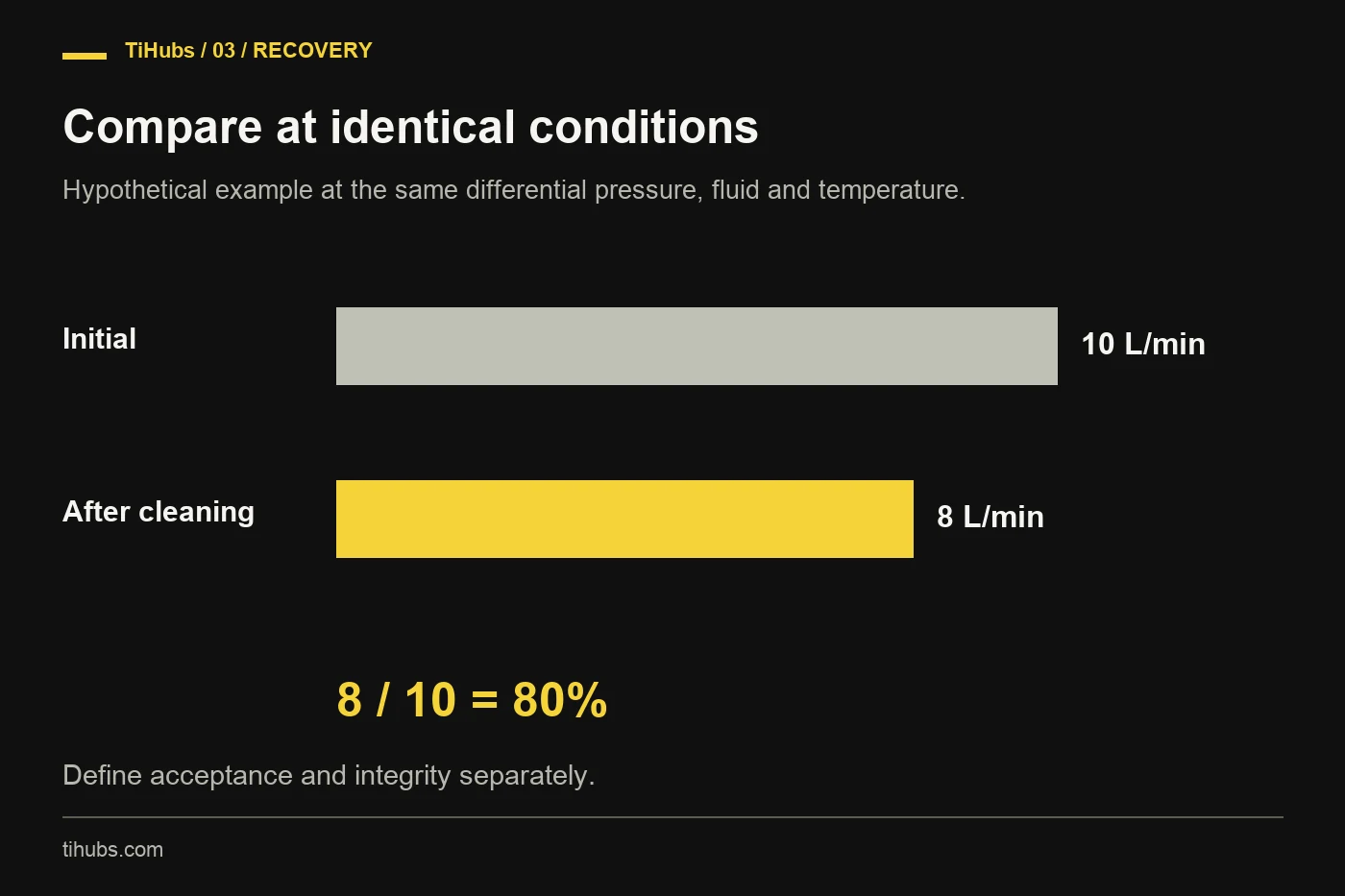
Consider a hypothetical comparison at the same test conditions: a new element passes 10 L/min at the chosen differential pressure, and after cleaning it passes 8 L/min. The measured flow recovery is 80% of the original value. Whether that is acceptable depends on the agreed criterion and the process requirement. Higher flow is not automatically better either; damage or bypass could increase flow while reducing effective filtration. Recovery and integrity must be interpreted together.
Ask the supplier to identify compatible cleaning methods and restrictions for the complete construction, including joints and seals. Do not improvise aggressive chemical cleaning solely because the body is titanium. Record how the element will be rinsed, dried, inspected and released for reuse. If the process needs continuous operation, include spare elements and the practical cleaning turnaround in the purchase comparison rather than calculating cost from purchase price alone.
Verify the housing interface before calling it interchangeable
Provide a dimensioned drawing of overall length, active length, diameters, end connections and seal locations. Nominal cartridge lengths do not prove that the sealing and locating surfaces match a particular housing. Distinguish thread standards, open-end and closed-end arrangements, bayonet features and other retention details. If the original part uses an adapter, show whether that adapter is included in the proposed supply.
For a replacement trial, check the assembled flow path as well as the bare cartridge. Incorrect compression, damaged seals or a mismatched interface can allow bypass that no improvement in media grade will solve. Assign responsibility for verifying fit and installation. Preserve the approved interface drawing for repeat orders, and identify any supplier change that could alter the seal or support arrangement.
Packaging is part of the delivered condition. Specify protection for porous surfaces and end connections, identification that does not obstruct active media, and any cleanliness requirements before installation. A cleanability discussion is incomplete if the element arrives with uncontrolled contamination or damage. The receiving check should confirm both the item’s identity and its readiness for the next approved operation.
Industrial buying guide / 05Recovery needs a controlled comparison
Hypothetical flow recovery at the same test conditions: 8 L/min after cleaning divided by 10 L/min initially equals 80%. Acceptance and integrity remain separate requirements.
06 / Trial and RFQ
Compare proposals through an agreed trial and release plan
When the process information is incomplete or the duty is demanding, make a controlled trial part of the purchasing plan. Agree the sample or feed, operating conditions, duration, measurements and success criteria before testing. Decide who will record results and who can approve the proposed element. A short demonstration of clear liquid is not a substitute for a trial that covers the actual loading and cleaning requirements.
Use a proposal matrix with separate acceptance lines
Compare retention basis, active area, clean resistance, pressure limits, materials, connections, cleaning scope and release documents independently. Mark missing evidence rather than treating a blank cell as compliance. Ask suppliers to identify exceptions and assumptions. If an alternative medium grade or geometry is proposed, evaluate its effect on the whole duty, including housing compatibility and operating interval, instead of accepting a single improved specification as proof of overall suitability.
For the trial record, preserve feed information, flow, temperature, pressure readings, sampling times and any changes in operating mode. Record the cleaning sequence and subsequent verification separately from the initial run. If the trial fails, distinguish insufficient retention, excessive resistance, poor recovery and mechanical fit problems. Each points to a different corrective action; changing only the micron label may not address the cause.
Agree the production release evidence after the trial establishes a suitable baseline. Identify which characteristics are checked for every element or batch and which performance evidence is tied to qualification. Keep the approved element drawing, material identity, media designation and relevant test records connected. For the wider documentation review, our titanium pre-shipment inspection guide explains how to organize acceptance before dispatch.
Send your duty and housing information through the enquiry tool below. TiHubs can review a sintered titanium filter sourcing enquiry and clarify the required supply scope. The proposed element, its performance evidence, availability and delivery must be confirmed for the application. The calculations here are purchasing illustrations, not a guarantee of retention, service life, chemical compatibility or suitability for a regulated process.
Preserve a useful baseline for the next purchase
After approving an element, record the conditions that made the approval valid. A commercial part number alone may be insufficient if the feed, temperature, cleaning process or housing changes later. Identify which changes require review and who evaluates them. For repeat orders, ask the supplier to declare construction or control-method changes that affect the agreed baseline. This record lets you reuse what the trial established without turning a successful result into an unlimited promise for different conditions.
07 / Build your RFQ
Build a sintered titanium filter enquiry
Describe the process result first, then connect the retention basis, flow conditions and housing interface. Add trial and cleaning acceptance requirements where they govern whether the proposed cartridge is suitable.
Information to include
Liquid or gas, composition, temperature, flow and pressure basis.
Particle-size requirement, removal efficiency and test method.
Active area, clean resistance, terminal and reverse differential limits.
Housing drawing, connection, seals and complete wetted materials.
Cleaning and trial criteria, release records, quantity and destination.
Build your RFQ checklist
Choose the product and add the information you have. Copy the resulting brief or send your requirements to TiHubs. Submitting an enquiry does not place an order.
08 / FAQs
Questions buyers ask
Does a 10 µm label mean every larger particle is removed?
Not by itself. The label needs an associated retention definition, efficiency and test basis. Ask whether it describes media grade or measured particle removal, and whether the result is by count or mass. Compare evidence under relevant conditions rather than treating the micron label as an unconditional barrier size.
Can bubble point replace a retention test?
No. A bubble-point result can serve an agreed quality-control or integrity role, but it does not independently establish field particle-removal performance. Define how the result relates to the qualified element and keep retention evidence separate. The applicable test procedure and acceptance criteria must be agreed.
Will twice the cartridge area give twice the usable flow?
Not automatically. Area helps compare superficial flux, but resistance, distribution, loading, housing passages and the required retention still matter. Any simple scaling assumes comparable media and operating conditions. Ask for an appropriate curve, calculation or trial for the complete proposed configuration.
Can I use the forward pressure limit for backwashing?
Do not assume that. Confirm the permitted reverse differential pressure and its conditions for the actual element, supports, joints and seals. Keep cleaning limits separate from normal operating criteria. The approved system procedure should define how cleaning is performed and verified.
How many cleaning cycles can a titanium cartridge withstand?
A universal number would be misleading. Service life depends on the duty, contamination, cleaning method and acceptance after recovery. Agree a trial and a measurable release criterion, then record performance over use. A reusable material does not guarantee that every contaminant can be removed or that damage cannot occur.
09 / Key takeaways
Keep the purchase requirements connected.
Write particle size and removal efficiency together with their test basis.
Keep bubble-point evidence separate from filtration-performance claims.
Use active area and fluid conditions to compare flow proposals.
Separate clean pressure drop, terminal operation and mechanical limits.
Approve connections, cleaning recovery and release evidence as one purchase scope.
Technical references
Sources and data scope
References reviewed November 14, 2026. Public source summaries support the discussion; the controlled specification, agreed edition and approved project requirements govern acceptance.
Mott — Sintered alloy filter elements — Examples of element configurations, cleaning scope and feasibility review; alloy-specific data must not be transferred to titanium without validation.
Ti
About TiHubs
TiHubs coordinates titanium material and custom supply enquiries from Baoji, China. Send the product, drawing revision and acceptance requirements so the proposed supply scope can be reviewed. Learn about our sourcing role.
Contents
TiHubs
Talk to TiHubs
Ask about titanium materials, grades or custom parts.
Enter your email to start chatting.
We use your email to respond to your enquiry. Your conversation is stored on this website.
Our team is away right now. Leave your enquiry and we will follow up by email.