Send a construction sketch and identify what runs through the centre. For a finished assembly, show the end fittings and the two points that define usable length.
Three strands of seven wires, individual wire 1.15 mm
Finished rope diameter reported as 6.51 mm. Material described as Grade 4 equivalent.
Lay in that example
S lay in each strand, Z lay in the rope
Direction is reported separately at the two construction levels
Published fine-wire example, HRM
Ti-10Zr, individual wire diameter 50 µm
Seven-wire and 7 × 7 constructions are illustrated.
Equal-wire geometric example
7 × 7 = 49 wires of 0.05 mm nominal diameter
Sum of individual circular sections approximately 0.0962 mm². No load rating follows.
Assembly length example
Pin-centre distance 900 mm, two equal end projections 20 mm each
Overall axial envelope 940 mm in this drawing example
Your starting specification.
Send a construction sketch and identify what runs through the centre. For a finished assembly, show the end fittings and the two points that define usable length.
The table identifies the basis for the quotation. Confirm material, dimensions, inspection and delivery for the selected part before ordering.
Material and delivery condition
Identify the material on the approved drawing and confirm its product form and condition with the quotation.
Chinese designations and international names are reference routes, not automatic substitutes. Grade, product specification, condition and acceptance requirements must be agreed together.
A first assembly, a replacement and a repeat order need different evidence.
Bare rope on a reel
For the quotation, identify overall diameter, construction, minimum uninterrupted length. For related supply options, see the parent product guide.
What to sendOverall diameter / construction / minimum uninterrupted length.
Cut lengths
For the quotation, identify length reference, cut end condition, quantity.
What to sendLength reference / cut end condition / quantity.
Fine-wire strand sample
For the quotation, identify alloy, filament diameter, number of wires.
What to sendAlloy / filament diameter / number of wires.
Engineering and purchasing guide
Send a construction sketch and identify what runs through the centre. For a finished assembly, show the end fittings and the two points that define usable length.
Wire area and rope envelope — Individual wire section, Envelope includes voids
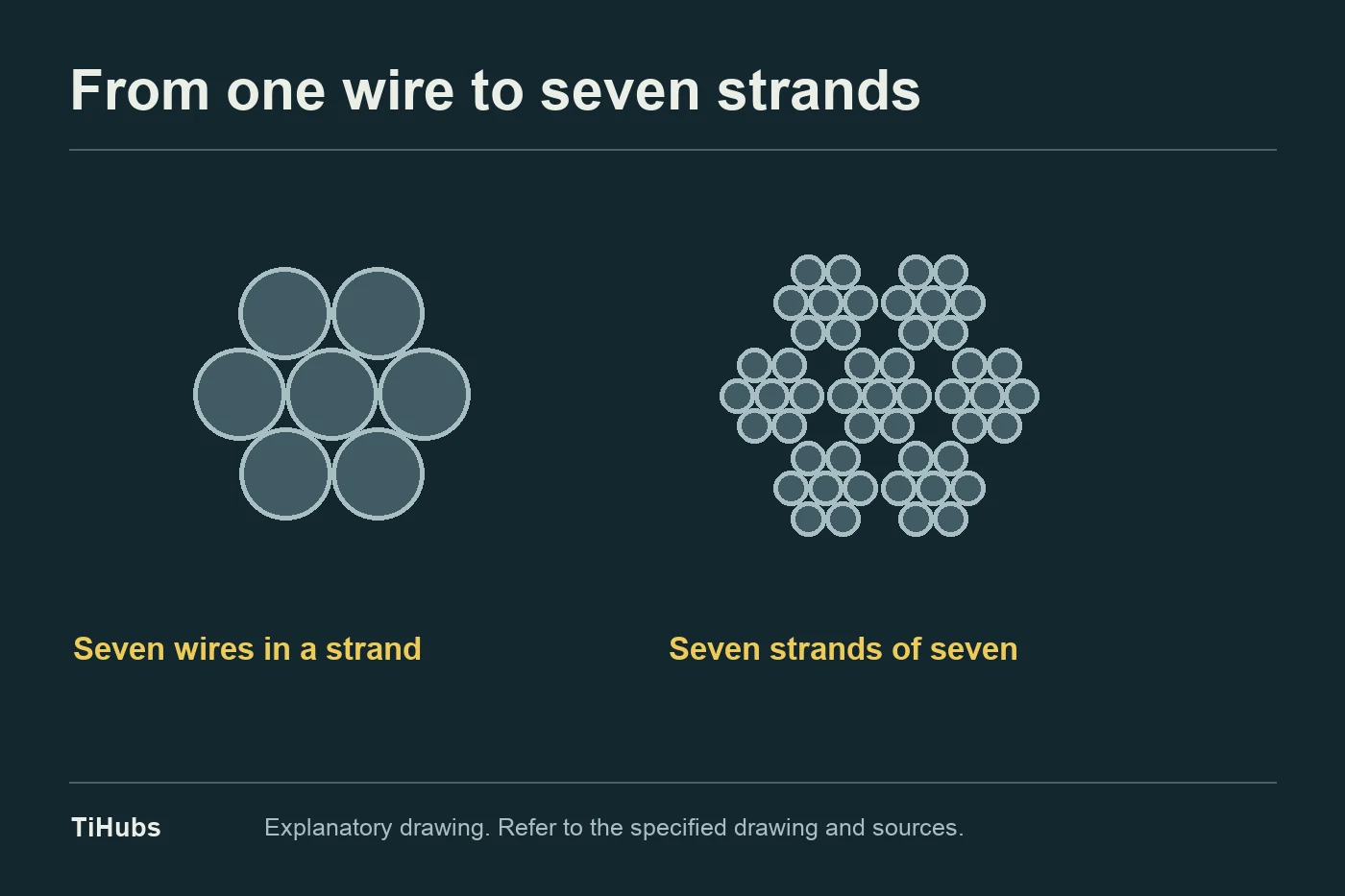
From one wire to seven strands. Seven wires in a strand, Seven strands of seven.
Order geometry schematic; not a dimensional drawing.
Identify the product under the word cable
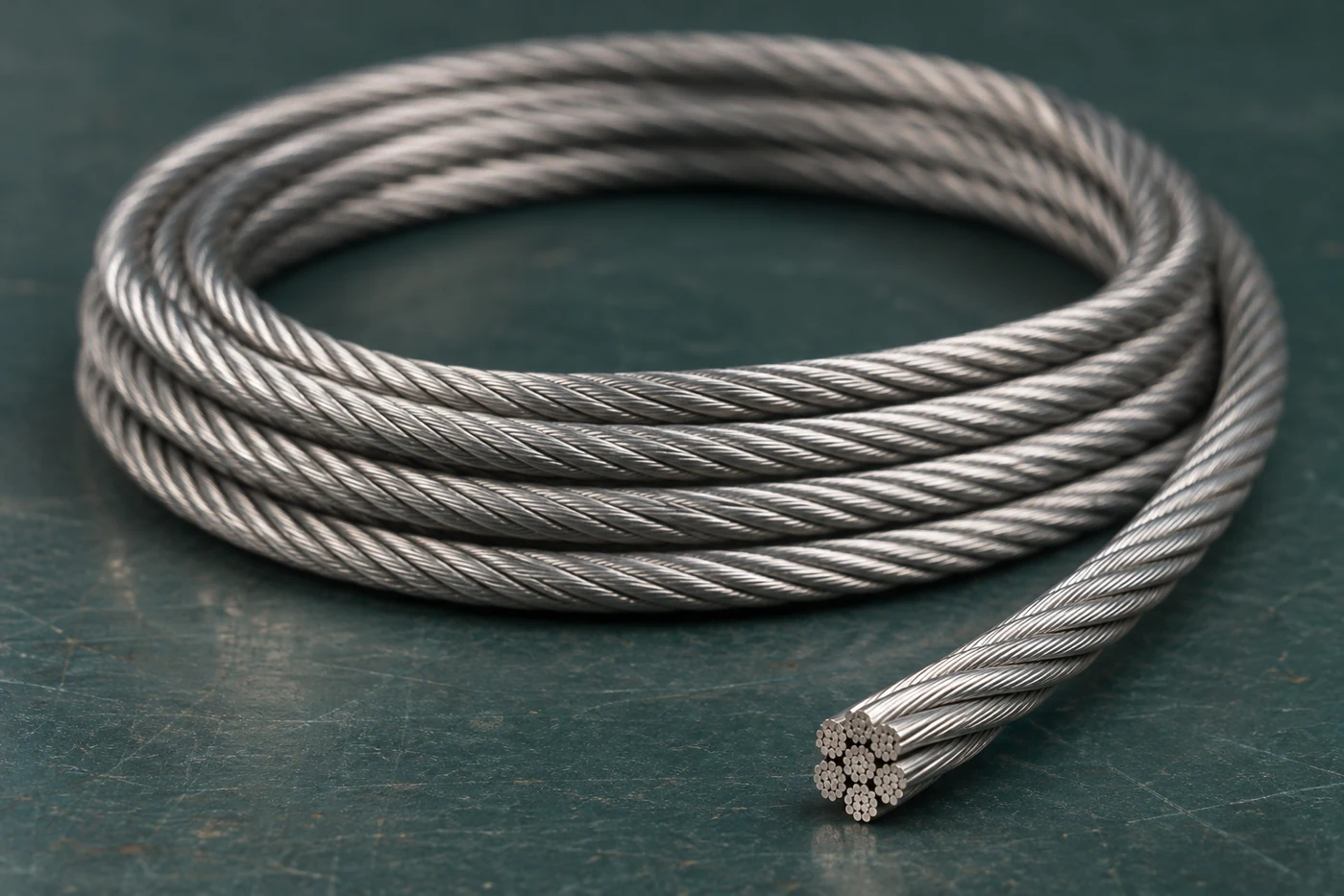
Start by describing what the cable does and what is inside it. A flexible assembly made from titanium wires laid into strands is a different purchase from solid titanium wire on a spool. An electrical lead protected by titanium armour can contain conductors, insulation and additional layers. A coated steel cable can look like an all-metal titanium rope in a photograph. A customer may use the same search words for all of these products. A drawing of the cross-section and a sentence describing the intended function are more informative for a quotation than an exterior photograph alone.
Working from the inside out, identify any centre wire, central strand, nonmetallic core or electrical conductor. Then identify the outer elements and any jacket. Indicate which elements must be titanium and where another material is permitted. For an all-metal assembly, the end fittings can still differ from the rope. For an armoured electrical cable, the armour may be the only titanium part. If the required function involves carrying a signal, include the electrical interfaces and the responsible cable engineer in the enquiry. If the item is a mechanical strand without conductors, state that so a bidder does not price an unnecessary electrical construction.
A Nippon Steel technical report provides a particularly useful distinction. Its water-sampling rope used high-strength commercially pure titanium described as equivalent to Grade 4. The same report separately describes an armoured cable with a titanium alloy around a conductor system. They belong to different drawings and were developed for different purposes. The successful manufacture of one does not establish the dimensions, working load or availability of the other. The report is a historical construction example. On a current order, the quoted manufacturer must confirm material, construction, length and acceptance evidence for the actual item proposed.
Define the delivery boundary early. Bare rope on a reel allows a downstream shop to cut and terminate it. Individually cut lengths reduce preparation work but leave the end fitting and assembly verification elsewhere. A terminated assembly can have a controlled pin-to-pin length and identifiable interfaces ready for a particular machine. These configurations can differ materially in cost and usable length even when the price list uses one rope designation. Describe which work the buyer will perform and what the supplier must verify before delivery. This separates an enquiry for a sample of stranded material from one for a finished industrial assembly that has to fit between two fixed points.
Read wire count, strand geometry and lay
Break a rope description into the wire, the strand and the completed rope. A wire is a single metallic element. A strand groups several wires, often laid helically. A rope may group several strands around its centre. Count the elements at the level indicated by the drawing. A seven-wire strand consists of seven individual wires. A seven-by-seven construction with seven equal seven-wire strands has forty-nine wires. Confirm whether any independent core or jacket is outside that count. Do not assume that every product carrying a similar shorthand has identical construction. A labelled sketch makes an agreement about counts much easier to inspect later.
In Nippon Steel’s published water-sampling example, three strands of seven wires were used. The individual wire diameter was 1.15 millimetres and the reported diameter of the resulting rope was 6.51 millimetres. The report distinguishes S lay for the wires in each strand and Z lay for the strands in the rope. These details describe the identified construction. They are not generic dimensions or mandatory directions for industrial titanium rope. Use them to see what information a complete quotation can contain. Measuring only the exterior would not reveal the constituent wire diameter, the material grade or the two levels of lay direction.
HRM’s fine-wire example shows another scale altogether. The manufacturer identifies Ti-10Zr alloy wire with a diameter of 50 micrometres and illustrates a seven-wire construction and a seven-by-seven construction. Fifty micrometres equals 0.05 millimetre. For an idealised set of forty-nine equal round wires, the sum of their individual cross-sectional areas is forty-nine times pi times 0.05 squared divided by four, approximately 0.0962 square millimetre. This calculation describes circles cut normal to each wire axis. It does not provide the rope’s external diameter or a rated load. The paths are helical and the finished envelope contains spaces between wires and strands.
If lay length matters, mark on the drawing which element completes a turn and along which axis the distance is measured. The pitch of a wire within a strand and the pitch of a strand within the rope answer different questions. Report the measurement condition so a comparison is repeatable. A close photograph with no scale can identify the apparent direction of external strands but gives limited evidence of the pitch beneath them. Request agreement on a first sample where appearance, repeated bending or installation into an existing guide makes the construction important. Keep that sample identified alongside its drawing revision rather than treating a photograph as the sole master.
Specify diameter, delivered length and reel
Specify at least two diameters when both affect acceptance. One belongs to the individual wire and another to the overall rope, measured by an agreed method. A coating or jacket may add a third outside diameter. A guide tube can be limited by the greatest external projection, while a forming or terminating process might depend on constituent wire size. State which requirement controls which interface. If a buyer measures a used item, describe how it was supported, where measurements were made and whether wear or coating loss affected the surface. Measurements across a distorted cut end can misrepresent the undisturbed body.
Length needs equally clear endpoints. Bare material may be ordered by uninterrupted reel length. A cut piece can be specified end to end in a defined condition. A finished assembly with two eyes may be dimensioned between pin centres. For an illustrative assembly with 900 millimetres between pin centres and a 20 millimetre outward projection beyond each centre, the overall envelope along that axis is 940 millimetres. A buyer who orders 900 millimetres overall would receive a different useful span. Give the references on a drawing, identify the fittings and agree the condition in which the span is checked. These drawing values illustrate definitions and should not be carried into an unrelated installation.
For reel supply, agree the minimum continuous length and whether any joins are permitted. A total of material spread across several short lengths might fulfil a total metre count but fail an installation requiring a single continuous run. State whether test samples come from the quoted continuous length or from an additional allowance. Identify reel dimensions and handling constraints that affect the buyer’s equipment. If the receiving machine accepts only a particular hub opening or maximum flange width, show them. A reel that cannot be mounted can create extra handling and a separate rewinding operation before the first usable length reaches production.
For pre-cut pieces, specify quantity by length, protection at each end and how items will be identified. Determine whether temporary end restraint is removed by the user or retained during another operation. Select packaging that keeps a defined end condition accessible for inspection while protecting it during transport. When several lengths differ only slightly, individual labels and a length schedule prevent confusion in stores. If the next operation is performed by a different company, send that company the length datum and termination allowance. Otherwise a correct delivered cut length may later be mistaken for a finished attachment length and be shortened or rejected.
A reel allocation exercise reveals another hidden difference between offers. Suppose an installation needs three uninterrupted 30 metre lengths, plus two separate 2 metre samples for inspection. The basic requirement is 94 metres before any cutting or termination allowance. Two reels of 47 metres each provide 94 metres in total but permit only two uninterrupted 30 metre cuts. A single 94 metre length could supply the three long pieces and both samples if no additional length is consumed. Add the actual cutting, end treatment and sampling allowances agreed for the job before ordering. State the required cutting plan, not just the sum of the finished lengths.
An order for a left-hand and a right-hand assembly also deserves separate drawings even where both consume the same bare rope length. At receipt, an easy method is to lay each sample against a labelled outline showing end A, end B and the direction in which the pins enter. Define how the supplier should protect the identifiers if the assemblies must be cleaned before use. This check establishes that the ordered ends and their orientation are distinguishable. It does not demonstrate the mechanical performance of the joint, which remains linked to the separate approved test evidence.
Select the alloy and the end connection
Select the alloy on the basis of the approved design and the function of the rope. The commercially pure titanium used in the historical sampling rope and the Ti-10Zr used in the fine-wire example demonstrate that a single material designation cannot stand for every titanium rope. Identify the proposed wire material, condition and record linking it to the production lot. Ask whether the cord construction includes another core material, outer jacket, lubricant or processing residue relevant to the intended use. A certificate for a starting wire provides evidence about that wire. The certificate alone does not describe every material in a finished assembly.
For end fittings, supply a dimensioned drawing of the interface. Identify pin diameter, hole or slot dimensions, orientation of the fitting and surfaces that locate on the mating part. An eye that looks correct in a photograph can be too thick for a clevis or can contact an adjacent surface before it pivots as required. Clarify the end included in any length measurement. A threaded fitting requires the exact thread designation and the face or point from which the functional length is established. If the ends differ, label them separately and identify the orientation of one relative to the other where installation depends on it.
Ask what evidence represents the attachment of the terminal to the stranded material. The strength or material certificate of the fitting body alone cannot characterise its connection to a particular rope construction. A test on bare wire cannot characterise that connection either. Define whether the supplier is offering a bare cut length, an untested prototype termination or a finished assembly with an agreed verification plan. The selection of attachment method and allowable service load belongs to a qualified design and the relevant product requirements. Avoid accepting a generic working load inferred from a material’s tensile property or the sum of individual wire areas.
Consider the environment of every component. An all-titanium description of the visible rope says little about a non-titanium sleeve, a protective jacket or the pin in the mating fitting. Record the fluid or atmosphere, temperature range, cleaning process and any reasons that material transfer or residue would matter. If a contact surface will see repeated movement, provide the interface and travel information for engineering review. Catalogue claims about one material’s corrosion behaviour do not validate an entire assembly operating in an unspecified environment. Obtain a proposed construction and resolve any unapproved material substitution before the lot enters production.
Request evidence for the finished construction
Start the inspection plan by distinguishing material identity, construction, geometry and mechanical performance. Wire documentation can verify constituent material. A construction record or a representative cross-section can establish strand arrangement. Measurement can verify dimensions and length under agreed conditions. A test on a terminated piece can provide evidence about that assembly in the stated configuration. None of these records replaces all the others. Ask the buyer’s engineering team which decision each record supports. This prevents a long set of certificates for the wrong level of construction from being mistaken for acceptance evidence of the item actually ordered.
When mechanical performance is contractual, identify the test article and the meaning of the measured result. A wire test, a bare-rope breaking test and a terminated-assembly test can produce different results with different failure locations. A reported breaking value is also different from a permissible working load. Do not convert one into the other without the design basis, applicable requirements and qualified approval. Specify whether a test is for qualification of a construction, a representative lot sample or an individual finished assembly. A report needs enough information about its specimen to support that distinction when the material is reviewed after delivery.
A useful report records the actual rope construction, constituent material, dimensions, sample identity, termination arrangement where applicable, measurement method and observed outcome. Where cyclic bending is relevant, ask for the conditions under which data were obtained, including the relevant contact geometry, direction of travel and intended motion. Performance in one test fixture cannot be transferred to another merely because both specimens have the same exterior diameter. A continuously moving rope can present different purchasing questions from a static restraint. The product and installation design must set the evidence needed for the particular service and decide how to use published examples.
Agree how test material will be provided. A destructive test consumes the specimen. A buyer requiring several full usable lengths should order a separate allowance if a segment must be cut for testing. Where terminations belong on both ends of a representative sample, that sample may require additional fittings and fabrication. Identify whether the evidence follows each reel, a production lot or a particular finished assembly. If an approved first sample establishes appearance or flexibility for production, define how later changes in wire source, alloy or construction are reviewed. A reference sample without an identity label and revision is hard to distinguish from an outdated development trial.
Compare enquiries and accept the shipment
Prepare quote lines in the order a receiving inspector will recognise the product. Identify the construction, wire alloy, individual and finished diameters, length or reel requirement, end condition and supplied fittings. State any required evidence and the boundary between the supplier’s work and the buyer’s assembly. For a controlled length and for a reel that will be cut later, use separate lines. Add the expected units, such as metres per reel, individual cut pieces or completed assemblies. A price per metre of bare rope and a price per fitted assembly can then be compared using the work and material the buyer actually needs.
For a repeat order, compare the proposed construction against the last accepted drawing and sample. A new bidder might offer the same outside diameter with fewer, larger wires. A pre-existing terminal or a guide developed around the original structure may consequently need review. Ask the supplier to highlight deviations in wire count, alloy, lay, coating and end treatment rather than placing them only in a general catalogue reference. Keep a list of accepted alternatives with the authority and effective revision. An exception allowed for a trial sample should not silently become permission to substitute a different construction on every subsequent delivery.
Inspect the package before releasing the material to production. Check reel identification, uninterrupted length and protection of accessible ends. For cut assemblies, compare the labelled measuring points with the purchase drawing and check fitting orientation. Match the material and construction evidence to the reel or assemblies received. Store a retained sample with its identity where the contract requires one. If a reel is divided between different production orders, record which cut lengths originated from it. A material certificate kept in the purchasing system has little practical value if downstream technicians cannot link it back to the piece on their bench.
Consider a maintenance job ordering several cable assemblies of equal overall length but different end fittings. An end-to-end packing check can be correct while the pin-centre dimensions or the fitting orientations are wrong. Assign each assembly a part number, make the two end drawings visible on the purchase schedule and record the functional dimension for that row. When verifying samples, confirm that the representative fitting matches the version to be installed. A strong result for a different termination geometry does not settle the question for this part. This small amount of detail can avoid reopening an installed enclosure simply to identify why the new assembly cannot reach its mating pin.
For a first enquiry to TiHubs, submit the construction sketch, dimensions with their measuring condition, material requirement, quantity and packaging or termination boundary. If a feature of the sample is unknown, mark it as unknown and say how it may be verified. A fabricator may be able to inspect a retained construction, provide a representative sample or quote alternatives for approval. Keeping the missing dimensions explicit is preferable to assigning an attractive but unsupported capacity. It also gives the buyer a purchasing record that can be reused when the second reel or the next set of finished assemblies is ordered.
Inspection points
Agree the acceptance evidence before the first part is released.
Agree the finished measuring points — Pin-centre length, Overall length
Order documentationTiHubs
Traceable from heat to shipment.
Material identificationGrade + specification
Batch identificationHeat / lot reference
Inspection scopeAgreed tests & results
Shipment identificationMarks + packing list
Illustrative document checklist. Not a certificate or test report.
01Published water-sampling rope, Nippon Steel
Finished rope diameter reported as 6.51 mm. Material described as Grade 4 equivalent.
Three strands of seven wires, individual wire 1.15 mm02Lay in that example
Direction is reported separately at the two construction levels
S lay in each strand, Z lay in the rope03Published fine-wire example, HRM
Seven-wire and 7 × 7 constructions are illustrated.
Ti-10Zr, individual wire diameter 50 µm04Equal-wire geometric example
Sum of individual circular sections approximately 0.0962 mm². No load rating follows.
7 × 7 = 49 wires of 0.05 mm nominal diameter05Assembly length example
Overall axial envelope 940 mm in this drawing example
Pin-centre distance 900 mm, two equal end projections 20 mm each06Identity & protection
Link tubes or bundles to the heat / lot and protect the bore and ends.
Records + end caps + supports
Source documents
Check the applicable series, revision and scope against the purchase drawing.
Library PDFs may be earlier editions. Check the document cover and your contractual revision. A reference file does not certify a supplied product.
TiHubs coordinates titanium sourcing through a local manufacturer network. Your specification guides the supplier review, technical discussion and delivery requirements.
Send a construction sketch and identify what runs through the centre. For a finished assembly, show the end fittings and the two points that define usable length.
You do not need to finalize every detail before contacting us.
TiHubs
Talk to TiHubs
Ask about titanium materials, grades or custom parts.
Enter your email to start chatting.
We use your email to respond to your enquiry. Your conversation is stored on this website.
Our team is away right now. Leave your enquiry and we will follow up by email.