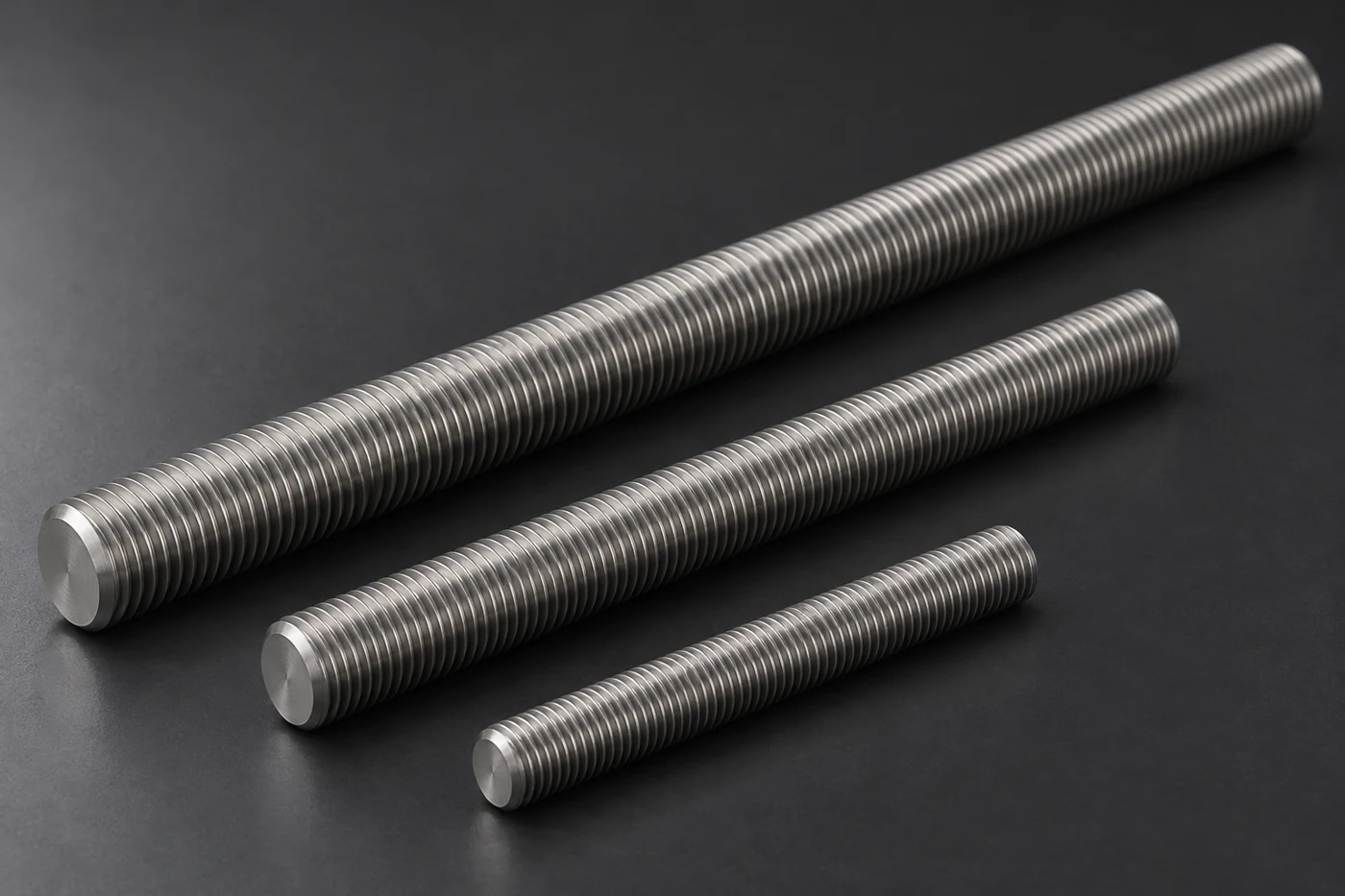
Titanium threaded rod specified for your assembly. Define the thread, material condition, useful geometry and release documents before comparing supply proposals.
20 years in titanium100+ Baoji factory connections
Defined threads. Controlled lengths. Traceable lots.
Choose the delivered configuration
A fully threaded rod, a double-ended stud and a headed bolt are different deliverables. Define the one your assembly needs.
Fully threaded rod
Fully threaded rod
Specify the complete external thread designation and usable threaded length. Overall cut length includes the ends; it does not necessarily equal full-form thread length. State the end chamfer, permitted incomplete threads and straightness requirement. A commercial label such as all-thread does not define grade, thread class, finish or acceptance. Compare quotations against the same drawing and supplied condition.
Complete thread designation
Overall and usable length
End and straightness requirements
Specify a thread that can be accepted
Diameter alone is not an order specification. Define the thread system, fit, usable geometry and evidence together.
Order item
Include in your enquiry
Why it matters
Material
Grade, condition, specification and edition
No substitution without approval
Thread system
Metric M or specified inch form / series
Name the governing standard
Thread designation
Diameter, pitch or TPI, class, handedness
Specify external and mating requirements
Length
Overall length and usable full-form thread
Include tolerance and end allowances
Stud geometry
Each threaded end, shank and runout
Use a controlled drawing
Surface / process
Rolled or cut if required; finish or coating
State when final dimensions apply
Inspection
Gauging system, dimensions, sampling and limits
Agree acceptance before manufacture
Delivery
Quantity, traceability, packing and destination
Confirm feasibility, price and timing
Your starting specification.
Grade and material condition; thread standard, diameter, pitch, class and handedness; overall and usable threaded length; end details; quantity; finish; drawing revision; inspection and lot-document requirements.
Sizes, manufacturing route, quantity and timing are confirmed after review. No universal torque, load capacity or stock availability is implied. Images are AI product illustrations.
Choose the specified material
These grade options support an enquiry. Suitability, processing, size availability and documents are confirmed for the project.
Chinese designations and international names are reference routes, not automatic substitutes. Grade, product specification, condition and acceptance requirements must be agreed together.
The surrounding joint determines the required engagement, surface condition, installation method and inspection.
Equipment fastening and tie members
Identify the approved joint design, engagement length, mating nut or tapped component and installation method. Titanium rod should not replace a steel fastener by matching only nominal diameter. The design authority must review stiffness, load distribution, environment and failure modes for the whole assembly. If a head is required, review titanium bolts as a different product scope.
What to sendJoint drawing, mating thread, environment and acceptance basis.
Corrosion-sensitive assemblies
Describe the actual medium, concentration, temperature and exposure, including crevices and contact with other metals. A generic corrosion-resistant description is not approval for every chemical or joint. Identify whether lubricant, coating or electrical isolation is compatible with the service and authorized by the designer. State cleaning requirements separately from appearance requirements.
What to sendMedium, temperature, mating materials and permitted surface treatments.
Drawing-controlled replacement parts
For replacement work, provide the original specification or an approved engineering drawing rather than only a worn sample. Confirm thread system and pitch; visually similar metric and inch threads are not interchangeable. Record any intentional change in material, finish or manufacturing route. If only starting stock is required, use the titanium bar and rod enquiry instead.
What to sendControlled revision, complete designation, quantity and traceability needs.
Control the route from blank to thread
Define which requirements apply to the starting material and which apply after threading, finishing and cutting.
Cut lengths and prepared ends / illustrative product view
THREAD · PITCH · CLASS · USABLE LENGTH · ENDS
Order geometry schematic; not a dimensional drawing.
Complete the designation before pricing
For metric M threads, ASME B1.13M addresses the profile and tolerance framework. ASME B1.1 addresses unified inch thread designations and geometry. State the applicable system and edition, diameter, pitch or threads per inch, external class and handedness. A class designation is not a load rating. Do not silently convert one system into another.
Define rolling or cutting where it matters
If the design requires a specific thread-forming route, put it on the order and require approval of changes. Otherwise ask the supplier to identify the proposed route for review. A rolled label alone does not prove fatigue performance, dimensional conformity or surface integrity. See the separate rolled versus cut titanium threads guide for the process decision; this page defines the purchased rod.
Evaluate the final surface and assembly condition
Identify coatings, cleaning and lubricants before final fit and installation requirements are agreed. Surface changes can affect thread engagement and friction. Do not apply a torque chart for another material or lubrication condition without engineering approval. The titanium fastener galling guide explains why the mating pair and assembly procedure need attention. No universal lubricant or torque is specified here.
Retain identity after the last operation
Link finished lengths to the material heat and relevant process lot, including any subcontracted operation. Establish when gauging occurs relative to coating, end finishing and cutting. A source-bar certificate is necessary where specified but does not verify the final thread. Agree the report format, lot identification and release authority before production so receiving inspection can match each delivery to the correct evidence.
Agree the release evidence
A material certificate, a thread gauge and a dimensional report answer different questions. Match the evidence to the order.
Where specified, define finished-part tests, method, sample and limits.
Agreed part evidence06Lot release
Connect pieces, package identity and reports after cutting and packing.
Traceable delivery
Read standards within their scope
ASTM B348/B348M concerns titanium bar and billet material. Finished thread geometry, part acceptance and assembly capacity require their own specified basis. Confirm the contractual edition; the library copy below is a reference.
Library PDFs may be earlier editions. Check the document cover and your contractual revision. A reference file does not certify a supplied product.
TiHubs coordinates titanium sourcing through a local manufacturer network. Your specification guides the supplier review, technical discussion and delivery requirements.
Confirm grade, dimensions, state, quantity and the purpose of the stock.
Review the supply route
Discuss manufacturing, finishing, inspection and documentation with the relevant supplier.
Agree the commercial scope
Confirm the quotation, lead time, acceptance requirements and delivery terms.
Coordinate inspection & delivery
Follow the agreed checks, marking, packing and shipment documentation.
Before you order
Resolve the thread, material and assembly boundaries before placing the order.
TITANIUM THREADED ROD · BAOJI SOURCING
Send your specification.
Titanium threaded rod specified for your assembly. Define the thread, material condition, useful geometry and release documents before comparing supply proposals.
You do not need to finalize every detail before contacting us.
TiHubs
Talk to TiHubs
Ask about titanium materials, grades or custom parts.
Enter your email to start chatting.
We use your email to respond to your enquiry. Your conversation is stored on this website.
Our team is away right now. Leave your enquiry and we will follow up by email.