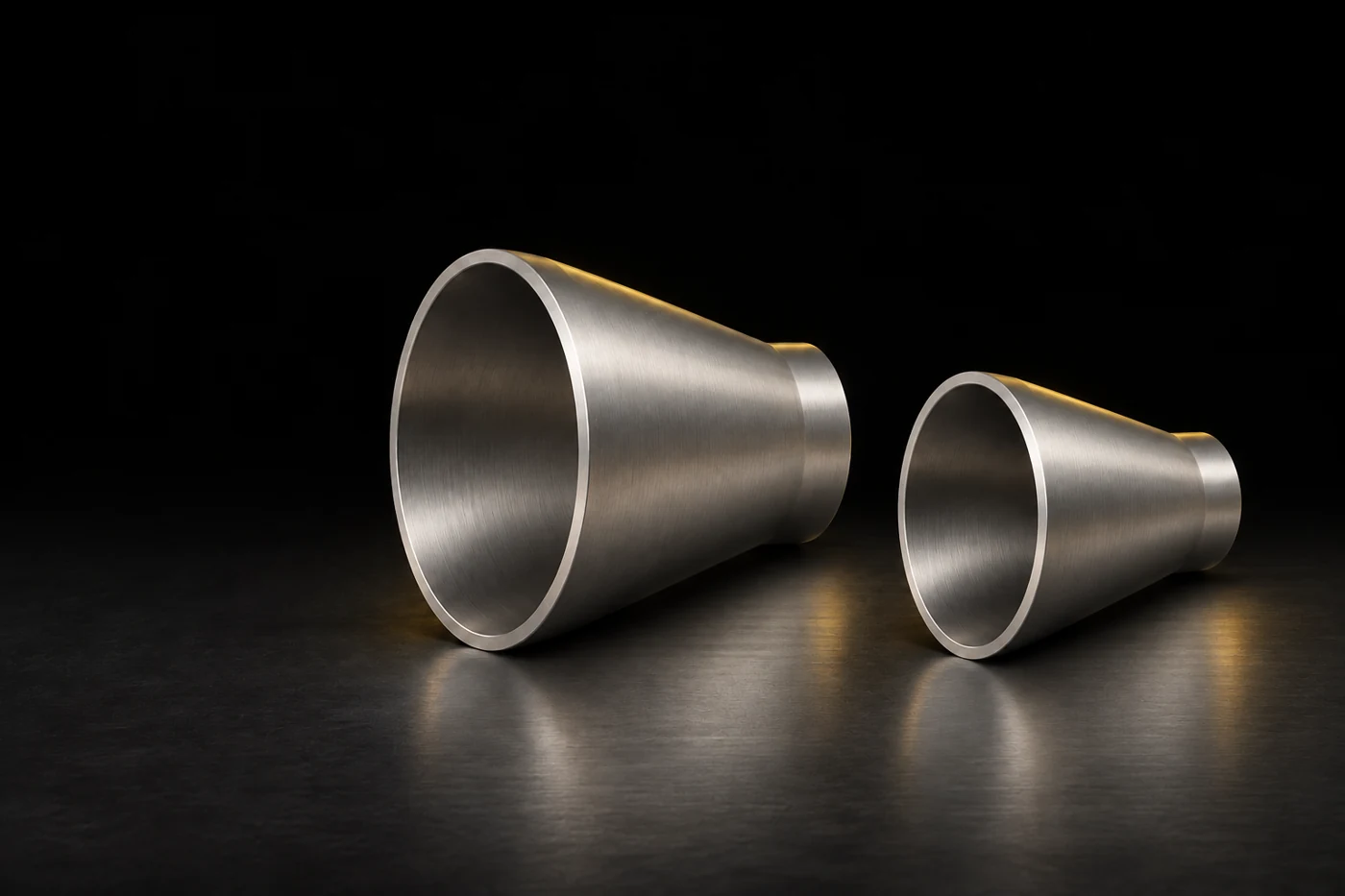
Source titanium pipe reducers with both connection ends fully defined. Confirm concentric or eccentric geometry, orientation, material, wall requirements and the inspection basis before comparing offers.
Define the flow-path and installation relationship before specifying the finished fitting.
Concentric reducers
Concentric reducers
The large and small ends share a common centerline in a concentric reducer. Specify both end sizes and wall requirements, overall length and the applicable dimensional standard or drawing. The geometry does not by itself establish suitability for every installation; retain the piping designer’s flow, support and equipment-interface requirements.
Large and small end sizes
Common-axis geometry
Length and end preparation
Treat each end as an interface
A reducer has two different connections; both need compatible dimensions and acceptance.
Order item
Include in your enquiry
Why it matters
Geometry
Concentric or eccentric
Define offset and installation orientation
Large end
Nominal designation, actual OD and wall
Match the larger mating pipe
Small end
Nominal designation, actual OD and wall
Match the smaller mating pipe
Length
End-to-end dimension and tolerance
Confirm available installation space
Material
Titanium grade and fitting specification
Include condition and traceability
Construction
Permitted seamless or welded route
Identify weld-related acceptance
Wall
End values and body/minimum requirements
Verify after forming
Welding ends
Bevel, land and bore transition as applicable
Coordinate with the joint specification
Service
Design basis, medium, temperature and pressure
Do not infer rating from schedule alone
Inspection
Dimensions, NDE/tests, marking and records
Specify method and acceptance scope
Your starting specification.
Concentric/eccentric reducer; drawing and revision; large and small end NPS/DN plus actual OD and wall basis; length; offset/orientation; grade and fitting specification; seamless/welded construction; bevels; pressure/temperature service basis; inspection, records, quantity and destination.
Dimensions, material condition, quantity, testing and delivery are confirmed in the quotation and order.
Specify the fitting material
Keep grade, fitting specification, construction and service review connected.
Chinese designations and international names are reference routes, not automatic substitutes. Grade, product specification, condition and acceptance requirements must be agreed together.
The reducer must match the adjoining pipe, equipment and approved installation.
Process-piping transitions
Identify the two connecting pipe specifications and the approved line requirements. Include orientation, support and access constraints. The titanium pipe fittings page covers the wider fitting package; this page focuses on the reducer’s two-end geometry and acceptance.
What to sendLine specification, two pipe ends and fitting drawing.
Pump and equipment connections
Use the equipment manufacturer’s piping requirements and the approved arrangement to select reducer geometry and orientation. Air management and inlet flow conditions can matter, but a universal installation rule cannot replace the actual equipment instructions. Provide the nozzle and adjacent piping details with the enquiry.
What to sendEquipment connection, flow direction and approved orientation.
Pipe-and-fitting supply packages
When buying reducers with adjoining seamless titanium pipe, align actual outside diameters, wall definitions, material and documentation across the package. Matching nominal labels does not resolve every dimensional or construction requirement. Identify who checks the final joint compatibility.
What to sendPipe schedule or wall limits, material and joint acceptance.
From nominal size to a complete RFQ
Resolve geometry, wall transitions, construction and records before production.
Conceptual titanium reducer illustration; concentric or eccentric form and all dimensions are controlled by the order drawing.
Define both end diameters and walls, end-to-end length, transition geometry and welding preparation.
Order geometry schematic; not a dimensional drawing.
Begin with both mating pipe ends
A reducer is a transition between two interfaces, so an enquiry that defines only the large size is incomplete. State the large and small nominal designations, actual outside-diameter basis and required wall information. Include the dimensional series used by the mating pipe. A number expressed in millimetres can describe a nominal designation or an actual measurement; identify which meaning is intended.
Provide the line specification or relevant assembly drawing. It should show how the reducer connects to pipe, a nozzle or another fitting, including the direction and installation constraints. If the order concerns a replacement, confirm whether the adjoining components remain unchanged. A new fitting that matches the removed part’s approximate envelope may still require end details that cannot be recovered reliably from a used sample.
Keep the finished fitting scope separate from the pipe supply scope. Starting pipe or plate can support manufacture, but the reducer must meet its own final geometry and acceptance. The quotation should identify a complete fitting or clearly state any unfinished stage. Procurement can then compare like-for-like supply rather than a formed blank against an inspected, prepared component.
Distinguish concentric and eccentric geometry
Concentric reducers have end axes on a common centerline. Eccentric reducers use an offset relationship. This geometric distinction should appear explicitly in the order and drawing. A side-view photograph can be misleading when the part is rotated, and a generic reducer description may leave the supplier free to quote the wrong form.
For an eccentric part, identify the required orientation and the reference used to establish it. A continuous outer profile and a continuous internal flow line are not necessarily identical requirements when wall thicknesses differ. Show the relevant datum, offset and end relationship instead of relying on an informal phrase such as flat on one side.
The choice also belongs to the piping arrangement. KSB’s guidance discusses eccentric reducers in horizontal suction lines as part of avoiding air pockets, while its equipment guidance distinguishes different installation conditions. Use the actual equipment and piping requirements to decide orientation. Do not turn a common installation practice into an unconditional rule for every pump, line direction or fluid.
Compare geometry without inventing a universal application rule
Geometry comparison. Neither form has a universal pressure, flow-loss or installation advantage.
Feature
Concentric reducer
Eccentric reducer
End-axis relationship
Common centerline
Offset axes
Orientation information
Define the assembly and any seam requirements
Also define offset direction and reference surface
Interface review
Both end sizes, walls and length
Both end sizes, walls, length and offset
Installation suitability
Determined by the approved piping arrangement
Determined by the approved piping arrangement
Pressure acceptance
Requires the applicable material and design basis
Requires the applicable material and design basis
Use nominal sizes and actual dimensions correctly
NPS and DN are nominal size designations, not instructions to manufacture the outside diameter equal to the designation. Obtain the actual end dimensions from the applicable series and drawing. Include units and the agreed edition. Avoid converting only the nominal label while leaving the mating-pipe geometry undefined.
The dimensional examples below come from Titanium Industries’ published Grade 2 eccentric-reducer Schedule 10S table. They illustrate the information needed at both ends; they are not TiHubs stock, production-capacity or delivery claims. The source’s specific product context remains part of the example. Final ordered dimensions and tolerances must follow the agreed specification and drawing.
Use such examples to check that an RFQ is complete, not to replace a controlled document. Confirm large and small end walls independently, even where they happen to have the same numerical value. The end-to-end length is another requirement and should not be inferred from the diameter ratio. A convenient drawing from another size combination may have a different length.
Published dimensional examples
Source: Titanium Industries, Grade 2 eccentric reducers, Schedule 10S table. Published dimensional examples, not a TiHubs availability or pressure-rating table.
NPS pair
Large / small OD (mm)
Length (mm)
Large / small wall (mm)
2 × 1
60.33 / 33.40
76.20
2.77 / 2.77
3 × 2
88.90 / 60.33
88.90
3.05 / 2.77
4 × 3
114.30 / 88.90
101.60
3.05 / 3.05
The examples show why one wall value cannot be assumed for both ends: the published 3 × 2 entry uses different large-end and small-end wall figures. They also show that nominal inch designations are not the actual outside diameters. Verify the specific ordered combination rather than extrapolating other sizes from these three entries. View the primary source table.
Keep material, dimensions and system design separate
ASTM B363 covers seamless and welded unalloyed-titanium and titanium-alloy welding fittings, including reducers. ASME B16.9 covers requirements for factory-made wrought buttwelding fittings, including dimensions and tolerances. These references address related aspects of the purchase, but a drawing or order must identify the applicable combination and edition rather than cite an undifferentiated list of standards.
ASME B16.25 addresses buttwelding-end preparation. Its relevance should be established through the governing joint and purchase requirements. Do not assume that adding its number resolves every bevel or internal transition without reviewing the actual component and applicable specification. State any purchaser-specific end details and their precedence clearly.
The piping system has its own design and acceptance basis. A fitting material designation or schedule label is not a universal pressure-temperature rating for every reducer and installation. Ask the responsible designer to establish the required service basis and confirm the fitting’s applicability. The supplier’s response should identify the material, construction and documentation offered against that basis.
Define wall requirements after forming
A reducer body transitions between two sizes, and its wall requirements must cover the finished geometry. Specify the end walls and any required minimum or other body-wall criteria through the applicable standard and drawing. Do not accept a starting-stock thickness as proof of every final section unless the required finished checks have been established.
Discuss the proposed manufacturing route and inspection access. Forming and finishing can make the relationship between nominal starting material and delivered wall more complicated than a simple constant-thickness sketch. Identify where thickness is checked and how results are reported. The inspection plan should address the actual body and end requirements, not only the easiest accessible rim.
Where the two pipe ends have different walls, review the internal transition and welding preparation. The designer and fabricator should agree how the joint meets the applicable requirements. Procurement should preserve those details in the drawing rather than ask the supplier to improvise an internal taper after the fitting has been made.
Specify construction and seam-related requirements
If seamless or welded construction is required, state it using the applicable fitting specification and purchase description. Do not infer the manufacturing route from the appearance of a finished surface. A welded fitting may have a seam that is not obvious in a catalogue image, while a claim of seamless supply needs an identifiable manufacturing and documentation basis.
Identify required weld-related inspection, testing and records through the agreed specification. Specify the extent, method and acceptance criteria where the project adds requirements. A request for tested welds is incomplete because different methods detect different conditions. The report must identify what was inspected and how the result relates to the supplied fitting.
For an eccentric reducer, seam location or orientation may also matter to the approved fabrication arrangement. Include any restriction explicitly and show how orientation is identified at delivery. Keep construction changes subject to review. A supplier should not silently switch routes because a different starting product is easier to obtain.
Coordinate the welding ends with the joint
Describe bevels, root-face or land requirements, end squareness and any internal shaping through the governing drawing and standard. Include the mating component where needed to establish the joint. An acceptable end on one part does not guarantee compatibility if the adjoining pipe uses a different wall or preparation convention.
State the final dimensional inspection stage and surface condition at the ends. Protection applied during transport should preserve prepared faces and prevent damage that changes the joint geometry. If the buyer intends to perform final end machining, identify the supplied allowance and remaining responsibility. Do not compare that unfinished scope directly with a ready-prepared fitting.
Titanium fabrication requirements also include the applicable welding procedure and control of the actual joint environment. The reducer supplier’s scope may end with the fitting, while installation welding belongs to another party. Keep those responsibilities explicit so a material certificate is not mistaken for approval of the completed field weld.
Review orientation with the equipment arrangement
For a pump connection, provide the manufacturer’s nozzle and suction-piping requirements alongside the reducer drawing. Identify the line direction, flow direction and any specified continuous upper or lower flow path. A phrase such as eccentric reducer flat side up needs a clear installation reference; otherwise different viewers can interpret the orientation differently.
Consider the adjoining straight lengths, elbows and supports through the approved piping design. Reducer geometry is one part of the inlet arrangement and cannot alone establish acceptable flow into equipment. Avoid quoting a universal pressure-loss improvement or pump-performance benefit from the material or shape without an applicable analysis.
Marking can support correct installation when its meaning is defined. If orientation marks are required, state their reference and permitted location. Confirm that marking does not conflict with material traceability or damage a controlled surface. The receiving team should be able to relate the physical part to the installation drawing without guessing from a photograph.
Set an inspection plan for the whole fitting
The dimensional report should identify both end diameters, required wall checks, end-to-end length, end preparation and the concentric or eccentric relationship. Include other specified geometry and surface criteria. Use the same measurement references as the drawing. An end-size report alone does not demonstrate the complete reducer shape.
Agree inspection sampling and any first-piece requirements before production. Where nondestructive examinations or other tests are required, specify method, extent and acceptance, with traceable results. Do not add a generic pressure test simply because the component belongs in piping; the governing specification and approved test plan determine what is required and how it is performed.
Material records should connect to the finished fitting and its markings. Identify the required document type and supplementary requirements in the order. A certificate for starting material can be part of the package, but receiving inspection also needs the evidence required for the manufactured fitting. Keep those document scopes clear when comparing suppliers.
Preserve fit and identity through delivery
Protect the welding ends, internal surface and external identification during packing and transport. Define any cleanliness or end-cover requirements relevant to the project. Similar-looking reducers may differ in grade, wall or construction, so preserve item and lot identity when multiple lines share a shipment. Packaging should allow the buyer to distinguish them without removing all protection at once.
The packing list should connect each item to its drawing or purchase line and required records. If an orientation mark is used, explain it in the supplied documentation. For small quantities of custom fittings, individual identity may be useful where separate inspection results are required. Agree that scope before production rather than requesting retrospective traceability after labels have been discarded.
At receipt, compare the delivered part with the approved requirement before installation. Resolve damage, missing records or dimensional differences while the fitting is still identifiable. A field adjustment or substitution can change the approved joint and should not be treated as a routine remedy without the appropriate technical review.
Prepare a complete reducer quotation request
Send the concentric or eccentric form, both nominal sizes and actual dimensional basis, both wall requirements, length and any offset or orientation definition. Include material grade, fitting specification, edition, permitted construction and end preparation. Add service and project requirements, inspection, documents, quantity and destination. A marked isometric or sectional drawing often resolves several of these questions at once.
Ask each supplier to identify deviations, exclusions and unfinished operations separately. Compare the same final material condition, geometry, inspection and records. A short catalogue description can conceal different assumptions about the small-end wall, construction or test scope. Resolve those differences before treating the offers as commercially equivalent.
TiHubs can review titanium reducer enquiries through its Baoji sourcing network and coordinate the fitting with related pipe and component requirements. The quotation should make the proposed supply scope and outstanding technical questions visible. Confirm the accepted drawing and documentation before ordering so manufacturing, receiving and installation work from the same definition.
Inspect the completed transition
Check the ends, body, wall and documentation against the agreed fitting requirements.
Illustrative inspection map for a reducer; no pressure-test result or certified production capability is shown.
Order documentationTiHubs
Traceable from heat to shipment.
Material identificationGrade + specification
Batch identificationHeat / lot reference
Inspection scopeAgreed tests & results
Shipment identificationMarks + packing list
Illustrative document checklist. Not a certificate or test report.
01Material and construction
Confirm grade, fitting designation and permitted route.
Defined supply02Large end
Check diameter, wall and preparation.
First interface03Small end
Check its own diameter, wall and preparation.
Second interface04Body geometry
Verify length, wall and axis/offset requirements.
Complete transition05Tests and records
Apply specified methods, extent and acceptance.
Traceable evidence06Delivery identity
Protect ends and preserve item and orientation marks.
Installation readiness
Use standards for their stated purpose
Material, dimensions, welding ends and system design are related but separate scopes.
Library PDFs may be earlier editions. Check the document cover and your contractual revision. A reference file does not certify a supplied product.
KSB — fitting and reducer guidance — Equipment-related context for air-pocket management; the actual approved installation remains controlling.
Baoji. One contact.
TiHubs coordinates titanium sourcing through a local manufacturer network. Your specification guides the supplier review, technical discussion and delivery requirements.
Confirm grade, dimensions, state, quantity and the purpose of the stock.
Review the supply route
Discuss manufacturing, finishing, inspection and documentation with the relevant supplier.
Agree the commercial scope
Confirm the quotation, lead time, acceptance requirements and delivery terms.
Coordinate inspection & delivery
Follow the agreed checks, marking, packing and shipment documentation.
Before you order
Confirm both ends and the approved installation before selecting a titanium reducer.
TITANIUM REDUCERS · BAOJI SOURCING
Send your specification.
Source titanium pipe reducers with both connection ends fully defined. Confirm concentric or eccentric geometry, orientation, material, wall requirements and the inspection basis before comparing offers.
You do not need to finalize every detail before contacting us.
TiHubs
Talk to TiHubs
Ask about titanium materials, grades or custom parts.
Enter your email to start chatting.
We use your email to respond to your enquiry. Your conversation is stored on this website.
Our team is away right now. Leave your enquiry and we will follow up by email.