Send the pump model, stage position and drawing with the view used to define rotation. Identify the ring and shaft interfaces and who will verify hydraulic performance after installation.
20 years in titanium100+ Baoji factory connections
Casting for finish machining · Finished impeller
Select the supply configuration
Use the drawing and the assembly configuration to identify the item to quote.
Casting for finish machining
Casting for finish machining
For the quotation, identify near-net outline, inspection stage, machining responsibility.
Near-net outline
inspection stage
machining responsibility
Dimensions and acceptance
Specify a drawing-based titanium centrifugal pump impeller. Compare cast and machined supply, stage position, rotation, wear-ring clearances, material evidence and rotor balance records.
Order item
Include in your enquiry
Why it matters
Manufacturer example in the cited CRT/CRTE construction table
Position 4 impeller, titanium Grade 1, EN/DIN 3.7025
Position 3 shaft is Grade 5. Identify components individually.
Illustrative bore limits of a stationary mating ring
80.16 to 80.20 mm
Drawing inputs for this arithmetic example only
Illustrative rotating land outside diameter
79.94 to 79.98 mm
Pair largest rotating land with smallest stationary bore for minimum clearance
Calculated diametral and radial clearance
Diametral 0.18 to 0.26 mm
Concentric radial clearance is half, 0.09 to 0.13 mm. These values are not service limits.
Illustrative unbalance moment
0.5 g at a radius of 40 mm
20 g·mm. This arithmetic does not set permissible residual unbalance.
Performance reference
Hydraulic Institute pump curves at specified speed and impeller diameter
Check flow, head and the meaning of any certification with the pump supplier.
Your starting specification.
Send the pump model, stage position and drawing with the view used to define rotation. Identify the ring and shaft interfaces and who will verify hydraulic performance after installation.
The table identifies the basis for the quotation. Confirm material, dimensions, inspection and delivery for the selected part before ordering.
Material and delivery condition
Identify the material on the approved drawing and confirm its product form and condition with the quotation.
Chinese designations and international names are reference routes, not automatic substitutes. Grade, product specification, condition and acceptance requirements must be agreed together.
A first assembly, a replacement and a repeat order need different evidence.
Casting for finish machining
For the quotation, identify near-net outline, inspection stage, machining responsibility. For related supply options, see the parent product guide.
What to sendNear-net outline / inspection stage / machining responsibility.
Finished impeller
For the quotation, identify shaft interface, shroud and passages, balance condition.
What to sendShaft interface / shroud and passages / balance condition.
Matched replacement set
For the quotation, identify quantity by stage, assembly order, inspection records.
What to sendQuantity by stage / assembly order / inspection records.
Engineering and purchasing guide
Send the pump model, stage position and drawing with the view used to define rotation. Identify the ring and shaft interfaces and who will verify hydraulic performance after installation.
Diametral and concentric radial clearance — Stationary bore, Rotating land
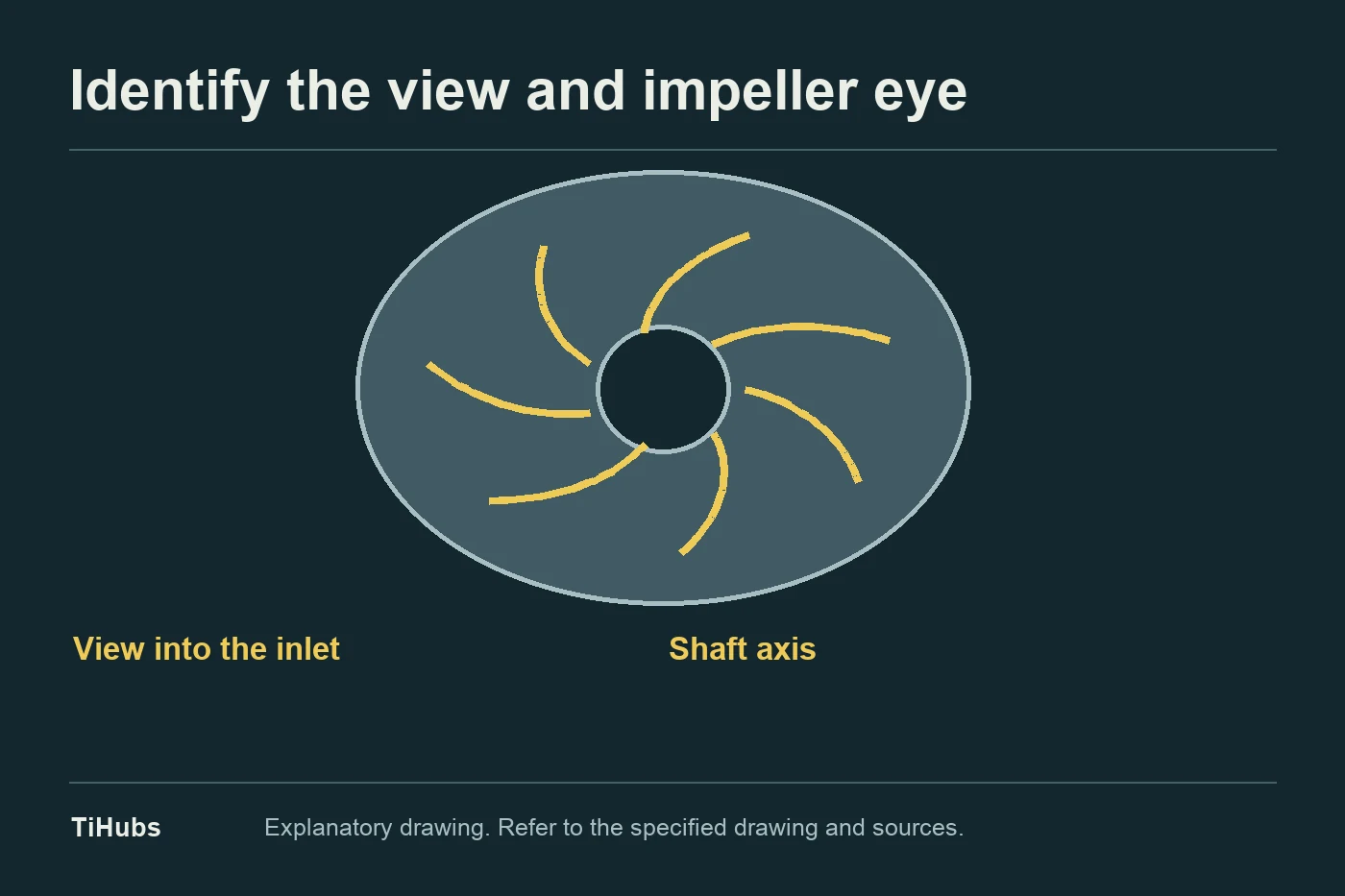
Identify the view and impeller eye. View into the inlet, Shaft axis.
Order geometry schematic; not a dimensional drawing.
Identify the exact wet-end component
Identify a centrifugal pump impeller by its place in the machine. Begin with the pump family, complete model code, serial number where available and the manufacturer’s sectional drawing. Mark the position of the required item on that drawing. Record the number of stages and whether the item sits at suction, discharge or an intermediate stage. Some assemblies use apparently similar elements with differences in hub projection, attachment or adjoining parts. A pile of loose components on a repair bench is a poor place to reconstruct their original order. If the pump is being dismantled by its owner, have the maintenance record preserve the position of parts before the items enter a purchasing enquiry.
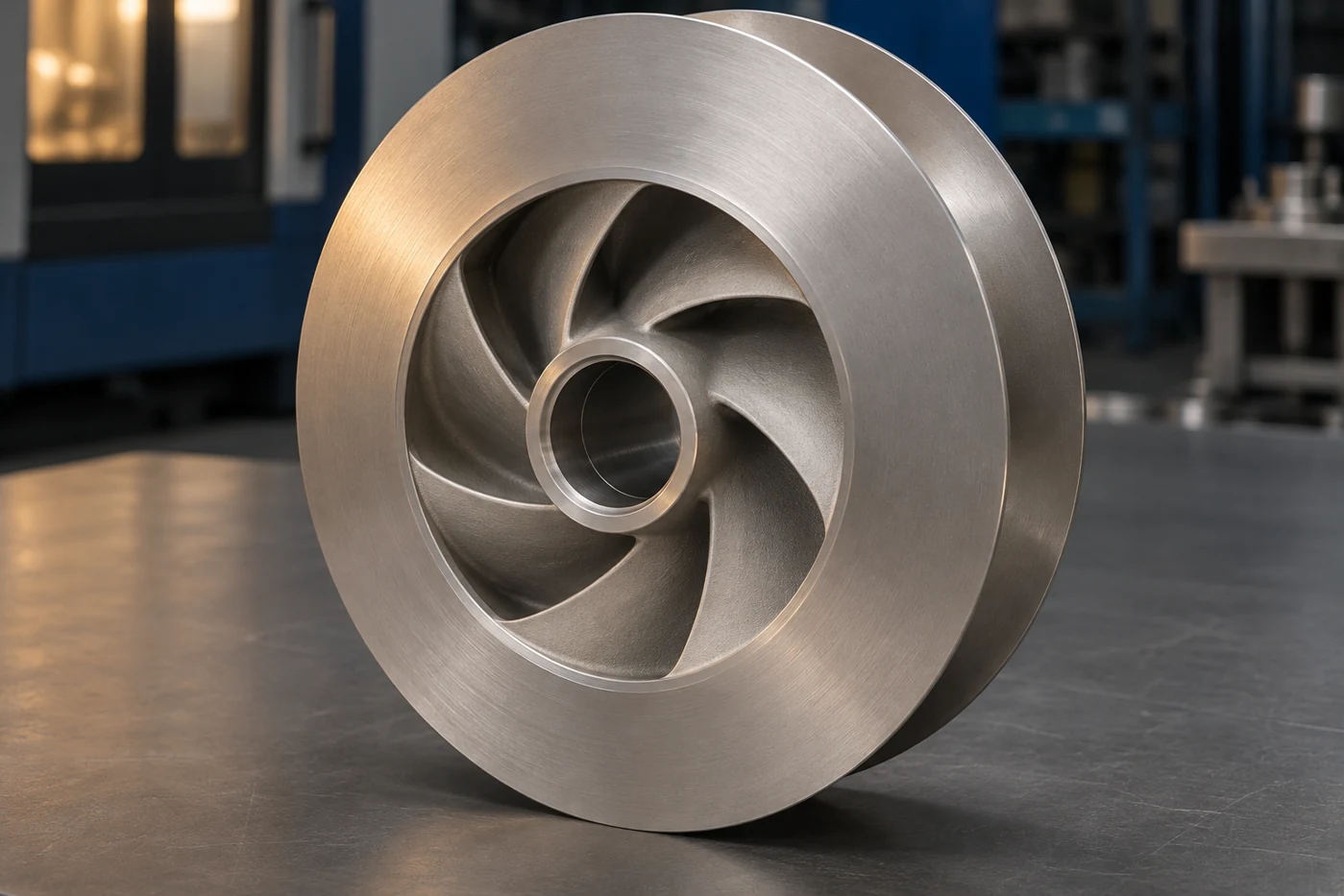
A replacement drawing needs more than an overall diameter and a central hole. Identify the inlet eye, the shrouds where present, the hub and the flow passages. Provide a view from the named end used to describe rotation. “Clockwise” changes meaning when the observer moves from the drive end to the suction end. A direction arrow accompanied by a view label avoids a mirror-image interpretation. Where a photograph accompanies the enquiry, include the viewing direction and show both faces. Use the photographs to identify features and the drawing to specify dimensions. Perspective in an oblique image can make two similar but incompatible hub lengths appear identical.
Separate the component from the assembly offered with it. One quotation may cover a bare impeller. Another may include a wear ring, sleeve, fasteners, spacers or a balanced stack. Ask what is supplied loose, what is fitted and what must be reused. An owner who intends to retain an existing shaft will need its approved mating dimensions. An owner buying an entire replacement stack will also need the axial positions and the sequence of interfaces. Make a small parts list next to the exploded view. This prevents the apparently simple purchase of one metal part from reaching the workshop without the hardware needed to install it.
The Grundfos CRT and CRTE booklet illustrates why the position matters. In the construction table cited below, the impeller in position four is Grade 1 titanium while the shaft in position three is Grade 5. A purchase description copied from the shaft line would therefore specify a different alloy for that impeller. This is an example from a named manufacturer’s drawing, not a universal material rule. Confirm the selected model and the applicable construction table. A supplier working to a customer’s original design needs the approved component specification and authority to use the drawing. A quotation for a drawing-based part does not itself establish endorsement or interchangeability with an original equipment manufacturer’s spare.
Set shaft, shroud and wear-ring interfaces
Build the dimensional review from surfaces that locate the rotating part. Identify the bore or shaft engagement, the face that sets axial position, the retention feature and the datum used to check concentricity or runout. Specify the fit using the approved values for this assembly. An outside diameter alone says little about how the component sits on its shaft. A bore measurement may be within size while a locating face is out of square. The result can be a correctly sized part positioned incorrectly in the machine. Ask the supplier to report the dimensions and geometric characteristics separately, including the datum used for each geometric check.
Consider a hypothetical stationary ring with a bore between 80.16 and 80.20 millimetres and an impeller land between 79.94 and 79.98 millimetres outside diameter. The smallest diametral clearance is the smallest bore minus the largest land, or 0.18 millimetre. The largest is the largest bore minus the smallest land, or 0.26 millimetre. For ideal concentric circles, the corresponding radial gap on one side is half the diametral clearance, or 0.09 to 0.13 millimetre. These are invented drawing inputs to illustrate arithmetic. They do not establish the clearance required for any liquid, speed, pump model or operating temperature.
Write the words radial or diametral next to the stated clearance and identify the surfaces to which it applies. A one-sided gap measured locally in an assembled pump can be unequal around the circumference if the axes do not coincide. A pair of diameters taken on a bench cannot measure that eccentricity. Similarly, local wear, coatings or temperature can affect the running condition. A buyer can use a simple tolerance subtraction to compare drawing limits while leaving the installed clearance decision to the responsible engineer. If both mating parts are supplied together, define whether the records cover each individually, the assembled clearance or both. Retain which ring was paired with which impeller when selection is part of the approved procedure.
Axial position deserves the same attention. Mark the face that seats against the spacer or shoulder and draw the surfaces that face the neighbouring stage. A change to a hub length can move the vanes relative to the stationary passages even when the rotating outside diameter remains identical. Specify the treatment of radii and corner relief where a hub meets a shaft shoulder. If the owner provides an existing part, distinguish intact reference surfaces from worn regions before using its measurements to create a drawing. Wear changes a measurement in the direction the designer least wants to reproduce. Where a nominal dimension is unknown, record the uncertainty and seek design approval rather than turning an observed witness mark into a purchase tolerance.
Compare cast, fabricated and machined routes
Ask bidders to identify the route used for the part they have priced. A near-net casting can leave surfaces for finish machining and can provide enclosed shapes subject to the foundry’s process capability. A machined component can offer direct control of accessible surfaces while the tool path may limit access inside a closed passage. A fabricated or formed impeller can bring together separately produced shrouds and vanes. Its joint construction and inspection access become part of the product description. The word titanium alone resolves none of these choices. Agree on the finished geometry and performance evidence before treating routes with similar outlines as equivalent.
For a casting supplied with machining stock, specify the delivered condition and which party finishes each surface. Put the stock allowance on the appropriate surface using the agreed drawing convention. Mark where the casting may be supported or clamped and which surfaces must stay free of damage. Inspection before machining and inspection after machining can reveal different conditions. When the quotation includes examination of a particular region, ask at what stage the examination is performed and what acceptance criteria apply. A photograph of a representative casting is useful for explaining the proposed form, but does not demonstrate the condition of an individual delivered casting.
For a finished machined impeller, identify the surfaces accessible to inspection and the proposed way to check the internal passage. Inlet and outlet widths measured at a few locations may leave differences in vane profile or shroud contour unseen. If the buyer controls the three-dimensional model, define its revision and its relationship to the dimensioned drawing. Resolve conflicts in the document order of precedence before production. Ask how the supplier will communicate a necessary manufacturing change. Rounding an edge for tool access can affect a flow passage or a fitting surface. The team responsible for the pump should approve the actual departure rather than discovering it in the first delivered part.
Compare quotations by cost to an inspectable finished component. A lower unit rate for a casting can be appropriate when the buyer has fixtures and machining capacity. The same quotation can be poor value if tooling, machining, inspection and balancing then have to be purchased separately for a single spare. Identify any pattern or fixture fees, their ownership and whether they recur on later orders. For a fabricated alternative, ask what traceability covers the constituent material and any joining operation. For each route, list the evidence that accompanies shipment and which checks rely on the buyer’s workshop or the assembled pump. This lets purchasing identify real savings without silently changing what the maintenance team receives.
Connect the impeller drawing to the pump duty
An impeller belongs to a pump operating at a particular duty. Give the supplier the normal flow and head, the operating speed, the liquid and the reference performance curve where the quotation includes hydraulic responsibility. Identify whether the requested part is an exact replacement for an approved trim or an intentional performance change. A supplier offered only a worn impeller may be able to quote geometric reproduction. The same supplier need not be able to certify hydraulic performance of a pump it will never assemble or test. State who owns that verification and what will happen if the finished component differs from the approved geometry.
The Hydraulic Institute presents performance curves for defined pump configurations and speeds and explains the best efficiency point at a given speed and impeller diameter. For procurement, this means asking which curve belongs to the actual size and configuration. A general family chart helps identify a pump range. A curve for another trim or speed cannot by itself verify the replacement the buyer is considering. When a certificate or test report is required, identify the machine or configuration it represents. A sheet giving dimensional results for one impeller and a pump performance test report are both useful documents, but they answer different questions.
A change in outer diameter has effects beyond the number on the drawing. The relationship between a trim and the operating point depends on the pump configuration and the system it serves. Do not turn proportional estimates into an efficiency or head guarantee. Ask the pump or system engineer to evaluate the intended operating point, the relevant manufacturer curves and any change in service. State whether the order asks only for the specified finish diameter or also for performance within defined conditions. If an alternative impeller is proposed, request the technical basis for substituting it and the scope of tests actually included in the offered price.
For a liquid other than the reference test fluid, collect the conditions the responsible engineer needs. Identify its composition or service description, temperature range and any suspended material relevant to material selection or passage wear. Include the cleaning regime when it differs materially from normal operation. A nominally titanium wetted component can operate alongside rings, sleeves, seals and other materials. Record which components are actually being changed. If repeated failures caused the replacement request, send the failure history and photographs with the dimensional data. A replacement part and a proposed correction to system operation are separate purchasing decisions. Keeping both visible gives the owner the opportunity to investigate the cause without delaying an accurately defined spare.
Specify material, balance and inspection evidence
Identify the alloy and the product form from which each component will be made. A certificate for sheet can be appropriate evidence of the input to a formed part. A casting requires evidence relevant to the casting and the order. A certificate for a billet cannot by itself describe an internal casting condition or establish a finished balance result. Ask for the material identity, heat or lot linkage and the record connecting input to the completed impeller. Where a replacement uses separate pieces, specify which pieces need independent records. Keep the grade designation distinguishable from the manufacturer’s pump model, drawing revision and dimensional inspection identifier.
Define the balancing condition before quotes arrive. One bidder could balance the bare impeller on a mandrel. Another might intend to balance an assembled rotor with its shaft, key convention, spacers and other stages. Both can reasonably offer “balancing” and still deliver records that cannot be compared. ISO 21940-11 addresses procedures and tolerances for rotors with rigid behaviour. Using the title alone does not assign a universal tolerance to all pump impellers. The applicable method, revision, specified residual unbalance and measurement arrangement belong in the approved requirement. Where flexibility or assembly behaviour calls for another assessment, the responsible rotor specialist should define it.
A small example distinguishes a mass from an unbalance quantity. A hypothetical 0.5 gram located at a radius of 40 millimetres represents 20 gram millimetres of unbalance. The same mass nearer the centre would have a smaller moment. The example gives neither a permissible residual value nor a correction instruction. On an actual balance report identify the item tested, the planes where applicable, the measurement units and the results against the agreed limits. If a key, fixture or installed group of parts forms part of the defined condition, record it. A pass without the reference condition leaves the receiving team unable to tell whether it describes the item ordered.
Separate geometry, material, balance and hydraulic evidence in the inspection plan. Surface examination can investigate certain visible or surface-breaking conditions within its agreed scope. It cannot demonstrate the required flow at the duty point. A balancing result describes the defined rotor condition and does not establish that a bore fit, shaft location or port geometry is within tolerance. Conversely, a complete set of dimensions does not measure residual unbalance. Give each required record a purpose and identify who signs it. If the buyer requires witnessed inspection, agree the witness stage before the part passes it. A finished component already in protective packaging may offer little access to the feature that the witness intended to examine.
Purchase a replacement that can be installed and traced
For a replacement order, start with a maintenance note explaining why the original is being removed. The reason may be routine overhaul, damage during a repair, erosion of a running land or a change in the process fluid. Pair that note with the serial identification, approved drawing and any condition report on the mating parts. A worn stationary ring can alter the observed gap even if the impeller remains within its own limits. If only the rotating component is being replaced, state the disposition of the stationary part. This prevents a supplier from interpreting a measured assembly gap as a requirement to enlarge the replacement impeller.
Use a bid comparison sheet that follows the installation sequence. Enter the delivered material and form, approved stage, shaft connection, locating face, shroud and ring interfaces, finish diameter, quantity and supplied accessories. Enter inspection and balance condition in separate columns. Add the extent of hydraulic responsibility and any test included. Note tooling, lead time and packaging for a spare that may stay in storage. A bidder can then propose an alternative on a separate line. The buyer can see whether the saving comes from a different production route or from leaving an operation to the maintenance workshop.
When the first part arrives, identify it against its drawing and corresponding records before removing all protection. Inspect the hub connection, exposed edges and location marks for transport damage. Keep matched rings, spacers or stages together if the purchase requires that identity. Check the actual revision, including concessions accepted during manufacture. A deviation granted for a first piece may be inappropriate on later units, so record whether it is temporary or a change to the drawing. Store inspection records with the part identification that will still be visible after it leaves the shipping box. A maintenance team receiving an unlabelled spare years later has few reliable ways to recover its original trim and balancing condition.
Close the order with a record usable for the next overhaul. Retain the approved geometry, pump identification and stage position along with material, balance and acceptance reports. If the owner conducts the final test, connect the installed unit and the test conditions to that same record. Compare performance concerns with the configuration and operating point observed during the test. This gives purchasing a basis for a true repeat order and gives maintenance a basis for investigating a difference. For an enquiry to TiHubs, submit the drawing or authorised technical brief, state the required delivery boundary and flag the interfaces that still require confirmation by the pump owner.
A practical receiving example is a crate containing two visually identical closed impellers for different pumps. A diameter check alone might accept them in either position. Read the part identity before comparing the drawing limits, then record the actual finished diameter, hub projection and seating face against the correct serial or lot reference. If both were balanced separately, retain their separate reports. If they belong to a matched set, inspect the set identification and keep its agreed assembly sequence. These few observations can resolve a future question about mixed spares without dismantling another machine merely to establish what the store received.
For a tender that permits salvaging an existing ring, ask for the price and evidence for both routes. One price might supply a finished rotating component for a new stationary ring. Another might rely on measuring the existing ring and receiving approval of its continued use. Include in the second option any delay while the pump is unavailable and the ring is measured. The relevant commercial comparison is the total cost and time needed to return a documented configuration to the owner. A nominal reduction in the price of the impeller can disappear once access, measurement and extra transport are included.
Inspection points
Agree the acceptance evidence before the first part is released.
Unbalance depends on mass and radius — Rotor axis, 0.5 g at 40 mm
Order documentationTiHubs
Traceable from heat to shipment.
Material identificationGrade + specification
Batch identificationHeat / lot reference
Inspection scopeAgreed tests & results
Shipment identificationMarks + packing list
Illustrative document checklist. Not a certificate or test report.
01Manufacturer example in the cited CRT/CRTE construction table
Position 3 shaft is Grade 5. Identify components individually.
Position 4 impeller, titanium Grade 1, EN/DIN 3.702502Illustrative bore limits of a stationary mating ring
Drawing inputs for this arithmetic example only
80.16 to 80.20 mm03Illustrative rotating land outside diameter
Pair largest rotating land with smallest stationary bore for minimum clearance
79.94 to 79.98 mm04Calculated diametral and radial clearance
Concentric radial clearance is half, 0.09 to 0.13 mm. These values are not service limits.
Diametral 0.18 to 0.26 mm05Illustrative unbalance moment
20 g·mm. This arithmetic does not set permissible residual unbalance.
0.5 g at a radius of 40 mm06Performance reference
Check flow, head and the meaning of any certification with the pump supplier.
Hydraulic Institute pump curves at specified speed and impeller diameter
Source documents
Check the applicable series, revision and scope against the purchase drawing.
Library PDFs may be earlier editions. Check the document cover and your contractual revision. A reference file does not certify a supplied product.
Grundfos — CRT, CRTE data booklet — Construction section identifies the impeller and shaft materials on the relevant sectional drawing. Check the model and position on the specific order.
ISO 21940-11 — Balancing procedures and tolerances for rotors exhibiting rigid behaviour, with the applicable amendment and contract edition to be confirmed.
Hydraulic Institute — Pump Curves — Defines pump performance curves and the relation of the best efficiency point to speed and impeller diameter.
Baoji. One contact.
TiHubs coordinates titanium sourcing through a local manufacturer network. Your specification guides the supplier review, technical discussion and delivery requirements.
Confirm grade, dimensions, state, quantity and the purpose of the stock.
Review the supply route
Discuss manufacturing, finishing, inspection and documentation with the relevant supplier.
Agree the commercial scope
Confirm the quotation, lead time, acceptance requirements and delivery terms.
Coordinate inspection & delivery
Follow the agreed checks, marking, packing and shipment documentation.
Before you order
Specify a drawing-based titanium centrifugal pump impeller. Compare cast and machined supply, stage position, rotation, wear-ring clearances, material evidence and rotor balance records.
TITANIUM PUMP IMPELLERS · BAOJI SOURCING
Send your specification.
Send the pump model, stage position and drawing with the view used to define rotation. Identify the ring and shaft interfaces and who will verify hydraulic performance after installation.
You do not need to finalize every detail before contacting us.
TiHubs
Talk to TiHubs
Ask about titanium materials, grades or custom parts.
Enter your email to start chatting.
We use your email to respond to your enquiry. Your conversation is stored on this website.
Our team is away right now. Leave your enquiry and we will follow up by email.