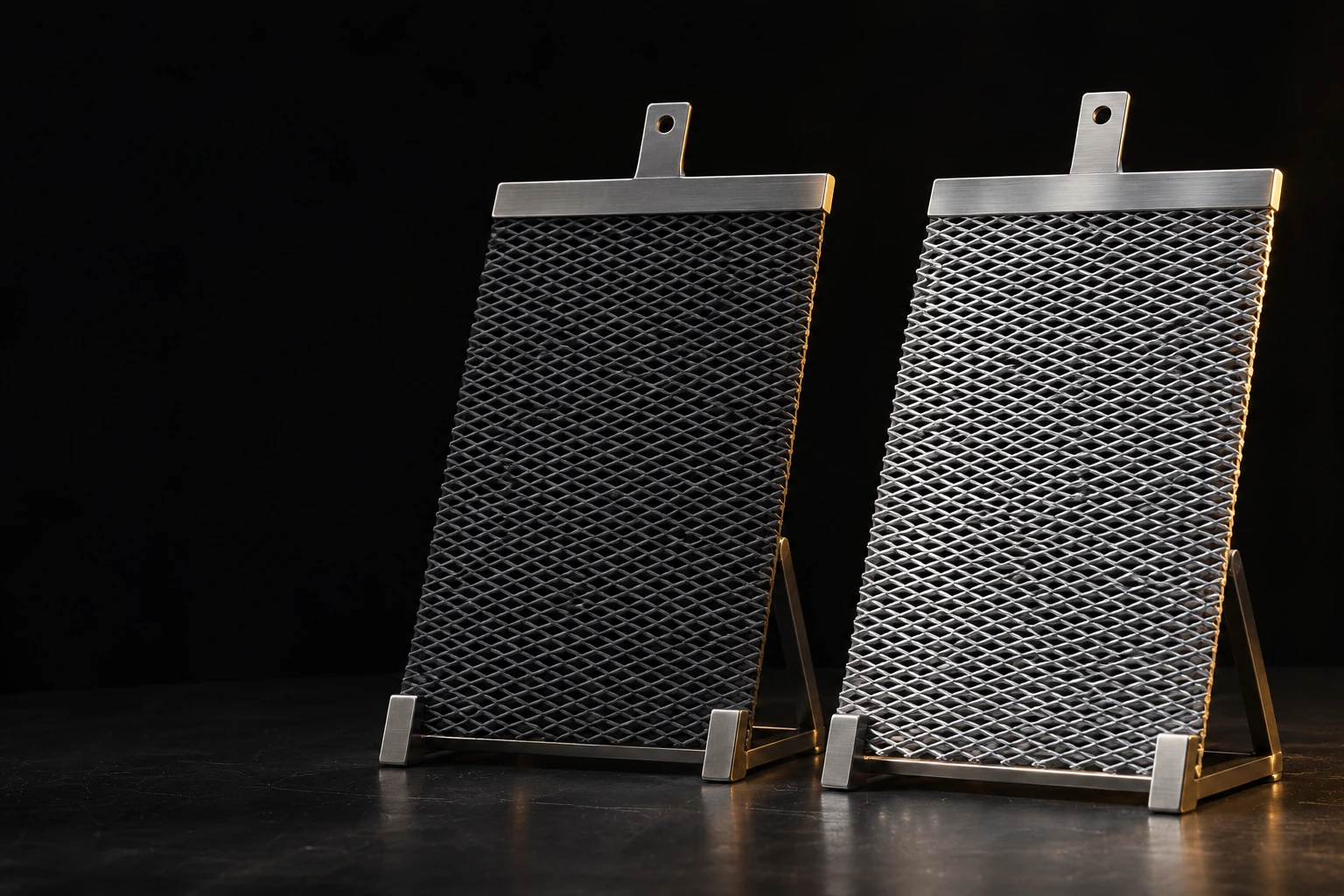
AI illustration. Appearance and labels do not verify material compliance.
Quick answer: specify the reaction before choosing the coating
The MMO vs platinized titanium anode decision starts with the electrolyte, intended reaction and measurable treatment result. MMO means a mixed metal oxide coating; platinized titanium uses a metallic platinum coating on a titanium substrate. Neither name alone defines a complete electrode specification, useful lifetime or treatment guarantee.
Ask suppliers to identify the coating system, active-area convention, operating envelope, assembly scope and end-of-life criterion. Compare performance under the same water chemistry, current, duty cycle and test method. A shiny surface or a large quoted lifetime number is not sufficient acceptance evidence.
01 / Coating families
Two coating families, many possible specifications
De Nora describes water-treatment electrodes whose coating and design are tailored to operating conditions and water quality. Its chlorine-generation electrodes are application-specific MMO systems. This supports an important purchasing principle: the acronym “MMO” does not identify one universal coating recipe or operating limit. [1][2]
Umicore describes platinized titanium anodes as platinum-coated titanium products and offers application-specific MMO anodes separately. Its product information also distinguishes coating and substrate choices. Those manufacturer examples establish product families, not a blanket claim that any Pt/Ti or MMO electrode will suit a particular water-treatment cell. [3][4]
Comparison
MMO on titanium
Platinized titanium
Functional coating
Specified mixed metal oxide system
Specified platinum coating
Required identity
Coating family/composition and controlled specification
Platinum specification, coating basis and substrate
Acceptance
Agreed loading, coverage, quality and performance evidence
Agreed thickness/loading, coverage, quality and performance evidence
Application review
Target reaction and actual electrolyte
Target reaction and actual electrolyte
Lifetime basis
Operating conditions and defined failure criterion
Operating conditions and defined failure criterion
Do not use coating color to verify composition or loading. Appearance can support an agreed visual inspection, but chemical identity and coating quantity need appropriate supplier records or agreed measurements.
02 / Water analysis
Send the water analysis before asking for a lifetime
Provide the feed-water analysis and the range expected during operation. Identify whether the cell treats natural water, prepared brine, recirculating process water or wastewater. Include the analysis date, sampling location and any upstream treatment that changes the water reaching the electrodes.
Information
What to specify
Electrolyte composition
Main species, chloride, bromide and relevant contaminants
pH and conductivity
Operating range and measurement basis
Hardness, solids and deposits
Feed condition, pretreatment and observed scale/fouling
Organics or process contaminants
Relevant analysis and variation during the duty cycle
Temperature and flow
Normal, maximum and abnormal conditions at the cell
Cleaning
Approved chemical/process, duration, frequency and rinse
Product or discharge requirements
Target output, measurement method and acceptance limits
If the water changes seasonally or by batch, quote the range rather than one favorable sample. Ask the supplier which missing values prevent a firm recommendation and which assumptions are being used for a provisional offer.
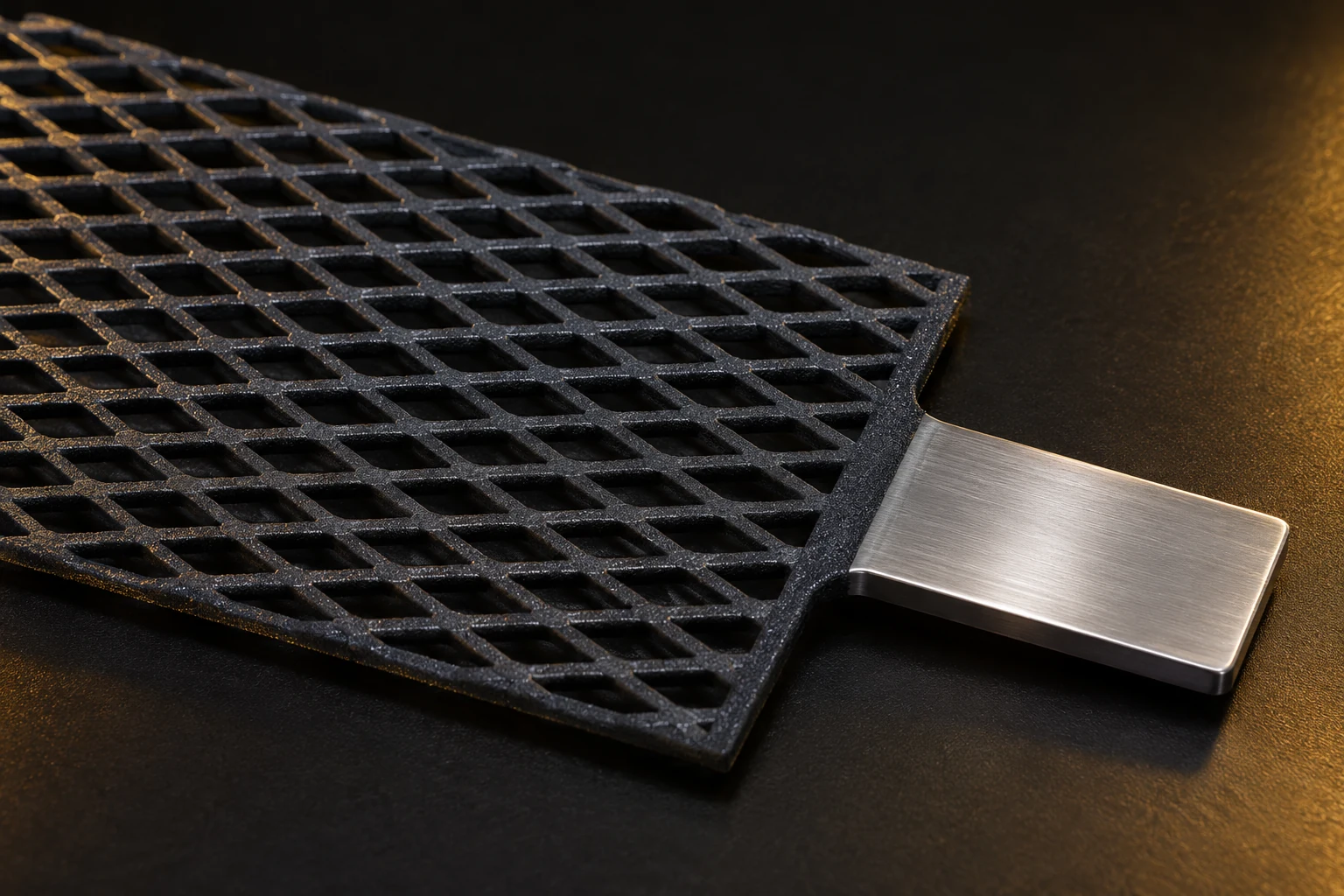
Application detailSpecify coated and connection regions
Appearance cannot establish coating composition, loading or performance. AI illustration; not production or inspection evidence.
03 / Target reaction
Define success as a measured process result
State the intended function: for example, production of an oxidant under a specified process, electrochemical oxidation of a defined stream, or another clearly described electrochemical duty. Then define how success is measured. Include throughput, target concentration or removal performance, sampling locations and the applicable acceptance criteria.
A published study of Ru/Ti/Ir/Ta oxide systems shows that coating formulation and test conditions affect electrochemical behavior. Such research helps explain why coatings must be specified; it does not establish a service-life warranty for a different commercial electrode or a complete treatment process. [5]
Byproducts also belong in the validation plan where relevant. A US Department of Defense demonstration reported unexpected perchlorate formation under its particular MMO treatment conditions. That result is not a universal outcome, but it demonstrates why coating choice alone cannot establish treated-water compliance. [6]
Agree which analytical results, operating records and sampling frequency will determine acceptance. The treatment-system designer should define the required process and byproduct checks for the intended use. Do not infer potable-water approval or discharge compliance from the presence of titanium or platinum.
04 / Current density
Define current density with an explicit area convention
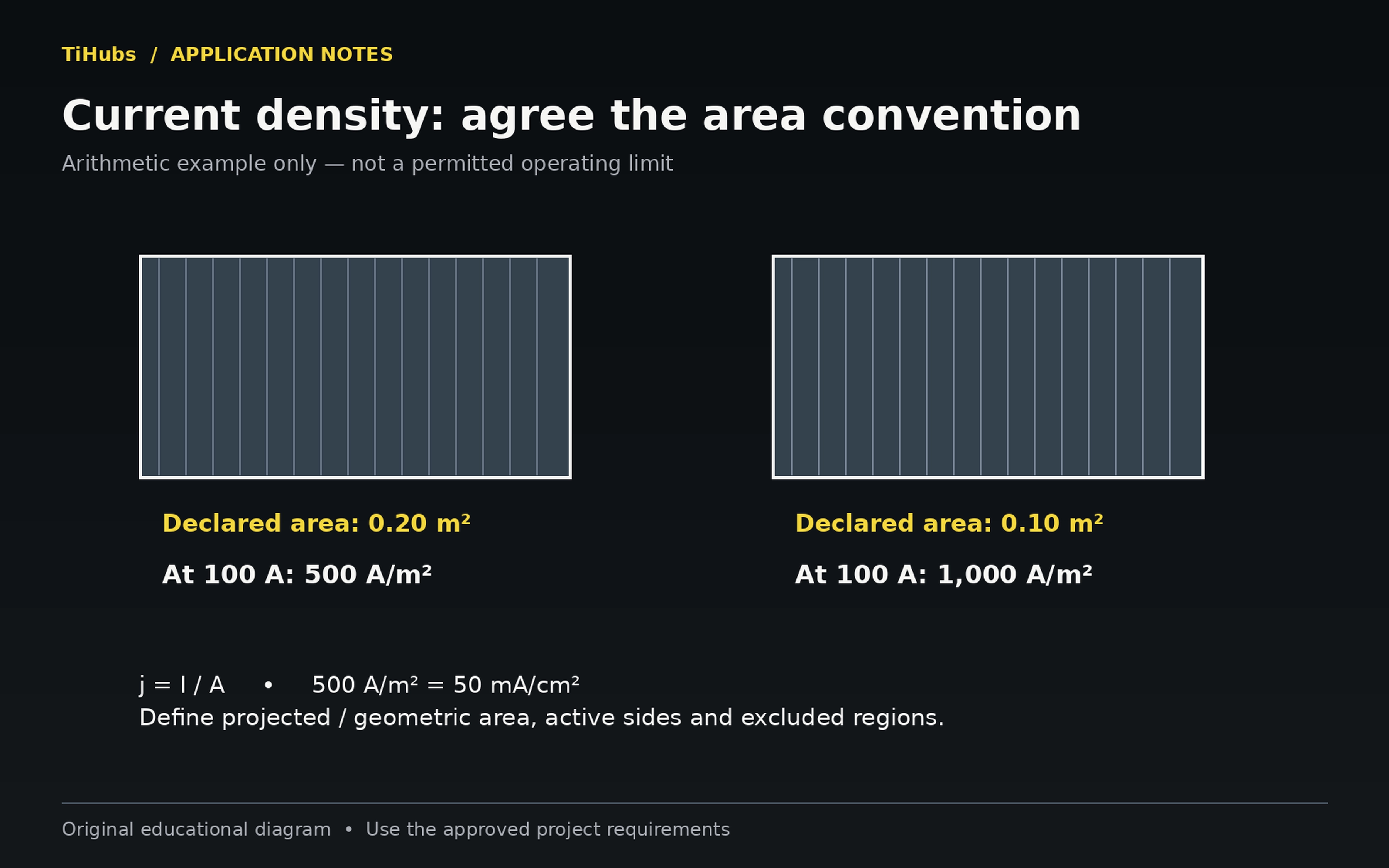
Current density is j = I / A, but the area convention must be stated. A supplier may refer to projected coated area, one active face, both active faces or another defined basis. A mesh electrode’s geometric surface is not automatically the same as its projected panel area.
For an arithmetic example only, 100 A divided by a declared active area of 0.20 m² is 500 A/m², equivalent to 50 mA/cm². If another quotation counts 0.10 m² for the same panel, it reports twice that current density. Neither number is a recommended operating limit; the example shows why the denominator must be agreed.
Electrical requirement
Define in the enquiry
Total current
Normal, maximum and operating control mode
Active area
One/both sides, projected/geometric basis and excluded regions
Current density
Value, units and the matching area definition
Duty cycle
Hours/day, continuous/intermittent operation and starts/stops
Polarity behavior
Fixed polarity, reversal sequence or abnormal reversal exposure
Electrical connections
Tab geometry, contact arrangement and assembly responsibility
Technical buying guideCurrent density needs an area definition
Arithmetic example only; these values are not recommended operating limits.
Do not assume a coating tolerates polarity reversal because another electrode in a different system does. Put the actual sequence into the specification and require the supplier to confirm its proposal against it. The same applies to startup, shutdown and any planned cleaning mode.
05 / Cell assembly
Review the cell, not just the coated panel
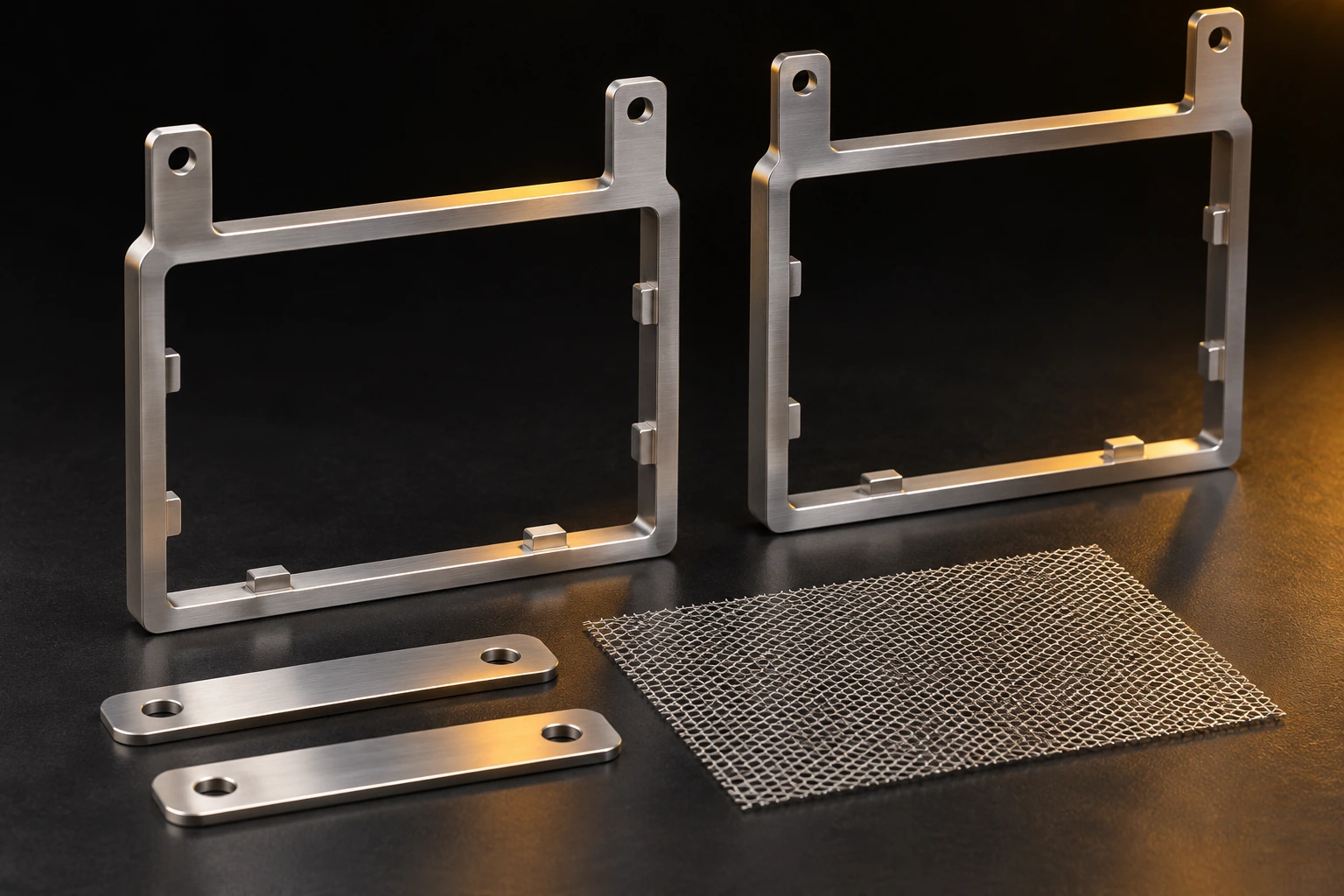
Supply a drawing of the electrode assembly, including coated and uncoated regions, mounting holes, connection tabs, electrode gap, cathode arrangement and flow path. Identify who supplies supports, seals, bus connections and other cell components. These boundaries prevent a quote for a coated blank being compared with a quote for a complete assembly.
The equipment engineer should review current distribution, gas management, flow, temperature and access for cleaning and replacement. A coating data sheet cannot establish that a poorly defined cell geometry will deliver uniform treatment. Record the proposed assembly conditions in the qualification plan.
Protect the functional surface during handling and installation. Ask for instructions covering contact points, packaging, storage and permitted cleaning. Do not improvise mechanical polishing or coating removal as a maintenance step; obtain the supplier’s approved procedure for the actual coating system.
Application detailDefine the assembly boundary
Supply the controlled drawing, mounting details and electrical connection requirements. AI illustration; not production or inspection evidence.
06 / Coating specification
Compare loading and thickness on the right basis
Ask what quantity is being specified and how it is verified. For a metallic platinum coating, thickness and mass loading can be related only with the relevant assumptions about area, coverage and coating structure. For mixed oxides, a quoted precious-metal loading is not automatically the total oxide-coating mass or a directly comparable thickness.
Coating statement
Clarification needed
“High loading”
Numerical value, units, area basis and measurement method
“Platinum coated”
Coating specification, coverage, thickness/loading requirement and evidence
“MMO coating”
Controlled coating identity and application-specific requirements
“Uniform coating”
Defined regions, method and acceptance criterion
“Long life”
Test conditions, operating envelope and end-of-life definition
“Recoatable”
Substrate assessment, stripping/recoating scope and new acceptance plan
Request a drawing marking coated edges, connection areas and any masking. Agree how defects, scratches, exposed substrate or handling damage are evaluated. A visual reference is useful only when viewing conditions and permitted features are defined.
07 / Lifetime evidence
Turn a lifetime claim into an acceptance statement
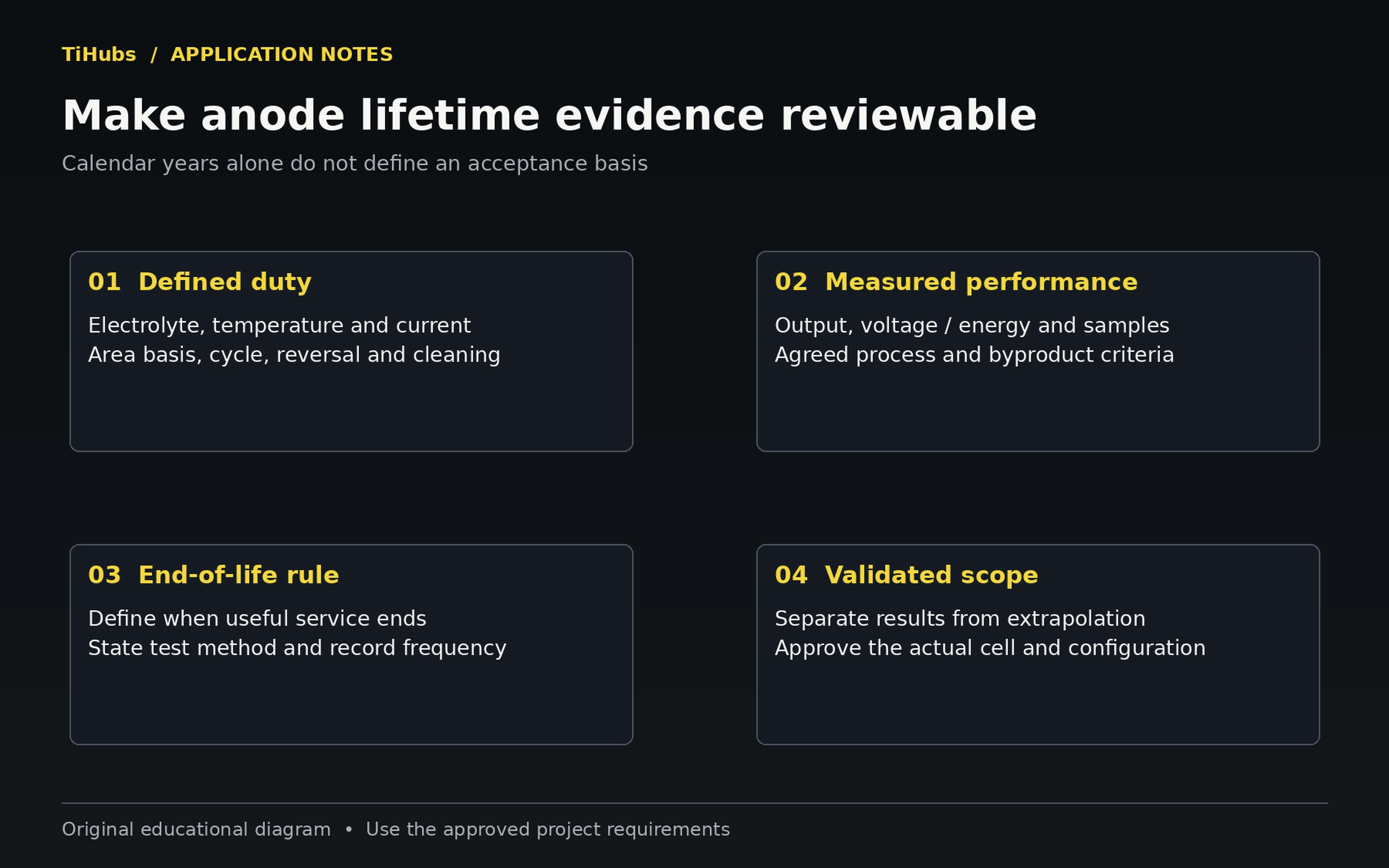
Ask whether lifetime is expressed in calendar time, operating hours, cumulative charge, charge per declared area or another basis. Then request the conditions supporting it: electrolyte, temperature, current density, duty cycle, cleaning and the criterion that ends useful service.
Possible end-of-life criteria may relate to voltage behavior, target output, coating condition or another agreed measure. The buyer and supplier must choose a criterion that represents the intended process. “Still conducting current” is not necessarily the same as meeting the required treatment output.
An accelerated test should state its purpose and method. Do not translate accelerated-test hours directly into field years without a validated relationship and clear scope. A useful qualification report separates measured results from extrapolation and identifies what remains to be confirmed in the actual cell.
A stated number of years is incomplete without duty, measurements and an end-of-life criterion.
For a pilot run, agree the operating log, sampling schedule, baseline measurements, intervention rules and inspection at completion. Retain the electrode identity and coating lot. If the pilot succeeds, record exactly which design and operating envelope are approved for production.
08 / Cost comparison
Compare cost per useful treatment output
Initial electrode price is one input. Include power consumption, achieved output, cleaning, downtime, replacement labor and any substrate refurbishment. Compare the same treatment endpoint; a lower cell voltage is not a complete efficiency comparison if useful output also changes.
The electrical arithmetic is power = voltage × current. For example, a cell operating at 8 V and 100 A draws 0.8 kW at that operating point. Over 10 hours at that constant condition, it uses 8 kWh. This is an illustrative calculation, not an electrode recommendation; actual energy accounting must include the chosen system boundary and variable operation.
To compare two offers, divide measured energy by the same accepted output basis, such as treated volume at a specified endpoint. State what auxiliary equipment is included. Keep hypothetical performance assumptions separate from pilot or production measurements.
Example: two anodes with different quoted lifetimes
Offer A states three years; Offer B states 20,000 operating hours. Neither can be ranked until the duty cycle, current density, chemistry and failure criterion are aligned. Ask both suppliers to complete the same conditions table and distinguish a contractual warranty from a test result or an estimate.
09 / Supplier review
What belongs in a practical supplier review
Request substrate identity and traceability, controlled coating identification, dimensional inspection and the agreed coating/performance evidence. Include a change-notification requirement for alterations that affect the approved configuration. Do not assume that a coating of similar appearance is the same qualified product.
For replacement electrodes, provide the existing drawing, current/voltage history, water analysis, cleaning history and observed failure pattern. Identify whether the old substrate is available for assessment. A recoating proposal should state whether the substrate is acceptable, which dimensions remain controlled and what new inspection or qualification is included.
Define the substrate, dimensions, coated regions and electrical connection details.
Agree coating identity, loading basis and the relevant inspection methods.
State operating limits, duty cycle and any polarity reversal.
Define process output, byproduct checks and end-of-life criteria.
Record pilot-test scope, deviations and the production-release authority.
Separate anode supply, cell integration, commissioning and treatment approval.
10 / Operating checklist
Build your water-treatment operating checklist
Enter the actual water analysis, target reaction and electrical duty. If a value is provisional, label it accordingly. The generated brief helps suppliers identify the coating and assembly questions that must be resolved before offering performance or lifetime commitments.
Build your operating-condition checklist
Choose the product and add the information you have. Copy the resulting brief or send your requirements to TiHubs. Submitting an enquiry does not place an order.
11 / FAQs
Frequently asked questions
Is MMO always preferable for water treatment?
No. MMO describes a coating family. The correct proposal depends on the electrolyte, intended reaction, cell arrangement, operating duty and required measured result.
Is platinized titanium automatically longer-lasting?
No. A lifetime comparison needs the same chemistry, temperature, current density, duty cycle and end-of-life definition. The coating name alone cannot establish the answer.
Can bare titanium replace a coated anode?
Do not treat it as an equivalent replacement. The functional coating is part of the electrode specification; changing or omitting it requires a process and electrical review.
How should current density be stated for mesh?
Declare the area convention, active sides and excluded regions, then use consistent units. Ask the supplier to confirm the same basis rather than assuming projected area and geometric surface area are interchangeable.
Does a coating thickness prove lifetime?
No. Thickness or loading is only part of the specification. Operating conditions, coating quality, process performance and the defined failure criterion also need evidence.
Can I use polarity reversal for cleaning?
Only if the actual electrode and system are specified and approved for that sequence. Provide the reversal duty in the enquiry and follow the confirmed operating procedure.
Does an MMO electrode guarantee safe treated water?
No. The complete treatment process needs validation against its intended-use criteria, including relevant byproduct checks. Electrode material is one part of that system.
Can old electrodes be recoated?
Potentially, subject to substrate assessment, geometry and the proposed coating process. Request a defined refurbishment scope and acceptance plan rather than assuming every used substrate is reusable.
12 / Key takeaways
The anode decision in five checks
Define water chemistry and the target reaction before selecting a coating family.
State current density with a consistent active-area convention.
Review the complete assembly, duty cycle and cleaning conditions.
Tie lifetime and performance claims to a test method and acceptance criterion.
Compare cost per accepted treatment output, with all scope assumptions visible.
The procurement schedules and arithmetic examples are original guidance. No current-density limit, coating recipe, potable-water approval or guaranteed lifetime is established here. Photographs are AI illustrations. References checked November 7, 2026.
Ti
About TiHubs
TiHubs coordinates titanium materials and custom supply from Baoji, China. Our founder’s 20 years in titanium inform a specification-led sourcing approach: clarify the product, manufacturing and acceptance requirements before quotation. Learn about our sourcing role.
Contents
TiHubs
Talk to TiHubs
Ask about titanium materials, grades or custom parts.
Enter your email to start chatting.
We use your email to respond to your enquiry. Your conversation is stored on this website.
Our team is away right now. Leave your enquiry and we will follow up by email.