Material identityStock conditionFinished-part requirements
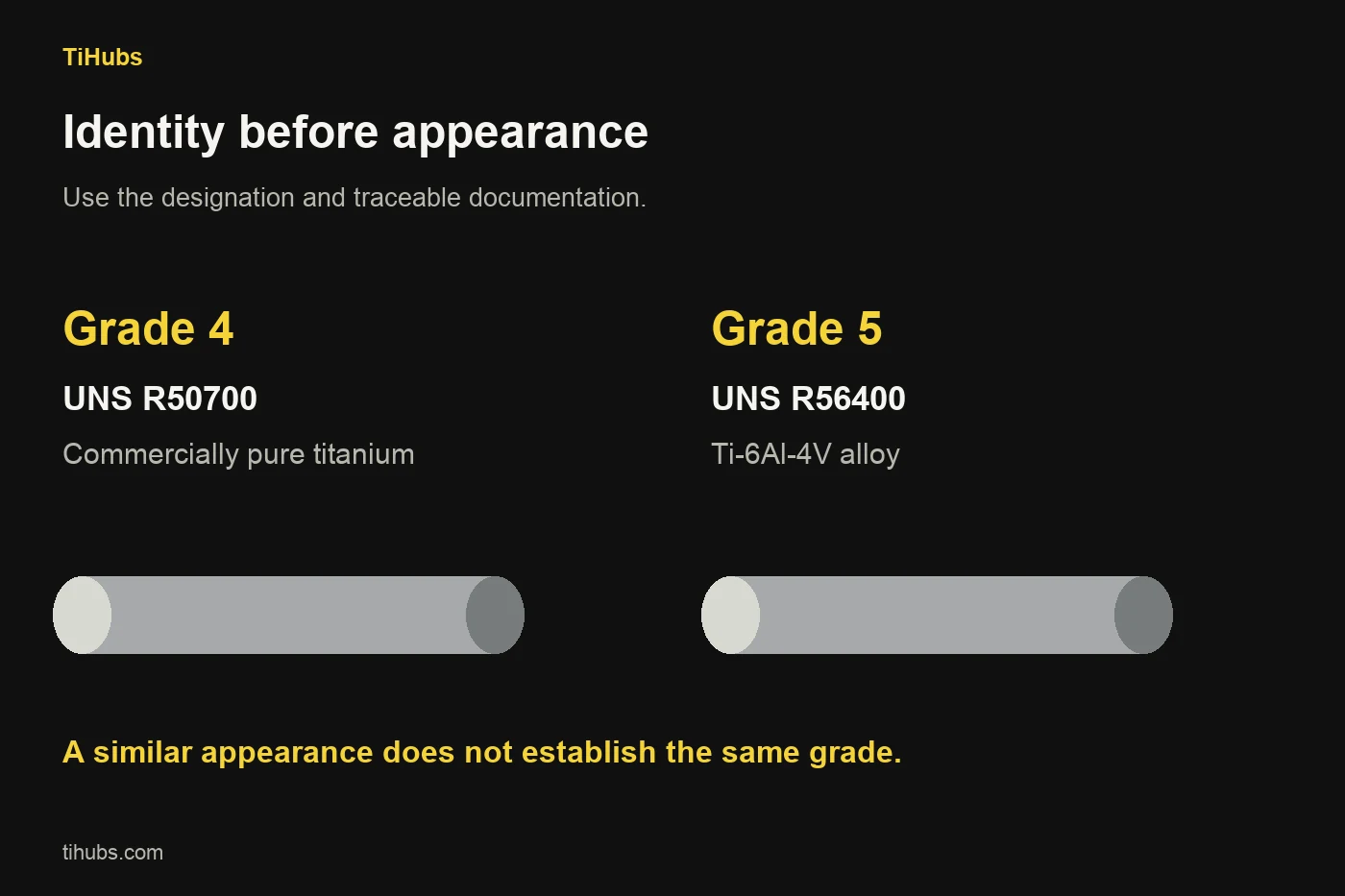
Grade 4Commercially pure titanium
Grade 5Ti-6Al-4V alloy
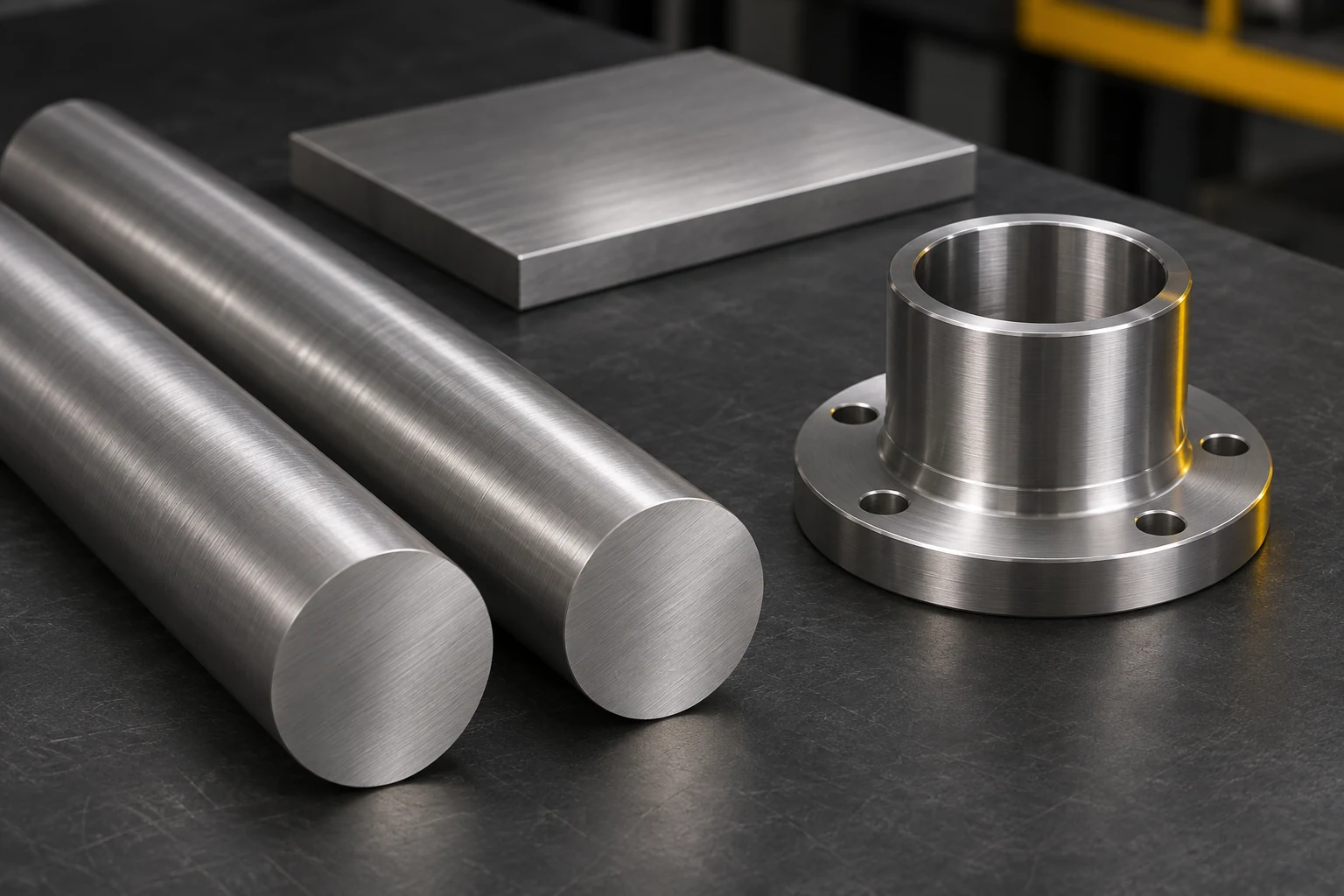
AI illustration; not a production or inspection record.
Quick answer
Grade 4 is commercially pure titanium; Grade 5 is Ti-6Al-4V and generally offers a higher-strength route. Choose between them using the approved design, service environment, stock form and final condition. Higher tensile strength alone does not establish greater stiffness, better corrosion performance or lower finished-part cost.
01 / Material identity
Start with the material definition
A drawing that says only “titanium” leaves a substantial purchasing decision unresolved. Grade 4 is commercially pure titanium; Grade 5 is the titanium alloy Ti-6Al-4V. The difference affects the material certificate, manufacturing route and engineering approval. It cannot be established from a silver surface, a photograph or a supplier’s description of a part as premium titanium. Begin by identifying which material the design actually requires, then ask what evidence would justify a change.
For a machined sleeve, mounting block or threaded component, the useful question is whether the approved design needs the strength and processing route of Grade 5 or can use Grade 4. A comparison of alloy names alone does not resolve that question. The drawing, load case, environment and available stock dimensions need to be considered together. A purchasing team should record the reason for considering the alternative: an unavailable diameter, a forming operation, machining difficulty, cost or an engineering redesign.
Selected published composition information; mass percent, not a complete purchase specification
Item
Grade 4
Grade 5
Material designation
Unalloyed titanium; UNS R50700
Ti-6Al-4V; UNS R56400
Aluminum addition
No intentional Al alloying range in the cited Grade 4 table
5.5–6.75%
Vanadium addition
No intentional V alloying range in the cited Grade 4 table
3.5–4.5%
Oxygen, maximum
0.40%
0.20%
Iron, maximum in these sources
0.50%
0.40%
Published basis
TIMETAL 75A, Table 1
TIMETAL 6-4, Grade 5 column, Table 1
Sources: TIMETAL 75A and TIMETAL 6-4. Both sheets carry a 2000 copyright date. These selected entries explain the material distinction; they do not replace the chemistry limits in the ordered product standard and edition. In particular, an absent intentional alloying range does not mean an element must be analytically zero. Residual-element requirements still matter.
Do not combine limits from unrelated documents to create a convenient specification. A plate supplier’s Grade 5 chemistry summary may differ from a historical bar reference. If the order is for bar, identify the bar specification and applicable edition; if it is for plate, use the plate specification. ASTM B348/B348M-25 identifies Grades 4 and 5 within its scope for annealed bars and billets. That public scope confirms identity and product coverage, not every acceptance requirement.
The practical output of this first review is a short material statement attached to the enquiry. It should name the grade, product form, standard, edition and delivery condition. When a substitution remains under evaluation, label it as a proposed alternative and request a separate quotation. This prevents a stock-availability discussion from quietly changing the engineering baseline. The Grade 4 and Grade 5 product pages provide the corresponding enquiry routes.
Industrial buying guide / 01Identity before appearance
The alloy designation and traceable certificate establish the material; surface appearance cannot distinguish these grades reliably.
02 / Strength evidence
Read strength with its conditions
Grade 5 usually attracts attention when a component needs higher strength. Nevertheless, “titanium strength” is not a single number. A minimum required by a purchase specification, a manufacturer’s typical result and a heat-specific certificate result answer different questions. The minimum defines an acceptance boundary for a particular product; a typical value describes published experience; the certificate records the tested material. None automatically becomes a design allowable for every geometry.
Two documented bar examples with different source scopes; not interchangeable acceptance limits
Published information
Grade 4 example
Grade 5 example
Source and condition
ATI CP Grade 4, bar section; 1,300°F anneal
TIMETAL 6-4, Table 3; annealed ASTM B348 bar, diameter or thickness ≤3.00 in
Tensile strength, minimum
550 MPa
895 MPa
0.2% yield strength, minimum
483 MPa
828 MPa
Elongation, minimum
15%
10%
Test temperature / direction stated in cited row
Not stated on the product-page bar summary
20°C; longitudinal
Edition context
Manufacturer web summary; no standard edition attached to this row
Historical datasheet referencing ASTM B348-95a
The Grade 4 entries are from ATI’s CP Grade 4 product page; the Grade 5 entries are from the TIMET datasheet, Table 3. Values are reproduced in the sources’ MPa rounding. They show why the material routes deserve separate engineering review, but the differing source conditions prevent treating this table as a controlled qualification comparison. Confirm today’s contractual limits against the ordered specification.
Before asking whether a part can become smaller, identify what limits it now. A bracket may be governed by deflection, a sleeve by contact pressure, a fastener by thread engagement, or a component by fatigue at a transition. Increasing tensile strength does not remove those constraints. Material substitution without a geometry review can preserve the same deformation problem while changing machining and inspection requirements.
Published physical-property ranges illustrate this point: TIMET lists an elastic modulus of 105–120 GPa for 75A and 107–122 GPa at 20°C for 6-4, with texture and heat treatment affecting the latter. The ranges overlap. Therefore, a large increase in tensile strength should not be interpreted as a similar increase in stiffness. This is an engineering inference from the cited ranges, not a promise about the deflection of a particular component.
Specify where the test sample represents the order. Bar diameter, plate thickness, sampling direction and final heat treatment can change the relevance of a certificate. When the supplied stock will undergo further thermal processing, ask which properties apply before and after that operation. If the buyer needs a finished-part property, the acceptance plan should identify the responsible processor and the evidence required after processing. A certificate for incoming stock cannot silently cover every subsequent manufacturing step.
03 / Machining route
Compare the finished-part route
For CNC purchasing, the meaningful comparison is the complete route from stock to an accepted part. Start with the machining envelope. A round component may suit a bar blank; a broad mounting component may suit plate; a heavily sculpted part may justify a forging enquiry. Selecting Grade 5 because it is familiar does not make an oversized billet economical, while selecting Grade 4 because it is commercially pure does not guarantee a shorter cycle.
Ask the machine shop to identify the operation that determines the quotation. It may be a deep bore, a thin wall, a long unsupported section, a precision thread or a difficult setup. Those features influence tool access, workholding, chip evacuation and inspection. A useful alternative-material review retains the same drawing revision and acceptance criteria so that the shop can explain which operations would change and which would remain essentially the same.
Titanium machining calls for attention to heat at the cutting edge, tool condition and rigidity. TIMET’s design and fabrication handbook discusses machining practices and titanium’s tendency toward galling. The purchasing consequence is to request a process proposal from the actual machining source, rather than impose an unsupported universal speed or claim one grade is a fixed percentage faster. Tool geometry, machine capability and cut conditions belong to that proposal.
Consider a sleeve with an external shoulder and a finished internal bore. The first quotation may assume a solid round blank; another may propose a bored blank. Compare the remaining stock, the intermediate operations and the dimensional inspection point. If one route includes a stress-relief operation, record its purpose and the required condition afterwards. A lower material mass can be offset by an extra setup or by a blank that arrives without adequate straightness or surface allowance.
For a plate-derived component, communicate the orientation of the part in the plate when the design or specification requires it. Do not leave the machining supplier to infer whether the longest part dimension should follow the rolling direction. Include the cut-edge allowance and any restrictions on thermal cutting. The titanium plate enquiry should describe the blank as purchased, while the machined-part enquiry should describe the finished deliverable.
A first article is especially valuable when the alternative changes stock condition or the removal pattern. Decide in advance what it must demonstrate: final dimensions, surface condition, thread quality, freedom from unacceptable burrs and any specified material tests. Record the accepted manufacturing route so that a later production batch does not rely solely on matching the grade name. If the part is already qualified, a prototype pass does not by itself authorize a permanent material change.
Keep machining evidence separate from material identification. An attractive finish cannot prove Grade 4 or Grade 5; a successful cut cannot demonstrate all chemistry limits. Conversely, a correct material certificate does not prove that a bore meets its geometric tolerance. Treat those as separate acceptance tasks and assign them to the documents and inspections that can actually answer them.
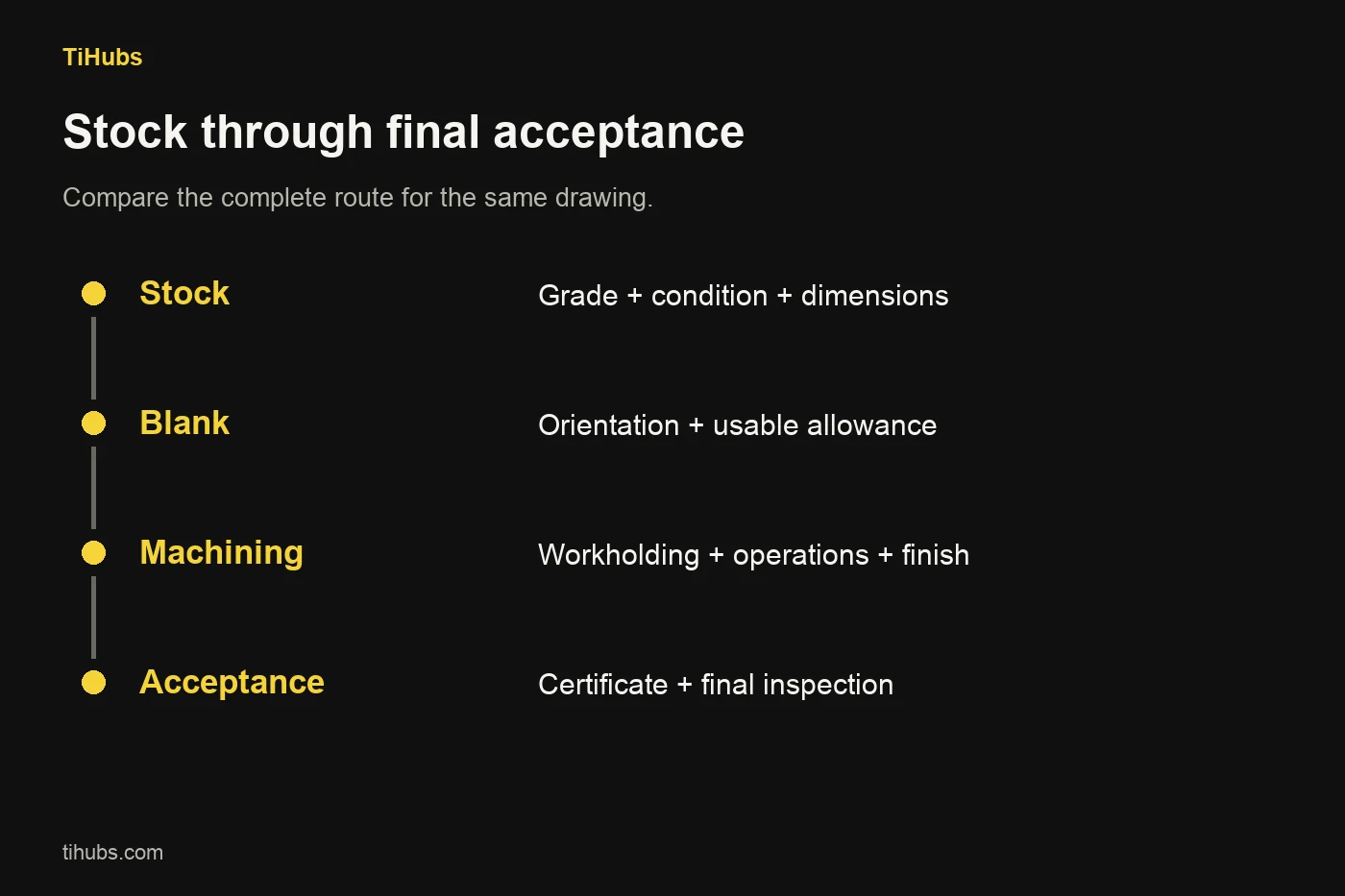
Industrial buying guide / 03Stock to accepted component
Connect stock condition, blank preparation, machining and inspection before comparing the two quotations.
04 / Service and joining
Check the service and joint
Corrosion resistance is another reason buyers compare these grades, but a higher grade number does not establish a better corrosion choice. Define the wetted environment before using a strength comparison to justify substitution. Record the process fluid, concentration range, operating and upset temperatures, deposits, cleaning chemistry and any stagnant zones. A component in an open, well-flushed stream is not necessarily equivalent to the same component beneath a gasket.
TIMET’s corrosion handbook distinguishes commercially pure titanium from alloyed routes and explains why laboratory results may not reproduce plant conditions. Its published guidance supports reviewing the actual environment. It does not justify assigning a universal corrosion score to Grade 4 and Grade 5. For a process change or uncertain fluid, ask for relevant operating evidence or an agreed test rather than copying a corrosion rate from an unrelated solution.
A common purchasing trap is to treat good performance of an existing Grade 4 part as evidence for Grade 5 in the same location. That history is useful baseline evidence for Grade 4. It is not automatically a qualification of another alloy. Write down what the existing record actually shows: exposure duration, observed surface condition, maintenance intervals and any failures. Then identify the evidence needed for the proposed material. This keeps the discussion specific and prevents both unnecessary upgrades and unsupported replacements.
If the component is welded, include the complete joint in the review. Identify the mating material, filler requirement, joint design, shielding arrangement, post-weld treatment and inspection criteria. A purchase of Grade 5 bar for a welded assembly is different from a purchase of the same bar for an entirely machined part. The welding procedure should be reviewed for the actual materials and condition, rather than inherited from a visually similar assembly.
For a threaded or sliding interface, ask whether wear, seizure or repeated assembly controls the design. Higher tensile strength is not a complete remedy for an interface problem. The approved surface treatment, mating material, lubrication and assembly process may be decisive. Where a coating is specified, establish its dimensions and inspection stage: a bore that meets size before coating may not meet the finished requirement afterwards.
Formed details need their own review as well. A machined component may still include a bent tab, swaged end or local expansion operation. Specify the forming state and the final material state separately. An elongation percentage from a tensile test does not directly prescribe a safe bend radius for that geometry. For tight or critical forming, obtain a representative trial using the intended thickness, orientation, tooling and thermal route.
The result should be a service-and-manufacturing decision, not a winner chosen from one strength row. If the component’s established material already satisfies the environment and load requirement, availability or cost may support keeping it. If a change offers a concrete benefit, preserve the evidence and approval that make the alternative acceptable.
05 / Quotation basis
Price the same deliverable
There is no reliable universal price ratio for Grade 4 versus Grade 5. A meaningful quotation depends on product size, quantity, condition, inspection, source availability and delivery destination. Compare prices for the same purchasing scope. A price per kilogram for rough bar cannot be compared directly with a price per accepted finished component, even if both quotations mention the same grade and nominal diameter.
Prepare two quotation lines when both grades are being evaluated. Keep the drawing revision, final quantity, destination and requested delivery date identical. State whether each line is approved material or an alternative awaiting review. Ask suppliers to declare the proposed stock form, delivered dimensions, usable allowance, surface condition and certification package. A supplier should be able to explain a deviation without hiding it inside a broad phrase such as “equivalent titanium.”
Then compare the costs that change the purchased result: stock and cutting, machining, heat treatment, inspection, packing and transport. Include first-article effort separately from recurring production where the quotation separates them. If the buyer retains offcuts, clarify their identification and documentation; if the supplier retains them, compare the net commercial scope. This is a quotation worksheet, not a claim that every supplier uses the same costing method.
Availability must be checked at the exact dimensions. A listed alloy does not establish stock of a particular diameter, length, condition or certificate scope. Ask whether the offer concerns existing material, material reserved from an incoming lot or a new production route. Obtain the proposed delivery milestones and the conditions that could alter them. Do not use a catalogue page as proof that either grade is available for immediate shipment.
Quantity also needs a clear basis. Distinguish the number of finished pieces from the number of blanks, and identify any additional material required for qualification or destructive testing. If the enquiry states only total weight, a supplier may propose a stock size that creates unnecessary machining waste. Providing the component envelope allows the supply and machining teams to discuss a more suitable blank without changing the approved finished drawing.
For repeat orders, maintain the accepted material and manufacturing requirements in one controlled purchasing package. A repeat part number should point to the correct drawing revision, material specification and inspection plan. If a later offer changes mill source, stock condition or process, review the change against that package. The benefit is practical: the buyer can compare a new offer with the last accepted supply instead of reconstructing the technical agreement from email fragments.
06 / Receipt and release
Keep identity through machining
Receiving inspection should connect the physical stock with the purchased requirements. Check the order line, material designation, dimensions, quantity and heat or lot identification against the certificate and packing information. If the delivery includes both grades, keep their identification distinct before cutting. Similar appearance makes an organized traceability system more useful than visual sorting at the machine.
Review the certificate beyond the headline grade. Confirm that it names the ordered product standard and condition, reports the required chemistry, and includes applicable mechanical results with units. Check whether the specimen direction and sampling basis are relevant to the product. A certificate showing a satisfactory tensile result does not excuse a missing chemistry requirement or an unapproved delivery condition.
When bars or plates are subdivided, establish how identity moves to each blank and any retained offcut. The marking method should suit the surface and the part’s requirements; avoid specifying an intrusive mark on a functional surface without approval. The goal is that the machining traveler, blank and test documentation remain connected after the original mill marking has been removed.
If incoming verification is requested, define what the method can establish. A chemical identification check and a tensile test address different properties. Require a method suitable for the elements or characteristics being accepted, and do not treat one instrument reading as proof of every line on the material certificate. Where the contract needs independent laboratory testing, agree on the sample, test method, acceptance limit and responsibility before material is consumed.
Release a proposed substitute only after the designated technical authority has approved it. Purchasing can collect evidence and compare offers; it should not convert a supplier suggestion into an engineering decision by changing an order description. Record whether approval covers one lot, a prototype or ongoing production. That distinction matters when a trial alternative was accepted because of a temporary supply problem.
Use the enquiry form below to start with the information already available. For raw stock, include the required bar or rod dimensions and condition. For finished components, include the drawing revision and acceptance requirements. TiHubs can review the proposed supply scope against that information; exact availability, certification and delivery remain quotation items to confirm.
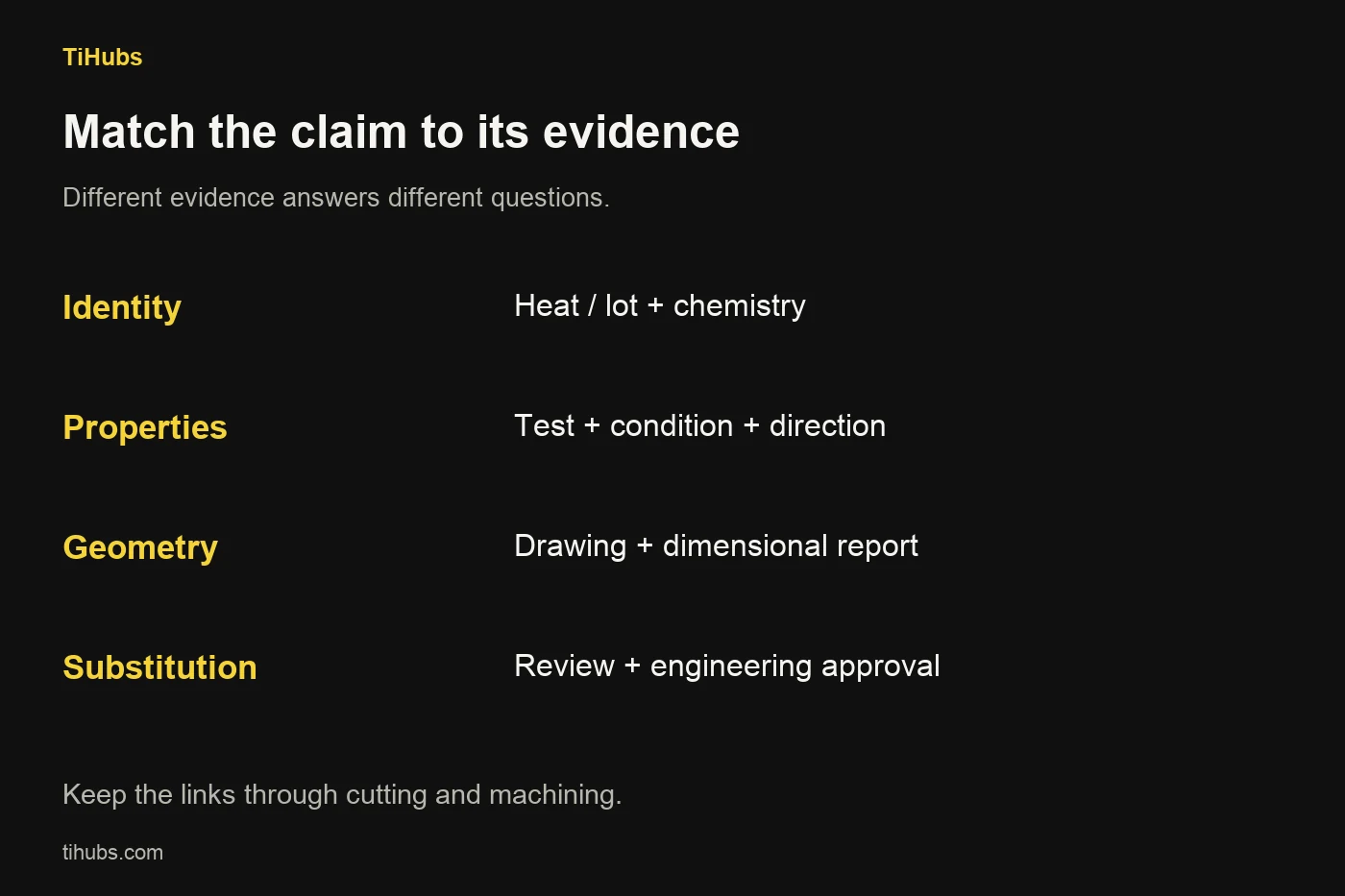
Industrial buying guide / 06Keep each claim with its evidence
Separate material identity, mechanical properties, finished dimensions and substitution approval.
07 / Build your RFQ
Prepare a Grade 4 or Grade 5 enquiry
Send the approved grade or identify both materials as alternatives for review. Include the stock or finished-part dimensions and the evidence needed at delivery, so the quotation answers the actual purchase decision.
Information to include
Grade, product standard, edition and delivery condition
Bar diameter or plate dimensions; finished drawing revision where applicable
Quantity, destination and requested delivery date
Service environment, further processing and inspection requirements
Whether substitution is approved, proposed for trial or prohibited
Build your RFQ checklist
Choose the product and add the information you have. Copy the resulting brief or send your requirements to TiHubs. Submitting an enquiry does not place an order.
08 / FAQs
Questions buyers ask
Is Grade 5 always better than Grade 4?
No. Grade 5 can support a higher-strength design, but the relevant decision also includes stiffness, environment, manufacturing and qualification. If an approved Grade 4 component already meets its requirements, changing grade needs a specific benefit and a documented review.
Can Grade 5 replace Grade 4 without changing the drawing?
Only when the applicable approval process permits the change. A supplier quotation or a higher tensile value does not authorize substitution. Record the revised material requirement, supporting evidence and whether approval applies to a trial, one lot or continued production.
Which grade is easier to machine?
Do not assign a universal machining ranking without the part and route. Ask the actual machining source to compare the same geometry, stock condition, tolerances and quantity. The difficult operation and tooling arrangement can matter more to the quotation than a general alloy description.
Are the table values guaranteed for my order?
No. The tables identify their published source and scope. The two mechanical examples have different source conditions and are not a common acceptance specification. Your order must state the applicable product standard, edition, condition and any additional agreed requirements.
Does a stronger grade automatically reduce component weight?
Weight reduction requires an approved geometry change. The material must still satisfy stiffness, fatigue, contact, joint and manufacturing constraints. Keeping the same geometry while changing grade does not deliver the weight reduction implied by a strength ratio.
What should I send for an accurate quotation?
Send the grade or proposed alternatives, product dimensions, drawing revision, quantity, destination and delivery target. Add the required standard, condition, certification and inspection. Identify any forming, welding or heat treatment after delivery so the supplier can review the correct material state.
09 / Key takeaways
Keep the purchase requirements connected.
Grade 4 and Grade 5 are different material routes, not interchangeable quality levels.
Keep chemistry and mechanical data attached to their product, condition and source.
Evaluate stiffness, service and interfaces before approving a strength-led substitution.
Compare complete quotations for the same accepted deliverable.
Preserve heat or lot identity through cutting, machining and final release.
Technical references
Sources and data scope
References reviewed November 14, 2026. Public source summaries support the discussion; the controlled specification, agreed edition and approved project requirements govern acceptance.
TiHubs coordinates titanium material and custom supply enquiries from Baoji, China. Send the product, drawing revision and acceptance requirements so the proposed supply scope can be reviewed. Learn about our sourcing role.
Contents
TiHubs
Talk to TiHubs
Ask about titanium materials, grades or custom parts.
Enter your email to start chatting.
We use your email to respond to your enquiry. Your conversation is stored on this website.
Our team is away right now. Leave your enquiry and we will follow up by email.