Service conditionsCorrosion evidencePurchase scope
Grade 2Commercially pure titanium
Grade 12Ti-Ni-Mo alloy
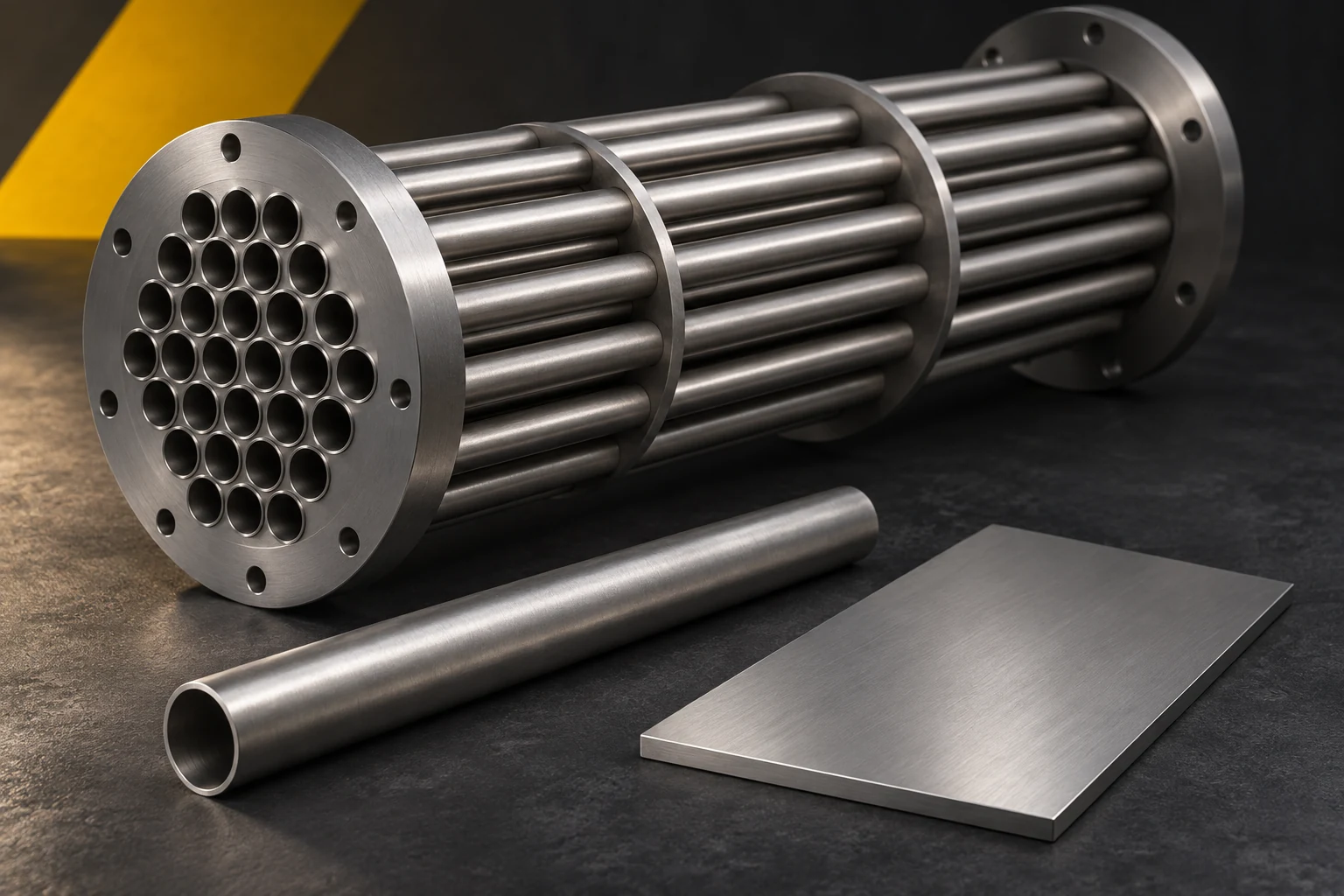
AI illustration; not a production or inspection record.
Quick answer
Grade 12 is a nickel-molybdenum titanium alloy that can be considered for more demanding chemical service than an established Grade 2 route. It is not a universal corrosion upgrade. Compare the actual fluid, concentration, temperature, crevices and cleaning cycle, then verify the product and fabrication requirements before ordering.
01 / The change request
What should the change solve?
A request for Grade 12 often starts with an existing Grade 2 heat exchanger, vessel lining or process component. The operating team may have seen local attack, changed the process fluid or increased the temperature. Purchasing then receives a simple instruction to obtain a better titanium grade. Before requesting prices, turn that instruction into a defined problem: what changed, where did it occur, and what must the replacement achieve?
Grade 2 is commercially pure titanium. Grade 12 contains deliberate nickel and molybdenum additions. The grade numbers do not form a universal corrosion ranking. Grade 12 can be a candidate when the service demands more than the established Grade 2 route, but suitability depends on the actual environment and component. A change justified for one stream cannot automatically be applied to every titanium part in the plant.
Material identities in the public scope of ASTM B338-17(2026)
Item
Grade 2
Grade 12
UNS designation
R50400
R53400
Material description
Unalloyed titanium
Titanium alloy
Nominal intentional additions
No Ni-Mo alloy designation
0.3% molybdenum; 0.8% nickel
Product context of the cited scope
Titanium tubes for condensers and heat exchangers
Source: ASTM B338-17(2026), public scope. The Grade 12 percentages above identify the nominal alloy, not the minimum and maximum chemistry limits for acceptance. Use the controlled specification for the complete requirements. A nominal addition must not be used as an exact target for judging a heat certificate.
For existing equipment, collect the original drawing and material records before changing the grade field. Establish whether the concern involves general thinning, a gasketed crevice, deposits, a weld, an expanded tube end or an unrelated mechanical failure. Photographs can locate the problem, but they should be connected to inspection observations and operating history. An alloy change will not necessarily correct an installation, cleaning or support problem.
Separate a replacement to the existing design from a redesigned component. The first route preserves the approved dimensions and requires evidence for the new material. The second may also change wall thickness, joint geometry or thermal duty and therefore needs a broader review. Suppliers should know which route they are quoting. Otherwise a lower-priced offer may quietly include a different wall or fabrication assumption.
When the existing Grade 2 component has satisfactory service history and no relevant process change, maintaining the established route may be sensible. When the service envelope has changed, the investigation should describe that change clearly. The Grade 2 and Grade 12 material pages are useful starting points for enquiries, while the decision below connects the grade to the equipment and operating requirements.
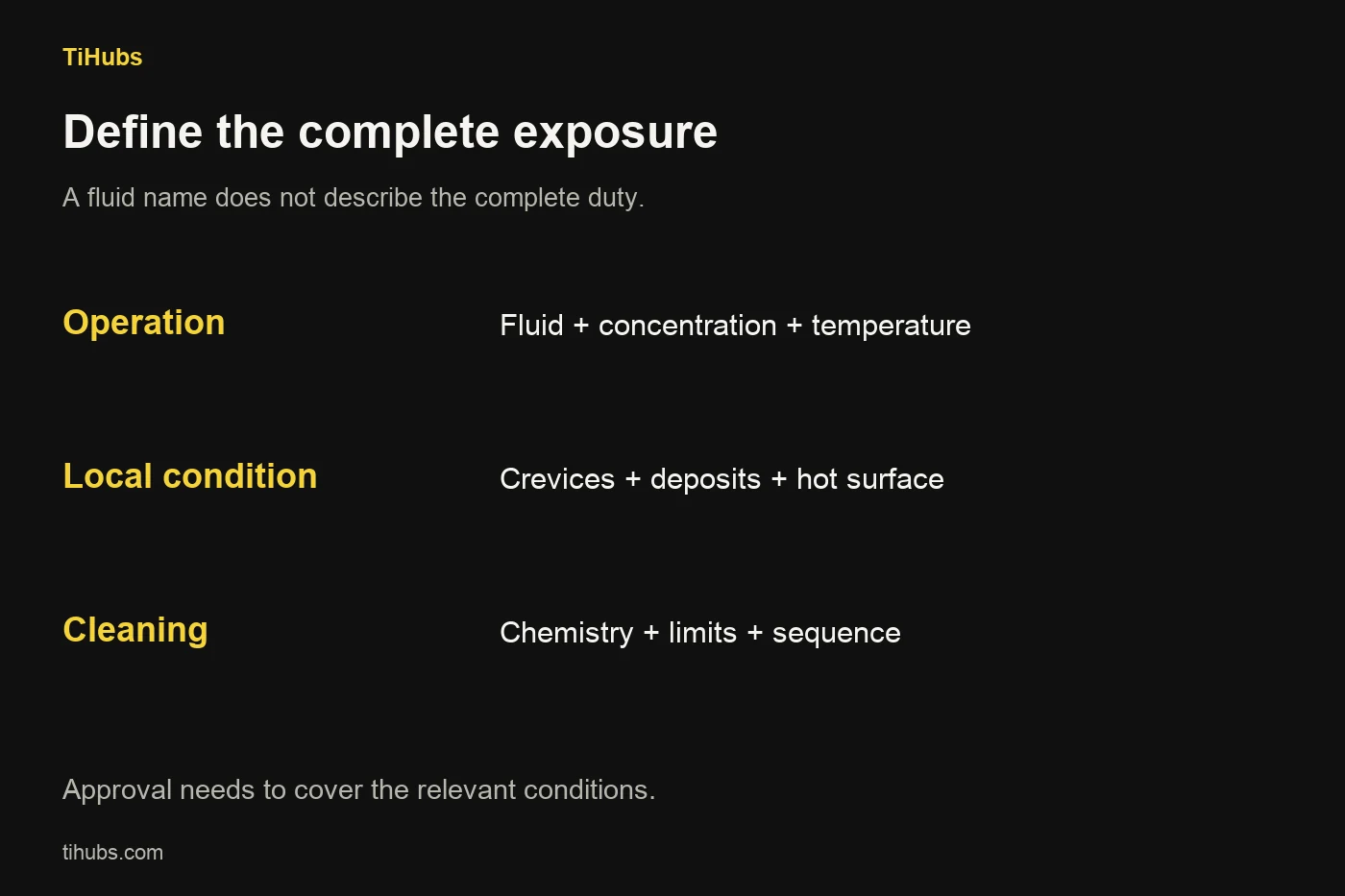
Industrial buying guide / 01Define the complete exposure
Normal operation, local conditions and cleaning belong in the same material review.
02 / Corrosion evidence
Compare the same exposure
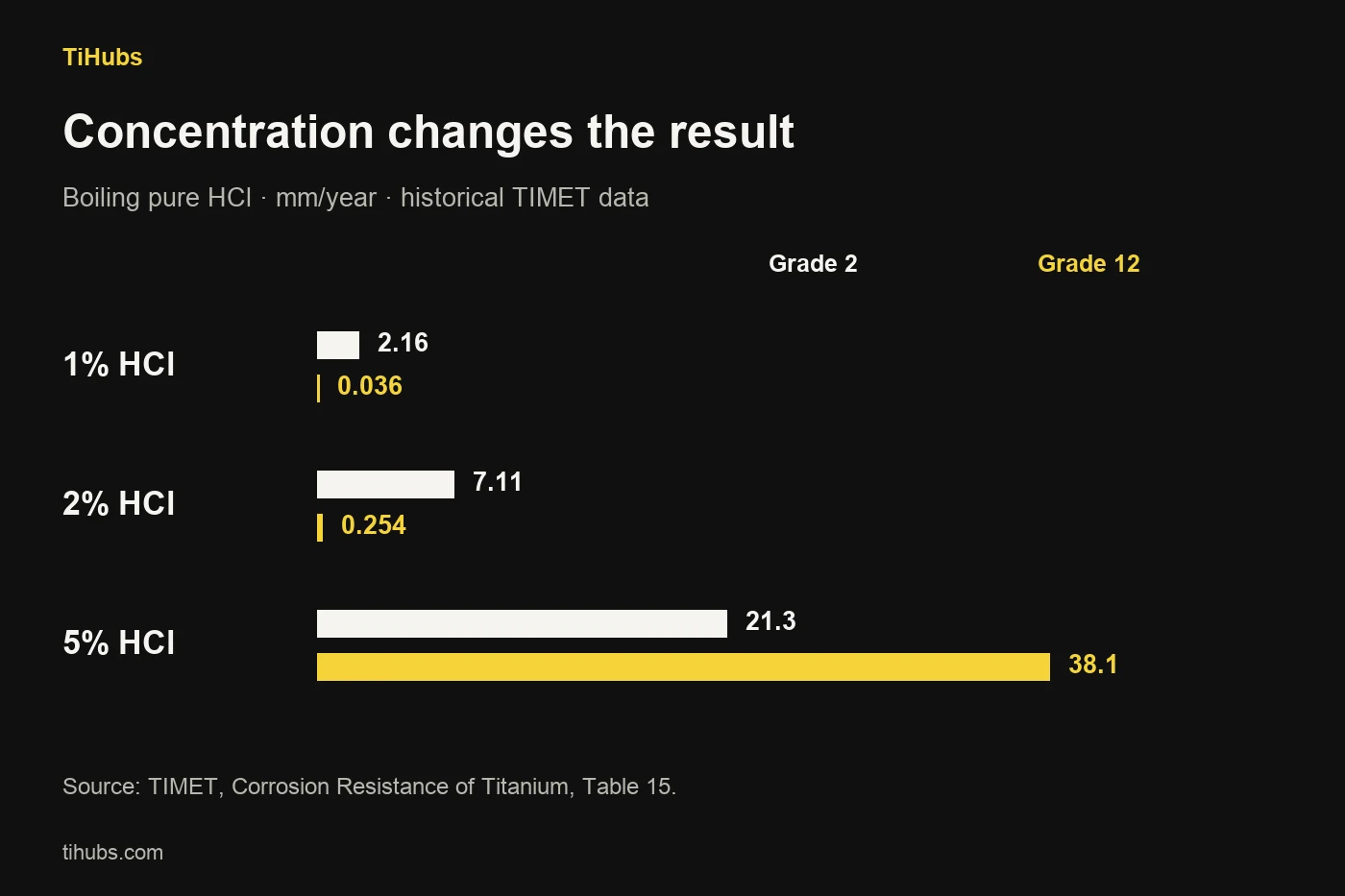
A real corrosion comparison needs the same medium and exposure conditions. TIMET’s corrosion handbook provides a useful example because it reports multiple titanium materials in the same table. The selected rows below concern dilute pure hydrochloric acid at boiling, with no ferric chloride addition shown. They are historical published test data, not a recommendation to operate equipment in those conditions.
Selected TIMET Table 15 results: boiling pure HCl, corrosion rate in mm/year
HCl concentration by mass
TIMETAL 50A / Grade 2
TIMETAL Code 12 / Grade 12
1%
2.16
0.036
2%
7.11
0.254
5%
21.3
38.1
Source: TIMET, Corrosion Resistance of Titanium, Table 15, printed page 11. The table presents rates as mpy with mm/year in parentheses; the values here retain its mm/year rounding. The selected rows do not state exposure duration, specimen condition or a numerical boiling temperature. Those omissions are retained rather than filled with assumptions. These results are not guaranteed service-life predictions or allowable corrosion limits.
The important observation is that the order changes. Grade 12 has the lower reported rate in the selected 1% and 2% rows, while its reported rate is higher at 5%. This directly contradicts a blanket claim that Grade 12 always resists hydrochloric acid better. It also shows why “acid resistant” is too broad for a purchase enquiry. Concentration and temperature belong beside the material name.
Do not interpolate a safe operating boundary between those rows. The source summarizes particular tests; a plant can have different impurities, flow, deposits and heat-transfer conditions. Nor should a lower number automatically be called acceptable. The equipment owner must define the permissible damage and required integrity using the applicable design and inspection basis. A relative comparison answers which published rate is lower; it does not answer whether either route qualifies.
A supplier may provide a corrosion chart for another acid, a room-temperature test or a different titanium alloy. Keep that information in its original scope. Ask which part supports the proposed Grade 12 application and which questions remain unresolved. An unsupported combination of several charts is not stronger evidence simply because it contains more numbers. A small, relevant test set can be more useful than a broad table without conditions.
Use the published evidence to frame the next investigation. Identify a normal operating case, a credible upset case and any cleaning exposure that differs materially from production. Then ask whether existing service data covers each case. Where it does not, agree on representative testing with the responsible materials specialist. This turns a corrosion comparison into a decision process that can support a purchase, rather than an attractive but unqualified performance claim.
Industrial buying guide / 02The result depends on concentration
Selected TIMET Table 15 values at boiling pure HCl; mm/year. Historical test results, not operating limits or life predictions.
03 / Service envelope
Include cleaning and local conditions
The fluid name in a process diagram is rarely enough to define the exposure. A useful material review records concentration ranges and relevant contaminants, rather than a single nominal concentration. It also distinguishes the bulk fluid temperature from the temperature of the metal where heat is transferred. The tube surface can experience a different local condition from the temperature displayed on a plant instrument.
Describe both sides of a heat exchanger. The process side may motivate the grade change, but the other side, the tubesheet and the joint remain part of the assembly. Include the operating sequence: startup, steady operation, shutdown, draining, standby and restart. Ask whether residual liquid remains in low points and whether deposits or gasketed regions restrict renewal of the fluid. The review should follow the component through its actual duty cycle.
Cleaning deserves a separate line in the enquiry. A cleaning solution may differ greatly from the normal process fluid in chemistry, concentration and temperature. Record the approved cleaning products and operating limits, together with any proposed change. Do not assume that a grade selected for normal service also qualifies every cleaning practice. The TIMET handbook specifically discusses the influence of environment and impurities; its examples should prompt a review of the plant procedure rather than an improvised chemical recipe.
For a local failure, preserve location-specific evidence. Was the damage beneath a gasket, near a tube expansion, beside a weld, on a hot surface or in an area that retained deposits? Was the remaining surface satisfactory? These observations help distinguish a general material problem from a local geometry or processing problem. A statement that “the titanium corroded” loses information that may determine whether Grade 12 addresses the actual cause.
Define what a representative test must reproduce. An open coupon can help assess general exposure, but it does not automatically represent a crevice, welded region or heat-transfer surface. If those features control the decision, include them in the test design or explain how separate evidence covers them. Agree how the specimen will be prepared, what exposure will be used, how results will be measured and who will approve the interpretation.
Report uncertainty plainly. If the fluid composition is still being established, label the quotation as provisional with respect to material suitability. The supplier can still investigate dimensions, manufacturing options and commercial terms while the service review proceeds. Separating those tasks allows progress without converting incomplete corrosion evidence into a guarantee. The final material release should refer to the approved service envelope and the evidence supporting it.
Preserve the same operating information for future purchases. If a later process change moves outside the reviewed envelope, the original material approval needs reassessment. This is especially relevant when a successful replacement becomes a plant-wide purchasing default. A grade that solved one equipment problem should not become a universal substitution rule without checking the other duties.
04 / Product and fabrication
Specify the tube or plate route
Once the service question is defined, identify the product being purchased. Heat-exchanger tube, pressure piping, plate and a finished welded assembly have different acceptance scopes. The same grade designation does not make their product standards interchangeable. For condenser and heat-exchanger tubes, ASTM B338-17(2026) is a relevant product-standard scope to review; the order still needs its applicable edition and complete requirements.
A tube enquiry should state outside diameter, wall basis, tolerances, length, straightness and end condition. Say whether the wall is nominal or minimum, and identify any additional local requirement after bending or joining. If tubes must pass through existing supports or tubesheet holes, provide the controlled interface dimensions. A nominally similar tube can create an installation problem when tolerances and end preparation are omitted.
Distinguish seamless, welded and welded/cold-worked routes where the specification does so. Require the supplier to identify the proposed route and the associated inspection plan. Do not assume that selecting the word seamless removes every inspection requirement, or that every welded product has the same processing history. The applicable standard and approved project requirements should determine the evidence, rather than a broad preference unsupported by the equipment design.
For plate, define the delivered condition, thickness and flatness requirements, dimensions and forming allowance. If the plate becomes a liner, formed head or welded panel, describe those operations. A corrosion-driven grade change still needs a workable fabrication route. Request a forming or welding review where necessary before committing to material that is difficult to process within the existing tooling and schedule.
A tube-to-tubesheet joint deserves explicit attention. State whether it is expanded, welded or combined, and identify the tubesheet material and any cladding. The existing joint procedure should be reviewed for the proposed material and dimensions. A correct tube certificate does not demonstrate that a revised joint will meet its leak, strength or corrosion requirements. Agree on representative qualification and final inspection before the production bundle is assembled.
Keep pressure design separate from the raw-material tensile table. A change in alloy strength does not authorize a thinner tube or plate by itself. Design temperature, applicable code, external pressure, vibration, support spacing, forming and joint details can control the required section. If thinner material is proposed, ask for the approved design change as a separate deliverable. Quoting the original and redesigned routes separately keeps their commercial comparison honest.
Send the product details through the titanium tube or titanium plate enquiry route. Describe whether the supplier delivers straight stock, cut blanks, formed components or a finished assembly. That boundary determines which party must perform later operations and provide the final acceptance evidence.
05 / Commercial review
Compare cost around the outage
Grade 12 should not be sold as an automatic cost saving or an automatic premium of a fixed percentage. The actual offer depends on product form, size, quantity, processing, test scope and availability. For an equipment replacement, the more useful comparison includes the complete delivered scope and the consequences of the planned installation. A low material price does not help if the required tube length or documentation cannot be delivered for the outage.
Ask for an offer against the established Grade 2 requirement and a separately identified Grade 12 alternative. Keep the quantity, drawing revision, delivery destination and inspection scope visible. If the alternative changes wall thickness, tube route or joining responsibility, record the difference before comparing totals. Commercial review should follow technical screening, because an unapproved alternative is not a compliant low bid.
Break the schedule into meaningful milestones: availability of suitable feedstock, production, testing, document review, packing and shipment. Identify whether the supplier is quoting existing stock or new production. For a shutdown project, agree when the full accepted package must arrive, rather than only when material is expected to leave a mill. The dates need to include any qualification work and review by the equipment owner.
Clarify the quantity reserved for tests and trials. A tube expansion trial, a welded qualification assembly or destructive sampling can consume material before installation begins. State whether the quoted quantity is total pieces produced or usable pieces released for the equipment. If spare tubes are needed, identify their dimensions, packing and traceability separately so they remain useful during maintenance.
Evaluate life-cycle claims only with evidence that applies to the service. A longer-life claim needs a defined exposure and a defensible basis; it cannot be inferred simply from nickel and molybdenum additions. If life remains uncertain, compare scenarios transparently rather than assigning a made-up service interval. Separate the actual supplier price from the buyer’s assumptions about outage, maintenance and replacement costs.
Consider an illustrative procurement situation: a plant has a fixed shutdown date, acceptable Grade 2 service history and a newly proposed cleaning process. The immediate question is whether to qualify the cleaning change, retain the existing process or review another material. Ordering Grade 12 first may not resolve that uncertainty. This is a decision example, not a reported TiHubs customer result. It shows why the technical trigger should guide the purchasing sequence.
At order acknowledgment, reconcile every deviation. An agreed alternative should name the approved material, product route and acceptance documents. A pending alternative should remain clearly pending. This avoids discovering during an outage that the supplier interpreted a material discussion as approval to change the delivered component.
06 / Acceptance plan
Release material with the evidence
The acceptance package should show what was supplied and how it meets the order. Start with heat or lot identity, product dimensions, grade, standard, edition and delivered condition. Check that the chemical results support the actual grade, including the intentional additions required for Grade 12. A certificate title alone is not enough when the recorded results or product scope do not match the purchase.
Review mechanical and product-test results against the applicable requirements. Keep their units, specimen basis and acceptance limits visible. For tubing, the inspection plan should identify the tests required for the selected manufacturing route and any agreed supplementary checks. Do not replace those requirements with a generic statement that the tubes are fully tested. The report should make clear which test was performed, on what material and with what disposition.
After cutting or forming, preserve identification so that the installed components remain connected to the records. A bundle containing several heats needs an agreed way to identify their use. Maintain the relationship among tube identity, fabrication records and final inspection without inventing unnecessary marking on functional surfaces. The chosen method should be compatible with the equipment owner’s traceability requirements.
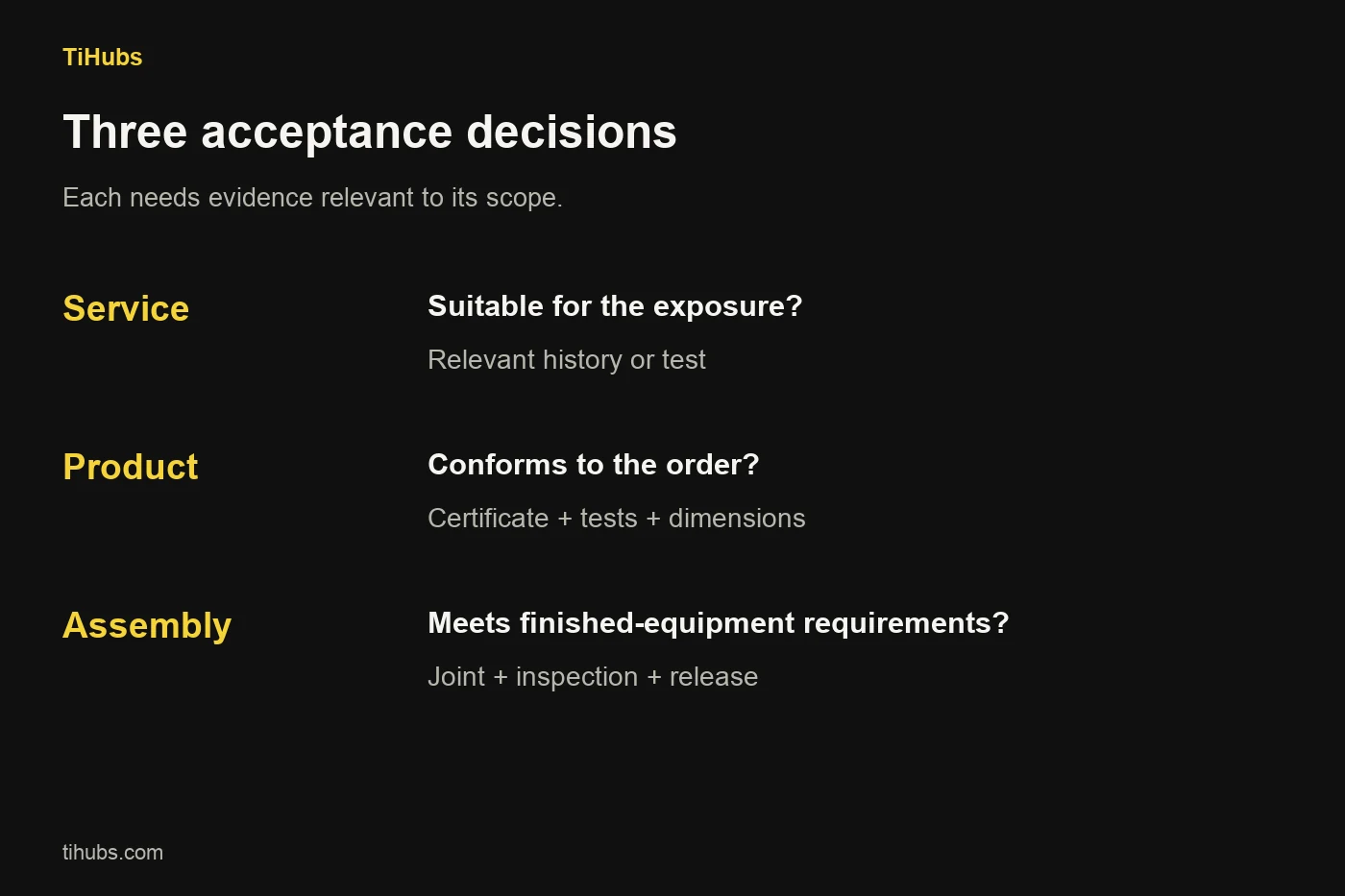
Separate material conformity from service qualification. A compliant Grade 12 certificate demonstrates the specified material within its scope; it does not certify an unreviewed process environment. Similarly, a satisfactory corrosion trial does not prove that production tubes meet dimensions or joint requirements. Both may be needed, but they should be reviewed as distinct evidence rather than substituted for one another.
Define the response to a discrepancy before installation. Keep affected material identified and obtain a documented technical disposition before repair, rework or use. If the proposed remedy changes the thermal condition, joining method or surface state, consider whether it affects the supporting qualification. A rushed replacement during a shutdown should still preserve a clear record of what was accepted and why.
Finally, retain a service baseline after installation. Record the approved operating envelope, the material actually installed and the planned inspection observations. This allows the next procurement decision to use the plant’s own relevant experience. It also makes a later process change visible, instead of assuming that a material approved years earlier covers an expanding range of operating and cleaning conditions.
Industrial buying guide / 06Separate the three approvals
Service suitability, product conformity and assembly acceptance answer different questions.
07 / Build your RFQ
Describe the duty and the product
For a Grade 2 or Grade 12 enquiry, send the service envelope and the exact tube, plate or assembly scope. Identify whether the alternative is approved or still requires technical review, so the offer can separate material availability from service suitability.
Information to include
Fluid, concentration range, temperature and cleaning exposure
Tube OD, wall basis and length, or plate dimensions and condition
Grade, product standard, edition and fabrication route
Joint, forming and inspection requirements
Quantity, destination, outage date and approval status
Build your RFQ checklist
Choose the product and add the information you have. Copy the resulting brief or send your requirements to TiHubs. Submitting an enquiry does not place an order.
08 / FAQs
Questions buyers ask
Is Grade 12 always more corrosion resistant than Grade 2?
No. The published HCl examples show that the relative result can change with concentration under boiling conditions. Those tests are not a universal service chart. Evaluate the actual environment, including local conditions and cleaning, before deciding whether the alternative is suitable.
Does Grade 12 contain palladium?
The nominal Grade 12 alloy in the cited ASTM scope is titanium with 0.3% molybdenum and 0.8% nickel. It is not the same designation as palladium-bearing Grade 7 or Grade 16. Use the full ordered specification for chemistry acceptance rather than relying only on the nominal description.
Can the corrosion rates predict equipment life?
Not directly. The cited table summarizes particular test conditions and does not provide every variable needed to reproduce the exposure. Equipment geometry, local damage, deposits, operating changes and acceptance criteria also matter. Do not convert these rates into a guaranteed replacement interval.
Can I keep the same tube-to-tubesheet procedure?
The procedure needs review for the proposed material, tube dimensions and joint arrangement. An existing Grade 2 procedure is useful starting information, but it does not automatically qualify Grade 12 in every assembly. Agree on any representative trial and the required final inspection.
Can Grade 12 justify a thinner wall?
Only through the applicable approved design process. A material-strength comparison is not a pressure-design calculation. Temperature, external pressure, vibration, support, corrosion assessment and joints may control the section. Keep a changed-wall proposal separate from a quotation to the original drawing.
What information helps TiHubs review the enquiry?
Provide the product dimensions, quantity, standard, condition and inspection scope, together with the fluid, concentration, temperature and cleaning conditions. Include the equipment drawing and approval status of any alternative. Availability, exact certification and delivery can then be reviewed against a defined supply requirement.
09 / Key takeaways
Keep the purchase requirements connected.
Start with the reason for changing the established Grade 2 route.
Grade 12 adds nickel and molybdenum; a higher number is not a universal performance ranking.
Keep corrosion results attached to the exact exposure and source limitations.
Review tubes, plate, forming and joints as part of the material decision.
Release the order against approved requirements and traceable evidence.
Technical references
Sources and data scope
References reviewed November 14, 2026. Public source summaries support the discussion; the controlled specification, agreed edition and approved project requirements govern acceptance.
ASTM — B338-17(2026) — Public scope for condenser and heat-exchanger tubing; grade identities and product-route context.
TIMET — Corrosion Resistance of Titanium — Historical manufacturer handbook; Table 15, printed page 11, supplies the selected boiling pure-HCl results. Not a service-life guarantee.
TiHubs coordinates titanium material and custom supply enquiries from Baoji, China. Send the product, drawing revision and acceptance requirements so the proposed supply scope can be reviewed. Learn about our sourcing role.
Contents
TiHubs
Talk to TiHubs
Ask about titanium materials, grades or custom parts.
Enter your email to start chatting.
We use your email to respond to your enquiry. Your conversation is stored on this website.
Our team is away right now. Leave your enquiry and we will follow up by email.