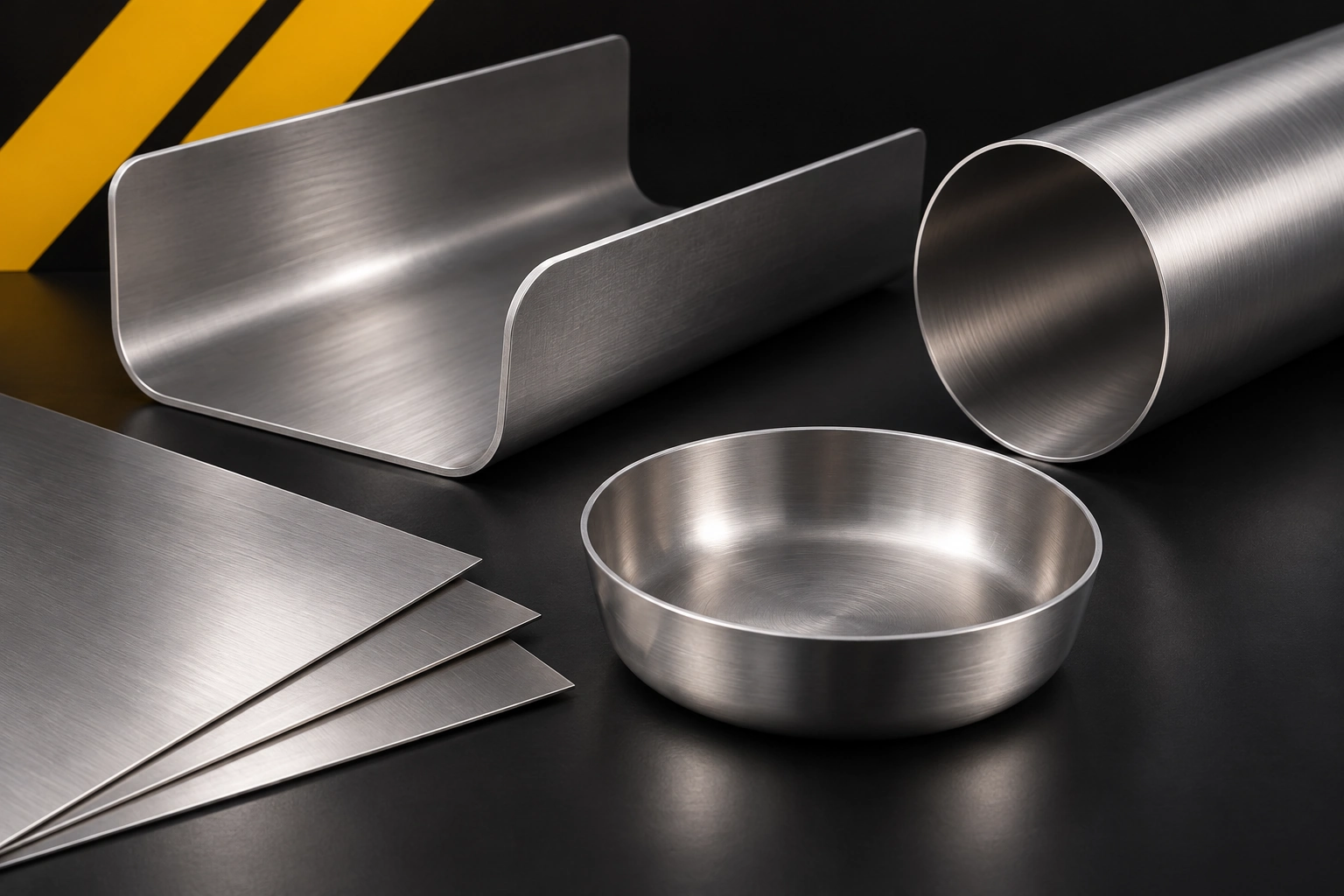
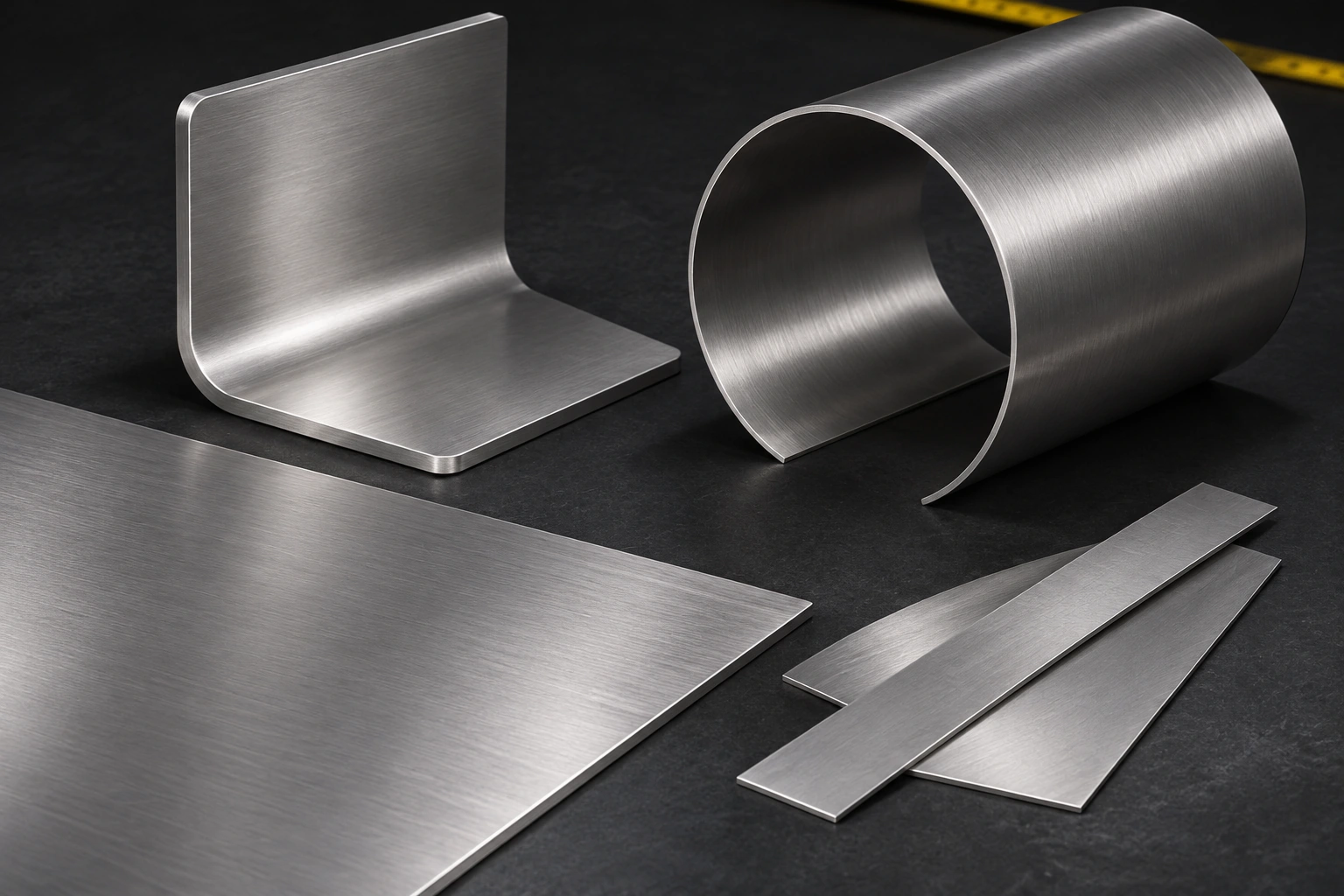
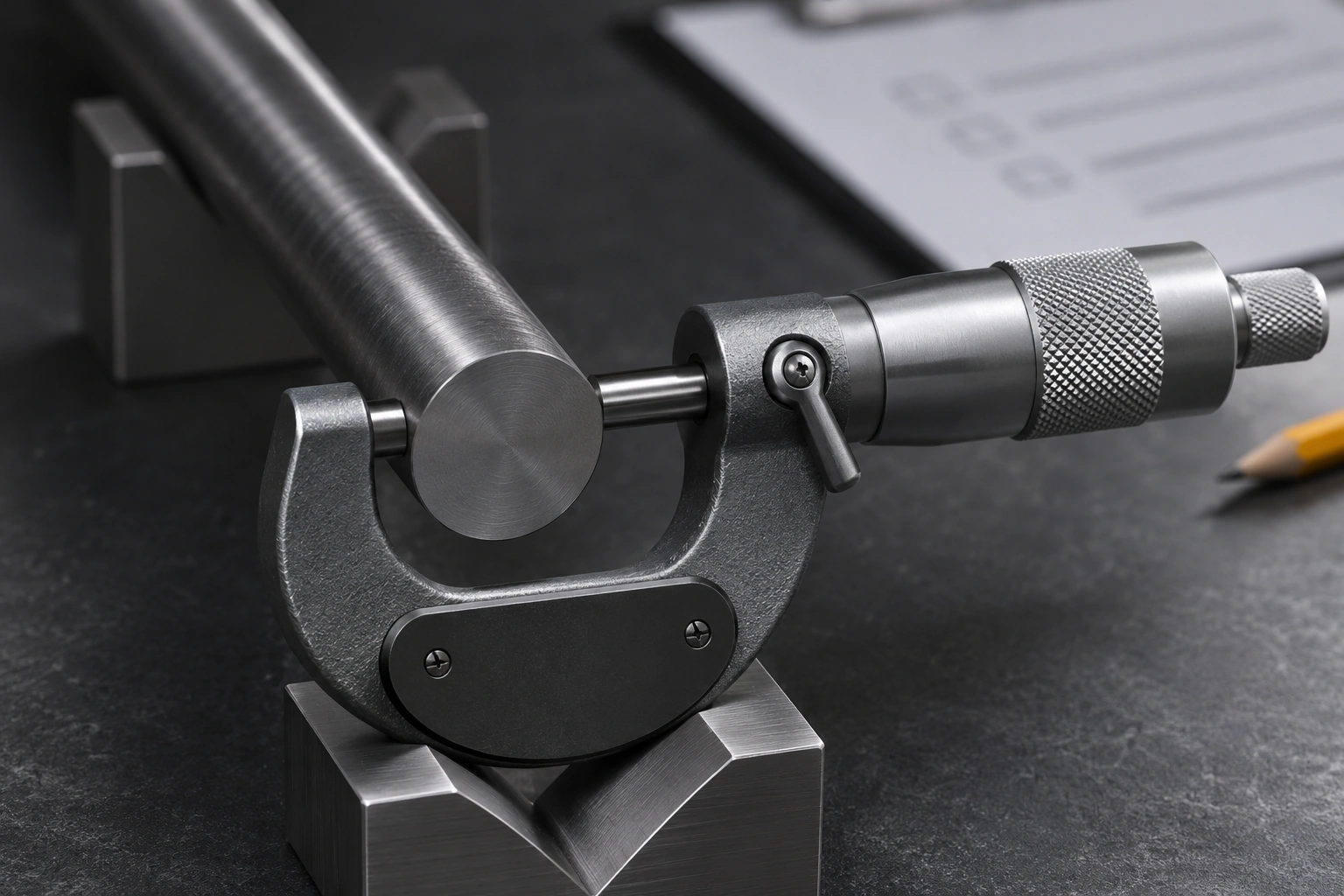
AI illustration. Appearance and labels do not verify material compliance.
Quick Answer
Start with Grade 1 when demanding cold forming is the main constraint; evaluate Grade 2 when the equipment needs its higher strength while retaining useful formability. Neither choice can be made from the grade name alone. Specify the delivered condition, thickness, surface and forming route, then verify the finished geometry and required properties. For tube manufacture, distinguish the starting strip or billet from the finished tube specification and acceptance tests.
01 / The purchasing question
The forming operation belongs in the material enquiry.
The practical grade 1 vs grade 2 titanium question is often about manufacturing, not a laboratory ranking. A fabricator wants to bend thin sheet without cracking, stamp a shallow or deep shape consistently, or make a tube that meets its final dimensional and inspection requirements. The buyer needs material that supports that route and still meets the equipment design.
Both are commercially pure titanium grades. TIMET describes Grade 1 as the most formable of the four standard commercially pure grades and identifies Grade 2 as a widely used industrial option with a higher strength level. This is a useful screening distinction; it is not a guaranteed bend radius, draw ratio or production yield for every shipment. [1][2]
The right enquiry therefore describes both the incoming material and the finished component. A sheet can comply with its purchase specification yet be unsuitable for an aggressive forming operation that was never disclosed. Equally, a very formable sheet may fail to provide the properties required by an unchanged equipment design. Define both ends of the process before comparing offers.
Product definitionStart with the product.
Define the form, condition and manufacturing requirements before comparing grades.
Acceptance evidenceConnect the records.
Dimensions, material identity and the agreed inspection scope belong together.
AI-generated editorial illustrations show product and inspection concepts. They are not production records or evidence of a particular material grade.
A comparison organized around the job
Purchasing question
Grade 1 starting point
Grade 2 starting point
Severe cold forming
Often the first grade to evaluate
Requires careful assessment of geometry and process margin
Equipment strength requirement
Confirm that the approved design permits it
Often a practical balance of strength and fabrication
Thin-sheet bending
Review condition, radius, direction and edge quality
Review the same variables; do not reuse a Grade 1 setup blindly
Stamping or drawing
Evaluate thinning, wrinkles, tearing and surface
Evaluate forming sequence, loads and final properties
Tube manufacture
Define route and final tube specification
Define route and final tube specification
Corrosion service
Assess the actual environment
Assess the actual environment; grade number is not a corrosion ranking
Commercial comparison
Price the accepted formed component
Price the accepted formed component
Use published data for screening, not a production promise
For context, TIMET’s historical datasheets list maximum oxygen contents of 0.18% for its Grade 1 material and 0.25% for its Grade 2 material. These reference values help explain why commercially pure grades should not be treated as one interchangeable material. The applicable ordered specification and actual batch results govern acceptance. [1][2]
Do not take a typical elongation from a datasheet and translate it directly into an allowable draw depth. A tensile specimen and a formed part experience different strain paths. Similarly, a published bend result has a test context; it is not automatically the minimum radius for your tool, edge condition, thickness or production speed. Ask for the relevant evidence instead of filling a missing process limit with a generic number.
Start with the equipment requirement
Before changing Grade 2 to Grade 1 for easier forming, confirm the design authority accepts the change. Review the component’s loads, operating temperature, joining method and corrosion exposure. If the approved thickness depends on the material properties, easier forming alone is insufficient justification for substitution. If the design permits either grade, the manufacturing comparison can then focus on quality, yield and total cost.
For pressure equipment, use the applicable design and material specifications rather than a blog comparison to establish allowable stresses or minimum wall thickness. The purchase enquiry should identify those requirements so the proposed material and manufacturing route can be reviewed against them. Neither “pure titanium” nor “for a heat exchanger” is a complete acceptance description.
02 / Requirements
Specify the condition and prove the forming route.
The material state is a purchasing variable. Record whether the sheet is supplied in the required annealed condition, what surface and dimensional requirements apply, and whether further processing is planned. ASTM B265 covers annealed titanium strip, sheet and plate; the order must still identify the relevant grade, dimensions, edition and additional requirements. [3]
For bending, send geometry that the fabricator can assess
Provide thickness, inside radius, bend angle, flange lengths, hole locations and drawing revision. State whether the bend direction relative to the rolling direction is controlled. Identify cosmetic surfaces and edges that will be highly strained. A sketch saying “bend 90 degrees” leaves too much uncertainty about the actual deformation and final acceptance.
TIMET’s fabrication handbook discusses springback, tooling, lubrication and preparation as part of titanium forming. [4] Translate that into a first-piece review: record the material lot, tool setup and sequence, then inspect angle, radius, local surface and dimensions after the part has been released from the tool. A part that looks correct under load may not retain the required geometry after unloading.
Do not solve cracking automatically by changing grade. Inspect the incoming edge and surface, confirm the material condition, and review the forming sequence with the fabricator. A damaged edge, unsuitable tool contact or an unqualified operation can remain a problem even after a material substitution. Conversely, a controlled process adjustment may allow the specified grade to be retained.
For stamping, define the finished part rather than only the blank
Supply the final drawing or model, not just the blank outline. Identify critical corners, walls, flange regions, trimmed edges and surfaces. State where thinning will be measured and which dimensions are inspected before or after trimming. If appearance matters, define acceptable tool marks with an agreed reference or measurable criterion. The statement “no scratches” is hard to apply consistently without context.
Ask the fabricator to propose a trial plan for the actual geometry. Record the material lot, thickness and condition used in the trial and the operations included in the quoted scope. Confirm whether trimming, cleaning, intermediate treatment or secondary calibration is included. A successful demonstration on a much simpler shape should not be treated as qualification of your production component.
Trial record
Why the buyer needs it
Example of an unresolved question
Material identity and condition
Connects the result with purchased stock
Was the sample the same condition as production material?
Thickness and orientation
Defines the tested starting point
Was the rolling direction changed during nesting?
Tool and process sequence
Makes the trial meaningful for repeat production
Did the quotation include all successful trial stages?
Final thickness distribution
Identifies local thinning
Which areas were measured and against what limit?
Surface and geometry report
Establishes usable output
Were dimensions checked after springback and trimming?
Approval and revision
Controls future production
Does a tooling change require another first piece?
Treat intermediate processing as part of the quotation
If the proposed route includes intermediate annealing, warm forming or other treatment, ask for the scope and acceptance consequences. Who carries out the operation? What surface restoration is required? Which dimensions or properties must be checked afterwards? Keep those questions visible in the order instead of treating them as workshop details that cannot affect delivery.
For a repeat purchase, do not assume that a successful trial on one lot guarantees every future lot under every setup. Agree the variables that matter for the process and define a reasonable incoming and first-piece control plan. This is especially useful when the finished geometry has little manufacturing margin or when material is sourced from more than one approved route.
03 / Acceptance and cost
Tube manufacture adds another acceptance boundary.
“Titanium tube” can describe several products and processes. A buyer may be ordering finished heat-exchanger tubing, strip intended for welded tube production, seamless tube, or a fabricated cylinder. Identify which of these is required before selecting Grade 1 or Grade 2. The starting material and the finished product have different inspection responsibilities.
Separate strip acceptance from finished-tube acceptance
For welded tube production, agree the starting-strip specification, width, thickness, surface, edge preparation and identity. Then agree the final tube dimensions, manufacturing route, condition and examination requirements. A strip certificate does not establish the performance or inspection status of the longitudinal seam in the completed tube. It also does not confirm final ovality, wall thickness or length.
ASTM B338 addresses seamless and welded titanium tubes for condensers and heat exchangers. ASTM B861 and B862 address seamless and welded pipe respectively. These titles describe different product scopes; they should not be selected simply because they all contain the word titanium. [5][6][7] Confirm the specification applicable to the design and the selected grade rather than assigning a generic “ASTM tube” label.
For seamless production, agree the starting-stock route and the final delivered condition. If the order includes subsequent bending, expansion or joining, disclose those operations. A tube that satisfies one set of supplied-product requirements may still need a separate process assessment for a demanding downstream operation. State who is responsible for evaluating that step and what evidence the buyer needs.
Write dimensional requirements for the actual use
Specify whether the drawing controls outside diameter, inside diameter, wall thickness or a combination, and identify the tolerances that matter to assembly. For a heat-exchanger tube, the fit with other components can make dimensional consistency important. For a bent tube, agree the allowable final geometry and local wall criteria. Avoid copying a straight-tube inspection plan unchanged onto a formed assembly.
Supply stage
Records to agree
What it does not automatically prove
Starting sheet or strip
Material certificate and incoming dimensions
Finished weld quality or final tube properties
Straight finished tube
Product-standard tests, dimensions and identity
Suitability for every subsequent bend or expansion
Formed tube or cylinder
Forming records and final geometry checks
Acceptance of a complete pressure assembly
Welded assembly
Approved joining and inspection documentation
Compliance with unstated service or design requirements
Compare cost per accepted component
Keep the geometry, quantity and acceptance basis consistent when comparing grades. Include blank utilization, trial work, tooling, process stages, inspection, finishing and rejected parts where relevant. A small difference in material price may be less important than whether the manufacturing route can repeatedly produce an acceptable part. Conversely, choosing a softer material may require an approved design change that removes the apparent saving.
Use a simple quotation comparison: material supplied, forming operations included, trial quantity, accepted production quantity, inspection deliverables and delivery terms. Ask which assumptions would change the price. If an offer is conditional on a successful trial, record the decision point and what happens if the trial does not meet the agreed criteria.
Make acceptance visible before shipment
Request the final material certificate and dimensional report at the agreed review stage. For formed components, identify the features that must be measured after the last relevant operation. Preserve material traceability through cutting and forming, including mixed batches. If the supplier proposes a grade or condition change during production, treat it as a controlled change and review its effect before continuing.
For incoming inspection, arrange access to the same drawing revision and approved trial criteria used by the supplier. A buyer cannot consistently accept a part against an informal photo while the fabricator works to a different dimensional interpretation. The most effective document set is the one that both sides can use to make the same decision.
04 / Build your RFQ
Build an RFQ around the forming requirement.
TiHubs coordinates titanium materials and custom supply through its Baoji network. For a Grade 1 or Grade 2 enquiry, share the finished geometry, material specification, condition, quantity and destination. Include the intended operation—bending, stamping, drawing, rolling or tube manufacture—and identify any required trial or first-piece approval.
If the grade is not yet fixed, state the equipment requirements and ask for clearly separated options. We can coordinate supply and process clarification; the final grade and design acceptance should be confirmed by the responsible technical team. If the drawing already specifies a grade, identify whether alternatives are allowed before asking suppliers to quote them.
Build your RFQ checklist
Choose the product and add the information you have. Copy the resulting brief or send your requirements to TiHubs. Submitting an enquiry does not place an order.
“Please review the attached forming drawing and quote the specified titanium grade and delivered condition. State the proposed process sequence, trial scope, dimensional and surface acceptance criteria, inspection records and heat/lot traceability. Identify any need for a grade change or intermediate treatment before production. Quote approved alternatives separately.”
05 / FAQ
Questions about Grade 1 and Grade 2 forming.
Is Grade 1 always better for thin sheet?
No. It is often a useful starting point for demanding forming, but the equipment may require a different strength level or a specifically approved material. Thickness alone does not determine the best grade.
Can I use a smaller bend radius with Grade 1?
Grade 1 generally offers more forming margin, but there is no universal radius that applies to every sheet and process. Evaluate thickness, condition, orientation, tooling, edge quality and the required final geometry through the agreed trial.
Does annealed mean every batch forms identically?
No. The condition is important, but the complete material and process requirements still matter. Keep the grade, product specification, thickness, surface and trial conditions controlled and review changes that could affect the result.
Can Grade 1 replace Grade 2 in an existing vessel?
Only after the responsible design authority has reviewed and approved the change under the applicable requirements. Easier forming does not establish adequate design strength or pressure-equipment compliance.
Does a higher grade number improve corrosion resistance?
Do not use that assumption. Assess the actual medium, concentration, temperature, contaminants and operating conditions. The Grade 1/Grade 2 choice here primarily concerns the required balance of properties and fabrication.
What should I send for a stamping quotation?
Send the final drawing or model, material and condition requirements, thickness, quantity, critical surfaces, allowable thinning and inspection criteria. Identify whether tooling and qualification trials are part of the requested supply.
Is ASTM B265 enough for finished tube?
B265 addresses strip, sheet and plate. A finished tube needs the applicable tube or pipe specification and any additional design requirements. Starting-strip compliance does not replace finished-product acceptance.
Which grade is cheaper after forming?
Ask for comparable quotations for accepted components. Material availability, process stages, tooling, trial scope, yield, inspection and delivery terms can change the result. A fixed percentage difference is not a dependable buying rule.
06 / Key takeaways
Choose for the finished component.
Grade 1 is a forming candidate. Confirm that its properties satisfy the approved design.
Grade 2 balances useful strength and fabrication. Verify the proposed route for the actual geometry.
Condition and process matter. Put thickness, orientation, surface and trial criteria into the enquiry.
Tube manufacture needs two scopes. Starting material and finished tube acceptance are separate.
Compare accepted output. Include forming, inspection, finishing and qualification in the cost review.
Technical references
Sources and data scope
Technical references checked November 7, 2026. Manufacturer datasheets provide screening context, not universal forming limits or batch guarantees. The examples and trial checklist are TiHubs procurement guidance. Use the ordered standard edition and approved component requirements for acceptance.
TiHubs coordinates titanium materials and custom supply from Baoji, China. Our founder’s 20 years in titanium inform a specification-led sourcing approach: clarify the product, manufacturing and acceptance requirements before quotation. Learn about our sourcing role.
Contents
TiHubs
Talk to TiHubs
Ask about titanium materials, grades or custom parts.
Enter your email to start chatting.
We use your email to respond to your enquiry. Your conversation is stored on this website.
Our team is away right now. Leave your enquiry and we will follow up by email.