AI illustration; not a production or inspection record.
Quick answer
ASTM B348 Grade 5 bar and AMS 4928 bar may share the Ti-6Al-4V alloy identity, but they are not automatically interchangeable. Check the exact specification revisions, product scope, delivery condition, applicable requirements and heat-specific evidence. Any substitution must follow the approval requirements attached to the drawing and order.
01 / Specification scope
Same alloy, different purchase requirements
A machining drawing calls for AMS 4928 titanium bar, but the available stock is described as ASTM B348 Grade 5. Both descriptions may lead to Ti-6Al-4V, yet that shared alloy name does not settle the purchase. The question is whether the particular stock, its processing history and its supporting records meet the requirements attached to the drawing. A supplier’s statement that the materials are equivalent is the beginning of a review, not its conclusion.
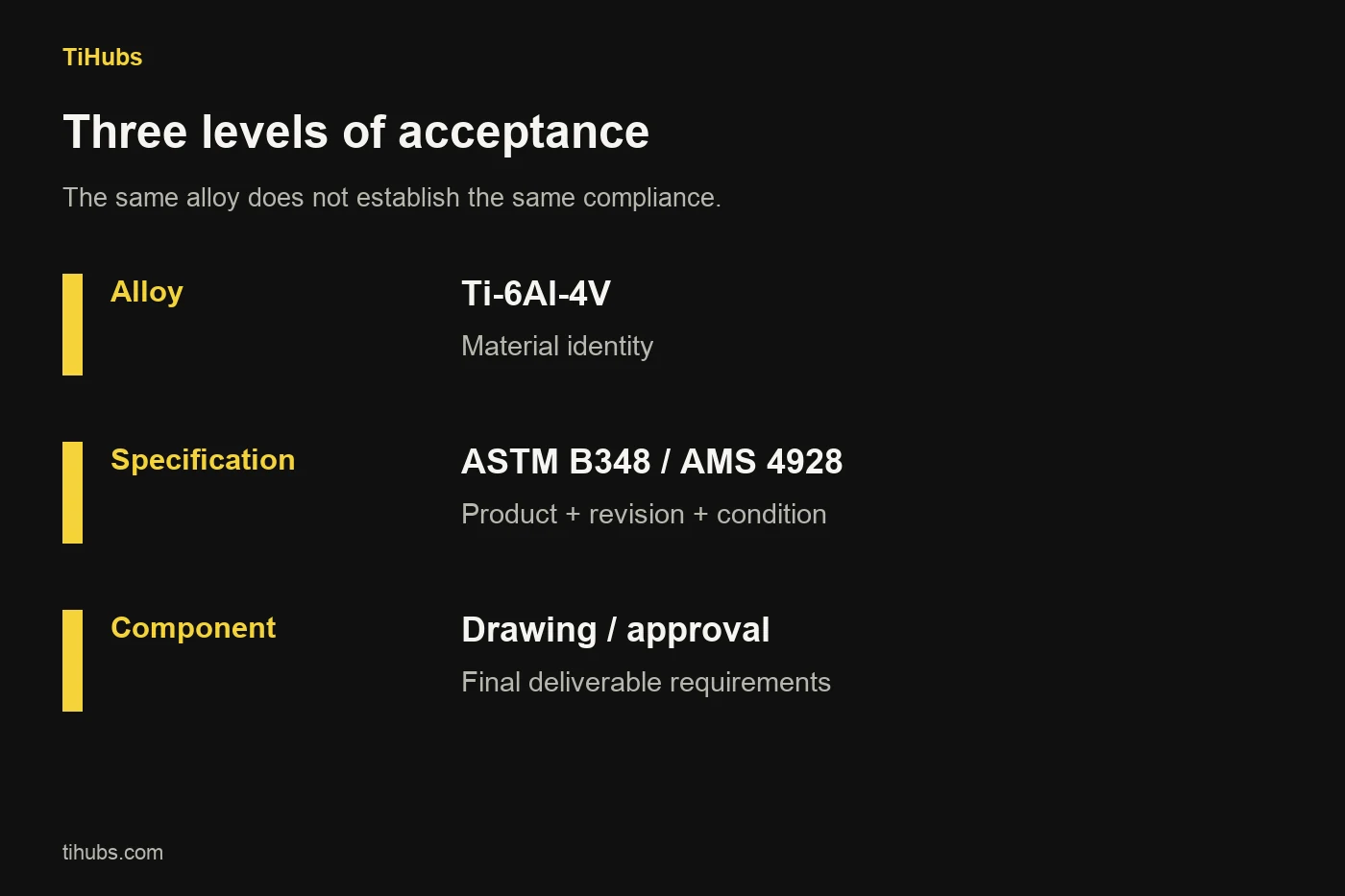
Start by separating three things: the alloy designation, the product specification and the acceptance of the finished component. The alloy describes the material family. The product specification establishes requirements for the supplied stock within its scope. The component drawing and its associated requirements govern what the finished part must be. Confusing these levels can turn an apparently convenient stock substitution into a documentation problem after machining has already consumed the material.
Verified public scope information; not a clause-by-clause equivalence table
Question
ASTM B348/B348M-25
AMS 4928X
Material coverage
Multiple titanium grades; Grade 5 is included
Ti-6Al-4V alloy
Published product coverage
Annealed bars and billets
Annealed bars, wire, forgings, flash-welded rings and drawn shapes; also specified stock for forging or rings
Edition consulted
2025 edition
Revision X, October 2025
What this establishes
The relevant Grade 5 bar route exists within the specification
The alloy and product route are within the published scope, subject to its limits
What it does not establish
Compliance with every AMS requirement
Compliance with every ASTM or buyer-specific requirement
Sources: the public ASTM B348/B348M-25 scope and SAE AMS 4928X record. The comparison is deliberately limited to published identity and scope. Detailed chemistry limits, tests, sampling, processing and acceptance must be checked in the controlled documents for the editions actually ordered. A current public listing does not automatically update an older drawing.
For this guide, the common purchasing case is annealed Ti-6Al-4V bar intended for machining. It is not a recommendation to substitute a billet for finished bar, or a forging for plate. If the product form itself is uncertain, first use the separate guide to titanium product standards. Resolving that earlier decision prevents a comparison between two standards from hiding a more fundamental difference in the supplied product.
Write the original requirement at the top of the enquiry exactly as controlled: specification, revision, product form, material designation and condition. Then write the proposed alternative on a separate line. This simple arrangement lets the technical reviewer see what is changing. It also allows the supplier to quote conforming stock and an alternative without accidentally presenting the alternative as already approved.
Industrial buying guide / 01Alloy, specification and approval
Keep material identity, the stock specification and the finished-part requirement connected without treating them as the same claim.
02 / Evidence review
Build a requirement-to-evidence matrix
A useful review compares requirements with evidence, rather than comparing two catalogue descriptions. Obtain a certificate example or the proposed stock’s records before committing the material to production. If the supplier can provide only a generic datasheet, treat it as preliminary information. It cannot identify the heat, establish the delivery condition of the available bar or confirm which edition was used when that material was produced.
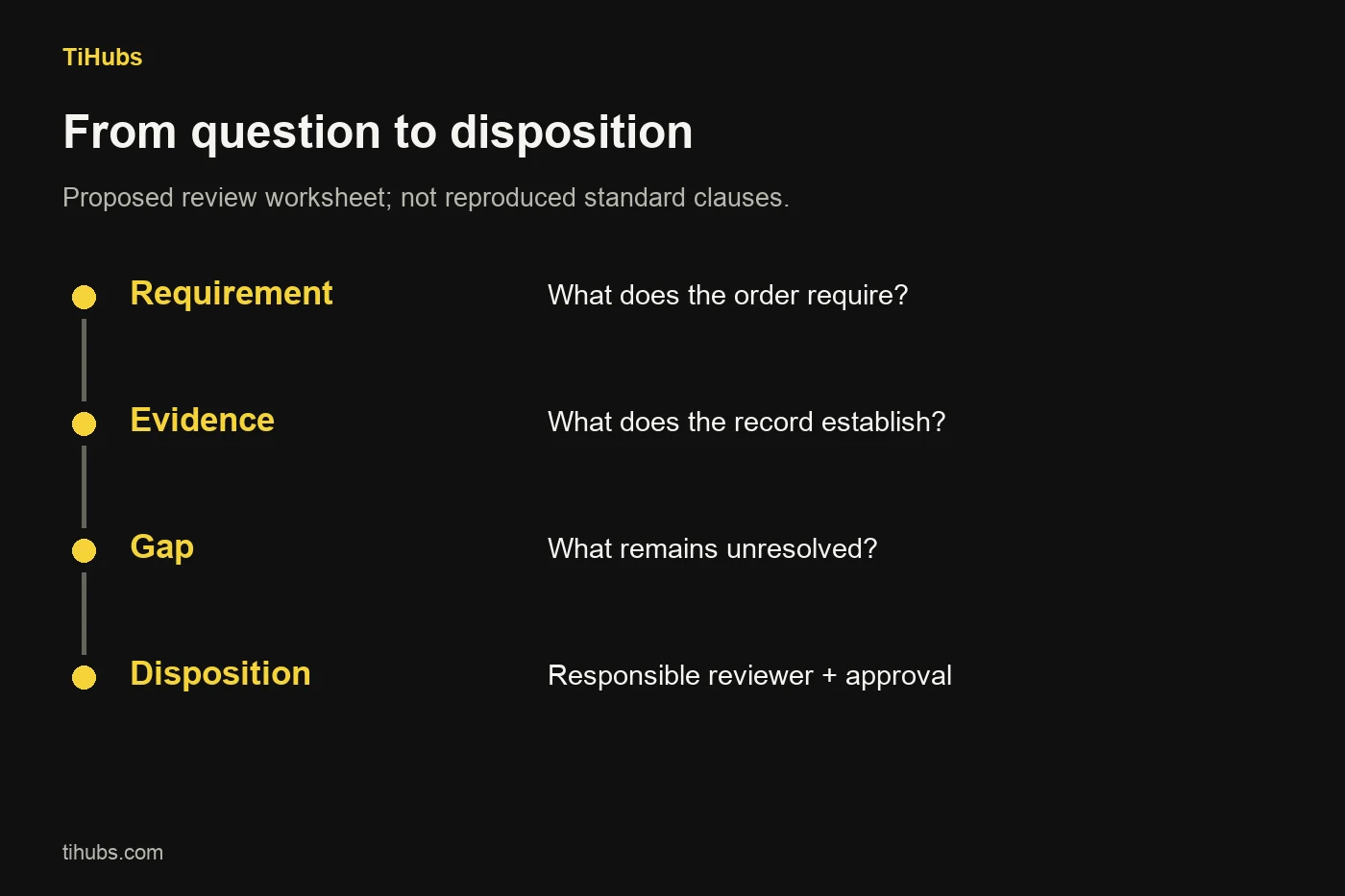
Create a worksheet with five columns: requirement, controlling document, evidence supplied, unresolved difference and disposition. The first column should contain a specific question. For example, does the certificate identify the ordered specification and revision? Does the product description match the bar size offered? Does the reported test represent the relevant delivery condition? A row labelled merely “quality” is too broad to produce an auditable answer.
Buyer-created review worksheet; requirements must come from the controlled order
Review area
Evidence to request
Decision if unresolved
Identity and scope
Material designation, product description, specification and revision
Clarify the offered product before evaluating properties
Processing and condition
Required manufacturing and heat-treatment records, where applicable
Refer the gap to the responsible technical authority
Chemistry and properties
Required results, units, sampling basis and applicable limits
Assess whether suitable additional evidence is possible
Dimensions and surface
Delivered size, tolerances, finish and usable allowance
Revise the stock proposal or reject the dimensional route
Source and traceability
Producer identity and links from heat or lot to delivered pieces
Hold release until the required links are established
The worksheet is an original purchasing aid, not a list of clauses claimed to appear identically in both specifications. Some orders impose additional source approvals, inspection requirements or customer restrictions. Put those in their own rows. This keeps a material-standard comparison from overlooking the actual reason a particular bar cannot be accepted, even when its reported chemistry and tensile results appear suitable.
Distinguish a missing document from a demonstrated nonconformance. A missing test report may be recoverable from the producer. A missing manufacturing history may not be reconstructable by testing the finished bar. A measured value outside a required limit is a different issue again. Recording the type of gap helps the buyer ask a useful question instead of requesting a new certificate that repeats the same unsupported statement.
Do not turn the review into an unqualified ranking of ASTM as low quality and AMS as high quality. The purchasing problem is compliance with a defined requirement. A well-documented ASTM order can be exactly right for its intended application, while an AMS-labelled offer can still be unsuitable if the size, condition, source or documentation does not match the drawing. The acronym alone does not complete receiving inspection.
Assign an owner and a closure condition to each open row. Purchasing may collect the information, the supplier may clarify its records, and the designated technical authority may decide whether a deviation is acceptable. Keeping those responsibilities visible reduces the chance that a delivery deadline becomes the only reason an unresolved material change is accepted.
Industrial buying guide / 02A review that can be closed
For each requirement, record the evidence, the unresolved gap and the person responsible for the disposition.
03 / Property interpretation
Why one tensile number is insufficient
A common shortcut is to compare a tensile strength value on the offered certificate with a value found in a datasheet. If the offered value is higher, the material is assumed to meet the other specification. That conclusion is incomplete. A tensile result is evidence about a tested specimen under stated conditions. It does not, by itself, establish every chemistry requirement, manufacturing restriction, sampling rule or additional inspection required by the order.
Read a result together with its units, specimen location, orientation, test method and represented condition, where these are required or relevant. Record whether the value is a minimum acceptance limit, a typical published property or an actual result. Mixing these categories makes a comparison look more precise than it is. A supplier’s typical property can be useful background while still being unsuitable as the contractual acceptance value.
This article therefore does not publish a universal ASTM-versus-AMS strength table. The public specification summaries reviewed do not provide a complete, common basis for such a table. Omitting an unsupported numerical comparison is more useful than giving a buyer a seemingly authoritative row that ignores size ranges or revisions. The correct numerical matrix belongs in the order review after the applicable controlled requirements are available.
The manufacturer’s TIMETAL 6-4 properties publication lists both ASTM B348 and AMS 4928 among specification routes for that alloy. That supports the distinction between alloy identity and the specification under which a product is supplied. It does not make every bar certified to one route automatically compliant with the other, and the historical publication is not a substitute for a current contractual standard.
Consider an illustrative review, not a TiHubs customer case. A buyer receives a certificate with the requested alloy name and satisfactory reported tensile results, but the certificate identifies a different specification revision. The next task is to identify which relevant requirements changed and whether the supplied records address them. Simply copying the newer revision onto the purchase order does not change the manufacturing history of material already produced.
Additional testing may answer a specific missing question when representative material and an appropriate method are available. Agree on the sample, laboratory, test method, applicable limits and disposition before testing. Avoid ordering a broad collection of tests without knowing which gap each is intended to close. A test that is not representative of the supplied condition can consume time and material while leaving the original uncertainty unresolved.
Also separate stock qualification from finished-part acceptance. Subsequent heat treatment, forming or other processing may introduce additional requirements. The incoming bar certificate describes its own supply stage; it is not a blanket certificate for every later operation. If a property is required after processing, the manufacturing and inspection plan should identify where that property is established and who is responsible for the evidence.
04 / Dual certification
What a dual-certified offer must explain
A dual-certified offer should identify the exact specifications and revisions claimed for the specific material, supported by records that demonstrate the applicable requirements. Two standard names printed beside a product description are not enough to evaluate that claim. Ask whether the certification applies to the actual heat, lot, dimensions and condition being offered, rather than to a general product family in the supplier’s catalogue.
Begin with the certificate issuer and the chain of supply. Identify the producer, any processor whose operations affect the requirements, and the distributor supplying the pieces. A distributor may legitimately transmit and supplement relevant records, but a buyer should understand the basis of each statement. A rewritten certificate that drops the original heat reference or obscures the producing source makes the evidence harder to assess.
Then ask how the material was evaluated against both requirements. The answer should point to existing records or an approved review, not merely to a chemical match. If additional testing was performed, determine which requirement it addressed and what material it represented. If a requirement concerns an earlier manufacturing operation, establish whether the original records demonstrate that operation. Later testing cannot automatically recreate every aspect of production history.
Use three distinct commercial descriptions when necessary: stock already documented to the ordered specification; stock offered with demonstrated dual certification; and alternative stock awaiting technical approval. Keeping these lines separate makes lead time and cost comparisons fairer. It also prevents a quote for unapproved material from appearing cheaper than a conforming offer simply because the review work has been left out.
For an aerospace-controlled component, check the drawing’s associated customer and source requirements as well as the material specification. The presence of an AMS designation is not an aircraft installation approval or evidence that a supplier is approved for every programme. Conversely, an industrial component may have no reason to adopt additional requirements that its approved design does not need. Define the application instead of treating a market label as a complete purchasing instruction.
If the buyer approves a deviation, record its boundary. Does it cover a prototype, one delivery lot, a temporary shortage or future production? Does it require a drawing change or a separate concession record? Which certificate and material identifiers are attached? An approval that says only “alternative acceptable” can be difficult to interpret when another lot arrives months later with a different source or condition.
Before release, reconcile the final purchase order, quotation, approval and inspection plan. They should describe the same deliverable. If the order still names only the original requirement while the quote supplies an alternative, resolve that mismatch explicitly. This is a practical control over the purchase record; it should not be replaced by an informal assumption that everyone remembers the earlier discussion.
05 / Stock and quotation
Compare usable bar and accepted cost
Even after the specification question is settled, two bars may not represent the same purchase. Compare the delivered diameter or section, length, tolerances, surface condition and machining allowance. A nominal size that looks sufficient in a catalogue may not provide enough usable stock for the finished drawing after surface removal and setup. Ask the machining source to confirm the proposed blank before placing a material order.
Distinguish the ordered bar dimensions from the final component dimensions. A finished shaft diameter should not be copied into the stock order without accounting for the agreed manufacturing route. A rectangular component may require an orientation or stock envelope that a round-bar quote does not capture. Where the drawing controls orientation, preserve that information through cutting and identification of individual blanks.
Request a breakdown that separates material, cutting, any additional processing, testing, documentation and delivery. The purpose is not to require every supplier to disclose its internal costing. It is to establish what is included in the offered price. A lower price that excludes the necessary certification review or independent testing is not yet a like-for-like comparison with a complete accepted supply.
Lead time should describe the actual proposed route. Existing bar with complete records, material awaiting further processing and a new production order may have different schedules. Ask which steps remain before release and which depend on buyer approval. Do not infer immediate stock availability from a product page that lists a material or standard. Confirm the specific dimensions, quantity and documentation at quotation.
An illustrative purchasing decision can be framed without inventing a price ratio. Offer A supplies the ordered specification with complete records. Offer B uses an alternative specification and requires a review plus additional evidence. Compare the total confirmed scope and the unresolved work for both offers. If B still has a technical gap, mark that gap as open rather than assigning a speculative savings figure to it.
Include material required for any agreed destructive tests or first-article work. Clarify whether the quoted quantity means delivered bars, cut blanks or accepted finished pieces. State how offcuts are identified if they are retained for future use. These details matter because the certificate-to-material link must remain usable after the original bar has been subdivided and its original marking is no longer on every piece.
For a repeat order, retain the accepted requirement matrix with the part’s purchasing package. Ask the supplier to identify changes in proposed source, condition or certification scope. Repeat purchase numbers should make the next review easier, not hide differences behind a familiar description. The titanium bar and rod enquiry can start with the required dimensions and controlled specification.
06 / Receiving and release
Close the review before machining
Receiving inspection should connect the physical delivery to the agreed purchase. Check the material identifiers, piece count, dimensions and condition against the packing information and certificate. Where several heats or lots are delivered, preserve their separation in the records and storage arrangement. A correct certificate for one bundle does not establish the identity of another unmarked bundle beside it.
Use the evidence matrix to close the original review questions. Confirm that the final documents contain the promised information, not just the wording used in the quotation. If a dual-certification review or deviation approval was required, verify that it applies to the delivered material. Record the document revisions and relevant identifiers so that someone reviewing the component later can reconstruct the acceptance decision.
Hold unresolved material apart from released stock according to the buyer’s control process. Cutting it first can remove markings and reduce the options for investigation or representative testing. If urgent production requires a proposed exception, route that request through the designated approval process. A delivery deadline does not supply the missing technical evidence.
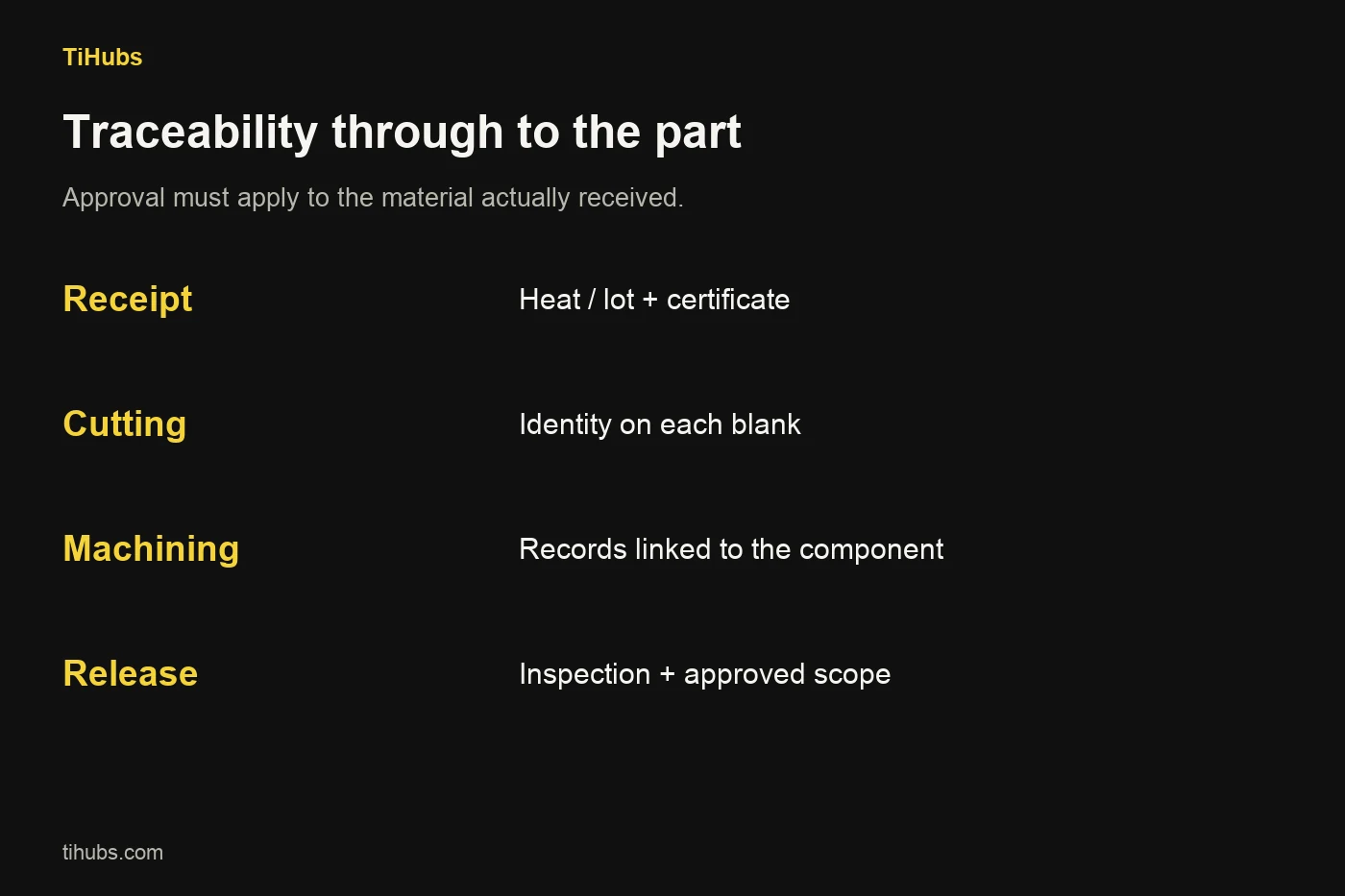
Transfer identification through the cutting and machining plan. The method should suit the part: a label, traveler or approved marking arrangement may be appropriate, while an intrusive mark on a functional surface may not be. The important outcome is continuity between the delivered stock, the work in progress and the records supporting the finished pieces.
Finally, store the purchase baseline and the approved outcome together. For a conforming purchase, that includes the final order and acceptance records. For an alternative, it also includes the reason for the change, the evaluated differences and the scope of approval. Future buyers should not have to infer from an old invoice whether a previous substitution was permanent or limited to a single lot.
TiHubs can review a bar supply enquiry when the required material, dimensions, quantity and evidence are defined. Send the drawing revision or a controlled material description, identify whether alternatives are permitted, and specify the delivery destination. The resulting quotation should state the proposed supply scope; exact availability, certification and lead time remain items to confirm for the order.
Industrial buying guide / 06From certificate to released pieces
Preserve the material link through receipt, cutting and machining, including the scope of any approved substitution.
07 / Build your RFQ
Prepare a specification-specific bar enquiry
Provide the original material requirement and list any proposed alternative separately. Include the bar size and the finished drawing where relevant, so the supply review addresses both compliance and usable machining stock.
Information to include
Required specification, revision, alloy and delivery condition
Bar diameter or rectangular section, length and tolerances
Drawing revision, machining allowance and orientation requirements
Quantity, destination and required delivery date
Certificate, testing, source restrictions and permission to propose alternatives
Build your RFQ checklist
Choose the product and add the information you have. Copy the resulting brief or send your requirements to TiHubs. Submitting an enquiry does not place an order.
08 / FAQs
Questions buyers ask
Is ASTM B348 Grade 5 the same as AMS 4928?
They can describe supply routes for the same Ti-6Al-4V alloy, but a shared alloy identity does not establish identical product requirements. Compare the ordered revisions, condition, scope and supporting records. The actual bar must meet the applicable purchase requirements or receive an authorized deviation.
Can an ASTM certificate simply be changed to AMS?
Changing a label does not establish compliance. The issuer needs a valid basis for the additional claim, including the relevant manufacturing and test evidence. Some gaps may be addressed with suitable records or testing; others cannot be reconstructed from the finished bar alone.
Does AMS 4928 always mean the bar is stronger?
No universal strength ranking is established by the standard names. Compare applicable requirements and actual results on a common product, size, condition and test basis. A higher reported tensile result also does not establish compliance with every other requirement.
What does dual certification mean for a buyer?
It should mean that the specific material is documented as meeting both identified specifications and revisions. Ask for the supporting certificate and traceability, then verify the requirements relevant to the order. Two acronyms in a catalogue are not sufficient evidence.
Should the latest revision replace the drawing revision?
Use the revision required by the controlled purchasing and engineering documents. A newer published edition is a reason to check applicability, not automatic permission to rewrite an existing requirement. Record the approval and any resulting change before ordering.
What is the fastest useful first step?
Send the controlled requirement, proposed stock dimensions and certificate information to the responsible reviewer before machining starts. A short requirement-to-evidence matrix usually identifies whether the issue is scope, documentation, actual nonconformance or a permitted alternative.
09 / Key takeaways
Keep the purchase requirements connected.
Alloy identity, product compliance and finished-part approval are separate questions.
Public scope summaries do not establish clause-by-clause equivalence.
Dual certification needs evidence for the specific material and revisions.
Compare usable stock and complete accepted supply, including unresolved review work.
Close documentation and approval gaps before cutting or machining.
Technical references
Sources and data scope
References reviewed November 15, 2026. Public source summaries support the discussion; the controlled specification, agreed edition and approved project requirements govern acceptance.
ASTM — B348/B348M-25 — Public scope used for product coverage and Grade 5 inclusion; not the full controlled specification.
SAE — AMS 4928X — Public identity, revision and product scope; detailed limits and requirements require the controlled document.
TIMET — TIMETAL 6-4 properties — Historical manufacturer publication showing different specification routes for the alloy; not a current equivalence approval.
Ti
About TiHubs
TiHubs coordinates titanium material and custom supply enquiries from Baoji, China. Send the product, drawing revision and acceptance requirements so the proposed supply scope can be reviewed. Learn about our sourcing role.
Contents
TiHubs
Talk to TiHubs
Ask about titanium materials, grades or custom parts.
Enter your email to start chatting.
We use your email to respond to your enquiry. Your conversation is stored on this website.
Our team is away right now. Leave your enquiry and we will follow up by email.