Annealed vs STA titanium: specify the condition you need.
“Grade 5” identifies an alloy, not its complete delivery state. The heat-treatment condition, section and manufacturing sequence determine which properties the supplier must demonstrate.
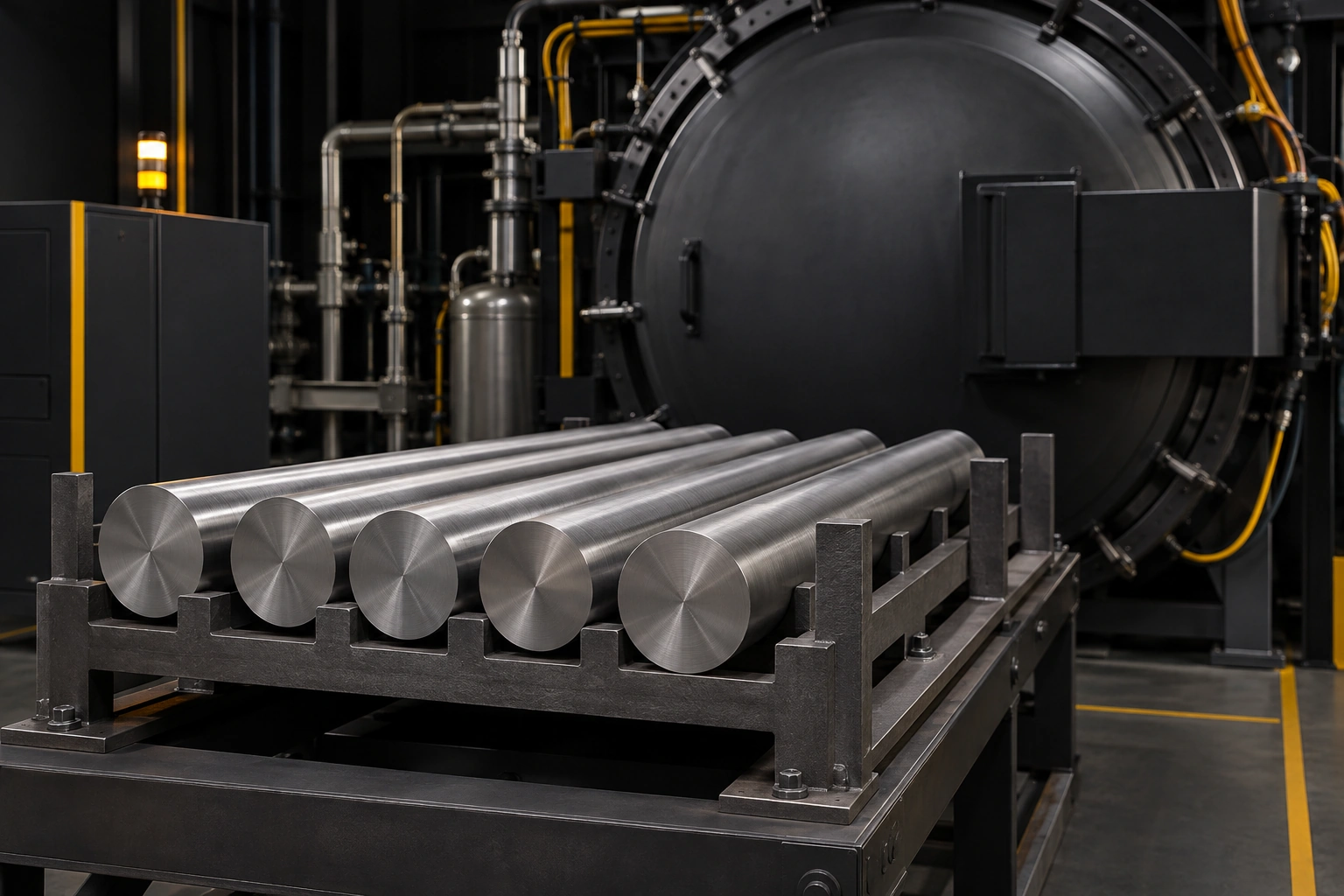
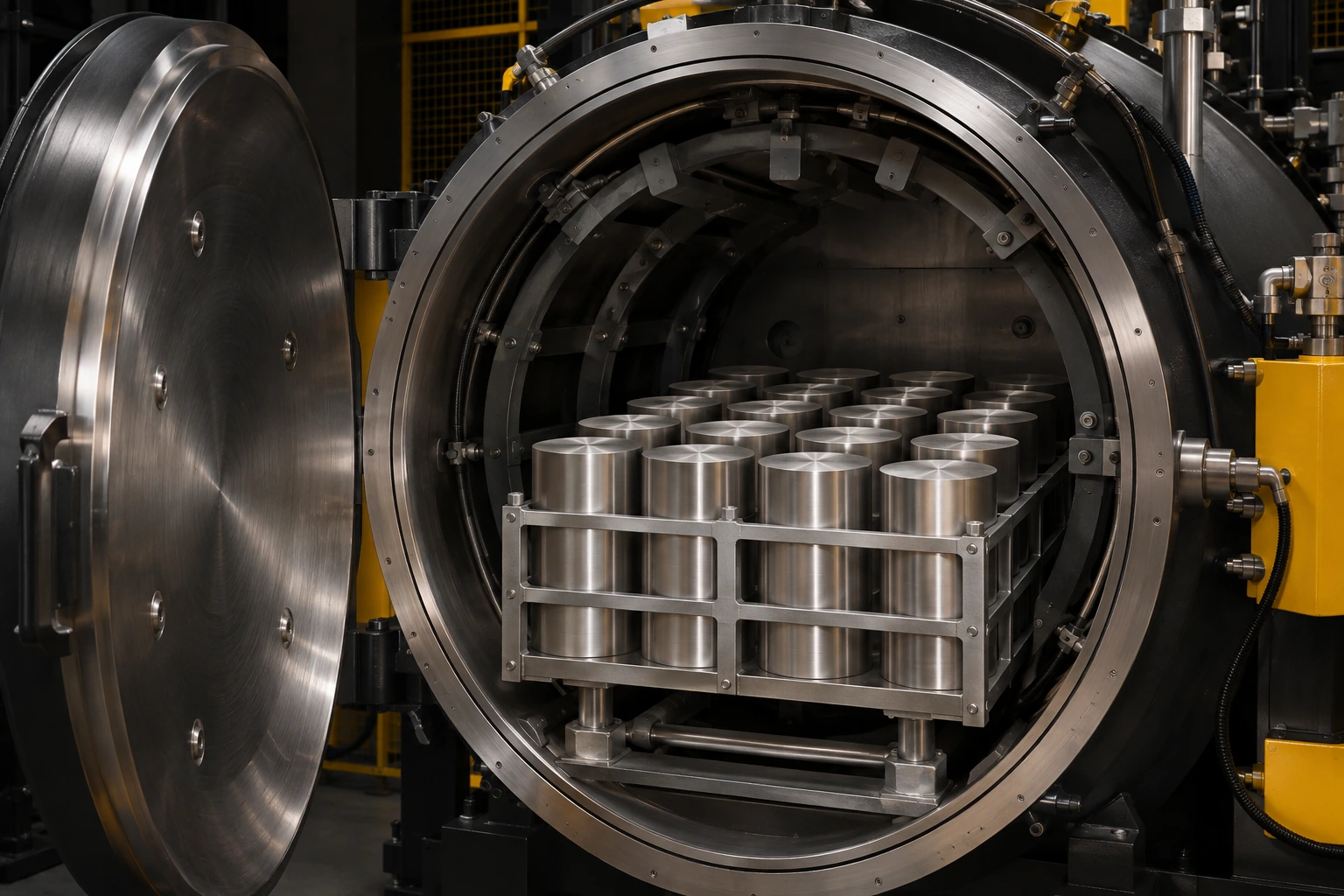
AI illustration. Appearance and labels do not verify material compliance.
Quick answer
Annealed and STA titanium are different delivery conditions. For Grade 5, solution treatment and aging can increase strength, but the result depends on section size, processing and the required property balance. Specify the exact product standard, condition and final acceptance requirements. Do not treat stress relief as STA, assume one heat-treatment recipe suits every part, or accept annealed stock against an STA drawing without approval.
01 / Condition definitions
The grade name does not define delivery condition.
An annealed vs STA titanium comparison matters whenever the drawing, quotation and certificate use different descriptions of Grade 5. An offer may say “Ti-6Al-4V bar” while the design assumes a particular heat-treated condition. That gap should be closed before purchase, because later testing cannot automatically recreate a missing or unsuitable manufacturing history.
STA means solution treated and aged. Annealing, stress relief and STA have different objectives and must not be treated as interchangeable labels. ATI identifies separate specification routes for annealed, solution-treated-and-aged and annealed heat-treatable products. The exact ordered specification and edition remain the controlling requirements. [1]
Condition description
What it tells the buyer
What it does not settle
Annealed
A specified annealing condition is intended
The exact product specification, final properties or later processing
Stress relieved
A defined treatment intended to address residual stresses
That the material has been solution treated and aged
Solution treated and aged
A solution-treatment and aging route is intended
Uniform properties for every section or automatic design approval
Annealed, heat treatable
Starting material intended for a specified later treatment route
That the delivered stock is already in the final STA condition
“Heat treated” only
Some thermal processing is claimed
Which condition, process, acceptance criteria or records apply
A strength increase comes with a property decision
The objective is the required combination of strength, ductility, toughness, fatigue behavior, dimensional stability and manufacturing feasibility. Choosing the highest available tensile figure can miss the property that controls the component. The responsible engineer should define the required condition and allowable data rather than leaving procurement to select a treatment from a generic comparison.
For Grade 5 material procurement, ask the supplier to state the delivered condition explicitly. If the buyer will perform additional processing, define the state in which the supplier must certify the stock and the state in which the finished component must be accepted. Those can be different stages with different responsible parties.
A typical hardness range is not a process certificate
A hardness result may support a quality plan, but it cannot alone establish that a required thermal cycle, atmosphere, cooling sequence and sampling plan were followed. It also cannot demonstrate all tensile or fracture-related properties. If the contract requires a process record, buy that record as part of the defined scope.
Avoid universal statements such as “all Grade 5 is annealed” or “STA is always better.” Stock availability, product specification, final geometry and application constraints can lead to different legitimate choices. The useful question is which condition the design requires and what evidence the offered route can provide.
Compare complete delivery routes instead of two condition labels
An annealed-versus-STA comparison becomes useful when each offer identifies the sequence from incoming stock to the accepted deliverable. One supplier may offer annealed stock for the buyer to process. Another may quote heat-treated stock. A third may quote a finished component with heat treatment included after rough machining. These offers assign different responsibilities and should not be compared as if the only difference were a material surcharge.
Route element
Question that belongs in the quotation
Starting stock
Which product specification, size and initial condition are supplied?
Rough processing
Who provides machining allowance and controls intermediate dimensions?
Heat treatment
Who performs the approved process and maintains lot identity?
Final processing
Which operations follow treatment and can affect final acceptance?
Release
Which records represent the condition and geometry being delivered?
A useful route description names the deliverable at the responsibility boundary. For example, “heat-treated rough blank ready for finish machining” is different from “finished component inspected after all contracted operations.” The buyer should know which dimensional and property checks remain outside the supplier’s price. Avoid wording such as “STA included” when it does not say what is treated, when it is treated and which evidence is supplied.
For a repeat order, retain the approved route with the drawing and material requirements. If the supplier proposes moving heat treatment to a different stage, review the change rather than assuming the final label guarantees the same outcome. The effect on distortion, finishing allowance, representative testing and traceability may matter even when the chemistry and nominal grade are unchanged.
02 / Process and section
Specify the complete manufacturing sequence.
Material selection / 01Section size belongs in the review.
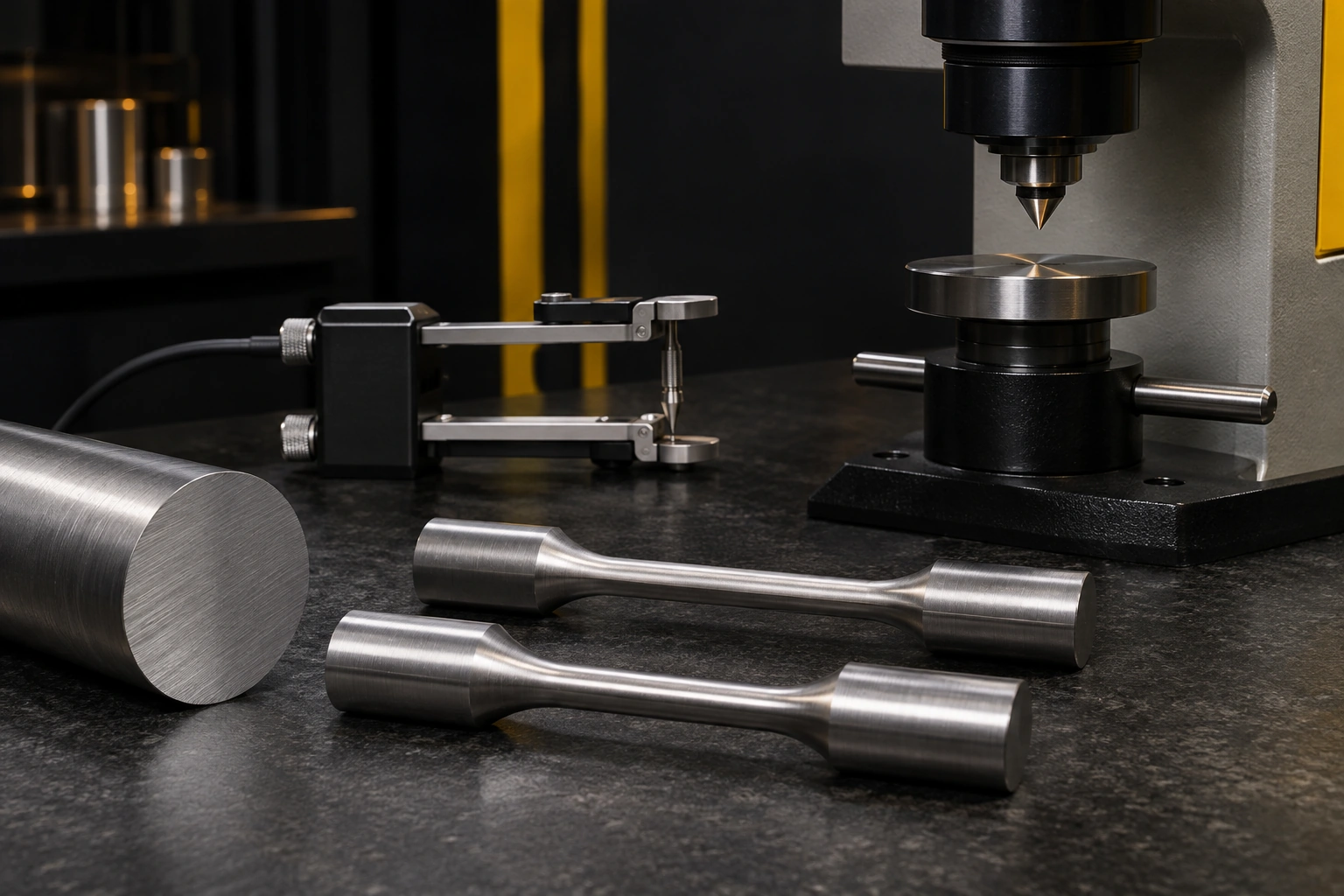
A small test specimen does not automatically represent a heavy section. AI illustration; not a production or inspection record.
Section size changes the question
A thin section and a heavy section do not cool in the same way. TIMET and ATI discuss the influence of section size and cooling on the attainable response of Ti-6Al-4V. A result demonstrated on a small specimen should not be assumed to represent the center of a much larger product without the applicable specification and qualification basis. [1][2]
State the stock dimensions and the controlling section of the part. For a forging, identify the drawing and the location from which tests are required. For a machined component, explain whether heat treatment occurs in the full blank, a rough-machined condition or near-final geometry. The supplier needs this information to assess feasibility and allowances.
Map the order from stock to final inspection
Stage
Question to resolve
Record or instruction
Starting stock
What grade, specification and condition are purchased?
Material certificate and heat identity
Rough machining or forming
What allowance remains and what features are protected?
Drawing and process plan
Thermal processing
Who applies the approved condition and controls the process?
Required procedure and treatment records
Surface restoration
What material removal or cleaning is required?
Approved finish and surface acceptance scope
Finish machining
Which dimensions are established after treatment?
Final drawing datums and tolerances
Property verification
Which specimens represent the delivered state?
Test location, orientation, lot and criteria
Final release
Who accepts material, dimensions and documents?
Release plan and deviation approvals
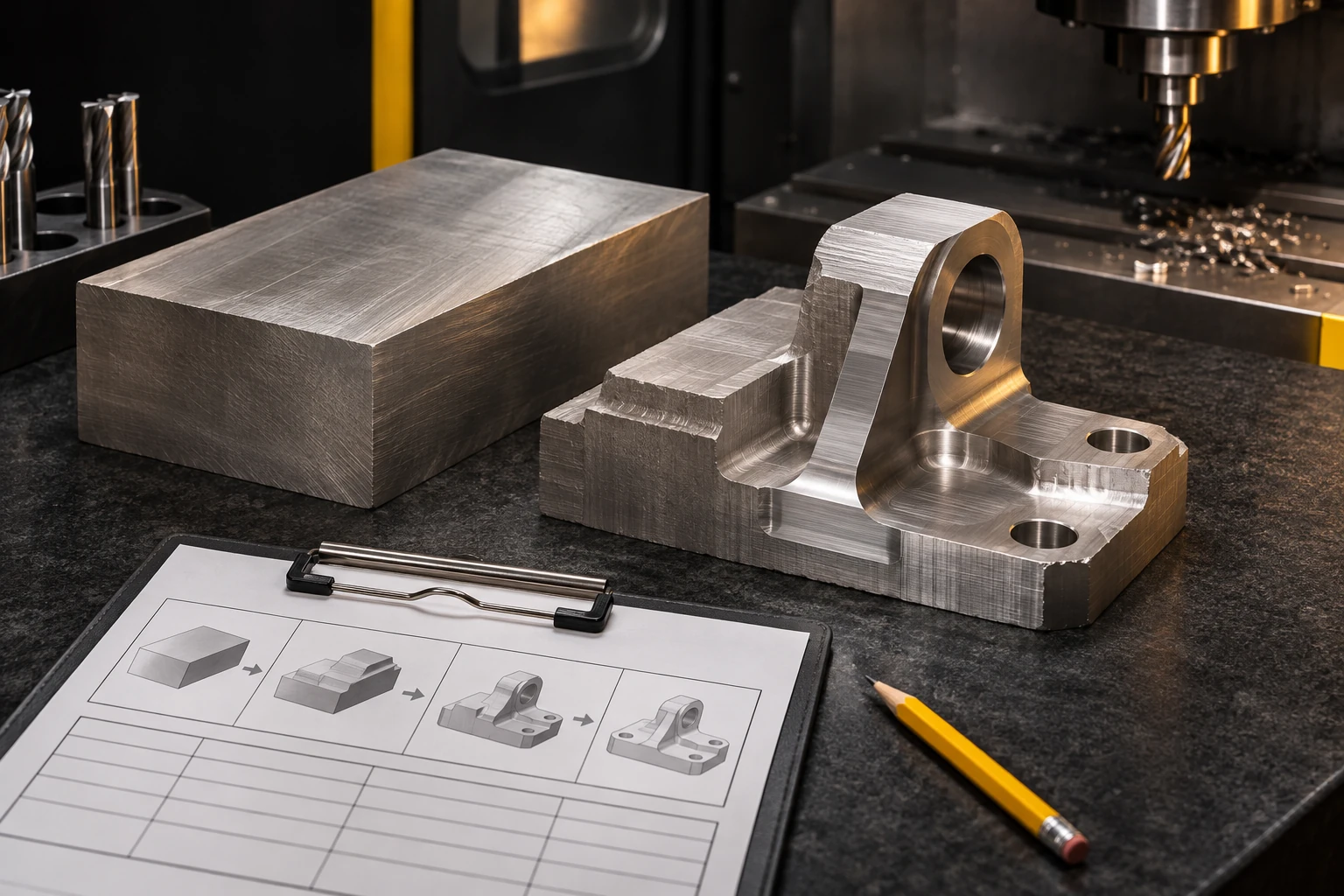
The sequence above is a planning framework, not a universal manufacturing prescription. The actual route should be established by the qualified processor and the design requirements. Do not insert an additional anneal or stress-relief operation merely because it appears beneficial; it can change the state that the design and certificate are intended to control.
Material selection / 02Plan the sequence and allowances.
Heat treatment and finish machining must support the same drawing. AI illustration; not a production or inspection record.
Plan for distortion and finishing allowance
Thermal processing can change dimensions and residual stress distribution. Long slender parts, asymmetric sections and heavily pocketed components deserve specific review. Ask when straightness, flatness, bores and critical interfaces will be inspected, what allowance is needed and whether corrective work is permitted. A tight final tolerance should not be promised from an unspecified stock condition.
The machining-cost guide explains why thin walls and difficult access affect processing cost. When heat treatment is added, the quote should also identify fixturing, handling, reinspection and any additional finishing operations. Keep these costs visible rather than treating STA as a single unexplained surcharge.
Control the surface as well as the bulk material
Titanium surface condition can be affected by high-temperature processing and subsequent cleaning. The order should state the required surface and any examination or removal requirements under the applicable specification. A clean-looking finish is not evidence that the complete surface acceptance requirement has been met.
If the part has fatigue-critical or sealing surfaces, identify them on the drawing and specify the allowed finishing route. Discuss whether heat treatment precedes or follows their final manufacture. The supplier should not have to choose between preserving a tolerance and removing material required by the surface specification without an agreed process plan.
Representative testing needs more than a nearby coupon
Define the test material, location, orientation and relationship to the production lot. A separately treated coupon can be useful only when the specification and qualification basis allow it to represent the product. Ask how the coupon experiences the relevant process and how its identity remains linked to the lot. Do not accept an unrelated historic test as evidence for a new batch.
Make heat-treatment responsibility visible at subcontract interfaces
A procurement route may involve a material producer, stockholder, machining shop, heat-treatment provider and inspection laboratory. The buyer does not need to manage every subcontract operation personally, but the contracting supplier should identify who owns conformity at each handoff. Agree which records must remain traceable to the delivered heat, batch or component lot and which changes require notification.
Before production, review an example of the planned record package. Confirm that the heat-treatment record identifies the material or component lot, the specified process basis and the relevant treatment stage. The required process details and release criteria come from the controlled specification and approved plan. A generic certificate stating “heat treated” may not establish that the ordered condition was achieved for the supplied scope.
The same discipline applies to test specimens. Ask how a specimen represents the product size, location and processing history required by the order. A small coupon can be convenient to test while experiencing a different thermal history from a large section. The specification or approved qualification plan should determine what representation is acceptable. Do not accept a nearby coupon merely because it has the same alloy name.
Where witnessing or document approval is required, define the hold point before the operation starts. Identify what must be submitted, who reviews it and whether production may continue while a clarification is open. This prevents a late request for evidence that can no longer be collected without repeating work. Keep the plan practical: reserve formal hold points for requirements that affect acceptance or cannot be reconstructed afterward.
03 / Quotation and records
Buy the required evidence with the material.
Illustrative case: an annealed quote for an STA drawing
A buyer requests Grade 5 components to a drawing that specifies an STA condition. The supplier quotes annealed bar and includes machining, but leaves heat treatment and final property testing out of the price. The offer is incomplete for the finished drawing requirement even if the raw material itself is compliant with its own annealed specification.
The buyer should obtain a revised scope identifying who performs heat treatment, which specification applies, what condition is delivered and how final dimensions and properties will be accepted. If the buyer intends to perform treatment after receipt, the order should instead define the appropriate intermediate deliverable and allowances. Both routes can be quoted; they are not the same product.
Material selection / 03Verify the final delivery state.
Link processing, test results and dimensions to the production lot. AI illustration; not a production or inspection record.
A document package that follows the actual route
Material certificate for the identified starting heat and product.
Required treatment record linked to the production lot and specification.
Mechanical and any other required examination results in the relevant final state.
Dimensional inspection after the last process that can affect the dimensions.
Approved deviations and a packing list that maintains lot identification.
The mill certificate buying checklist is useful for reviewing the starting material evidence. For a heat-treated finished part, add the processor and final-inspection records required by the contract. A raw-stock mill certificate and a final component report should support one another without being described as the same document.
What changes price and lead time
Heat-treatment batch planning, section size, furnace availability, required qualification, specimen preparation, tests, surface restoration and dimensional rework can affect the commercial scope. Small orders may carry a minimum processing charge. A sample route can take longer than a repeat qualified route even when the material is already available.
Ask for the complete delivery milestone: stock allocated, process approved, treatment completed, test results accepted and documents released. If a test fails or a dimension changes, agree who reviews the disposition and how the schedule will be updated. This is more actionable than asking for a fixed number of extra days for all STA material.
Substitution is a controlled change in either direction
An annealed material cannot be accepted against an STA requirement solely because it is cheaper or easier to machine. Conversely, an STA material is not automatically acceptable where the design requires annealed properties. Record the proposed deviation, compare the full requirements and obtain the appropriate written approval before relying on the substitute.
For repeat orders, reference the approved specification and revision instead of copying a supplier shorthand such as “same heat treatment as last time.” Personnel, equipment and product size can change. A reproducible order tells the next reviewer what condition is required and how conformity will be shown.
Plan the response to distortion, missing evidence and rework
Suppose a heat-treated blank meets the required material tests but moves outside the machining allowance assumed by the drawing. The issue is not settled by the material certificate alone. Review the actual remaining stock, datum strategy and final geometry before accepting a repair or further processing. A dimensionally recoverable blank and a conforming finished component are different delivery stages.
Similarly, an acceptable final dimension does not resolve missing evidence for the specified condition. A hardness spot check may help investigate the situation, but it cannot reconstruct every required process or mechanical-test record. The hardness testing guide explains why scale, preparation and purpose must be stated before using a hardness result. Any substitute evidence needs approval from the responsible specification owner.
If rework is proposed, identify exactly what operation will be repeated and what acceptance checks must follow. Do not assume that an additional heating or straightening operation is automatically permitted. Its acceptability depends on the governing requirements and approved processing route. Preserve the original nonconformance record and connect the rework authorization to the affected lot rather than changing the paperwork to make the original route appear compliant.
Commercially, separate the responsibility for development risk from the responsibility for delivering the contracted condition and geometry. A prototype route with agreed process development is different from a repeat production route already qualified by the supplier. State how trial material, destructive samples, reinspection and replacement are priced. This helps the buyer compare a lower starting-stock quotation with a more complete offer without overlooking the work needed to reach an accepted component.
04 / Build your RFQ
Turn the comparison into a clear enquiry.
Attach the drawing and specify the required delivered condition. If heat treatment is performed after your receipt, describe the planned later operations and identify which party owns final property and dimensional acceptance.
Information to include
Grade 5 product form, dimensions and controlling section
Product and heat-treatment specifications with editions
Delivered condition and required final component condition
Manufacturing sequence, allowances and critical surfaces
Treatment responsibility, representative tests and acceptance limits
Required records, traceability, quantity and delivery milestone
Build your RFQ checklist
Choose the product and add the information you have. Copy the resulting brief or send your requirements to TiHubs. Submitting an enquiry does not place an order.
05 / FAQs
Questions buyers ask
What does STA mean for titanium?
Solution treated and aged. It describes a processing condition, whose exact requirements must come from the applicable specification and product scope.
Is stress-relieved Grade 5 the same as STA?
No. Stress relief does not by itself establish solution treatment and aging or the resulting required properties.
Is STA always stronger in every part size?
The attainable response depends on section and processing. Use the applicable product requirements and representative evidence rather than a universal number.
Can annealed stock be heat treated later?
A later route may be possible, but starting-stock requirements, processing, allowances and final acceptance must be planned and approved.
Can hardness alone prove the STA condition?
No. It does not establish all required processing records or mechanical properties. Use the evidence required by the specification.
Why should dimensions be checked after heat treatment?
Thermal processing can affect distortion and dimensional stability. The final inspection stage should follow the processes relevant to the finished tolerance.
06 / Key takeaways
Keep the purchase requirements connected.
Put the full condition in the quotation and purchase order.
Distinguish annealing, stress relief and STA.
Review section size and the complete process sequence.
Agree who verifies the final properties and dimensions.
Control condition changes through a documented approval.
Technical references
Sources and data scope
References reviewed November 9, 2026. Manufacturer data explains material behavior; it does not certify an offered heat or establish design allowables. Use the controlled product specification, required edition and approved engineering requirements for acceptance.
TiHubs coordinates titanium materials and custom supply from Baoji, China. Our founder’s 20 years in titanium inform a specification-led sourcing approach: clarify the product, manufacturing and acceptance requirements before quotation. Learn about our sourcing role.
Contents
TiHubs
Talk to TiHubs
Ask about titanium materials, grades or custom parts.
Enter your email to start chatting.
We use your email to respond to your enquiry. Your conversation is stored on this website.
Our team is away right now. Leave your enquiry and we will follow up by email.