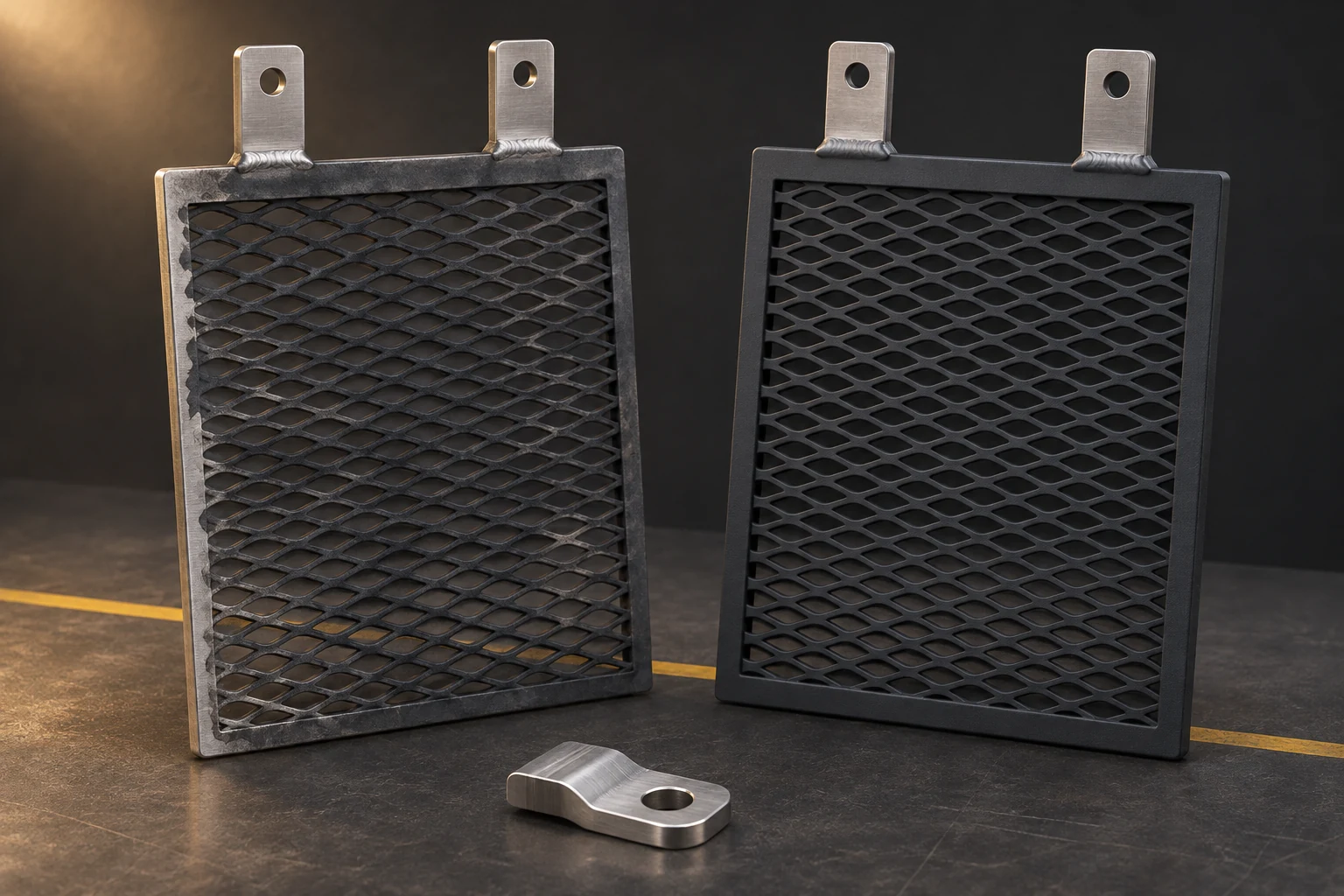
AI illustration; not a production or inspection record.
Quick answer
Recoating is worth evaluating when the existing titanium structure, connections and geometry remain suitable for a qualified renewal process. Replacement may be preferable when damage, changed duty or schedule prevents that route. Diagnose the performance problem, inspect the substrate, define coating and current-density requirements, and compare complete accepted costs and downtime. Appearance alone does not establish remaining life or recoating eligibility.
01 / Identify the real problem
A tired anode is not automatically a worn-out substrate
A production line needs more voltage to maintain current, coating quality has become uneven, or an electrode has reached its planned maintenance date. The purchasing question is whether to recoat the existing MMO titanium anode or buy a replacement. Before requesting either price, establish what has deteriorated. Catalytic coating, titanium structure, electrical connections and the surrounding process can require different corrective actions.
First, can the existing metallic structure remain suitable after preparation and any approved repair? Second, can the renewed coating satisfy the intended electrochemical duty? Third, is returning and qualifying that assembly commercially preferable to replacing it? A positive answer to only one question is insufficient. An excellent coating cannot correct an unsuitable current-carrying connection or a frame that no longer fits the cell.
Cell voltage alone does not isolate anode failure. It includes contributions from both electrodes, the electrolyte, electrical contacts and other cell components. Compare readings at equivalent current, temperature, electrolyte composition, spacing and flow. Review maintenance and operating changes before attributing a voltage increase to coating consumption. A changed process can make a sound electrode appear to have deteriorated.
Look for the timing and distribution of the symptom. A sudden change after maintenance suggests a different investigation from gradual deterioration over a long campaign. A localized problem near a connection differs from uniform loss of performance across a panel. Photographs and operating records should preserve these distinctions rather than compressing all observations into the label failed anode.
A 2019 study by Xu and colleagues on IrO₂–Ta₂O₅ titanium anodes found deactivation associated with coating loss, sometimes together with titanium passivation, under its accelerated sulfate-electrolyte test conditions. The study did not identify a universal residual-iridium threshold predicting final deactivation before passive-film formation. See the SINTEF publication record. This supports investigating mechanism and condition rather than judging remaining service solely from appearance or precious-metal content.
Keep the maintenance decision separate from a change in coating family. If the new electrolyte or process requires a different catalytic formulation, that is also a qualification question. The MMO versus platinized titanium anode guide discusses the broader coating-family choice. Here the focus is whether an existing MMO assembly is a defensible platform for renewed service.
02 / Inspect the reusable structure
Decide eligibility before committing to the coating operation
Start with an identified assembly and its drawing. Record the original substrate grade, dimensions, mesh or plate geometry, connection design, coating history and service environment where available. Keep each returned item distinguishable. Two anodes from the same installation may have different damage, repair history or remaining dimensions and should not receive a single undifferentiated acceptance decision.
Photographs are useful for triage, but they cannot establish remaining thickness, crack depth or electrical integrity. Ask the refurbishment provider to define an incoming inspection and the conditions under which the quotation can change. Inspection after controlled coating removal may reveal information that is not visible on receipt. Agree on that decision point before the original surface is altered.
Procurement review framework; acceptance limits must come from the actual design and qualified provider
Observed condition
Question to resolve
Possible disposition
Coating performance has declined; structure appears intact
Does inspection confirm dimensions, joints and suitability for preparation?
Candidate for a defined recoating review
Localized connection or frame damage
Is a qualified repair possible without compromising fit or current distribution?
Repair and requalification, or replacement
Cracks, torn mesh or unacceptable section loss
Can the design requirement be restored and verified?
Replace affected components or the assembly if not recoverable
Changed process chemistry or current duty
Does the existing design suit the new service?
Engineering review before either route
Unknown identity or contamination
Can the missing information be established adequately?
Hold pending review; do not assume eligibility
Measure the features that determine reuse
For mesh, inspect strands, junctions, perimeter attachments and local distortion. For plate, inspect flatness, thickness, edges and attachment zones. The controlling features depend on the design. A local measurement on an undamaged corner does not represent a visibly affected connection or thin mesh strand. Agree on inspection locations and reporting so the reuse decision can be traced to the relevant geometry.
Review welds and current-carrying attachments under an appropriate inspection plan. A frame can retain its overall dimensions while a connection has become unreliable. Conversely, a repairable attachment does not necessarily require disposal of the whole assembly. The provider should identify the proposed repair, its qualification basis and the checks needed afterward, with the buyer’s approval where the order requires it.
Do not specify a generic percentage of remaining titanium as the acceptance limit. The necessary section depends on mechanical loading, electrical duty, geometry and the preparation route. An apparently small local loss at a critical attachment can matter more than a larger loss in a noncritical region. Use drawing-based criteria and a documented engineering disposition.
Ask what happens if the item fails inspection after stripping. The commercial agreement should cover the inspection charge, recovery or return of the item, any separately approved repair and the replacement option. A conditional quotation is reasonable when the condition is genuinely unknown; an undefined right to add work after receipt makes the buyer’s cost and schedule difficult to control.
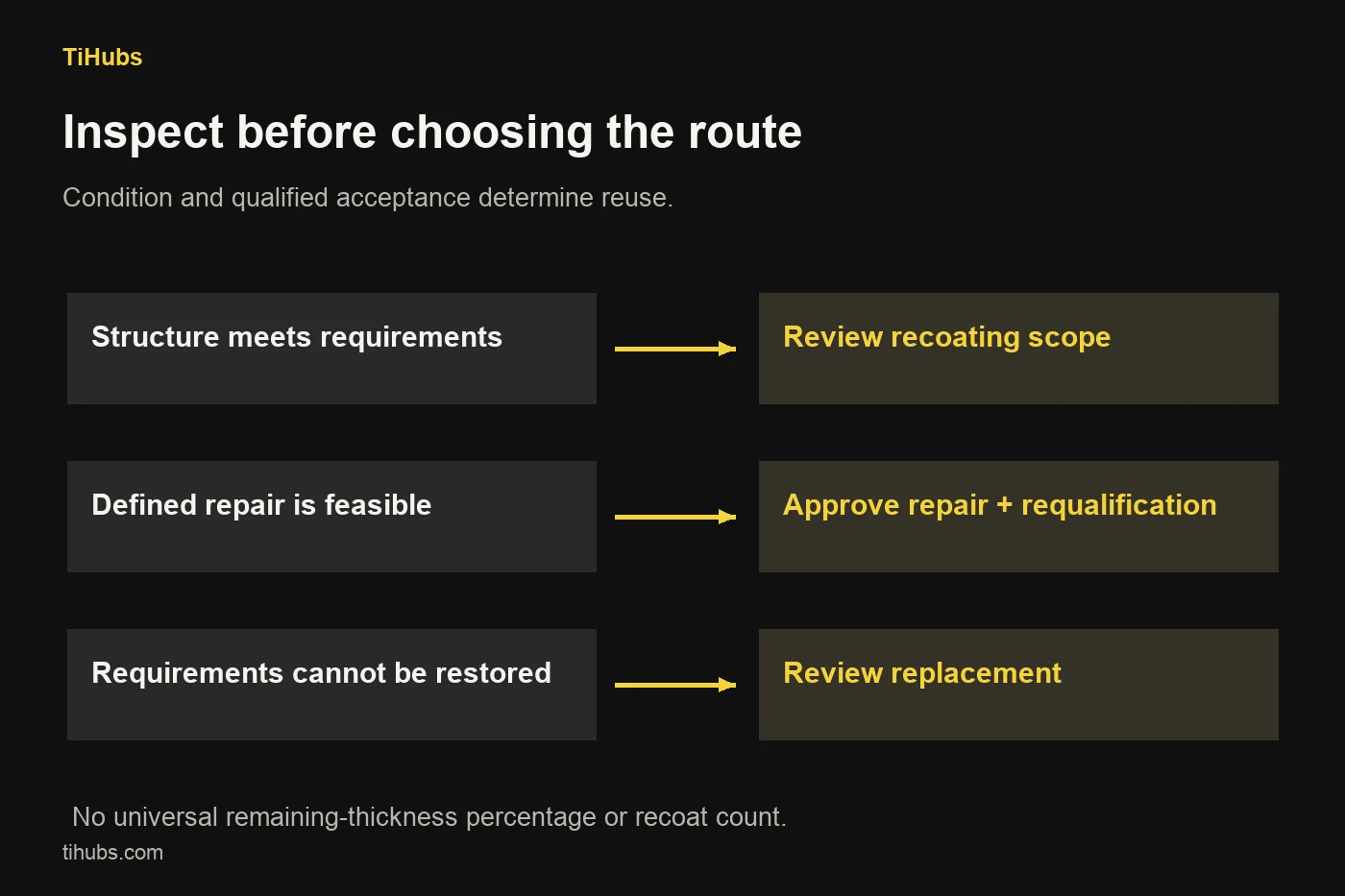
Industrial buying guide / 02Reuse begins with an inspection decision
Separate a sound substrate, a defined repair and an unsuitable assembly. The drawing and qualified review establish acceptance limits.
03 / Specify the renewed surface
Recoating is a controlled manufacturing route
A useful recoating offer identifies preparation, any substrate repair, surface treatment, coating application, thermal processing where applicable and final inspection. The provider may protect proprietary formulation details, but the buyer still needs a defined performance and acceptance basis. A statement that the anode will be recoated with MMO does not specify the reaction, environment, loading basis or qualified operating envelope.
State the electrolyte composition and relevant impurities, temperature range, total current, current-density basis, polarity and operating cycle. Include shutdown exposure, cleaning practice and any intended changes from the previous campaign. Renewing the same nominal coating does not establish suitability for a changed process. A lifetime problem may recur if its operating cause remains unresolved.
Keep loading, thickness and coated area distinct
Coating thickness and precious-metal loading are related to the coating system but are not interchangeable purchasing descriptions. Ask which quantity is controlled, how it is measured or calculated, which elements it includes and what area is used in the denominator. A mass per square meter based on projected mesh area cannot be compared directly with one based on actual coated surface without a defined conversion.
Identify active surfaces and deliberately uncoated contact zones on the drawing. Edges, rear faces, mesh intersections and attachment regions may need specific treatment. A total coating mass can conceal uneven distribution. Acceptance should address the features relevant to the application rather than assuming that a single aggregate number describes every location.
Surface preparation and thermal processing can affect the substrate as well as the coating. The refurbishment provider should control the route for the actual geometry and previous history. The buyer should not prescribe an improvised stripping recipe from a generic internet description. Ask for qualified processing, dimensional checks after relevant stages and a clear response to newly exposed damage.
Repair sequencing also matters. Welding or reshaping after coating may damage a surface already accepted. Establish which operations occur before coating and what reinspection follows any later correction. If the scope includes replacing mesh on an existing frame, describe it as such. Rescreening, local repair and recoating an unchanged assembly are different manufacturing and traceability cases.
Do not convert accelerated test hours into a service promise
An accelerated test is useful only with its electrolyte, temperature, current density, specimen preparation and failure criterion. A result from one formulation or test condition does not directly predict life in another plant. Request the relationship between the qualification evidence and the proposed service, and distinguish comparative laboratory screening from a contractual operating guarantee.
A test coupon can provide process evidence without proving every feature of a large assembly. Identify how coupons represent the coating batch and which full-assembly checks remain necessary. If a performance guarantee is offered, record the operating envelope, maintenance obligations, measurement basis and remedy. The number of calendar months alone leaves essential parts of the commitment undefined.
04 / Area and electrical duty
Check the current path before comparing service life
Current density is total current divided by a defined active area. The definition is critical for mesh, two-sided plates and partially masked assemblies. A drawing’s width multiplied by height may describe projected area, while the coating provider uses another basis. State the convention in the enquiry and keep it consistent through quotation, testing and operation.
Illustrative arithmetic at 1,000 A; these are not recommended operating limits
Explicit area assumption
Calculation
Average current density
Defined active area of 0.50 m²
1,000 ÷ 0.50
2,000 A/m² = 200 mA/cm²
Effective area reduced to 0.45 m²
1,000 ÷ 0.45
2,222 A/m² ≈ 222 mA/cm²
Different quoted area basis of 0.25 m²
1,000 ÷ 0.25
4,000 A/m² = 400 mA/cm²
The first two rows show that a 10% reduction in the assumed active area raises the average current density by about 11.1% at unchanged total current. Real current distribution can be nonuniform, so this arithmetic does not determine local peaks. The third row shows how a different area convention can double the reported value without changing total current. Resolve the convention before comparing any supplier’s limit.
Connections belong in the performance review
Describe connection geometry, mating surfaces, assembly method and the plant’s inspection requirements. A poor contact can add resistance and localized heating. Renewing the catalytic surface does not automatically repair that part of the circuit. Determine whether the returned assembly includes only the anode or also its current distributor, cable termination and other components requiring inspection.
Use an agreed measurement method for contact or assembly resistance where required. Record instrument arrangement, contact locations and test conditions rather than comparing numbers obtained by different setups. The relevant acceptance limit must come from the design and qualified procedure. A handheld reading without a defined method can be misleading at the low resistances involved.
Keep cell spacing and assembly alignment visible. A distorted panel can affect the gap and current distribution even if it remains mechanically intact. Check the mounting references, flatness and installed clearance against the actual cell drawing. Do not approve straightening solely because the panel looks flat afterward; any required inspection and dimensional evidence must accompany the correction.
Voltage changes also have an energy consequence, but only after comparable operation has been established. As an illustrative calculation, a 0.20 V difference at 1,000 A represents 200 W of DC power and 1,600 kWh over 8,000 hours. This is not a predicted improvement from recoating. Purchased AC energy also depends on the power supply and operating profile. Use measured, normalized performance when evaluating an economic claim.
For a line with multiple anodes, review how current is shared and what changes when one assembly is replaced or refurbished. Mixing conditions may require a commissioning check appropriate to the system. The objective is a stable production arrangement, not merely an isolated electrode that passes a laboratory test.
Industrial buying guide / 04Use the same active-area definition
Original arithmetic at 1,000 A. A different area basis changes the reported average current density; these values are not operating recommendations.
05 / Cost and turnaround
Compare complete routes to accepted production
A recoating price should be compared with the complete replacement route, using the same output and acceptance requirements. Include inspection, preparation, repair, coating, qualification, packing and transport. For replacement, include the new substrate or assembly, coating, inspection, fit verification and commissioning. Identify which items are firm and which remain conditional on inspection or engineering review.
Evaluate downtime separately from workshop turnaround. Removing anodes, cleaning and documenting their condition, outbound transport, inspection approval, processing, return transport and installation can all affect the outage. A quoted coating lead time may start only after an acceptable substrate is released. Ask for a schedule that identifies dependencies and the point at which a delivery commitment becomes firm.
Use a break-even condition instead of a universal saving
Define Cr as the complete accepted recoating cost and Cn as the complete accepted replacement cost, excluding production interruption. If recoating causes Δd additional days of otherwise avoidable downtime and the relevant loss is L per day, its direct cost advantage survives only when Cn − Cr exceeds L × Δd, before other differences are considered. Use the plant’s own values; this is a comparison framework, not a market-price estimate.
A spare set can change that result by separating workshop time from line downtime. Its purchase, storage, inspection and compatibility costs still belong in the wider plan. Confirm whether the provider offers a suitable exchange or temporary arrangement and whether the process accepts it. Do not assume spare assemblies are available merely because another manufacturer advertises that service.
Compare expected usable production over a common period when credible performance evidence exists. Avoid dividing price by an unsupported promised lifetime. If the future life is uncertain, show a range and the conditions that would change the decision. A lower initial price can lose its advantage through another early shutdown, but that possibility should be evaluated with evidence rather than an invented failure probability.
Retired coatings may retain recoverable value, but the amount and commercial treatment depend on composition, residual material, contamination and the recovery agreement. Identify ownership, sampling or assay arrangements, deductions and settlement timing where recovery forms part of the offer. Do not subtract a speculative precious-metal credit from the purchase cost and present it as guaranteed savings.
Set a stop point for unexpected repairs. The provider can report findings with photographs, measurements, proposed work, cost and schedule impact, then obtain the approval required by the order. This makes the decision concrete before more processing is committed. A planned alternative replacement route is especially useful when the substrate condition cannot be confirmed in advance.
The commercial comparison should end with a defined outcome: eligible for the agreed recoating route, repairable under an approved scope, or unsuitable for reuse. Preserve the findings even if replacement is chosen. They can reveal whether the next anode needs a different connection, geometry, coating specification or operating practice.
Two different decision paths
Consider a hypothetical assembly removed after gradual voltage deterioration while the electrolyte and operating conditions remained stable. Inspection confirms acceptable geometry and connections, and the provider can qualify renewed coating for the same duty. Recoating then becomes a credible candidate, subject to the full quotation and schedule. The decision still needs the failure review: if the coating deteriorated unusually early, simply repeating the previous specification may reproduce the problem.
Now consider an assembly bent during handling, with a damaged attachment but little apparent coating wear. Its remaining catalytic appearance does not justify immediate return to service. The controlling issue is whether geometry and the current path can be restored and verified. If no qualified repair fits the outage, replacement may be preferable even though the coating was not exhausted. These are illustrative decision scenarios, not TiHubs customer cases.
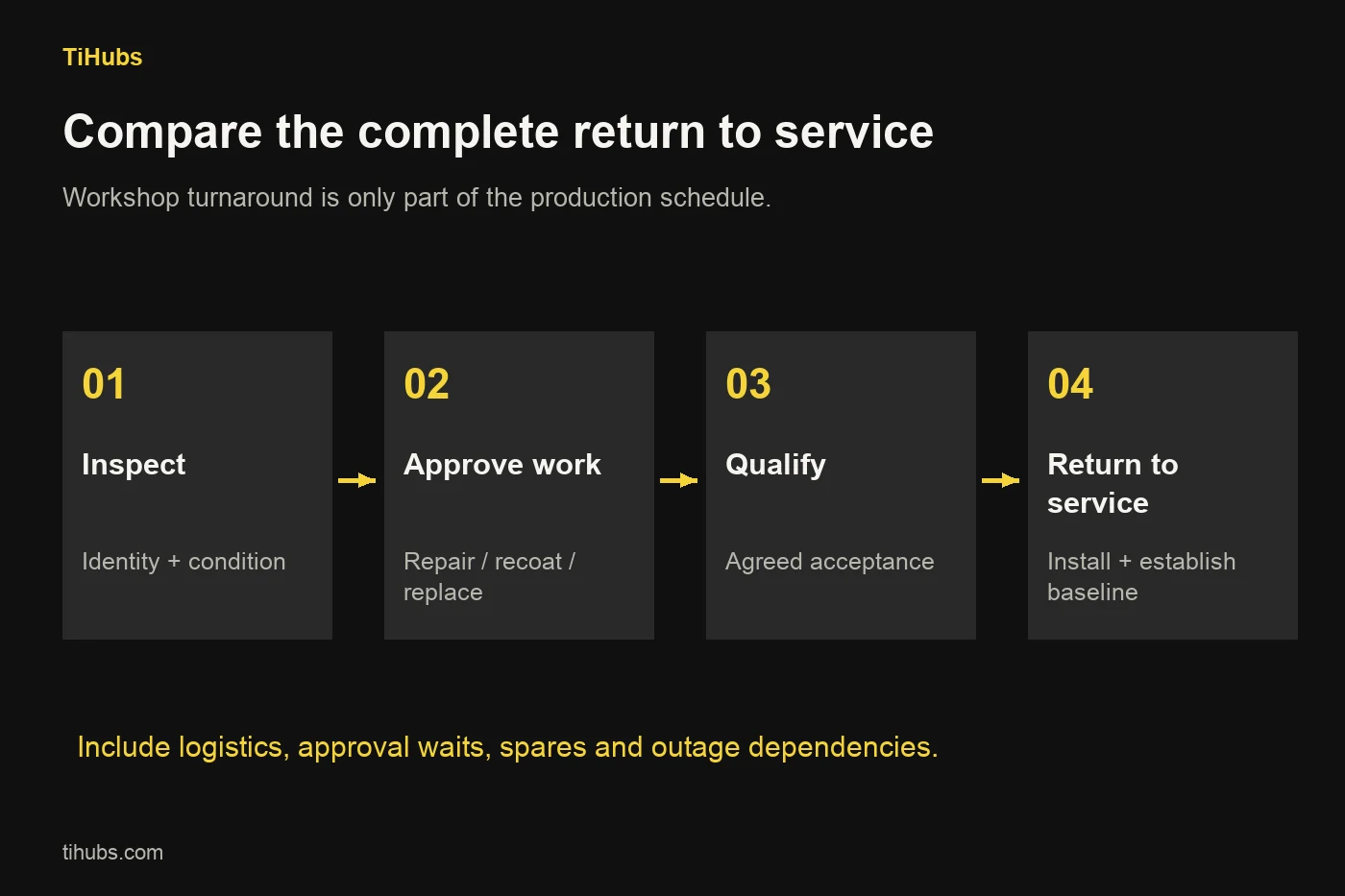
Industrial buying guide / 05Compare the complete return to production
Inspection, processing, qualification, logistics and downtime belong in the same decision. Workshop time alone does not define the plant outage.
06 / Records and return to service
Define acceptance before the used anodes are shipped
Prepare an itemized return list with unique identification, drawings, photographs, service history and the reason for removal. Declare process residues and provide the cleaning or handling information required by the receiving provider. Agree on packing that protects geometry and contact surfaces. A damaged return shipment can eliminate the reuse opportunity before the technical assessment starts.
Define the final record package according to the assembly and duty. It may include incoming condition, dimensional inspection, approved repairs, coating-batch traceability, controlled loading or thickness evidence, applicable electrical checks and agreed performance testing. Specify which results are required for every item and which represent a batch. A generic certificate of conformity should identify the requirements to which conformity is being declared.
Do not borrow an inspection from an unrelated electrode design. For example, leak testing is relevant to assemblies with a pressure or liquid boundary, but it is not a universal acceptance test for every open mesh anode. The inspection plan should address actual failure consequences and construction. Similarly, an appearance check cannot substitute for an agreed electrical or electrochemical test.
At receiving, reconcile item identity, dimensions, connections, coated areas and documentation before installation. Preserve any restrictions or operating conditions attached to the release. The commissioning plan should establish a new baseline at defined current, electrolyte, temperature and other relevant conditions, then compare production quality and performance with the agreed acceptance basis.
TiHubs can review titanium anode enquiries and replacement requirements from drawings and operating conditions. If an enquiry concerns an existing assembly, provide its condition and history so the required supply or specialist evaluation scope can be clarified. Recoating availability and responsibility must be confirmed explicitly; this guide is not a claim that every returned anode can be refurbished through TiHubs.
A defensible decision connects the failure evidence, reusable structure, coating duty, complete cost and final acceptance. Recoating can preserve a suitable fabricated titanium assembly. Replacement can be preferable when the structure, design or schedule no longer supports that route. The important result is an anode that returns the process to its defined requirements, with records explaining why the selected route is suitable.
07 / Build your RFQ
Prepare an anode condition and duty brief
Send drawings, item photographs and operating history together with the intended duty. Identify whether the enquiry concerns a replacement assembly, a new coating requirement or evaluation of an existing anode.
Information to include
Item identity, dimensions, mesh or plate geometry and connections
Electrolyte, impurities, temperature, polarity and operating cycle
Total current and explicitly defined active-area basis
Observed symptoms, previous repairs and coating history
Inspection requirements, outage window and replacement alternative
Build your RFQ checklist
Choose the product and add the information you have. Copy the resulting brief or send your requirements to TiHubs. Submitting an enquiry does not place an order.
08 / FAQs
Questions buyers ask
Can every MMO titanium anode be recoated?
No. Eligibility depends on the substrate, connections, dimensions, contamination, previous processing and intended service. Initial photographs help triage, but a qualified inspection may be needed before and after controlled preparation. Define the decision point and alternative route in advance.
Does higher cell voltage prove the coating is exhausted?
No. Cell voltage also reflects electrolyte conditions, contacts, spacing, the other electrode and other system components. Compare operation on a consistent basis and investigate the symptom distribution before attributing the change to the anode coating.
How many times can a titanium anode be recoated?
There is no universal number. Each cycle must leave a structure that meets the applicable dimensional, mechanical and electrical requirements. Keep item-level records of service, preparation and repairs, and base reuse on inspected condition rather than a fixed cycle count.
Is coating thickness enough to compare offers?
Not by itself. Define coating system, controlled loading or thickness, area basis, active surfaces and qualification evidence. A total loading does not automatically describe local coverage, adhesion or performance in the specified electrolyte and current regime.
Is recoating always cheaper than a new anode?
No. Include inspection, preparation, repairs, coating, qualification, transport and production interruption. A spare set can change the downtime comparison. Use actual quotations and plant costs; a universal percentage saving hides the condition and schedule assumptions that decide the result.
Does TiHubs guarantee a recoating service for my used anodes?
No service commitment is made by this guide. TiHubs can review the enquiry and replacement requirements; any refurbishment availability, specialist responsibility, inspection criteria and commercial scope must be confirmed for the actual assembly and process.
09 / Key takeaways
Keep the purchase requirements connected.
Diagnose coating, structure, connections and process separately.
Approve reuse against inspected geometry and a qualified preparation route.
Define current density and coating loading with an explicit area basis.
Compare complete accepted costs, outage dependencies and credible performance.
Preserve item identity, repair history and the return-to-service baseline.
Technical references
Sources and data scope
References reviewed November 15, 2026. Public source summaries support the discussion; the controlled specification, agreed edition and approved project requirements govern acceptance.
De Nora — Treater anodes — Manufacturer example of titanium MMO anodes with refurbishment and recoating options for copper-foil surface treatment.
Xu et al. — IrO₂–Ta₂O₅ titanium anode durability, 2019 — Primary study, Corrosion Science 150, 76–90, DOI 10.1016/j.corsci.2019.01.018. Reported mechanisms concern its defined sulfate accelerated-test conditions; no general service-life guarantee is inferred.
Ti
About TiHubs
TiHubs coordinates titanium material and custom supply enquiries from Baoji, China. Send the product, drawing revision and acceptance requirements so the proposed supply scope can be reviewed. Learn about our sourcing role.
Contents
TiHubs
Talk to TiHubs
Ask about titanium materials, grades or custom parts.
Enter your email to start chatting.
We use your email to respond to your enquiry. Your conversation is stored on this website.
Our team is away right now. Leave your enquiry and we will follow up by email.