Grade 5 vs 7075 aluminum: compare complete part designs.
Titanium is not lighter than aluminum at equal volume. Its value depends on whether the design, environment and service requirements justify a different material and manufacturing route.
AI illustration. Appearance and labels do not verify material compliance.
Quick answer
Grade 5 titanium can be valuable where its material and service properties justify the processing cost, but 7075 aluminum is lighter at equal volume. Using nominal densities of 4.43 and 2.80 g/cm³, an identical solid titanium shape weighs about 1.58 times as much. Compare approved designs, material conditions, stiffness, environment, joints and complete manufacturing cost; do not assume a direct material swap produces a lighter or better component.
01 / Mass and design basis
Equal volume is not equal design performance.
A grade 5 titanium vs 7075 aluminum comparison should begin with the reason for considering a change. A designer may need different environmental performance, a smaller envelope, a particular temperature capability or a different maintenance strategy. A buyer may instead be comparing availability or machining cost. These objectives require different evidence and may lead to different conclusions.
The material descriptions must also be complete. Grade 5 needs a specified product and delivery condition. Aluminum 7075 needs the required temper and product specification; T6 and T651 should not be silently treated as identical order descriptions. The finished geometry and processing route must match the design assumptions.
Decision factor
Grade 5 titanium
7075 aluminum
Nominal planning density
4.43 g/cm³ using TIMET reference
2.80 g/cm³ using Kaiser reference
Equal-volume mass
Higher
Lower
Strength comparison
Depends on condition, form and section
Depends on temper, form, thickness and direction
Stiffness comparison
Check modulus and section geometry
Check modulus and section geometry
Environment
Evaluate actual medium, temperature and contacts
Evaluate temper, protection and actual exposure
Manufacturing
Quote tools, stock allowance, process and inspection
Quote the same finished requirements and protection scope
Substitution
Requires an approved design and process review
Requires an approved design and process review
The density comparison uses published nominal values from TIMET and Kaiser. It is a mass-calculation basis, not a complete strength-to-weight ranking. [1][2]
A transparent equal-volume example
A solid block of 100 × 50 × 10 mm has a volume of 50 cm³. At the stated densities, its nominal mass is 221.5 g in Grade 5 and 140 g in 7075. The titanium block is approximately 58% heavier. The example isolates density; it says nothing about whether either block meets a particular load or environment requirement.
A titanium design may use less material if the engineering requirements permit it, but that is a redesigned component. It needs new checks for stress, stiffness, local contact, buckling, fatigue and manufacturing constraints. Calling a material “high strength-to-weight” does not establish that it wins every equal-stiffness or equal-envelope comparison.
Strength and stiffness can favor different geometries
A thin bracket may be controlled by deflection rather than yield. A short loaded pin may be controlled by bearing, shear or fatigue details. A large plate may be controlled by panel buckling. Compare the actual geometry and load case, not a single ratio copied from two datasheets. The engineer should identify the controlling requirement before procurement ranks materials.
For a candidate titanium route, the Grade 5 product and condition requirements help establish the supply scope. The aluminum baseline should be equally specific so that the comparison does not pit a fully defined titanium product against an unspecified “7075” reference.
Compare tolerances and interfaces at the same functional level
A fair material comparison begins with the function of each critical dimension. A mounting pattern, bearing seat, sealing face or alignment feature may need tight control, while an external contour may permit a broader tolerance. Identify the functional requirement before copying every tolerance from one material’s drawing to the alternative. The same numerical tolerance can have different cost consequences when stock form, machining sequence, thermal response and inspection setup change.
Ask the engineer which interfaces must remain interchangeable and which features may be redesigned. If a titanium replacement must fit an existing assembly, preserve the approved interface dimensions and identify any mass, balance or thermal constraints. If both designs are new, allow each material to use a suitable section and manufacturing route. Comparing identical geometry can answer an equal-volume question, but it may miss the better design for either material.
Inspection conditions should also be defined where they affect the result. A thin component measured free on a bench can differ from the same component measured in a fixture. The drawing or inspection plan should state the required condition and datum strategy. Do not assume that a part held flat during inspection will retain the required geometry after release or assembly. Treat fixture assumptions as part of the quotation scope.
Separate raw-material conformity from finished-part acceptance. An aluminum temper designation or a titanium delivery condition belongs in the material requirement, while the finished geometry, surface and assembly interfaces need their own criteria. Retain both sets in the comparison record. This prevents a supplier from demonstrating the right material while leaving the actual functional interface insufficiently defined.
02 / Application and process
Review geometry, environment and manufacturing together.
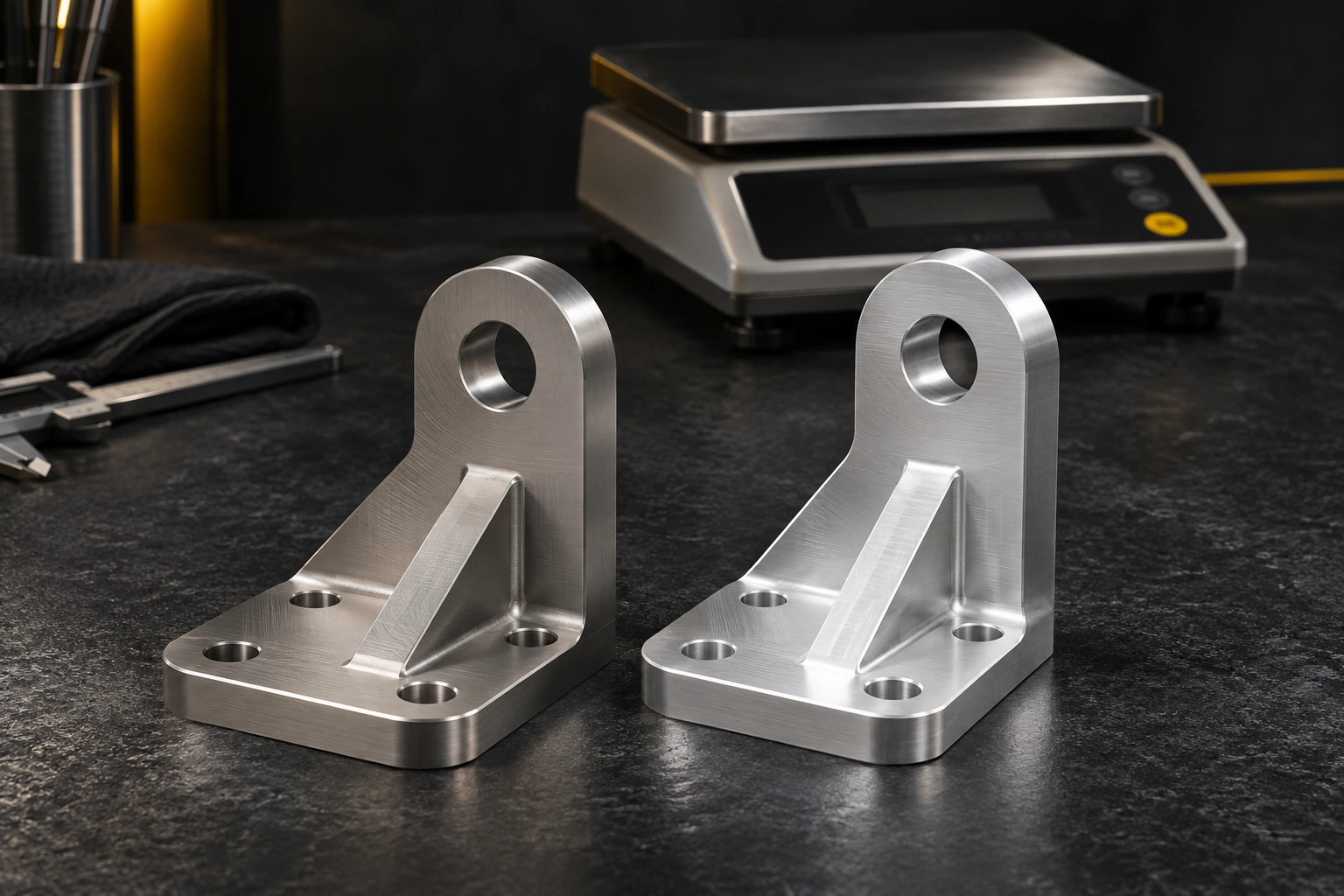
Material selection / 01Equal volume exposes the density difference.
Titanium is heavier than aluminum for the same solid geometry. AI illustration; not a production or inspection record.
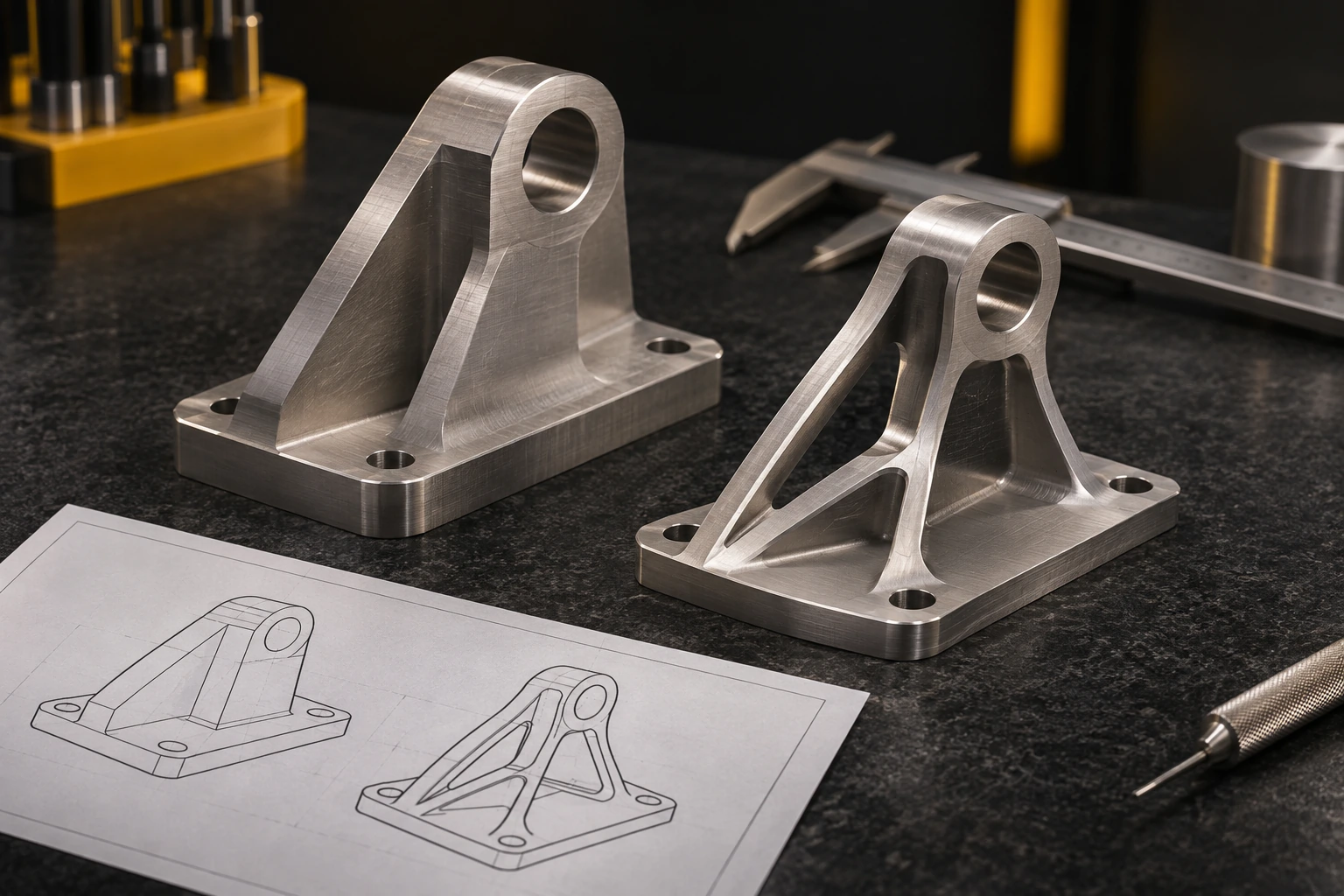
Define the comparison as a pair of approved designs
Keep separate drawings or clearly identified revisions for each candidate. State dimensions, tolerances, surface requirements, allowable mass and assembly interfaces. If one material requires a different wall or fillet, include that change in its cost and validation scope. A material-only substitution can leave the supplier guessing which dimensional requirements still apply.
Design constraint
Question to answer
Evidence to prepare
Loads and life
What static, cyclic, impact or vibration conditions apply?
Approved load cases and acceptance requirements
Deflection and alignment
What movement is acceptable at the interfaces?
Stiffness criteria and assembly tolerances
Envelope and mass
Can section geometry change?
Candidate drawings and mass estimates
Environment
What fluids, humidity, salt, cleaning and temperatures occur?
Normal and upset service profile
Contacts and joints
Which metals, fasteners and insulating features are present?
Joint drawing and corrosion/contact review
Manufacturing
What stock, temper/condition and finishing route are assumed?
Process plan and inspection scope
Corrosion is an assembly and environment question
Do not describe either material as universally corrosion-proof. The actual exposure, surface treatment, crevices and maintenance conditions matter. For aluminum, specify the required protective finish and any temper-related design requirements. For titanium, assess the medium and contacts rather than assuming its corrosion reputation resolves every service condition.
When titanium and aluminum are used together, evaluate galvanic interaction in the presence of an electrolyte, along with contact area, drainage and protective or isolation measures. The assembly designer should define the interface arrangement. A material supplier can provide the specified stock, but an isolated coupon cannot validate the complete mixed-metal assembly.
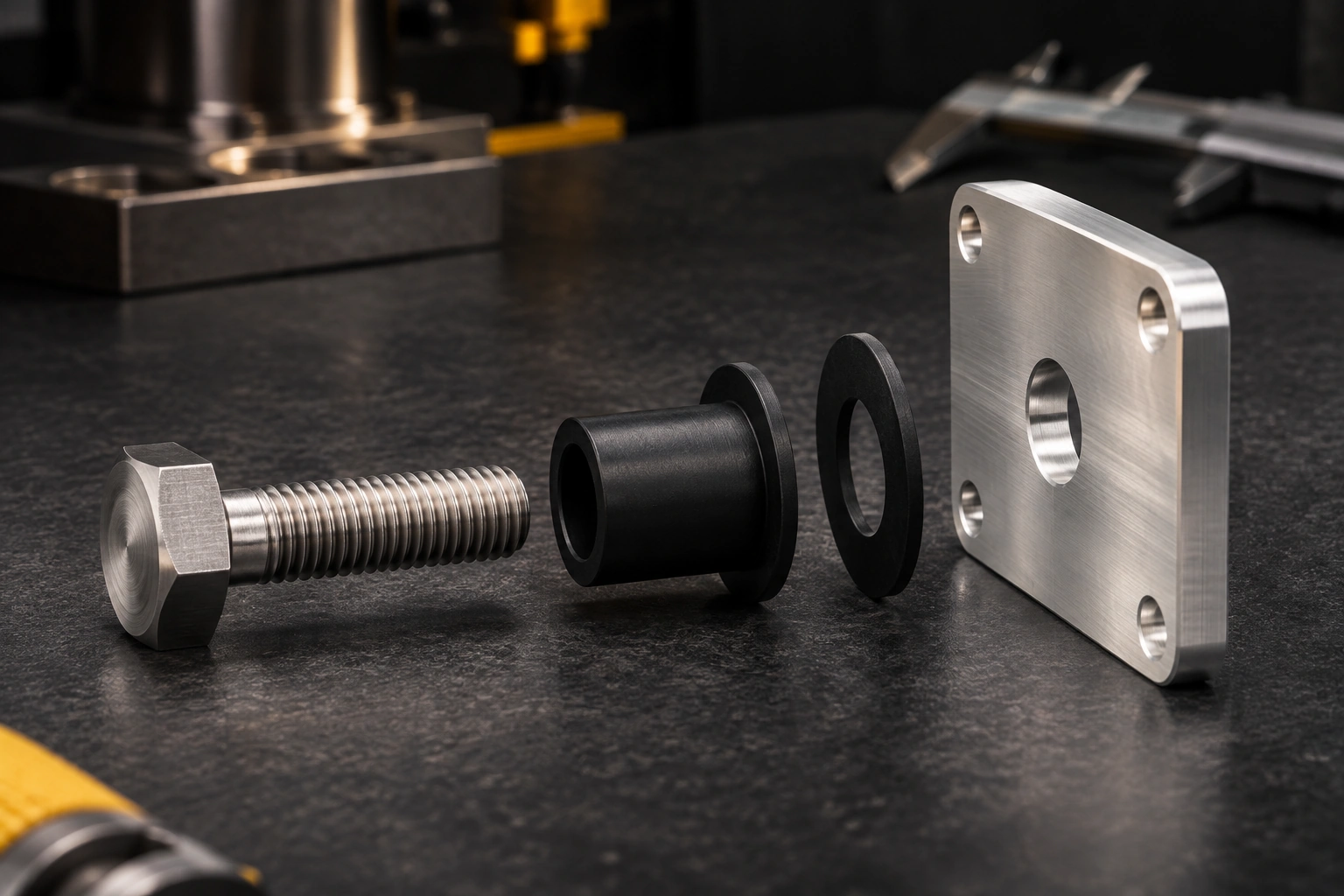
Material selection / 02Review mixed-metal interfaces.
Contacts, joints and exposure belong in the assembly decision. AI illustration; not a production or inspection record.
Temperature and thermal movement need their own review
Room-temperature tensile data do not define long-term service at another temperature. Review the actual temperature range, exposure duration, thermal cycling and relevant property data. Differential expansion at restrained joints can also matter. The fact that a material has a high melting point is not a usable service-temperature limit for a precision component.
Kaiser’s 7075 datasheet provides temper-specific physical and product information, while TIMET discusses Ti-6Al-4V properties in a different material context. Use those documents as starting references and obtain the design data appropriate to the actual product and service. Do not combine unrelated maxima from multiple tables into an imaginary best-case material. [1][2]
Machining and finishing can outweigh raw-material price
Quote the same accepted geometry, quantity, inspection and document scope. Titanium machining can require a different toolpath and process plan; aluminum may require a particular protective finish and dimensional allowance for that finish. Setup, tool access, thin-wall stability and workholding can dominate small-batch costs. A kilogram price ratio is not a finished-part cost ratio.
The titanium CNC quotation guide explains how deep pockets, internal corners and tight tolerances affect the titanium route. Provide a complete drawing for both candidates so the supplier can separate material, machining, finishing and inspection costs.
Joining is not a transferable assumption
A joint designed for one alloy and process should not be carried into the alternative without review. Fastener preload, bearing surfaces, thread engagement, welding or bonding routes and inspection may change. If a part is already part of a qualified assembly, identify the change-control requirements before obtaining prototype quotes.
Review contact, wear and fasteners before treating either alloy as a drop-in choice
A structural bracket may look simple until the contact surfaces and fasteners are considered. Identify threaded connections, sliding contacts, clamped interfaces, bearing surfaces and any dissimilar-metal contact exposed to the environment. Then ask which requirements are handled by material selection, geometry, surface treatment, lubrication or an approved insulating detail. A higher base-material strength does not resolve every contact or wear problem.
For a substitution, review the complete joint rather than changing only the largest component. Fastener material, engagement, installation procedure, coating system and maintenance access can all affect the accepted design. The responsible engineer should define the appropriate joint and installation requirements. A supplier should quote those requirements explicitly instead of assuming that the existing fasteners and assembly practice transfer unchanged.
Surface condition must be compared on an equivalent functional basis. A quotation for an uncoated machined titanium part and a quotation for a finished aluminum part with a specified coating include different operations and acceptance evidence. Define roughness where required, coating scope where specified, protected surfaces, visual requirements and any post-finish dimensional checks. State whether masking or contact areas need particular treatment.
Do not treat a coating as a universal solution to an unresolved environment or contact problem. Its suitability, durability and inspection requirements depend on the approved application. Similarly, choosing titanium does not eliminate the need to assess interfaces and maintenance. Where the alternative changes the inspection or replacement method, include those changes in the decision before considering a lifecycle cost advantage.
03 / Cost and substitution
Compare cost per accepted serviceable part.
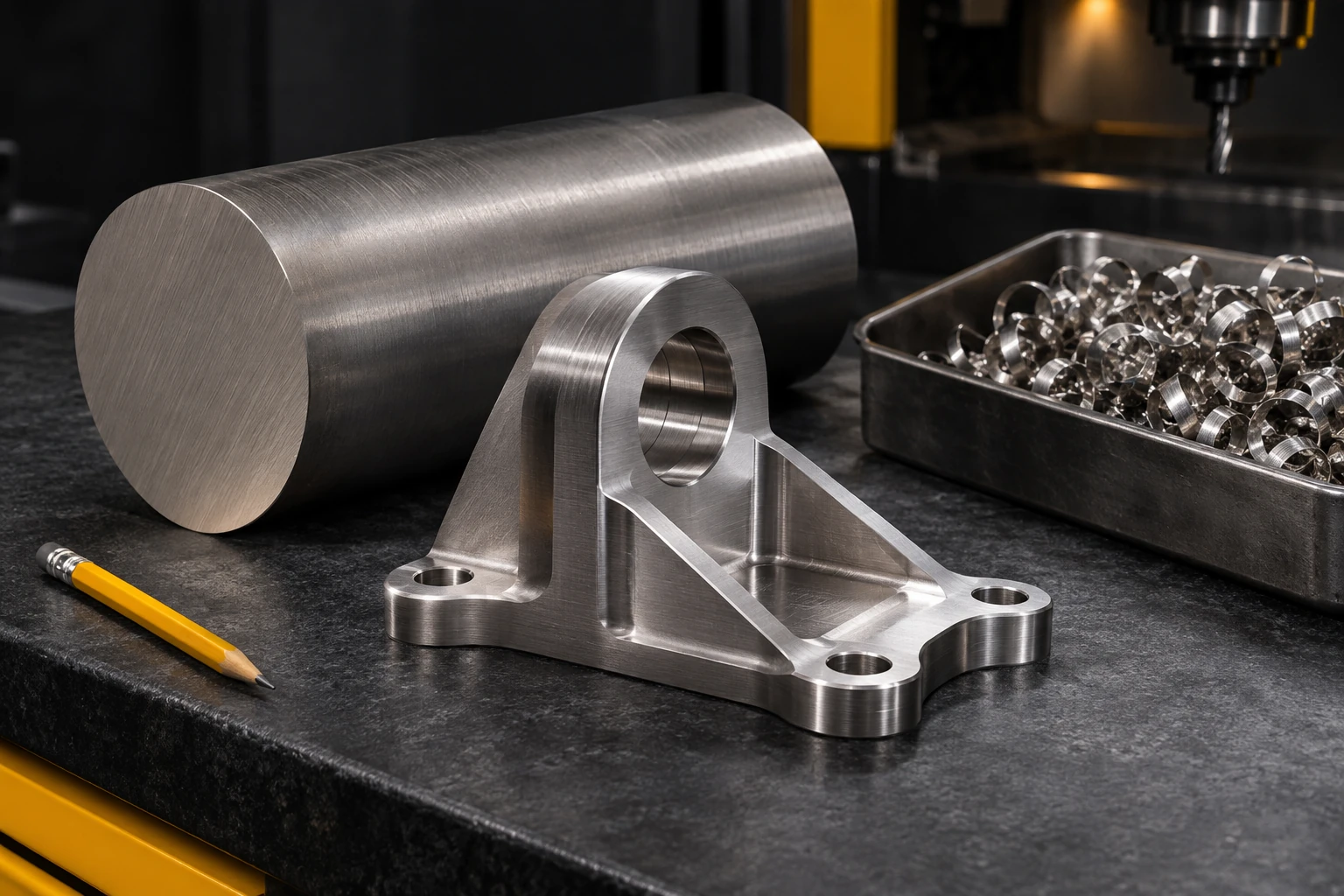
Material selection / 03Price the accepted part.
Material yield, processing, finishing and evidence all contribute. AI illustration; not a production or inspection record.
Build a cost model with visible assumptions
Cost element
Include in both alternatives
Avoid this shortcut
Raw stock
Usable dimensions, condition/temper, quantity and yield
Comparing only price per kg
Processing
Setup, machining, tooling, forming or heat treatment
Assuming identical cycle times
Surface and protection
Required finishing, cleaning and coating allowance
Leaving protection out of one quote
Verification
First article, material records and final inspection
Comparing unequal evidence packages
Qualification
Engineering review and required testing
Treating a material change as already approved
Service
Maintenance, replacement and downtime assumptions
Claiming a payback without a service model
Illustrative case: a protected indoor positioning bracket
A bracket operates in a benign indoor environment and is controlled mainly by stiffness and machining cost. Replacing its approved 7075 design with the same titanium geometry increases equal-volume mass and may add processing cost without addressing a demonstrated problem. The useful comparison is whether a revised titanium design offers a benefit that justifies qualification, not whether titanium sounds more premium.
Illustrative case: a component with demanding exposure
A component has an environment and maintenance history that motivates a titanium review. The buyer should document the exposure, failures and interfaces, then ask engineering to establish a suitable candidate design. The titanium quotation should include any altered joint or surface requirements. Potential service savings should be based on evidence and stated assumptions rather than a universal lifespan claim.
These are decision examples, not recommendations for an unspecified application. A well-supported material choice can favor either route. The buyer’s role is to keep the technical and commercial assumptions consistent enough that the alternatives can be compared fairly.
Release the alternative with a controlled record
Identify the original drawing, alloy, temper or condition and acceptance scope.
Describe the proposed material and geometry changes separately.
Review loads, environment, interfaces, manufacturing and validation requirements.
Obtain the required technical approval and issue the revised drawing.
Quote and inspect against that approved scope.
Retain the material and process evidence with the first-article record.
For a titanium enquiry, send the reference aluminum design and explain what improvement is being sought. TiHubs can coordinate a defined titanium supply and manufacturing quotation. Our quotation comparison checklist helps keep usable stock, inspection and commercial terms visible once the technically acceptable options are established.
Use a break-even model that exposes uncertainty
For a purely illustrative commercial comparison, suppose an approved titanium design costs 300 currency units more per installed component than an approved aluminum design. If a documented maintenance scenario estimates a net saving of 60 units per year, a simple undiscounted break-even calculation gives 300/60 = five years. These invented figures are not TiHubs prices, predicted service lives or evidence that titanium will save money in a particular application.
The useful part of the model is the list of assumptions. The incremental installed cost should include qualification, hardware, finishing and installation changes where relevant. The annual saving should be based on maintenance actually avoided, not on a general belief that titanium lasts longer. If there is no demonstrated difference in maintenance or service performance, the calculation cannot manufacture one from a material datasheet.
Model input
Question to test before relying on it
Initial cost difference
Are both offers complete and technically acceptable?
Maintenance difference
What operating history or analysis supports the estimate?
Replacement interval
Is it an observed value, an engineering assumption or a guarantee?
Downtime consequence
Is the allocation realistic for this component and installation?
Uncertainty
Does the decision still hold under a less favorable scenario?
Run at least a lower-benefit and a higher-benefit scenario using assumptions agreed by the buyer’s team. Consider the planned service period and any remaining value, but avoid assigning an exact long-term return when the operating evidence is weak. For a protected indoor component with easy replacement, the higher initial cost may remain difficult to justify. For a difficult-to-access component with a supported maintenance benefit, the same premium may be acceptable. The conclusion belongs to the complete application, not to the alloy name alone.
04 / Build your RFQ
Turn the comparison into a clear enquiry.
Provide the existing 7075 drawing and temper, the proposed titanium requirement and the reason for the change. Identify which geometry and interfaces can change, and which performance criteria are fixed.
Information to include
Reference alloy, temper/condition, standard and drawing revision
Static/cyclic loads, stiffness, mass and envelope requirements
Normal/upset environment, temperatures and maintenance history
Contacts, fasteners, joining and protective finishes
Candidate geometry, stock allowance, quantity and validation scope
Required certificates, first-article results, destination and schedule
Build your RFQ checklist
Choose the product and add the information you have. Copy the resulting brief or send your requirements to TiHubs. Submitting an enquiry does not place an order.
05 / FAQs
Questions buyers ask
Is Grade 5 titanium lighter than 7075 aluminum?
Not at equal volume. Using 4.43 and 2.80 g/cm³, the same solid shape is about 1.58 times as heavy in titanium. A redesigned part requires a separate comparison.
Is titanium always stronger for the same weight?
No universal conclusion follows from a grade name. Condition, geometry, load type, stiffness and service requirements determine the useful comparison.
Can I replace 7075-T6 with Grade 5 without changing the drawing?
Only through the required technical change review and approval. Material and process assumptions can affect the entire assembly.
Are 7075-T6 and T651 interchangeable labels?
No. State the required temper and product specification. The quotation should identify exactly which product and condition it covers.
Can titanium and aluminum be used in the same assembly?
They can require a specific interface review, including galvanic exposure, isolation, drainage, joints and maintenance. The assembly design controls the solution.
Which material is cheaper for a finished part?
Compare equal accepted scopes: stock, yield, setup, machining, finishing, inspection and qualification. A raw-price ratio does not answer the finished-cost question.
06 / Key takeaways
Keep the purchase requirements connected.
Compare equal-volume mass honestly before claiming weight savings.
Define complete material conditions for both alternatives.
Review stiffness, environment and interfaces with strength.
Quote manufacturing and qualification as part of total cost.
Approve the revised design before accepting a substitute.
Technical references
Sources and data scope
References reviewed November 9, 2026. Manufacturer data explains material behavior; it does not certify an offered heat or establish design allowables. Use the controlled product specification, required edition and approved engineering requirements for acceptance.
TiHubs coordinates titanium materials and custom supply from Baoji, China. Our founder’s 20 years in titanium inform a specification-led sourcing approach: clarify the product, manufacturing and acceptance requirements before quotation. Learn about our sourcing role.
Contents
TiHubs
Talk to TiHubs
Ask about titanium materials, grades or custom parts.
Enter your email to start chatting.
We use your email to respond to your enquiry. Your conversation is stored on this website.
Our team is away right now. Leave your enquiry and we will follow up by email.