Grade 2 vs Grade 4 titanium: choose the right CP balance.
Higher-strength commercially pure titanium can be useful, but it changes the forming and acceptance questions. Compare the actual product, condition and specification before replacing Grade 2.
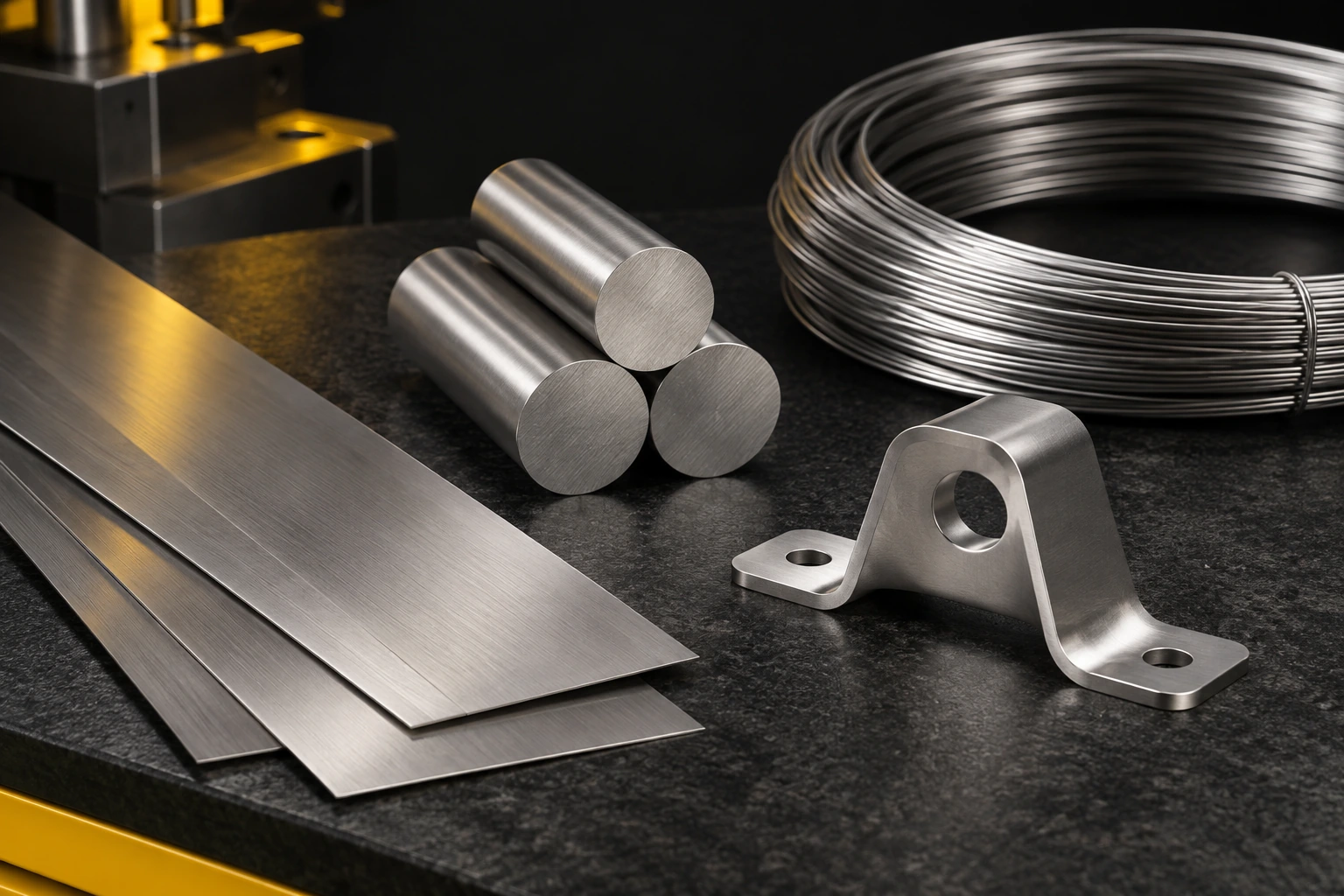
AI illustration. Appearance and labels do not verify material compliance.
Quick answer
Grade 2 and Grade 4 are commercially pure titanium grades with different controlled chemistry and strength requirements. Grade 4 generally offers higher strength, while Grade 2 is often a more accommodating starting point for demanding forming. Neither grade is automatically better for every application. Specify the product standard, condition, geometry and required evidence; a Grade 4 label alone does not establish implant-material compliance.
01 / CP material comparison
Higher-strength CP titanium involves trade-offs.
A grade 2 vs grade 4 titanium comparison is useful when the design calls for commercially pure material but needs a different balance of strength and formability. It is also useful when a supplier proposes Grade 4 because it is available sooner. In both cases, the buyer needs to identify the actual reason for the change and the requirements that must remain satisfied.
“Commercially pure” does not mean chemically identical or free of controlled elements. The CP grades have specified chemistry limits, including interstitial elements that affect properties. ATI describes the grades as distinct material options and provides separate typical hardness examples. The order still needs the complete product specification, rather than a general “pure titanium” description. [1]
Buying factor
Grade 2
Grade 4
Material family
Commercially pure titanium
Commercially pure titanium
Strength direction
Lower strength level in common comparable product contexts
Higher strength level in common comparable product contexts
Forming priority
Often a useful starting point for substantial forming
Requires closer review where high strain or tight radii are involved
Equal-volume mass
Similar nominal CP density
Similar nominal CP density
Machining
Quote actual geometry and condition
Quote actual geometry and condition; do not assume a fixed cost premium
Industrial or implant scope
Defined by the ordered material specification
Defined by the ordered material specification
Substitution
Requires review if the drawing specifies Grade 4
Requires review if the drawing specifies Grade 2
A higher grade number does not guarantee a better part
Higher strength can be useful when the approved design requires it, but a component may instead be controlled by forming strain, stiffness, corrosion, fatigue detail or connection performance. The engineer should identify the limiting requirement. Procurement should then obtain material that matches the chosen balance and the supporting evidence.
Changing between these CP grades does not create a major equal-volume weight reduction. If the goal is a lighter part, the geometry must be redesigned and checked. A thinner sheet or smaller section can change buckling, vibration, dent resistance and local joint loads. Do not approve a reduction merely because one tensile value is higher.
Do not assume a universal corrosion advantage
Evaluate the full medium, temperature and surface or crevice conditions. Higher strength and hardness do not automatically improve corrosion resistance. If the application is a corrosion-driven equipment component, document the service conditions before deciding whether a stronger CP grade addresses the actual problem.
The Grade 2 material page is a useful starting point for its supply forms and order requirements. The Grade 4 material page should be read as a distinct product route, not as permission to upgrade every Grade 2 order.
Choose between material substitution and a geometry change
If a Grade 2 part needs more strength, compare two questions separately: whether the alloy should change and whether the geometry should change. A thicker section, a different support arrangement or a revised local feature may address the design need while retaining the approved material route. Conversely, an envelope-constrained component may justify evaluating Grade 4. The buyer should ask the engineer which requirements are fixed before requesting competing quotations.
A material change can also shift the difficult part of production. A stronger starting material may reduce the margin available for a demanding forming step, while a revised geometry may require different tooling or more machining. Compare the complete route to the accepted part. The relevant outcome is not the highest strength printed on the quotation, but a component that meets the approved requirements with a repeatable production and inspection process.
Design situation
Useful comparison
Existing drawing with no approved changes
Quote the specified grade; identify alternatives separately
Restricted space with a strength concern
Review Grade 4 together with condition, fabrication and acceptance
Forming dominates the route
Compare representative trials and the most demanding local feature
Machining dominates the route
Compare stock size, allowance, tool access and final tolerances
Repeated supply with established service history
Identify the benefit and requalification scope of any change
For early development, ask for a written decision record that identifies the baseline and the alternative. Include the reason for considering Grade 4, the properties or process behavior to be demonstrated and the criteria for accepting the trial. This gives procurement a stable basis for comparing offers and prevents an exploratory suggestion from becoming an undocumented production substitution.
02 / Forming and standards
Match the grade to the fabrication and standard.
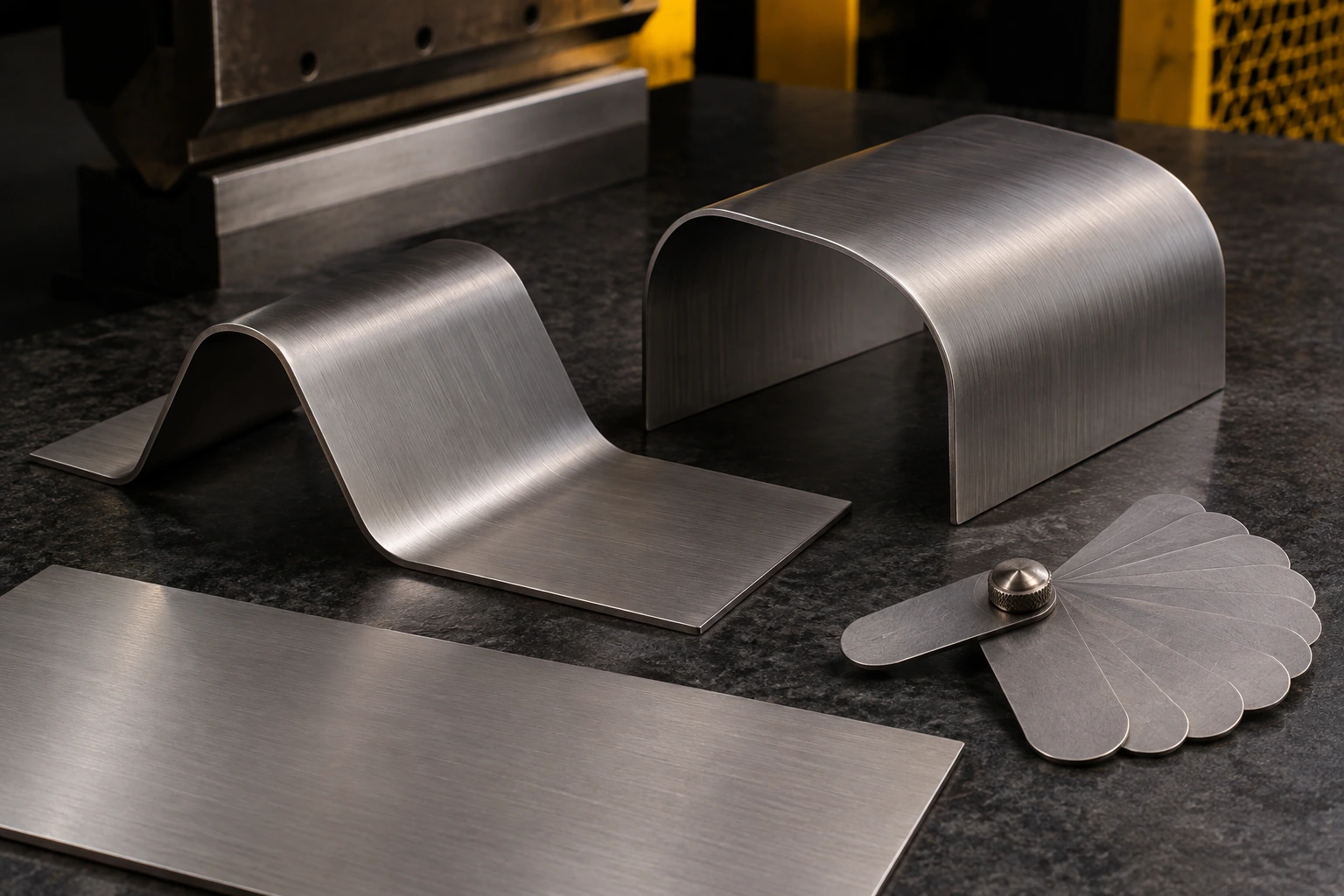
Material selection / 01Qualify the difficult forming feature.
A grade change can require a new trial and setup. AI illustration; not a production or inspection record.
For formed sheet, qualify the demanding feature
Identify the smallest radius, deepest draw, largest local stretch, edge condition and direction relative to the sheet processing orientation. The difficult feature may be a flange corner or hole near a bend rather than the overall part shape. Include the drawing, material condition and thickness tolerance when asking the supplier to review feasibility.
A first trial should represent the intended material and production process. Record blank orientation, surface preparation, tooling and inspection results. If Grade 4 is proposed for a part previously made in Grade 2, assess springback, local thinning and cracking criteria rather than assuming the same setup will work.
Manufacturing operation
Information to provide
Evidence worth requesting
Bending
Thickness, radius, angle, direction and edge condition
Representative bend trial and final dimensional results
Deep drawing or stretching
Blank, draw depth, local radii and final wall requirements
Agreed forming trial and thickness distribution checks
Heading or upsetting
Starting stock, deformation sequence and final geometry
Process qualification and required surface examination
Machining
Datums, tolerance, surface and stock allowance
First-article dimensions and material identity
Welding
Joint detail, material combination and final service
Approved procedure and specified joint inspection
Our titanium sheet bend-radius guide addresses the geometry and trial requirements in more detail. Use it to prepare a specific forming enquiry; do not turn a general grade comparison into an unsupported universal minimum bend radius.
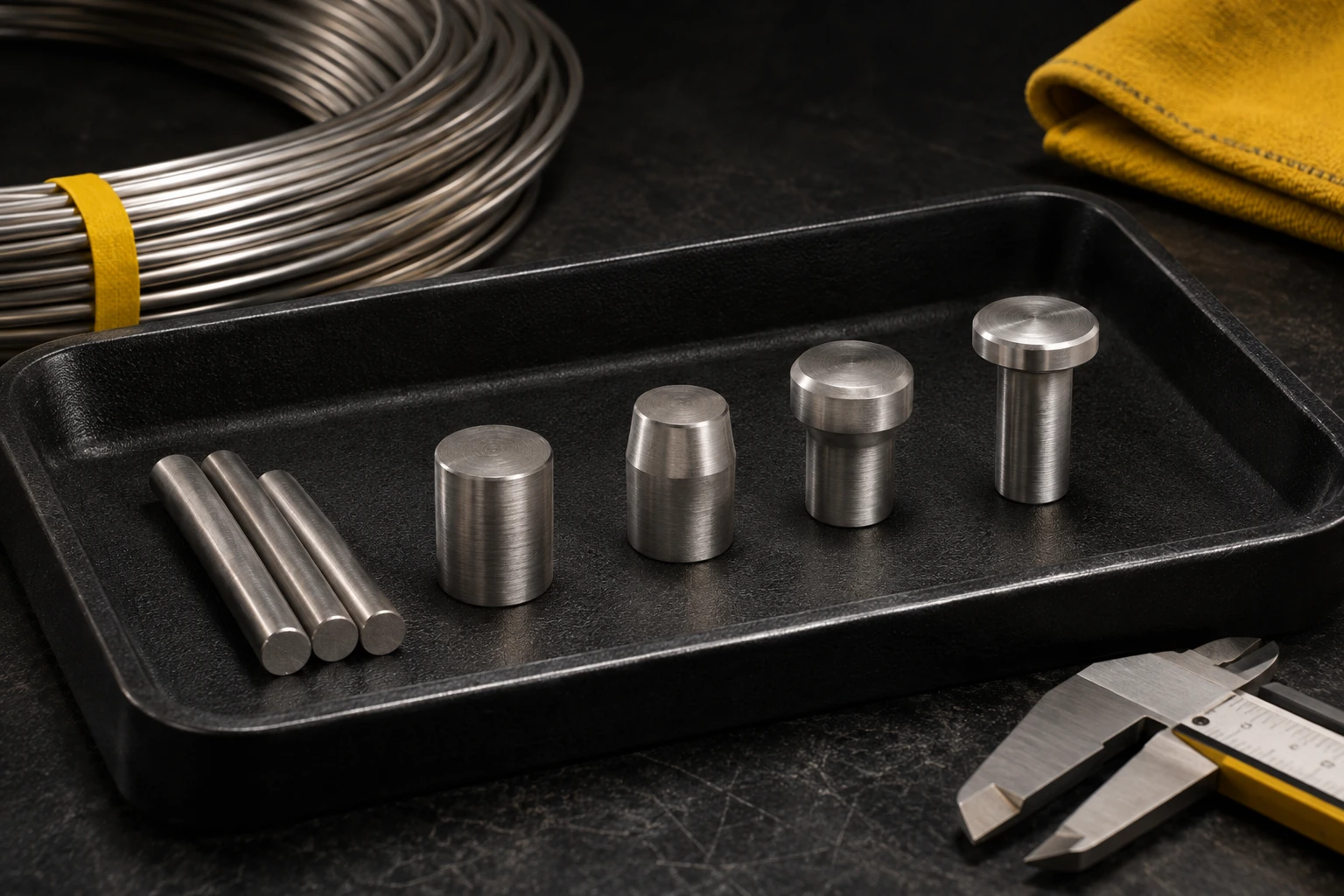
Material selection / 02State the stock and processing condition.
A grade name does not establish cold-forming suitability. AI illustration; not a production or inspection record.
For bar or wire, specify more than the grade
Diameter, straightness, surface, condition and allowable defects can determine whether material works in an automatic machining or forming process. If a customer buys wire for a later cold-forming operation, the supply condition and ductility requirements need to reflect that operation. A chemistry match alone does not establish processing suitability.
For machined parts, separate the material certificate from final dimensional acceptance. If several heats are processed together, define how identity will be retained through cutting and workholding. A finished component may no longer carry the original bar marking, so container or batch controls must maintain the agreed linkage.
Industrial Grade 4 and implant-material Grade 4 need distinct order descriptions
ASTM F67 addresses unalloyed titanium for surgical implant applications. Industrial product standards such as ASTM B265 and B348/B348M have their own scopes. A generic Grade 4 designation does not establish that a lot meets the specified edition of F67 or the buyer’s additional quality requirements. [2][3][4]
If the supply chain requires implant material, provide the approved specification, product form, condition, manufacturing and documentation requirements. Raw-material conformity does not approve a finished device. The device manufacturer retains its separate design, validation and regulatory responsibilities.
The F67 versus F136 material-purchasing comparison helps separate unalloyed titanium from the Ti-6Al-4V ELI material route. Neither “medical grade” nor a brochure application list should replace the controlled material specification on an order.
Design a forming trial around the feature most likely to fail
A broad flat coupon may be easy to form while the actual part has a short flange, a cutout near a bend, a small edge distance or a difficult transition between radii. Use the controlled drawing to identify the most demanding features and ask the fabricator which ones need demonstration. The trial should represent the ordered thickness, condition, direction and edge preparation rather than an easier material sample chosen only for availability.
Before the trial, define the inspection sequence. Some dimensions are meaningful immediately after forming, while others need assessment after later joining, trimming or finishing. Identify where surface condition, cracks, thinning, springback or final fit will be assessed and which approved limits apply. Do not create acceptance criteria retrospectively from whichever trial result happens to look best.
Record the production variables that must remain controlled after approval. These may include material source and condition, tooling, bend sequence, lubrication and the treatment of cut edges. The exact controls depend on the process and specification; a purchasing article cannot prescribe one universal setup. The important procurement step is to make the approved trial reproducible and to define which changes require further review.
If a Grade 4 trial fails, distinguish a material-limit question from a process-development question. Review whether the trial matched the intended condition and drawing, whether the edge or surface was damaged before forming, and whether the agreed tooling and sequence were used. The response may be a design review, a process revision or retention of Grade 2. It should not be an unrecorded change in grade or thickness made only to obtain one acceptable sample.
03 / Purchase and acceptance
Accept the specified material, not a general purity claim.
Illustrative case: a stronger replacement cracks during forming
A supplier proposes Grade 4 sheet for an existing Grade 2 formed bracket. The buyer accepts it because the strength is higher. The production bend then needs a different setup and shows unacceptable cracking at an edge. The purchasing failure was not simply choosing a poor material; it was accepting a substitution without reviewing the forming requirement and trial evidence.
A better process is to quote the original material and the proposed alternative separately. The alternative should identify changed assumptions, trial requirements and any drawing modification. The technical owner can then decide whether the additional strength provides enough value to justify the manufacturing change.
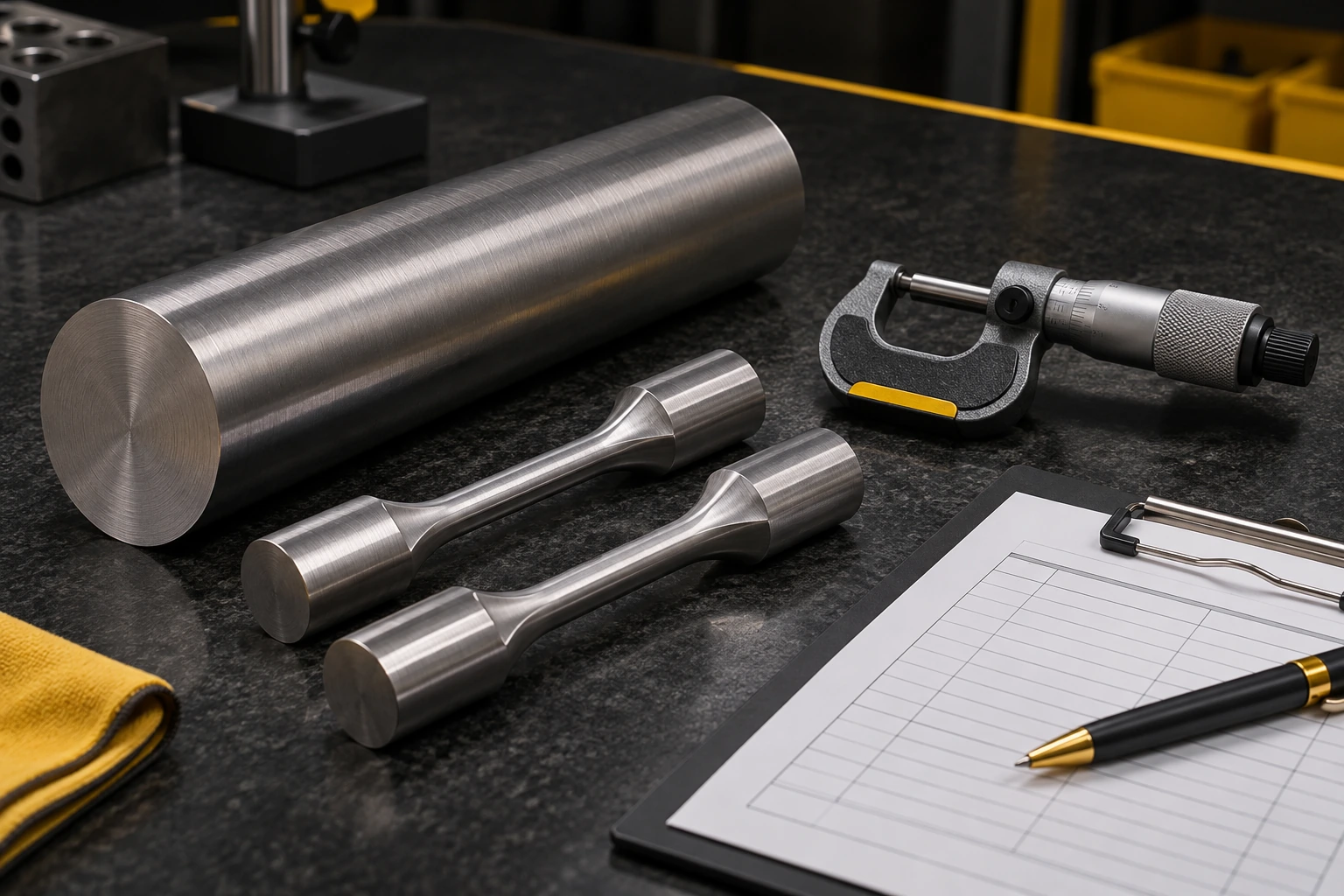
Material selection / 03Connect properties with the actual lot.
The certificate and finished product must describe the same delivery scope. AI illustration; not a production or inspection record.
Check chemistry, properties and condition together
Review the certificate against the full ordered specification and edition. Confirm the heat identity, product size, condition, required chemistry and mechanical results. If the certificate describes a different product or an earlier condition, ask how it relates to the delivered material. A test report detached from that relationship is insufficient.
Record the controlled drawing and complete material designation.
Confirm the actual product standard, edition and delivered condition.
Compare every required chemistry and mechanical criterion.
Review forming, machining or joint validation where the grade has changed.
Match final dimensions and physical labels to the heat/lot records.
Close deviations with the authorized technical decision before release.
Availability and price are product-specific
Grade 2 may be readily available in one sheet size while Grade 4 is available in a particular bar diameter. Minimum quantity, cutting yield, surface condition and certification scope can reverse an assumed price ranking. Request quotations for the same usable dimensions, condition, quantity, tests and delivery terms.
For a repeat component, consider the cost of changing tooling, validating a new process or managing mixed material stock. A small raw-material saving may not justify a change. Conversely, a technically approved change may be useful when it resolves a supply constraint. Make the decision from the complete scope, not a generalized statement about which grade costs more.
Write the substitution boundary explicitly
If no alternatives are permitted, state that clearly. If Grade 2 and Grade 4 are both candidates, ask the supplier to identify which grade and condition each price covers and what evidence is included. Do not accept a certificate that merges designations ambiguously. Dual conformity must be established against both complete requirements, not implied by the word “CP.”
TiHubs can coordinate the product and document review with the proposed Baoji supply route. Sending the demanding drawing features and the required standard early helps distinguish a readily quotable stock purchase from a material change that requires engineering validation.
Separate industrial material evidence from application approval
A Grade 4 quotation can be commercially attractive while still lacking the specification required by a particular application. A grade name identifies a material designation within a defined system; it does not by itself establish every product, cleanliness, traceability or regulatory requirement in a customer’s supply chain. State the required material standard and edition and identify any additional approved requirements in the order.
For a medically related raw-material purchase, keep the discussion focused on the material requirements supplied by the responsible customer or technical team. A material certificate is not approval of a finished medical device. Likewise, a supplier’s experience with medical customers does not replace the actual product specification, required records and lot traceability for the order being placed. Avoid accepting broad marketing language as evidence of compliance.
For industrial bar, sheet or wire, the same discipline is useful even when no medical application is involved. Review the required chemistry, mechanical properties, condition, dimensions and surface requirements together. If a quotation uses a different product standard or proposes a different test scope, list the gap explicitly. Additional testing can address some gaps, but it cannot automatically recreate an undocumented manufacturing or processing history.
Keep the final substitution approval narrow. Identify the affected drawing revision, product form, dimensions, delivery condition and permitted source or evidence route. A successful Grade 4 trial for one machined component should not authorize Grade 4 for a different formed sheet part. Where a buyer wants to compare the mechanical data more closely, the tensile-property review guide explains how strength, elongation and specimen context should travel together. This produces a usable purchasing decision rather than an unrestricted statement that one CP grade is better.
04 / Build your RFQ
Turn the comparison into a clear enquiry.
State why Grade 2 and Grade 4 are being compared. Attach the drawing and identify the features that control strength, forming or surface performance, together with the required industrial or implant-material specification.
Information to include
Product form, dimensions, tolerances and quantity
Grade and condition; alternatives permitted or prohibited
Required material standard, edition and application scope
Critical bends, drawing features, joints and processing sequence
Chemistry, mechanical tests and first-article evidence
Traceability, certificate package, destination and delivery date
Build your RFQ checklist
Choose the product and add the information you have. Copy the resulting brief or send your requirements to TiHubs. Submitting an enquiry does not place an order.
05 / FAQs
Questions buyers ask
Are Grade 2 and Grade 4 both pure titanium?
Both are commercially pure grades with controlled chemistry limits. They are not chemically or mechanically identical.
Is Grade 4 stronger than Grade 2?
In common comparable product contexts it has a higher strength level. The exact acceptance values depend on product, condition and specification.
Can Grade 4 replace Grade 2 in a formed part?
Only after review of the drawing, condition, forming route and required validation. Higher strength alone is not sufficient approval.
Is Grade 4 automatically medical grade?
No. State the applicable material specification, such as the required F67 edition, and all additional requirements. A grade label alone is incomplete.
Will Grade 4 make the same part much lighter?
The nominal densities are similar. Significant mass reduction normally requires a geometry change and an engineering review.
Does CP titanium need chemistry verification?
Yes, where required by the order. The controlled elements and traceability distinguish the specified material from a generic purity claim.
06 / Key takeaways
Keep the purchase requirements connected.
Use Grade 4 for a demonstrated requirement, not an automatic upgrade.
Include forming and final-condition constraints in the comparison.
Keep industrial and implant-material scopes explicit.
Review the complete certificate and physical identity.
Compare usable product cost and validation effort.
Technical references
Sources and data scope
References reviewed November 9, 2026. Manufacturer data explains material behavior; it does not certify an offered heat or establish design allowables. Use the controlled product specification, required edition and approved engineering requirements for acceptance.
TiHubs coordinates titanium materials and custom supply from Baoji, China. Our founder’s 20 years in titanium inform a specification-led sourcing approach: clarify the product, manufacturing and acceptance requirements before quotation. Learn about our sourcing role.
Contents
TiHubs
Talk to TiHubs
Ask about titanium materials, grades or custom parts.
Enter your email to start chatting.
We use your email to respond to your enquiry. Your conversation is stored on this website.
Our team is away right now. Leave your enquiry and we will follow up by email.