Connect the seller, production route, material evidence and release responsibilities before placing a titanium order in China. Turn supplier claims into order-specific checks.
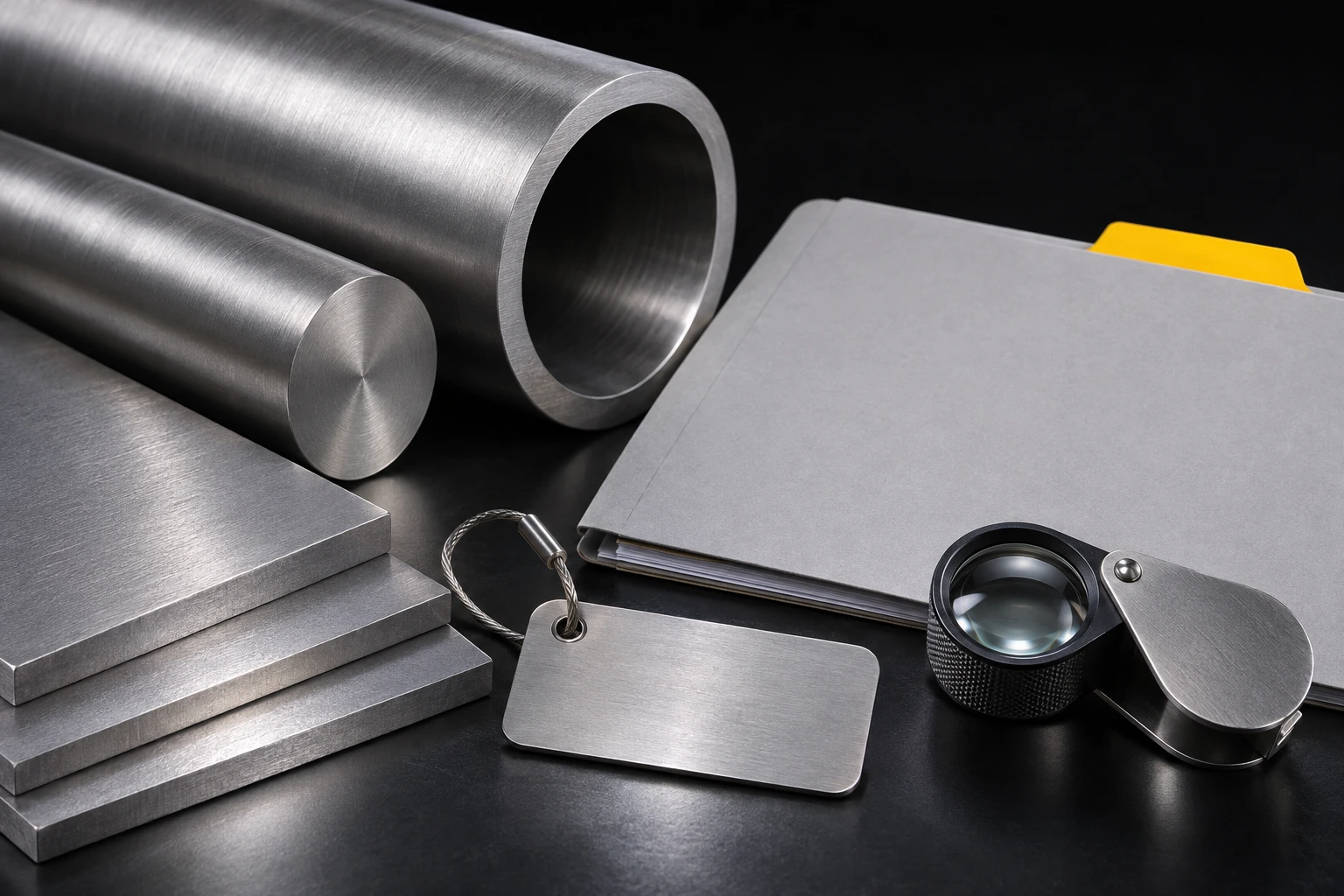
AI illustration. Appearance and labels do not verify material compliance.
How should you buy titanium from China?
When buying titanium from China, verify three separate things: who is responsible for the sale, whether the proposed supply route can meet the order, and whether the delivered material has the required evidence and traceability. A registered company, a factory photograph or a management-system certificate can support part of the review; none independently proves that a particular batch of titanium meets your specification.
Use staged checks. Define the product, verify the contracting identity, review the relevant process and source, qualify what needs qualification, agree inspection and change controls, and release the shipment against the order. Keep the level of review proportional to the product and application. This guide offers a purchasing framework, not a claim that all Chinese suppliers or all titanium orders carry the same risk.
01 / Define the order
Begin with the order you actually need
Supplier evaluation is difficult when the enquiry says only “titanium material.” Define the grade, product form, specification and edition, condition, dimensions, quantity and acceptance requirements first. A business capable of sourcing commercial sheet may not have an appropriate route for a tightly controlled forging, heat-exchanger tube or finished precision component.
Separate mandatory requirements from preferences. Identify which material sources, process routes, inspection bodies or records require prior approval. If the project needs regulated or customer-specific qualification, establish that basis with the responsible project team before selecting a supplier. A general purchasing checklist cannot replace an application’s required qualification process.
Use the titanium RFQ template to issue one controlled scope. Ask each candidate to explain how it would fulfil that scope, including what it performs itself, what it sources and what it subcontracts. The useful comparison is between credible delivery plans, not the number of product names on a website.
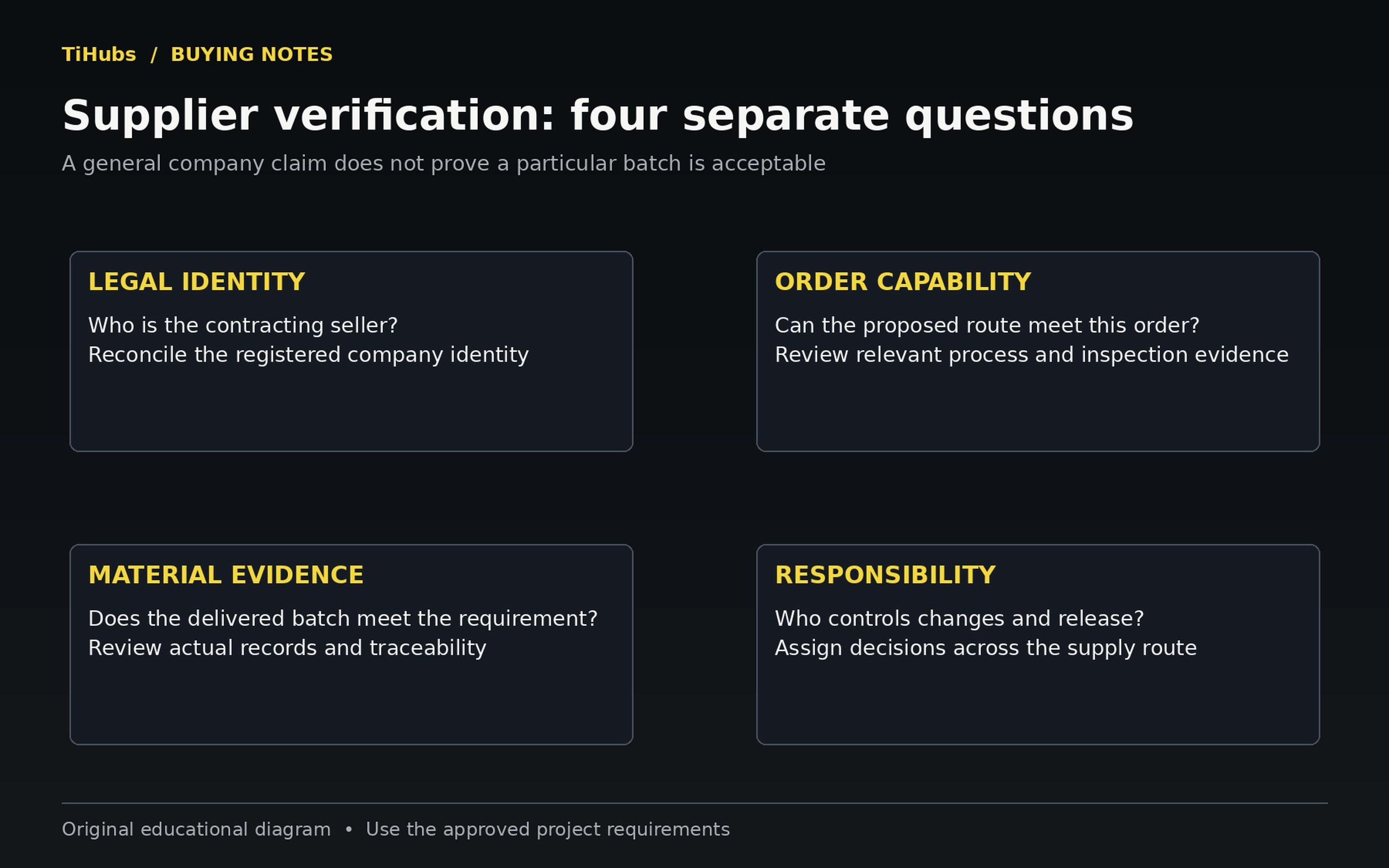
Purchasing planning diagramVerify four different parts of the supply proposal
Original purchasing diagram. Company identity, relevant capability, material evidence and responsibility are separate checks.
02 / Seller identity
Verify the contracting company's identity
Obtain the seller’s registered Chinese name and Unified Social Credit Code, and reconcile them with the entity named on the quotation and proposed order documents. An English trading name may be useful for communication, but it should not leave the contracting identity ambiguous. Record the business address and the contact responsible for the order through your normal vendor-onboarding process.
China’s State Administration for Market Regulation identifies the National Enterprise Credit Information Publicity System as a source of enterprise registration information. Its public information can help check names, registration details and other published records. [1] Use the official system or appropriate professional support; do not treat an unverified screenshot supplied by the seller as the only identity evidence.
Registry information has limits. Registration is not a demonstration of titanium processing capability, production capacity, financial reliability or batch conformity. A business scope is not an equipment audit. Record what was checked, when it was checked and what remains unverified, then continue with order-specific evidence rather than stopping at a successful name match.
03 / Supply roles
Manufacturer, stockholder or sourcing coordinator?
Different supply models can be suitable. A manufacturer may control a particular production process, a stockholder may offer available certified material, and a sourcing coordinator may combine material, cutting, machining and inspection across several sources. Evaluate the model against the project rather than assuming one label guarantees a better outcome.
Supply role
Potential value
Questions the buyer should resolve
Manufacturer
Direct process control within its demonstrated scope
Which stages are in-house, and which are subcontracted?
Stockholder
Access to existing sizes and shorter material preparation
Are stock identity, condition, documents and reservation verified?
Processor
Cutting, forming, machining or finishing to the order
How are starting-stock identity and final results connected?
Sourcing coordinator
One commercial interface across multiple sources
Who controls source selection, changes, inspection and issue resolution?
Ask for a process-and-responsibility map. It should identify the seller and the organizations or controlled stages responsible for material supply, processing, testing, document collection, packing and release, to the disclosure level agreed for the project. Where source confidentiality applies, agree a workable verification arrangement rather than leaving responsibility undefined.
TiHubs operates as a titanium sourcing and supply coordinator in Baoji. The purchasing value is the coordination of a suitable route and clear communication—not an implication that every process takes place in a TiHubs-owned factory. Confirm the proposed route and responsibilities for each order.
04 / Relevant capability
Verify capability against the product and dimensions
A machine list is useful only when it relates to the work. Ask for evidence of similar product forms, size ranges, material conditions, tolerances and inspection requirements. For a machining enquiry, review the relevant geometry and measurement capability. For tube supply, focus on the proposed manufacturing route, dimensions and required examinations. For sheet, review the available stock or production basis and processing scope.
Use a structured capability discussion: what is the critical characteristic, how will it be produced, how will it be measured, and what record will demonstrate acceptance? Request suitably redacted examples when prior customer information is confidential. The absence of a public customer drawing is not itself a problem; the supplier still needs a credible way to demonstrate the relevant capability.
When a visit or remote review is appropriate, follow the proposed material and process through the actual stages instead of relying on a general factory tour. Identify any outsourced operations and the controls applied to them. Record questions that require follow-up evidence. A photograph can show an object or location, but not the full history or acceptance of the material you will receive.
05 / Certification
Check certification scope and status
If management-system certification is relevant to your supplier approval, verify the legal entity, covered locations, scope, issuing body, standard and current status. ISO explains that certification is performed by external certification bodies and points buyers to certificate verification through the issuing or accreditation bodies and IAF CertSearch. [2] Follow the official verification route and reconcile the result with the actual entity performing the work.
Keep management-system certification distinct from product acceptance. ISO’s published guidance makes clear that ISO 9001 certification does not mean a particular product is itself certified to a product specification. [3] The order still needs the appropriate material certificate, actual required results, inspection and traceability.
If a certificate cannot be verified immediately, request clarification from the relevant body rather than assuming either fraud or validity. A name mismatch, different site or narrow scope may require explanation. Document the result and decide whether it satisfies your supplier-approval criteria before making a commitment.
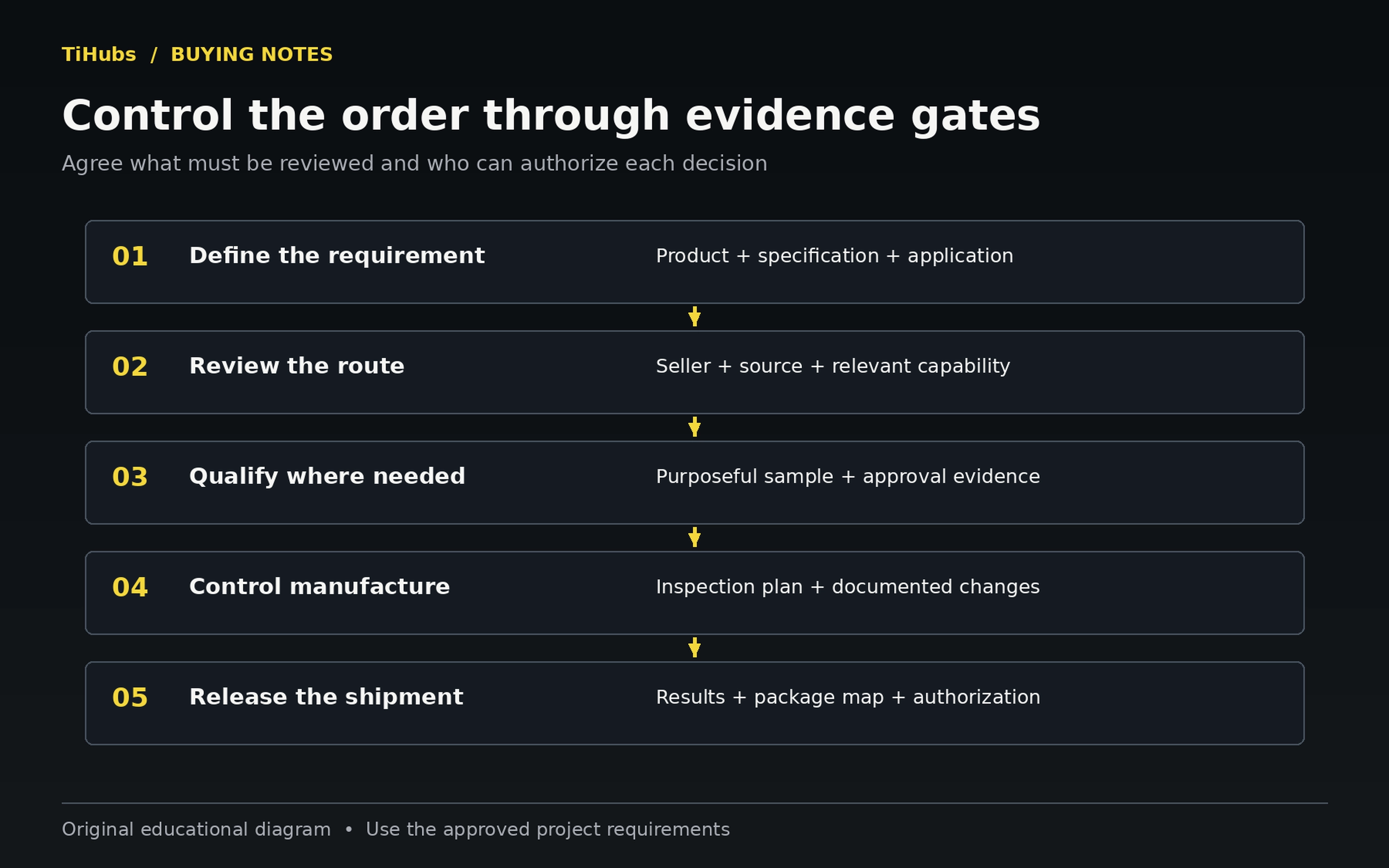
Purchasing planning diagramControl the order through review and release
Original purchasing diagram. Assign evidence and approval requirements before each important commitment.
06 / Production source
Connect the proposed production source to the order
Ask whether the quotation is based on identified stock, a planned mill order or an alternative source to be selected later. Those proposals carry different document and scheduling assumptions. For existing stock, request the relevant actual certificate and inventory identification at the appropriate stage. For new production, agree what source and process information must be approved before manufacturing.
Define how source changes are controlled. If a different heat, mill, product form or processing route is proposed, the supplier should identify the change and its effect on compliance, evidence, price and schedule. A source substitution should not be hidden inside a delivery update. State which changes require buyer approval and which fall within a previously approved range.
Do not confuse geographic proximity with complete control. Baoji’s titanium supply base can support coordinated sourcing, but a local address alone does not establish the route for your order. The practical evidence is a documented supply plan and the records linking the resulting material to the approved requirement.
07 / Traceability
Review material evidence before it becomes a shipment
A useful document review connects the purchase line, exact material designation, standard edition, condition, heat and applicable product or test lot. Check that the reported results represent the supplied material, not simply a similar product from the same supplier. Ask how the original issuer can clarify a discrepancy if one appears.
If stock is cut or machined, require a controlled parent-to-piece link. Define how identification will remain available after the original marking is removed. A packing list should reconcile dimensions, quantities and package allocation without breaking the material-to-certificate connection. Several unrelated certificates in one email do not form a traceability system by themselves.
The mill certificate checklist provides a detailed review method. Where a rapid alloy screening result is proposed, understand its limits: our XRF and PMI guide explains why a displayed alloy name does not establish every chemistry, property or condition requirement.
08 / Sample qualification
Use samples to answer a defined question
Decide whether you need a material sample, a process trial, a dimensional first article or an appearance reference. Each serves a different purpose. Identify the sample’s source, condition, manufacturing route and relationship to the proposed production lot. A loose coupon with no identity may help discuss appearance, but it cannot demonstrate the full traceability of a future batch.
Write an acceptance plan for the sample: characteristics to check, methods, required reports, reviewer and decision date. If the sample is destructive-test material, establish which lot it represents and how it was selected. If it is a first article, agree which dimensions or process features it is intended to validate before batch production starts.
Control what changes after approval. A successful sample from one route is not a blanket approval for a different material source or manufacturing method. Record the conditions under which qualification must be revisited. Keep sample approval distinct from final batch release and from any commercial decision to order production quantities.
Illustrative product viewReview the evidence required for the order
AI illustration; not a factory, certificate or inspection record. Agree the relevant methods, samples, records and release responsibility.
09 / Inspection scope
Agree an inspection plan and the release authority
An inspection plan should identify the requirement, method, coverage, acceptance criteria, record and responsible party. Include document review and material identity as well as physical checks. Decide which activities are supplier inspections, independent examinations, purchaser witness points or hold points that require approval before proceeding.
Stage
Evidence to agree
Decision or responsibility
Before allocation
Source, stock identity and relevant documents
Approve the proposed material basis where required
Before processing
Drawing revision, process and inspection plan
Close technical questions and hold-point requirements
During manufacture
Required process and examination records
Address deviations before they become shipment problems
Before packing
Actual results, quantities, surface and identification
Resolve nonconformities and authorize packing
Before dispatch
Final document set, package map and release record
Named party confirms the agreed shipment conditions
Do not add an independent inspection visit only after the goods have been packed if critical observations require earlier access. Confirm lead time for inspection booking, sampling and reports. Agree how a missed witness point or incomplete record will be handled rather than assuming a final photograph can replace it.
Use the pre-shipment inspection guide to build the product-specific scope. More inspection is not automatically better; the useful plan targets the actual acceptance requirements and preserves the evidence needed for a release decision.
10 / Commercial basis
Keep commercial responsibility aligned with the supply route
The quotation and order should identify the contracting seller, deliverables, quantity basis, price inclusions, validity and delivery conditions. Confirm who is responsible for collecting certificates, coordinating subcontractors, arranging agreed inspection, packing and resolving a shortage or nonconformity. A multi-stage supply chain needs a clear commercial interface, even when technical records come from different organizations.
Follow your organization’s vendor and payment-verification controls. Reconcile the approved entity and account information through established channels, and independently verify unexpected changes before acting. Do not rely solely on an urgent message or a modified invoice attachment. Keep approval authority with the staff responsible for those decisions.
For delivery, state the selected trade rule, edition and exact named place. Check the full allocation with the responsible logistics and commercial teams. Customs classification, import requirements and any application-specific restrictions depend on the actual product and destination; confirm them for the transaction rather than copying an assumed universal tariff or clearance rule into the RFQ.
11 / Packing review
Inspect the packing as part of the order
Agree how sheet faces and edges, bar surfaces, tube ends and precision features will be protected. Keep different heats or lots identifiable inside the package. Ask for a package map that shows which items and records belong to each crate or bundle, together with net and gross weights and dimensions needed for transport planning.
Where wood packaging is used, check the actual construction and destination requirements. ISPM 15 concerns relevant raw-wood packaging and dunnage, while wholly processed wood materials such as plywood can fall outside that scope. [4] A plywood panel does not prove that every solid-wood support in a mixed crate is exempt. Have the responsible packing and logistics parties confirm compliance for the complete package.
Packing photographs are helpful for recording protection, labels and package condition before closure. They should complement the inspection and packing records, not replace required measurements or material certificates. Define how transport damage or a quantity discrepancy will be documented at receiving and reported through the agreed process.
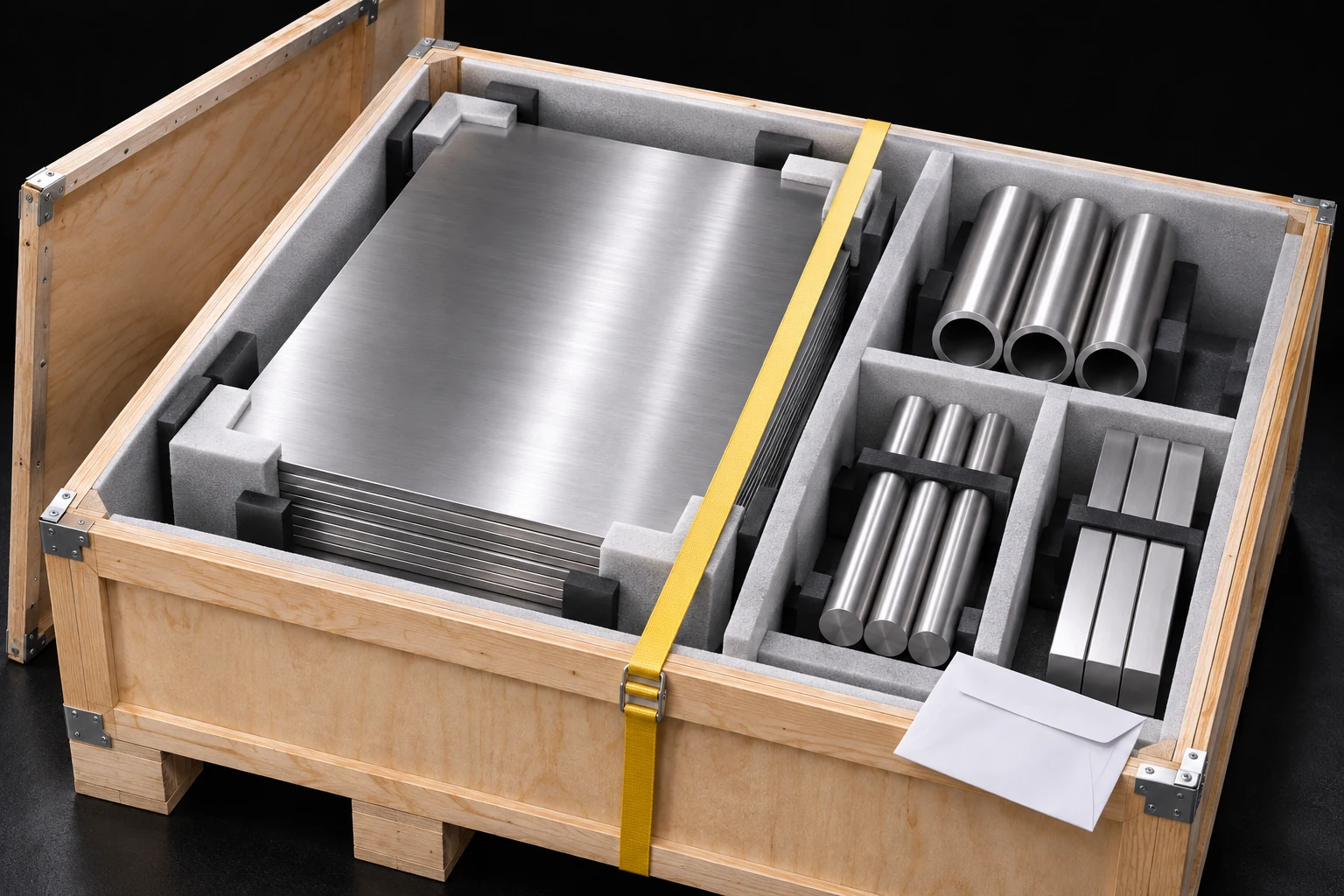
Illustrative product viewInclude protection and packing in the offer
AI illustration; not a factory, certificate or inspection record. Confirm the actual packing design, package map and transport requirements.
12 / Change-control case
Worked case: the seller is verified, but the route changes
Consider an illustrative order for cut titanium bar blanks. The buyer verifies the seller’s identity and approves a quotation based on identified stock with matching documents. Before cutting, the seller reports that the stock has been allocated elsewhere and proposes another source with the same nominal grade and diameter.
The correct next step is a controlled change review. Ask for the new source and material identification, applicable specification and condition, relevant certificate and results, usable dimensions, quantity and delivery impact. Check whether the original approval required a particular source or heat. If the evidence meets the approved requirement, the authorized buyer can accept the revised basis and update the order record.
If the new certificate is incomplete or the condition differs, place the change on hold. Do not accept a renamed document or a promise to repair the paperwork after dispatch. Decide whether additional legitimate evidence, a different approved route or a revised schedule can resolve the issue. The seller’s registration remains valid, but that fact does not answer the batch-specific question.
This case illustrates why supplier approval and shipment approval are separate controls. A capable supplier can still face an inventory change; a useful sourcing process makes the change visible and gives the buyer a documented decision before the material moves into irreversible processing.
13 / Resolve discrepancies
Treat discrepancies as decisions with evidence
Create a nonconformity or clarification record that identifies the affected order line, pieces or lot, the required condition, the observed difference and the immediate containment. Keep potentially affected material separate and identifiable. Ask the supplier for the cause, proposed disposition, evidence and cost or schedule consequences.
The options depend on the requirement and authority: provide a legitimate missing record, rework under an approved route, replace, reject or request an authorized concession where permitted. A concession should identify the exact deviation and approval; it should not silently rewrite the original requirement or obscure what was delivered.
Also distinguish a documentation gap from a demonstrated material failure. Both may prevent release, but they call for different investigations. Retesting cannot necessarily recreate missing manufacturing history, and a corrected certificate must come through an authorized process that preserves its connection to the original record.
14 / Repeat orders
Build a controlled repeat-order process
After delivery, review the actual outcome: usable quantity, document completeness, dimensional acceptance, packing condition, promised versus actual milestones and how issues were handled. Use this order-specific evidence to improve the next purchase. A repeat order should reference the approved specification and revisions, not rely only on “same as before.”
Ask which elements of the route will remain the same and which may change. Reconfirm material allocation, source controls and any customer approvals that still apply. Update the contact and responsibility map when organizations or personnel change. A good first delivery is useful evidence, but it does not eliminate the need to control later changes.
TiHubs can coordinate material review, processing options and inspection communication across the Baoji supply network. The goal is a clear purchasing record: what was required, what was offered, which changes were approved, and what evidence supports the delivered material.
15 / Build your checklist
Build your China sourcing checklist
Summarize the product, approved specification, proposed supplier role and the evidence you need to review. Identify the source-disclosure, sample, inspection and shipment-release decisions that require your approval. The checklist below turns these points into a brief you can copy or submit for a sourcing discussion.
Build your purchasing and RFQ checklist
Choose the product and add the information you have. Copy the resulting brief or send your requirements to TiHubs. Submitting an enquiry does not place an order.
16 / FAQs
Buying titanium from China FAQs
Is a manufacturer always a better choice than a sourcing company?
No single label settles the decision. Evaluate the demonstrated process scope, source controls, evidence, communication and commercial responsibility for your order. A coordinator should be transparent about its role and the proposed supply route.
Does a business licence prove production capability?
It supports identity checks, not a technical capability assessment. Review relevant processes, dimensions, records, qualification needs and inspection capability separately. Registry information and order evidence answer different questions.
Does ISO 9001 certification prove the titanium batch is compliant?
No. Check the management-system certificate’s scope and status, then separately verify the ordered product evidence, actual results, inspection and traceability for the delivered material.
Must I visit every supplier before placing an order?
The appropriate review depends on product risk, application and qualification requirements. Visits, remote reviews, samples and document checks can each contribute. Define what evidence is needed rather than assuming one method proves everything.
Can I accept a different source if the grade name is unchanged?
Only after the proposed change is reviewed against the approved requirements and source-control rules. Check the actual material, condition, evidence, quantity and schedule, and obtain the required authorization before processing or release.
What should an approved sample represent?
State its purpose and connection to the proposed material and process. A visual reference, test coupon and first article are different evidence types. Record what later changes require another review.
Is third-party inspection a replacement for a complete order?
No. Inspectors need defined requirements, methods, coverage and acceptance criteria. Agree the scope and timing early, including the records and release authority. An inspector cannot resolve an undefined specification merely by visiting the factory.
What should I send TiHubs for a supplier review?
Provide the product form, grade and specification, drawing revision, quantity, intended use, required evidence and delivery target. Add the source, sample or inspection questions you need answered, while excluding unrelated confidential information.
17 / Key takeaways
Verify the entity, the route and the batch
Confirm the contracting identity, then evaluate order-specific capability separately.
Make production sources, subcontracted stages and responsibilities visible to the agreed level.
Control samples, source changes, inspection and traceability through documented decisions.
Release the shipment against the approved order and actual evidence, not general supplier claims.
Technical references
References and scope
This is an original supplier-evaluation and order-control guide. It does not verify any particular supplier or replace application-specific qualification, legal review or transaction-specific import requirements.
TiHubs coordinates titanium materials and custom supply from Baoji, China. Our founder’s 20 years in titanium inform a specification-led sourcing approach: clarify the product, manufacturing and acceptance requirements before quotation. Learn about our sourcing role.
Contents
TiHubs
Talk to TiHubs
Ask about titanium materials, grades or custom parts.
Enter your email to start chatting.
We use your email to respond to your enquiry. Your conversation is stored on this website.
Our team is away right now. Leave your enquiry and we will follow up by email.